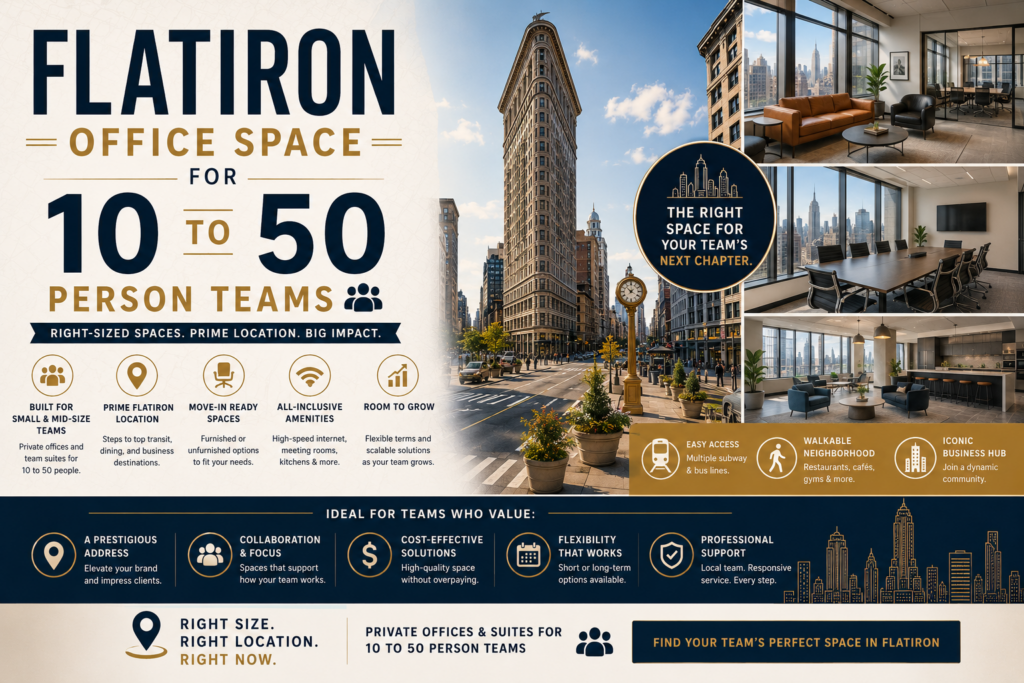
Flatiron remains one of the strongest markets for midsize office users that want location, speed, and flexibility in one search. Manhattan logged 11.78 million square feet of leasing in the first quarter of 2026, which marked its strongest first quarter since 2014. Midtown South also stayed active, with asking rents reported at about $80.27 per square foot by one major brokerage and $88.32 per square foot by another, while availability ranged from 13.4% to 16.9% depending on methodology.
Current Flatiron examples on your site show why this team-size page matters. Active examples and recent pricing snapshots run from smaller 1,100 to 1,700 square foot offices at roughly $4,400 to $8,350 per month, up through 4,700 to 5,500 square foot spaces at about $18,000 to $24,050 per month. Current listings also show actual suites at 1,750 SF, 2,500 SF, 3,067 SF, 4,125 SF, 5,000 SF, 5,370 SF, and 6,500 SF, which lines up well with the search intent behind teams of 10, 20, 30, 40, and 50 people.
Quick fit: Flatiron works best for teams that want private offices or team rooms without jumping straight into a giant full-floor commitment. The neighborhood supports boutique direct leases, furnished subleases, and short-term private suites in a much tighter size band than many broader Manhattan searches do.
What Teams This Size Should Expect in Flatiron
For this search, the real question is not whether Flatiron has offices. The real question is which format fits your headcount, term, and growth plan. Search results around this topic lean toward flexible operators, team rooms, and local inventory pages because many users want immediate space, simple pricing, and strong neighborhood access. Current flexible inventory in the area advertises a 10-person room at $6,000 per month, a 20-person room at $10,000 per month, and a larger team room for 40 at $24,500 per month.
That flexible intent only covers part of the market. Your own listings show that traditional and semi-traditional inventory gives teams more layout control, more privacy, and better scaling room. A 1,750 SF suite can support 10 workstations. A 2,500 SF furnished full floor can fit about 17 people. A 4,125 SF turnkey floor can support 30 people. A 6,500 SF full-floor sublet can seat about 43 people in a generous plan.
Size planning matters more than raw headcount. Our office planning resources recommend starting around 125 to 175 rentable square feet per person, then adding enough room for meeting areas, pantry space, and future hiring. Those same resources also note that loss factor often runs about 25% to 30% in Class A buildings and about 15% to 25% in older Class B and C stock.
That rule changes the search fast. If your team needs 4,000 usable square feet, you may need to lease roughly 5,000 to 5,200 rentable square feet once you account for building efficiency. For hybrid teams, the same resource notes that 30 people often land around 4,000 to 4,500 RSF, while 50 people often land around 6,000 to 7,500 RSF.
Flatiron also suits this size band because the market gives you several layout personalities in one neighborhood. You can chase a clean prebuilt. You can take a furnished loft. You can grab a plug-and-play sublease. You can also move into a white-box floor and design your own program if the term justifies that effort. Current site inventory reflects all four paths.
Current Size and Budget Ranges for Teams of 10, 20, 30, 40, and 50
Smaller teams that need real privacy
A 10-person team in Flatiron usually shops in the 1,500 to 2,000 square foot band if it wants a reception point, one or two private rooms, a pantry, and room to grow. One current local example at 1,750 SF supports 10 workstations and adds two perimeter rooms, one larger interior room, a wet pantry, and a private restroom. On the flexible side, the area also shows a dedicated 10-person team room at $6,000 per month.
That range gives a tenant two very different choices. A flexible team room lowers setup costs and shortens the move timeline. By contrast, a private leased suite gives you more control over acoustics, branding, room mix, and daily workflow. Current user reviews on one flexible option praise location and service, but they also mention weak internet, thin walls, uneven room acoustics, dim lighting, and temperature limits in some rooms.
Growing teams with departments starting to form
A 20-person team usually needs more than raw desk count. Most groups at this stage want at least one real conference room, one smaller meeting room, a pantry, a focus room, and some hiring cushion. In practice, that often pushes the search into roughly 2,500 to 3,500 square feet. Current examples include a 2,500 SF furnished full floor set up for 12 to 13 workstations plus multiple conference rooms, a 2,500 SF direct lease that can support roughly four to sixteen people depending on layout, and a 3,067 SF open loft with pantry, private restroom, and negotiable term. Flexible inventory in the area also offers a 20-person room at $10,000 per month.
Budget-wise, the current Flatiron pricing snapshot on your site supports this middle band. Recent examples show 2,100 SF at $7,700 per month, 2,500 SF at $10,200 per month, and 3,200 SF at $13,850 per month. That gives office users a realistic frame before they even request specific asking rents.
Mid-size teams that need collaboration rooms and leadership space
A 30-person team usually lands in the 4,000 to 5,000 square foot range unless it runs an unusually dense benching plan. Your own listing inventory supports that math. One current 4,125 SF turnkey sublet accommodates 30 people and includes 30 workstations, two glass meeting rooms, one large conference room, a new pantry, and lounge space. Another current 5,000 SF plug-and-play option includes two glass offices, two conference rooms, high-quality furniture, sit-stand desks, A/V, a full pantry, and a three-year sublease term.
A 40-person team can still live in a strong midsize footprint, but the plan needs discipline. A current 6,500 SF full-floor sublet fits about 43 people with one large conference room, two meeting rooms, two private offices, a pantry, and private bathrooms. That is a healthy benchmark for a team that values comfort, meetings, and client-facing polish more than desk density.
Larger teams that still want Flatiron character
A 50-person team usually starts around 6,000 square feet if it wants a balanced plan. Many teams then stretch toward 7,500 square feet or more once they add recruiting capacity, executive rooms, break areas, phone booths, or showroom elements. That estimate lines up with your size-planning guidance for 50-person hybrid teams and with current Flatiron inventory that ranges from efficient 5,000 to 5,370 SF floors up through 6,500 SF full-floor sublets. One 5,370 SF direct lease even carries an estimated capacity of 67 people, which shows how much density, room count, and finish strategy can change the answer.
This is also where rent planning needs more discipline. On your current Flatiron pricing snapshot, 4,700 SF shows at $18,300 per month, 5,150 SF at $18,000 per month, and 5,500 SF at $24,050 per month. Once annual rent crosses $250,000 in Manhattan south of 96th Street, Commercial Rent Tax can enter the picture, though credits may reduce the burden between $250,000 and $300,000. A 50-person search should model that early, not after the deal memo.
The Space Types That Best Fit This Search
Furnished sublets make sense when speed matters most. Current local sublets in this range include 2,500 SF, 4,125 SF, 5,000 SF, and 6,500 SF examples, many with furniture, wired desks, conference rooms, and pantry space already in place. That path cuts capex, shortens move-in, and often works best for teams with one- to three-year planning windows.
Direct leases work better when the company wants control. Your site’s current inventory includes direct options at 1,750 SF, 2,500 SF, 5,370 SF, and several current price points from smaller boutique suites up through midsize loft floors. This route usually opens the door to better customization, stronger renewal leverage, and cleaner long-term branding. The tradeoff is time, design work, and more lease negotiation.
Flexible private suites serve a different purpose. They answer the urgent version of this search. One current neighborhood option shows one-month minimum terms for 10-person and 20-person team rooms, while a larger 40-person room requires a longer minimum term. That model often bundles internet, furniture, utilities, cleaning, and meeting space access into one simple monthly figure.
White-box loft space fits teams that know they will stay. A current 5,370 SF direct lease in Flatiron offers a nearly blank canvas and can divide into smaller pieces, which helps a team shape its own ratio of offices, desks, and meeting rooms. If you plan to stay through the next hiring phase, that flexibility can beat a prebuilt that never quite fits your culture.
Current Flatiron Spaces Worth Touring
If you want this page to actually convert, it should not stop at general advice. It should give readers live-fit examples they can click.
For a team of about 10, Small Union Square Office Rental offers 1,750 SF with 10 workstations, two perimeter rooms, a larger interior room, a wet pantry, and a private restroom.
For a 15 to 20 person group that wants a private floor, Flatiron Furnished Office Space offers 2,500 SF, a full-floor layout, two conference rooms, a meeting room, a kitchen, and a setup geared to about 17 people.
For a team that wants open loft character and term flexibility, Flatiron Area Office Loft Rental offers 3,067 SF, 11-foot ceilings, a pantry, a private restroom, and a term that can extend to 2028.
For a 25 to 30 person operation, Furnished West 20th Street Office Space offers 4,125 SF, 30 workstations, two glass meeting rooms, one large conference room, and a lounge-like pantry.
For a 30 to 40 person team that wants turnkey speed, Flatiron Plugin Play Sublet offers 5,000 SF, two offices, two conference rooms, a full pantry, brand-new restrooms, and a three-year sublease term.
For a team that wants either dense efficiency or future expansion room, Furnished Whitebox Office Space offers 5,370 SF with divisibility and an estimated capacity of 67, while Broadway Full Floor Office Space for Lease offers 6,500 SF and an estimated capacity of 43 with a more generous full-floor program.
You should also keep two utility links close to the main body. Readers who still need to size their requirement should use the office space calculator. Teams that want to widen the search beyond one or two examples should browse the broader Flatiron office space listings.
How to Lease Smart and Avoid Expensive Mistakes
The best Flatiron search does not start with photos. It starts with a space program. The City’s commercial leasing guide says tenants should think through location, space needs, professionals, lease process, and risk before signing. That same guide also lays out the core steps: request for proposals, a letter of intent or term sheet, lease drafting, and review of key business terms.
Next, compare effective occupancy cost, not just sticker rent. A turnkey private suite may look expensive on a per-desk basis, yet it can save on furniture, wiring, cleaning, and move speed. A direct lease may post a better face rate, but the real cost changes once you add design, furniture, cabling, and the time value of a slower opening. Current flexible team rooms in Flatiron show monthly pricing transparency, while your direct and sublet inventory shows the larger payoff in layout control.
Room mix matters just as much as square footage. A dense 5,000 SF plan can handle a surprising headcount if you keep private rooms limited. That same floor can feel undersized if leadership wants several enclosed offices, a boardroom, phone rooms, and a hospitality pantry. Your own calculator resources underline that point, and current listings in Flatiron show how dramatically layout changes practical capacity.
Tenants should also protect the legal side early. The City advises business owners to consult an attorney and other professionals before signing a commercial lease. Eligible small businesses in New York City may also qualify for free legal help when signing a new lease, amending one, renewing, terminating, or handling a lease dispute.
Finally, use a tenant-side process, not a listing-by-listing process. We can filter dozens of Flatiron options, compare direct and sublet economics, and narrow the field to the right size band before your team spends weeks touring the wrong spaces. Your own site already frames that offering clearly: we filter hundreds of listings, provide a top-ten report, and do it with no fee to the tenant.
Questions Teams Ask Before Signing
How much space does a 10-person team need in Flatiron? Most teams start around 1,500 to 2,000 square feet if they want a clean mix of open seating and a few enclosed rooms. A current 1,750 SF example supports 10 workstations and still includes multiple rooms, a pantry, and a private restroom.
What does a 20-person office cost in Flatiron? It depends on format. Current flexible team rooms in the area show about $10,000 per month for 20 people. Current Flatiron pricing examples on your site show direct or loft inventory around $7,700 per month at 2,100 SF, $10,200 per month at 2,500 SF, and $13,850 per month at 3,200 SF.
Can a 50-person team stay in Flatiron without taking too much space? Yes, but the answer depends on layout discipline. Your size guidance suggests many 50-person teams land around 6,000 to 7,500 RSF, while current Flatiron examples range from efficient 5,370 SF layouts to more generous 6,500 SF full floors. A denser plan can work. A more executive-heavy plan will need more square footage.
Should we choose a flexible suite or a direct lease? Choose flexibility if you need speed, simple billing, and short commitments. Choose a direct lease if you want custom planning, stronger brand control, and a longer runway. Current local flexible inventory shows one-month minimum terms for some team rooms, while direct inventory on your site shows more traditional multi-year options and white-box customization opportunities.
What is the biggest mistake teams make in this size range? Many groups shop by headcount alone. That approach ignores loss factor, room count, hybrid policy, and future hiring. Your own planning guide warns that tenants should ask about efficiency, expansion rights, and whether the layout truly fits the way the team works.
Do larger Flatiron teams need to think about Commercial Rent Tax? Absolutely. In Manhattan south of 96th Street, businesses generally owe Commercial Rent Tax when annual rent reaches at least $250,000, though credits may reduce the tax between $250,000 and $300,000. For larger or higher-end Flatiron suites, that can matter sooner than many teams expect.
If your team wants a sharper shortlist, send us the headcount, budget, desired move date, and whether you prefer furnished, sublease, or direct space. We will compare the strongest-fit Flatiron options, size them against your actual operating needs, and cut out the noise. You pay no tenant fee for that search in the usual Manhattan lease structure.
Fill out our 📋online form or give us a call today 📞212-967-2061 — let’s find the right office for your business.