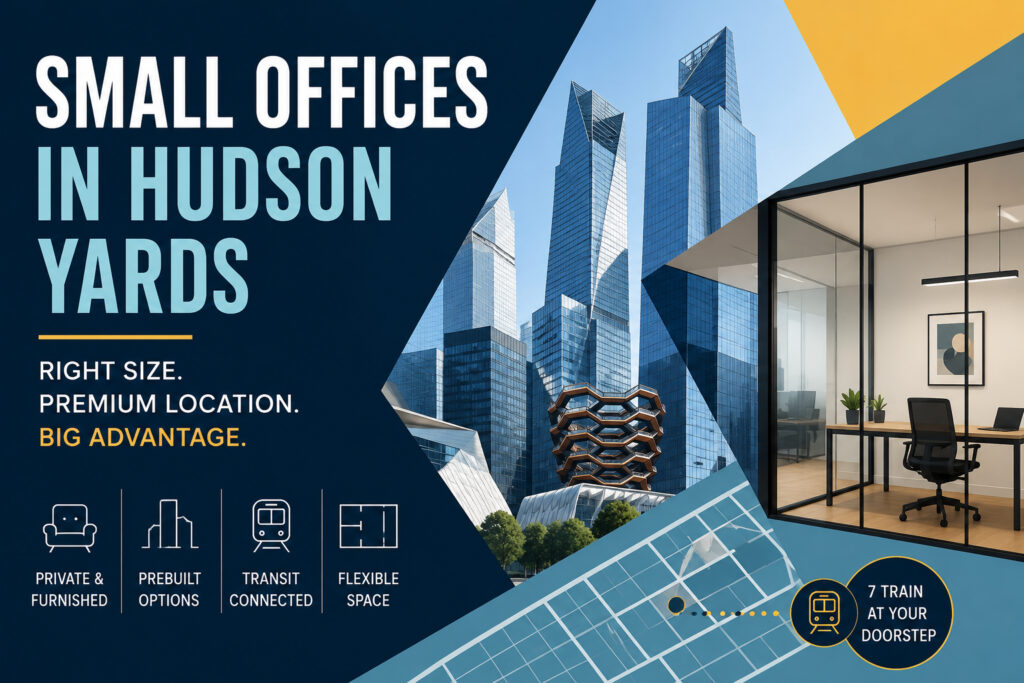
Small Offices in Hudson Yards
Hudson Yards gives small tenants a rare mix of new construction, strong transit, and premium daily convenience. The neighborhood runs from West 30th Street to West 34th Street, between 10th and 12th Avenues, with direct access to the No. 7 subway, quick access to Penn Station, nearby bus service, ferry access, and bike connections. That access matters because a small office works best when your team can arrive quickly, meet clients easily, and move through Midtown West without friction.
Small office space here does not mean one thing. In this district, the phrase can point to a furnished private office, a compact prebuilt suite, a furnished sublease, or a smaller direct lease in a building near the core. The benchmark inventory blend all of those meanings together, including flexible offices, private suites, large direct listings, and nearby edge-of-district options.
That mix creates opportunity, but it also creates confusion. Hudson Yards includes several huge office towers, and those buildings mostly serve larger occupiers. As a result, smaller users usually find the best fit in carved-out prebuilt suites, furnished plug-and-play space, selective subleases, or smaller offices just outside the main core. Official building pages show why: one flagship tower contains 1.8 million square feet, another contains 2.6 million square feet, another contains 1.3 million square feet, and another can hold more than 500 people on a single floor.
If you want a broad market snapshot first, start with our Hudson Yards office for rent page or review office space in Hudson Yards to see how current availabilities typically sort.
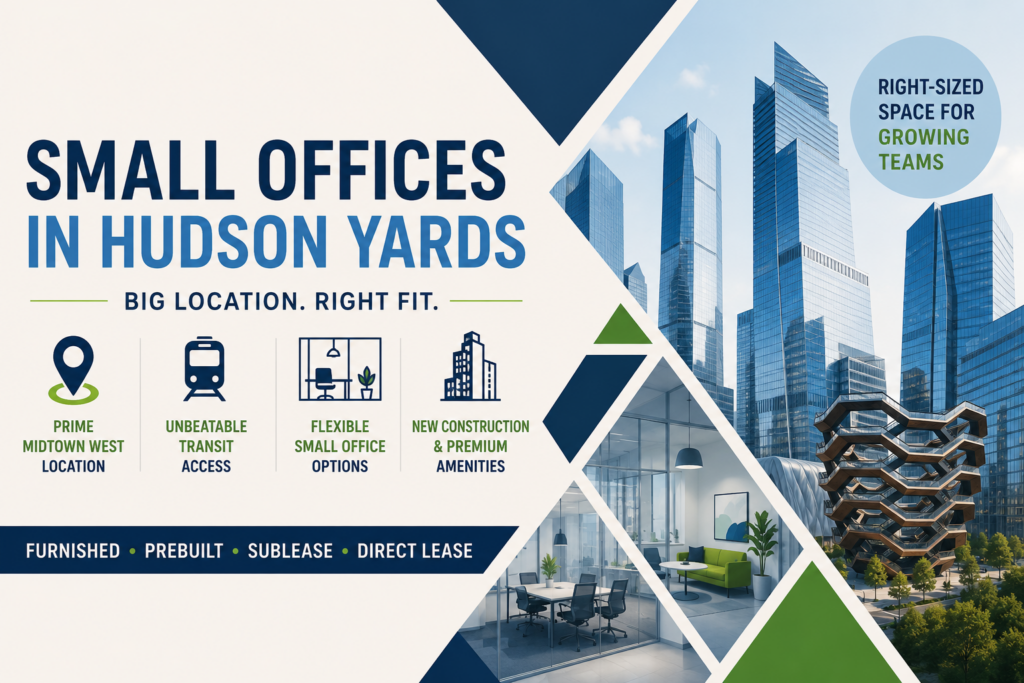
What Small Offices Means Here
In Hudson Yards, a “small office” usually falls into one of four lanes. First, you have a private office inside a serviced or flexible workspace. Second, you have a prebuilt suite that already includes walls, conference space, and finished interiors. Third, you have a furnished sublease, which can lower both cost and setup time. Fourth, you have a direct lease for a smaller standalone suite, though those appear less often in the core.
That distinction matters because each lane answers a different tenant need. A small legal team may want privacy and branding. A startup may want speed and low upfront spend. A boutique investment group may want a finished office with a sharper image. Meanwhile, a consulting team may care most about Penn Station access and fast client meetings. Hudson Yards can support all of those needs, but not through the same product.
The core district skews big, polished, and infrastructure-rich. One building connects directly to the High Line and the public square. Another links directly underground to the No. 7 station. Another sits across from the station and at the meeting point of the district, the High Line, and Hudson Park & Boulevard. Those features make the area attractive, yet they also push much of the stock toward large-scale users and premium buildouts.
So, for a small tenant, the smartest question is not, “Is there office space here?” The better question asks, “Which kind of small office fits my timing, privacy, and cost goals?” Once you frame the search that way, the market becomes much easier to read.
Practical takeaway: If you need immediate move-in, start with furnished or flexible options. If you need privacy for a small team, focus on prebuilt suites and select subleases. If you need full customization, widen the search and allow more time. This is a practical leasing framework based on how the district’s large building stock and current online inventory present smaller options.
For tenants who want a wider district view, compare our Hudson Yards office space for rent overview with Hudson Yards office space for lease and Hudson Yards offices.
Where Small Offices Actually Show Up
Small offices in Hudson Yards usually show up in three places. The first sits inside a flexible office center. The second sits inside a finished prebuilt suite within a larger office tower. The third sits just outside the main core, where the district meets Penn Station, Midtown West, or the High Line edge. The benchmark PDF shows that current online results already pull from all three buckets, which confirms how tenants actually shop this market.
Inside the main core, you get the strongest amenity stack. The official work pages highlight direct restaurant and retail access, panoramic views, outdoor terraces, strong lobby experiences, floor-to-ceiling glass, and immediate proximity to the No. 7 subway. The official neighborhood page also shows nearby coffee, dining, childcare, beauty services, and everyday convenience uses across the district. That combination supports teams that host clients often or want a polished daily routine.
Along the Penn Station side and the district edge, small tenants usually get more practical options. Penn Station sits only two blocks east, with Amtrak, LIRR, NJ Transit, PATH, and several subway lines nearby. That proximity explains why many office listings marketed to Hudson Yards users sit slightly outside the core. You still keep the neighborhood’s convenience, but you often gain smaller footprints and faster decision paths.
The High Line side forms another useful lane. One major tower in the district connects directly to the High Line through a public passageway, and another sits at the intersection of Hudson Yards, the High Line, and Hudson Park & Boulevard. That edge works well for firms that want a polished office address without losing access to Chelsea, West 30s inventory, or nearby creative stock.
This geography matters because not every “Hudson Yards” office serves the same tenant. Core space suits teams that prioritize image, building systems, and a new-build environment. Edge space often suits tenants who want smaller footprints, easier economics, and more inventory. Most small-office searches work best when you compare both.
If you want to explore those choices now, review Hudson Yards office for lease, offices for lease in Hudson Yards, and partial floor office in Hudson Yards. Tenants who need a fast setup should also compare furnished Hudson Yards office, Hudson Yards furnished office space, and furnished Hudson Yards office for rent.
What Small Offices Cost
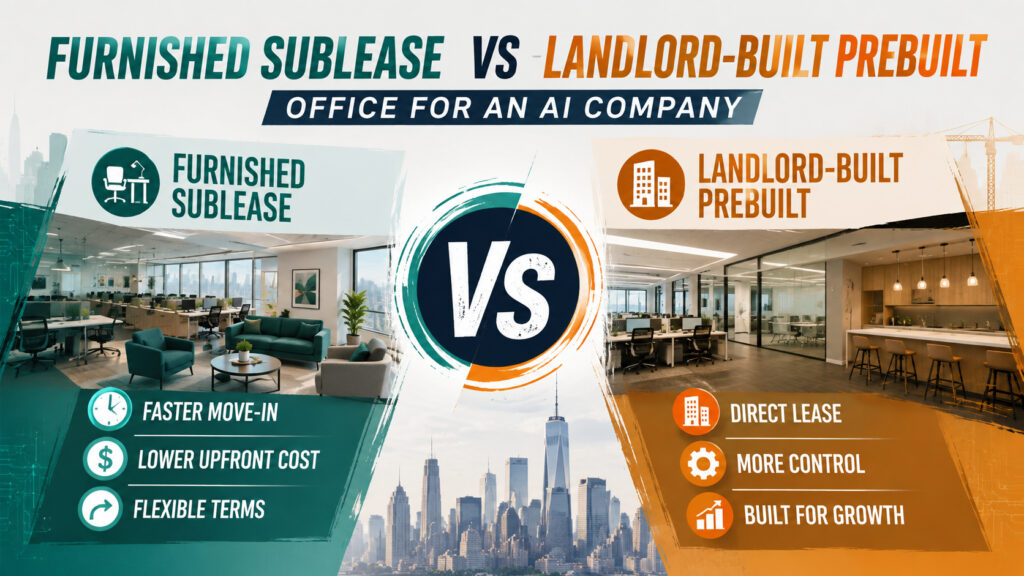
The biggest pricing mistake in Hudson Yards comes from mixing per-seat pricing with annual rent per square foot. Flexible private offices often price by desk, by office, or by monthly membership. Traditional leases usually quote annual rent per square foot. Furnished subleases can sit somewhere in between because the rent structure may look traditional while the move-in cost feels closer to flex space.
Today’s market benchmark illustrates this split clearly. It shows current online overview pricing for smaller flexible offices in the area at roughly $500 to $1,050 per workstation per month, along with private prebuilt suites around $4,400 to $8,500 per month. The same benchmark also shows one nearby flexible office example starting at $1,380 per month for a two-person office, while another directory shows flexible space from about $500 per person per month. Those figures give tenants a realistic first screen, even though actual pricing changes by term, service level, and layout.
Direct lease pricing requires a different lens. The benchmark PDF shows one neighborhood inventory portal with 24 available office spaces and an average asking rent of $43 per square foot, yet the same snippet shows a very large average suite size. That number helps for broad market context, but it does not describe the cost of a true small office in a top-tier tower. By contrast, a recent small-office example in the district showed about 5,700 square feet marketed at $170 per square foot, or roughly $80,750 per month, which better reflects premium new construction. Manhattan’s tight top-end market also pushed premium rents higher through 2025 and 2026 as demand concentrated in newer assets.
That range tells you something important. “Affordable” in Hudson Yards usually means one of three things: a smaller furnished office, a short-form sublease, or a compact prebuilt suite outside the most expensive floors and views. Raw direct space in the newest core buildings can cost much more, especially when your firm needs branding, private conference rooms, or custom construction. Reuters also reported that tenants continue to favor high-quality New York offices as return-to-office patterns strengthen, which keeps pressure on the best product.
Several factors shape your real monthly spend. Furniture matters. Term length matters. Move-in speed matters. Buildout matters too. A “cheaper” raw suite can cost more once you add design, cabling, furniture, permits, and time. A furnished suite can look expensive at first glance, yet save money when you count setup costs and lost time.
For budgeting help, review Hudson Yards office space cost. If you want side-by-side examples, compare Hudson Yards prebuilt suite, furnished Hudson Yards space, and office space in Hudson Yards.
How to Choose the Right Format
Choose a furnished private office when speed comes first
A furnished private office fits teams that need to move quickly, avoid construction, and keep setup simple. This route works well for founders, satellite teams, project groups, and firms that need a shorter initial commitment. The benchmark PDF shows that many smaller-office results already direct users toward this option, which reflects real demand for immediate occupancy and lower friction.
Choose a prebuilt suite when privacy matters most
A prebuilt office suits tenants who want their own front door, stronger branding control, and a more private work environment. This format usually works best for firms that outgrow a shared setting but still want turnkey speed. Hudson Yards supports that model because the district’s newer buildings emphasize quality common areas, strong infrastructure, direct transit access, and polished tenant amenities.
Choose a sublease when value leads the conversation
A good sublease can cut both cost and timeline. In Manhattan, available sublease supply has fallen sharply from pandemic highs, which means the best options can leave the market quickly. Even so, subleases remain useful for tenants who want existing furniture, fast possession, and shorter lease terms than a new direct deal might offer.
Choose a direct lease when you want long-term control
A direct lease fits teams that want to control layout, image, and future planning. That route usually makes sense once your headcount feels stable and your brand needs justify a longer commitment. In Hudson Yards, that decision also means paying close attention to total occupancy cost, because premium buildings offer premium systems, premium services, and often premium economics.
Keep transit and daily workflow at the center
Transit should shape your shortlist from day one. The official neighborhood page shows the No. 7 subway as the main conduit, Penn Station two blocks east, multiple bus lines nearby, ferry access on the Hudson, and bike access with nearby Citi Bike. Those connections can matter more than a dramatic view when your team commutes from several boroughs or the suburbs.
Treat amenities as workflow tools
Hudson Yards gives tenants a strong daily support system. Official district pages highlight on-site dining, coffee, childcare, wellness, parking, and direct access to public open space. Those features help small teams because they reduce friction, support recruiting, and make client visits easier. They are not just extras here. They shape how the office functions each day.
For tenant-specific guidance, use our How to Lease an Office in Hudson Yards page. If your team needs a more specialized fit, compare headquarters space in Hudson Yards, partial-floor options, and a furnished partial-floor office.
Common Questions
Are there true small offices inside Hudson Yards?
Yes, but they make up a narrower slice of the market than many tenants expect. The district’s best-known office towers carry very large floorplates and massive overall square footage, so truly small options usually appear as furnished offices, prebuilt suites, or carved-out subleases rather than raw mini-suites.
Is a coworking office the same as an office for rent?
No. A coworking or serviced private office usually includes furniture, shared services, and faster move-in. A traditional office for rent usually comes through a direct lease or sublease and gives you more control over privacy, term, and layout. The benchmark PDF shows that tenants searching this phrase encounter both models at once, which is why the distinction matters.
Can I find furnished small offices in this neighborhood?
Yes. Furnished options already appear throughout the current benchmark, and they remain one of the best ways to secure a small footprint without a long buildout. That route often makes the most sense when speed, convenience, and upfront cash control matter more than deep customization.
Should I search only inside the main core?
Not always. Penn Station sits only two blocks east, and the district touches key West Side corridors, so many viable “Hudson Yards” options sit just outside the strict core while still serving the same commute and client pattern. Small tenants often find better size efficiency there.
What should I compare before I tour?
Start with five questions. How fast do you need to move? How much privacy does your team need? Do you want furniture included? How long do you expect to stay? Which commute matters most, the No. 7 station, Penn Station, the West Side Highway, or the High Line side of the neighborhood? Those factors narrow the market faster than headline rent alone.
What is the smartest next step?
Begin with the format, not the building. Decide between furnished, prebuilt, sublease, and direct lease first. Then compare current Hudson Yards office for rent, furnished Hudson Yards office, Hudson Yards prebuilt suite, and office space in Hudson Yards options to see which lane fits your team best.
A small office in Hudson Yards can work exceptionally well for the right tenant. The key is choosing the right product type, not chasing every listing that uses the neighborhood name. Once you sort the market that way, Hudson Yards becomes far easier to navigate, price, and lease.
Looking for an Office in the Hudson Yards?
We represent tenants, not landlords. We compare direct leases, subleases, furnished suites, and prebuilt offices across the district. Then we narrow the field to spaces that match your size, budget, and move-in date.
Fill out our 📋 online form or give us a call today 📞 212-967-2061 — let’s find the right options for your business.