Hudson Yards Office Space Cost
Hudson Yards office space cost usually starts with the quoted rent. However, the real number always runs deeper than the headline ask. Tenants need to separate asking rent, occupancy cost, and concessions before they compare any space.
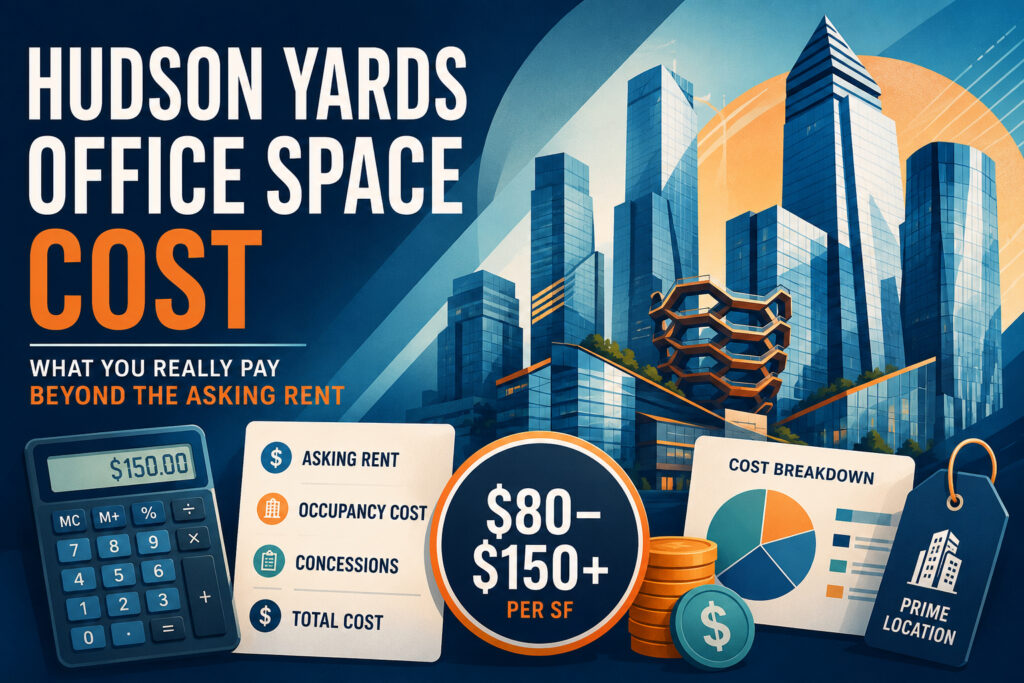
Right now, the public pricing picture clusters around a premium band. Core direct space in Hudson Yards often falls around $80 to $150+ per square foot. Search-result summaries and live market pages also show that top-tier space can push into the $115 to $155 range, while fringe or non-core options can surface much lower numbers.
That spread confuses many tenants. One search result may quote a trophy tower. Another may quote a small side-street space. A third may show a furnished suite. A fourth may price a desk, not a full office. None of those products belong in the same cost bucket.
Quick answer: if you want true Hudson Yards direct office space in the newer premium inventory, expect a premium range. If you want smaller, older, edge, or short-term space nearby, expect more variance. If you want an accurate budget, price the space by rentable square feet, then add the occupancy items that sit outside the asking number.
Base rent math looks like this:
| Size | $80 PSF | $100 PSF | $125 PSF | $150 PSF |
|---|---|---|---|---|
| 1,000 RSF | $6,667/mo | $8,333/mo | $10,417/mo | $12,500/mo |
| 5,000 RSF | $33,333/mo | $41,667/mo | $52,083/mo | $62,500/mo |
| 10,000 RSF | $66,667/mo | $83,333/mo | $104,167/mo | $125,000/mo |
| 20,000 RSF | $133,333/mo | $166,667/mo | $208,333/mo | $250,000/mo |
Those numbers show base rent only. They do not include escalations, electricity, after-hours HVAC, furniture, or build-out costs.
What counts as asking rent
Asking rent is the advertised annual price per rentable square foot. It gives you a starting point. Even so, it does not tell you what the lease will cost after negotiation. It also does not tell you whether the space arrives raw, prebuilt, branded, furnished, or ready for immediate use.
Current Hudson Yards inventory illustrates that range well. Our live pages show a mix of large direct blocks, large sublets, furnished suites, and partial-floor options. Recent examples include space around 45,942 RSF, 45,543 RSF, 30,314 RSF, 20,840 RSF, 11,907 RSF, and 10,853 RSF.
That inventory mix matters. A 45,000-square-foot headquarters floor does not price like an 11,000-square-foot furnished suite. Likewise, a direct lease does not price like a sublease. A polished prebuilt often carries a higher face rate, yet it can lower your move-in cost and timeline.
What counts as occupancy cost
Occupancy cost means the full cost of using the office. Start with base rent. Then add the items that make the space work each day. In Manhattan leasing, those items often include tax escalations, operating expense increases, electricity, cleaning rules, HVAC terms, security deposits, and the rentable-versus-usable square footage spread.
That distinction protects tenants from bad comparisons. A cheaper quoted rent can lose fast if the space needs a full build-out. Another space may quote a higher rent, yet arrive furnished and ready. A third option may offer free rent, stronger allowance money, or better assignment rights. Smart tenants compare the full structure, not the headline number.
Use this simple framework:
Base rent = rentable square feet × quoted PSF
Occupancy cost = base rent + escalations + utilities + service extras + move costs
Effective cost = total lease obligation minus concessions, divided by term and square footage
That formula keeps the search honest. It also helps you compare a polished direct lease against a second-generation sublease or a furnished short-term option.
What counts as concessions
Concessions are the value items that reduce your real cost. Free rent is the most visible example. Tenant improvement money matters too. So do turnkey construction, delivered furniture, phased occupancy, capped increases, renewal rights, and sublease flexibility.
Those terms still exist in Manhattan. Yet leverage has become more selective at the top of the market. Direct availability at 32 Manhattan trophy towers fell to 4.4% in recent reporting. Manhattan sublease inventory also dropped below 11 million square feet in the second quarter of 2026. Meanwhile, 2025 produced a record 313 Manhattan leases starting at $100 PSF and 9.9 million square feet of top-tier transactions.
That market backdrop matters in Hudson Yards. Premium inventory still commands attention. Better space still draws tenants. Large blocks still move. As a result, concessions did not disappear, but they stopped acting like a blanket discount. The best leverage usually comes from timing, competition, credit, and realistic alternatives.
Why one page says $80 and another says $150
Hudson Yards search results combine several different products. That mix explains the price gap that frustrates tenants. Today’s SERP screenshots show search engines blending direct Class A pages, broad listing portals, flexible-office pages, map results, neighborhood guides, office directories, and building-specific research.
The lower end often reflects one of four things. First, the space may sit on the edge of the district. Second, the suite may reflect older or less central inventory. Third, the result may show a small sublease. Fourth, the page may quote a different product, such as flexible space or desks. Bing’s result set for this query even separates premium Class A space from subleases, creative offices, and per-person flexible pricing.
The upper end usually signals prime direct space in the core development or in the broader trophy cluster nearby. Recent coverage of the wider Hudson Yards district shows tighter premium supply and trophy pricing well above Manhattan averages. Nearby top-tier space has also posted asking rents from $125 to $225 PSF in the broader district.
So the right question is not, “What does Hudson Yards cost?” The right question is, “Which Hudson Yards product am I pricing?” Once you answer that, the market starts to make sense.
What drives cost inside Hudson Yards
Floor height changes value. River views change value. Turnkey condition changes value. Layout efficiency changes value. Term length changes value. Delivery timing changes value. Expansion rights change value. Transit access and amenity depth change value too.
Hudson Yards earns its premium because the product differs from older Midtown stock. The district offers new construction, larger plates, stronger glass lines, deeper amenity packages, and direct access to the No. 7 line, with Penn Station nearby. Those features support recruiting, attendance, and operating efficiency. They also help explain why tenants keep paying up for top-tier space.
Scale also matters here. The district includes some of Manhattan’s largest and newest office towers. Published inventory pages place the main office supply around 1.8 million square feet, 2.6 million square feet, 2.9 million square feet, 1.3 million square feet, and a future 1.4 million square feet addition. A nearby Hudson Boulevard tower adds another 2.85 million square feet in the broader competitive set.
That sheer scale attracts large tenants first. Smaller users still have options, but the district naturally favors larger blocks, stronger credit, and longer planning windows. That bias can affect both price and concession structure. It can also limit true plug-and-play choices in the core towers.
How to budget the space correctly
Start with your real headcount. Then map the layout. After that, pick the product type. A small team may do better in a furnished suite. A growth company may prefer a prebuilt floor. A larger user may unlock more value in a partial or full-floor direct lease.
Next, price the office in rentable square feet. Many tenants forget that usable space and rentable space differ. That gap affects every dollar on the deal. Once you know the rentable figure, convert the ask to monthly base rent and then layer in the operating items.
After that, ask for the delivery condition in writing. If the space arrives raw, budget construction time and cost. If the unit arrives prebuilt, test whether the layout truly fits. If the suite arrives furnished, confirm furniture ownership, wiring quality, meeting-room count, and technology readiness. A cheaper floor can become expensive once you rebuild it.
Finally, compare at least three real alternatives. Include one direct lease. Include one sublease if possible. Include one ready-to-go space if speed matters. That side-by-side view usually sharpens both economics and timing.
A cleaner way to read Hudson Yards pricing
Use this grid when you budget:
| Product type | Typical pricing signal | Best fit |
|---|---|---|
| Large direct lease | Premium face rent, deeper negotiation on structure | Long-term users |
| Large sublease | Potential discount, shorter term, limited control | Mid-term users |
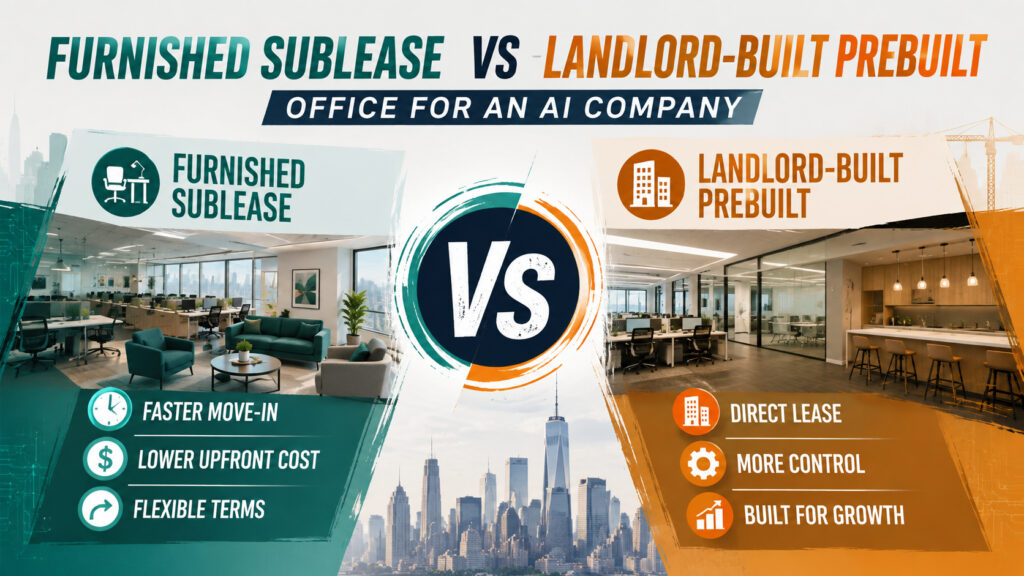
| Prebuilt direct space | Higher face rate, faster move-in | Teams that value speed |
| Furnished suite | Easier launch, fewer upfront costs | Smaller or urgent users |
| Flexible office | Priced by desk or small suite | Very short-term needs |
That is why public numbers look so scattered. The pages do not always describe the same thing. Search engines simply place them beside one another. Your budget should not.
What tenants should expect right now
Expect premium asking rent in the core market. Expect tighter supply for true trophy options. Expect more negotiation room on delivery structure than on fantasy-level pricing. Expect the best deals to move faster than lower-quality space.
Expect the broadest value gap between face rent and real cost when the space needs heavy work. Expect less surprise when the suite comes fully built and furniture-ready. Expect the strongest leverage when you start early and create live competition.
Expect Hudson Yards to hold its premium position as long as Manhattan keeps rewarding better buildings. Current leasing data, trophy availability, and premium rent growth all support that view.
If you want the short version
Hudson Yards office space cost often means premium direct rent, not bargain space. Many current public references cluster around $80 to $150+ PSF for the district’s prime direct options, with higher pricing in the strongest towers and lower pricing on the fringe or in different product types. Your actual cost depends on how the lease structure works after electricity, escalations, build-out, and concessions enter the math.
If you need current options, start with current Hudson Yards office inventory, then compare Hudson Yards office space, Hudson Yards office listings, and our commercial leasing guide. For live examples, review a large-block Hudson Yards sublet, a large direct headquarters floor, a full-floor direct lease, a furnished Hudson Yards suite, and a partial-floor Hudson Yards option.
We represent tenants, not landlords. We help you compare the real cost of each option, then negotiate the structure that protects your budget. When you are ready, we can build a shortlist, run the numbers, and help you secure the right Hudson Yards office on better terms.
FAQ copy
What is the average cost of office space in Hudson Yards?
Most public pricing references for this search cluster around a premium direct-rent band of roughly $80 to $150+ PSF. Prime space in the strongest inventory can run higher. Nearby fringe or non-core space can quote lower.
How much is 1,000 square feet in Hudson Yards per month?
At $80 PSF, base rent runs about $6,667 per month. At $150 PSF, base rent reaches about $12,500 per month. Those numbers exclude escalations, utilities, and other occupancy items.
What is the difference between asking rent and occupancy cost?
Asking rent is the quoted annual price per rentable square foot. Occupancy cost adds the other items that shape the real bill, such as escalations, electricity, HVAC rules, delivery condition, and move costs.
Are subleases cheaper in Hudson Yards?
They can be. Yet price alone does not decide value. A sublease may offer a shorter term or lower rent, but it can also limit flexibility, branding, and control. Manhattan sublease supply has tightened, so strong subleases do not always trade at deep discounts.
Do Hudson Yards landlords still offer concessions?
Yes, but the best buildings usually offer targeted concessions, not easy giveaways. Free rent, improvement money, and delivery terms still matter. Tight trophy availability has reduced blanket leverage at the high end.
Why do I see very different prices for Hudson Yards online?
Because the results mix different products. One page may show direct space. Another may show fringe inventory. Another may quote a desk or a furnished suite. Search engines place those products side by side even though tenants should price them separately.
What sizes are available in Hudson Yards right now?
Current live examples on our pages include options around 10,853 RSF, 11,907 RSF, 20,840 RSF, 30,314 RSF, 45,543 RSF, and 45,942 RSF. That mix shows that Hudson Yards can serve both mid-size users and major headquarters blocks.
Is a furnished office cheaper than a direct lease?
Not always. A furnished unit may carry a higher face rate. Still, it can lower your upfront cost and reduce downtime. The right answer depends on term length, construction needs, and how fast you must move.
When should I start a Hudson Yards office search?
Start early if you need custom work, a large block, or several real alternatives. Premium Manhattan supply has tightened. Early planning gives you more leverage and more time to compare structure, not just price.
Pricing Options
Fill out our 📋 online form or give us a call today 📞 212-967-2061 — let’s find the right options for your business.