Leasing opened the year with real momentum, Manhattan availability kept tightening, and asking rents moved higher, even though different market trackers still showed meaningful variation in citywide numbers. That mix creates a market where speed matters, but discipline matters more.
In plain English, office tenants still have leverage in 2026. However, that leverage does not sit everywhere at once. It sits in the format you choose, the timing you control, the concessions you model correctly, and the neighborhoods you cross-shop with intent.
The Manhattan office market changed shape in 2026
Manhattan did not enter 2026 as a soft, drifting market. One current tenant-side market summary logged 11.78 million square feet of leasing in the first quarter, while another tracked 12.4 million square feet in the same period. Availability held near the mid-teens, then tightened further into May, when Manhattan supply fell to 69.18 million square feet, availability dropped to 13.2%, and asking rents reached their highest level since August 2020.
That strength did not spread evenly across all space. Premium space kept attracting outsized demand. Manhattan recorded 313 leases priced at $100 per square foot or more in 2025, covering 9.9 million square feet across 125 buildings. At the same time, record-priced leasing reinforced a wider “flight to quality,” especially in space that helps employers draw people back in.
Supply pressure also changed the backdrop. For the first time in 25 years, more U.S. office space is set to be demolished or converted than newly built, with 23.3 million square feet removed versus 12.7 million square feet completed by the end of 2025. That trend matters in Manhattan because fewer fallback options support rents in the best space and reduce the margin for delay.
Yet tenants should not confuse a firmer market with a closed market. The city still offers direct leases, built space, furnished sublets, and managed offices across major business districts. A prepared tenant can still create competition. An unprepared tenant usually creates urgency for the landlord instead of leverage for itself.
Tenant-first takeaway: 2026 does not reward passive searching. It rewards early comparisons, sharper filters, and a wider view of office formats.
Tenant leverage still exists, but it moved
The easiest mistake in 2026 is assuming leverage vanished because trophy rents rose. That misses the bigger picture. Manhattan still carried 10.86 million square feet of sublet availability in the first quarter, and second-quarter reporting placed available sublease space below 11 million square feet. Even after a sharp pullback, that remains meaningful depth for tenants who care about speed, term flexibility, and built space.
Sublease no longer acts like a giant overhang. Instead, it acts like a strategic reserve. Available sublease space has dropped to less than half its late-2022 peak, while leasing from AI, finance, and legal users has helped absorb that inventory. Owners have also started pulling back some sublet space to pursue direct deals at higher rates. That shift narrows the obvious bargains, but it also tells tenants where to look first when timing matters.
Another form of leverage sits in the market data itself. Current Manhattan asking-rent and availability figures still vary by source. One tenant-side comparison put citywide asking rent at $77.55 per square foot and availability at 13.7%. Another current Manhattan article summarized citywide asking-rent figures ranging from $73.13 to $78.01. Those gaps do not make the research useless. They prove that tenants should never choose a space from one headline metric alone.
Therefore, the real 2026 tenant advantage comes from comparison work. If one corridor pushes rate, another may offer faster delivery. If one direct lease looks expensive, a finished sublet may cut build-out time and preserve cash. If one landlord will not move on structure, a competing format often will.
The right office format now matters as much as the right rent
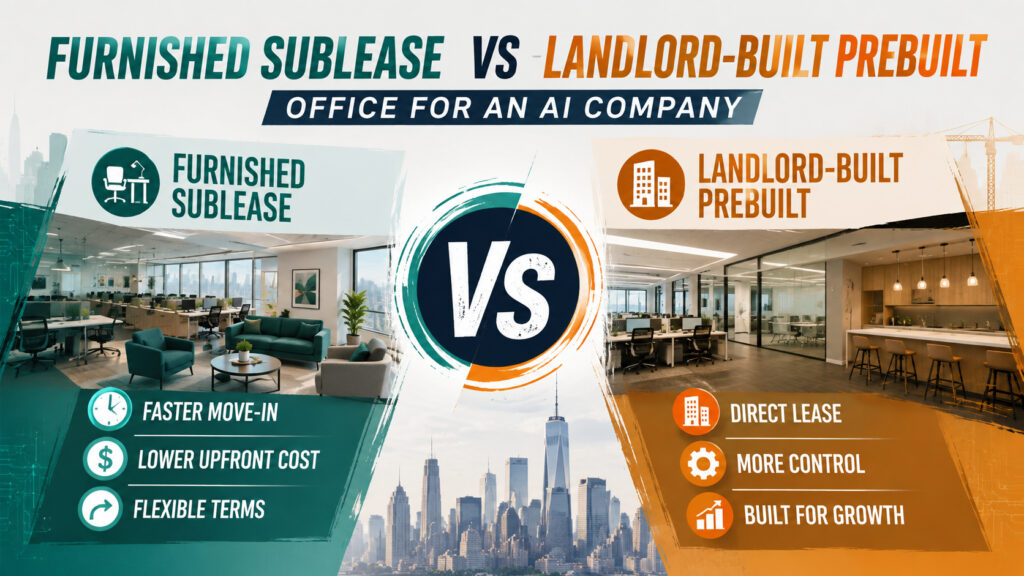
A direct lease still works best when your company wants control. That path usually makes the most sense when you need your own front door, stronger privacy, network control, custom branding, or a term long enough to justify layout decisions. In 2026, direct space also works well for teams that expect steady in-office attendance and want leverage on renewal, build-out, and future rights.
A furnished sublet wins when speed and value outrank customization. That route can solve swing space, short-run expansion, a delayed build-out, or a new-market test. It often reduces cash burn because the layout, furniture, and wiring already exist. In a market where finished space tours well and moves faster, that matters.
Managed private office space solves a different problem. It works best for founders, tiny satellite teams, project groups, or companies that need a short commitment and a simple monthly bill. It rarely replaces a true private office for a stable team over a longer horizon. Instead, it buys time, speed, and convenience.
That is why 2026 tenants should search by use case first. If you need instant occupancy with privacy, built sublet should enter the mix early. If you need long-term control, direct lease should stay on the table. If you need thirty to ninety days of breathing room, then managed space can help bridge the gap without forcing a rushed long-term commitment.
Live inventory shows how wide that spread can be. A current Plaza District turnkey sublet lists 11,091 square feet. A current Midtown furnished suite lists 6,355 square feet. A current furnished Wall Street sublet lists 10,973 square feet with an estimated capacity of 73 people. A current Penn Plaza furnished sublet lists 3,378 square feet for a team of up to 16. Those examples make one point clear: tenants should match the format to the team, not force the team into a single format.
A tenant does not sign “asking rent.” A tenant signs a full cost stack. That stack includes rentable size, usable efficiency, loss factor, tax escalations, operating expenses, electricity, internet readiness, cleaning, security deposit, HVAC rules, build-out timing, and future flexibility. In 2026, those variables often decide the winner long before the sticker rate does.
That issue grew more important because market benchmarks still differ by source. When current Manhattan trackers can place asking rents anywhere from the low $70s to the high $70s per square foot, a tenant who compares only headline rate will misread value. Proposal modeling beats a market headline every time.
Loss factor deserves special attention. Rent usually applies to rentable area, not pure usable area. A seemingly cheaper suite can become the more expensive option once you price the real usable footprint. The same problem appears with “all-inclusive” flexible space, where a low advertiser rate may assume longer commitments, capped conference-room usage, or added setup charges.
Tenants should also price time as a cost. A raw direct deal may look less expensive on paper, but it can lose if construction drags, approvals stall, or rent starts before the office truly functions. Built sublets and prebuilt direct suites often win in 2026 because they remove months of friction, not because they always post the lowest headline number.
A practical comparison should answer five questions before the short list gets smaller:
What is the real monthly occupancy cost after every pass-through and concession?
How much usable space does the team actually control?
When can the team legally and practically occupy the space?
Which format gives the best balance of privacy, speed, and flexibility?
What rights protect the company if headcount, budget, or timing changes?
The strongest 2026 office strategy starts with a simple truth: people do not come in for rows of desks. Current workplace data shows that collaboration with colleagues ranks as the top reason for office attendance at 68%, followed by in-person meetings at 58%. The same research shows that most organizations now target more office time, with 66% aiming for mostly in-office attendance three or more days a week, while Tuesday draws the highest attendance by a wide margin.
That pattern changes how tenants should think about layout. Global average office utilization rose to 53%, while peak utilization climbed to 80% and overall occupancy reached 111%, meaning more people are assigned to offices than there are physical seats. In other words, many workplaces now sit quiet on some days and feel crowded on peak days. A tenant that sizes space only from payroll or headcount will often get the mix wrong.
The better 2026 layout uses the office as a shared work platform. That means fewer assumptions about one desk per person and more investment in conference rooms, phone booths, touchdown points, quiet rooms, support areas, and collaboration zones that work on peak days. Recent workplace research shows global space composition around 35% individual space, 19% collaboration space, 24% support space, and 22% amenity space, while activity-based concepts now sit near focus-based concepts in overall preference.
Amenities still matter, but tenants should rank the right ones. Daily convenience now beats gimmicks. Current workplace data points to cafés and restaurants as the most valued amenity category, while support for real interaction and smoother routines matters more than ornamental extras. In a tenant-forward search, the question should not be, “Does the building look impressive?” The better question is, “Does this office help our team do its best work together three days a week or more?”
Tenant-first rule: pay for features that improve attendance, collaboration, and speed of work. Skip features that only photograph well.
Smart tenants now ask for data, not just tours
A polished tour can hide a weak operating setup. In 2026, tenants should ask what the landlord, operator, or sublandlord actually knows about how the space performs. Current workplace technology research shows that 77% of organizations already use space reservation systems, 94% feed data into their space systems, 91% send occupancy data downstream, and 70% govern data quality through regular auditing. That means better questions now exist, and tenants should use them.
Start with utilization. Ask when attendance peaks, how conference rooms perform, which days overload the floor, and whether desk sharing or assigned seating drives the plan. Ask next about internet carriers, room-booking rules, after-hours HVAC, visitor management, and badge or check-in practices. Then ask what assumptions support the current layout. If the answer sounds vague, the space may have been designed more for leasing than for actual use.
This issue matters because the policy and the reality still diverge in many offices. Current global workplace data shows 70% of respondents say employees come in less often than leaders require or expect. That gap tells tenants not to treat current headcount as a reliable occupancy formula. Instead, tenants should ask for peak-day behavior, team overlap, and real attendance patterns before locking into either too much space or too little.
The due-diligence list for 2026 should feel stricter than it did in 2025:
Ask for the true delivery condition.
Ask for the real monthly number, not only the quote.
Ask how the office performs on peak attendance days.
Ask what flexibility exists for renewal, sublease, expansion, or exit.
Ask whether the layout fits your team’s actual weekly schedule, not a theoretical one.
When the search gets serious, use live filters, not assumptions. Our current database covers more than 1,400 Manhattan listings and updates daily, which helps tenants compare direct space, sublets, and ready-to-occupy options against the same requirement set. That is the right 2026 move because the market now changes too quickly for static search habits.
The tenant-forward path through 2026
The strongest tenant strategy in 2026 does not chase the cheapest office in Manhattan. It finds the office that gives the company the best mix of cost control, speed, layout fit, commute logic, and future flexibility. A tenant can still win in this market, but only when the search starts early enough to create options and disciplined enough to remove false bargains.
Some teams should renew and use their leverage there. Others should relocate into built space before choice narrows further. Small teams may do best in managed offices for a short bridge period, then graduate into private sublet or direct space once attendance patterns settle. Larger teams should usually compare at least one direct lease, one built sublet, and one move-in-ready option in the same corridor before making a final decision.
The 2026 tenant advantage comes from preparation, not luck. Build the requirement first. Compare the formats honestly. Model the full cost. Then negotiate from a position of clarity, not urgency.
We represent office tenants only. We compare direct leases, subleases, and move-in-ready options across Manhattan from the tenant side. Then we negotiate the business terms with one goal in mind: more control for your company, better economics for your budget, and a cleaner path to the right office.
Fill out our 📋online form or give us a call today 📞212-967-2061 — let’s find the right office for your business.