The 2026 office landscape points to a clear theme. Small businesses are not standing still. Instead, they are tightening operations, protecting cash flow, using more automation, and making sharper real estate decisions. That shift matters for every tenant comparing renewals, relocations, sublets, and first offices in Manhattan.
If you are planning a move, we represent tenants. We help compare direct space, subleases, and sale options through one lens: what makes the most financial sense for your business. That matters even more when rents, concessions, and timing move in different directions across Manhattan.
Read this first:The goal in 2026 is not to lease the biggest office. The goal is to lease the right office, at the right cost, with the right flexibility.
Cost pressure is real, but demand is not dead
June 2026 brought 531,423 business applications nationwide. Projected formations from that pipeline reached 29,741. New companies still launch. Growing firms still make bets. Expansion did not disappear in 2026. It simply became more selective.
At the same time, business owners are working through tougher operating math. Small business optimism fell to 95.3 in May. Uncertainty rose to 91. Job openings that owners could not fill still stood at 29%. Inflation ranked near the top of reported problems. Labor costs also hit a record reading as a primary business concern.
Price pressure adds another layer. The all-items consumer price index rose 4.2% in the twelve months through May 2026. Energy jumped 23.5% over that span. Food rose 3.1%. When utilities, commuting, deliveries, and vendor bills move higher, fixed office costs get more scrutiny.
That is the key change for 2026. Many small businesses still want office space. Yet they now want each square foot to solve a problem. Some need a better client address. Others need easier hiring near transit. Many need a plug-and-play suite that avoids a long build-out and protects working capital.
Manhattan is tighter than many tenants expect
The Manhattan office market did not freeze in 2026. In the first quarter, leasing volume reached 8.5 million square feet. Overall vacancy fell to 13.5%. Average asking rent rose to $85.31 per square foot. Direct Class A asking rent reached $95.49 per square foot. That is not a tenant panic market. It is a market with strong pockets, weaker pockets, and faster movement for the best ready-to-go space.
Momentum remained visible in late spring. May leasing volume alone hit 3.02 million square feet. That figure sat 43% above the five-year monthly average. At the same time, direct availability in a set of top-tier towers fell to 4.4% of inventory, down sharply from 2024. Premium product is tightening. Waiting for endless choice at the top end makes less sense now.
Sublease conditions also changed. Available Manhattan sublease space dropped below 11 million square feet in the second quarter of 2026. That is less than half the late-2022 peak of 23 million square feet. Small tenants should read that carefully. Sublets still create value, but the best ones no longer linger. Good furnished space now moves with more urgency.
Another signal matters for smaller tenants. Artificial intelligence users drove 1 million square feet of Manhattan leasing in the first quarter and captured 56% of tech leasing. That surge does not mean every small business needs a trophy tower. It does mean big, fast-moving tenants are absorbing choice blocks in the neighborhoods they prefer. Smaller firms need to shop earlier and filter harder.
Smart tenants are changing how they search
The strongest small-business office strategy in 2026 starts with efficiency, not ego. Firms are leaning on automation, tighter workflows, and fewer people doing more tasks. Search behavior and current reporting both show that shift. Office demand now follows that same logic. Businesses want layouts that support output without carrying waste.
That usually means four things. First, tenants want prebuilt or lightly furnished suites. Second, they prefer fewer hallways and more usable seats. Third, they want conference space that can double as private offices. Fourth, they want clean move-in timing. The live small-suite examples on our site fit that pattern well. A 1,537 square foot Small Seventh Avenue Office includes three perimeter rooms, a workstation area, and a kitchenette. A 1,750 square foot Small Union Square Office Rental supports about ten workstations, two glass-fronted rooms, an interior room, and an in-suite restroom. A 3,606 square foot Small Lexington Avenue Office offers reception, two perimeter rooms, open work area, and a full pantry.
That is a major break from broad 2025-era thinking. Last year’s framing leaned more toward generic resilience and expansion. The 2026 tenant mindset is sharper. Tenants are asking, “How fast can we operate from this suite?” They are also asking, “How long can this layout work before we outgrow it?” Those are better questions in a cost-sensitive cycle.
The market now rewards that discipline. Manhattan headline rents can look expensive. However, your actual rent path still depends on product type, location, condition, term length, and how much build-out you avoid. Saving months on construction can matter as much as saving a few dollars per foot. Preserving cash often beats chasing a vanity address.
The best neighborhood depends on your risk and workflow
Tenants should stop treating Manhattan as one rent field. It is not. Different neighborhoods now solve different business problems. Some support client-facing teams. Others support lean operating costs. A resilient office strategy starts by matching location to workflow.
Midtown East works well for firms that need transit access, polished presentation, and a deep mix of direct and sublet options. Current live listings on our Midtown East page include footprints of 2,400 square feet, 2,791 square feet, 3,026 square feet, 3,078 square feet, 3,325 square feet, 5,680 square feet, 9,850 square feet, and 16,029 square feet. Our Midtown East office space page also shows search filters from under 1,000 square feet to over 20,000 square feet, with price bands running from under $40 per foot to over $90 per foot. For tenants who want a central, professional corridor, that range matters.
Midtown South suits firms that want energy, recruiting appeal, and efficient mid-sized layouts. Live options now include 3,826 square feet, 5,532 square feet, two 6,131 square foot suites, 7,725 square feet, and almost 14,000 square feet. That makes Midtown South office space useful for businesses that need a bit more room, but still want sharper layout efficiency than a full headquarters tower. This submarket also remains attractive for companies that expect team growth, but still want flexibility in their first move.
The Financial District stays important for cost control. Headline Manhattan averages sit in the mid-$80s per foot. Yet our downtown pages still showcase much lower-priced examples. Featured Financial District spaces include a 1,500 square foot sublet at $32 per foot, a 3,100 square foot sublet at $34 per foot, a 4,000 square foot lease at $33 per foot, and a 5,500 square foot lease at $32 per foot. Live neighborhood listings also include 2,340 square feet, 5,606 square feet, 5,857 square feet, 7,280 square feet, 11,163 square feet, 13,757 square feet, and 17,507 square feet. For tenants focused on cost, speed, and value, Financial District office space deserves a serious look.
One more example helps frame the market. A Midtown East tower page on our site currently shows unit sizes from 2,094 square feet to 15,995 square feet across direct spaces, furnished suites, and sublets. That variety is why tenants should compare building-level inventory, not just neighborhood averages. You can review that inventory at 560 Lexington Avenue.
Lease structure matters as much as rent in 2026
A resilient tenant does not only negotiate rate. A resilient tenant negotiates risk. That means the lease structure must fit your cash cycle, hiring plan, and growth range. In 2026, that point matters more than ever.
Start with size discipline. Our live search tools organize options from under 1,000 square feet to over 20,000 square feet. That range looks simple, but it forces a better question: how much space will your operating model really use? If your team now relies more on automation, shared desks, hybrid schedules, or denser front-office seating, you may not need the footprint you assumed last year. Use our Office Space Calculator before you tour.
Next, compare direct space against sublets the right way. Direct leases can offer longer control and more identity. Sublets can cut build-out time and reduce entry cost. Yet sublet supply has tightened, so the highest-value opportunities now disappear faster. Our Office Subletting guide is useful here, especially for tenants that need speed or shorter obligations.
Then focus on total occupancy cost. Rent is only one line. Furniture, wiring, pantry work, moving, downtime, and legal review also hit cash flow. In a year when inflation remains elevated and energy costs have surged, tenants should favor suites that reduce startup friction. That is why move-in-ready spaces deserve extra weight in 2026. They protect time, cash, and attention.
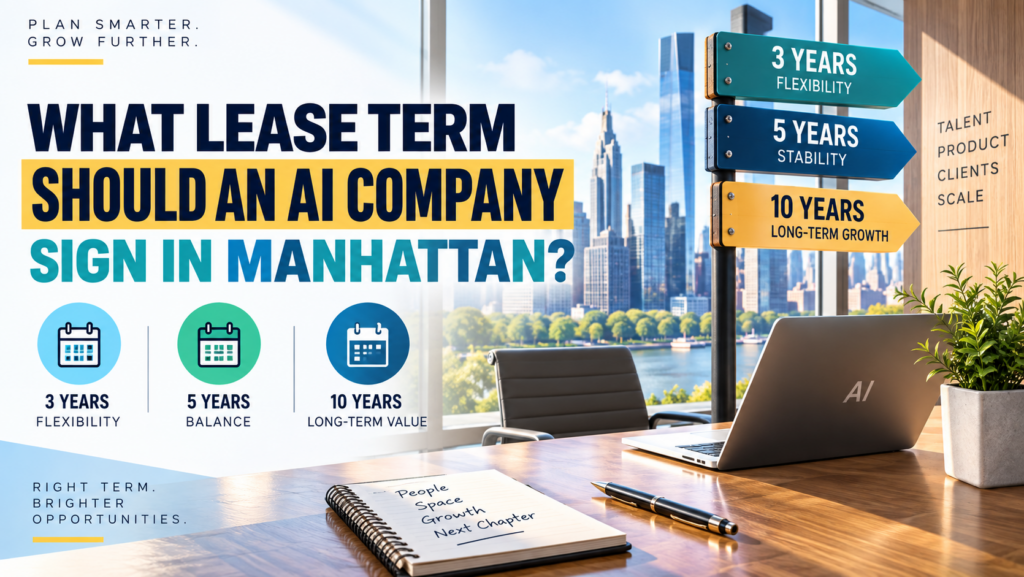
Finally, protect future choices. If you project growth, lease a layout that can absorb it. If demand is less certain, avoid paying for unused area today. In both cases, we recommend building a search around “usable next-step flexibility,” not maximum square footage. The right office should support your next eighteen to thirty-six months without trapping your business. Our Commercial Leasing Guide (NYC) can help frame that comparison.
Tenant representation matters more in 2026
Small businesses are still moving. They are still forming. They are still hiring and signing leases. Even so, the 2026 tenant does not win by moving fastest alone. The tenant wins by making fewer mistakes. That means comparing neighborhoods, layouts, term structures, and real occupancy cost before emotion takes over.
We represent tenants across Manhattan. We can build a short list from live office listings, narrow options by neighborhood, and line up direct leases, sublets, and sale opportunities side by side. We can also help you move from a broad search into specific options like Midtown East, Midtown South, Union Square, Penn Station, or the Financial District without losing sight of budget, move date, and growth needs.
Economic uncertainty in 2026 does not mean small businesses should hide. It means they should lease with intent. If you need a right-sized office, a faster setup, or a lower-risk structure, we can help you find space that supports the business you are building now, not the one you imagined two years ago.
Fill out our 📋online form or give us a call today 📞212-967-2061 — let’s find the right office for your business.