24/7 Office Requirements for AI Engineering Teams in Manhattan
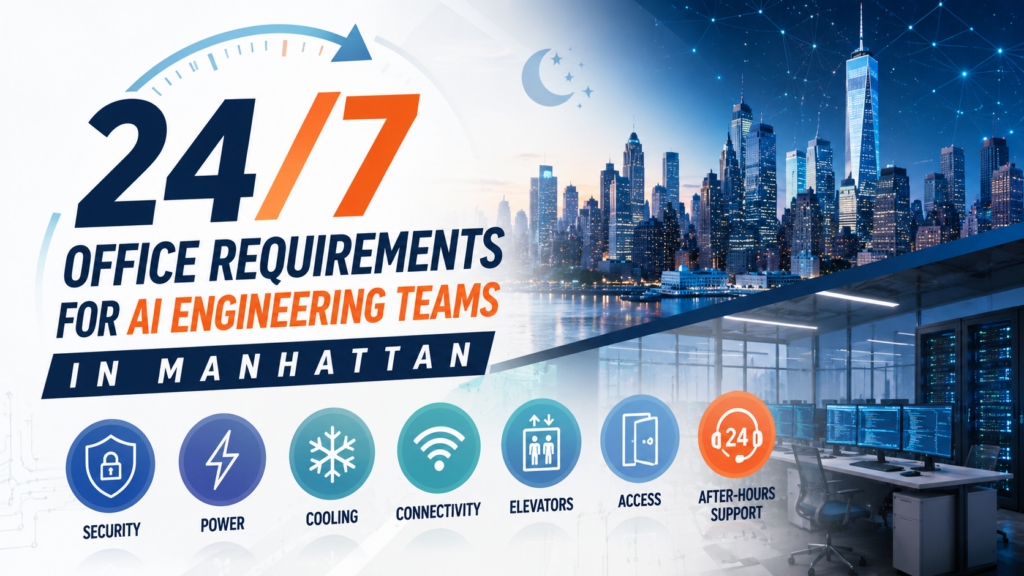
What a true 24/7 Manhattan office must provide
A true 24/7 office gives an AI engineering team much more than a keycard that works after midnight.
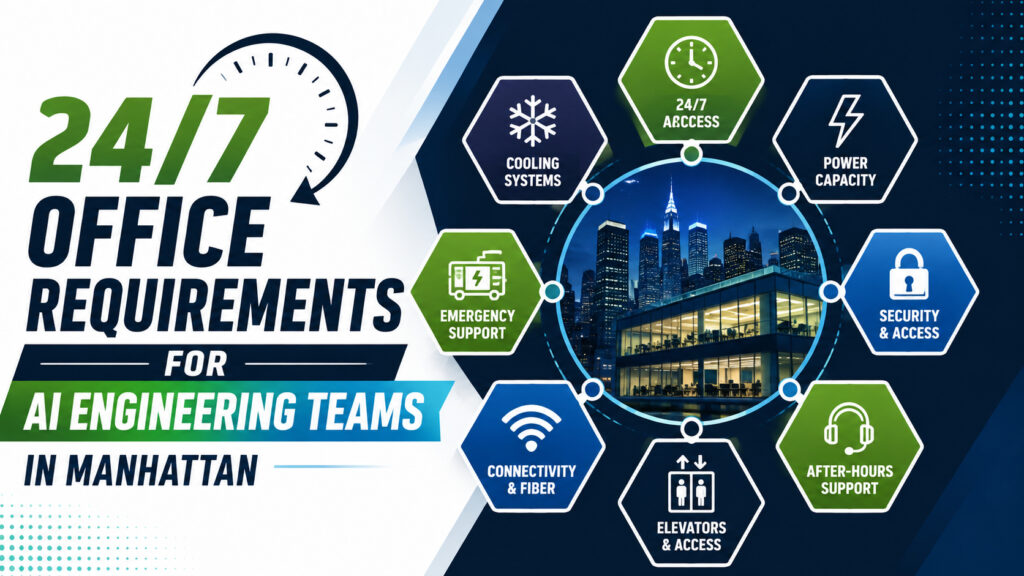
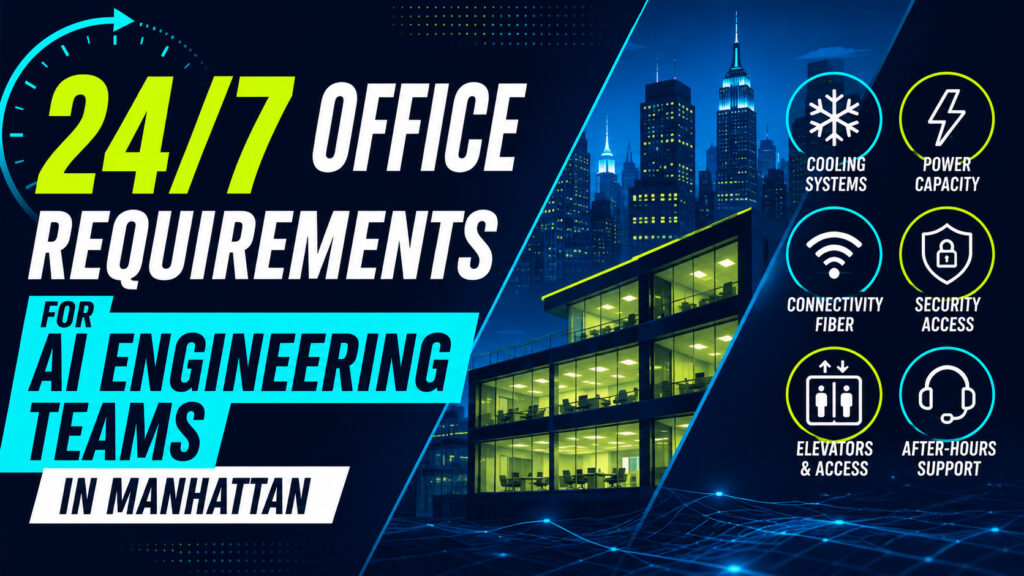
Employees need dependable entry, elevators, cooling, power, connectivity, security, and emergency support. Visitors may also need controlled access during unusual hours. Engineering teams should confirm these services before treating any Manhattan building as suitable for continuous operations.
That distinction matters because 24/7 access and 24/7 building service are not the same thing. A building can permit overnight entry while limiting HVAC, freight service, visitor processing, or engineering support.
Cloud-first teams create another important distinction. They may need modest local power despite running large computing workloads elsewhere. Conversely, teams operating local workstations or hardware labs may create substantial electrical and cooling requirements.
The tenant rule: Never ask only, “Does the building have 24/7 access?” Ask, “Exactly what operates at 2:00 a.m.?”
The best office should support the people, equipment, and workflows that remain active after conventional business hours.
| Requirement | What “24/7” should mean to the tenant | What needs verification |
|---|---|---|
| Building entry | Authorized employees can enter continuously | Keycard rules, weekend access, holidays, temporary credentials |
| Passenger elevators | Employees can reach the leased floor | Elevator schedule, destination controls, maintenance shutdowns |
| HVAC | Occupied areas remain usable overnight | Base hours, overtime charges, zones, tenant controls |
| Technical cooling | Hardware rooms receive cooling continuously | Dedicated units, condenser water, electrical supply, maintenance |
| Electrical power | Required circuits remain available continuously | Capacity, panels, submeters, emergency arrangements |
| Internet service | Production connectivity continues around the clock | Carrier paths, redundancy, equipment-room access |
| Security | Staff can enter and leave safely | Lobby staffing, cameras, turnstiles, incident procedures |
| Visitor access | Approved guests can enter after hours | Registration, escorts, remote authorization |
| Freight service | Equipment can enter when required | Freight hours, reservations, engineer charges |
| Engineering support | Building problems receive a response | On-call contacts, response procedures, emergency charges |
| Cleaning | Operations can continue without unnecessary disruption | Cleaning schedule, restricted rooms, weekend service |
| Loading and deliveries | Critical shipments can reach the tenant | Dock hours, package rules, messenger procedures |
This operational definition matters more than a building-class label.
A prestigious lobby cannot cool an equipment room. Loft character cannot guarantee redundant connectivity. Likewise, a newer tower cannot automatically satisfy every unusual engineering requirement.
Start with the operating model. Then compare buildings.
An AI company should document when employees arrive, how many remain overnight, and which systems must run continuously. That requirements sheet should follow the team into every property tour.
The office does not need to become a data center
The phrase “AI engineering office” often creates the wrong mental picture.
Many teams conduct compute-intensive training through remote infrastructure. Their Manhattan office may contain laptops, monitors, networking equipment, and several high-performance workstations.
Those teams can often use conventional office infrastructure.
Other organizations perform hardware testing, edge-computing development, robotics work, or workstation-intensive research. Their requirements may differ dramatically.
Therefore, tenants should define where the computing actually happens before demanding unusual building specifications.
A cloud-first team should not overpay for unnecessary infrastructure. Meanwhile, a hardware-heavy team should not assume conventional office specifications will work.
That distinction keeps the office search focused.
Why after-hours operations matter more for some AI teams
Continuous access can support international engineering groups, deployment schedules, incident response, research deadlines, and late product releases.
Overnight occupation may remain occasional rather than routine.
That difference matters.
A team needing midnight access twice monthly has different priorities from one staffing engineers throughout the night. Similarly, unattended hardware has different needs from occupied work areas.
The requirements should identify three separate operating periods:
Normal hours cover the ordinary workday.
Extended hours cover evenings and weekends.
Critical hours cover overnight periods when specific people or systems cannot tolerate interruption.
This approach prevents tenants from using “24/7” as a vague requirement.
Instead, it turns continuous operation into measurable building criteria.
Primary action: Compare buildings with reliable after-hours service before comparing cosmetic finishes.
After-hours building services that determine real usability
An employee reaching the lobby at 1:30 a.m. should not discover that “24/7 access” meant only an unlocked card reader.
True usability depends on the entire path from sidewalk to workstation.
That path includes the front door, turnstiles, elevators, tenant doors, climate systems, restrooms, lighting, and emergency support.
Lobby access comes first.
Ask who staffs the entrance overnight. Then determine how the building handles employees, visitors, food deliveries, messengers, and contractors.
Some offices use attended lobbies throughout the night. Others rely more heavily on keycards, cameras, intercoms, or remote monitoring.
Neither model automatically fails.
However, the system must match the tenant’s risk profile.
Teams handling sensitive products may prefer stronger visitor controls. Companies hosting overseas colleagues could need easier late-night guest processing.
Passenger elevators need their own answer
Round-the-clock front-door entry becomes meaningless when employees cannot reach their floor.
Confirm passenger elevator operation during nights, weekends, and holidays.
Next, ask what happens during scheduled maintenance.
Buildings with multiple elevators may maintain useful redundancy. Smaller properties may have fewer alternatives during repairs.
Tenants should also understand after-hours destination controls.
A keycard might automatically release only the tenant’s floor. Alternatively, staff may need another credential or lobby authorization.
Never leave this question until move-in.
HVAC creates the biggest misunderstanding
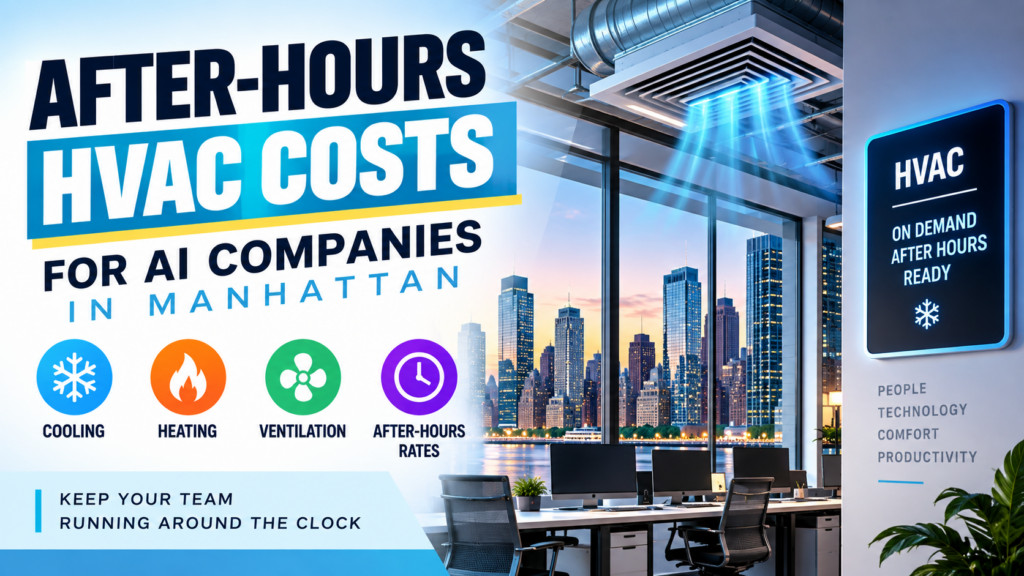
Conventional office leases often define specific base-building HVAC hours. Tenants can face separate arrangements outside those periods.
That matters because late access does not guarantee late cooling.
An engineer working at midnight still generates heat. Monitors and workstations add more. Enclosed rooms can become uncomfortable much faster than open floors.
Therefore, ask exactly when ordinary HVAC stops.
Then request the current overtime HVAC schedule.
Important questions include the hourly charge, billing minimum, required notice, and affected zone. Tenants should also ask whether charges escalate during the lease.
Zoning matters almost as much as pricing.
Suppose six engineers work inside one portion of a 20,000-square-foot floor. Paying to cool the entire floor may create unnecessary expense.
A smaller HVAC zone could produce much better economics.
Tenant-controlled units can offer even greater flexibility.
Current Manhattan inventory demonstrates that these configurations exist. For example, one 5,000-square-foot Chelsea full-floor office currently describes tenant-controlled ductless HVAC available continuously.
The feature still requires technical review.
A listing description does not replace engineering diligence.
“Tenant-controlled HVAC” needs a definition
That phrase can describe several very different systems.
One tenant might control a thermostat during building operating hours. Another could control a dedicated unit whenever necessary.
A third arrangement may use supplemental cooling only inside an equipment room.
Therefore, ask what the control actually controls.
Confirm whether the system serves the whole premises, one zone, or one room. Next, identify who pays its electricity.
Maintenance responsibility also matters.
The lease should explain whether the landlord or tenant repairs the equipment. An overnight team should understand what happens when that equipment fails.
Building engineers matter after the management office closes
Continuous operations create unusual maintenance questions.
Who responds when water appears near the premises at 11:45 p.m.?
Who investigates an HVAC failure?
What happens when an electrical breaker trips outside normal hours?
The tenant should receive a written emergency contact procedure before occupancy.
That procedure should identify building security, management, engineering, and emergency escalation channels.
Response availability does not necessarily mean free service.
A lease or building rulebook may impose callout charges. Therefore, tenants should request current schedules during financial review.
Freight elevators can become an engineering bottleneck
AI teams sometimes receive hardware, laboratory equipment, server cabinets, batteries, monitors, or specialized furniture.
Passenger elevators may not accommodate those deliveries.
Accordingly, confirm freight access before signing.
Ask about evening and weekend freight availability. Then investigate reservation requirements, insurance certificates, dock rules, and engineer charges.
A building can offer perfect employee access while imposing narrow equipment-delivery windows.
That mismatch causes avoidable problems.
Visitor access requires separate planning
Late engineering work often involves contractors, candidates, investors, customers, or colleagues from other offices.
Those people may not hold permanent credentials.
Ask how an employee admits a guest after the lobby switches procedures.
Can an authorized tenant submit the visitor remotely?
Does security require advance notice?
Must an employee meet the guest downstairs?
Can the building issue temporary credentials?
These questions carry particular importance for companies that work across global time zones.
Food, packages, and messenger access also matter
Late teams eventually need deliveries.
However, some buildings restrict delivery personnel after certain hours. Security may require employees to collect food from the lobby.
That policy can work perfectly well.
The issue involves predictability rather than luxury.
Similarly, teams should understand overnight package procedures. Critical technical equipment may require signature, secure storage, or freight coordination.
Cleaning can disrupt sensitive work
Standard cleaners often enter offices during evening hours.
For many companies, that arrangement creates no problem.
A team handling confidential work may prefer restricted access to certain rooms. Hardware areas can also require special instructions.
Therefore, establish which areas cleaners may enter.
Restricted rooms should use clear access controls.
Likewise, cleaning schedules should respect overnight employees. Vacuuming beside an engineering sprint at midnight defeats part of the office’s purpose.
Restrooms and common areas need continuous access
Confirm that restrooms remain available after normal operating hours.
The same question applies to common lounges, terraces, bike rooms, showers, conference centers, and pantry amenities.
Some amenities may close even when the office remains accessible.
That limitation rarely disqualifies a building.
Still, tenants should know the difference before marketing “24/7 operations” internally.
Power, cooling, connectivity, and hardware planning for AI engineering
The most expensive infrastructure mistake begins with an undefined technical requirement.
“AI-ready” means almost nothing without an equipment schedule.
Instead, engineering leadership should identify expected hardware, power draw, network requirements, cooling demand, and growth.
Start with the simplest question:
Will significant computing equipment operate inside the Manhattan office?
A cloud-first software team may answer no.
A research or hardware organization may answer yes.
That single answer changes the search.
Cloud-first engineering teams usually need reliability before raw capacity
Large remote computing workloads do not automatically create a massive office electrical load.
Engineers may use ordinary laptops or modest workstations while accessing remote resources.
Those tenants should prioritize dependable internet, comfortable extended-hours HVAC, security, and network redundancy.
The office can remain technically sophisticated without becoming infrastructure-heavy.
Therefore, spend money where downtime actually occurs.
Redundant connectivity may matter more than extra electrical capacity.
High-performance workstations change the calculation
Workstations concentrate both electrical demand and heat.
Tenants should provide an equipment schedule to an electrical or mechanical professional when loads become meaningful.
The schedule should include workstation quantity, approximate wattage, monitors, networking gear, and expected simultaneous use.
Do not size electrical requirements solely from headcount.
Two 25-person engineering groups can create completely different loads.
One might use lightweight laptops.
The other could operate powerful local machines throughout the day.
Local racks require another level of diligence
Rack-mounted hardware moves the requirement closer to a technical-room problem.
The tenant should investigate electrical distribution, cooling, floor conditions, noise, ventilation, and permitted installation methods.
Building ownership must also permit the proposed work.
Most construction and many office alterations in New York City require appropriate approvals or permits. Licensed design professionals often handle plans for qualifying work.
Therefore, never assume a spare conference room can become a server room.
The space needs technical review first.
Cooling math explains why hardware rooms become difficult
Electrical equipment ultimately releases heat into the surrounding environment.
A useful planning conversion puts one kilowatt near 3,412 BTU per hour.
That makes the scale easier to understand.
A 10 kW equipment load produces roughly 34,120 BTU per hour.
Divide that figure by 12,000.
The theoretical equipment load alone equals about 2.84 tons of cooling.
A 30 kW load approaches 102,360 BTU per hour, or roughly 8.53 tons.
Those figures exclude many real-world design considerations.
People, lighting, room conditions, redundancy, equipment diversity, and system performance also matter.
The calculation still illustrates the central issue.
A small room can create a large cooling requirement.
Continuous hardware requires continuous cooling
Base-building office HVAC may stop during periods when hardware continues running.
That mismatch creates risk.
A dedicated supplemental unit can solve the problem in some buildings.
However, tenants should identify where that unit rejects heat.
Possible designs can require electrical service, drainage, condenser water, outdoor equipment, or other building accommodations.
A mechanical engineer should review the final design.
The lease must also permit the installation.
Rights matter as much as physical feasibility.
Verify electrical capacity instead of counting outlets
A wall full of receptacles does not prove available capacity.
Tenants should ask about the suite’s electrical service and panel capacity.
Then identify spare capacity and existing loads.
Submetering also deserves attention.
One current 5,594-square-foot Flatiron office advertises tenant-controlled air conditioning, submetered electricity, and 24/7 access.
Those features illustrate the right questions.
They do not eliminate technical verification.
Ask where additional electrical capacity would come from
Hardware-heavy teams may need more than the existing suite supplies.
A feasibility study should identify the pathway for any increase.
Can the tenant add circuits from existing panels?
Would an upgrade require building distribution work?
Does sufficient upstream capacity exist?
Who pays?
How long could the work take?
These answers can change a seemingly attractive lease into an impractical project.
Backup power needs a precise purpose
“Does the building have a generator?” remains an incomplete question.
Ask what the generator serves.
Many systems prioritize life safety and essential building functions.
That does not automatically mean tenant workstations or computing equipment receive backup power.
Therefore, identify the exact requirement.
A team that needs orderly equipment shutdown has different needs from a team demanding uninterrupted production.
UPS equipment may handle short interruptions.
Longer continuity creates a more complicated design question.
Network redundancy should include physical path diversity
Two internet contracts do not necessarily create true redundancy.
Both services could eventually share infrastructure.
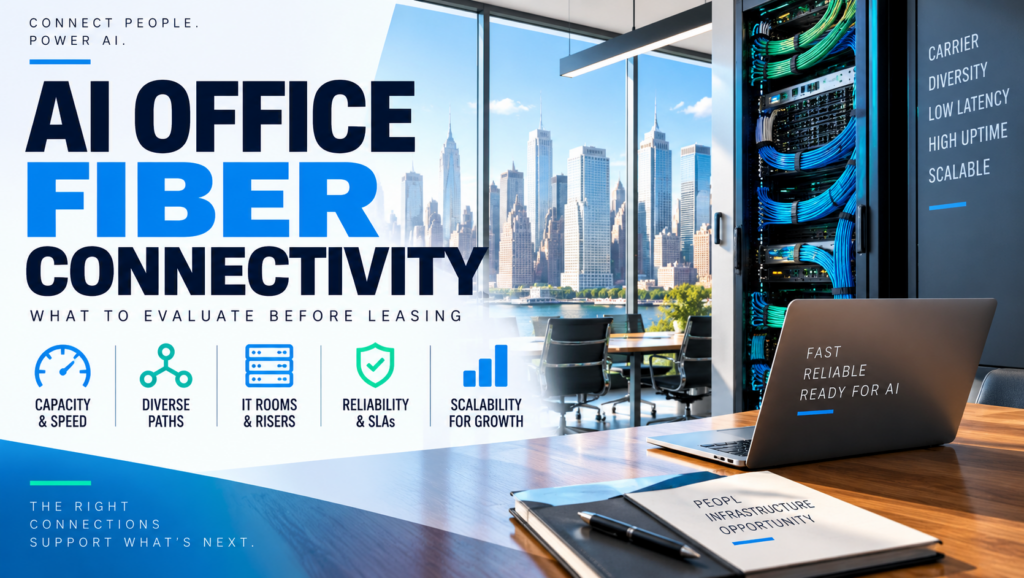
Accordingly, technical teams should investigate carriers, points of entry, risers, equipment rooms, and installation paths.
The practical goal involves eliminating obvious single points of failure.
Ask where the fiber enters the property.
Next, determine how service reaches the tenant floor.
Then ask whether a second provider can follow a meaningfully different path.
Do this before lease execution whenever connectivity carries operational importance.
Carrier availability is only the beginning
A carrier might serve the building without having active service inside the exact suite.
Installation can require surveys, riser access, landlord approvals, and building coordination.
Consequently, “fiber in the building” does not equal “internet ready tomorrow.”
A fast occupancy plan should verify provisioning time early.
Our guide to leasing Manhattan space quickly explains why connectivity belongs on the critical path.
Sensitive engineering work also changes the layout
Security should cover more than digital systems.
Teams may need controlled hardware rooms, restricted project spaces, private calls, and acoustically separated meeting areas.
A confidential model review inside an open bullpen creates obvious privacy problems.
Likewise, glass conference rooms can create visual exposure.
Therefore, map sensitive workflows before accepting an attractive existing layout.
Our secure-office guide for data-sensitive AI teams covers that decision in greater depth.
Noise deserves more attention
High-performance equipment can create fan noise.
Dense engineering areas also generate conversation and meeting noise.
Acoustics affect both concentration and privacy.
A good 24-hour layout should separate loud collaborative areas from focus zones.
Technical rooms need even stronger separation when equipment operates continuously.
Late-night staffing makes this more important.
A noisy room causes greater disruption when only several people occupy the floor.
Lease, operating-cost, and compliance questions to settle before signing
A tenant can choose the correct building and still negotiate the wrong lease.
Operational requirements need written protection.
Otherwise, an attractive promise during a tour may disappear inside building rules or operating-cost language.
Start these discussions before the lease draft.
The letter of intent should flag unusual requirements whenever they materially affect the deal.
Examples include continuous access, extended HVAC, supplemental cooling, extra electrical capacity, dedicated telecom rights, and unusual equipment.
Leaving those matters until final lease negotiations reduces leverage.
Put after-hours access into the business discussion
The tenant should confirm continuous employee access as an operating requirement.
Do not rely exclusively on a brochure.
Likewise, clarify whether future building-rule changes could materially restrict that access.
Commercial leases require legal review.
Therefore, experienced counsel should translate the business requirement into appropriate lease language.
The broker’s job involves identifying the requirement and negotiating the economic framework.
Obtain the overtime HVAC schedule early
Ask for current charges before comparing final buildings.
The schedule should explain billing periods, zones, minimums, advance-notice rules, and weekend procedures.
Then model realistic usage.
Consider a simple example.
A team expects four extra HVAC hours each weekday.
That equals roughly 20 overtime hours weekly.
At 50 working weeks, the office could consume around 1,000 overtime HVAC hours annually.
The actual expense then depends on the building’s rate and zoning.
That amount can materially change effective occupancy cost.
Therefore, compare total operating cost, not rent alone.
Calculate the cost per usable after-hours hour
Suppose one building offers a lower rent but expensive overtime cooling.
Another asks more rent but provides tenant-controlled HVAC.
The second option may cost less for a late-working team.
The reverse can also occur.
A team that rarely works late may save money with conventional building hours.
That is why 24/7 capability should not become an automatic premium requirement.
Buy the operating flexibility you will actually use.
Review electricity separately
Determine how the tenant pays for electricity.
Possible arrangements can include direct metering, submetering, or lease-based electricity charges.
Hardware-heavy teams should model future load as well as current consumption.
A low initial electrical bill can rise substantially after local equipment expands.
Therefore, growth assumptions belong inside occupancy budgeting.
Include supplemental cooling economics
The equipment itself represents only one cost.
Installation can require engineering, electrical work, piping, controls, construction, and approvals.
Ongoing expenses may include electricity, service contracts, and repairs.
Restoration obligations also deserve attention.
A landlord might require equipment removal when the lease expires.
Negotiating those obligations before installation creates much better certainty.
Clarify condenser-water or building-system rights
Some supplemental cooling designs depend on shared building infrastructure.
If a proposed system requires that resource, establish availability before commitment.
The tenant should identify capacity, rates, hours, and maintenance responsibilities.
Likewise, any recurring charge needs financial modeling.
A mechanical engineer can determine whether the proposed system actually requires such access.
Investigate roof, shaft, and pathway rights
Technical installations sometimes need pathways beyond the tenant premises.
Those requirements can involve risers, shafts, roof areas, or other common building spaces.
The lease must permit any necessary access.
Ownership may also impose approved-contractor requirements.
Therefore, the technical team should identify pathways before lawyers finish documents.
Understand building work rules
New York City office alterations can trigger plans, permits, inspections, and licensed-professional involvement.
The Department of Buildings provides public records showing permits, violations, complaints, occupancy information, and other property history.
Review those records as part of building diligence.
Next, ask the landlord about internal approval procedures.
Building approval and government approval remain separate processes.
A tenant may need both.
Construction timing can destroy a fast occupancy plan
A move-in-ready office can support rapid occupancy.
Custom infrastructure can change that schedule.
Mechanical equipment, electrical upgrades, security work, and telecom installation create dependencies.
Therefore, decide which modifications must exist on day one.
Other improvements may wait.
That sequencing can preserve an aggressive move date.
After-hours construction rules also matter
An operating office may eventually need upgrades.
Building rules can restrict noisy work to evenings or weekends.
That arrangement sounds convenient until overtime labor and engineering charges appear.
Ask about those policies before planning future expansion.
Likewise, investigate required building personnel during construction.
A freight operator, engineer, or security officer may generate additional charges.
Local energy policy belongs in the discussion
New York City applies greenhouse-gas limits to many larger buildings through Local Law 97.
Most buildings exceeding 25,000 gross square feet fall within the law’s coverage, subject to exceptions.
Continuous operations can increase energy consumption.
The city’s framework even recognizes certain 24-hour and energy-intensive operations as special circumstances in specific adjustment provisions.
That does not mean an AI tenant automatically receives any adjustment.
Instead, ask how ownership manages building energy and related operating expenses.
The practical tenant question remains straightforward:
Could my after-hours electricity or cooling usage create additional charges during this lease?
Document the service matrix
Before signing, request a final written summary.
It should cover building access, HVAC, security, elevators, freight, engineering, telecom, electricity, and technical alterations.
This document does not replace the lease.
Rather, it helps the broker, attorney, technical team, and tenant identify unresolved issues.
Anything crucial should then reach the appropriate contractual document.
How Manhattan building types and neighborhoods change the 24/7 decision
No Manhattan neighborhood guarantees a 24/7 AI-ready office.
The requirement lives at the building and suite level.
That principle prevents a common mistake.
Tenants sometimes assume newer towers always offer superior after-hours performance.
Others assume older lofts automatically provide flexible round-the-clock use.
Neither shortcut works reliably.
Compare actual systems.
Midtown South requires building-by-building screening
Flatiron, NoMad, Chelsea, SoHo, Union Square, and nearby districts offer many offices attractive to engineering teams.
However, the building stock varies greatly.
A renovated loft can provide tenant-controlled cooling and continuous access.
Another property nearby might rely heavily on central HVAC schedules.
Therefore, inspect operational specifications before falling in love with architecture.
Current inventory illustrates the variation.
A 2,600-square-foot Midtown South loft currently advertises new tenant-controlled air conditioning and continuous key-fob access.
Meanwhile, a 2,691-square-foot SoHo office advertises tenant HVAC control and an attended 24/7 lobby.
Those examples show why suite-level diligence beats neighborhood assumptions.
Midtown can solve operational requirements differently
Large Midtown buildings often provide substantial professional management and structured access systems.
Yet tenants still need exact answers about after-hours HVAC and individual-suite controls.
Continuous lobby security does not automatically extend HVAC.
Similarly, a sophisticated central plant can still follow defined operating hours.
One Grand Central area office currently lists 24/7 attended security and tenant-controlled HVAC.
That pairing represents the type of operational information teams should identify.
Again, engineering review remains appropriate for unusual technical loads.
Downtown can create a useful operational comparison
Lower Manhattan deserves consideration when a tenant values building services and cost discipline.
Current market data also shows a meaningful pricing gap.
One Q2 2026 survey placed overall Manhattan asking rent at $80.17 per square foot. Downtown averaged $61.34 under the same methodology.
That does not make Downtown automatically cheaper for a 24-hour operation.
Overtime services can change the effective comparison.
A lower base rent with expensive HVAC may lose against a more expensive building with better tenant controls.
One 5,606-square-foot Financial District office currently advertises tenant-controlled HVAC and attended 24/7 lobby security.
Thus, tenants should compare both occupancy economics and operating flexibility.
Building class cannot replace technical diligence
Class A can provide modern systems, professional management, and sophisticated access.
Nevertheless, that designation does not answer every engineering question.
Older renovated buildings can sometimes offer exceptional tenant autonomy.
Conversely, premium towers can impose structured service schedules.
Use building class as context.
Then inspect the actual operating specification.
Floor size changes after-hours economics
A small full-floor tenancy can provide useful control.
Employees may enjoy private elevator access, dedicated HVAC, and fewer shared corridors.
However, full floors do not automatically reduce operating costs.
Large zones can make overtime cooling expensive.
Partial-floor suites create different tradeoffs.
They may share central systems but reduce the area that requires cooling.
Therefore, compare HVAC zones rather than assuming one occupancy format wins.
Single-tenant floors can improve security
Teams handling sensitive work may value stronger control over visitor circulation.
A private floor can reduce unrelated foot traffic.
Dedicated access systems may improve that arrangement further.
Still, a private floor cannot substitute for proper internal controls.
Sensitive rooms may still require separate card readers, locks, or acoustic treatment.
Neighborhood choice should follow people after building requirements
An office that operates continuously should remain practical late at night.
Employee commute patterns deserve attention.
Ask where late-shift employees live.
Next, assess the transportation routes they actually use.
A daytime commute can differ from a late-night commute.
Service frequency changes during evenings and weekends.
Accordingly, employees should test the route when unusual schedules form a major operating requirement.
Do not over-optimize for “the AI neighborhood”
Manhattan’s AI leasing activity has expanded substantially.
Technology companies leased 4.15 million square feet during the first half of 2026. AI companies accounted for 1.50 million square feet across 63 transactions.
Midtown South captured 75.1% of technology leasing in that study.
Those figures explain the intense interest in several Midtown South corridors.
However, they do not prove that every AI team should locate there.
After-hours operations may favor another building.
Customer geography may point elsewhere.
Commutes could override clustering.
Budget may also change the answer.
Our Manhattan neighborhood comparison for AI companies owns that broader location decision.
This page should guide a narrower question:
Which building can support your team reliably after conventional business hours?
A tenant-side due diligence process for comparing buildings
The fastest way to compare 24/7 offices is not touring more space.
Instead, eliminate buildings that cannot satisfy essential operations.
That process starts before the first tour.
Build an operating profile before reviewing inventory
Engineering leadership should separate required features from preferred features.
A useful profile answers several questions.
How many people might work after 6:00 p.m.?
How many remain after midnight?
Will anyone work weekends?
Does equipment run unattended?
What local hardware will operate continuously?
How much downtime can the business tolerate?
Which visitors arrive outside conventional hours?
What deliveries require freight access?
Once those answers exist, building comparisons become much clearer.
Categorize every requirement
Use three categories.
Critical requirements can disqualify a building.
Important requirements affect ranking but remain negotiable.
Optional features improve the workplace without controlling the decision.
For example, continuous employee access may rank as critical.
A staffed overnight lobby could rank important.
A 24-hour tenant lounge might remain optional.
This hierarchy prevents amenities from overshadowing operations.
Send technical questions before the tour
Property representatives can often answer basic questions beforehand.
Ask about building access, lobby coverage, HVAC hours, overtime HVAC, tenant controls, fiber, and electrical capacity.
Do not wait until the conference room impresses everyone.
An unsuitable building should leave the shortlist early.
That saves negotiating time later.
Tour during the hours you intend to use the building
A noon tour shows only part of the property.
Return after conventional business hours when continuous access matters greatly.
Test the entrance procedure.
Use the elevator.
Observe lobby staffing.
Check common lighting.
Listen for noise.
Walk from nearby transportation.
This simple exercise often reveals more than another daytime tour.
Bring technical staff into finalists
A tenant broker can screen operational questions.
However, specialized loads deserve specialized review.
Bring appropriate IT, electrical, mechanical, security, or design professionals into finalist properties.
Their involvement should happen before lease execution.
A beautiful office becomes irrelevant when the infrastructure upgrade costs more than the space saves.
Ask for documentation
Verbal answers help during early screening.
Final diligence requires stronger information.
Request applicable building rules, HVAC schedules, overtime rates, telecom information, and technical specifications.
Ask for electrical documentation where necessary.
Likewise, obtain information about supplemental cooling rights.
The exact document set will depend on the requirement.
Compare buildings through a service matrix
A simple matrix forces apples-to-apples analysis.
| Building question | Candidate A | Candidate B | Candidate C |
|---|---|---|---|
| Employee access 24/7 | |||
| Lobby staffing overnight | |||
| Passenger elevators 24/7 | |||
| Standard HVAC hours | |||
| Overtime HVAC rate | |||
| Minimum HVAC billing period | |||
| Tenant-controlled cooling | |||
| Supplemental cooling permitted | |||
| Electrical capacity verified | |||
| Electricity billing method | |||
| Multiple connectivity options | |||
| Diverse service path possible | |||
| Freight access after hours | |||
| After-hours engineer available | |||
| Guest access after hours | |||
| Hardware-room feasibility | |||
| Security modifications permitted | |||
| Immediate occupancy | |||
| Expansion pathway | |||
| Total after-hours operating cost |
This format also exposes false equivalence.
Two buildings might both receive a “yes” for 24/7 access.
However, one could require expensive overtime HVAC.
The other may offer tenant-controlled cooling.
The matrix turns that difference into a decision factor.
Price the actual operating year
Do not compare only annual base rent.
Build an operating model around expected use.
Include rent, electricity, overtime HVAC, supplemental cooling, technical maintenance, and recurring building charges.
Then account for one-time costs.
Those can include cabling, access controls, UPS equipment, cooling installation, and electrical work.
Our 2026 Manhattan AI office cost guide covers the broader rent calculation.
Here, focus specifically on the 24-hour premium.
Tightening inventory makes early screening more important
Manhattan availability fell to 14.4% during Q2 2026 under one major market survey.
That same report placed average asking rent at $80.17 per square foot.
Another Q2 survey recorded Midtown South asking rent at $81.14 overall.
Its Class A average reached $104.50 per square foot.
Different firms use different methodologies.
Therefore, those numbers should provide market context rather than quote any individual office.
Their more important message concerns decision speed.
Suitable inventory deserves technical screening before a tenant spends days negotiating economics.
Score service reliability separately from aesthetics
Create one score for operations.
Then create another for workplace quality.
Do not combine them immediately.
A gorgeous office may score ten for design and four for after-hours reliability.
Another may look less dramatic but score ten operationally.
That distinction keeps engineering needs visible during an emotional leasing process.
Stress-test the finalist
Before commitment, imagine several realistic failures.
The main internet service fails at 10:00 p.m.
The dedicated cooling unit stops Saturday afternoon.
A contractor needs urgent weekend access.
Thirty new workstations arrive unexpectedly.
The elevator undergoes maintenance overnight.
A visiting engineer arrives without a permanent badge.
Now ask how each building responds.
The exercise converts abstract amenities into operating consequences.
Review future growth before accepting today’s solution
A ten-person company might run almost entirely through cloud infrastructure.
Six months later, the team could add hardware testing.
Another organization could double engineering headcount without changing local compute.
Therefore, define plausible growth cases.
Then determine whether the building can accommodate them.
Expansion does not always require more square footage.
Sometimes it requires more power, cooling, network capacity, or access credentials.
That is why technical scalability deserves its own review.
Frequently asked questions about 24/7 AI engineering offices in Manhattan
What does 24/7 office access mean in Manhattan?
It usually means authorized employees can enter outside standard business hours.
However, tenants should verify each supporting service separately.
HVAC, freight elevators, lobby staffing, visitor access, cleaning, and engineering support may follow different schedules.
Therefore, treat “24/7 access” as the first question, not the final answer.
Does 24/7 access include air conditioning?
Not necessarily.
A tenant may have uninterrupted physical access while central HVAC follows defined operating hours.
Ask when base service stops.
Then review overtime charges and tenant-controlled options.
Hardware requiring continuous cooling needs an independent technical solution when base HVAC cannot provide it.
Do AI engineering teams need 24/7 HVAC?
Not every team does.
A cloud-first company with occasional late work may only need affordable overtime comfort cooling.
A continuously staffed team may benefit from tenant-controlled HVAC.
Local hardware can create a stronger requirement.
Match the system to actual usage.
Does every AI company need extra electrical capacity?
No.
Large remote compute workloads do not automatically increase Manhattan office power requirements.
Cloud-first teams may operate with conventional office loads.
Local GPU workstations, testing hardware, or racks can change the requirement considerably.
An equipment schedule should guide the decision.
How much cooling does local computing equipment require?
The answer depends on actual electrical load and system design.
As a rough heat conversion, 10 kW represents about 34,120 BTU per hour.
That equals roughly 2.84 tons before other design factors.
A mechanical professional should determine the actual required system.
Can an ordinary office conference room become a server room?
Do not assume so.
The room may lack sufficient cooling, electrical capacity, ventilation, drainage, fire protection, or permitted installation pathways.
The building must also approve proposed alterations.
Technical and design professionals should inspect the condition first.
Should AI teams put model-training servers inside their Manhattan office?
Only when the operating model genuinely requires them.
Many teams use external computing infrastructure.
In that case, office reliability may depend more heavily on connectivity and employee systems.
Avoid recreating expensive infrastructure without a clear business requirement.
What internet questions should an AI engineering team ask?
Start with available carriers.
Then ask about service entry points, risers, installation time, and path diversity.
Determine whether the suite already has active service.
Finally, identify where network equipment can operate securely and continuously.
Does having two internet providers guarantee redundancy?
No.
The providers could share portions of the same physical infrastructure.
Teams requiring high resilience should investigate path diversity.
That includes building entry points and internal routes.
An IT professional can evaluate the proposed design.
Should a Manhattan AI office have backup power?
That depends on the continuity requirement.
First, determine what must survive an outage.
Then distinguish building emergency systems from tenant equipment.
A generator inside the building does not automatically power ordinary tenant outlets.
UPS equipment may handle shorter interruptions for appropriate systems.
What should teams ask about after-hours security?
Ask who controls entry after normal hours.
Next, review lobby staffing, cameras, keycards, visitor registration, and tenant-floor access.
Also ask how the building handles lost credentials.
Sensitive teams should investigate private-floor and internal-room controls.
Do visitors receive 24/7 access too?
Usually, visitors follow separate procedures.
A guest may need preregistration, tenant confirmation, identification, or an escort.
Therefore, companies hosting international colleagues should test the process.
Do not assume employee access rules apply to everyone.
Can food deliveries reach the office overnight?
Building procedures vary.
Some properties allow delivery personnel upstairs.
Others require employees to meet them in the lobby.
Clarify the rule when late staffing occurs regularly.
A predictable restriction rarely creates a serious problem.
Can hardware deliveries happen at night?
Possibly, but freight procedures control the answer.
Ask about dock hours, freight elevators, reservations, insurance certificates, and required building personnel.
Large equipment may also require dimensional or weight review.
Plan hardware moves separately from employee access.
Does a staffed lobby guarantee engineering support overnight?
No.
Security and building engineering serve different functions.
Ask whether engineering staff remain onsite.
If not, identify the on-call process.
Then review response expectations and applicable charges.
What happens if after-hours HVAC fails?
The answer should come from the building’s operating procedures.
Identify the emergency contact.
Then establish who can access and repair the equipment.
Tenant-owned supplemental systems also need service planning.
Critical hardware should have monitoring appropriate to its risk.
Is tenant-controlled HVAC always better?
Not automatically.
Continuous control can provide flexibility.
However, tenants may pay electricity, maintenance, and repair expenses.
A team with minimal evening usage could spend less through occasional overtime HVAC.
Compare the annual economics.
What does “24/7 tenant-controlled HVAC” mean?
Ask for a system-level explanation.
The phrase might describe one room, several zones, or an entire premises.
Determine which equipment operates independently from base-building hours.
Next, establish who maintains it.
Finally, identify how electricity gets billed.
Do Class A Manhattan buildings offer better 24/7 access?
Some provide sophisticated security and professional operations.
Yet building class alone cannot establish technical suitability.
A renovated loft may provide excellent after-hours control.
Another premium property may rely on scheduled central systems.
Review each building individually.
Are loft offices good for 24/7 AI engineering teams?
They can work extremely well.
Certain lofts provide dedicated units, secure access, open engineering layouts, and excellent connectivity.
Others may present electrical, mechanical, elevator, or access limitations.
Older construction increases the importance of technical review.
Is Midtown South automatically the best location?
No.
Midtown South has attracted substantial technology demand, including AI tenants.
Still, the best 24-hour location depends on the actual building.
Commutes, clients, budget, access, cooling, and technical infrastructure can favor another submarket.
Is Downtown suitable for late engineering teams?
It can be.
Many buildings offer professional security and strong infrastructure.
Current market pricing also creates a useful comparison against Midtown.
However, individual operating arrangements still determine suitability.
Should office selection start with neighborhood or infrastructure?
Start with business requirements.
Then identify acceptable neighborhoods.
Within those locations, screen buildings for critical infrastructure before comparing aesthetics.
That sequence reduces wasted tours.
It also prevents teams from forcing their requirements into an unsuitable favorite building.
How early should IT staff join the office search?
Bring them in before selecting the final building.
Basic requirements should enter the search even earlier.
IT staff can then examine connectivity, technical rooms, security, and deployment timing.
Hardware-intensive teams may also need electrical and mechanical professionals.
When should an engineer inspect a prospective office?
Bring one into the process when unusual electrical, mechanical, structural, or technical requirements could affect feasibility.
Do not wait until construction begins.
An early review can identify expensive problems while the tenant still has alternatives.
How should teams compare overtime HVAC charges?
Model expected annual usage.
Do not compare only the hourly rate.
Include billing minimums, zones, escalation, weekend schedules, and required notice.
A lower rate can still cost more when the building forces large zones.
Should overtime HVAC terms appear in the lease?
Material operating requirements deserve appropriate contractual attention.
The broker should negotiate the business issue.
Commercial lease counsel should determine suitable language.
Do not rely solely on oral assurances when continuous operations matter.
What building records should a tenant review?
New York City provides public building information concerning permits, applications, occupancy, complaints, and violations.
Technical professionals may review additional records depending on proposed work.
The scope should reflect the lease and construction plan.
Can AI tenants install supplemental cooling anywhere?
No.
Feasibility depends on the property, equipment, pathways, electrical supply, and building approvals.
Some projects may also require regulatory filings or permits.
Therefore, negotiate the right before depending on the installation.
Does Local Law 97 affect a 24/7 office tenant?
The law directly regulates covered buildings rather than creating a simple “AI tenant rule.”
Most buildings above 25,000 gross square feet fall within its coverage, subject to exceptions.
Tenants should still understand energy-related operating charges and building policies.
That matters more as operating hours expand.
Should engineering teams avoid buildings with overtime HVAC?
No.
Overtime HVAC can work economically for occasional late usage.
The problem arises when tenants assume continuous service comes free.
Model the intended schedule.
Then compare that expense against tenant-controlled alternatives.
Does 24/7 access require employees to work overnight?
No.
Continuous access creates optionality.
Teams may use it only during releases, emergencies, deadlines, or international collaboration.
That flexibility can still hold substantial value.
However, tenants should avoid paying heavily for a feature they rarely use.
What is the most important question during a 24/7 office tour?
Ask what actually operates after midnight.
Then request details for HVAC, elevators, security, freight, visitor access, engineering support, and technical systems.
A simple “yes” about continuous access does not answer those questions.
What should a 24/7 AI engineering office prioritize first?
Reliability comes first.
Employee access should work whenever authorized staff need the premises.
Cooling must match people and equipment.
Connectivity should meet the team’s actual resilience standard.
Power must support real hardware loads.
Security should match the sensitivity of the work.
Finally, the lease should preserve those requirements economically.
What should a team do before making an offer?
Create the operating requirements sheet.
Screen the building against it.
Price expected after-hours costs.
Then bring technical professionals into any unresolved infrastructure question.
Only after that work should rent and aesthetics decide between otherwise suitable options.
The practical standard for a 24/7 Manhattan AI office
The right office does not need every premium technology.
Instead, it needs the correct systems for that engineering team.
A cloud-first startup may require secure continuous entry, redundant connectivity, and occasional evening HVAC.
A larger engineering organization might need staffed overnight security and tenant-controlled climate zones.
Hardware-intensive research could require dedicated cooling, additional circuits, controlled equipment rooms, and stronger technical support.
Those businesses should not use the same checklist weights.
The requirement belongs to the operation, not the industry label.
That principle also protects capital.
Teams should never buy data-center capabilities for ordinary office work.
Conversely, they should never place high-density hardware into conventional rooms without engineering review.
Our AI-optimized Manhattan office guide covers broader infrastructure and location screening.
The AI company tenancy guide addresses the wider Manhattan office decision.
This page owns the narrower operating question:
Can your team depend on the building when conventional office hours end?
For an AI engineering team that genuinely operates around the clock, that answer deserves more weight than the lobby, view, furniture, or neighborhood reputation.
The strongest candidate should deliver reliable access without hidden operational friction.
Its HVAC structure should match expected hours.
Electrical capacity should match real equipment.
Connectivity should match the required uptime.
Security should match the information and hardware inside.
Finally, after-hours operating costs should remain understandable before the lease begins.
Compare buildings with reliable after-hours service before committing to a Manhattan office.
Ready to Review Market Options
We represent office tenants, not landlords, throughout Manhattan. We compare buildings around your operating schedule before rent negotiations shape the decision. Our priority is simple: secure reliable after-hours service without paying for infrastructure your team does not need.
Fill out our 📋 online form or give us a call today 📞 212-967-2061 — let’s find the right options for your business.