Manhattan Office Lease Requirements: What Landlords Need to Know About Your Business
Signing a long-term office lease in Manhattan involves more than agreeing on the rent, choosing a location, and determining how much space your company needs. Before approving a lease, a commercial landlord will generally want to understand your company’s background, financial condition, operating history, and ability to meet its obligations throughout the lease term. Consequently, businesses searching for office space in New York City should prepare for a financial and operational review before their lease agreement is finalized.
Manhattan office lease requirements typically include business identification documents, company financial statements, tax returns, bank references, credit information, and details about the intended use of the premises. Depending on the size and financial strength of the tenant, the landlord may also request a security deposit, letter of credit, corporate guarantee, or personal guarantee from the business owner.
However, these requirements are not identical for every tenant or property. An established company with substantial assets, consistent profitability, and a long commercial leasing history may qualify under very different conditions than a recently formed business, growing startup, or privately held professional services firm.
More importantly, the financial information a tenant provides can influence more than whether a landlord approves the application. It may also affect the security deposit, personal guarantee requirements, tenant improvement allowance, rent concessions, and other economic terms negotiated before signing.
Understanding how landlords evaluate prospective tenants can therefore help Manhattan businesses approach the leasing process with greater confidence, protect their financial interests, and potentially negotiate a more favorable office lease.
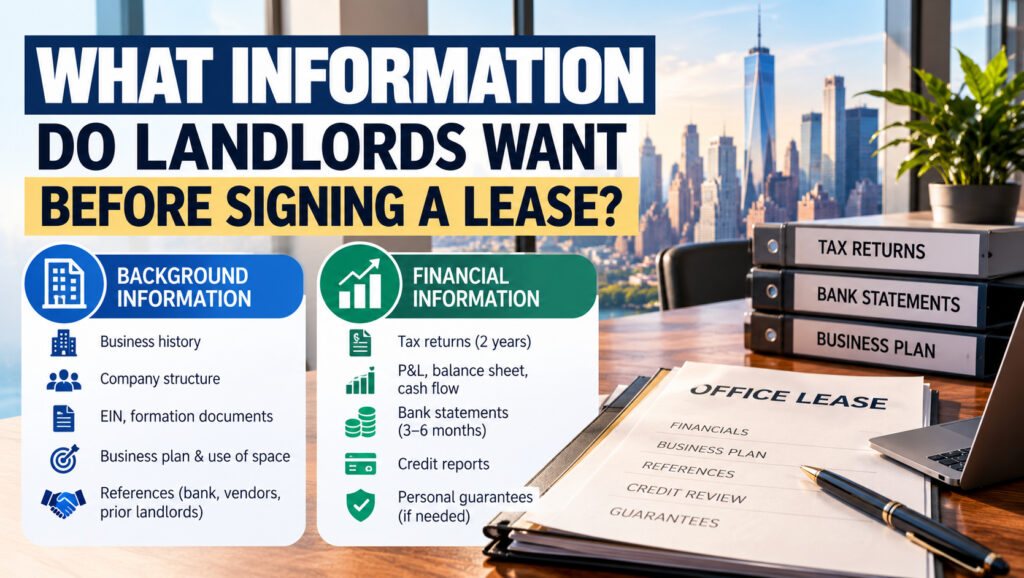
What Information Does a Manhattan Landlord Require Before Signing an Office Lease?
Most commercial landlords want to answer three fundamental questions before entering into a long-term office lease: Who is the tenant? Can the tenant afford the financial obligations? And how likely is the business to remain a dependable occupant throughout the agreement?
Unlike a residential lease, which is generally evaluated on an individual’s income, employment, and personal credit history, a commercial office lease may involve a detailed examination of the business itself.
The landlord is not simply evaluating whether the prospective tenant can afford next month’s rent. Instead, the property owner is assessing whether the company can reasonably support several years of rent payments, operating expenses, and other contractual obligations.
For example, a company leasing a full floor in Midtown Manhattan may be committing to five, seven, or ten years of occupancy. Furthermore, the landlord may be investing considerable money to prepare the premises, provide improvements, or accommodate the tenant’s particular requirements.
As a result, the approval process will typically address several areas:
- Corporate identity: The legal name, ownership structure, age, and registration status of the business.
- Business operations: The company’s industry, activities, staffing requirements, and intended use of the office.
- Financial condition: Revenue, profitability, liquidity, assets, liabilities, and available cash.
- Creditworthiness: Payment history, business credit, and previous leasing relationships.
- Lease security: The proposed security deposit, financial guarantees, or other arrangements protecting the landlord.
Although these categories are common, the documentation requested and level of scrutiny will vary. A landlord reviewing a small furnished office rental may require less extensive information than an owner negotiating a large, customized headquarters lease.
For tenants, the important distinction is that financial qualification is a negotiated component of commercial leasing, not necessarily a fixed application standard.
What Business Background Information Will a Manhattan Office Landlord Request?
Commercial landlords generally begin their evaluation by establishing the identity and legitimacy of the prospective tenant.
This process is commonly known as tenant due diligence or commercial tenant screening.
What corporate documents are needed for an NYC office lease?
A landlord may request articles of incorporation, a certificate of formation, an operating agreement, or other documentation confirming the legal existence of the company.
Additionally, the prospective tenant may be asked to provide its Employer Identification Number, business address, formation date, and information identifying the individuals authorized to sign the lease.
For companies organized as limited liability companies, partnerships, or corporations, the landlord may want confirmation that the individual executing the agreement has the authority to bind the business.
In some transactions, a certificate of good standing or a corporate resolution may be required.
These requests serve a practical purpose. The landlord needs to know precisely which legal entity is accepting responsibility for rent and other lease obligations.
For tenants operating several related businesses, however, this introduces an important negotiating consideration.
A business owner may control multiple corporations or affiliated companies, but the landlord should not automatically assume every related entity will guarantee the obligations of the tenant.
Therefore, the legal identity of the proposed tenant should be established early, especially when an organization intends to lease space through a subsidiary or a newly formed operating entity.
Does a landlord want to know what type of business will occupy the space?
Yes. Manhattan office landlords frequently evaluate the intended use of the premises, the company’s industry, and its operational requirements.
A professional services firm, technology company, financial organization, medical practice, and creative production business may each have substantially different needs.
For instance, a law firm might require numerous private offices, confidential meeting rooms, and a formal reception area. Conversely, a technology business may prefer open workstations, collaborative spaces, smaller meeting rooms, and an informal employee environment.
Similarly, companies operating extended hours, hosting large numbers of visitors, or installing specialized equipment may require additional building approvals.
Accordingly, landlords may ask about the number of employees, anticipated visitors, operating hours, electrical demand, and any unusual construction or infrastructure requirements.
These questions also help determine whether the intended use is permitted under the building’s governing documents, certificate of occupancy, and applicable regulations.
From the tenant’s perspective, discussing these requirements early can prevent unnecessary expenses after occupancy. It can also help identify buildings with appropriate elevator access, HVAC availability, power capacity, internet infrastructure, and existing office layouts.
Will a landlord investigate previous commercial leasing history?
A landlord may request references from previous commercial property owners or managing agents, particularly when reviewing a privately owned company with a limited financial history.
Previous leasing references can help demonstrate whether the business consistently paid rent, maintained the premises, complied with its lease, and surrendered space appropriately at the end of its tenancy.
A company with several years of successful office occupancy may benefit from presenting this history proactively.
For example, a tenant that has continuously occupied its existing Manhattan office for eight years, without default or significant disputes, possesses a useful qualification that may not be immediately apparent from its financial statements.
Moreover, positive relationships with former landlords can sometimes support a request for a reduced security deposit or less restrictive guarantee provisions.
However, a lack of previous commercial leasing experience does not automatically prevent approval. First-time tenants can often demonstrate reliability through other financial and operational records.
What Financial Statements Do Landlords Require for a Long-Term Office Lease?
The most commonly requested financial documents are a recent balance sheet, profit and loss statement, business tax returns, and evidence of available cash or financial reserves. Depending on the property owner and the transaction, additional information may include cash flow statements, bank references, credit reports, and supporting accounting records.
The purpose is to determine whether the company has sufficient financial capacity to meet its lease obligations without creating an unreasonable risk of default.
Importantly, Manhattan landlords do not generally follow one universal financial qualification formula. Instead, the amount of documentation requested often depends on the tenant’s history, the proposed lease commitment, the landlord’s investment, and the security offered.
Why does a landlord ask for a profit and loss statement?
A profit and loss statement, commonly called a P&L or income statement, summarizes a company’s revenue, expenses, and earnings over a designated period.
Commercial landlords use this information to evaluate whether the business generates enough income to support its anticipated office occupancy costs.
For example, a company earning consistent profits may present a stronger financial profile than one whose operating expenses repeatedly exceed its revenue.
Nevertheless, losses do not always indicate financial weakness. Growing businesses sometimes deliberately operate at a loss while investing in expansion, product development, staffing, or market acquisition.
Therefore, an accountant-prepared explanation of unusual expenses, one-time charges, or temporary operating losses may help a landlord understand the company’s actual financial position.
Tenants should also distinguish between historical results and current performance.
A business with a difficult previous year but substantially improved revenue during the current year may benefit from presenting both its historical statements and updated year-to-date financial information.
Why do commercial landlords request a balance sheet?
A balance sheet identifies a company’s assets, liabilities, and equity at a particular point in time.
Essentially, it helps the landlord determine what the company owns, what it owes, and the financial resources potentially available to meet its commitments.
Landlords may pay particular attention to cash, short-term investments, accounts receivable, outstanding debt, and other current obligations.
For instance, two businesses may report similar annual revenues but possess very different financial strengths.
One may have substantial cash reserves and relatively little debt. The other might depend on borrowed funds and have limited liquidity after meeting payroll and operating expenses.
Consequently, annual revenue alone rarely tells the complete story.
A business with moderate revenue but a strong balance sheet may sometimes be a more attractive tenant than a company with substantially higher sales and significant financial instability.
How many years of business tax returns does a landlord want?
Many landlords request approximately two years of business tax returns, although some may seek three years or accept alternative documentation.
Tax returns provide a historical perspective on revenue, income, and reported business activity.
Nevertheless, they may not accurately reflect the company’s most recent condition, especially if the business has undergone substantial changes.
For that reason, landlords frequently consider tax records together with current financial statements.
If the business operates through multiple entities, management should clarify which returns relate to the actual tenant and which belong to affiliates that are not parties to the proposed lease.
Furthermore, business owners should determine whether the landlord genuinely requires complete tax returns or whether accountant-certified financial statements can satisfy the underwriting review.
This distinction becomes particularly important for privately held companies seeking to limit the disclosure of sensitive financial information.
Will a landlord ask to see company bank statements?
Yes, some commercial landlords request recent business bank statements or other evidence of cash reserves.
The purpose is generally to verify liquidity rather than simply assess revenue.
For example, a company may have profitable operations but insufficient immediately available cash to cover a security deposit, construction expenses, furniture purchases, and the first several months of office occupancy.
Landlords may therefore want to confirm that a tenant can absorb these initial costs while continuing normal operations.
However, full bank statements are not necessarily mandatory in every transaction.
Depending on the financial package, a landlord may accept a bank reference, a verified statement of available funds, or an accountant-prepared financial summary.
Tenants should avoid assuming that complete access to their banking activity is automatically required.
Instead, the parties can determine what information is reasonably necessary for approval and how it can be provided securely.
Will the landlord require audited financial statements?
Not every office tenant needs audited financial statements.
An audited financial statement has been examined by an independent accounting professional under applicable auditing standards. Consequently, it generally provides stronger independent assurance than internally prepared records.
Large institutional tenants may already have audited financial reports available.
However, many smaller privately held Manhattan businesses do not.
In these situations, landlords may accept financial statements prepared or reviewed by an accountant, supported by tax returns and other documentation.
The distinction matters because commissioning an audit solely to qualify for an office lease can be expensive and time-consuming.
Therefore, tenants should establish the landlord’s actual financial reporting requirements before undertaking additional accounting work.
How Do Manhattan Landlords Evaluate a Company’s Ability to Afford Rent?
A landlord’s financial review generally focuses on whether the company’s cash flow, assets, and available financial resources appear sufficient to support the proposed lease.
However, the asking rent is only part of that calculation.
The financial obligation of leasing office space can include base rent, annual escalations, electricity, operating expense increases, real estate tax escalation payments, applicable commercial rent taxes, cleaning charges, after-hours HVAC, insurance, and other expenses.
Furthermore, a tenant may face considerable initial occupancy costs.
These can include a security deposit, furniture, communications infrastructure, moving expenses, architectural work, and improvements not covered by the landlord.
As a result, a responsible office budget must consider both ongoing and one-time costs.
How much revenue does a business need to qualify for an office lease?
There is no single minimum-revenue threshold that universally applies to Manhattan office leases.
Some landlords evaluate earnings and cash flow in relation to the proposed rental obligation. Others place greater emphasis on available cash, financial reserves, a parent company guarantee, or an established credit history.
A profitable business with consistent revenue may qualify without substantial additional security. Meanwhile, a newly funded company could potentially qualify despite limited operating revenue if it demonstrates sufficient liquidity.
For example, suppose two companies are evaluating the same Manhattan office.
The first company generates significant annual revenue but operates with narrow profit margins and limited cash reserves. The second has lower annual revenue but maintains substantial liquid assets and minimal debt.
Although the first company appears larger, the second may offer a stronger credit profile under certain underwriting standards.
Therefore, prospective tenants should not evaluate their qualification solely on gross annual sales.
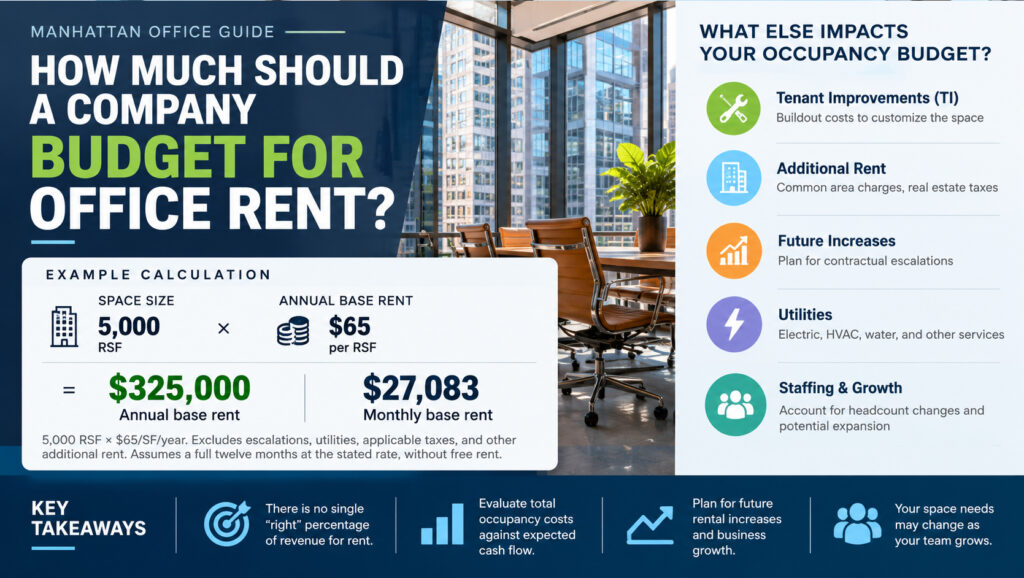
How much should a company budget for office rent?
The appropriate office rent budget depends on a company’s profitability, staffing needs, other operating obligations, projected growth, and access to capital.
There is no universally appropriate percentage of company revenue that every Manhattan office tenant should allocate to rent.
Nevertheless, businesses should evaluate occupancy costs against expected cash flow rather than relying exclusively on current revenue.
Consider a hypothetical tenant leasing 5,000 rentable square feet at an annual base rent of $65 per rentable square foot.
ILLUSTRATIVE BASE RENT CALCULATION
Annual base rent
$325,000
Monthly base rent
$27,083
5,000 rentable SF × $65/SF/year. Excludes escalations, utilities, applicable taxes, and other additional rent. Assumes a full twelve months at the stated rate, without free rent.
While the company might reasonably afford the quoted base rent, the actual occupancy budget could be higher once the other expenses are included.
Furthermore, the business should account for future rental increases and its anticipated staffing requirements.
A company expecting to grow from twenty employees to thirty-five employees may need a different layout or expansion arrangement than a similarly sized business expecting to maintain its existing workforce.
Accordingly, preparing a realistic occupancy budget is both a financial qualification exercise and an opportunity to make a better long-term real estate decision.
Will landlords consider projected revenue or future business growth?
Yes, although projections generally carry less weight than documented financial performance or secured funding.
For startups, expanding businesses, and companies entering new markets, future revenue projections may help explain why their current financial statements do not fully represent their expected ability to support the lease.
However, landlords will often distinguish between speculative growth and revenue supported by signed contracts, recurring customer relationships, committed funding, or established business operations.
An organized financial presentation can therefore help an expanding tenant tell a credible story.
For example, a business preparing to increase its Manhattan staff from fifteen to forty employees might explain the expected staffing timeline, financial resources supporting that expansion, and the anticipated office occupancy costs.
This information could also help negotiate future expansion rights or identify a space with room for additional employees without requiring an immediate relocation.
Do Landlords Run Credit Checks on Commercial Office Tenants?
Commercial landlords may review business credit reports, payment histories, and other financial indicators before approving a long-term lease.
Business credit information can help identify outstanding obligations, delinquent payments, collection activity, and other matters relevant to the prospective tenant’s financial reliability.
However, commercial credit evaluations differ from consumer credit checks. A business may have substantial revenue and financial resources without possessing an extensive commercial credit history.
This is particularly true for newly formed subsidiaries, partnerships, professional practices, and companies that have historically relied on internal capital rather than borrowing.
Will the landlord check the business owner’s personal credit?
Sometimes. A landlord may request personal credit information when a business owner is expected to guarantee the lease or when the company’s independent financial history is insufficient.
Nevertheless, signing a commercial lease through a corporation or limited liability company does not automatically mean that every shareholder, member, or executive must undergo a personal credit review.
The distinction depends on the proposed lease structure and whether individuals are personally accepting financial responsibility.
For example, a well-capitalized corporation might enter into an office lease without requiring its president to provide a personal guarantee. Conversely, a smaller company with limited assets may be asked to provide additional assurances from its principal.
Therefore, business owners should understand whether a credit authorization pertains to the company, an individual guarantor, or both.
They should also establish whether the requested personal credit check is connected to an actual guarantee requirement rather than a routine application request.
Can a company with poor credit still lease office space in Manhattan?
Yes. Weak business credit does not necessarily disqualify a company from leasing commercial office space.
Instead, a landlord may seek additional protection to compensate for the perceived risk.
Depending on the circumstances, this might involve a larger security deposit, a letter of credit, a stronger corporate guarantor, or a more limited lease commitment.
For instance, a company whose financial difficulties resulted from a temporary disruption several years earlier may have substantially improved its position.
Updated financial statements, consistent recent revenues, and evidence that previous obligations have been satisfied can help demonstrate that improvement.
Furthermore, tenants may benefit from considering office spaces that require relatively little landlord-funded construction.
A company selecting an existing furnished office with an efficient floor plan may reduce the landlord’s initial financial exposure compared with a tenant requesting an extensive custom installation.
This difference can sometimes create an opportunity to negotiate more manageable security requirements.
What Happens If a Startup Cannot Provide Several Years of Financial Statements?
New businesses often cannot provide the operating history requested by a traditional commercial landlord.
A startup formed six months ago, for example, cannot furnish three years of corporate tax returns or demonstrate an extensive record of commercial rent payments.
However, Manhattan office landlords regularly encounter tenants with limited business histories, including startups, newly formed professional partnerships, and businesses establishing their first New York City location.
Therefore, the absence of historical financial information does not automatically prevent a lease transaction.
Instead, landlords may evaluate alternative evidence of financial capacity.
What financial documents can a startup provide instead of tax returns?
A startup may be able to support its lease application with current business bank balances, verified investment funding, recent financial statements, capitalization records, or other documentation establishing its available resources.
Additionally, an accountant-prepared financial summary may explain the company’s funding structure and projected operating expenses.
For a newly established subsidiary, the financial strength of a parent organization may also become relevant if that parent is willing to provide credit support.
Nevertheless, it is important to distinguish between funds already available to the business and money the company merely expects to receive.
Committed capital and verifiable cash generally provide stronger assurance than speculative future financing.
Therefore, businesses should prepare a clear explanation of how the proposed office occupancy will be funded throughout the initial lease period.
Are venture-backed companies treated differently by landlords?
Venture-backed businesses may be evaluated differently from traditional profitable companies because their financial resources and operating models can vary considerably.
For example, a technology startup might have substantial cash reserves from an investment round while reporting operating losses associated with development, staffing, and expansion.
A landlord evaluating that company may focus on its available capital, expected spending, and financial runway rather than profitability alone.
However, venture backing does not automatically eliminate requirements for a security deposit or guarantee.
Landlords may consider the funding structure, future obligations, liquidity, and proposed cost of preparing the premises.
For tenants, a useful strategy is to present a clear financial picture without overstating future growth.
Furthermore, choosing an office that accommodates current staffing while providing some expansion flexibility may reduce the amount of capital committed to real estate before the company requires additional space.
How Much Security Deposit Does a Manhattan Office Landlord Require?
There is no universal security deposit amount that applies to every commercial office lease in Manhattan.
Unlike many residential rental arrangements, commercial office deposits are generally subject to negotiation between the landlord and tenant.
Depending on the business’s financial strength, proposed lease term, property, and required improvements, a landlord might request several months of rent as security.
Some tenants may negotiate a comparatively modest deposit. Others may face requirements equal to three, six, or more months of rent, particularly when their credit history is limited or the landlord must undertake substantial construction.
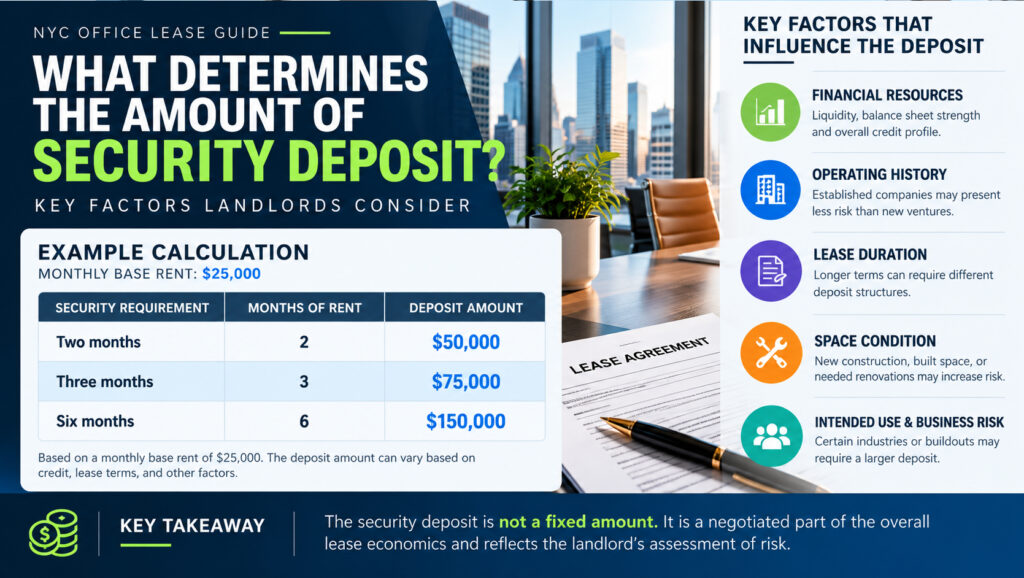
What determines the amount of security deposit?
Landlords typically consider the tenant’s financial resources, operating history, creditworthiness, lease duration, and the anticipated cost of preparing or restoring the office.
For example, an established financial services company leasing an already constructed office may present a different risk than a new company requesting major alterations before occupancy.
Similarly, a tenant leasing a full floor for ten years may receive a different security proposal than a company entering a shorter agreement for a smaller prebuilt suite.
The deposit also represents money the tenant cannot freely use for other business purposes.
Consequently, its size affects the company’s available working capital.
Consider a hypothetical office with a monthly base rent of $25,000.
| Security requirement | Amount |
|---|---|
| Two months | $50,000 |
| Three months | $75,000 |
| Six months | $150,000 |
The difference between a three-month and six-month deposit is $75,000.
That amount could otherwise support furniture purchases, employee hiring, technology improvements, or other business expenditures.
Therefore, security deposit negotiations should be considered part of the overall financial structure of the lease rather than an administrative detail.
Can a tenant negotiate a lower security deposit?
Yes. The security deposit is frequently a negotiable term, although the owner’s willingness to reduce it depends on the transaction.
Tenants with strong financial statements, substantial liquidity, and established leasing histories may be better positioned to seek a smaller deposit.
However, a tenant without those advantages may still have alternatives.
For example, a landlord might consider reducing the deposit after the company has completed several years of timely rent payments.
This arrangement is sometimes described as a security deposit burn-down or scheduled reduction.
A lease could provide for a reduction after a specified period, subject to the tenant meeting agreed financial or performance conditions.
Furthermore, tenants should distinguish between a deposit reduction that occurs automatically under clearly defined conditions and one that requires the landlord’s later discretionary approval.
An automatic reduction offers greater predictability when planning future working capital.
What is a letter of credit in an office lease?
A letter of credit is a financial instrument issued by a bank that provides the landlord with a specified source of payment if conditions permitting a draw are satisfied.
In some Manhattan office transactions, a landlord may accept a letter of credit instead of a traditional cash security deposit.
However, a letter of credit is not necessarily equivalent to having unrestricted access to the secured funds.
Banks may require collateral, cash reserves, financial covenants, or other security before issuing the instrument. Additionally, issuance and renewal fees can create ongoing costs.
Therefore, tenants should compare the actual economic impact of a letter of credit with the cost of providing cash security.
The lease should also address the circumstances under which the landlord may draw on the letter, renewal requirements, expiration dates, and the procedure for returning or reducing the security.
Will a Manhattan Landlord Require a Personal Guarantee on an Office Lease?
A landlord may require a personal guarantee when the business entering the lease does not possess sufficient independent financial strength.
A personal guarantee makes an individual responsible for certain obligations of the corporate tenant.
This requirement is particularly important for business owners because it can undermine some of the financial separation they expected when operating through a corporation or limited liability company.
For example, a business owner may establish an LLC specifically to separate business liabilities from personal assets.
However, signing a broad personal guarantee can expose that individual to contractual liability for obligations the LLC cannot satisfy.
Consequently, business owners should never assume that signing a lease through an LLC automatically protects them from personal liability.
The guarantee itself must be carefully evaluated.
Can a business owner refuse to personally guarantee an office lease?
Yes. A business owner can negotiate or decline a proposed personal guarantee, although the landlord may refuse to proceed without acceptable alternative security.
The strength of the tenant’s financial position often influences the outcome.
A financially established business may be able to avoid a personal guarantee entirely.
Alternatively, a landlord may accept a corporate guarantee from a financially stronger affiliated entity, an increased security deposit, or another negotiated arrangement.
Moreover, even when a personal guarantee cannot be eliminated, its duration, monetary exposure, and conditions may be negotiable.
For Manhattan tenants, one especially important alternative is the Good Guy Clause.
What Is a Good Guy Clause in a Manhattan Office Lease?
A Good Guy Clause, more precisely called a Good Guy Guaranty, is a negotiated form of limited personal guarantee commonly associated with New York City commercial leases.
Generally, it is intended to limit the guarantor’s personal exposure when a tenant properly vacates and surrenders the premises before the expiration of the lease.
This arrangement offers a potential compromise between the landlord’s need for protection and the business owner’s desire to avoid guaranteeing every remaining rental payment under a long-term agreement.
For example, suppose a business owner signs a seven-year office lease and the company becomes unable to continue operations after three years.
Under a broad personal guarantee, the owner might remain personally responsible for substantial obligations extending beyond the company’s actual occupancy.
Under a properly drafted Good Guy Guaranty, the individual’s liability may instead be limited to obligations accruing through the date the tenant satisfies the agreed surrender conditions.
However, a Good Guy Clause does not automatically terminate the company’s lease. Even if the individual guarantor is released from further personal liability, the corporate tenant may remain responsible for its contractual obligations unless the landlord separately agrees to terminate or release them.
This distinction is essential when evaluating the financial consequences of closing, downsizing, or relocating a business.
How does a Good Guy Clause work in Manhattan today?
The specific language of the guarantee determines how the provision operates.
Typically, a Good Guy Guaranty involves conditions concerning advance notice, payment of outstanding obligations, removal of occupants and property, and the return of possession to the landlord.
For example, a guarantee may require the tenant to provide advance written notice before vacating.
It may also require the tenant to leave the premises in the condition specified by the lease and surrender possession without remaining occupants or subtenants.
Nevertheless, the required notice period, financial obligations, and surrender conditions are not identical in every lease.
The precise wording matters considerably.
In October 2025, New York’s highest court addressed the interpretation of a commercial Good Guy Guaranty involving an office tenant. The court concluded that, under the language of the particular agreement, the guarantor’s liability ended when the tenant satisfied the specified surrender conditions; the landlord’s formal acceptance of surrender was not an additional requirement.
That decision reinforces an important practical principle: the scope and termination of personal liability depend on the actual terms of the guarantee and lease, not simply on whether a document is labeled a Good Guy Guaranty.
Accordingly, tenants should have qualified New York commercial real estate counsel review these provisions before execution.
Is a Good Guy Clause better than a full personal guarantee?
From the standpoint of limiting personal financial exposure, a properly negotiated Good Guy Guaranty can offer substantial advantages over an unrestricted personal guarantee.
A full guarantee may expose the individual to the tenant’s contractual obligations throughout the lease, subject to its wording.
A Good Guy Guaranty may limit that exposure by establishing conditions under which the individual’s ongoing liability ends.
However, some agreements contain broad financial obligations, extended notice periods, restoration requirements, or other provisions that can materially reduce the intended protection.
Therefore, tenants should evaluate more than the title of the clause.
They should understand precisely what obligations are guaranteed, when liability ends, and what must occur for the guarantor to obtain a release.
Can a tenant negotiate the terms of a Good Guy Guaranty?
Yes. The terms of a Good Guy Guaranty may be negotiated as part of the overall office lease.
For example, a business owner may seek a shorter advance notice requirement, narrower guaranteed obligations, clearly defined surrender conditions, or an express limit on liability.
In some circumstances, a tenant may also negotiate a reduction or expiration of the guarantee after a period of successful occupancy.
These arrangements depend on the landlord’s acceptance and the financial strength of the tenant.
Nevertheless, tenants should address guarantee requirements during the early negotiation process rather than waiting until the final lease documents are prepared.
By that point, substantial time and money may already have been invested in legal review, architectural planning, and other transaction expenses.
Can a Landlord Require Personal Financial Statements From the Business Owner?
A landlord may request personal financial information when an owner, principal, or other individual is being evaluated as a prospective guarantor.
A personal financial statement generally summarizes the individual’s assets, liabilities, and net worth.
Depending on the proposed guarantee, the landlord may also request supporting information concerning liquidity, financial accounts, investments, real estate, or outstanding debts.
However, the business owner should distinguish between providing financial information to support a negotiated guarantee and providing unrestricted disclosure unrelated to any agreed personal obligation.
For example, if the landlord has agreed to accept the corporation’s credit without a personal guarantee, the tenant may have a reasonable basis to question why extensive personal financial statements are necessary.
Furthermore, individuals should understand the consequences of signing a personal financial statement or credit authorization.
A business owner’s personal assets should not be placed at contractual risk without a clear understanding of the obligations being accepted.
Does a Manhattan Landlord Have the Right to Keep Requesting Financial Information After the Lease Is Signed?
Possibly. Some commercial leases contain provisions requiring the tenant to provide updated financial information during the lease term.
These provisions may allow the landlord to request annual financial statements or other specified records, sometimes subject to frequency limits, confidentiality protections, and defined circumstances.
For example, the landlord may want current information when refinancing the property, selling the building, or evaluating a tenant’s request to assign the lease.
However, tenants should not assume that an initial financial disclosure requirement automatically gives the landlord unlimited access to future records.
The extent of continuing financial reporting should be addressed in the lease.
Can tenants negotiate limits on ongoing financial disclosures?
Yes. Tenants may seek to limit financial reporting obligations to information reasonably necessary for legitimate ownership or financing purposes.
For instance, a business may prefer to provide annual accountant-prepared statements rather than detailed monthly operating reports.
Additionally, the lease may define how often documents can be requested and establish conditions for confidential treatment.
This issue can be particularly significant for privately held firms whose financial statements contain sensitive information concerning revenue, expenses, compensation, or business strategy.
Consequently, the financial reporting provisions of the lease should be reviewed as carefully as the original application requirements.
How Can Office Tenants Protect Confidential Financial Information?
Providing financial records is often a normal part of commercial leasing. Nevertheless, tenants should take reasonable measures to protect confidential business and personal information.
A landlord’s legitimate interest in evaluating creditworthiness does not necessarily require unlimited access to every financial record maintained by the company.
For example, complete bank account numbers, unrelated personal identifiers, or sensitive transaction-level details may not be necessary for the particular review.
Where appropriate, tenants may propose alternatives such as accountant-prepared summaries, redacted documents, or verification letters.
Furthermore, financial information should be transmitted through a secure process rather than circulated unnecessarily among multiple parties.
Should a tenant sign a confidentiality agreement before providing financial statements?
For sensitive financial information, a confidentiality agreement or written confidentiality undertaking may be appropriate.
Such an arrangement can establish how the information will be used, which parties may receive it, and what protections apply to its storage and disclosure.
For example, a landlord may legitimately need to share financial information with its attorneys, lenders, accountants, or other representatives involved in approving the transaction.
However, the tenant may seek reasonable limits on disclosures unrelated to the proposed lease.
Similarly, documents should be provided only after the prospective landlord and property have been sufficiently identified.
A business should not be expected to disclose extensive confidential financial records to unknown intermediaries merely to begin exploring available office space.
When should financial documents be provided during the leasing process?
The timing depends on the property and proposed transaction.
In some cases, the landlord may request preliminary financial information before issuing or seriously considering a lease proposal.
In others, a financial package may be reviewed after the parties have agreed on principal business terms.
For tenants, the goal should be to provide enough information to establish credibility without unnecessarily distributing sensitive documents before a viable transaction exists.
A practical approach is to prepare financial information in advance while controlling when and to whom it is disclosed.
This allows a tenant to respond efficiently when a suitable office becomes available without compromising its financial privacy during the initial search.
Can Strong Financial Statements Help a Tenant Negotiate Better Lease Terms?
Potentially, yes.
A landlord evaluating two otherwise comparable prospective tenants may assign greater value to a company with substantial financial resources, an established operating history, and a dependable record of paying rent.
That stronger credit profile can sometimes influence the terms the owner is willing to negotiate.
However, financial strength does not guarantee discounted rent or additional concessions. Market conditions, competing tenant interest, building vacancy, lease duration, and the landlord’s investment requirements also matter.
Nevertheless, strong financial information may improve a tenant’s negotiating position in several areas.
Can a financially qualified tenant negotiate more free rent?
Free rent is commonly considered as part of the overall economics of a Manhattan office lease.
A landlord may offer a rent concession to attract a tenant, accommodate construction or relocation schedules, or improve the competitiveness of a proposed transaction.
A financially strong tenant may sometimes have an advantage because the landlord perceives a lower risk of default.
However, the amount of free rent available also depends on the property, market conditions, lease term, and competition for the space.
Furthermore, tenants should distinguish between free rent and a reduction in the ongoing rental rate.
For example, three months of free base rent at the beginning of a seven-year lease does not necessarily eliminate electricity charges, certain additional rent, or other expenses during that period.
Therefore, the economic value of a concession should be calculated over the entire lease term rather than evaluated solely by the number of free months.
Can better financials increase the tenant improvement allowance?
A tenant improvement allowance is money a landlord agrees to contribute toward preparing an office for occupancy.
Depending on the negotiated arrangement, this may support construction, modifications, finishes, or other improvements.
A landlord evaluating a substantial construction allowance may be especially concerned about the tenant’s long-term financial strength.
After all, extensive improvements can represent a considerable upfront investment.
Consequently, a financially qualified tenant may be better positioned to negotiate an improvement package, although the actual allowance depends heavily on the building, existing condition of the space, lease economics, and proposed term.
This can be particularly valuable for companies with specialized layouts.
For example, a law firm may need private partner offices, conference rooms, and reception space. A technology company may instead prioritize collaborative areas, phone booths, and flexible workstations.
Rather than paying for these improvements entirely out of pocket, tenants should examine whether the landlord will provide or contribute toward the required installation.
Does leasing a prebuilt or furnished office improve approval chances?
In some circumstances, choosing an existing prebuilt or furnished office can make a transaction easier for both parties.
A prebuilt office generally requires less construction than an unfinished space.
Therefore, the landlord may have less money at risk before the tenant begins paying rent.
Meanwhile, the tenant may avoid substantial construction expenses and reduce the time required to establish operations.
If furniture is already included, the business may also avoid purchasing desks, conference tables, seating, and storage equipment.
However, tenants should verify whether the furniture is included in the lease, provided under a separate agreement, or being sold as part of the transaction.
They should also confirm its condition, ownership, maintenance responsibilities, and removal requirements.
For businesses seeking to conserve capital, a suitable furnished office may be more financially attractive than a lower-priced unfinished space requiring extensive improvements.
Importantly, the existing layout must still support the company’s staffing and operational requirements.
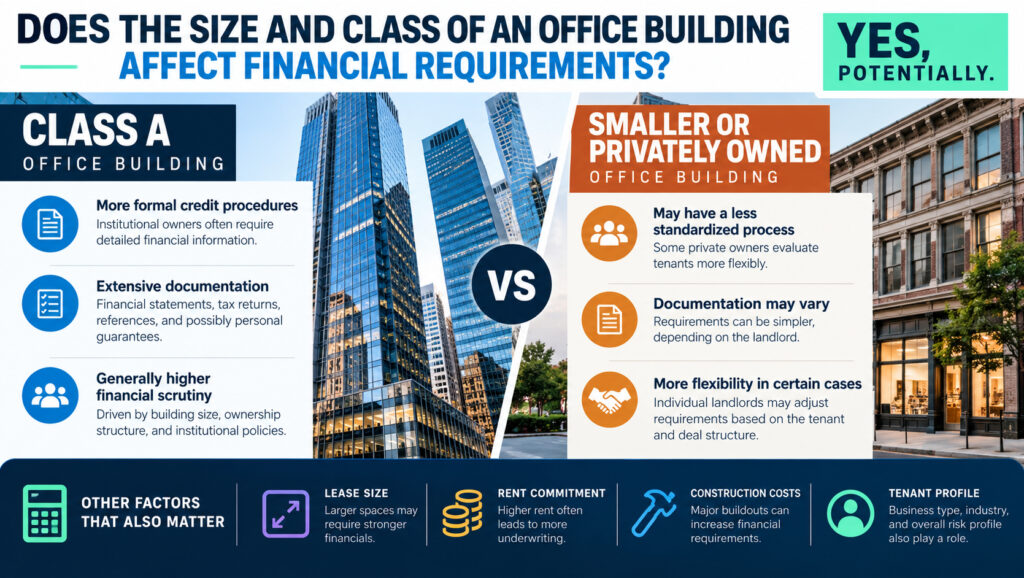
Does the Size and Class of an Office Building Affect Financial Requirements?
Yes, potentially. Although building class does not establish a universal financial qualification standard, the nature of the property and ownership can affect the approval process.
For example, an institutionally owned Class A office tower may have formal credit procedures and extensive documentation requirements.
Meanwhile, a smaller privately owned commercial building may evaluate a prospective tenant through a less standardized process.
Nevertheless, individual landlords within either category may impose strict or flexible requirements.
The proposed lease size, rent commitment, construction costs, and tenant profile can be just as important as the property’s classification.
Are Class A office landlords more demanding about tenant financials?
Some Class A landlords maintain detailed underwriting standards, particularly when negotiating substantial leases or funding expensive tenant improvements.
However, it would be misleading to assume every Class A building requires stronger credit than every Class B or Class C property.
A well-capitalized tenant might negotiate favorable terms in a premium building. Conversely, a landlord operating a smaller property might insist on a substantial personal guarantee for a new business.
Therefore, tenants should compare specific buildings and ownership requirements rather than making assumptions based exclusively on the property’s class.
Can tenants find more flexible financial requirements in smaller Manhattan office buildings?
Sometimes. Smaller properties and individual ownership groups may offer opportunities for more customized negotiations.
For example, an owner may place considerable value on a tenant’s established professional reputation, history of operating in the neighborhood, or willingness to occupy an existing office without expensive renovations.
This may be especially useful for smaller professional services firms and businesses seeking several thousand square feet rather than a major corporate headquarters.
However, flexible qualification standards do not necessarily mean favorable lease terms.
A tenant should still compare the asking rent, building condition, operating expenses, security requirements, and long-term obligations.
The objective is not merely to obtain approval. It is to secure an appropriate office under economically sustainable conditions.
How Does Office Location Affect a Company’s Long-Term Financial Commitment?
Manhattan location decisions can influence office leasing costs well beyond the quoted rent per square foot.
For example, businesses comparing Midtown, Midtown South, Chelsea, the Flatiron District, Union Square, and the Financial District may encounter different asking rents, building configurations, construction requirements, and operating costs.
However, the lowest advertised rent does not always produce the lowest total occupancy expense.
A building with an efficient existing layout may require fewer modifications and less rentable square footage than another property with a less suitable configuration.
Similarly, transportation accessibility and neighborhood characteristics can affect employee commuting, recruitment, and client access.
Therefore, companies should evaluate office location together with budget, image, staffing, and day-to-day operational needs.
Does a prestigious Manhattan address justify higher leasing costs?
That depends on the business.
A law firm, investment business, consulting company, or client-facing professional organization may place considerable value on a recognizable business address, professional lobby, quality finishes, and convenient meeting facilities.
For such tenants, office image can support business development, employee recruitment, and client expectations.
Conversely, a company whose employees primarily work remotely or rarely receive visitors may place greater value on floor plan efficiency, transportation access, and lower occupancy costs.
Furthermore, building prestige should not automatically outweigh financial discipline.
A company may benefit more from leasing a slightly less prominent address if the savings provide additional meeting rooms, better furniture, upgraded technology, or sufficient space to accommodate staff growth.
Ultimately, the appropriate location is the one that supports the business without creating unnecessary financial strain.
Can an efficient office layout reduce the rent a company needs to pay?
Yes. An efficient layout can reduce the amount of rentable space needed to accommodate employees and business operations.
For example, a firm that previously relied on large private offices and oversized circulation areas may be able to operate more efficiently in a space with appropriately sized offices, shared meeting rooms, and better workstation placement.
Similarly, businesses using bench seating, bullpen arrangements, or a combination of assigned and shared workstations may have different space requirements than firms with predominantly enclosed offices.
However, reducing square footage should not compromise privacy, ergonomics, employee comfort, or daily operational flow.
For example, a legal practice requiring confidential conversations may not benefit from an overly open seating arrangement, even if the configuration reduces the overall office footprint.
Therefore, space efficiency should be measured by functionality rather than density alone.
A properly designed 4,500-square-foot office may be more useful than an inefficient 5,500-square-foot office, depending on the organization.
That difference can produce significant rent savings over a long-term lease.
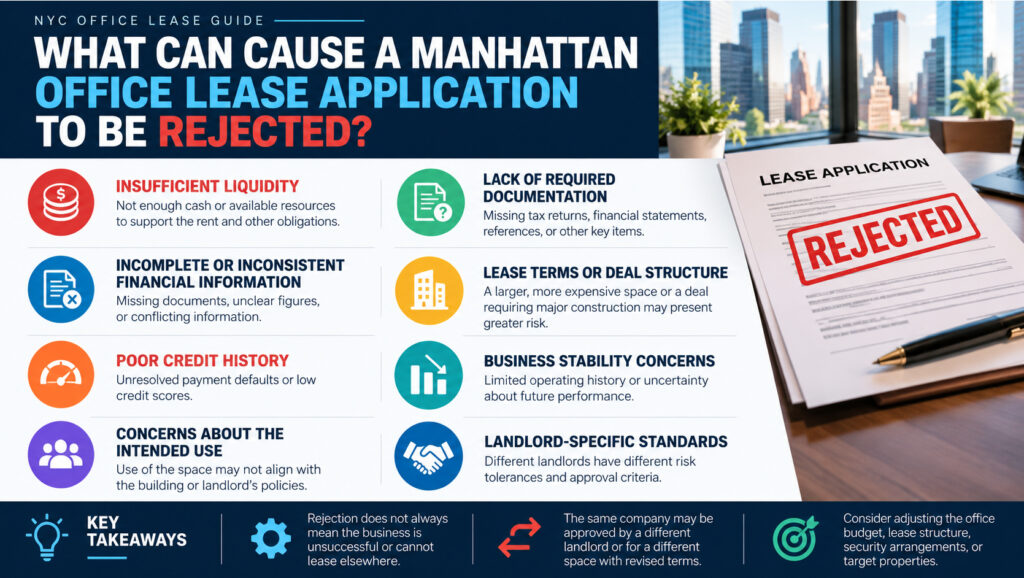
What Can Cause a Manhattan Office Lease Application to Be Rejected?
A landlord may decline a prospective tenant when the available information does not adequately support the financial or operational requirements of the proposed lease.
For example, an application may encounter difficulties because of insufficient liquidity, unresolved payment defaults, inconsistent financial information, or concerns about the intended use of the premises.
A lack of necessary financial documentation can also delay approval.
However, rejection is not always a judgment that the business is unsuccessful or incapable of leasing office space elsewhere.
Different landlords may evaluate the same company differently.
Furthermore, the proposed transaction itself may be the problem.
A business might be financially qualified to lease a moderately priced prebuilt office while presenting greater risk for a substantially more expensive office requiring extensive landlord-funded construction.
Consequently, a rejected application may indicate the need to reconsider the office budget, lease structure, security arrangement, or target properties.
Can a business overcome a landlord’s concerns about its financial history?
Sometimes. The appropriate response depends on the underlying issue.
If the concern involves outdated information, recent financial statements may provide a clearer picture.
If the business lacks a long operating history, available capital or a qualified corporate guarantor may help establish its credibility.
Similarly, if the concern involves limited liquidity, the tenant might consider a smaller space, lower upfront construction costs, or a different security arrangement.
Nevertheless, tenants should avoid committing to rental obligations that are unreasonable merely to satisfy a landlord’s requirements.
A commercial lease should support the company’s operating objectives, not compromise its financial stability.
When Should a Tenant Prepare Financial Documents for an Office Search?
Ideally, businesses should begin gathering relevant financial information before entering serious lease negotiations.
This does not mean every prospective tenant must disclose confidential documents during the initial property search.
Rather, the company should determine what information is available, who can authorize its release, and whether the financial records accurately reflect its current condition.
For example, management may discover that the latest balance sheet is outdated, a corporate document requires updating, or the company’s reported earnings need additional explanation.
Addressing these matters before identifying a preferred office can reduce delays later.
Moreover, preparation allows the company to evaluate its own financial readiness before committing significant time and resources to negotiations.
What should a tenant prepare before submitting a lease proposal?
Before entering serious negotiations, it is helpful to establish the legal entity that will sign the lease, assemble current financial information, and determine the company’s realistic occupancy budget.
The business should also identify any limitations concerning personal guarantees or security deposits.
In addition, management should know whether the company will require landlord-funded construction, furniture, specialized infrastructure, or other improvements.
These issues are connected.
For example, a tenant seeking a substantial improvement allowance while offering limited financial security may encounter different negotiations than one accepting a fully built office with minimal landlord expenditure.
Therefore, addressing financial readiness and physical space requirements together can improve the efficiency of the entire search.
Should Tenants Negotiate Financial Requirements Before Signing a Letter of Intent?
A letter of intent, or LOI, generally establishes the principal business terms the landlord and prospective tenant intend to incorporate into a lease.
While an LOI is often substantially nonbinding, specific provisions may be binding depending on its language.
For that reason, the document deserves careful attention.
In particular, the parties should attempt to establish major financial terms before investing heavily in lease drafting.
These can include the proposed security deposit, any personal or corporate guarantee, anticipated construction allowance, free rent, and other principal economic arrangements.
For example, a tenant might negotiate favorable rent and free rent only to discover later that the landlord expects a personal guarantee the business owner is unwilling to provide.
Alternatively, an unexpectedly large security deposit could reduce the working capital available for staffing and operations.
Addressing these issues earlier can help prevent the transaction from collapsing during the legal review process.
Can the landlord change financial requirements after approving the initial proposal?
Financial approval and final lease execution are not necessarily the same event.
A landlord may condition an initial proposal on satisfactory financial review, verification of documentation, or acceptance of particular security arrangements.
Likewise, a company may discover that the final lease documents contain financial reporting obligations or guarantee language that differs from its understanding of the initial proposal.
Consequently, tenants should distinguish between preliminary business discussions and terms that have actually been agreed upon in writing.
It is also advisable to have legal counsel compare the final lease and guarantee documents against the negotiated business terms.
What Other Financial Obligations Should Manhattan Office Tenants Examine Before Signing?
Although a landlord’s background and financial review focuses on the tenant’s ability to perform, businesses should conduct their own review of the proposed lease.
The fact that a landlord is willing to approve a tenant does not mean the office is affordable or the terms are favorable.
A prospective tenant should understand the entire financial commitment, including recurring expenses, upfront costs, and potential obligations arising later in the lease.
Do Manhattan office leases include expenses beyond base rent?
Yes. Depending on the lease structure, additional costs may include electricity, operating expense increases, real estate tax escalations, after-hours HVAC, cleaning services, and other building-related charges.
Furthermore, businesses occupying qualifying commercial premises in Manhattan south of 96th Street may be subject to New York City’s Commercial Rent Tax.
As of October 2026, the tax generally applies when annual or annualized gross rent reaches at least $250,000, subject to applicable exemptions and credits.
Therefore, tenants evaluating a seemingly affordable office should calculate their total expected occupancy costs rather than looking at the advertised base rent alone.
Are tenants responsible for removing improvements at the end of the lease?
Depending on the agreement, a commercial tenant may be required to remove certain alterations, repair damage, or restore portions of the premises before surrendering possession.
These obligations can create substantial expenses, particularly when the office contains specialized installations or extensive custom construction.
Consequently, tenants should determine whether the lease requires restoration and whether the landlord is willing to waive removal of particular improvements.
This can be especially important for businesses negotiating a Good Guy Guaranty because surrender conditions and guaranteed obligations may interact with restoration requirements.
Can a tenant negotiate the right to expand, downsize, or leave early?
Potentially. Depending on the property and landlord, tenants may negotiate expansion rights, termination options, sublease rights, assignment rights, or other provisions providing flexibility.
These rights are not automatically included in a commercial office lease.
However, they can become particularly valuable for businesses expecting significant changes in staffing, revenue, or operational structure.
For example, an expanding company may benefit from an opportunity to lease adjoining space later without immediately paying for unused square footage.
Conversely, a business expecting changes in staffing or remote-work participation might prioritize subleasing flexibility or a negotiated early termination option.
Each arrangement has its own conditions, costs, and limitations.
Nevertheless, discussing future flexibility before signing is generally preferable to attempting to renegotiate a restrictive agreement several years into the term.
Frequently Asked Questions About Manhattan Office Lease Requirements
Do all Manhattan office landlords require tax returns?
No. Many request business tax returns, but some will accept other financial documentation depending on the company’s size, history, and financial strength. The landlord’s underwriting standards and the proposed transaction determine what is required.
Can I rent a Manhattan office without showing personal financial information?
Yes, in some circumstances. A financially established company may qualify based on its own financial condition without requiring its owners to submit personal financial statements. However, personal information may be requested when an individual guarantee is involved.
Does an LLC protect me from personal liability under an office lease?
An LLC ordinarily provides a degree of separation between business and personal liabilities. However, signing a personal guarantee can create direct contractual liability for the individual, regardless of the LLC structure.
How long does a commercial landlord’s financial approval take?
The process varies. A straightforward application with complete documentation may be reviewed relatively quickly, while a complex transaction involving multiple entities, unusual financial circumstances, or extensive construction may take longer. Financial approval is only one stage of completing an office lease.
Can a landlord approve a business that is not profitable?
Yes. Profitability is only one consideration. Some landlords will evaluate liquidity, available capital, financial backing, operating history, and alternative security arrangements when reviewing an unprofitable company.
What is the difference between a corporate guarantee and a personal guarantee?
A corporate guarantee makes another business entity responsible for specified lease obligations. A personal guarantee makes an individual responsible. The financial exposure depends on the terms and limitations of the particular guarantee.
Is a Good Guy Clause required in every NYC commercial lease?
No. It is a negotiated contractual arrangement, not a provision automatically included in every office lease. Its availability depends on the landlord, tenant, and proposed transaction.
Will a Good Guy Clause let my business cancel its office lease?
Not necessarily. A Good Guy Guaranty generally concerns the individual’s personal liability, rather than automatically terminating the corporate tenant’s obligations. The business may remain liable after surrender unless the parties agree otherwise.
Can a commercial landlord ask for more than six months of security?
Potentially, yes. Commercial security deposits are generally negotiated, and the required amount may vary substantially based on the transaction and tenant’s creditworthiness. A large request does not mean the tenant must accept it without negotiation.
Do landlords require financial statements every year after the lease begins?
Some do, depending on the lease. Continuing reporting requirements should be expressly reviewed and, where appropriate, negotiated before execution.
Does a larger office lease require more extensive financial documentation?
Often, although not invariably. Larger lease commitments and more substantial landlord-funded improvements may justify greater underwriting scrutiny. However, the tenant’s financial strength and the owner’s policies also influence the requirements.
Can a tenant negotiate an office lease without first completing a credit application?
Yes. Many transactions begin with a property search, business proposal, and negotiation of principal terms before the financial review is completed. Nevertheless, the landlord may require financial approval before executing the final lease.
Can I use a parent company’s financial statements to qualify for an office lease?
Potentially. A landlord may consider the financial resources of a parent company, particularly if that organization agrees to provide a corporate guarantee or other legally enforceable credit support. Merely being affiliated with a financially strong company does not necessarily establish the tenant’s own creditworthiness.
What is the most important financial document for office lease approval?
There is no single document that every landlord considers most important. Profit and loss statements demonstrate operating performance, balance sheets show assets and liabilities, and cash information supports liquidity analysis. Landlords usually consider the financial package as a whole.
Does a landlord’s approval mean the office lease is a good financial decision?
No. Financial approval means the landlord is prepared to consider accepting the tenant under the proposed conditions. It does not establish that the rental rate, security deposit, space configuration, operating expenses, or long-term commitment are appropriate for the business.
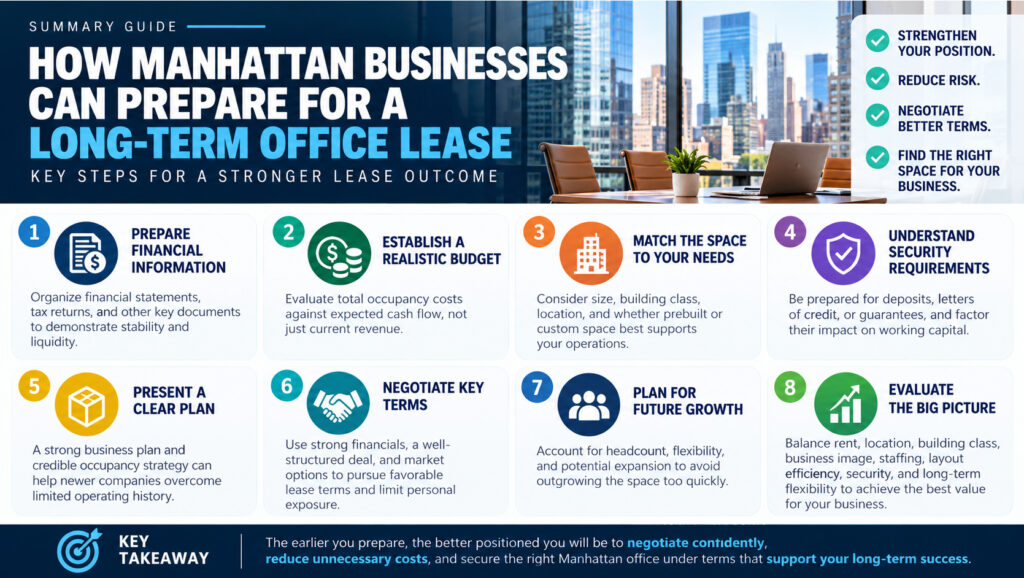
Summary: How Manhattan Businesses Can Prepare for a Long-Term Office Lease
Manhattan office lease requirements are designed to help landlords evaluate the businesses occupying their properties and the financial risks associated with long-term rental commitments.
For prospective tenants, however, the qualification process should not be viewed exclusively as an obstacle to overcome.
It also provides an opportunity to understand the company’s financial readiness, establish a realistic occupancy budget, and negotiate the terms of a lease that supports its future operations.
An established business with strong financial statements may be able to negotiate a more favorable security arrangement or avoid extensive personal guarantees. Meanwhile, a younger company can sometimes overcome a limited operating history by presenting credible financial information, sufficient available capital, and a practical occupancy plan.
Additionally, tenants should carefully evaluate the interaction between financial qualifications and the physical office they intend to lease.
A well-configured prebuilt office, for example, may reduce construction costs, preserve working capital, and eliminate unnecessary spending on furniture or improvements. Similarly, choosing an appropriately sized office in a suitable Manhattan location may deliver greater long-term value than committing to excess square footage in a more expensive property.
The Good Guy Clause also deserves particular attention. When properly negotiated, it may substantially reduce a business owner’s personal exposure, although it should never be confused with an automatic cancellation right for the corporate tenant.
Ultimately, the objective is not simply to prove that a company qualifies for a Manhattan office lease. It is to secure the right office under financial terms that make sense for the business.
That means balancing rent, location, building class, business image, staffing, layout efficiency, security requirements, future flexibility, and the company’s available financial resources.
The earlier these matters are considered, the better positioned a tenant may be to negotiate confidently and avoid unnecessary costs or obligations.
Find Manhattan Office Space That Fits Your Business and Budget
At NewYorkOffices.com, we help businesses identify and evaluate available office space throughout Manhattan, including Midtown, Midtown South, Chelsea, Flatiron, Union Square, NoMad, and the Financial District.
As tenant-side commercial real estate brokers, we represent businesses seeking office space rather than landlords marketing their properties.
Our role is to help tenants compare suitable offices, evaluate asking rents, understand available lease concessions, and identify opportunities to reduce unnecessary occupancy costs. Additionally, we help businesses assess the practical advantages of furnished offices, prebuilt installations, full-floor opportunities, and spaces that can accommodate their particular staffing and operational needs.
Whether your company is establishing its first Manhattan office, relocating from an existing building, expanding its workforce, or negotiating a new long-term lease, understanding the property’s financial qualification requirements is an important part of the process.
We can help you identify potential office opportunities that fit your company’s budget, image, location preferences, staffing requirements, and expected lease commitment, while working with you to pursue favorable business terms.
Our tenant brokerage services are provided at no fee to the tenant under the customary landlord-paid commission arrangement.
Fill out our 📋 online form or give us a call today 📞 212-967-2061 — let’s find the right office for your business.