Where Can Small Teams Still Find Office Space in Flatiron
Why this neighborhood still works for small teams
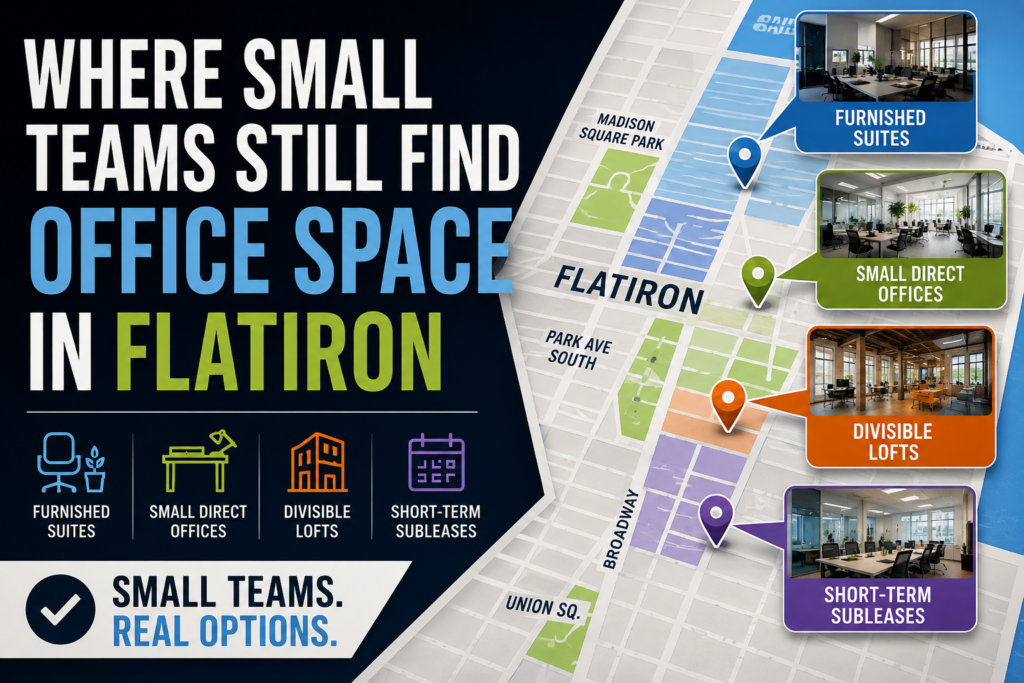
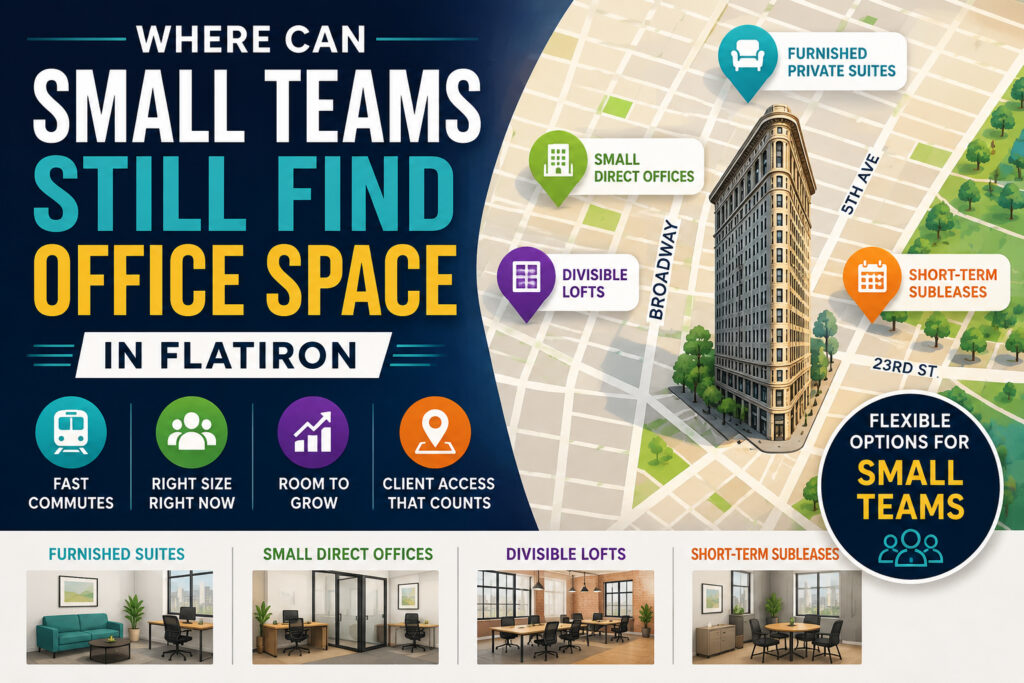
Yes, small teams can still find office space in Flatiron. The catch is simple. The best options rarely sit in one single bucket. Most real choices now fall into four lanes: furnished private suites, small direct offices, divisible lofts, and short-term subleases. That mix matters because a two-person startup, an eight-person advisory firm, and a twelve-person product team do not shop the same way.
What keeps the district attractive is not just prestige. Teams come here for fast commutes, strong client access, and a building stock that still includes smaller loft floors and partial-floor suites. The neighborhood also gives growing firms a ladder. You can start with a serviced room, move into a built office, then graduate into a larger direct lease without leaving the area. That kind of progression still exists here, and that is a big reason small companies keep circling back to Flatiron.
If you want live inventory first, start with our Flatiron office listings and our broader Flatiron office space overview. Those pages help you see the market as it exists now, not as it looked a year ago.
The corners where smaller suites still survive
The most expensive addresses do not usually serve the smallest tenants well. Space near Madison Square Park and the Park Avenue South corridor attracts bigger budgets, larger expansions, and premium asking rents. By contrast, the west side of the district, the prewar side streets, and many Broadway loft buildings still produce the better small-team opportunities. That is where partial floors, boutique suites, and more flexible layouts tend to surface.
That split explains why one search for Flatiron office space can feel confusing. One address may target trophy users. Another may work for a ten-person firm that values light, ceiling height, and a pantry more than a park-front identity. In practical terms, smaller teams usually do better when they widen the map by a few blocks and focus on usable layouts, not just headline addresses.
The neighborhood’s smaller inventory often hides inside loft buildings with efficient partial floors. A current example on our site shows a 1,025 SF small Flatiron office that fits roughly four to ten seats. Another current option offers a 5,370 SF white-box loft divisible to 1,060 SF, 2,155 SF, 3,230 SF, or 3,540 SF. Those examples matter because they show the real answer to this question: small teams still find space here when they target buildings that can break floors down intelligently.
The office formats that actually fit smaller headcounts
Small-team office hunting works best when you match the format to the company stage. A furnished room solves one problem. A direct lease solves another. A sublease solves a third. The mistake is assuming they all compete on the same terms.
| Format | Best fit | Why it works | Good internal starting point |
|---|---|---|---|
| Serviced private suite | 2 to 6 people | Fast move-in, furniture included, simple monthly billing | Why Flatiron works for small businesses |
| Small direct office | 4 to 10 people | Better privacy, more control, stronger long-term economics | Small Flatiron District Office |
| Divisible loft or prebuilt suite | 6 to 15 people | Lets you right-size now and grow inside the same footprint | Furnished Whitebox Office Space |
| Short-term furnished sublease | 8 to 20 people | Faster occupancy, existing buildout, lighter upfront spend | West 20th Street Office Space Rental and 900 Broadway 10th Floor Sublet Office Space |
Current operator pages, directory listings, and live Flatiron inventory support this split between suites, direct leases, divisible lofts, and furnished subleases. They also show why the same neighborhood can serve both a two-person team and a fifteen-person team without forcing the same lease structure on both.
Serviced private suites work best when speed matters more than customization. You pay for simplicity. Furniture, internet, and shared amenities often come bundled. That route makes sense if your team wants one room, a polished common area, and a short launch timeline.
Small direct offices make more sense when privacy and control matter. A direct suite gives you your own front door, your own daily rhythm, and fewer shared-space compromises. It also starts to look smarter once your team needs several private rooms, a real pantry, or a layout that does not depend on meeting-room credits.
Subleases sit in the middle. They often arrive furnished and wired. That reduces setup time and lowers the friction of getting into the neighborhood. For growing teams that need a solid office now, but do not want a long direct term yet, this can be the cleanest bridge.
What the numbers look like right now
Rent depends on location, condition, and lease type. Still, the market gives small teams real benchmarks. CommercialCafe lists current Flatiron asking rents averaging about $73 per square foot, with listed rates as low as $57 and as high as $87. Broader Midtown South reports place the market in the high-$70s to low-$80s range, while value loft corridors inside Flatiron can still price below the premium park-front band.
Flexible private-office pricing also shows a usable range. One current Flatiron operator advertises a 2-person private office from $1,590 per month and a 4-person office from $2,870 per month on a twelve-month commitment. Another current neighborhood pricing guide places typical serviced private suites at roughly $1,200 to $2,500 for one to two people, $2,500 to $6,500 for three to five people, and $5,000 to $13,000+ for six to ten people. Those numbers matter because they frame the real choice between paying for convenience and leasing square footage directly.
Day-use and lighter-flex options keep the entry point even lower. Current neighborhood listings show day access from about $80 at one design-forward Flatiron workspace, while broader desk platforms advertise offices from $50 per day and desks from $15 per day. That does not replace a true office for most teams, but it does give founders and hybrid groups a cheap landing zone while they test the district.
Sublease economics deserve special attention. Our current Union Square sublease guide, which tracks the same nearby cluster, shows $88.34 per square foot in direct asking rent versus $69.00 per square foot in sublet asking rent, or roughly a 22% gap. Small teams should not read that as an automatic bargain, because term length, furniture quality, and remaining life all matter. Even so, the spread helps explain why furnished subleases remain one of the strongest answers for teams that want Flatiron without a full direct buildout.
Space size tells its own story. Our current ten-person guide notes that a team of ten often shops in the 1,500 to 2,000 SF band if it wants a reception point, private rooms, a pantry, and room to grow. Meanwhile, one live NYO listing shows a 1,025 SF loft that supports four to ten seats, and another shows a 3,400 SF furnished sublease designed for roughly ten to sixteen people. Those examples show why “small office” in Flatiron can mean very different things depending on whether you need one room or a full operating layout.
How to choose the right path for your team
A two-person or three-person team usually should not over-lease. If you need speed, use a furnished private suite first. That choice keeps your move light, your setup fast, and your monthly math clear. Once headcount hardens, you can compare that monthly number against a small direct office.
A four-person to six-person team reaches the real crossover point. At that stage, a serviced suite still works, but a small direct loft starts to get interesting. A current 1,025 SF Flatiron office on our site supports four to ten seats, which means a compact team can gain privacy and identity without jumping into a huge footprint. That is often the point where direct leasing stops feeling excessive and starts feeling efficient.
A six-person to ten-person team should compare every path side by side. This is where private suites, small prebuilt offices, and nearby subleases all compete. The right answer depends on how often the full team comes in, how much privacy you need, and whether you want one open room or several enclosed spaces. If your team needs real meeting habits, stronger acoustics, and room to hire, the direct or sublease route often wins.
An eight-person to fifteen-person team usually benefits from space that already has shape. A built sublease can let you inherit meeting rooms, furniture, and wiring. A divisible loft can do the same thing in a different way by giving you a clean rectangular floor and future expansion space. Live NYO examples show both paths in play, from divisible loft inventory to furnished subleases in the 3,000 SF range and above.
If your team expects fast growth, read our Flatiron office space for 10 to 50 person teams alongside the smaller listings. That guide helps frame the next step before you lock into the wrong first step.
What to ask before you tour
First, ask how many people actually work in the office on the same day. Hybrid teams often shop too large. Daily attendance matters more than total payroll. A six-person company that peaks at four in-office people shops very differently from a six-person company that works together every day.
Next, ask what the quoted price really includes. Some options bundle furniture, internet, coffee, meeting-room access, and mail handling. Others quote a rent number but leave you with electric, internet, after-hours HVAC, setup work, or taxes and fees. Small teams make better decisions when they compare total occupancy cost, not just sticker rent.
Then, ask whether you need one room or a full office system. A single private room can work for a founder team. A client-facing group may need reception, one meeting room, a pantry, and sound separation. That difference changes the square footage target immediately. It also changes whether a shared-building suite, a direct partial floor, or a prebuilt sublease makes the most sense.
After that, ask how fast you must move. If the answer is “within weeks,” furnished subleases and serviced private suites usually rise to the top. If the answer is “within a quarter,” you can widen the search to include smaller direct suites and white-box opportunities that need light work. Timing often decides the format before budget does.
Finally, ask whether this office can still work after your next hire cycle. Moving twice in one year costs more than most teams expect. A small suite that can stretch, or a divisible floor that can phase up, often beats a perfect-looking room that forces another search in six months. That is why expandable lofts and well-shaped subleases matter so much in this neighborhood.
Find a Flatiron Office Today
We represent tenants, not landlords. Our role is to source smaller Flatiron offices, compare direct lease and sublease options, and keep the shortlist honest. If you want help, we can line up tours, pressure-test the economics, and negotiate from the tenant side.
Fill out our 📋 online form or give us a call today 📞 212-967-2061 — let’s find the right options for your business.