Questions to Ask Tenant Rep Broker NYC
Why these questions matter in NYC right now
A tenant rep broker in NYC does far more than schedule tours. A good one should help you define need, gather proposals from multiple landlords, compare economics, coordinate architects and counsel, and drive the business terms before legal language hardens. That workflow appears in the City’s own commercial leasing guide, and it matters more in a market where better buildings tighten first.
Face rent alone will not protect you. Real occupancy cost turns on free rent, tenant improvement dollars, escalations, tax pass-throughs, operating expenses, utilities, security deposit, guaranty exposure, and end-of-term obligations. That is why the smartest questions do not start and end with the quoted rent.
The lease also carries unusual weight in commercial space. The City guide states that a commercial tenant’s rights are almost all governed by the lease, that the first landlord draft usually favors the owner, and that landlords do not have to renew by law unless the lease says so. Consequently, your broker must think beyond “space found” and into “risk controlled.”
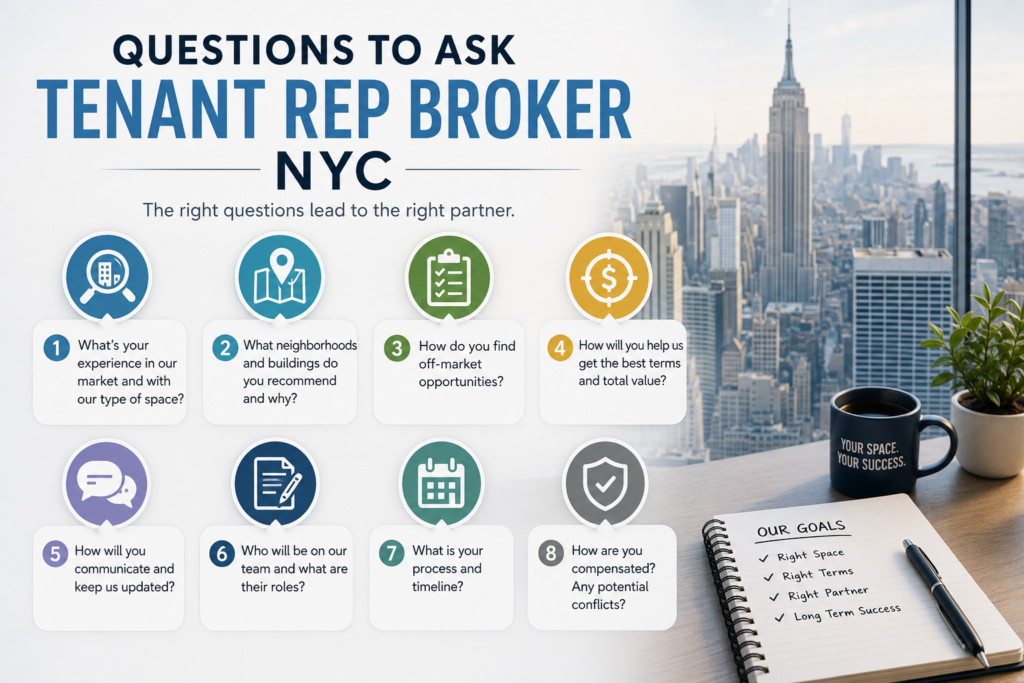
Questions about loyalty, conflicts, and accountability
Ask who the broker really represents
Ask this:Do you or your firm list space for landlords in the same neighborhoods I want to tour, manage buildings for owners, or invest in properties that could appear in my search?
That question gets to the core issue. Some firms chase tenant work while also serving owners. Others keep a tenant-only model. The practical concern is simple: compensation, confidentiality, and loyalty can pull in different directions when the same firm sits on both sides of the market. If the answer sounds vague, keep digging.
Ask this next:If you do have landlord-side relationships, how will you disclose conflicts and protect my data?
A strong answer should sound clear, direct, and specific. You want a written process, not a verbal shrug. You should also expect the broker to explain who can see your requirements, budget range, timing pressure, and shortlist.
Ask how the broker gets paid
Ask this:Who pays you in a direct lease, in a renewal, and in a sublease? Will I owe anything if the landlord or sublandlord does not pay?
In the City’s commercial leasing guide, the landlord usually pays the broker in a standard commercial lease. However, office tenants should still confirm the structure in writing, especially on subleases, unusual off-market deals, and representation agreements that discuss landlord non-payment. Never assume. Ask.
Ask this too:Does your compensation change by listing or landlord? If so, will you disclose material differences?
That question sounds awkward. Ask it anyway. Compensation can shape advice. A tenant-forward broker should not flinch when you ask how they keep economics from steering the search.
Ask what the representation agreement really says
Ask this:How long does the agreement last, what geography does it cover, how do I terminate it, and what tail period applies after termination?
This matters. Exclusive agreements can improve focus and negotiating leverage, but weak drafting can create future disputes. Watch for overly broad areas, no clear exit right, and tail clauses that stretch too long without a defined prospect list. Before you sign anything, ask the broker to show value first through a market survey, curated options, or clear comparable data.
Ask this before you sign:If I already found a building, toured a floor, or contacted an owner, how does the agreement treat that lead?
That point deserves clarity on day one. You want clean rules around prior contacts, self-sourced opportunities, and deals already in motion. Otherwise, a simple inquiry can turn into a compensation fight later.
Ask who will stay involved after the pitch
Ask this:Who will run the search day to day, who will build the economics, who will negotiate, and who will stay on the account after I sign?
The strongest tenant reps can explain their bench. They can name the people who will handle analysis, tours, project coordination, and negotiation. They can also tell you what each person actually does. That transparency matters because many searches fail in the handoff, not the interview.
Questions about market knowledge, coverage, and neighborhood fit
Ask for recent tenant-side transactions in your exact lane
Ask this:How many office leases have you personally completed in my size range, for tenants, in my target neighborhoods, during the last year?
That question moves past brand talk. You want current, personal, tenant-side experience in the exact lane you will occupy. A broker can work inside a famous firm and still lack hands-on depth in your deal size, your geography, or your building type. Ask for examples that match your reality.
Ask this next:Can you show me three tenant references who used you more than once?
Repeat clients tell you more than polished testimonials. They suggest the broker added value not only during the first lease, but also during renewals, expansions, or later moves. Long-term tenant orientation matters in New York because the first lease rarely closes the story.
Ask for a real market survey, not a short email list
Ask this:Will you run a full market survey across direct leases, subleases, short-term options, and move-in-ready suites before we fall in love with one floor?
You want breadth before emotion. The City guide states that your broker should gather proposals from multiple landlords. Broader coverage creates leverage, protects timing, and helps you see which price gap comes from location, which gap comes from building quality, and which gap comes from lease structure.
Ask this too:Will you show me public listings, privately circulated opportunities, and sublease inventory in one comparison?
A smart search should include all three buckets. That does not mean every off-market whisper is real. Still, the broker should have access to more than what appears on public websites and should explain how they verify current availability before you tour.
Ask how the broker will size the requirement
Ask this:How are you converting headcount into usable and rentable square footage?
Start there, not with a random round number. A practical planning rule for Manhattan office users is 150 to 200 usable square feet per employee. Open plans often run lower, hybrid layouts often run in the middle, and private-office-heavy layouts often run higher. If your team works hybrid, shared seating can reduce the requirement further.
Ask this next:Can you pressure-test my size assumption against layout style, growth, and density?
That is where real broker value shows up. The right broker should translate your workstyle into square footage, then tie that need to live inventory and budget. If you want deeper planning help, pair this page with how much office space you need.
Ask which neighborhoods truly fit your team
Ask this:Which submarkets fit my commute pattern, budget, image, and lease term length best, and why?
A useful answer should compare tradeoffs, not just praise a favorite district. Internal Manhattan pricing guides place the highest asking levels in the Plaza and Park Avenue corridor, strong next-tier pricing near Hudson Yards and Penn, broad middle bands in Flatiron, SoHo, and Tribeca, and frequent value plays in the Financial District. Current building class, floor condition, and term can widen or compress any one range, so ask for live comps, not canned talking points.
If your search starts from geography, move from broad intent to live inventory with NYC office space listings, then compare Grand Central office space, Penn Station office space, Midtown East office space, Flatiron office space, SoHo office space, Hudson Square offices, and Financial District office space. Those pages help you compare inventory by district before you tour.
Ask if the broker will compare direct space against sublease space
Ask this:Will you show me both direct and sublease options, and will you tell me when one path beats the other?
That question matters because the paths solve different problems. Subleases can offer lower effective occupancy cost, faster move-ins, existing furniture, shorter terms, and reduced build-out burden. Yet the City’s guide warns that a sublease also adds risk: if the prime tenant violates the main lease or fails to pay the landlord, the landlord can terminate the sublease and evict the subtenant. Renewal rights also tend to shrink in subleases.
Ask this follow-up:If you recommend a sublease, what prime-lease risks, restoration costs, and consent issues should I underwrite first?
You want the broker to answer that without hesitation. Faster occupancy means little if hidden liability follows you out at the end.
Questions about money, concessions, and the real cost of the deal
Ask for face rent and effective rent on every serious option
Ask this:For each space, what is the asking rent, what is the effective rent, and what assumptions drive the difference?
This is one of the best questions to ask a tenant rep broker in NYC. Base rent never tells the whole story. Effective rent folds in free rent, tenant improvement dollars, escalations, taxes, operating expenses, and other pass-throughs. A broker who cannot explain that spread cannot protect your budget.
Ask for the math:Please show the full comparison in writing.
You want a side-by-side model, not a fuzzy verbal summary. A good Manhattan pricing guide even shows how a quoted rent can fall materially once free rent and TI are applied over the term. If you want a primer before the interview, read how office space pricing works in Manhattan.
Ask what sits on top of base rent
Ask this:What additional rent should I expect above base rent, and do you have estimates for each building?
The City guide says tenants often pay more than base rent through operating expense increases, real estate tax increases, fixed annual bumps, or other building-wide formulas. In practical terms, one lease can look cheaper on the first page and still cost more over time. Ask what the base year is, what expenses pass through, and how the broker is benchmarking those items across your shortlist.
Ask this too:What are the typical annual escalations here?
Some Manhattan guides cite 2% to 3% as a common band. Even a “small” annual bump compounds over a five- or ten-year term, so it belongs in every financial comparison.
Ask about electricity, cleaning, HVAC, internet, and after-hours use
Ask this:Is electricity direct-metered, submetered, or included, and what else do I pay outside the rent?
The City guide calls electricity the main utility expense and notes that tenants usually pay it separately from rent. Payment often comes through a direct meter from the utility or a submeter billed by the landlord. Both methods can change your monthly cost materially, especially in dense or high-usage layouts.
Ask this next:What do after-hours HVAC, condenser water, supplemental cooling, cleaning, internet, and access cards cost?
That follow-up matters because two comparable suites can produce very different monthly bills after you layer in real operations. Ask the broker to price the whole monthly occupancy picture, not just the lease headline.
Ask what concessions are realistic now
Ask this:What free rent and tenant improvement package should a tenant like me expect in this submarket, building class, and term length?
Do not ask whether concessions exist. Ask how much you can realistically win. The City guide says rent abatements are common and best discussed at the term sheet stage. It also defines the tenant improvement allowance as the landlord’s contribution toward initial alterations. In other words, you should negotiate these items early, before the lease draft tries to narrow them.
Ask this too:Will the landlord cover my full build-out, or do I need to budget extra cash?
Current internal construction guidance gives a useful range: basic office build-outs can start around $50 to $100 per square foot, mid-range work often lands near $150 to $250, and high-end custom work can exceed $300 to $400. In many cases, the landlord package will not cover every upgrade. Your broker should say that plainly. For more context, see office construction pricing.
Ask what deposit and guaranty the landlord will want
Ask this:What security deposit, letter of credit, or guaranty do you expect this landlord to require from a company like mine?
The City guide says security deposits usually equal a number of months of rent, with two months as a common figure, though the number changes with financial strength, guaranty structure, and access to cash or credit. Cash tied up in security cannot fund hiring, furniture, cabling, or move costs, so this point deserves the same attention as the rent itself.
Ask this next:If the landlord asks for a good guy guaranty, what does yours actually cover?
That phrase sounds friendly. The drafting often is not. The City guide explains that a true good guy guaranty limits personal liability after you vacate, but warns you to avoid clauses that force payment of accelerated rent, extra performance obligations, or repayment of free rent, TI, or broker commission. That is a major interview question because a weak broker can agree to a “good guy” in name only.
Questions about lease terms, risk, and legal protection
Ask how the broker works with your lawyer
Ask this:When do you want counsel involved, and how do you divide business negotiations from legal negotiations?
The City guide puts the lawyer into the process early, especially before you sign. It also says the landlord usually delivers the first draft and that the first draft usually favors the landlord. A serious tenant rep should welcome early legal review instead of acting like counsel slows things down. Good brokers and good lawyers make each other stronger.
Ask this follow-up:Will you keep the term sheet clean, complete, and specific before legal drafting starts?
That is where money leaks or stays protected. The more precise the term sheet, the fewer unpleasant “surprises” show up later in the lease rider.
Ask which clauses the broker will push first
Ask this:Other than rent, which clauses do you think matter most for my business, and why?
A strong broker should answer with your operational needs, not a generic list. Common pressure points include renewal rights, expansion rights, assignment and subletting, use language, commencement language, TI timing, notice and cure periods, restoration, and default language. The answer should sound tailored to your company and your likely growth path.
Ask about renewal rights now, not at the end
Ask this:If I stay, what renewal option should I negotiate today, and how should the rent get set?
The City guide says commercial landlords do not have to renew and can ask for any rent at renewal unless the lease gives you protection. Renewal language therefore belongs in the first negotiation, not the last year of the term. Internal Manhattan leasing guides also note that common office lease terms run five to ten years, often with options to renew.
Ask this too:How early will I need to exercise the option?
Renewal deadlines often require notice months before expiration. If the broker cannot explain the notice window, the market formula, and any grace strategy, keep looking. For deeper reading, see structuring renewal options and expansion rights and what to know about renewal options in a Manhattan office lease.
Ask about assignment, subletting, and exit flexibility
Ask this:If I outgrow the space, shrink, merge, or sell the company, how easy will it be to assign or sublet?
The City guide says you can negotiate assignment and subletting rights and can ask the landlord to act reasonably when giving consent. It also warns that even after a transfer you may still carry liability if the new occupant fails to pay. That means the broker should negotiate transfer language with the endgame in mind, not just the move-in.
Ask this next:Will the landlord have recapture rights, profit-sharing rights, affiliate carve-outs, or approval fees?
Those details matter because they shape flexibility years later. If the broker treats transfer language like a footnote, your future options may narrow when you need them most.
Ask about possession, commencement, and delay risk
Ask this:When do I get access, when does rent start, and what happens if work or delivery runs late?
The City guide warns tenants not to assume the space will be available on the desired date and advises including a cancellation right if the space is unavailable by a set outside date. Internal Manhattan guidance also notes that lease commencement can trigger rent, construction deadlines, and TI reimbursement clocks. A smart broker should separate possession, construction access, lease commencement, and rent commencement whenever the deal needs that structure.
Ask this too:What TI deadlines could cause me to lose landlord money?
That follow-up matters if the landlord offers improvement dollars. Missed invoice or completion milestones can burn value fast.
Ask about restoration, furniture, and cabling before you sign
Ask this:What will I have to remove at the end of the lease, and can you negotiate leave-in-place language or a cost cap now?
Many tenants focus on entry cost and ignore exit cost. That mistake can get expensive. Internal Manhattan guides say restoration clauses often require the tenant to return the office to a prior condition and warn that subleases can push demolition, furniture, or cabling removal risk onto the occupant. Because build-out choices echo at move-out, this subject belongs in the interview.
Ask about legal use, permits, and code issues
Ask this:Does the building’s certificate of occupancy allow my use, and what permits or approvals could delay occupancy?
The City guide tells tenants to confirm whether the legal occupancy permits the intended use. It also notes that significant alterations may require government approvals and that licensed professionals should handle that work. If your use creates unusual electrical, HVAC, public-access, or compliance needs, the broker should identify those issues before you issue an LOI.
Ask this next:Do I need an architect or engineer before I sign?
If your space requires renovation or system changes, the City guide says yes. Bring those experts in early, not after rent starts.
Questions about timing, buildout, move-in, and broker red flags
Ask when the process should begin
Ask this:Based on my size and build-out needs, when should I start the search and when should I start renewal leverage?
You are looking for a calibrated answer, not a guess. The City’s sample timeline shows that brokers, architects, engineers, lawyers, insurance, term sheet work, and lease negotiation can all stack before move-in. Internal Manhattan leasing pages suggest starting six to twelve months before the desired move date for many office searches, with earlier starts for larger or more customized requirements. Broader tenant-rep guidance pushes even earlier windows for larger occupancies.
Ask who joins the team, and when
Ask this:When will you bring in an architect, engineer, project manager, and lawyer?
That is not overkill. The City guide says architects should come in before signing if renovations matter, engineers should step in before signing if systems must change, and lawyers should engage early because they can speed up and strengthen negotiation. A broker who delays every specialist until after the handshake shifts risk back to you.
Ask how the broker will run the search to finish
Ask this:What does your process look like from first call to signed lease?
The answer should sound orderly. It should include needs assessment, market survey, tours, proposal comparison, term sheet, professional review, negotiation, and move planning. The City guide lays out that sequence clearly, and tenant-rep best practices echo it. You want a broker who can explain the path before you pay with time.
Ask for red flags before the broker becomes one
Ask this:What should make me say no to any broker I interview, including you?
The best answer often reveals the best advisor. Common warning signs include dodging conflict questions, refusing to discuss compensation differences, pushing a broad agreement without termination rights, offering no written market survey, skipping comparable deals, minimizing legal review, or steering you toward one building before the full market is tested. Long tail clauses, unclear geographic scope, and silence on landlord non-payment also deserve caution.
What your final shortlist should prove
Your final broker shortlist should prove six things. First, the broker protects your side clearly. Second, the broker knows your exact size range and neighborhood lane. Third, the broker can price effective rent, concessions, deposit, and guaranty honestly. Fourth, the broker treats transfer rights, renewal rights, and restoration as money questions, not legal trivia. Fifth, the broker can run the process early enough to create leverage. Finally, the broker stays accountable after the lease ink dries.
If you want the next step after this page, begin with what an office broker is, then review the commercial leasing guide for NYC, how office space pricing works in Manhattan, how much office space you need, how to secure the best office lease, and the live NYC office space listings. Those pages help you turn interview questions into a real tenant strategy.
A tenant-forward broker should make you feel more informed after every call. Better questions force better answers. In NYC office leasing, that often means a better lease too.
Fill out our 📋 online form or give us a call today 📞 212-967-2061 — let’s find the right office for your business.