Your Broker’s role is to compare direct leases and subleases against your timing, budget, operations, and risk tolerance. That tenant-first approach helps you judge the entire occupancy cost before you commit. A tenant Broker represent office tenants, not property landlords.
Quick answer:A direct lease usually wins when you need control, renewal options, custom work, growth rights, or a longer runway. A sublease often wins when you need speed, furniture, lower upfront capital, or a shorter commitment. However, the strongest choice depends on the documents, remaining term, space condition, and total occupancy cost.
What a Direct Lease and Sublease Actually Mean
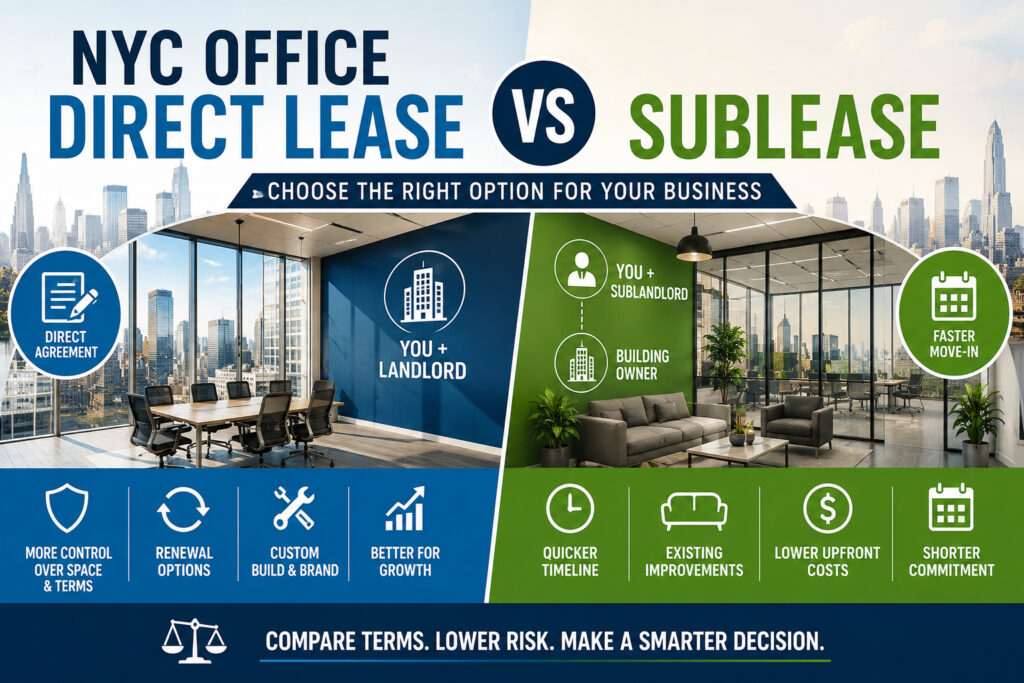
A direct office lease creates a landlord-and-tenant relationship between your company and the building owner. You negotiate your rent, term, construction package, security, use rights, and other business terms with that landlord. Direct leases commonly support longer occupancies and greater customization than subleases.
That structure matters because your company controls its own lease relationship. You do not depend on another office tenant to preserve your right to occupy the premises.
A commercial office sublease works differently. Your company rents from an existing tenant that already holds a lease covering the space. That existing tenant becomes your sublandlord, while the building owner remains the prime landlord.
The existing tenant’s lease becomes the prime lease or overlease. Your sublease operates underneath that document. Therefore, the prime lease can limit your term, use, alterations, access, signage, and other rights.
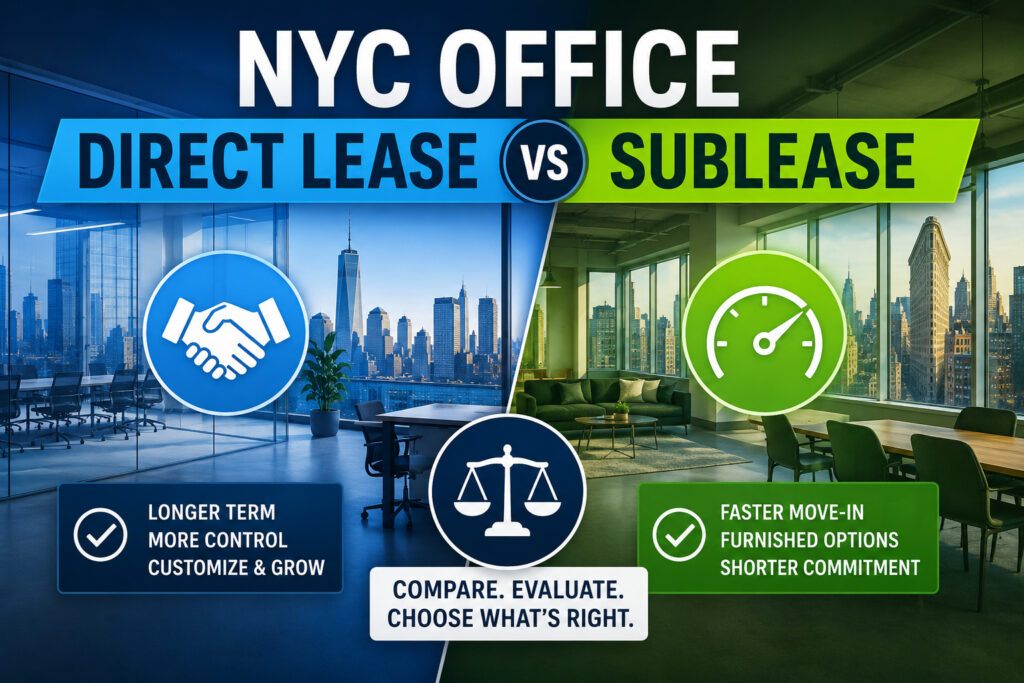
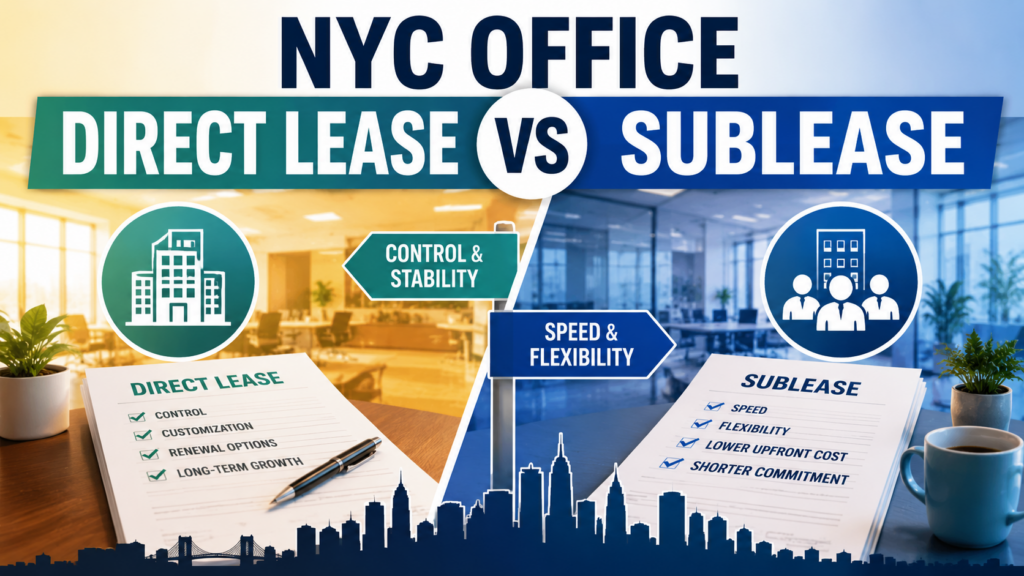
That distinction creates the central trade-off. A direct lease gives you a cleaner relationship and more negotiating control. A sublease can give you speed, existing improvements, furniture, and a shorter commitment.
Neither structure automatically offers the better deal.
What does “sublet” mean in an NYC office search?
People often use sublet and sublease conversationally when discussing second-generation office space. However, the signed documents determine the actual legal relationship.
A true sublease leaves the prime lease in place. An assignment transfers a broader leasehold interest to another party. A landlord can also negotiate a replacement direct lease after an existing tenant leaves.
Those structures create different liabilities. Therefore, never rely only on a listing label.
When a space interests you, identify who will actually sign your occupancy agreement. That answer tells you whether you are evaluating a direct lease, sublease, assignment, or another arrangement.
The easiest comparison starts with the business consequences rather than the asking rent.
Issue
Direct Lease
Sublease
Your counterparty
Building landlord
Existing tenant
Underlying relationship
Your lease controls occupancy
Prime lease plus sublease control occupancy
Typical commitment
Often several years
Limited by remaining prime-lease term
Move-in speed
Fast for finished space; slower with construction
Often fast when already built and furnished
Customization
Usually greater
Usually more limited
Furniture
Tenant often supplies it
Frequently available with the space
Construction money
Landlord may provide improvements or allowances
Usually limited or unavailable
Free-rent potential
Often negotiable
Depends on sublandlord economics
Renewal control
Can negotiate extension rights
Often uncertain beyond prime-lease expiration
Expansion rights
Can negotiate directly with landlord
Usually harder to secure
Building relationship
Direct
Usually indirect
Landlord consent
Not relevant to initial lease
Prime lease may require it
Credit review
Landlord reviews tenant
Sublandlord and landlord may both review
Prime-lease exposure
None
Significant diligence issue
Best fit
Stability, control, customization
Speed, flexibility, existing infrastructure
Manhattan direct leases commonly run around five or ten years. Shorter direct arrangements also exist, especially in smaller finished suites. Subleases commonly serve tenants seeking shorter commitments because their expiration cannot exceed the controlling leasehold interest.
Still, lease type does not determine space condition.
A direct suite can arrive fully built, wired, and ready for occupancy. Conversely, a sublease can require furniture changes, cabling work, repairs, or layout modifications.
That distinction matters when comparing real alternatives. Do not assume “direct” means construction or “sublease” means turnkey.
Your best comparison should address term, condition, capital, control, risk, and exit strategy together.
What Each Option Actually Costs in NYC
Asking rent creates only one part of the financial picture. A lower quoted number can still produce a worse deal after other costs enter the model.
Current Manhattan data shows why subleases attract attention. During the second quarter of 2026, Manhattan’s overall average asking rent reached $80.17 per square foot. Sublease asking rent averaged $59.94 per square foot. Sublease availability represented 2.6% of the market.
Midtown showed an overall average asking rent of $86.18 per square foot. Its sublease average reached $63.19 per square foot. Downtown recorded $61.34 overall and $47.13 for sublease space.
Q2 2026 Market
Overall Asking Rent
Sublease Asking Rent
Overall Availability
Sublease Availability
Manhattan
$80.17/SF
$59.94/SF
14.4%
2.6%
Midtown
$86.18/SF
$63.19/SF
12.7%
2.3%
Downtown
$61.34/SF
$47.13/SF
16.6%
3.5%
Important: overall asking rent does not equal direct-only asking rent. Therefore, those figures do not establish a universal sublease discount. They provide current market context instead.
Compare total occupancy cost, not just rent
A direct lease may carry a higher face rent but provide substantial landlord investment. Longer terms can support free rent, construction contributions, and stronger improvement packages.
Meanwhile, a furnished sublease may eliminate much of your initial build-out expense. Existing conference rooms, offices, kitchens, wiring, and workstations can preserve cash.
Then account for free rent and landlord contributions.
This calculation produces a true occupancy cost rather than a misleading face-rent comparison. Our commercial leasing guide explains the other expenses that can affect a Manhattan office lease.
Term, Speed, Furniture, and Construction Can Change the Winner
A sublease becomes especially attractive when your business needs an office before a conventional construction schedule works.
Existing sublease space often contains another company’s completed office infrastructure. Yet you must confirm exactly what remains at delivery. Furniture inside a suite does not automatically mean you receive ownership of it.
Ask for a furniture inventory. Identify desks, chairs, conference tables, appliances, fixtures, audiovisual equipment, and other personal property.
Next, determine whether you own those items after signing. Some sublandlords transfer furniture. Others only permit its use during the sublease.
A direct lease can also move quickly
Tenants sometimes assume direct space requires months of construction. That assumption can eliminate strong options unnecessarily.
Many landlords offer finished or prebuilt office suites. Therefore, the real comparison should involve delivery condition against delivery condition.
A finished direct suite may give you speed plus a direct landlord relationship. Meanwhile, an incompatible sublease might need significant reconfiguration.
Layout compatibility changes the economics.
Consider a 10,000-square-foot office with the wrong mix of private offices and conference rooms. Its discounted rent means less after you demolish walls and rebuild the premises.
Likewise, a sublease becomes valuable when the inherited build-out closely matches your program.
Remaining term matters more than the word “sublease”
A short term can protect a business with uncertain headcount. However, frequent relocations create costs and operational disruption.
Direct Manhattan leases often support five-year or longer planning horizons. Smaller suites and transitional requirements can support shorter terms.
Sublease expiration depends on the prime lease. Consequently, you should compare the available term against your actual business forecast.
A bargain becomes less compelling when you must move again twelve months later.
For live examples of different second-generation layouts, review our current NYC office sublets.
Control, Renewal, Consent, and Prime-Lease Exposure Matter Most
Price attracts tenants to subleases. Control usually determines whether the savings remain worthwhile.
With a direct lease, you can negotiate your renewal rights with the landlord from the start. You can also address expansion, assignment, subletting, alterations, signage, and restoration in your own lease.
A subtenant inherits more constraints.
Your sublease may incorporate many prime-lease requirements. Accordingly, you need both documents before making a fully informed commitment.
Landlord consent can become a critical condition
Commercial transfer rights depend heavily on negotiated lease language in New York. Many commercial leases require landlord consent before a tenant can sublease its premises. Some clauses also state that consent cannot face unreasonable withholding.
A prime lease can give the landlord additional rights after receiving a sublease request. For example, negotiated provisions can include a right to recapture the proposed space. New York courts have enforced commercial leases containing such mechanisms.
Therefore, investigate consent requirements before treating a sublease as available.
Prime-lease exposure deserves special attention
A sublease depends on the lease above it. New York courts have recognized that prime-lease expiration or termination following certain defaults can end subordinate occupancy rights.
That risk separates subleasing from direct leasing.
Counsel should examine default provisions, termination mechanics, and any protections available to the subtenant. Depending on the transaction, counsel may also explore recognition or non-disturbance protections.
Never evaluate a sublease solely from its own rent schedule.
Review the prime lease, amendments, landlord consent, permitted use, expiration date, and relevant default provisions.
Credit, Taxes, and Legal Details Can Shift the Decision
Direct landlords usually evaluate tenant credit before committing substantial capital to a transaction. Longer terms and larger construction packages can increase that scrutiny.
A landlord may request financial statements, tax returns, bank information, security, a letter of credit, or guaranty support. The exact package varies by tenant and transaction.
Subleases do not eliminate financial review. A sublandlord has its own exposure, while the prime lease may give the building owner approval rights. Commercial consent provisions can consider a proposed subtenant’s financial condition.
Do not apply apartment subletting rules to an office
New York’s well-known residential subletting statute specifically addresses tenants renting residences. Commercial office transactions operate under a different contractual framework.
That difference matters.
Do not assume a commercial landlord must follow residential approval deadlines. Likewise, do not assume residential standards regarding reasonable consent automatically govern your office.
Your attorney should review the specific commercial documents.
A sublease does not automatically avoid Commercial Rent Tax
New York City’s Commercial Rent Tax can apply to qualifying commercial occupancy in Manhattan south of 96th Street. Current rules generally begin with annual or annualized gross rent of at least $250,000. Exemptions and credits can change the final result.
Crucially, the city’s definition of tenant includes a sub-lessee. Therefore, choosing a sublease does not automatically remove this potential expense.
Certain incentive programs can also distinguish between leases and subleases. One current Lower Manhattan reduction specifically requires a qualifying lease rather than a sublease.
Treat taxes as part of your occupancy model. Have your accountant or tax adviser confirm your actual exposure before signing.
How to Compare Real NYC Office Opportunities
The strongest decision process starts before you tour anything.
First, define how much uncertainty your company can tolerate. Headcount, hiring plans, client traffic, privacy, hybrid attendance, and meeting demand should shape the requirement.
Next, set the business horizon. Decide how long the location must work before another move becomes acceptable.
Then compare direct and sublease opportunities simultaneously.
Our tenant-broker process starts with the operating requirement rather than random listings. It also compares lease structures through total occupancy cost.
For every direct lease, normalize these terms
Record the rentable area, face rent, escalations, free rent, security, and construction contribution.
Then review delivery condition, landlord work, commencement triggers, electricity, HVAC, cleaning, taxes, and operating charges.
Finally, compare renewal, expansion, assignment, sublease, alteration, and restoration rights.
The goal is not to pick a lease type first. Build one financial and operational scorecard, then let the better opportunity win.
Questions NYC Office Tenants Ask Before Choosing
Is it better to lease or sublease office space in NYC?
A direct lease usually fits tenants seeking control, continuity, customization, and longer-term rights. A sublease often fits tenants prioritizing speed, flexibility, existing improvements, and lower initial capital. Neither option wins automatically.
What does “direct lease” mean for office space?
You sign your office lease directly with the building landlord. Your company becomes that landlord’s tenant for the agreed premises and term.
Can you sublease commercial office space in New York City?
Yes, commercial subleases occur throughout NYC. However, the prime lease determines important transfer rights and restrictions. Many negotiated leases require landlord consent.
Is a sublease always cheaper than a direct lease?
No. Current Manhattan averages show lower sublease asking rents, but individual opportunities can differ substantially. Build-out, furniture, concessions, term, and condition can reverse the apparent advantage.
Can a subtenant renew after the sublease ends?
Not automatically. The sublandlord cannot simply grant occupancy beyond rights it controls under the prime lease. A future direct deal with the landlord requires separate agreement.
What happens if the prime tenant defaults?
Certain prime-lease defaults can threaten the subtenant’s occupancy. New York decisions confirm that subordinate rights can end after some prime-lease terminations.
Should a startup choose a sublease?
Only when the term, layout, capital requirement, and growth forecast align. A short commitment helps some growing companies. Others outgrow the space too quickly.
Should an established company always choose a direct lease?
No. A high-quality sublease can create excellent short-term economics for an established tenant. The company must accept the shorter runway and added document risk.
Which option offers better renewal certainty?
A direct lease usually gives you the better opportunity to negotiate renewal rights from day one. Sublease continuity depends on the prime lease and future landlord negotiations.
Which option offers faster occupancy?
A furnished, compatible sublease can move very quickly. A finished direct suite can also support rapid occupancy. Construction scope often matters more than the lease label.
Which option gives me more control over branding and design?
Direct leases generally provide greater negotiating room for alterations, signage, construction, and long-term space planning. Subleases usually inherit more preexisting restrictions.
What should I compare before choosing?
Compare total cost, remaining term, layout, furniture, construction, renewal, consent, credit, taxes, repairs, growth rights, and exit risk.
Ready to See Your Options?
A direct lease gives you the clearest route to long-term control and continuity. A sublease can deliver exceptional efficiency when its economics, documents, and expiration date fit your plan. We compare both markets side by side and negotiate from the tenant’s side.
Fill out our 📋online form or give us a call today 📞212-967-2061 — let’s find the right options for your business.