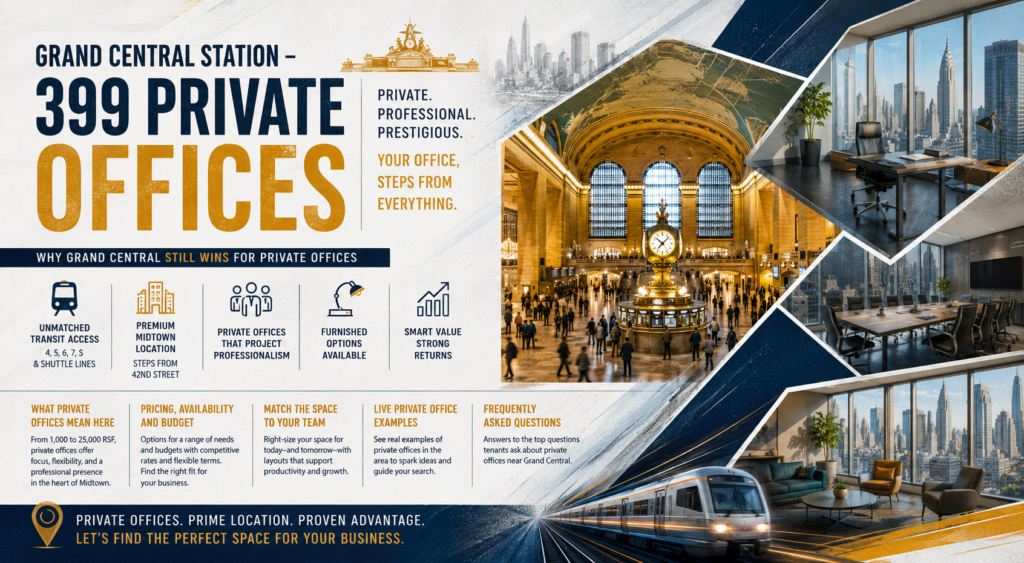
Grand Central Station – 399 Private Offices
Why Grand Central Still Wins for Private Offices
If you searched this exact phrase for a live inventory count, treat the number as a snapshot. Most office users who type “Grand Central Station” mean the office district around the terminal. Current market data sizes that submarket at about 43.9 million square feet. One major workspace marketplace now shows 409 offices there. Another flexible-office platform shows 18 flexible office spaces.
Transit drives the district. Grand Central serves commuter rail from the north on the Harlem, Hudson, and New Haven lines. East Side rail from Long Island now runs directly into Grand Central for the first time. That service added 50% more train capacity into and out of New York City. In May 2026, a new 45th Street entrance opened for the roughly 72,000 daily riders who use Grand Central Madison.
Rider demand backs up the location story. Commuter rail from the north carried just over 71 million riders in 2025. MTA also reported that weekday travel demand at Grand Central looked similar to 2019, with stronger midday off-peak use. East Side rail from Long Island carried 82 million riders in 2025 and reached 90% of its pre-pandemic ridership.
The subway side improved, too. The Grand Central–42 St upgrade now supports an estimated 400,000 daily riders. That project added 14 new staircases, widened 24 more, replaced 10 escalators, and increased public mezzanine floor area by 20%. The rebuilt shuttle also now runs six-car trains, which expanded capacity by 20%.
Exact placement matters here more than most tenants expect. MTA says the 47th or 48th Street side can reach Long Island platforms in about four to five minutes. By contrast, 42nd Street, 43rd Street, or the terminal often take six to eight minutes. Transfers from commuter rail inside the terminal can take ten to twelve minutes. Therefore, route-to-desk time matters as much as the street address.
Tenant takeaway: Grand Central fits teams that care about commute speed, client access, and deep office choice.
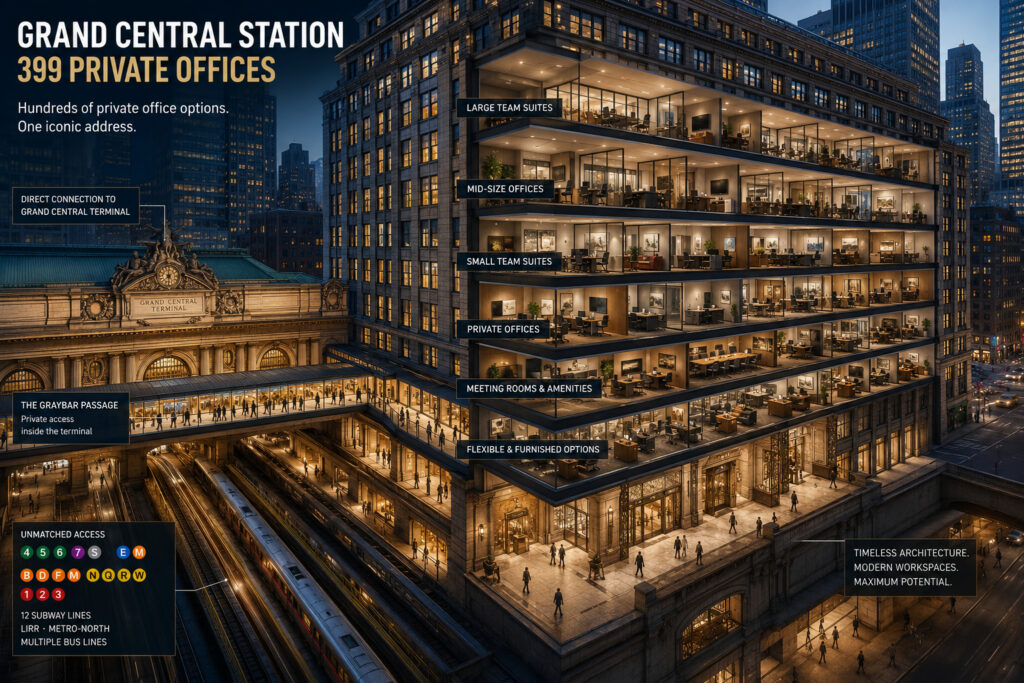
What Private Offices Mean Here
“Private office” does not describe one product in this area. It can mean an all-inclusive serviced room inside a shared center. It can also mean a furnished sublease, a prebuilt direct lease, or a larger partial-floor suite with your own branding and control. That range makes Grand Central useful for both small teams and larger occupiers.
Choose speed first. Then choose control. Serviced space usually bundles internet, cleaning, utilities, staff support, and shared amenities. Plug-and-play subleases give you more privacy and lower startup cost. Furnished direct leases feel closer to a normal office deal, but they still cut setup time. Prebuilt direct leases sit at the border between flexibility and permanence.
Amenities run deeper here than many search pages admit. One area guide reports breakout space in 89% of buildings. That same guide shows coffee or tea in 97% of buildings, 24-hour access in 35%, and 44 bookable meeting rooms across the district. Those numbers matter because private office users do not lease walls alone. They lease daily function.
Indoor terminal access adds another layer. Some buildings let tenants reach rail connections without stepping outside. That feature can save real time in bad weather. Still, a one-block walk can bring better economics and nearly the same access. As a result, direct connection helps, but it should not dominate the whole decision.
Quick read: In Grand Central, “private office” can mean monthly flexibility, short-term furnished control, or a longer direct lease with your own identity.
Pricing Availability and Budget
Grand Central’s overall asking rent sat at $69.93 per square foot in the first quarter of 2026. Class A averaged $74.18. Vacancy measured 18.5%. Leasing activity reached 878,004 square feet. Another 2.1 million square feet sat under construction. Midtown overall averaged $84.79 per square foot, while Midtown sublease asking rents averaged $64.02. Manhattan as a whole posted 11.78 million square feet of leasing in the quarter, with availability down to 13.7%.
That data tells a clear story. Grand Central is not cheap, but it still offers leverage in parts of the market. A practical planning band for many direct deals runs from the upper $50s to the low $90s. Better value often appears in older or repositioned stock. Trophy floors and heavily serviced product can run much higher. That range is an inference from current submarket averages, Midtown pricing, and local live guidance.
Do not stop at headline rent. Some deals come full-service gross. Others push utilities, janitorial, or operating-cost pass-throughs back to the tenant. A practical planning rule uses about 150 square feet per employee for a normal office layout. That means roughly 1,500 square feet for 10 people, 3,000 square feet for 20, and 4,500 square feet for 30. Current local guidance turns that into about $6,875 to $11,250 per month for 10 people, $13,750 to $22,500 for 20, and $20,625 to $33,750 for 30, before telecom and other extras.
Flexible inventory widens the range further. One platform shows 18 spaces from $239 per person each month near Grand Central. Another operator near the terminal lists private offices from $605 per person each month. A premium flexible provider nearby lists offices from $1,018 per month at one location and $1,296 per month at another. Monthly private suites also show up at $1,500 for three people, $3,500 for five, and $4,500 for six, with one-month minimum terms. In other words, format often changes cost more than geography.
Match the Space to Your Team
Small teams still have real options here. Current inventory includes a 1,040 square foot suite built for up to seven people. That office includes three private rooms, a conference room, a kitchen, 24/7 access, and a lobby attendant. At the lightest end of the market, another nearby operator advertises flex offices from $395 per month. So even a very small team can choose between a true office and a lighter monthly format.
Midsize groups get the deepest choice set. One current prebuilt office spans 6,252 square feet and includes three private offices, two conference rooms, and a boardroom. Another live suite spans 6,572 square feet and supports about 47 people with ten private offices and three conference rooms. A different partial floor offers 8,303 square feet with 11 private offices and 47 workstations. That mix works well for advisory, legal, recruiting, finance, and hybrid teams that need both privacy and open seating.
Larger groups can still avoid raw construction. One furnished sublease spans 12,987 square feet and suits about 73 people. Another direct lease offers 11,335 square feet with 18 private offices and three conference rooms. Even outside those examples, current building pages in the district show blocks that run well beyond 20,000 square feet. Therefore, the area does not stop at boutique suites. It also works for larger headquarters-style needs.
Move timing should shape the shortlist. Furnished offices cut setup time and reduce upfront capital needs. Prebuilt direct leases keep more control while still moving faster than raw space. Short monthly terms also exist in the district. However, if your team relies on East Side rail from Long Island, compare desk-to-platform time before you tour. A faster entrance can save minutes every day.
Live Private Office Examples
Start with a 1,040 SF office that includes three private rooms, a conference room, and a balcony. Then review a 6,252 SF prebuilt suite with three private offices, two conference rooms, and a boardroom. Next, compare a 6,572 SF prebuilt layout built for about 47 people with ten private offices and three conference rooms.
If you need more density, look at an 8,303 SF partial floor with 11 private offices and 47 workstations. After that, study an 11,335 SF direct lease with 18 private offices and three conference rooms. If your team wants a furnished larger suite, add a 12,987 SF sublease planned for about 73 people to the set.
True terminal access can matter for some groups. If that feature sits near the top of your list, compare a 7,134 SF turnkey suite with six private offices and two executive rooms. That kind of option works well for firms that want a polished arrival, immediate transit, and a faster move-in path.
For broader research, pair those listings with the current pricing guide, the furnished office guide, the flexible office guide, the direct-access guide, and the full Grand Central office search page. Together, those pages let you compare lease form, move-in speed, and exact location before you commit to tours.
Frequently Asked Questions
Are there really hundreds of private office options near Grand Central?
Yes. Live counts vary by source and by day. One large workspace marketplace currently shows 409 offices in the district. Another flexible-office platform shows 18 flexible office spaces. So a count like 399 should be read as a live snapshot, not a fixed total.
What rent should I budget first?
Start with the submarket average. Grand Central averaged $69.93 per square foot in Q1 2026, and Class A averaged $74.18. Then adjust for building class, layout quality, lease type, and included services. Midtown sublease asking rents averaged $64.02, so subleases can sometimes beat direct deals on economics.
What is the fastest move-in option?
Serviced and furnished suites usually move fastest. Prebuilt direct leases also move faster than raw construction. Monthly private offices exist in the district, and some listings carry one-month minimum terms. Therefore, speed depends more on product type than on neighborhood alone.
Do I need direct terminal access?
Not always. Indoor access helps in bad weather and can improve the daily experience for commuter-heavy teams. Still, a one-block walk can preserve nearly the same convenience at a better price. Compare the total commute, not just the front door.
How much space should I plan per person?
Use about 150 square feet per employee for a conventional office plan. That rule produces workable numbers for private rooms, meeting space, kitchen areas, and circulation. Smaller serviced suites can run denser, as current monthly listings show offices around 120 to 200 square feet for three to five users.
Is Grand Central good for suburban commuters?
Yes. Commuter rail from the north lands directly at the terminal through the Harlem, Hudson, and New Haven lines. East Side rail from Long Island now also runs into Grand Central, and MTA says that service increased train capacity by 50%. That combination gives the district unusual reach across the region.
Can I still negotiate here?
Yes, especially outside trophy floors. Grand Central vacancy stood at 18.5% in Q1 2026, even as Manhattan availability tightened overall. That suggests tenants still hold leverage in parts of the district. This is an inference from current vacancy and market-tightening data, not a guarantee for every building.
What should I compare before I tour?
Compare route-to-desk time first. MTA says some entrances reach Long Island platforms in about four to five minutes, while others take six to twelve. After that, compare lease structure, included services, privacy level, and the real working layout. Also ask what the rent includes. Headline rent alone never tells the full story.
Can I find offices for both tiny teams and larger footprints here?
Yes. Current live inventory ranges from a 1,040 square foot small suite for seven people to larger prebuilt, furnished, and direct-lease options above 10,000 square feet. Building pages in the district also advertise blocks above 20,000 square feet. Grand Central works because it covers small, midsize, and larger occupiers in one transit-first market.
Why do some private office prices look cheap, while others look expensive?
Because the products differ. A lightly branded monthly suite does not price like a high-end serviced office. A short sublease does not price like a long direct lease. Some rents include utilities, internet, cleaning, staffing, and shared rooms. Others do not. In Grand Central, format changes price as much as location.
We represent tenants only. We compare live office options near Grand Central from the occupier’s side. Then we negotiate rent, concessions, layout, and timing around your move, not an owner’s agenda.
Fill out our 📋 online form or give us a call today 📞 212-967-2061 — let’s find the right office for your business.