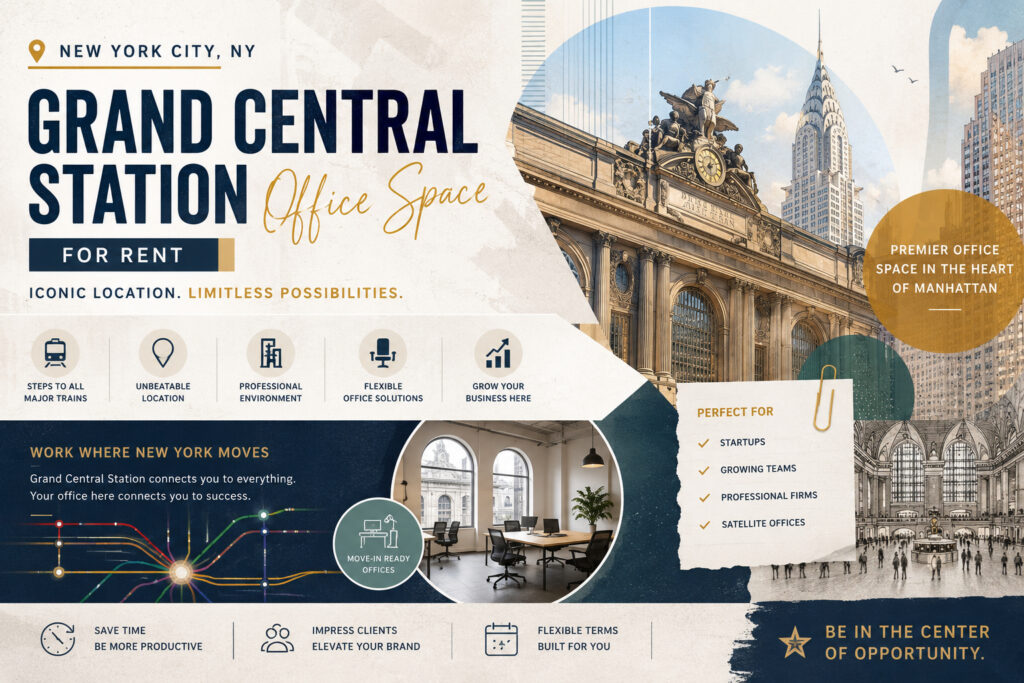
We represent tenants, not landlords. We compare space, pricing, terms, and timing from the occupier’s side. This page gives office users a current, practical, and fully tenant-forward guide to leasing near Grand Central.
Why Grand Central Still Works
Most searchers who type “Grand Central Station” mean the office district around the terminal in Midtown East. In real market terms, that area ranks as one of Midtown’s largest office submarkets, with major reports sizing it at roughly 43.9 million to 47.1 million square feet, depending on methodology.
Location drives the demand. The district centers on the blocks around East 42nd Street and the surrounding Park, Madison, Lexington, and nearby Third Avenue corridors, so tenants sit close to regional rail, east side subway service, and dense Midtown business activity. That combination keeps Grand Central relevant for local teams, suburban commuters, visiting clients, and firms that need an address with instant recognition.
Transit remains the biggest reason tenants choose this area. Grand Central connects the northern suburbs and Connecticut through commuter rail, links Long Island through Grand Central Madison, and ties into the 4, 5, 6, 7, and S subway lines. On May 22, 2026, a new accessible entrance opened at 45th Street and Madison Avenue, adding another direct route into Grand Central Madison, commuter rail, and subway connections.
That access changes real leasing decisions. Firms with staff in Westchester, Connecticut, Long Island, Queens, or the east side of Manhattan often gain a shorter, simpler commute here than they would in many west side or downtown options. As a result, Grand Central works especially well for legal, financial, consulting, recruiting, insurance, and other client-facing teams, while newer prebuilts also fit hybrid creative and technology groups.
Image also matters. Grand Central gives tenants a Midtown address with strong lobbies, established towers, new commuter infrastructure, and a broad mix of traditional and modern layouts. Yet it often costs less than the very top north Midtown trophy pockets, which is why many tenants see it as a strong balance of prestige and value.
Tenant takeaway: Grand Central works best for companies that value commute efficiency, polished identity, and a deep mix of direct, sublease, furnished, and prebuilt choices.
Rent, Availability, and Budget Reality
If you want the cleanest market answer, start with the live ranges. Current local pricing guidance puts many Grand Central direct lease options in the $55 to $90 per square foot band, with value or discounted subleases sometimes dropping into the low $30s to mid $40s, and trophy product often climbing above $100 per square foot.
The larger market reports confirm the same basic story. One Q1 2026 report places Grand Central at $69.93 per square foot overall and $74.18 per square foot for Class A. Another places Grand Central at $75.56 per square foot overall and $79.70 per square foot for Class A. Those two reads differ because brokerage houses define inventory and availability in different ways, but both support the same tenant conclusion: Grand Central sits in a real Midtown band, not in a fantasy bargain band.
Availability also remains meaningful. One Q1 2026 report shows 18.5% vacancy in Grand Central, while another shows 12.0% availability. Different labels matter here, but either way, tenants still have choice across direct leases, prebuilts, and select subleases.
The Midtown backdrop helps frame the district. Q1 2026 sources place Midtown overall around $76.96 to $84.79 per square foot, with availability around 12.6% to 12.8%. That means Grand Central can compete well inside Midtown, especially when a tenant values east side rail access and does not want to pay the highest north Midtown premiums.
For practical budgeting, a standard planning rule of 150 square feet per employee still works well for many conventional offices. Using today’s Grand Central pricing, that often means a 10-person team starts near 1,500 square feet and budgets about $6,875 to $11,250 per month. A 20-person team often starts near 3,000 square feet and budgets about $13,750 to $22,500 per month. A 30-person team usually starts near 4,500 square feet and budgets about $20,625 to $33,750 per month, before furniture, wiring, internet, moving, or overtime HVAC.
Sublease math deserves separate attention. Midtown’s sublet supply has contracted for seven straight quarters, and one Q1 2026 source places Midtown sublease asking rent at $64.02 per square foot, well below Midtown’s overall $84.79 asking rent. That gap explains why well-built, move-in-ready subleases near Grand Central can offer serious value, especially for firms that want speed and existing infrastructure.
Smaller-tenants should read the market a little differently. Current local guidance shows many conventional small private offices near Grand Central clustering from roughly 800 to 2,000 square feet, with realistic pricing often in the mid $40s to low $70s per square foot for walkable small-suite inventory, though premium blocks and polished builds can rise above that.
Which Office Type Fits Your Team
Direct lease fits tenants who want the widest building choice, the strongest control, and the best chance to negotiate delivery terms. That structure usually works best for firms with branding needs, longer timelines, or real buildout requirements. It also gives tenants more room to negotiate work letters, free rent, and improvement packages in older Class A and upgraded Class B stock.
Sublease fits tenants who care about speed, timing, and lower headline cost. In many cases, a sublease brings furniture, conference rooms, pantry buildout, cabling, and a shorter commitment. That can save months of setup work and flatten capital costs, especially for firms replacing coworking, testing a New York office, or bridging to a later flagship lease.
Furnished or serviced office space solves a different problem. These options usually quote by desk, by room, or by monthly suite price, not by square foot, so tenants should compare them on an all-in basis. One current marketplace page shows 409 offices around Grand Central, an average full-time office cost of $769 per desk per month, 7 coworking spaces, and 44 meeting rooms, plus popular serviced suites that start at a few hundred dollars per month for small private offices.
That means searchers should not lump every result into one bucket. A traditional lease, a sublease, a furnished suite, and a day office can all appear on the same search results page, but they answer different business needs. Grand Central ranks so well with occupiers because it supports all four formats within the same transit-rich district.
Small teams also need to watch the handoff point between conventional leased space and serviced product. Public and local listing data show that true private leased offices often begin around 800 to 1,000 square feet and run through 2,000 square feet for many boutique users. Once the requirement drops below that mark, the market shifts heavily toward executive suites, furnished offices, and coworking-style private rooms.
Larger teams have real depth in Grand Central too. Current local examples span 5,000-square-foot turnkey sublets, 6,000-square-foot prebuilts, 8,000-square-foot furnished opportunities, and direct leases above 12,000 square feet. That breadth matters because it lets tenants move up in image and infrastructure without jumping straight into a massive trophy floor.
How to Search and Negotiate Like a Tenant
Start with staffing, not with a floor plan. The most compact benchmark in current workspace guidance uses about 100 square feet per employee, while a more normal conventional planning rule near Grand Central uses about 150 square feet per employee. Dense hybrid teams can push lower. Traditional professional-service layouts usually need more room.
Next, price the real monthly occupancy cost. Base rent alone does not tell the whole story. Tenants should also compare furniture, internet, cabling, electricity method, move costs, buildout savings, after-hours HVAC, and setup time, because a space that looks cheaper on paper can cost more in practice.
Then separate asking rent from final economics. One move-in-ready sublease can beat a direct lease because the prior tenant already paid for offices, pantry, glass, wiring, and reception. On the other hand, a direct lease can win if the landlord gives enough rent relief or improvement money to offset the higher face rate.
Commute testing should shape every tour. Walk the suite to the station entrance your team will actually use, not the one shown in a brochure. That matters even more now because the new 45th Street and Madison Avenue entrance creates another useful east side access point into Grand Central Madison, commuter rail, and subway lines.
Tenants should also inspect the building, not just the space. Check lobby quality, elevator waits, security access, HVAC control, restrooms, freight timing, conference availability, bike access, and whether the space already matches your work style. Flexible pages around Grand Central show strong breakout, coffee, and 24-hour access rates, which can matter for teams that want plug-and-play convenience.
Timing matters as well. Current marketplace guidance recommends roughly three to four months for serviced or managed offices and about six months for leased office searches. Larger requirements, custom branding, legal review, or construction work usually demand more runway.
If you want the cleanest tenant process, compare three tracks at once. First, tour polished direct prebuilts. Second, price ready subleases with furniture. Third, benchmark a serviced option for speed. That side-by-side process exposes the true tradeoff between control, flexibility, and cost far faster than browsing one category at a time.
Tenant checklist: Ask for the rentable square footage, usable square footage, loss factor, delivery condition, term, electricity method, HVAC schedule, and true monthly occupancy cost before you rank any option.
Sample Grand Central Offices to Review
A strong search should begin with the broad inventory page, then narrow into real examples. Start here: Grand Central office space listings. That page gives a larger pool of Grand Central lease, sublease, and purchase options above 1,000 square feet.
Small furnished option: A 1,500 SF move-in-ready sublet near Grand Central fits about 8 to 10 people and offers immediate occupancy with furniture already in place. That kind of suite works well for advisory, legal, or recruiting teams that want speed and privacy without a full buildout.
Mid-size turnkey sublet: A 5,034 SF Lexington corridor sublease gives a controlled reception point, pantry support, private rooms, and a clean circulation path. Professional-service users often like this layout because it balances collaboration and privacy.
Prebuilt direct lease: A 5,992 SF prebuilt suite on East 42nd Street includes an open area for 24 workstations, six private offices, a pantry-breakout area, and a conference room. Teams that want a polished, near-term move without a raw buildout should look closely at this profile.
Creative full-floor style: A 6,252 SF creative prebuilt office adds an entire-floor feel with 20 workstations, three private offices, two conference rooms, and a 16-seat boardroom. Hybrid teams that need meetings, visibility, and a stronger brand impression often prefer this format.
Larger furnished sublease: An 8,285 RSF furnished Lexington Avenue opportunity runs through December 2026 and includes 14 private offices, about 25 workstations, and a 16-seat conference room. That makes it a serious bridge option for a 30-to-40-person group that wants quality now without a long initial commitment.
Upper mid-size direct lease: A 12,826 SF double-corner direct lease supports roughly 73 people and includes 61 workstations, six offices, three conference rooms, and two meeting rooms. Firms that need scale, but not a giant full-floor flagship, should keep this kind of layout in the mix.
These examples show the district’s real range. Grand Central can serve a boutique 10-person user, a 25-person hybrid office, or a 70-person operating floor without forcing every tenant into the same lease structure. That is one of the district’s biggest practical advantages.
Frequently Asked Questions
What does “Grand Central Station office space” really mean? Most office users mean the Midtown East office district around Grand Central Terminal and Grand Central Madison, not just one block or one building. In market reporting, that district forms a major Manhattan office submarket with tens of millions of square feet of inventory.
How much should a small team expect to spend near Grand Central? A 10-person team often starts around 1,500 square feet and budgets near $6,875 to $11,250 per month for conventional space. Smaller boutique suites can land lower or higher, but that range gives a realistic starting point for direct lease planning.
Are there true small private offices near Grand Central? Yes. Current local inventory includes private leased and subleased offices in the 1,040 to 1,649 square foot range, and broader public inventory supports the idea that many practical private suites cluster from about 800 to 2,000 square feet.
Is Grand Central only trophy Class A space? No. The district mixes trophy towers, standard Class A space, upgraded classic stock, prebuilts, subleases, and furnished offices. That variety explains why local pricing spans from value bands into premium trophy bands.
Why do different market reports show different rents and availability? Brokerage firms use different boundaries and different definitions, especially when they separate vacancy from availability or classify buildings in different ways. Still, the reports point in the same direction: Grand Central remains a large, active Midtown submarket with meaningful choice and asking rents that sit in a real Midtown range.
Is a sublease still worth chasing in 2026? Yes, but tenants should move faster on good turnkey options. Midtown sublet supply has tightened sharply, and the sublease rent gap versus overall Midtown asking rent still creates real opportunity for occupiers who want furniture, speed, and lower setup cost.
When should a tenant begin the search? A practical minimum is about six months for a traditional leased office and three to four months for serviced or managed space. Bigger requirements, custom buildouts, and slower approvals should start earlier.
Does furnished space always save money? Not always. Furnished space often saves time and upfront capital, but the pricing unit can shift from square feet to desks or monthly suite fees. Because of that, tenants should compare furnished options on an all-in occupancy basis, not on headline rent alone.
Who benefits most from a Grand Central location? Teams with suburban commuters, frequent client meetings, east side business ties, or a need for strong Midtown identity usually benefit most. Firms that recruit from Long Island, Westchester, Connecticut, and east side subway corridors often see the strongest operational upside.
What is the strongest next step for a tenant? Start with a full Grand Central office space search, then compare a direct prebuilt, a turnkey sublease, and a furnished option side by side. That process gives you the clearest read on value, control, and speed before you commit.
If you are considering office space near Grand Central, we represent tenants and can help you compare every available option in the district, from small move-in-ready suites to full-floor headquarters opportunities. Our team evaluates pricing, concessions, layouts, and lease terms across the market so you can make an informed decision. Whether you need 1,000 square feet or 50,000 square feet, we can help you identify and negotiate the right space for
Fill out our 📋online form or give us a call today 📞212-967-2061 — let’s find the right office for your business.