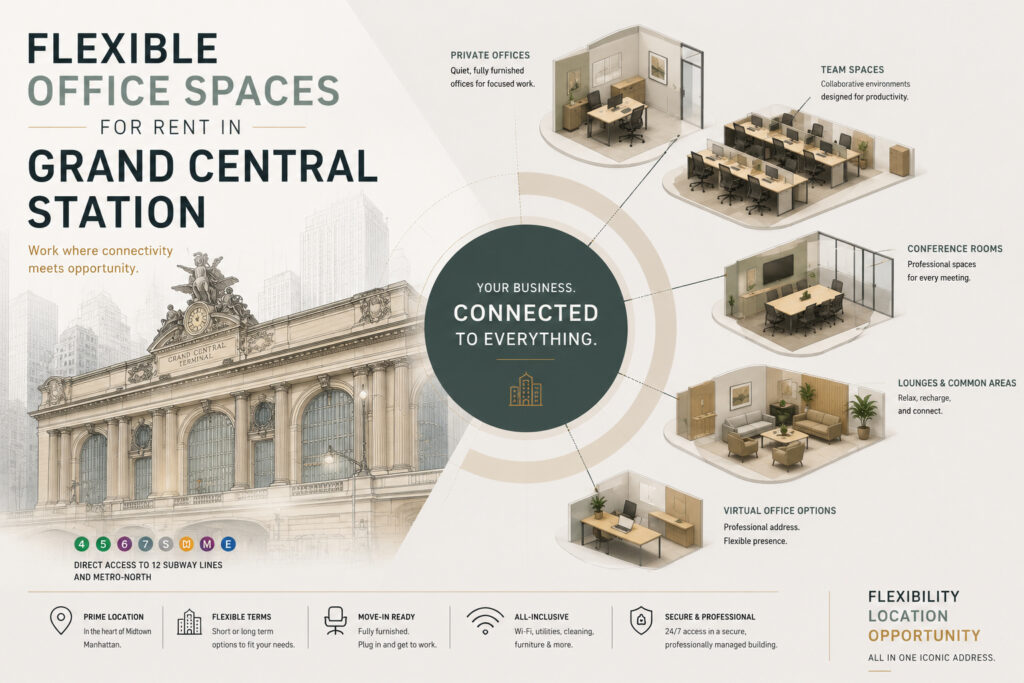
Grand Central gives office tenants three advantages at once. First, it offers dense transit access. Second, it gives you unusual inventory depth. Third, it lets you choose between prestige, value, and speed within the same district. The broader Grand Central submarket contains more than 43 million square feet of office inventory across 171 buildings, including 72 Class A properties.
That scale matters because flexible office demand does not point in one direction. Some teams want a one-person office for six months. Others need a furnished suite for 20 people next month. Larger groups may want a plug-and-play sublease, a prebuilt floor, or a direct lease with shorter decision cycles. Grand Central supports all of those paths because the district mixes older value buildings, upgraded Class A stock, trophy product, staffed executive suites, coworking, day offices, and true direct-access inventory.
The transit story remains the core draw. Grand Central Terminal connects Metro-North’s Harlem, Hudson, and New Haven lines. Grand Central Madison gives all 11 LIRR lines a direct East Side connection. The MTA says that project can save more than 160,000 daily riders as much as 40 minutes and increase rail capacity into Manhattan by 50%. During 2025, 70,000 people passed through Grand Central Madison on a typical weekday, and the MTA opened a new accessible entrance at 45th Street and Madison in May 2026.
Those gains help tenants in practical ways. A harder commute hurts attendance. By contrast, a simpler trip supports hiring, client meetings, and office utilization. If your staff lives in Connecticut, Westchester, the Hudson Valley, or Long Island, Grand Central compresses friction better than most Manhattan submarkets. The district keeps improving on that front, not drifting backward.
Public supply also runs unusually deep here. A recent Grand Central availability review found direct leases, subleases, prebuilt suites, white-box floors, furnished offices, serviced private offices, coworking, day offices, and virtual offices all active in the market. The same review noted roughly four hundred office and workspace listings on one major platform and about one hundred forty-seven office spaces on another, while a workspace marketplace currently shows 408 offices, 7 coworking spaces, and 44 meeting rooms around Grand Central.
Tenant takeaway: Grand Central does not win because it offers one product. It wins because it gives you many products around the same transit core. That broader mix creates more leverage when you compare speed, price, privacy, and commute quality.
What flexible office space means here
Flexible office space in Grand Central means far more than a shared desk. In this district, the phrase covers day passes, meeting rooms, private serviced offices, furnished executive suites, plug-and-play subleases, and prebuilt direct leases that reduce build-out time. That wider definition matches actual search behavior because users want private space, short terms, and quick occupancy, not just coworking.
Coworking, day offices, and meeting rooms fit hybrid teams, interviews, investor days, short projects, and overflow needs. One large marketplace currently averages Grand Central coworking at about $47 per person per day and meeting rooms at about $13 per person per hour. A Midtown East location near Grand Central also markets private day offices at $150 per day and conference rooms at $50 per hour.
Private serviced offices work best when you need privacy and speed. They usually bundle furniture, internet, reception, shared amenities, and short commitments. Recent Grand Central availability reports highlight private office inventory for teams as small as one person and as large as fifty, with several near-terminal options already furnished and ready for near-term move-in.
Furnished executive suites appeal to firms that meet clients often and want a polished front-of-house experience. Current inventory summaries around Grand Central note staffed reception, flexible lease structures, and direct terminal access in several executive-suite buildings. That format often suits law, consulting, finance, and satellite teams that value image but do not want a full traditional build-out.
Plug-and-play subleases give tenants one of the strongest value plays in the district. They often include existing layouts, furniture, and shorter remaining terms. A recent Grand Central market review highlights lower effective rents, shorter commitments, existing build-outs, and faster occupancy as the core reasons tenants chase subleases here.
Prebuilt direct leases sit at the border between flexibility and permanence. They usually give you a private, branded office without the delay of raw construction. Small and midsize direct suites near Grand Central now include high-end prebuilts, boutique layouts, and efficient partial floors that let a tenant move quickly while keeping full control over access, privacy, and day-to-day operations.
Who should rent flexible space here? Startups fit it. Satellite teams fit it. Growth-stage firms fit it when headcount still shifts. Established companies also fit it when they need a project office, a New York presence, or a prestige address without a heavy capital outlay. Meanwhile, commuter-heavy teams benefit most because the location reduces the daily pain that often kills office attendance.
Current prices, sizes, and terms
The broad market backdrop supports a serious search. Cushman & Wakefield puts Manhattan’s Q1 2026 average asking rent at $73.13 per square foot, with Midtown at $76.96 and Midtown Class A at $86.57. Colliers reports Midtown demand at 6.78 million square feet in Q1 2026, the strongest quarter since 2018, with average asking rent at $84.74 and sublet supply down 31.4% year over year. Savills also reported a strong Q1 2026 leasing environment, led by demand for top-tier space. That combination means good space still exists, but better space moves faster.
Within Grand Central itself, current pricing spreads wide because lease type matters more than the neighborhood label. A recent Grand Central pricing guide places many traditional lease options around $55 to $90 per square foot annually. Trophy product often moves above $100 per square foot. Some discounted subleases or value-oriented options still fall into the low $30s to mid-$40s. That spread creates opportunity for tenants who compare product types instead of chasing one label.
Flexible office users should think in monthly dollars, not only annual rent. One current Grand Central serviced-office center shows about 13 office options for teams from one to fifty people, including a one-person office near $824 per month and a ten-person office near $5,495 per month. Another nearby center shows private offices starting around $1,590 per month for teams of two to ten. A third Grand Central option starts around $2,295 per month for teams of roughly two to three people. Those examples show why tenants should compare all-in occupancy cost, not ask only for a “price per desk.”
Monthly pricing can also swing hard based on product quality. One budget-oriented furnished-office listing near Grand Central currently advertises one-person space from $665 per month and two-person space from $910 per month on one-month minimum terms. By contrast, a more premium Grand Central flex operator currently lists one-person offices from $4,539 per month, three-person offices from $7,762 per month, and eight-person suites from $12,306 per month. Same neighborhood. Very different product. Very different service stack.
Small-team supply remains strong. Recent Grand Central inventory includes a 1,040-square-foot office sized for roughly seven people, a 1,300-square-foot high-end prebuilt near the terminal, and a 3,000-square-foot direct suite with a two- to seven-year term. Those options matter because many teams do not need coworking. They need a real office, just without excess square footage.
Mid-size and larger tenants also have room to choose. Current internal listings include a 6,252-square-foot creative prebuilt office, a 7,134-square-foot turnkey suite with direct terminal access, a 10,500-square-foot furnished full-floor installation, an 11,823-square-foot furnished office, a 13,717-square-foot move-in-ready full floor, and a 31,813-square-foot growth floor. Separate Grand Central availability reports also show large blocks from roughly 14,206 square feet to 54,199 square feet in nearby inventory. That range makes the district unusually scalable for teams that want to start small and grow without leaving the submarket.
Term structure also runs from highly flexible to traditional. Hourly and daily bookings remain active. Monthly private offices often start with one-month minimums. Direct leases can stretch from two years to seven years on smaller suites. Subleases now surface with remaining terms into 2027 and 2028. In other words, Grand Central lets you solve for urgency, uncertainty, or long-term control without changing neighborhoods.
How to choose the right fit
Start with the commute map, not the floor plan. If your staff comes from Westchester or Connecticut, direct terminal access carries real weight. If your team lives on Long Island, the indoor route to Grand Central Madison matters just as much. A space that saves ten minutes each way can outperform a nicer office that adds daily friction.
Next, decide how much privacy you need. Shared space works well for solo operators, hybrid users, or teams that meet on a fixed rhythm. Private offices work better when you handle sensitive calls, host clients, or need your own access controls. Furnished suites and plug-and-play subleases split the difference because they keep speed while improving privacy.
Then, match the term to your business stage. Choose short-term flex if headcount still moves, if you need New York space fast, or if you want a capital-light launch. Pick a prebuilt direct lease when your team size feels stable, your workflow demands more control, or your brand needs a more private footprint. Let your business horizon guide the decision, not the other way around.
Use headcount planning with discipline. One major workspace guide around Grand Central still uses roughly 100 square feet per person as a common benchmark. That number helps as a starting point, not a law. Add more space if your team uses larger conference rooms, file storage, internal meeting zones, or dedicated call rooms. Trim space only if your desk ratio stays lean and your staff spends limited time in the office.
Also, price the full package. Ask whether the quote includes internet, furniture, cleaning, mail handling, meeting room credits, after-hours access, and guest policy. Check the pantry, phone rooms, natural light, HVAC control, and security process. Confirm expansion rights if growth may hit within a year. Read the restoration language before you sign anything.
Finally, compare speed honestly. Day offices and serviced suites can solve a need almost immediately. Furnished subleases usually move faster than raw space. Prebuilt direct suites often land in the middle. Raw construction takes the longest. If time matters, the fastest space often creates more value than the cheapest quote.
A better tenant process looks like this: map your commute, set your headcount range, choose your term, rank your must-have features, then compare a private flex suite, a furnished sublease, and a prebuilt direct lease side by side. That method usually reveals the best fit faster than touring ten similar spaces.
Is Grand Central Station the same as Grand Central Terminal? Searchers use both names, but the historic rail hub officially carries the name Grand Central Terminal. The LIRR concourse below it operates as Grand Central Madison. For tenants, the bigger issue is connection quality, not the label.
How much do flexible office spaces for rent in Grand Central Station cost right now? The honest answer depends on product and service level. Current examples range from about $665 per month for a one-person furnished office to around $824 per month for another one-person office, to roughly $5,495 per month for a ten-person private office, while premium offerings climb much higher. Traditional leases in the district often land around $55 to $90 per square foot annually, with trophy space above $100.
Can I rent month to month near Grand Central? Yes, very short commitments exist in the market. Current listings around Grand Central show one-month minimum terms on several private office products, while day offices, meeting rooms, and coworking bookings give even shorter options.
Can I get a private office instead of coworking? Absolutely. Grand Central inventory includes serviced private offices, furnished executive suites, plug-and-play subleases, and prebuilt direct leases in addition to coworking. Many tenants search “flexible” when they actually want a private office with faster occupancy. The market supports that preference well.
Are small offices common near Grand Central? Yes. Recent internal inventory highlights a 1,040-square-foot office for about seven people, a 1,300-square-foot prebuilt suite close to the terminal, and multiple private office products for one to ten people. Small users do not need to settle for a shared bench unless they want one.
Do furnished offices exist beyond executive suites? Yes again. Current Grand Central inventory includes furnished private offices, furnished team suites, furnished subleases, and larger furnished full-floor options. That gives tenants a faster move-in path without forcing them into one standard office format.
Do direct-access offices matter that much? They matter most for commuter-heavy teams. Connected buildings cut walking time, reduce weather exposure, and simplify trips to Metro-North or the LIRR concourse. That advantage grows when your workforce depends on rail access several days each week.
When should I choose a direct lease instead of flexible space? Choose a direct lease when your headcount looks stable, your team needs stronger branding or control, and your horizon extends beyond a short test period. Stay with flexible space when you need speed, uncertainty protection, or a furnished launch. The right answer depends on how much change you expect during the next twelve to twenty-four months.
Flexible office spaces for rent in Grand Central Station work best when they solve a clear business need. For some tenants, that means one fast private office near the trains. For others, it means a furnished suite, a direct-access installation, or a prebuilt floor that supports growth. If you want the right outcome, compare live availability, current pricing, and direct-access options before you tour.
Fill out our 📋online form or give us a call today 📞212-967-2061 — let’s find the right office for your business.