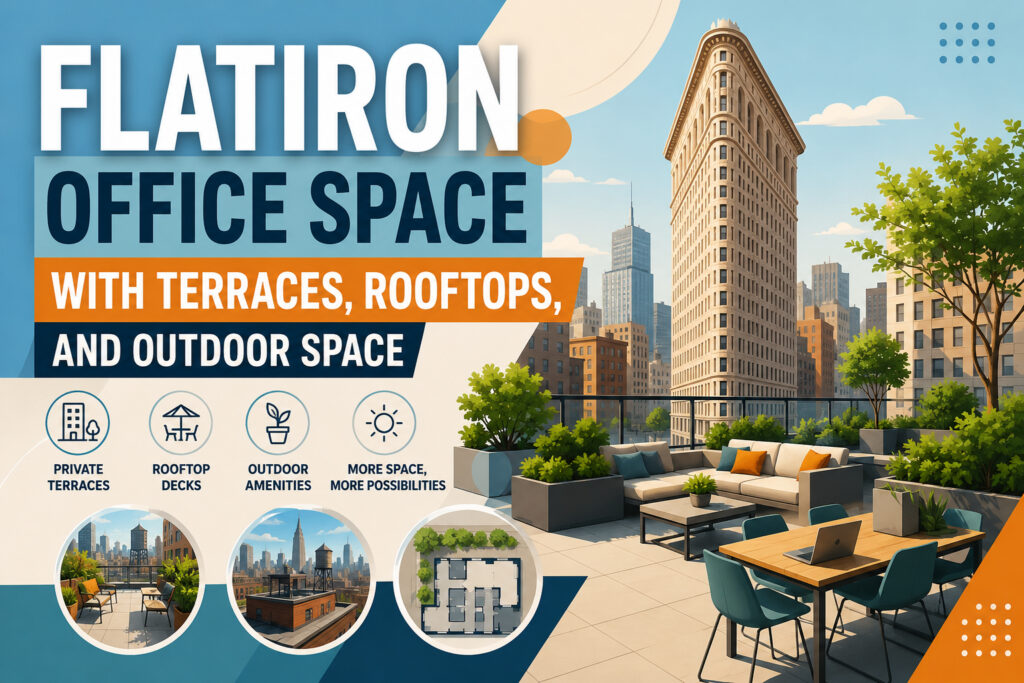
Flatiron Office Space with Terraces, Rooftops, and Outdoor Space
Flatiron office space with outdoor access appeals to tenants for one clear reason. It gives a team the energy of Midtown South without trapping the entire workday indoors. In this part of Manhattan, the inventory mixes classic loft buildings, larger Fifth Avenue options, park-adjacent buildings, top-floor suites, and flexible layouts that range from small built spaces to full-floor occupancies. Current public inventory also spans a wide pricing band, which means the right answer depends less on the label and more on how usable the outdoor component really is.
Start with the neighborhood itself. Flatiron sits in one of Manhattan’s strongest office corridors, with fast access to Union Square, Madison Square Park, Broadway, Fifth Avenue, and the westward loft blocks. Public market sources place Flatiron inventory at about 12.2 million square feet, while broader Midtown South asking rents remain above $81 per square foot and Class A Midtown South asking rents sit above $104 per square foot in mid-2026. In other words, this is not a bargain-basement submarket, but it still gives tenants more range than many trophy corridors in Midtown.
If you want a wider neighborhood baseline before you tour, review our guides to the best buildings in Flatiron, loft office space in Flatiron, and office space near Union Square for Flatiron tenants. Those pages help frame the market before you isolate outdoor access as the top filter.
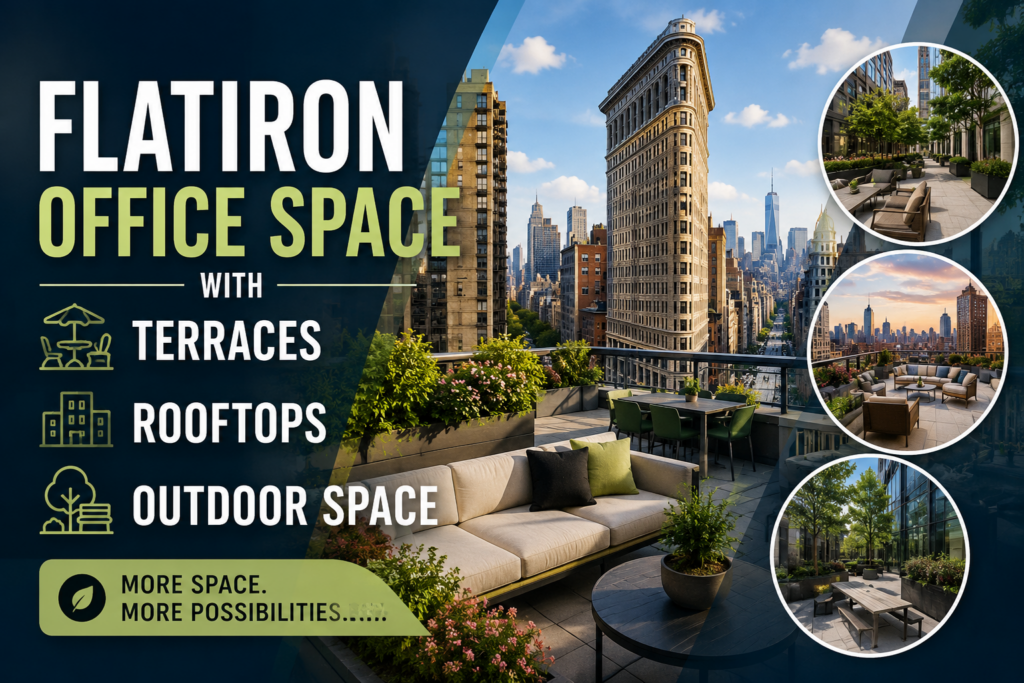
What tenants usually mean by outdoor space
Not every “outdoor” office option means the same thing. In practice, most tenants mean one of four things: a private terrace attached to their suite, a shared rooftop deck for tenant use, a landscaped roof garden or courtyard that works as an amenity, or a top-floor office with a patio or outdoor breakout area. That distinction matters because privacy, booking rights, guest rules, and daily access all change from one format to the next.
A shared roof deck works best when your team wants fresh air, lunch seating, informal meetings, or occasional client gatherings. A private terrace works better when leadership wants control, branding, quieter use, and fewer scheduling limits. Meanwhile, a landscaped garden or courtyard often feels calmer and more usable during a normal workday because people can move in and out quickly without treating the space like a special occasion.
That is why marketing language alone does not help enough. Some buildings advertise “outdoor access” when they really mean a common roof with no power, limited seating, or restricted hours. Others offer outdoor space that can function like real working square footage, with Wi-Fi, outlets, furniture, and room for meetings or events. A tenant should separate true usability from decorative appeal before any shortlist becomes serious.
If you want a broader framework for how this amenity performs in Manhattan leasing, read our page on outdoor space as an office amenity. It explains why terraces, rooftops, courtyards, and outdoor work areas now influence retention, culture, and workplace value in a more direct way than they did a few years ago.
Why this search can feel confusing
Tenants often run into mixed results because this topic pulls together several different product types. Some options are traditional office leases. Others are directories that aggregate many listings. You will also run into coworking inventory, short-term flex space, and even rooftop or penthouse venues that suit meetings or events more than daily occupancy. Each option can fit a specific use case, but they do not answer the same leasing question.
A growth company searching for a headquarters should treat those categories very differently. A private office membership can work for a small satellite team or rapid move-in. An event-ready penthouse may help for off-sites, productions, or presentations. A listing directory helps with market breadth. Yet none of those replaces a tenant-controlled office lease if you need signage, secure access, long-term economics, layout control, furniture rights, or dedicated outdoor use.
This is also why tenant goals matter more than aesthetic buzzwords. If you need a true leased office, filter first for lease type, then for access level, then for outdoor usability. Once you do that, the field narrows fast and the remaining options become far easier to compare. Our commercial leasing guide helps if you want a deeper explanation of direct leases, subleases, term strategy, and concessions before you begin tours.
Where the strongest options usually sit in Flatiron
The eastern and park-adjacent side of the neighborhood usually carries the highest-profile product. That area tends to offer cleaner common areas, stronger building systems, larger floor plates, and a higher chance of curated outdoor amenities. In today’s market, it also commands the sharper pricing. Public sources continue to show tight conditions near the premium corridors, while broader Midtown South rents remain elevated and Class A supply keeps tightening.
The Fifth Avenue and Broadway core gives many tenants the best balance. This stretch often blends classic Flatiron identity with practical access to transit, nearby parks, and larger daylight-filled floors. It also includes better odds of finding repositioned buildings that combine prewar character with contemporary systems. If your team wants outdoor access without drifting into a glass-tower feel, this band often deserves the first tour set.
The westward loft blocks and side streets usually deliver more value. Those buildings often trade a bit of polish for better economics, stronger character, and more flexible occupancy strategies. They can work especially well for creative firms, design users, agencies, founder-led teams, and companies that care more about texture and light than about a formal tower environment. That side of Flatiron also remains the area where value lofts still stand out relative to the premium corridor.
In real terms, the neighborhood now includes options such as a larger Fifth Avenue building with communal rooftop access, a park-front building with select outdoor terrace components, a top-floor suite with a roof patio, and a loft-oriented option with a rooftop terrace. Those examples show why “outdoor space” is not one product. It is a spectrum that runs from shared amenity use to direct private control.
What current pricing and availability really tell you
There is no single Flatiron number that answers this search. Current public directory data places the average listed office rent in Flatiron around $73 per square foot, with lower asking rents around $57 and higher listed rents around $87. At the same time, broader Midtown South asking rents reached $81.14 per square foot in Q2 2026, while Midtown South Class A asking rents reached $104.50. Other neighborhood-level sources place the combined Flatiron and Union Square asking benchmark in the high-$80s, which shows how much the result changes when geography and building quality change.
That spread matters because outdoor access usually lives in the upper end of the market. Not always, but often. Value lofts and subleases can still hit the upper-$50s to upper-$70s, especially on side streets or in older stock. Publicly posted examples right now include a 2,255-square-foot suite at $72, a 3,083-square-foot suite at $77, a 6,379-square-foot sublease at $69, and a 2,882-square-foot sublease at $59. Once you move into curated rooftop amenity buildings, penthouse layouts, or park-front product, pricing usually rises with scarcity.
Size also shifts the search. LoopNet currently shows 33 Flatiron office spaces for lease on that search page, while public listing examples on other platforms run from smaller suites near 1,200 square feet to larger blocks above 7,000 square feet, with some repositioned buildings offering much larger floor plates. For a tenant, that means the neighborhood can serve a boutique user, a growth-stage floor taker, or a larger headquarters search, but the best outdoor options narrow fastest because they are less common than standard office inventory.
If speed matters, also review furnished and plug-and-play office space in Flatiron and office sublets. Those routes can shorten move-in time, and they sometimes offer access to amenity-rich buildings without the build-out timeline of a raw direct deal.
How to judge whether the outdoor component is actually usable
Usability beats romance. A beautiful rooftop does not help much if your team cannot use it on a normal Tuesday. Ask who controls access, whether guests need approval, whether the lease grants use or only a revocable license, and whether the space stays open beyond business hours. Then check basics such as Wi-Fi, power, shade, furniture, food rules, event rules, security, and elevator access.
Privacy should come next. Some tenants need a common roof for occasional breaks. Others need a terrace that supports recruiting meetings, quick team huddles, or executive use without a crowd. A private patio attached to a penthouse-style layout solves a different problem than a shared amenity deck inside a larger building. The right answer depends on whether your team wants culture space, client space, leadership space, or simply daily breathing room.
Weather and maintenance matter too. Wind exposure, seasonal usability, furniture durability, drainage, and cleaning standards all shape how often the team will actually step outside. A smaller but comfortable terrace often outperforms a larger roof that feels harsh, overexposed, or hard to reach. The best outdoor office space works because it invites repeat use, not because it photographs well once.
Then tie the outdoor area back to the floor plate. If the office lacks pantry space, lounge space, or meeting variety, a usable outdoor area can take pressure off the interior plan. If the layout already works well, the terrace becomes a genuine premium rather than a patch. That is why we compare outdoor space together with circulation, natural light, HVAC control, conferencing, and pantry layout instead of treating the roof as a separate feature.
Who should target this kind of office and when it makes the most sense
Outdoor-ready Flatiron offices work best for teams that use the office as a culture engine, not just a desk container. That includes groups that recruit heavily, host visitors often, run client-facing meetings, want a stronger executive environment, or simply need more daypart variety for staff. Outdoor access also helps firms that want the neighborhood’s energy but need a calmer pressure valve during the workday.
This product type makes the most sense when your company plans to stay long enough to benefit from the amenity. A fast short-term stop may not justify paying for terrace scarcity. By contrast, a headquarters move, a premium sublease, or a top-floor relocation often does. Current Manhattan leasing data shows continued tightening, strong demand, declining sublease supply, and elevated activity in Midtown South, so desirable outdoor-enabled options will not linger the same way generic inventory can.
If your team wants character first, begin with loft office space in Flatiron. If speed matters, start with plug-and-play offices or sublet options. If you want the broader neighborhood context first, compare our Flatiron building guide with our Union Square adjacency guide. That path keeps the search tenant-led from the start.
Flatiron office space with terraces, rooftops, and outdoor space is not one narrow category. It is a layered set of choices that includes shared roof decks, curated amenity gardens, private patios, penthouse suites, loft buildings with rooftop access, and larger repositioned assets with stronger common spaces. The right move starts when you define how your team will use the outdoor area, what lease structure fits, and what level of privacy matters most. Once those answers are clear, we can filter the market to the options that fit your team instead of wasting your time on space that only looks right from a distance.
Find Office with Outdoor Component
We represent tenants, not landlords. That means we help you compare outdoor access, daily usability, and lease economics across the neighborhood with your side of the table in mind. If outdoor space matters to your culture, recruiting, client experience, or day-to-day workflow, we can narrow the field to the buildings and layouts that actually deliver it.
Fill out our 📋 online form or give us a call today 📞 212-967-2061 — let’s find the right options for your business.