FinTech Office Space in Midtown Manhattan
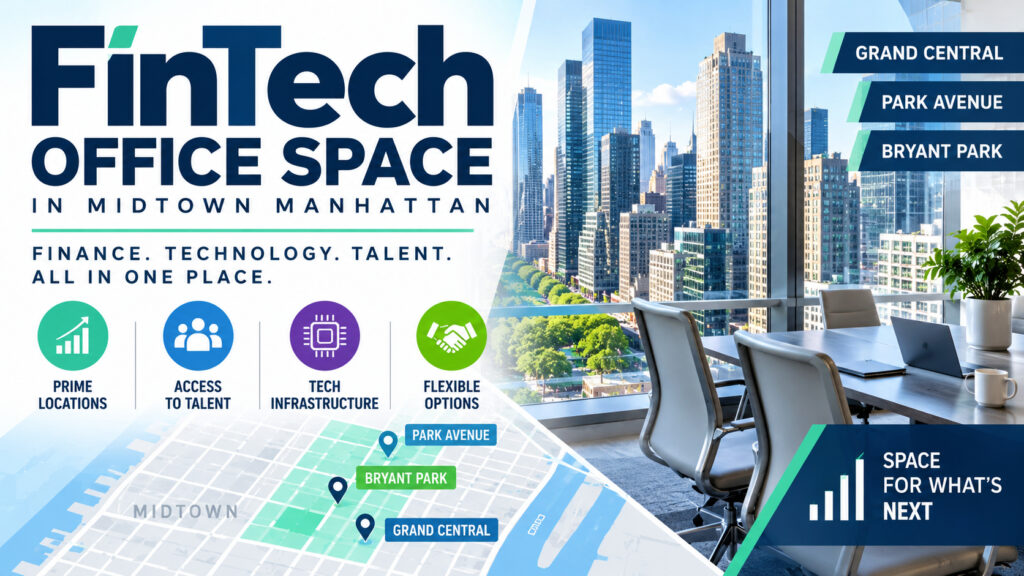
FinTech office space in Midtown Manhattan sits where finance, technology, transportation, talent, and client access overlap.
However, the right FinTech office requires more than a prestigious Midtown address. It must support your people, technology, security, growth, meetings, and daily operating model.
Midtown also contains several distinct office markets. Consequently, choosing the right corridor matters almost as much as choosing Midtown itself.
What FinTech Office Space in Midtown Manhattan Actually Means
“FinTech office space” does not describe one special type of commercial lease. Instead, it describes office space that fits a financial technology company’s operating requirements.
Those requirements can differ significantly between businesses.
A payments platform may prioritize engineering teams, conference rooms, and recruiting. Meanwhile, a trading technology company may require dense power, cooling, multiple monitors, and resilient connectivity.
Enterprise platforms often need another combination. They may require substantial client areas, controlled access, executive offices, private meeting rooms, and scalable floors.
Therefore, the best FinTech office combines technology infrastructure with financial-services functionality.
That distinction helps explain why many very different office products can seem relevant.
A traditional direct lease provides long-term control. A sublease can reduce cost and accelerate occupancy. Prebuilt space reduces construction requirements.
Flexible offices solve another problem. They give smaller teams short commitments and rapid occupancy.
Design case studies represent something different again. They show workplace possibilities, rather than currently available real estate. Trading-focused FinTech workplaces can include multi-screen desks, raised flooring, cable management, acoustic treatments, and technology-rich meeting rooms.
For a serious Midtown search, start with the business requirement rather than an office category.
Your office brief should answer several questions before touring.
How many people need permanent desks? How many employees work remotely? Which teams expect private rooms?
Consider your client traffic as well. Then determine whether your operation needs enhanced power, dedicated cooling, supplementary HVAC, or additional security.
Finally, model growth.
A 40-person company expecting 80 employees should not evaluate space like a stable 40-person professional firm.
The best FinTech office does not simply fit today’s headcount. It supports the company you expect to operate during the lease.
That principle becomes especially important in Midtown. High-quality supply has tightened as leasing activity increased during 2026. Midtown availability reached 12.1% by August under one current market methodology.
Why Midtown Works for Enterprise FinTech Companies
Midtown gives FinTech tenants something difficult to replicate elsewhere: access to several business ecosystems within one compact district.
Finance remains a major source of Midtown demand. Technology, professional services, legal services, investors, consultants, and corporate users also maintain substantial footprints here.
That mixture matters for enterprise FinTech.
Many FinTech companies sell directly into banks, asset managers, insurers, corporations, and institutional investors. Midtown places those relationships within a dense business environment.
Recent leasing activity reinforces that connection. A FinTech company completed a 220,000-square-foot Midtown lease near Grand Central during 2025.
Transportation creates another advantage.
Grand Central connects Midtown offices with subway service, commuter rail, and Long Island service through its newer regional terminal. That network expands the practical recruiting radius beyond Manhattan.
A company with employees across Westchester, Connecticut, Long Island, Queens, Brooklyn, and Manhattan can therefore centralize around one commute node.
Penn Station changes the equation for western Midtown. It gives New Jersey, Long Island, Amtrak, and Manhattan subway commuters another powerful access point.
Between those hubs sits a wide range of office environments.
Park Avenue provides polished corporate towers. Grand Central combines accessibility with large Class A inventory.
Bryant Park and Sixth Avenue provide another blend. Tenants can combine corporate infrastructure with strong dining, hospitality, public space, and transportation access.
Farther north, Rockefeller Center and the Plaza District emphasize image, client experience, and high-end offices.
Meanwhile, Third Avenue can provide useful alternatives for companies that want Midtown East without paying for Park Avenue frontage.
That diversity prevents one common mistake.
FinTech companies should not treat Midtown as one uniform office market.
A client-driven institutional platform might prioritize Park Avenue. A growing technology platform may prefer Bryant Park.
An operations-heavy business could favor efficient Midtown East floors. Another company may prioritize Penn access because employees commute from New Jersey.
Midtown also gives larger companies meaningful scale.
Current inventory on our site ranges from small furnished offices through substantial partial and full-floor opportunities. That range lets a tenant compare different operating models without leaving the district.
Where FinTech Companies Should Look Within Midtown
Grand Central deserves the first look for companies that value regional commuting and financial-services proximity.
Current options include a 2,731-square-foot furnished direct lease near Grand Central. The layout combines open workspace, a conference room, kitchen facilities, and immediate Midtown access.
Larger teams can consider a 12,826-square-foot double-corner Grand Central office. It contains private rooms, meeting areas, and more than 60 workstation positions.
That type of configuration can suit a FinTech business moving beyond startup-scale occupancy.
Park Avenue fits companies that place greater weight on corporate identity, clients, investors, and executive presence.
For example, this 9,142-square-foot full-floor Park Avenue office combines open work areas, private offices, conference rooms, and a dedicated full-floor identity.
Another 8,517-square-foot Park Avenue prebuilt provides a mixed open and perimeter-office configuration.
Companies requiring considerably more space can examine a 21,557-square-foot two-floor Park Avenue sublease. The installation includes executive offices, workstations, collaboration areas, and an internal stair.
Bryant Park and Sixth Avenue create a different Midtown experience.
These corridors suit businesses that want institutional buildings without relying entirely on an old-line financial-services identity.
A 13,208-square-foot furnished Bryant Park floor provides an immediate plug-and-play option for a larger team. It supports up to 88 people under its marketed configuration.
Alternatively, a 7,040-square-foot furnished Bryant Park sublease combines glass-fronted rooms, workstations, natural light, and a substantial staff kitchen.
Rockefeller Center and the surrounding Sixth Avenue corridor can serve client-facing FinTech firms.
One current 6,607-square-foot furnished Rockefeller-area sublease includes 22 workstations, several meeting rooms, reception, and dedicated infrastructure space.
Third Avenue deserves attention when Park Avenue pricing exceeds the budget.
A 4,451-square-foot full-floor Midtown East office provides a smaller direct-lease alternative with a largely open layout.
The practical lesson is simple.
Choose the Midtown corridor around the business model, not the postcard.
What Midtown FinTech Office Space Costs in 2026
Midtown office pricing requires context because different datasets use different boundaries and methodologies.
The freshest August 2026 Midtown figures place average asking rent at $85.55 per square foot annually. Availability stood at 12.1%.
Another major second-quarter study placed Midtown’s average at $84.99 per square foot and availability at 12.3%.
A separate second-quarter methodology reported $76.98 per square foot for Midtown overall. Its Class A average reached $88.50 per square foot.
That variation does not mean one number must be wrong.
Market boundaries, available-space samples, building classifications, and calculation methods differ. Therefore, tenants should treat market averages as orientation rather than quotes.
| Market benchmark | Current asking rent | Current availability | What it means for a FinTech tenant |
|---|---|---|---|
| Midtown | $85.55/SF | 12.1% | Core Midtown carries a meaningful premium. |
| Midtown sublease | $59.88/SF average ask | 2.1% sublease availability | Furnished opportunities can change the economics. |
| Downtown | $62.01/SF | 16.1% | Lower average cost creates a strong value alternative. |
| Midtown South | $86.26/SF | 16.4% | Tech-oriented districts no longer guarantee cheaper rent. |
Current figures reflect August 2026 under the same published methodology.
Those numbers also explain why “How much does Midtown office space cost?” has no single satisfactory answer.
A 10,000-square-foot office at $85.55 per square foot carries about $71,292 in monthly base rent.
At Downtown’s $62.01 average, the same square footage produces about $51,675 in monthly base rent.
That creates roughly $19,617 monthly difference before other lease economics.
Yet headline rent only starts the calculation.
Tenants should compare free rent, improvement allowances, annual escalations, operating expense increases, real estate tax exposure, electricity, cleaning, and overtime HVAC.
Furniture, cabling, internet installation, security systems, moving costs, architecture, legal fees, and restoration obligations can also affect total occupancy cost.
A sublease adds another variable.
Midtown’s current average sublease asking rent sits near $59.88 per square foot. That is dramatically below the overall Midtown average.
However, a sublease may provide less term flexibility or less control over alterations.
Therefore, compare the full economic package rather than ranking offices by asking rent alone.
What a FinTech Office Must Support
A FinTech company should evaluate infrastructure before finishes.
Beautiful conference rooms cannot compensate for insufficient power, unreliable connectivity, poor acoustics, or weak access controls.
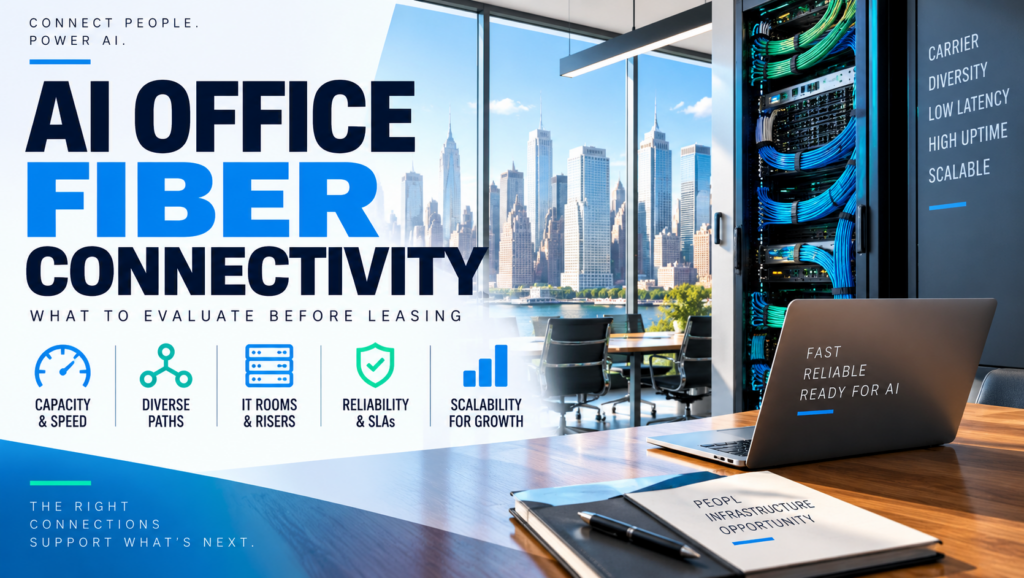
Connectivity comes first. Ask which carriers serve the building and suite. Then confirm pathways, installation timing, redundancy options, and riser access.
Trading or data-intensive teams should investigate power density as well. They may also need supplemental cooling, equipment rooms, or additional electrical capacity.
Security requires both physical and digital planning.
An attended lobby can control building access. Suite-level systems can then separate employees, visitors, executives, vendors, and sensitive areas.
Private meetings create another requirement.
Financial information, client discussions, investor conversations, and employment matters should not compete with open-office acoustics.
Consequently, examine wall construction, door quality, conference-room placement, sound transmission, and reception design.
Layout should reflect how the company actually works.
Engineering teams often value concentrated open areas and small project rooms. Sales teams may need phone rooms and video-call capacity.
Executive groups can require more enclosed offices. Client-facing businesses may need a larger reception and boardroom program.
Trading-oriented operations can demand denser workstation layouts. Cable management, screens, electrical loads, and cooling become more important as density increases.
Hybrid work adds another layer.
Fewer assigned desks do not automatically mean less space. Companies sometimes replace desk areas with collaboration rooms, video rooms, lounges, training areas, and larger meeting facilities.
Building amenities can offset some requirements.
Shared conference centers may reduce your internal meeting-room count. Tenant lounges can supplement breakout space.
Likewise, fitness facilities, food service, outdoor areas, and bike storage can support recruiting without consuming private rentable area.
Current Midtown listings increasingly include these features. Several Park Avenue and Grand Central options provide tenant lounges, fitness facilities, conference amenities, outdoor areas, or building food services.
Still, amenities should support the workplace strategy.
They should never substitute for core infrastructure.
For FinTech tenants, infrastructure is part of the lease decision rather than a post-lease technology project.
Which Lease Structure Fits a FinTech Company
A direct lease gives a company the greatest long-term control.
Tenants can negotiate construction, signage, expansion rights, renewal options, assignment provisions, security requirements, and other operating terms.
However, direct leases usually require more commitment.
Companies should compare current direct office space when long-term occupancy, identity, and customization matter. Our current database covers Midtown buildings across Grand Central, Park Avenue, Bryant Park, Rockefeller Center, and surrounding corridors.
A prebuilt direct lease occupies the middle ground.
The landlord has already completed much of the office. Therefore, tenants can often move sooner without accepting a sublandlord’s remaining lease term.
Prebuilts work especially well for established teams that want stability without commissioning a complete new installation.
A sublease solves another set of problems.
Many subleases already contain furniture, conference rooms, workstations, kitchens, cabling, and other infrastructure.
That can reduce both time and capital requirements.
Browse Midtown and Manhattan office sublets when speed, existing infrastructure, or shorter commitment matter. Current inventory includes options throughout Park Avenue, Grand Central, Bryant Park, Rockefeller Center, and other Midtown corridors.
Subleases require different diligence.
Confirm the remaining term, consent process, furniture rights, restoration obligations, building access, security, utilities, and technology arrangements.
Also determine what happens when the sublease expires.
A rapidly growing FinTech company may save money today but face another relocation much sooner.
Flexible or serviced offices serve a narrower purpose.
They can work for a new market entry, project team, temporary swing space, or very small company.
Month-to-month flexibility also helps teams with uncertain hiring.
However, enterprise FinTech tenants should compare privacy, security, branding, meeting capacity, and effective per-person cost.
Flexible space should represent a deliberate operating choice.
It should not become the default simply because someone can occupy it next week.
Buying office space solves a completely different problem.
Ownership ties capital to real estate and substantially narrows available Midtown choices. Leasing usually provides far more location, size, and timing flexibility.
For most growth-oriented FinTech firms, the more useful comparison involves direct lease versus prebuilt versus sublease.
Should a FinTech Company Lease in Midtown or Downtown Manhattan?
Neither district wins every FinTech office search.
The right answer depends on your clients, employees, budget, space requirement, brand, and expected growth.
Current August 2026 data makes the economic difference unusually clear.
Midtown averaged $85.55 per square foot, while Downtown averaged $62.01 per square foot. Midtown therefore carried about a 38% asking-rent premium under that methodology.
Availability also differed.
Midtown stood at 12.1%, while Downtown remained higher at 16.1%. That wider Downtown availability can improve choice for some requirements.
Midtown generally deserves the advantage when commuter access drives the decision.
Grand Central provides exceptional access for northern suburbs and Long Island. Penn Station strengthens Midtown for New Jersey and regional rail commuters.
Midtown also makes sense when clients, investors, counterparties, attorneys, or financial institutions cluster nearby.
A Park Avenue, Grand Central, Bryant Park, or Rockefeller-area office can reduce friction for frequent meetings.
Downtown deserves a serious comparison when occupancy cost matters more.
The current asking-rent gap becomes significant as square footage grows.
For 10,000 square feet, the current averages imply roughly $235,400 in annual base-rent difference.
At 25,000 square feet, that gap approaches $588,500 annually before concessions and other lease costs.
However, asking rent does not determine the winner alone.
A deeply discounted Midtown sublease could compete directly with Downtown economics. Midtown’s August sublease asking average stood at $59.88 per square foot.
Conversely, a premium Downtown tower can cost much more than the district average.
The company should therefore compare specific buildings against specific buildings.
Brand also changes the answer.
Institutional FinTech companies may prefer a Midtown identity because it aligns closely with established financial services.
Other companies may prefer Downtown’s financial heritage and modern office towers.
Founder-led teams sometimes consider Flatiron or NoMad instead.
Those neighborhoods belong to Midtown South rather than core Midtown. Current Midtown South asking rents reached $86.26 per square foot in August, so a technology-oriented location does not automatically provide savings.
The strongest decision combines commute analysis, actual inventory, lease economics, technology requirements, and future headcount.
Do not decide Midtown versus Downtown from neighborhood averages alone.
How to Secure the Right Midtown FinTech Office
Start earlier than the date when you urgently need desks.
A conventional Manhattan office requirement usually deserves about nine to twelve months of planning before occupancy. Larger headquarters and substantial custom projects can justify twelve to eighteen months.
Furnished space can move much faster.
A straightforward plug-and-play transaction may require only a few months when negotiations, consent, technology, and moving remain simple.
Begin by creating one internal requirement.
Set the target move date, current headcount, projected headcount, budget, preferred corridors, and desired lease term.
Then define technology.
Document power, internet, security, supplemental cooling, server requirements, after-hours access, and disaster-recovery needs before touring.
Next, separate must-haves from preferences.
A redundant communications path may represent a true requirement. A particular lobby finish probably does not.
After that, compare the whole Midtown market.
A strong shortlist might deliberately include Park Avenue, Grand Central, Bryant Park, Sixth Avenue, Third Avenue, and Penn alternatives.
Those options create negotiating leverage because they solve the same business requirement differently.
Tour spaces with the floor plan in hand.
Count real workstations. Measure conference capacity. Examine column placement and natural light.
Check where clients enter and where employees gather.
Then inspect the infrastructure rather than admiring the furniture.
Before proposing terms, model the complete economics.
Base rent alone cannot compare a furnished sublease against a direct lease requiring construction.
Free rent, improvements, escalations, electricity, operating charges, moving expenses, technology, and furniture can materially change the result.
The proposal stage should preserve flexibility.
Compare several viable options before allowing one landlord to define the economics.
Landlord financial strength, construction obligations, building systems, lease language, and future expansion rights also deserve attention.
Meanwhile, keep the renewal option alive when you already occupy Manhattan space.
A credible renewal alternative can protect leverage during relocation negotiations.
Our tenant-side leasing process covers requirements, market comparison, tours, proposals, negotiations, renewals, relocations, expansions, and contractions.
For a live requirement, use Get Midtown FinTech spaces and include your headcount, target size, budget, move date, and preferred Midtown corridor. Current inventory across our database exceeds 1,400 Manhattan commercial listings and receives ongoing updates.
Find a Midtown Office Today
We represent office tenants, not landlords, throughout the search, tour, negotiation, and lease process. Our role is to compare the market around your requirements and protect your negotiating position. Start with your headcount, timing, budget, and preferred Midtown corridors, and we will build the relevant shortlist.
Fill out our 📋 online form or give us a call today 📞 212-967-2061 — let’s find the right options for your business.