Diplomatic Office Security Requirements Near the United Nations
Diplomatic office security near the United Nations starts with a crucial distinction. No single security standard applies to every mission, observer office, consular unit, or international organization.
Instead, each office must coordinate federal property requirements, local building laws, landlord rules, and its own protective program. International accreditation alone does not approve a lease, construction project, security installation, or office opening.
The strongest office strategy begins before the property search. Tenants should define operational risks, visitor patterns, confidentiality needs, delegation schedules, and emergency responsibilities before touring available spaces.
What Diplomatic Office Security Requirements Actually Mean
The phrase “diplomatic office security requirements” can describe several different obligations. Tenants should separate those obligations before comparing buildings.
A permanent mission may need different controls from an observer office. Likewise, a consular operation may receive more public visitors than a policy office.
An international organization may also require another approval path. Meanwhile, a nongovernmental liaison office may hold no diplomatic property status.
Many broad explanations combine these categories. They also confuse domestic mission offices with diplomatic facilities located outside the United States.
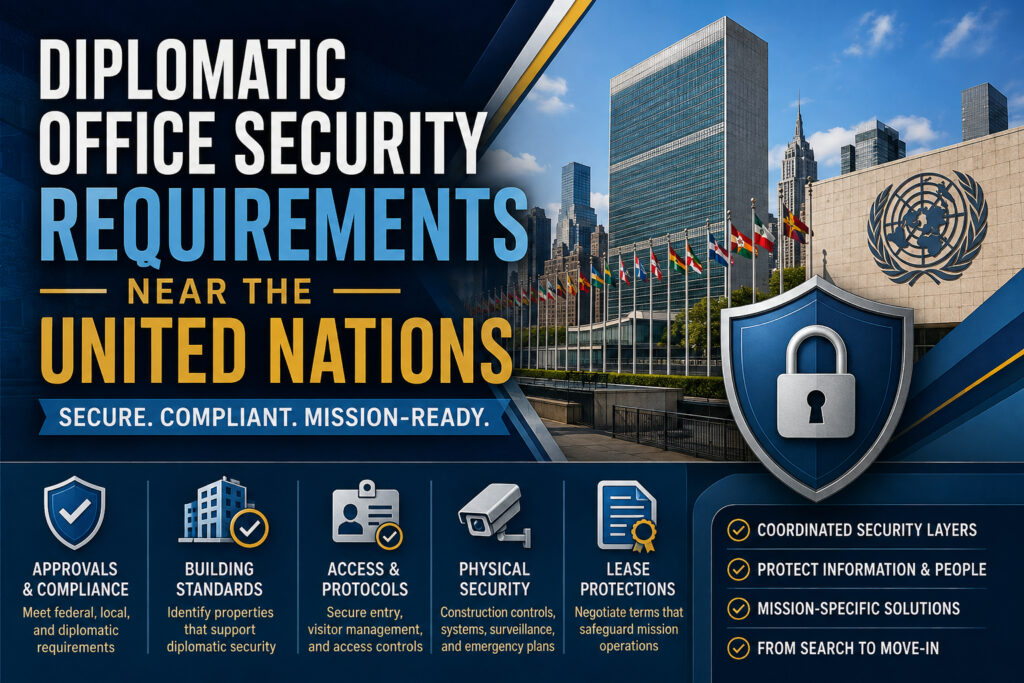
The practical answer is simple: a diplomatic office near the United Nations needs several coordinated security layers.
Those layers usually include:
- Legal authorization for the mission’s property transaction
- A lawful office use under local occupancy records
- Landlord approval for alterations and security systems
- Building access procedures that support the tenant’s risk profile
- Internal controls for visitors, information, deliveries, and emergencies
- Coordination procedures for visiting officials and major events
No landlord can grant diplomatic accreditation. Equally, accreditation does not replace a commercial lease or municipal approval.
A grounds pass provides access to the United Nations complex. It does not provide unrestricted access to a privately operated office building.
Mission personnel must complete the applicable registration process before receiving eligible headquarters credentials. Meeting delegates may follow a separate registration process.
Do not assume that overseas diplomatic construction standards automatically control a New York lease. Many public materials discuss hardened facilities, setback requirements, and overseas security standards.
Those rules primarily govern certain government facilities abroad. They do not automatically become the building code for every foreign mission office in Manhattan.
A mission may still adopt comparable protections after a threat assessment. However, the tenant should distinguish policy preferences from mandatory local requirements.
That distinction prevents unnecessary construction. It also helps the mission direct limited funds toward meaningful controls.
General office-market guides often emphasize rents, building classes, transportation, and nearby amenities. Those topics matter, but they do not answer the complete security question.
The Rules That Govern the Premises
Diplomatic office security near the United Nations operates through overlapping legal and operational frameworks. Each framework answers a different question.
Federal property review asks whether the mission may acquire or change the property. A foreign mission must notify the appropriate federal authority before certain property transactions.
Federal law defines acquisition broadly. It can include a purchase, lease, alteration, addition, or change in the property’s intended use.
The law generally provides a review period before the mission proceeds. A shorter period may apply when the reviewing authority permits one.
Therefore, a mission should not treat federal property review as a post-signing formality. Counsel should address the process during the letter-of-intent stage.
The lease may need a condition covering federal disapproval. Additionally, the construction schedule should reflect any required review.
Local law asks whether the space can support the proposed use. New York City regulates building occupancy, alterations, fire safety, egress, accessibility, and construction.
The office must match the building’s lawful use. A change affecting use, occupancy, or egress may require an amended occupancy document.
Minor alterations may instead conclude with a completion document. Older properties may rely on another official record confirming lawful use.
Most construction projects require permits. A licensed design professional usually prepares and files the applicable plans.
Even internal security work may trigger review. New walls, doors, electrical work, fire-alarm changes, and structural attachments can require approvals.
Fire safety rules apply throughout the city. Diplomatic status does not create a private exception to general fire-safety obligations.
The city fire code governs emergency preparedness, fire-protection systems, hazardous materials, and operational practices. Building ownership may affect who prepares each required plan.
A large office building may maintain a comprehensive building-wide emergency plan. Nevertheless, the mission still needs internal instructions for its personnel.
Those instructions should fit the building’s official procedures. Conflicting evacuation commands can create dangerous delays.
International protocol rules govern registration and headquarters access. They do not approve the private office itself.
Consequently, a tenant should run three workstreams at once:
- Property authorization and diplomatic administration
- Local real estate, code, and construction compliance
- Mission-specific security planning and daily operations
Delaying one workstream can delay the entire opening.
Security Requirements to Define Before Touring
The best security program starts with written requirements. A vague request for a “secure building” gives brokers and landlords little direction.
Instead, the mission should create a functional security brief. That brief should describe operations without disclosing sensitive protective information.
Begin with the office’s mission and population. Record expected staffing, visiting officials, public appointments, contractors, and delegation surges.
Headcount alone cannot determine the correct space. Visitor volume, meeting frequency, and confidentiality often matter more.
A policy office may need controlled meeting rooms and secure communications. By contrast, a consular function may require screening capacity and orderly public queues.
Map the visitor journey from sidewalk to meeting room. Each transition creates a separate decision point.
A useful review covers:
- Curbside arrival and vehicle discharge
- Main entrance visibility
- Lobby check-in
- Turnstile or elevator release
- Suite reception
- Waiting areas
- Interview or meeting rooms
- Departure and after-hours procedures
The mission should decide where identification occurs. It should also determine who verifies appointments and who handles exceptions.
Separate public, controlled, and restricted areas. Good layouts reduce unnecessary movement through sensitive work zones.
Reception should not open directly into executive offices. Likewise, service vendors should not cross confidential meeting routes.
A layered plan may include a public reception zone, a controlled staff zone, and restricted rooms. Restricted rooms may support records, communications, equipment, or sensitive meetings.
Define information-security needs before selecting walls and ceilings. Physical security and information security must support each other.
The mission should evaluate acoustic privacy, network pathways, wireless exposure, equipment cooling, and communications redundancy. It should also review landlord access to risers and telecom rooms.
Standard glass conference rooms may not suit sensitive discussions. Open ceilings may also complicate acoustic and technical controls.
Plan for peak events, not only normal weekdays. High-level meetings can change staffing, arrivals, deliveries, and local street conditions.
A suitable office should absorb those changes without blocking exits or overwhelming reception. The building team must also understand advance-notice expectations.
Create measurable building criteria. Statements such as “good security” cannot support an objective comparison.
A stronger requirement might request:
- An attended lobby during defined hours
- Reliable after-hours access
- Controlled elevator destination procedures
- Documented visitor management
- A managed loading or messenger process
- Landlord cooperation with approved tenant security
- Resilient power, cooling, and communications
- Suitable emergency communications
- Private full-floor or limited-corridor access, when needed
These criteria help eliminate unsuitable buildings before costly design work begins.
Choosing the Right Building and Location
Distance from the United Nations matters, but proximity alone does not determine security. A closer building can create operational disadvantages.
Sidewalk congestion, motorcade restrictions, demonstrations, and event closures may affect immediate-adjacency locations. Meanwhile, a building several avenues west may offer stronger infrastructure.
Tenants should compare three broad location patterns.
Immediate United Nations vicinity
This area supports short walks to official meetings. It may also provide an established diplomatic tenant environment.
However, nearby activity can create security and logistics pressure. Street access may change during major sessions or dignitary visits.
Buildings in this zone can also attract frequent visitors. Therefore, tenants should inspect lobby capacity and elevator procedures carefully.
The consulate office space guide explains how diplomatic tenants use this broader corridor.
Turtle Bay and the Second Avenue corridor
This location can balance proximity and office functionality. Many buildings support traditional professional layouts, attended lobbies, and full-floor configurations.
Yet building quality varies considerably. Tenants should never infer strong security from a diplomatic mailing address.
A current furnished office near Turtle Bay illustrates the type of conventional layout tenants may encounter. Any listed feature still requires independent verification.
Third Avenue through the Grand Central district
This area provides broad building choice and stronger regional transportation. Larger office towers may also offer more developed building-management systems.
The longer walk can matter during severe weather or schedule-intensive sessions. Still, transportation resilience may outweigh immediate adjacency for larger teams.
Current asking rents vary by building class, condition, floor, and transaction type. Tenants can review the Grand Central rent guide for budgeting context.
Rent should not drive the decision alone. Security construction, after-hours services, utilities, and restoration obligations can change the total cost.
Evaluate the whole building, not only the suite. A polished office cannot correct a weak loading process or unreliable elevator system.
During inspections, review:
- Lobby staffing and post orders
- Visitor overflow space
- Elevator count and control
- Freight access
- Package and messenger procedures
- Emergency stairs
- Fire command systems
- Backup-power coverage
- Telecommunications providers
- Water and flood exposure
- After-hours HVAC
- Property-management presence
- Procedures during street closures
A full-floor office can improve privacy and circulation control. However, it can also increase construction and restoration costs.
A customizable full-floor opportunity near the diplomatic corridor shows how blank space can support a purpose-built layout. Tenants should confirm every security feature through design review.
Consider resilience as part of security. A secure office that cannot operate during an outage may fail its mission.
Ask which systems receive emergency power. Then identify any gap affecting communications, access control, cooling, or essential workstations.
A generator label means little without a load schedule. The mission needs written confirmation of actual coverage.
Lease Terms and Construction Approvals
A conventional office lease may not support diplomatic security operations. The letter of intent should identify special rights before lease drafting begins.
Late security requests often create delays. They can also weaken the tenant’s negotiating leverage.
The commercial leasing guide covers the broader New York leasing process. Diplomatic tenants should add a security-specific lease rider.
The permitted-use clause must match the actual operation. “General office use” may not cover every mission function.
The clause should address diplomatic, administrative, meeting, cultural, and related official activities. It should also reflect any public-facing appointments.
Counsel should confirm that the intended use aligns with federal approval and local occupancy rules.
Landlord consent rights must support the security design. The lease should identify which installations need approval.
Possible installations include:
- Access-control readers
- Suite cameras
- Duress devices
- Intercoms
- Reinforced partitions
- Security glazing
- Specialized doors
- Communications equipment
- Supplemental cooling
- Cabling and dedicated pathways
- Reception barriers
- Equipment in shared telecom areas
The lease should prevent arbitrary delays. It should also set reasonable review deadlines.
Define ownership and removal obligations. A landlord may treat attached security equipment as a building improvement.
The tenant may instead need to remove controlled technology. Therefore, the lease should distinguish removable equipment from permanent construction.
Restoration language deserves particular attention. Removing reinforced improvements can cost more than installing them.
Protect access to critical infrastructure. The tenant may need scheduled or emergency access to risers, telecom rooms, roof areas, and electrical closets.
Shared access creates confidentiality concerns. Accordingly, the lease should establish notice, escort, and contractor rules.
Address landlord entry into the premises. Standard leases often give the landlord broad inspection and emergency rights.
The mission should negotiate workable notice and escort procedures. True emergencies still require immediate action.
The lease must also address access after water leaks, fire alarms, or life-safety events. Security policy cannot obstruct emergency response.
Clarify building services and extra charges. After-hours HVAC, freight use, lobby staffing, and security coordination may generate additional costs.
Obtain the current fee schedule before signing. Otherwise, low base rent can hide high operational expenses.
Coordinate construction responsibilities. The landlord may build the office, fund an allowance, or deliver a contribution.
Security-sensitive work may require tenant-selected specialists. The lease should allow qualified contractors, subject to reasonable building standards.
Most construction requires formal filings and permits. Changes involving alarm systems or life-safety equipment may require additional review.
Do not begin work from an architectural rendering alone. The project team should complete code, engineering, and security reviews first.
A proper sequence usually includes:
- Operational brief
- Initial building assessment
- Test fit
- Security concept
- Engineering review
- Lease protections
- Federal property coordination
- Landlord approval
- Permit drawings
- Construction and commissioning
Each step should produce a documented decision.
Operating the Office After Occupancy
Security does not end when construction finishes. Daily procedures determine whether expensive systems work as intended.
A mission should assign clear responsibility for office security. That person must coordinate with management, staff, vendors, and outside authorities.
Access credentials need a complete lifecycle. The office should control issuance, activation, review, suspension, and return.
Shared credentials undermine accountability. Delayed deactivation also creates unnecessary exposure.
Staff changes should trigger immediate updates. Contractors and temporary personnel should receive limited access.
Visitor management needs predictable rules. Every visitor should follow an appropriate process for the office’s risk level.
That process may include advance registration, identification, host confirmation, badges, escort requirements, and departure recording.
Exceptions require defined approval. Reception personnel should never improvise during a high-pressure arrival.
Deliveries need their own route and procedure. Packages, catering, flowers, diplomatic pouches, and maintenance materials create different risks.
The mission should identify acceptable delivery points and hours. Large items may require freight reservations and building documentation.
Unattended packages require a response plan. Staff should know whom to contact without handling suspicious items.
Meeting-room procedures should match meeting sensitivity. Not every conference needs the same protection.
A routine administrative meeting may use a standard room. A sensitive discussion may require stronger acoustic, device, and attendance controls.
Staff should know which room suits each meeting type. Clear classification reduces both risk and inconvenience.
Emergency planning must connect the suite with the building. The mission needs building instructions, internal roles, and accountability procedures.
Fire evacuation may require immediate departure. Another incident may call for sheltering or movement to an alternate area.
Personnel should understand the difference. Regular exercises can reveal communication and accountability failures.
Large office buildings may follow formal fire-safety and emergency-action requirements. The owner generally manages the building plan, while tenants support implementation.
Plan for visiting delegations before arrival. Delegations can increase vehicles, staff, interpreters, media, and meeting demand.
Advance planning should cover:
- Arrival windows
- Building notifications
- Lobby staffing
- Elevator movement
- Credential checks
- Waiting areas
- Secure meeting rooms
- Vehicle coordination
- Emergency contacts
- Departure sequencing
The mission should also separate building access from United Nations headquarters access. Each location controls its own credentials.
Maintain systems and records. Access control, alarms, communications, emergency supplies, and contact lists require scheduled reviews.
A broken component can remain unnoticed for months. Preventive testing reduces that risk.
Sensitive records need appropriate retention. Routine building records may follow different rules from mission-security information.
Questions Tenants Ask Before Committing
Does every diplomatic mission need armed security?
No universal rule requires the same protective staffing for every office. The mission’s threat assessment, government policy, and operations guide that decision.
Building staff also serve a different function from mission protection. Tenants should never assume an attended lobby replaces their security program.
Does diplomatic immunity exempt the office from building rules?
No. Diplomatic privileges do not eliminate local building, fire-safety, and construction requirements.
Federal diplomatic property authorities also monitor compliance with applicable local permits.
Does a United Nations grounds pass grant office-building access?
No. The pass governs access to the United Nations premises.
The landlord and mission control the commercial building and private suite. Each site uses separate procedures.
Do overseas embassy standards apply to a New York mission office?
Not automatically. Overseas facility standards primarily govern designated government properties located abroad.
A mission may voluntarily adopt similar measures. Still, local law and federal foreign-mission rules control the New York premises.
Can a mission sign a normal lease immediately?
The mission should first review federal notification requirements with counsel. Federal law can require notice before a lease or property alteration proceeds.
A proper lease structure should account for that review.
Can the mission install cameras and access control after signing?
Only when the lease, building rules, and applicable laws permit the work. Landlord approval may also require plans and insurance documents.
Negotiating these rights before signing creates a safer path.
Is a full floor always more secure?
Not necessarily. A full floor can reduce shared circulation and improve zoning.
However, elevator openings, stair doors, mechanical rooms, and landlord access still require review. Full-floor space may also increase costs.
Should the office face the street or occupy a high floor?
Neither choice works for every mission. A lower floor may simplify access and emergency movement.
A higher floor may offer greater separation from street activity. Yet elevators and evacuation become more important.
How much additional space does security require?
The answer depends on reception, screening, waiting, circulation, storage, meeting, and equipment needs.
Security space should appear in the test fit. Adding it after lease execution can reduce usable staff capacity.
How early should planning begin?
Start before touring buildings. Specialized approvals, lease negotiations, design, permits, equipment procurement, and commissioning all require time.
Large or heavily customized projects need longer lead times. Early planning also preserves negotiating leverage.
What should a tenant inspect during a building tour?
Inspect the entire arrival and service path. Do not limit the review to offices, views, and finishes.
Walk through the lobby, elevators, stairs, loading area, messenger process, and after-hours entrance. Ask management to explain real procedures.
How should a mission compare two buildings?
Use a weighted decision matrix. Rent should form only one category.
Other categories should cover compliance, security fit, resilience, construction complexity, operating costs, transportation, and schedule risk.
A slightly higher rent may reduce major construction. Conversely, an inexpensive suite may require expensive infrastructure.
What creates the greatest leasing risk?
Unverified assumptions create the greatest risk. Common examples include promised generator coverage, unrestricted alterations, and automatic diplomatic approval.
Written evidence should support every critical feature. The lease should also capture every negotiated right.
Tenant Representation for a Diplomatic Office
Diplomatic office searches require more than a listing survey. They require coordinated property review, security-aware comparisons, test fits, and carefully structured lease negotiations.
We represent office tenants throughout that process. Our role remains focused on the tenant’s operational needs, financial interests, approval schedule, and long-term flexibility.
Begin with a confidential requirements discussion before touring space. That preparation helps identify buildings which can support the mission from the first day onward.
Fill out our 📋 online form or give us a call today 📞 212-967-2061 — let’s find the right options for your business.