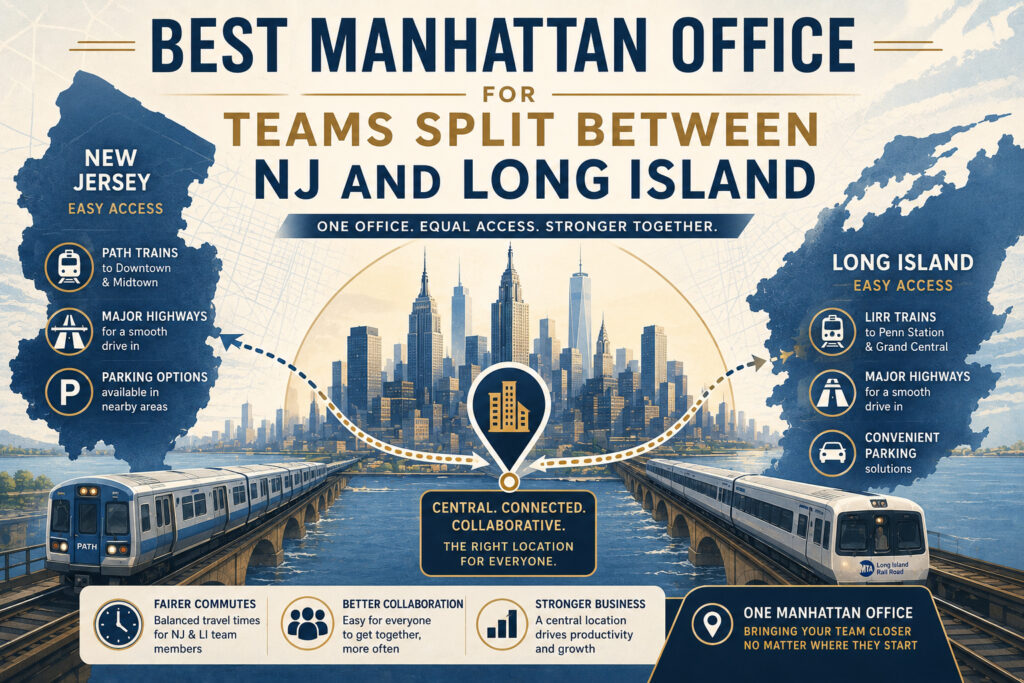
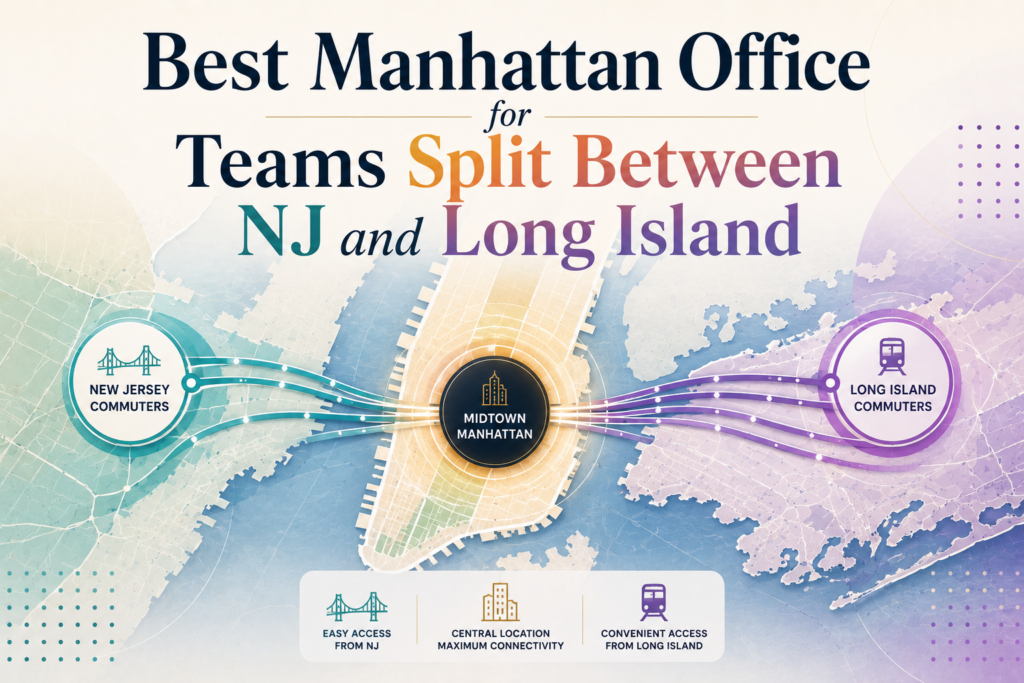
For most truly split teams, the best first search zone runs from Bryant Park through Herald Square and into the north edge of NoMad. That corridor gives New Jersey riders direct access from the West Side rail hub and the Midtown bus terminal, while Long Island riders can use either the West Side terminal or the East Side terminal and finish with a short walk or one simple hop. Five New Jersey commuter-rail lines serve Penn, more than five dozen bus routes serve the Midtown bus terminal, and Long Island service now splits between Penn and Grand Central after the East Side expansion increased Manhattan-bound capacity by 50 percent.
If your roster leans New Jersey, move west. Should your roster lean Long Island, move east. When the split stays close to even, Bryant Park usually produces the fairest daily result because it cuts transfer pain on both sides and keeps backup subway options close.
The best office for this search does not chase one perfect commute. It removes the most daily friction for the most people.
Why this search is different
A New Jersey-only office search is easy. A Long Island-only office search is easier. A split-team search changes the map because one terminal-first answer usually hurts the other half of the staff.
That is why “best” means something different here. The winning address usually minimizes four things at once: transfers, weather exposure, last-mile walking, and late-day unpredictability. A nominally faster trip can still lose if the office sits too far from the station or forces a second train on the way home.
Rail access matters even more now because prime Midtown choices sit inside the congestion zone south of and including 60th Street. Drivers entering that zone pay an added toll, though some crossing credits can apply from certain tunnels during peak periods. In practice, that makes a transit-first office strategy even more valuable for mixed New Jersey and Long Island teams.
Long Island commuters also no longer behave like one single pool. Service now splits between Penn and Grand Central, and the railroad itself says many weekday rush-hour trips to Manhattan are divided between those two terminals. The East Side terminal especially matters because the railroad says nearly half of riders travel to the East Side and may be better served there.
New Jersey commuters are not one group either. Rail riders arrive at Penn. Many bus riders land near Times Square. Hudson River rapid-transit riders often reach the West 33rd Street corridor or Lower Manhattan. Therefore, the best Manhattan office for a split team usually lives in the central band that can absorb all three arrivals without drama.
Where most teams should focus
Bryant Park and the Sixth Avenue spine
Bryant Park is the best overall answer for many balanced teams. The location sits between the West Side rail hub and the East Side terminal, while the Midtown bus terminal stays within easy reach. One current Bryant Park building page highlights that exact advantage and notes immediate walking distance to Bryant Park, Grand Central, Penn, and the Midtown bus terminal, with a deep set of nearby subway lines.
The rent picture also works better here than many tenants expect. Smaller Bryant Park suites on the site’s current guidance run roughly $75 to $95 per square foot in Class A buildings, $55 to $75 in boutique or Class B product, and about $50 to $65 for furnished subleases. A current Bryant Park value-oriented building page also shows asking rents around $63 to $71 per square foot, which matters if you want a central address without paying top-trophy pricing.
Herald Square, Penn, and the west side of the midpoint
Herald Square and the Penn-adjacent blocks win when your team leans New Jersey, needs direct Penn arrivals, or values the broadest West Side transit stack. They still work for Long Island riders because Penn remains one Manhattan arrival point for Long Island service, and the Herald Square corridor softens the last leg for anyone who must continue east or south.
The headline numbers here can scare tenants. One current local New Jersey commuter guide places the Penn Station submarket at $105.81 per square foot in Q1 2026, with Class A at $125.96. Yet the same local guidance still shows a broad practical range below that headline, with many Class A towers asking $85 to $110, repositioned Class B space asking $55 to $75, and older loft-style value plays sitting around $40 to $55.
Grand Central wins when Long Island riders make up the larger share of the office, when East Side client access matters, or when leadership values a classic Midtown East profile. The longer the Long Island roster, the stronger this area becomes. That logic only sharpened after the East Side terminal opened and expanded direct rail access to Midtown East.
Price here depends on product, not cliché. Current local guidance for the Grand Central area places many direct leases around $55 to $90 per square foot, with some discounted subleases dropping into the low $30s to mid-$40s, while trophy product can run far above that. Another current local page cites Grand Central at $69.93 per square foot overall and $74.18 for Class A in Q1 2026.
NoMad and nearby Midtown South work best for firms that want a more flexible midpoint with strong recruiting appeal, varied layouts, and better layout value than many East Side trophy corridors. These blocks rarely beat Bryant Park on pure commute fairness. Even so, they can win on overall workplace experience, culture, and deal structure.
The numbers here support that tradeoff. One recent local guide places Flatiron and Union Square asking rents around $87.18 per square foot, with direct space around $88.34 and sublet space around $69.00. Another current local class-B guide places Flatiron and NoMad around $48 to $58, which shows how wide the product spread can be within short walking distance.
The broader Manhattan market has firmed up again. CBRE put Manhattan’s average asking rent at $80.42 per square foot in May 2026, with availability down to 14.5%. Earlier Q1 2026 data put Manhattan at $78.01 overall, while Midtown sat higher at $84.79 with a 12.8% availability rate. Cushman’s Q1 2026 Manhattan report also placed borough-wide asking rents at $73.13, which shows why tenants should compare methodologies before anchoring on any one market figure.
That market backdrop matters because it changes negotiating leverage by block and building type. Central Midtown has improved, yet pricing still breaks wide by age, renovation quality, and term length. As a rule, Bryant Park and Penn-adjacent value product can still undercut premium East Side trophy space by a large margin, while Midtown South often gives the best mix of identity and flexibility.
Hybrid teams should also compare lease formats, not just neighborhoods. Traditional leases still make sense for stable headcounts and branding control. Subleases often win for speed and lower capital spend. Serviced and private-office products can help smaller or uncertain teams because citywide marketplace data shows serviced private offices starting around $1,100 per month and coworking around $300, while one recent Manhattan private-office benchmark placed average asking levels near $785 per desk monthly.
A few live examples show how varied the middle of Midtown can be. The Bryant Park sublease linked above offers 11,577 square feet, 21 private glass offices, and 30 workstations. The full-floor Bryant Park option offers 20,624 RSF and room for about 137 people. The Penn-Herald floor offers 8,592 square feet, up to 48 workstations, two conference rooms, and six meeting rooms. Meanwhile, the Midtown South floor gives you 6,514 RSF for roughly 43 people, and the premium east-side suite offers 1,928 square feet for a team of about 13.
If your workforce is not truly split, do not force a midpoint. Use the sharper page instead. Start with the NJ-heavy guide, the PATH-heavy guide, the bus-heavy guide, or the Hoboken-heavy guide. That keeps this page focused on the harder mixed-commuter problem and avoids pushing you into the wrong compromise.
How to choose the right floor before you tour
Start with a weighted commute map. Count where people actually begin their day, then weight that count by in-office frequency. A five-day commuter should matter more than a once-a-week commuter when you choose your search radius. That simple step makes many “obvious” locations look less obvious.
Next, time the trip from street door to desk, not just station to station. Hidden friction often hides in elevator waits, mezzanines, bad entrances, and awkward lobby paths. One current transit comparison page makes this point clearly: a short subway ride can still feel long if the accessible path, crossover, or exit sequence adds extra minutes.
Then, compare effective economics, not sticker rent alone. Penn-adjacent local guidance currently notes concession packages that can include roughly 6 to 12 months of free rent and $50 to $100 per square foot in improvement allowances, depending on term and building tier. Those concessions can change the real cost enough to justify a stronger commute location or a better buildout.
After that, match the layout to your attendance pattern. Hybrid firms usually overpay when they lease a giant open plan for a team that rarely appears together. Prebuilt, furnished, and plug-and-play suites often work better because they shorten move time and reduce upfront spend. Short-term and shared options matter most when the headcount, schedule, or capital plan still moves every quarter.
Finally, tour the edges of the corridor, not just the most famous block. A fair answer for split teams often sits a few streets off the trophy core. That is why Bryant Park value product, Herald Square side streets, and the north NoMad edge deserve real attention before you default to the priciest station-front address.
The tenant-focused conclusion
The best Manhattan office for teams split between New Jersey and Long Island usually sits in the central Midtown band, not at either extreme. Bryant Park and the Sixth Avenue spine give the strongest all-around answer, Penn and Herald Square win when New Jersey carries more weight, Grand Central wins when Long Island carries more weight, and NoMad becomes the smart alternative when layout quality and flexibility matter as much as terminal proximity.
Tenant-side office hunting works best when you compare commute quality and lease economics together. A stronger layout in the wrong place will hurt attendance. On the other hand, a famous address with the wrong commute mix will cost more and feel worse.
Choosing the right Manhattan office for a team split between New Jersey and Long Island is not about finding a prestigious address. Instead, success comes from minimizing commute friction, reducing transfer points, and creating a location that feels equally accessible to both sides of the workforce.
A tenant-focused search can uncover locations that improve attendance, support recruiting efforts, and lower occupancy costs at the same time. When commute convenience and lease economics align, companies gain a workplace that employees actually want to use while preserving long-term flexibility.
Fill out our 📋online form or give us a call today 📞212-967-2061 — let’s find the right office for your business.