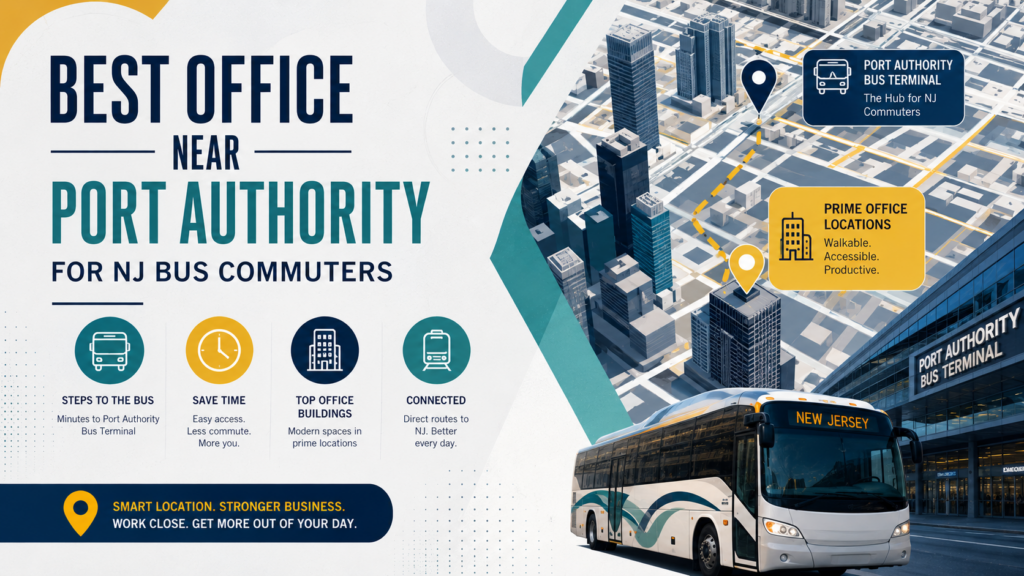
Best Office Near Port Authority for NJ Bus Commuters
Quick answer
For most New Jersey bus commuters, the best Manhattan office sits within a short walk of Port Authority Bus Terminal or along an easy transfer from the 42nd Street transit spine. That usually means the blocks around West 40th through West 43rd Streets, especially from Eighth Avenue east to Sixth Avenue. Teams with mixed bus and rail commuting often do best in the overlap zone between Port Authority and Penn Station, usually the upper West 30s through low West 40s.
Port Authority deserves much more attention than most office content gives it. The terminal sits in the heart of Midtown, one block west of Times Square. It also links directly to the A, C, E, N, Q, R, W, 1, 2, 3, and 7 trains, plus the shuttle to Grand Central. NJ TRANSIT alone serves New York City by bus on more than five dozen routes from across New Jersey, while the Lincoln Tunnel Exclusive Bus Lane averages more than 1,850 daily buses and more than 18.5 million passengers each year.
That transit stack changes the office search. A bus rider feels the last walk every day. Therefore, a “better” address loses value fast when it adds two subway transfers or a long crosstown hike. The right office near Port Authority does not merely look central. It cuts friction for the largest share of the team.
Who should target this location
This area works best for firms with heavy bus commuting from New Jersey. It also fits companies that hire from Bergen, Hudson, Essex, Union, Passaic, and nearby counties through Port Authority-oriented service patterns. Just as important, it suits firms that need rapid access to Times Square, Bryant Park, Midtown West, and other west-side Midtown destinations without asking staff to zigzag through Midtown after arrival.
Mixed commuter teams should look closely too. Some companies pull staff from New Jersey by bus, others by NJ TRANSIT rail, and others from Long Island or Queens. In that case, the best answer often shifts from “right on top of Port Authority” to “close enough to Port Authority and still walkable to Penn.” That overlap zone usually beats a pure East Side play.
Client-facing firms can still make this area work. Modern Times Square, Bryant Park west, and select Midtown West buildings deliver stronger image, better amenities, and cleaner lobby experiences than older market stereotypes suggest. Meanwhile, budget-driven tenants can still find practical value product a few blocks south and west.
Best blocks and walk zones
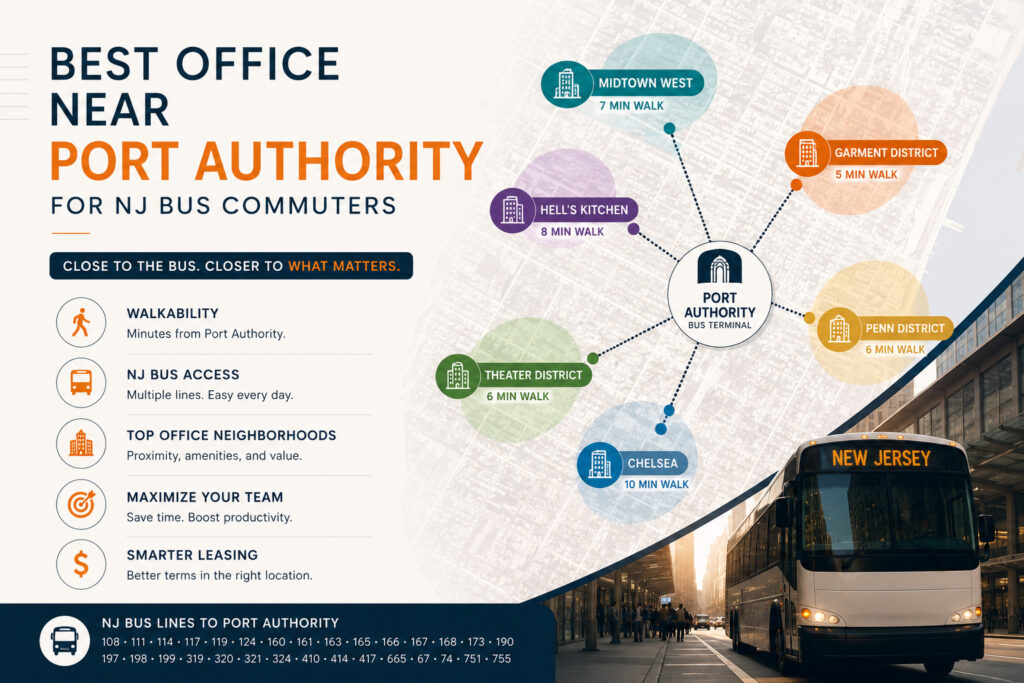
The strongest zone sits closest to the terminal. Think West 40th to West 42nd Streets, especially around Eighth Avenue and the Times Square transfer complex. That area gives the shortest final walk for true bus-heavy teams. A building such as 202 West 40th Street makes the logic obvious because it sits directly above the Times Square–42nd Street complex, adjacent to Port Authority, and about 0.3 miles from Penn Station.
The next-best zone extends east toward Sixth Avenue. Those blocks keep the walk manageable while adding Bryant Park access, stronger office identity, and deeper Class A product. That is where addresses like 3 Times Square and 151 West 42nd Street become especially compelling. They keep commuters close to the Port Authority ecosystem while adding better building options than many purely west-of-Eighth properties.
A third zone bridges Port Authority and Penn Station. That band usually runs from West 37th through West 40th, mainly along Seventh and Eighth Avenues and the nearby Garment District blocks. This area often works best for firms with a split commute map. One nearby west-37th example shows how realistic that overlap can be, with roughly a four-minute walk to Penn Station and about seven to eight minutes to Port Authority. That balance can solve more hiring problems than a terminal-pure strategy.
The stretch zone starts once you push farther east. Bryant Park east, Grand Central, and Midtown East can still work when the office need outweighs the commute penalty. Yet bus-heavy teams will usually lose time there unless staff use the 42nd Street corridor well. The MTA’s 42nd Street connection does help, because it created a free in-station transfer between Times Square and Bryant Park. Still, that move adds another step to the daily routine.
Port Authority versus Penn Station
Port Authority wins when the team arrives by bus and wants the shortest possible walk. That sounds obvious, yet many office searches blur the issue by chasing “Midtown” in general. If the majority of staff exit buses at Port Authority, the office should usually sit in the Port Authority walk shed first, not in a rail-led district that looks convenient only on a map.
Penn Station wins when the commute base shifts toward rail or when the company needs a larger regional catchment. Penn draws NJ TRANSIT rail, LIRR, Amtrak, and deep subway overlap. That is why Penn-proximate office content consistently frames the corridor as one of Manhattan’s strongest recruiting zones for regional commuters. For tenants with mixed New Jersey rail, Long Island, and west-side Manhattan movement, Penn can beat Port Authority on total reach.
However, the overlap matters more than the rivalry. Many firms do not need to “choose” one hub in absolute terms. They need a block that keeps Port Authority easy while preserving walk access to Penn. That is why Penn Station Offices and Midtown West Offices should both sit in the search path for this topic. One solves rail-heavy needs. The other preserves the stronger bus logic.
The simplest rule works well. Choose Port Authority-first when the team mostly rides buses and works near 42nd Street, Times Square, or Bryant Park west. Choose Penn-first when the team mixes bus and rail or wants a deeper west-30s office inventory. Then test each live option by the real last leg, not by a broad neighborhood label.
What office product looks like by block
Near Port Authority itself, you will find practical west-side product, transit-first Class B and C options, older loft stock, and selected repositioned assets. This is where value often shows up first. For example, 580 Eighth Avenue offers roughly 3,800-square-foot full-floor opportunities across several floors, with asking rents around $39 per square foot. That kind of small-floor identity works well for lean teams that want the terminal close and the rent lower.
As you move east or step into stronger Times Square product, the building quality rises. 3 Times Square is an approximately 885,000-square-foot Class A tower on Seventh Avenue between West 42nd and West 43rd Streets. Its floor plates run about 28,000 to 35,000 square feet, and its local office listings currently span roughly 1,195 to 18,600 square feet. That range makes it useful for both smaller tenants and larger floor-seeking users.
Bryant Park west adds a different profile. 1 Bryant Park gives trophy-level identity and larger, more polished options. The building is about 2.35 million square feet, and the page shows current examples from roughly 2,902 square feet up to 40,519 square feet. A bus-led tenant may pay more there, but the trade can work when image, amenities, and premium infrastructure matter.
Then there is the large-scale Times Square choice. 151 West 42nd Street totals about 1.8 million square feet and includes a 45,600-square-foot amenity floor. Its page currently shows immediate full-floor sublease options around 55,662 and 55,644 square feet. For bigger users, that puts genuine scale right inside the Port Authority catchment, rather than forcing a compromise into a weaker commuter location.
What rent expectations look like now
Tenants should not expect a single clean “Port Authority rent.” This location spans several submarkets and building classes. Citywide market reports for Q1 2026 place Manhattan asking rents between about $73.13 and $77.55 per square foot, while Midtown-specific reports sit higher, ranging from about $76.96 to $84.79 depending on methodology and inventory. In other words, the market feels firmer than it did a year ago, but pricing still varies heavily by exact block and product.
The best applied benchmark comes from the nearby Penn corridor because that market overlaps physically and competitively with Port Authority searches. Current tenant-facing guidance for Penn Station places Class A towers around $85 to $110 per square foot, repositioned Class B around $55 to $75, and older loft or value plays around $40 to $55. The same guidance notes that concessions can still matter, with six to twelve months of free rent and tenant improvement allowances in roughly the $40 to $100 range depending on product and term.
That spread matters for Port Authority users. It means a bus-first company does not need to choose between “cheap old Midtown” and “very expensive trophy Midtown.” It can choose a pricing lane. Small firms can stay close to the terminal in practical full-floor or partial-floor product. Midsize firms can step into upgraded prebuilt space nearby. Larger tenants can pay for towers that still preserve commuter logic.
Best locations and buildings to compare
Start broad, then narrow. Review Midtown West Offices first. After that, compare Penn Station Offices to understand where the bus-rail overlap starts to make sense. Those two pages frame the real search field better than a generic Midtown map.
Next, compare the direct building options that best reflect the Port Authority question. Use 202 West 40th Street for immediate terminal adjacency. Use 3 Times Square for stronger Times Square Class A positioning. Use 151 West 42nd Street for major-floor availability and premium amenity support. Use 1 Bryant Park when the company wants a top-tier Bryant Park identity without abandoning bus access. Add 580 Eighth Avenue when cost control leads the search.
Those comparisons answer different tenant needs. One option maximizes walk speed. Another strengthens image. A third handles scale. A fourth preserves value. That is the right way to evaluate this topic, because “best” depends on commute mix, lease economics, and office type at the same time.
How to choose the right office near Port Authority
Begin with the people map. Count how many employees truly arrive by bus. Then separate them from rail riders, subway riders, and hybrid staff. Once you know that split, the location decision becomes much clearer. A bus-majority team should protect the final walk first. A mixed team should test the Port Authority-Penn overlap.
After that, choose the block before the building. The block controls daily friction. The building controls image, efficiency, and concessions. Many tenants reverse that order and regret it later. A beautiful space loses appeal when the commute annoys the team every morning.
Then compare proposals on full cost, not headline rent. Use How Much Does Office Space Near Penn Station Cost Today? to understand nearby west-side price tiers. Use Compare Office Proposals NYC to pressure-test concessions, loss factor, utilities, HVAC, deposit demands, and timing risk. Finally, run the Office Space Calculator and review the Commercial Leasing Guide before tours turn into negotiations.
FAQ
What is the best Manhattan office area for NJ bus commuters?
For most bus-heavy teams, the strongest answer sits near Port Authority itself or within the 42nd Street corridor that links Times Square, Bryant Park, and Midtown West. That keeps the last leg short after arrival.
Is a Times Square office better than a Penn Station office for bus riders?
Usually yes, if most employees use Port Authority. Penn often wins only when the commute mix tilts toward rail or when the office requirement needs the west-30s overlap zone.
Can a Bryant Park office still work for NJ bus commuters?
Yes, especially on the west side of Bryant Park or along the 42nd Street corridor. The free Times Square–Bryant Park connection also makes the move easier than many tenants expect.
What kind of rent should a tenant expect near Port Authority?
Expect a wide spread. Nearby west-side value product can sit around the high $30s to $50s per square foot. Repositioned Class B often lands in the mid-$50s to mid-$70s. Stronger Class A product can move into the mid-$80s and above.
Does construction on the new bus terminal change the logic?
No. The long-term case remains strong because the replacement terminal stays on site, service continues during construction, and the project adds better wayfinding, ADA access, new ramps, storage and staging, and future public open space.
Which building types fit this search best?
Small teams often do well in practical full-floor or prebuilt west-side spaces. Midsize firms can target upgraded Times Square or Midtown West suites. Large users should compare major towers on West 42nd Street and nearby Bryant Park options.
Office Space Near the Port Authority
We represent tenants, not landlords. We compare live options, not brochure language. We also negotiate rent, concessions, timing, and flexibility so a smart commute decision becomes a smart lease decision.
If your team rides in through Port Authority, start with Midtown West Offices, compare Penn Station Offices for overlap, and shortlist 202 West 40th Street, 3 Times Square, 151 West 42nd Street, 1 Bryant Park, and 580 Eighth Avenue. Then use Compare Office Proposals NYC and the Commercial Leasing Guide before you commit.
Fill out our 📋 online form or give us a call today 📞 212-967-2061 — let’s find the right office for your business.