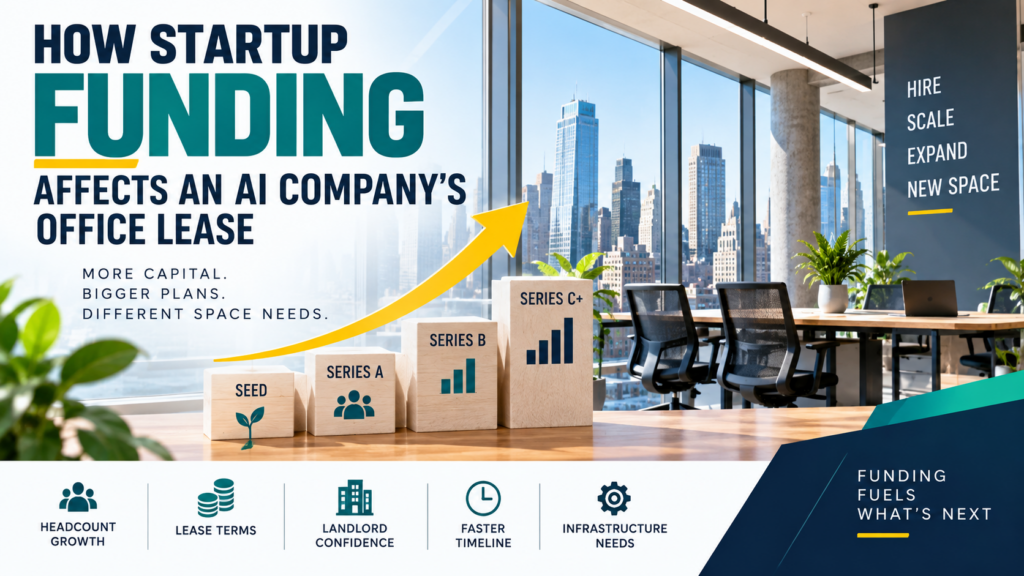
How Startup Funding Affects an AI Company’s Office Lease
Fresh funding can change an AI company’s office requirements almost overnight. Hiring accelerates, client activity rises, and founders start planning beyond today’s headcount. Meanwhile, landlords examine the company’s finances before accepting that growth story.
The central issue is not simply whether an AI startup has raised money. The real question is whether the company can convert funding into landlord confidence without creating excessive fixed costs.
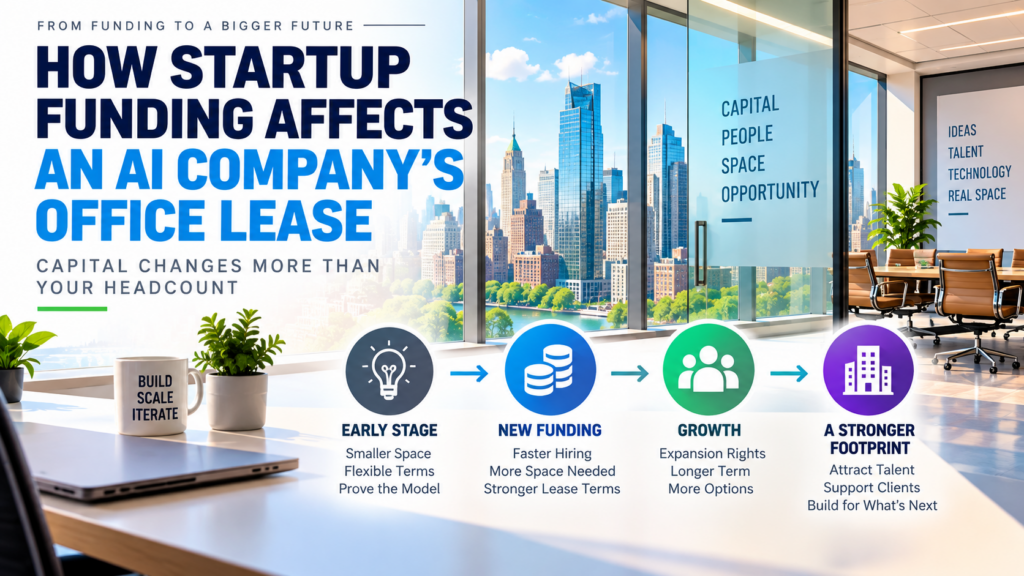
A funding round affects office size, lease length, security, concessions, expansion rights, and approval speed. It can also affect which buildings will seriously consider the company.
That makes an AI startup funding office lease a financial decision before it becomes a real estate decision.
Will a Manhattan landlord lease office space to a newly funded AI startup?
Yes. However, funding alone does not guarantee approval. A landlord wants enough evidence to understand liquidity, runway, burn, growth plans, and lease exposure.
Funding Changes the Lease Before It Changes the Address
A newly funded AI company usually approaches Manhattan office space differently than an unfunded startup.
Before financing, management may plan around today’s employees. After financing, the company often plans around tomorrow’s organization.
That difference affects almost every lease decision.
Funding can accelerate the office timeline
A completed financing round can create immediate space pressure.
New employees may already have signed offers. Sales teams may need client rooms. Executives may want an established Manhattan headquarters. Recruiting can also require private interview rooms.
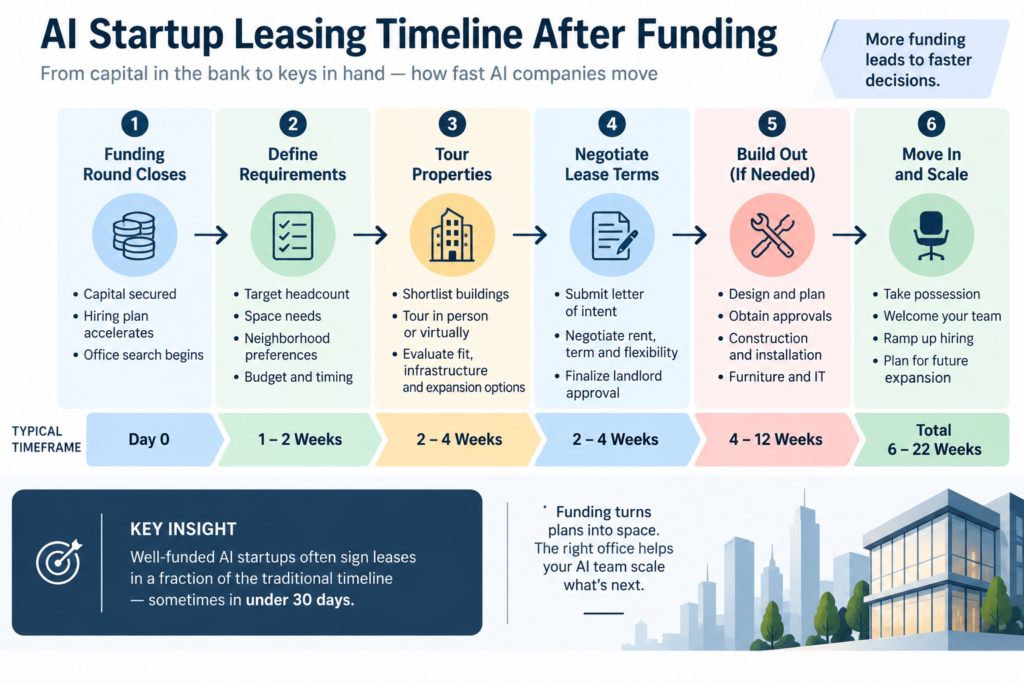
As a result, some AI companies now move from tours to serious negotiations within weeks. Current market reporting has documented transactions moving far faster than traditional six-month searches.
Speed can help a tenant secure a scarce office. Yet speed should not eliminate financial discipline.
Fast leasing and rushed leasing are different things.
A prepared tenant can move quickly because the important decisions happened before touring.
That preparation should establish:
Current headcount → approved hires → probable hires → peak attendance → target footprint → maximum occupancy cost.
Once those variables make sense, the company can move aggressively without guessing.
Funding can increase the target footprint
Artificial intelligence companies frequently expect rapid hiring after capital arrives. Therefore, founders may consider substantially more space than today’s workforce requires.
That approach can work when hiring visibility looks strong. It becomes dangerous when projected hiring depends on another future financing round.
The better approach separates employees into several categories.
Current employees need space immediately.
Signed hires deserve near-certain space allocation.
Approved hires deserve weighted consideration.
Possible hires should influence expansion rights rather than today’s full commitment.
This distinction prevents optimism from becoming rent.
For smaller teams, a 2,600-square-foot move-in-ready sublet near Madison Square Park illustrates one compact option. It includes work areas, meeting rooms, a pantry, tenant-controlled cooling, and 24-hour access.
A different growth profile may fit a 2,691-square-foot turnkey SoHo office. Its published layout includes 20 open workstations, private offices, a kitchen, and additional capacity.
Neither footprint becomes correct merely because a company raised capital. The hiring plan must justify the space.
Funding changes what the office needs to accomplish
An early startup may need desks, internet, and a conference room.
A funded AI company can need considerably more.
Recruiting creates interview rooms. Enterprise sales creates client-facing rooms. Hybrid calls require phone booths. Engineering teams need quiet areas. Leadership needs confidential meeting space.
Some companies also need stronger cooling, electrical capacity, after-hours HVAC, redundant connectivity, or dedicated IT areas.
Consequently, two offices with identical square footage may serve the same company very differently.
A 3,038-square-foot furnished Flatiron office includes several meeting rooms and phone booths. Those features can reduce additional construction before move-in.
Likewise, this 3,150-square-foot Flatiron office combines open seating, a conference room, private office, phone booth, pantry, and breakout space.
For a rapidly hiring company, usable infrastructure may matter more than a small difference in quoted rent.
Funding does not turn rent into free money
A venture round may look enormous beside today’s operating budget.
That comparison can create a false sense of affordability.
Office obligations continue whether hiring succeeds or stalls. Rent remains due after product delays. Security remains committed after revenue misses. Furniture retains little relevance when a company shrinks.
Therefore, do not set an office budget as a simple percentage of the funding round.
Set it against the company’s operating model.
Fresh capital should increase optionality. A poorly structured lease can remove it.
What a Manhattan Landlord Actually Underwrites
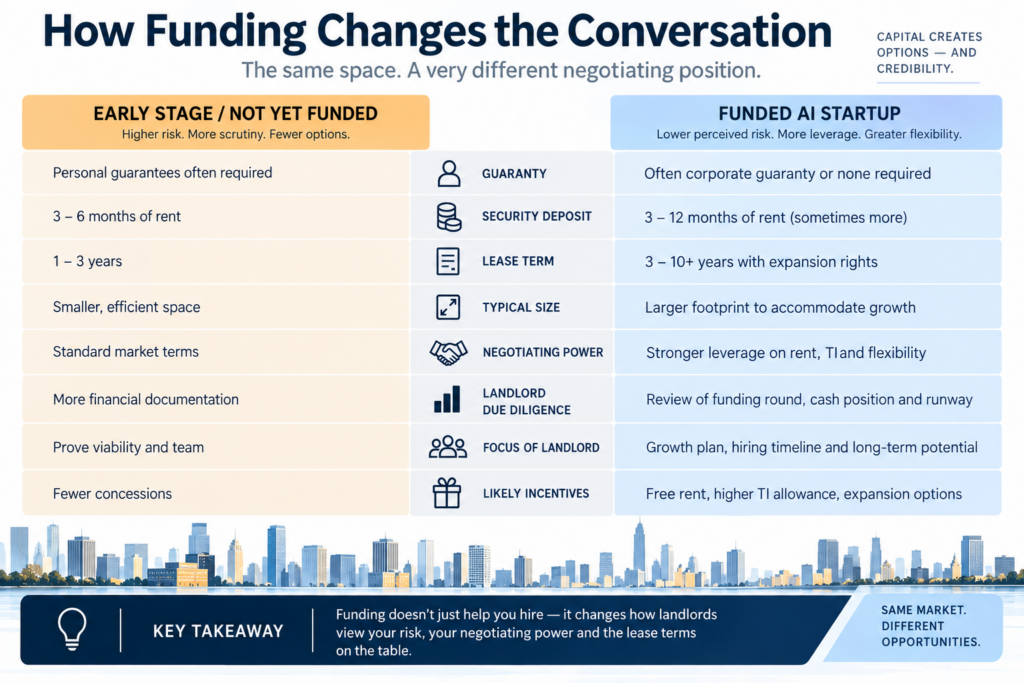
A landlord does not evaluate a startup exactly like an established corporation.
Large mature companies can show years of audited statements, predictable revenue, and established credit. A young AI company may offer something different.
It may have substantial cash, strong institutional backing, rapid growth, limited operating history, and significant monthly burn.
That requires a different underwriting conversation.
Landlords care about cash more than headlines
A financing announcement can establish credibility. Still, the headline amount rarely tells the full financial story.
A landlord wants to understand how much capital the company actually controls.
For example, a large announced round may include conditions or future funding tranches. Another company may hold most proceeds immediately.
Those situations create different lease risk.
Similarly, valuation does not equal cash.
A company can carry a very high valuation while maintaining a relatively short operating runway. Conversely, a modestly valued startup may hold substantial cash.
Post-money valuation measures investor pricing. Landlord underwriting focuses more heavily on payment capacity.
What should a newly funded startup show the landlord?
A strong package tells one understandable financial story.
The landlord should see the legal tenant, completed funding, available liquidity, operating burn, expected hiring, and proposed lease obligation.
The package often includes financial statements, current cash evidence, and basic corporate information. Depending on the deal, ownership may request more detail.
A landlord may also want evidence that the financing actually closed.
That distinction matters when a company signs an office lease during active fundraising.
An unsigned term sheet does not equal funded cash. A committed closing may carry more weight than an early financing conversation.
Prepare the package before making an aggressive offer
AI companies often lose time by waiting until lease negotiations start.
The better sequence begins earlier.
Before making a serious proposal, management should know which information it can release. Counsel should also identify confidential material.
A useful landlord package can address these categories:
| Landlord question | Tenant package response |
|---|---|
| Who signs the lease? | Correct legal entity and organizational details |
| Did the funding close? | Appropriate closing evidence |
| How much liquidity exists? | Current cash or acceptable financial evidence |
| How quickly does cash decline? | Monthly burn and operating context |
| How long is the runway? | Base-case financial planning |
| Why does the company need this space? | Hiring and occupancy plan |
| Can the company support the term? | Lease-cost analysis |
| What protects the landlord? | Proposed security structure |
| Who controls the company? | Appropriate ownership information |
| What happens during growth? | Expansion and assignment strategy |
The goal does not involve disclosing everything.
The goal involves giving the landlord enough information to approve the credit.
Control confidential financial information
Startup financials often contain sensitive information.
Revenue, burn, investor ownership, customer concentration, and financing details may reveal competitive information.
Therefore, tenants should control who receives the package.
The lease can also address future financial reporting requirements. An AI company should avoid unnecessarily broad obligations.
A company may need to provide periodic financial information. However, the lease should address confidentiality and reasonable access.
Our broader AI office lease clause guide covers financial confidentiality alongside expansion, assignment, subleasing, and termination rights.
Runway matters more than round size
Consider two hypothetical AI startups.
Company A raises $50 million and burns $4 million monthly.
Company B raises $25 million and burns $750,000 monthly.
The larger round does not automatically create the stronger tenant.
Other obligations also matter.
Management needs to consider payroll, cloud costs, model expenses, legal costs, recruiting, insurance, sales spending, and expected revenue.
Office rent becomes one part of that cash equation.
Therefore, a landlord may ask an important question:
How much runway remains after the lease starts?
The tenant should ask the same question first.
Revenue can strengthen the story without replacing liquidity
Some AI startups have substantial recurring revenue. Others prioritize growth before predictable cash flow.
Landlords can evaluate both.
Still, a tenant should explain recurring revenue clearly when it materially improves credit.
Contracted enterprise business may help demonstrate durability. Growing recurring revenue can also help explain a planned increase in office size.
However, projections require caution.
Landlords generally give actual cash and actual revenue more weight than optimistic forecasts.
Investor quality can help, but investors usually do not sign the lease
Institutional backing can improve a landlord’s perception of the company.
It can indicate third-party diligence and access to capital markets. Yet landlord protection usually comes from the tenant’s own obligations.
A landlord should not assume investors will rescue a portfolio company.
Likewise, tenants should not assume prestigious backing eliminates security requirements.
Funding improves the credit conversation. It does not automatically transfer investor credit to the startup.
The landlord also underwrites its own investment
Tenant credit becomes more important when the landlord spends heavily on the office.
Imagine an owner funding substantial construction, brokerage costs, and free rent. The owner must recover those costs during the lease.
A lightly improved office creates a different risk profile.
Therefore, a startup requesting extensive landlord work may encounter tougher credit conditions.
The landlord can seek more security, a longer term, or both.
A furnished existing installation can reduce this friction.
That explains why a newly funded company should compare total transaction structure, not merely face rent.
Security Deposits, Guarantees, and Startup Credit
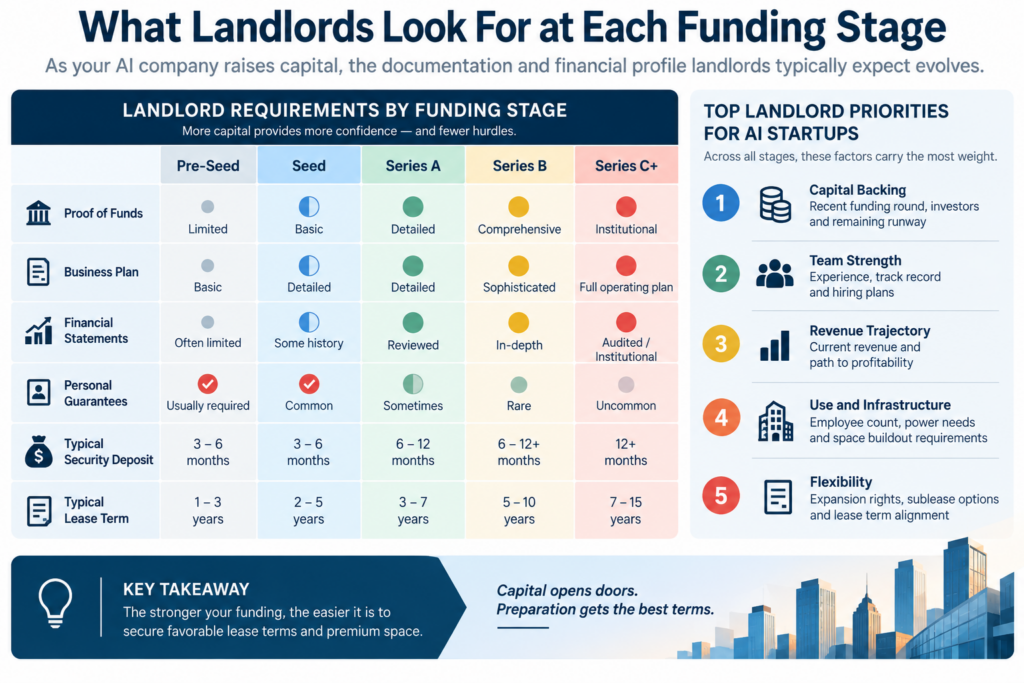
Security often becomes the most misunderstood part of an AI startup office negotiation.
Founders sometimes assume a successful round will produce a conventional deposit.
Landlords may see the situation differently.
A cash-rich startup can still have volatile revenue, aggressive hiring, and a short operating history.
Consequently, ownership may request meaningful security.
There is no universal startup security deposit
Commercial office security depends on many factors.
These include company liquidity, revenue, burn, landlord investment, term length, space condition, building quality, and negotiating leverage.
An established profitable tenant may secure relatively modest terms.
A newly formed company may face a larger requirement.
The best response is not simply arguing over the opening number.
Instead, negotiate the security architecture.
That architecture can matter more than the original amount.
Our guide to commercial lease deposits and guarantees explains how these structures differ.
Cash security has a real runway cost
Suppose a company posts twelve months of rent as cash security.
That money remains company property under New York’s statutory framework. New York law requires qualifying lease security to remain held in trust.
However, the tenant cannot freely use those funds for payroll or product development.
Therefore, security affects practical liquidity even when accounting treatment differs from rent expense.
That makes deposit negotiations especially important after a funding round.
A letter of credit may preserve a different form of liquidity
Some leases use a letter of credit instead of cash security.
That structure can work well in certain circumstances. Yet it does not make security economically meaningless.
Banks can require collateral, fees, documentation, and renewal procedures.
The lease also establishes draw conditions.
Tenants should review those mechanics carefully with counsel and their banking team.
Security burn-downs can reward improved credit
A newly funded startup may accept stronger initial security while seeking a future reduction.
That reduction can depend on objective conditions.
Examples include sustained revenue, additional financing, minimum unrestricted cash, time without default, or another measurable credit threshold.
The details matter.
An ambiguous clause can become worthless later.
A useful burn-down should identify the exact condition, amount, timing, and release process.
For a growing company, that can convert future financial improvement into recovered liquidity.
A future funding round can become a negotiation trigger
The lease can sometimes connect stronger credit with lower security.
For example, the company may expect another institutional round during the lease.
Instead of assuming the landlord will voluntarily reduce security, address the possibility during initial negotiations.
A measurable funding threshold can create a clear release mechanism.
That approach turns a future financing event into a contractual benefit.
Avoid unnecessary personal exposure
A landlord may request additional guarantees when startup credit looks weak.
Founders should understand exactly what the proposed guarantee covers.
A broad personal guarantee creates materially different exposure from limited lease security.
Likewise, a corporate guarantee only helps when the guarantor has meaningful credit.
These issues deserve legal review before signature.
Commercial leasing terminology can make similar-looking protections produce very different outcomes.
Good credit can also improve economics
Strong financial presentation can affect more than acceptance.
A credible tenant package can support negotiations around security, landlord work, rent commencement, concessions, and lease structure.
It can also help the tenant move faster.
That matters in a market where quality fitted offices increasingly attract multiple interested tenants.
Credit preparation creates negotiating leverage before rent negotiations begin.
How Funding Should Change Office Size and Budget
A funding round should influence office planning.
It should not determine the answer by itself.
The correct space usually reflects people, attendance, workflow, growth probability, and runway.
Start with peak attendance, not total payroll
A company can employ 70 people without needing 70 daily desks.
Alternatively, a highly office-centric company may need nearly every workstation each day.
Therefore, start with expected peak attendance.
Then add appropriate rooms for the work.
Engineering-heavy teams may prioritize focus rooms. Sales-heavy teams may need additional call rooms. Recruiting pushes interview-room demand higher.
Customer demonstrations can require presentation areas.
The final footprint should reflect operating reality.
Separate committed hiring from aspirational hiring
Funding often unlocks a large hiring plan.
Yet every planned role does not deserve a desk today.
Assign each future role a probability.
For example, signed employees deserve full weighting. Approved near-term hires deserve high weighting. Longer-term hires deserve lower weighting.
That exercise produces a more realistic occupancy curve.
Expansion rights can handle the remaining upside.
A screening range can narrow the search
No square-footage formula works for every AI company.
Still, broad ranges can help a tenant organize the initial search.
| Team profile | Early screening range | Typical planning priority |
|---|---|---|
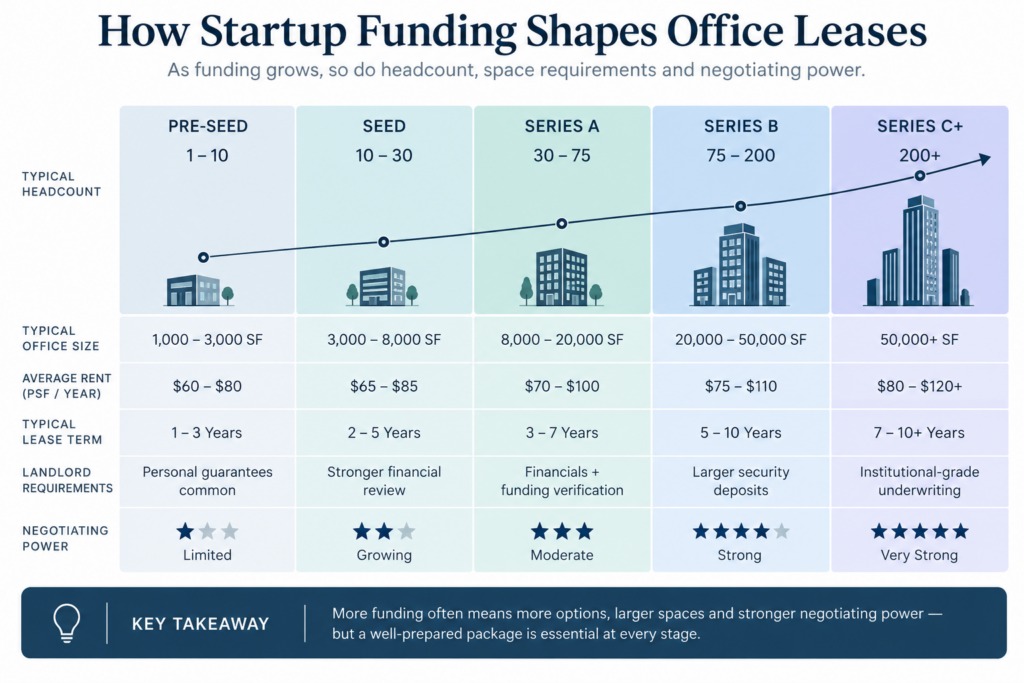
| Smaller funded team | 2,000–3,500 RSF | Turnkey occupancy and speed |
| Growing early-stage team | 3,500–8,000 RSF | Hiring capacity and expansion |
| Established growth team | 7,500–15,000 RSF | Department planning and infrastructure |
| Larger scaling organization | 15,000+ RSF | Long-term capacity and control |
These figures provide search bands, not architectural standards.
A dense office can hold more people. An executive-heavy layout needs more area.
Client rooms, kitchens, lounges, labs, internal stairs, and wellness rooms also change the answer.
Compact offices can support the first post-funding phase
A startup moving from a temporary setup may not need a giant headquarters immediately.
A furnished office can create a useful first step.
This 3,483-square-foot Chelsea and Flatiron loft office offers one intermediate footprint.
Meanwhile, a 4,000-square-foot full-floor SoHo office provides an entire-floor format with meeting and private-room infrastructure.
Larger early-stage teams can examine a 5,000-square-foot furnished Flatiron office when they need more immediate capacity.
These examples show why teams should compare layouts rather than square footage alone.
Do not lease every future desk today
Overleasing feels inexpensive when the company holds fresh capital.
Unused rent becomes more noticeable later.
Suppose 40 employees occupy a space designed for 80 people. Management expects rapid hiring.
That can make sense when approved recruiting supports the forecast.
It becomes speculative when the second 40 depend on a future round.
Rather than buying every future desk, consider:
Current footprint + reasonable growth capacity + expansion rights.
That structure can preserve capital without sacrificing upside.
Empty space has an opportunity cost
An unused office still consumes cash.
It also creates furnishing, utilities, cleaning, insurance, and operational obligations.
Even a modest amount of excess space becomes material across several years.
Therefore, calculate the cost of the empty portion.
For example:
Annual excess-space cost = unused rentable square feet × effective occupancy cost.
That number makes the overleasing decision more concrete.
Management can then compare excess-space cost against the risk of moving again.
Underleasing also has a cost
Taking too little space creates another problem.
A company can outgrow the office during active recruiting.
Employees then crowd meeting rooms. Phone calls spill into hallways. Hiring becomes harder.
The company may also face an expensive second move.
Accordingly, the goal is not minimum square footage.
The goal is controlled excess capacity.
Funding gives an AI startup the ability to reserve that capacity intelligently.
Build an occupancy budget, not a rent budget
Base rent tells only part of the story.
A tenant should model every meaningful occupancy expense.
These can include electricity, cleaning, HVAC, connectivity, insurance, furniture, construction, security, legal costs, moving, and restoration.
After-hours cooling can matter greatly for teams that work extended schedules.
Telecommunications costs can also vary significantly between buildings.
Construction deserves particular attention.
A cheap raw office may ultimately cost more than a higher-priced furnished space.
Stress-test rent against runway
A startup should model the lease under more than one growth case.
Growth case: hiring proceeds on plan.
Slower case: hiring takes twice as long.
Capital case: the next funding round arrives later.
Contraction case: management freezes hiring.
The lease should remain survivable in more than the most optimistic scenario.
This test becomes especially important with long terms.
A seven-year obligation can outlast several product cycles and financing events.
Think in total lease liability
Monthly rent feels manageable.
Total contractual liability looks different.
A company committing $100,000 monthly faces $1.2 million annually before other expenses.
Across five years, nominal base payments can reach millions.
Escalations increase that amount further.
That is why investors, finance leaders, and boards may care about lease structure.
Fresh financing creates the ability to sign. Financial planning should determine whether the company should sign.
Lease Structure, Term, and Flexibility After Funding
Funding changes how much flexibility a startup can afford.
It should also change how carefully the company negotiates that flexibility.
A fast-growing AI company should negotiate around possible change, not today’s organization chart.
Direct lease or sublease?
A direct lease creates a relationship with the building owner.
That structure can offer stronger long-term control and greater customization.
However, direct leases may involve longer commitments and more documentation.
A sublease can offer an existing installation, furniture, and shorter remaining term.
Yet sublease rights depend on both the sublandlord and master lease.
Neither option is universally better.
The correct structure depends on timing, capital, customization, and growth visibility.
Our Manhattan AI office-space guide explains the broader occupancy choices for artificial intelligence companies.
Furnished space can protect post-funding capital
A newly funded startup does not always need a custom headquarters.
Furniture, construction, cabling, conference rooms, kitchens, and phone rooms consume money and management attention.
A completed office can move those costs into an existing installation.
For example, this 5,274-square-foot furnished Flatiron office already includes workstations, conference rooms, and phone rooms.
A 5,550-square-foot full-floor SoHo office offers another full-floor growth format.
Meanwhile, a 6,250-square-foot Flatiron full-floor office can suit a team seeking more control.
Lease term should follow visibility
A short lease maximizes near-term flexibility.
A longer lease can improve stability and justify additional landlord investment.
Neither objective automatically wins.
Consider how confidently management can forecast the organization.
A seed-stage company may have limited visibility beyond several years. A later-stage company may know its expected department structure more clearly.
Building ownership also matters.
Some landlords prefer longer commitments, particularly when contributing substantial capital.
The tenant should compare term alongside concessions, security, improvements, and rights.
A longer lease can buy more than time
Longer terms can support landlord-funded construction.
They can also create stronger negotiating economics.
That benefit comes with a cost.
The company carries more long-term liability.
Therefore, a tenant should not extend a lease simply to obtain free rent.
Calculate the entire package.
An extra concession can look attractive while the additional years create far greater liability.
Short terms can have hidden limitations
A startup may ask for two or three years because its future remains uncertain.
That request can work in some spaces.
However, landlords may resist investing heavily into a short lease.
The tenant may also receive fewer concessions.
Additionally, a short lease can force the company back into the market during its busiest growth period.
Therefore, flexibility should include more than expiration date.
Expansion rights deserve early attention
A rapidly funded company should ask a simple question:
What happens when we need another 5,000 square feet?
The best answer may involve the same building.
Expansion rights can cover adjacent space, future vacancies, or defined floors.
A right of first offer can give the tenant an early opportunity.
Other structures may provide different levels of priority.
Precise drafting matters because vague expansion language creates little certainty.
A larger initial footprint can replace expansion rights
Sometimes adjacent future space simply does not exist.
In that case, management must compare two risks.
The first involves paying for excess space now.
The second involves moving after rapid growth.
A strong building with limited internal expansion may justify more initial capacity.
Conversely, a building with predictable future vacancies can support a smaller starting footprint.
This is why the building’s stacking plan matters to a growth tenant.
Assignment rights matter during financing and M&A
AI companies can change ownership quickly.
They can acquire another business. Another organization can acquire them. Corporate structures can also change after financing.
The lease should anticipate those possibilities.
Overly restrictive assignment language can create friction during a major corporate event.
The company should review change-of-control provisions before signing.
An office lease should support the business transaction, not obstruct it.
Subleasing rights provide a downside valve
No startup wants to plan for contraction immediately after funding.
Responsible management still considers it.
Strong sublease rights can reduce exposure after a hiring freeze, strategic change, or consolidation.
Landlords typically retain approval rights.
Therefore, the details matter.
The lease should establish reasonable standards, response procedures, and permitted transferees.
Termination rights can create valuable optionality
A true termination option can provide significant protection.
Naturally, landlords rarely give that flexibility without economic consideration.
A tenant may need to pay a fee or reimburse unamortized transaction costs.
Still, a defined exit can be valuable for a company with unusually volatile growth.
The tenant should evaluate the option’s real cost rather than its label.
Negotiate security reduction alongside growth rights
Expansion protects the upside.
Subleasing and termination protect the downside.
A security burn-down protects liquidity after improved performance.
Together, these provisions create a more complete growth lease.
Our detailed page on office lease clauses for fast-growing AI companies covers these rights in greater depth.
Larger fitted offices create another growth path
A company moving beyond the 5,000-square-foot level gains more choices.
A 6,500-square-foot furnished Union Square office can support a larger team without starting from raw space.
This 6,514-square-foot furnished Midtown South office provides another furnished option.
A startup seeking a larger private floor can examine this 6,900-square-foot Flatiron office.
For a funded company, these comparisons should include construction savings, occupancy timing, layout efficiency, and lease flexibility.
What the Manhattan Office Market Means for Funded AI Companies
Capital matters more when desirable office supply tightens.
As of August 2026, Manhattan’s office market had recorded strong leasing activity and declining availability.
One major market dataset measured Manhattan availability at 12.5%. It placed total available inventory at 65.4 million square feet. That marked the lowest total availability since September 2020.
The same dataset reported 29.91 million square feet of year-to-date leasing through August. That represented a 9.4% increase from the comparable 2025 period.
Sublet inventory had also declined 22.3% year over year to 10.07 million square feet. That represented its lowest level since August 2019.
Different market reports use different methodologies
Another major August dataset measured Manhattan availability at 13.7%.
It reported average asking rent of $80.05 per square foot. Sublease availability measured 2.4%, with average sublease asking rent at $58.44.
The absolute percentages differ because market researchers use different inventories and definitions.
The practical tenant conclusion remains similar.
Manhattan has tightened meaningfully, while well-positioned offices face stronger demand.
This matters most for turnkey space.
A funded company that wants immediate occupancy may compete within a much smaller inventory subset.
AI leasing has become a significant market force
Artificial intelligence companies leased approximately 1.50 million square feet during the first half of 2026.
Those transactions occurred across 63 deals.
AI companies represented more than one-third of Manhattan technology leasing demand during that period.
Midtown South captured 75.1% of technology leasing during the same period.
That concentration helps explain why Flatiron, NoMad, Chelsea, Union Square, and nearby neighborhoods deserve careful planning.
Demand does not make every office expensive.
However, it reduces the wisdom of assuming another identical space will appear next week.
Funding improves speed only when the tenant has already prepared
A company cannot control building supply.
It can control readiness.
Teams should establish their budget, financial package, decision-makers, attorney, target footprint, and required lease rights before touring seriously.
That preparation allows management to act when the right space appears.
Our guide to how quickly an AI company can lease Manhattan office space covers the transaction timeline.
Flatiron and NoMad fit many growth-stage searches
Midtown South offers a broad collection of loft buildings, renovated properties, and modern Class A offices.
For funded AI companies, the area can combine transit access with proximity to related technology activity.
A team that needs approximately 8,000 square feet can examine this 8,264-square-foot furnished full-floor office.
Larger teams can compare that format with a 10,439-square-foot furnished Park Avenue South sublet.
The relevant question is not whether one neighborhood carries the strongest label.
The question is whether location improves hiring, attendance, customer access, and operating efficiency.
Union Square can support employee accessibility
Union Square provides broad subway access from multiple directions.
That can matter when an AI company recruits throughout the city and nearby regions.
Transit convenience may improve attendance without requiring management to impose longer commutes.
It can also create a useful bridge between downtown residential areas and Midtown.
For a company evaluating several neighborhoods, commute mapping should happen before tours.
Otherwise, management can fall in love with an office that creates daily employee friction.
Our Manhattan neighborhood comparison for AI companies can help establish the initial geographic range.
SoHo and nearby downtown neighborhoods serve a different profile
Some teams prioritize loft character, client presentation, creative surroundings, or downtown employee concentration.
SoHo can address those preferences.
Yet beautiful space still needs practical infrastructure.
Check elevators, cooling, electrical service, internet providers, security, restrooms, and after-hours access.
An impressive office loses value when employees cannot work comfortably during peak operating hours.
This principle becomes more important for intensive AI teams.
Midtown can solve a transportation problem
Not every AI company should follow technology clustering.
Midtown can make sense for employees commuting through major rail terminals.
It can also suit teams that meet frequently with institutional clients.
A company should therefore evaluate commute time alongside rent.
Saving several dollars per square foot may not justify weaker employee access.
Likewise, paying a premium requires a measurable operational reason.
Downtown can create value for larger requirements
Downtown can offer economics and larger blocks that differ from Midtown South.
That can help a growing tenant needing substantially more square footage.
However, neighborhood choice should follow workforce geography.
A downtown lease becomes less attractive when most employees commute from the opposite direction.
The right analysis combines rent, transit, recruiting, client access, building quality, and future expansion.
Growth-stage companies can move into full-floor formats
Once the organization passes smaller startup footprints, an entire floor can improve control.
Private elevator exposure, dedicated meeting areas, internal branding, and consistent security can become more important.
This 13,075-square-foot full-floor Chelsea and Flatiron office illustrates that next size category.
A much larger scaling organization can review a 30,000-square-foot furnished full-floor SoHo and Hudson Square option.
Large footprints require a different financial analysis.
At that scale, tenant improvements, infrastructure, expansion strategy, and lease liability become board-level considerations.
Asking rent does not equal final occupancy cost
Published asking rents provide market context.
They do not tell a tenant what a specific transaction will cost.
Building quality, floor height, condition, term, concession package, landlord work, and credit all affect economics.
Sublease pricing works differently again.
Therefore, compare spaces using effective occupancy cost.
That comparison should account for every meaningful economic difference.
A lower face rent can lose after construction costs.
A higher face rent can win when the space already contains valuable improvements.
A Funding-Stage Office Lease Playbook
Different financing stages create different real estate problems.
Treating every funded startup alike produces poor decisions.
A newly seeded company and a late-stage organization may both call themselves AI startups.
Their lease strategies should still look different.
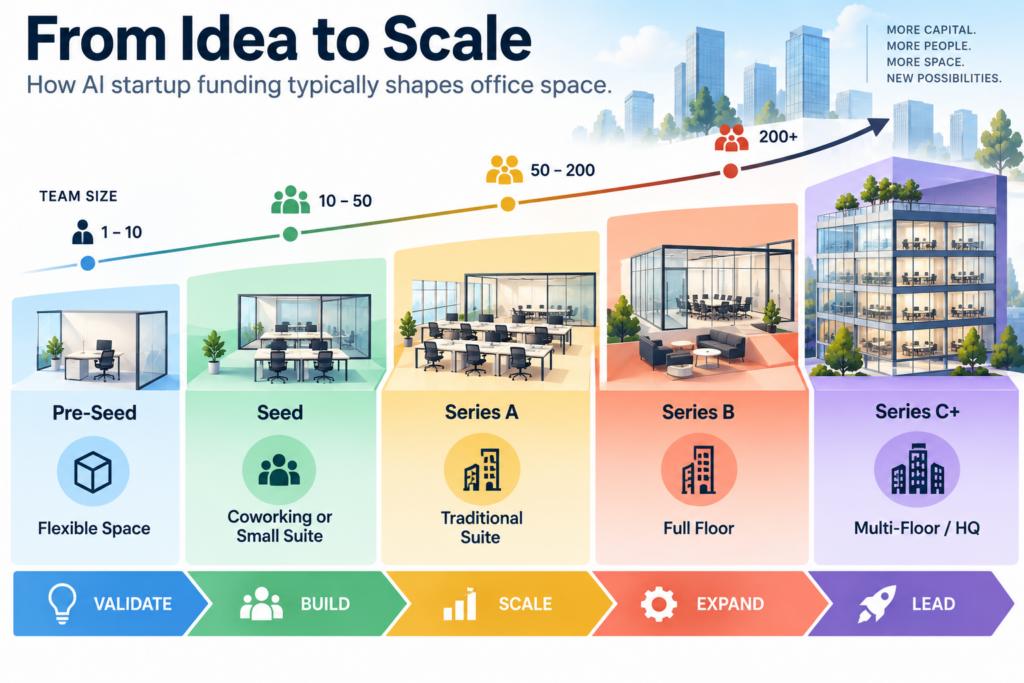
Pre-seed and seed companies need capital protection
At this stage, future headcount may remain difficult to predict.
Therefore, avoid building an office around the best-case hiring plan.
Prioritize speed, low upfront construction, manageable security, and a realistic commitment.
A small fitted direct lease or sublease may provide the right balance.
For suitable teams, the 2,600-square-foot Fifth Avenue sublet creates one example.
The 2,691-square-foot SoHo turnkey office offers another layout approach.
The objective is simple.
Do not let the first institutional check create the company’s first oversized fixed liability.
Series A companies should plan for approved hiring
A Series A company often has clearer hiring objectives.
It may need engineering, sales, recruiting, finance, and leadership seats during the lease.
Accordingly, the search can shift from today’s team toward a defined occupancy curve.
This stage also makes expansion rights more valuable.
Management should ask where the next increment of space can come from.
A building that supports internal growth may justify a slightly higher rent.
Avoid paying for several years of unused desks solely to solve an expansion problem.
Series B companies can negotiate from greater financial strength
Later financing can improve landlord confidence.
The company may show stronger liquidity, revenue, operating history, and institutional sponsorship.
Use that improvement.
Negotiate security rather than accepting an early-stage structure automatically.
Also revisit landlord work.
A longer operating horizon may justify more customized improvements.
Still, preserve assignment, subleasing, and expansion rights.
The organization can change dramatically before the lease expires.
Series C and later companies should think like long-term occupiers
Later-stage companies often need larger contiguous blocks.
At this point, space planning becomes more complex.
Departments may need dedicated neighborhoods. Customer areas grow. Recruiting operations expand. Security and technology requirements become more substantial.
Management may also care about branding and building identity.
A longer direct lease can make sense.
However, long-term control should not eliminate flexibility.
Future acquisitions, public-market events, restructuring, and new office locations can still change occupancy needs.
A bridge round calls for a different strategy
Not every financing event represents aggressive expansion.
A bridge round may primarily extend runway.
That distinction should change the office decision.
When capital exists to preserve operations, management should avoid treating it like expansion financing.
A shorter commitment may make more sense.
A fitted sublease can also reduce construction spending.
Current space may even deserve renegotiation before relocation.
The purpose of the financing should inform the purpose of the lease.
A down round should trigger a fresh occupancy review
A company raising at a lower valuation may still have substantial cash.
Nevertheless, the financing can indicate changed growth assumptions.
Revisit hiring forecasts before signing new space.
Do not use an outdated headcount plan merely because the office search already started.
Likewise, revisit expansion assumptions.
The team may still grow, but timing can shift.
Real estate should follow the revised operating plan.
Funding before a lease creates the cleanest underwriting story
A completed financing gives the landlord a clear cash position.
It also gives management more confidence when setting an office budget.
Therefore, closing funding before signing often simplifies the process.
However, timing does not always allow that sequence.
A company may need office space before the round closes.
That creates additional underwriting complexity.
Leasing during a funding round requires careful sequencing
When financing remains in process, avoid presenting uncertain capital as completed capital.
Instead, define the current financial position accurately.
Then decide whether the lease depends on the financing.
Possible strategies vary by transaction.
Management may delay execution, pursue a shorter interim solution, or structure another practical bridge.
The company should coordinate closely with counsel and finance leadership.
The lease must not assume money that has not arrived.
Funding after lease signing can create a renegotiation opportunity
Suppose a startup signed its lease before a major capital raise.
The original deal may contain high security because the tenant appeared riskier.
A later financing improves the balance sheet.
The landlord does not automatically owe the tenant new terms.
However, an existing contractual burn-down can convert the funding event into a security reduction.
That is why tenants should think about future financing while negotiating today’s lease.
Acquisition funding creates another question
Capital may support acquisitions rather than organic hiring.
That can change office planning quickly.
The acquired team may already occupy another office.
Management then needs to compare consolidation, dual offices, assignments, subleases, and lease expirations.
A large funding round does not necessarily mean more Manhattan square footage.
Sometimes it creates an opportunity to rationalize the entire portfolio.
Questions AI Companies Ask Before Signing a Manhattan Office Lease
Will a Manhattan landlord lease office space to a newly funded AI startup?
Yes.
A newly funded AI company can become an attractive tenant when its financial package supports the obligation.
Landlords will usually look beyond the funding announcement.
Expect questions around liquidity, burn, operating runway, revenue, lease size, and security.
The company should also explain why its proposed footprint matches actual hiring plans.
Preparation can turn an unfamiliar startup into an understandable credit.
Does a startup need revenue to sign an office lease?
Not necessarily.
Some funded companies sign leases before meaningful revenue develops.
However, limited revenue can increase attention on cash, burn, funding quality, and security.
A strong balance sheet can support approval.
Still, no single metric decides every transaction.
Landlord risk tolerance also varies.
Does valuation matter to a landlord?
Valuation can provide context.
It does not pay rent.
A landlord generally cares more about liquidity and payment capacity.
Therefore, a billion-dollar valuation should not substitute for a clear financial package.
Tenants should present valuation only within the broader credit story.
Does the funding round determine how much office space we should lease?
No.
Funding enables a lease. It should not dictate square footage.
Use hiring plans, peak attendance, workplace strategy, customer needs, and growth probability.
Then compare that requirement with financial runway.
That process produces a more defensible footprint.
How much larger should we lease than today’s headcount requires?
There is no universal percentage.
Some rapidly scaling AI companies have taken significant excess capacity. Current market reporting documents unusually aggressive forward leasing among certain tenants.
That does not create a benchmark every startup should copy.
Start with realistic hiring.
Then price the unused area.
Finally, compare that cost with the potential expense of moving again.
Should we sign a lease before or after the funding closes?
Closing first generally creates a clearer financial picture.
However, business needs may require parallel processes.
When financing remains unfinished, disclose the company’s current position accurately.
Do not build the lease economics around unreceived proceeds.
The correct timing depends on cash, urgency, funding certainty, and space availability.
Can we tour before financing closes?
Absolutely.
A company can begin learning the market before completing financing.
In fact, early touring can improve budgeting.
Management can understand neighborhoods, pricing, size efficiency, and available lease structures.
However, avoid committing to an unaffordable lease because financing appears likely.
Tours provide information. They do not require premature commitment.
How much cash does a landlord expect us to show?
There is no fixed universal amount.
The answer depends on total rent, term, landlord investment, existing revenue, burn, and security.
A landlord usually wants confidence that the company can meet the lease obligation.
Therefore, think in terms of runway rather than an arbitrary cash multiple.
The package should explain why current liquidity supports the proposed commitment.
Do investors need to guarantee the lease?
Usually, investor backing and investor liability are different concepts.
An investment firm can finance a startup without guaranteeing its office lease.
A landlord may value the investor profile.
Yet the lease generally remains the tenant’s obligation unless another party explicitly guarantees it.
Do not assume funding sponsorship equals a guarantee.
Can founders avoid personal guarantees?
That depends on the transaction.
Strong company liquidity can improve the case for corporate-only obligations.
A landlord may still request additional protection when company credit looks limited.
Tenants should negotiate the structure carefully.
Counsel should review any guarantee before execution.
Personal exposure should never hide inside language management does not fully understand.
How large should the security deposit be?
No single number applies to every commercial startup lease.
A landlord can weigh company credit, landlord investment, lease term, construction, and market leverage.
Rather than focusing only on the opening deposit, negotiate future reductions.
A well-written burn-down can return liquidity after the company reaches agreed milestones.
Should we use cash security or a letter of credit?
Both structures can work.
Cash remains straightforward but restricts usable liquidity.
A letter of credit can create different collateral and banking requirements.
Compare bank costs, collateral impact, draw mechanics, renewal requirements, and lease language.
The cheaper-looking structure does not always preserve more operating flexibility.
Can our security deposit decrease after another funding round?
Potentially.
The lease should establish that right before signature.
A financing-based reduction works best with objective criteria.
Define the qualifying financing, minimum amount, required proof, release amount, and timing.
Do not rely on a future handshake.
Can stronger revenue reduce security later?
A properly negotiated lease can connect security reduction to defined financial improvement.
Revenue thresholds can form part of that structure.
Other tests can include cash levels or profitability.
Choose metrics the company can verify without exposing unnecessary information.
Objective conditions reduce later disputes.
What lease term makes sense for a funded AI startup?
The term should reflect visibility.
A young company may value shorter commitments.
A growth-stage company may gain from a longer direct lease.
Consider construction costs, concessions, expansion, expected hiring, and possible relocation.
The best term gives the company enough stability without converting uncertainty into excessive liability.
Should an AI startup choose a direct lease or sublease?
Choose based on business requirements.
Subleases can provide furniture, infrastructure, and shorter commitments.
Direct leases can offer longer control, stronger landlord relationships, and customization.
Compare each opportunity individually.
A favorable sublease with the wrong expiration can fail the growth plan.
Likewise, a perfect direct lease can become too rigid.
Is coworking the best option after funding?
Not automatically.
Flexible workspace can serve as a short bridge when timing remains uncertain.
It can also support temporary teams.
However, companies needing privacy, branding, dedicated infrastructure, or predictable long-term occupancy may prefer traditional space.
Evaluate flexible space as one tool.
Do not let a temporary solution replace long-term planning.
Our short-term office guide for AI startups addresses that transition.
How quickly can a funded AI company sign a Manhattan lease?
A prepared company can move quickly.
Current AI leasing activity has shown dramatically compressed transaction timelines.
Still, signing and occupancy are different milestones.
A built furnished office can support faster occupancy.
Raw space may require design, permits, construction, furniture, cabling, and inspections.
Therefore, ask both questions:
When can we sign?
When can employees actually work there?
What slows down landlord approval?
Incomplete financial information creates common delays.
Entity confusion also causes problems.
A landlord may receive financials for one company while another entity appears on the proposal.
Unclear funding status can create more questions.
Large construction requests can also require deeper credit review.
Prepare these details before the lease reaches legal documentation.
What slows down the tenant?
Internal indecision can cost more time than landlord review.
Founders may disagree about neighborhood, size, image, or price.
Boards can also require approval above a certain lease liability.
Therefore, establish decision authority before the search reaches final offers.
Know who can approve economics.
Also know who signs the lease.
Should we negotiate expansion space now?
Yes, when future growth appears plausible.
Ask what could become available during the lease.
Then determine whether meaningful rights can cover it.
Expansion language becomes especially valuable when the company starts below its long-term forecast.
Without that planning, success can force another relocation.
What happens if hiring slows?
The answer should influence the original deal.
A company with uncertain hiring should avoid relying exclusively on aggressive growth.
Consider a smaller initial footprint, sublease rights, expansion rights, and reasonable term length.
A termination option may also deserve consideration.
The downside case belongs in negotiations before growth slows.
What happens if we double headcount faster than expected?
That is the opposite problem.
The company may need adjacent space, another floor, or a second location.
Good expansion rights can help.
Building selection also matters.
Ask about future vacancies before signing.
A building with no expansion pathway can make an otherwise perfect small office less attractive.
Can we sublease unused office space?
Many commercial leases permit subleasing under defined conditions.
However, landlord consent and lease restrictions usually matter.
Review recapture rights, profit-sharing provisions, approval standards, and permitted subtenants.
Do not assume unused desks can automatically generate sublease income.
The lease language controls the practical option.
How do lease payments affect startup runway?
Every occupancy dollar competes with another use of capital.
That does not make office rent wasteful.
A productive workplace can support recruiting, collaboration, customers, and culture.
The correct question is whether those benefits justify the total occupancy cost.
Model lease payments alongside payroll, technology costs, and future financing assumptions.
Does an office help an AI company raise more funding?
An office does not create investment quality.
However, a functioning workplace can support recruiting, operating discipline, customer meetings, and team cohesion.
Those factors may strengthen the organization.
Still, tenants should not lease expensive space mainly to impress investors.
The business should justify the office independently.
Can an office improve customer credibility?
For some businesses, yes.
Enterprise customers may value an established operating presence.
Client-facing meeting space can also improve presentations and diligence visits.
However, that value depends on the company and customer.
Do not pay for elaborate reception space when customers rarely visit.
Build for actual operating behavior.
How does office leasing affect startup growth?
The office can either support growth or constrain it.
Too little space creates operational friction.
Too much space drains capital.
An inflexible lease can restrict later decisions.
A well-structured lease gives the company enough room to execute while protecting multiple future outcomes.
That balance matters more than architectural spectacle.
Should we use funding to build a custom headquarters?
Only when the business case supports it.
Custom construction can create excellent workplace performance.
It also consumes money and time.
A company with stable long-term occupancy may justify that investment.
A rapidly changing early-stage company may gain more from a strong existing installation.
Compare the cost of customization against the expected period of use.
How much does Manhattan office space cost?
Market-wide asking rents provide only context.
One August 2026 dataset placed Manhattan’s average asking rent at $80.05 per square foot. It placed average sublease asking rent at $58.44.
Actual opportunities can sit well below or above those averages.
Neighborhood, building quality, floor, condition, term, and size all matter.
Our Manhattan AI office cost guide provides a fuller cost framework.
Is the cheapest office usually the best startup office?
No.
A cheap raw office may need substantial construction.
Another space may have poor cooling, inefficient layout, limited conference rooms, or weak transit access.
Conversely, an expensive office can waste capital when its premium features provide little business value.
Compare economic value against operating value.
Price matters. Cost matters more.
Should we disclose our funding round before negotiating rent?
Funding information can strengthen credit.
It can also influence how the landlord perceives the tenant’s financial capacity.
Therefore, disclosure needs strategy.
Provide enough information to support credit approval.
Avoid treating fundraising success as permission to abandon economic discipline.
A well-funded tenant should still negotiate seriously.
Does more funding mean the landlord will charge more?
A quoted rent generally reflects the space and market.
However, negotiations include more than rent.
A financially stronger tenant can improve the landlord’s risk profile.
That strength can support negotiations around security, construction, concessions, and flexibility.
Use the funding round to improve credibility.
Do not use it to signal unlimited willingness to spend.
What office lease application does a newly funded startup need?
Commercial landlords do not use one universal application.
The package often functions more like a credit submission.
It can include entity information, financial statements, liquidity evidence, funding information, and business background.
The landlord may request additional material after reviewing the initial package.
Preparing it early saves time later.
Do we need a business plan for the landlord?
Not always in formal presentation form.
Yet the landlord needs to understand what the company does.
A concise explanation can help ownership evaluate an unfamiliar AI business model.
Describe the product, customer base, funding, growth trajectory, and office use.
Avoid overwhelming the decision-maker with technical language.
Clarity improves underwriting.
What should we say about projected headcount?
Use a defensible forecast.
Separate current employees from signed hires and approved openings.
Then explain the timing.
That approach makes the proposed footprint easier to understand.
It also helps the tenant determine whether expansion rights can replace additional initial space.
Can we keep our office search confidential?
Yes, with appropriate process control.
Funding, hiring, relocations, and acquisitions can create sensitive information.
Limit unnecessary distribution of financials.
Likewise, control who knows the target buildings and timeline.
Our guide to confidential office searches for AI companies addresses those situations.
Should employees participate in choosing the office?
Key operational stakeholders should influence the program.
That does not require a company-wide building vote.
Leadership should understand commuting patterns, working styles, department needs, and attendance expectations.
Employee data can prevent expensive location mistakes.
However, management still needs a clear decision process.
When should an AI startup begin looking?
Begin before the need becomes an emergency.
A fitted office can move quickly.
A custom build takes much longer.
Early planning also gives the tenant time to compare direct leases, subleases, neighborhoods, and different sizes.
A funding round can accelerate urgency.
Preparation keeps urgency from weakening negotiating leverage.
What should we inspect during an office tour?
Do not tour only for appearance.
Check workstation efficiency, natural light, meeting rooms, phone rooms, cooling, restrooms, pantry, elevators, security, and accessibility.
Confirm telecommunications options.
Ask about after-hours HVAC.
Study surrounding transit.
Also understand potential construction.
An attractive office can still hide expensive operational shortcomings.
How should we compare several shortlisted offices?
Build a normalized comparison.
Include usable layout, asking rent, concessions, construction, furniture, security, term, commencement, operating costs, and expansion potential.
Then add qualitative factors.
These include commute quality, recruiting appeal, client presentation, building operations, and move-in timing.
Avoid comparing one office by face rent and another by monthly total.
Use the same economic framework for every option.
What is the biggest mistake after a large funding round?
The biggest mistake is confusing ability to spend with need to spend.
Fresh capital expands choices.
It should not eliminate discipline.
A company can choose a better office, stronger infrastructure, and more growth capacity.
Still, every lease dollar should support an identifiable operating objective.
What is the second biggest mistake?
Waiting until the perfect office appears before preparing landlord credit.
That sequence wastes valuable time.
A competitive property may receive several serious proposals.
The company that already understands its finances can move faster.
A tenant should prepare the package before making the final shortlist.
What should we do before the first serious Manhattan tour?
Create a one-page occupancy brief.
State the current headcount, signed hires, approved hiring, expected attendance, target move date, preferred neighborhoods, and budget.
Add the required meeting rooms and specialized infrastructure.
Then establish the acceptable lease term.
Finally, prepare the financial package.
That work can eliminate unsuitable buildings before the team spends hours touring them.
What should the board understand before approving a lease?
The board should see more than monthly rent.
Show total contractual liability, security, expected construction spending, commencement timing, and downside options.
Include the hiring assumptions that justify the footprint.
Also explain expansion rights.
This gives decision-makers the complete capital commitment.
A lease becomes easier to approve when the business rationale remains explicit.
How should a funded AI startup think about office space?
Treat the office as operating infrastructure.
It should help people build, hire, sell, meet, collaborate, and execute.
However, infrastructure should remain proportionate to the company.
The strongest lease is not the largest lease.
The strongest lease supports growth without requiring growth to happen perfectly.
Prepare your landlord package before the tour becomes competitive
Funding creates opportunity, but preparation converts that opportunity into negotiating power.
Start with the legal tenant, completed financing, liquidity, burn, runway, headcount plan, and security strategy. Then match those facts with a defensible office requirement.
Next, review current Manhattan office listings against the company’s actual growth curve. Compare direct leases, furnished offices, subleases, and expansion paths before committing fresh capital.
Finally, structure the lease around more than today’s organization. Protect the upside with expansion rights, protect the downside with transfer flexibility, and protect liquidity with thoughtful security terms.
That is how startup funding should affect an AI company’s office lease.
Find a Startup Office Space Today
We represent office tenants, not landlords. Our job is to protect your flexibility, cash, leverage, and occupancy timeline. We also prepare the landlord package that supports a faster approval.
Fill out our 📋 online form or give us a call today 📞 212-967-2061 — let’s find the right options for your business.