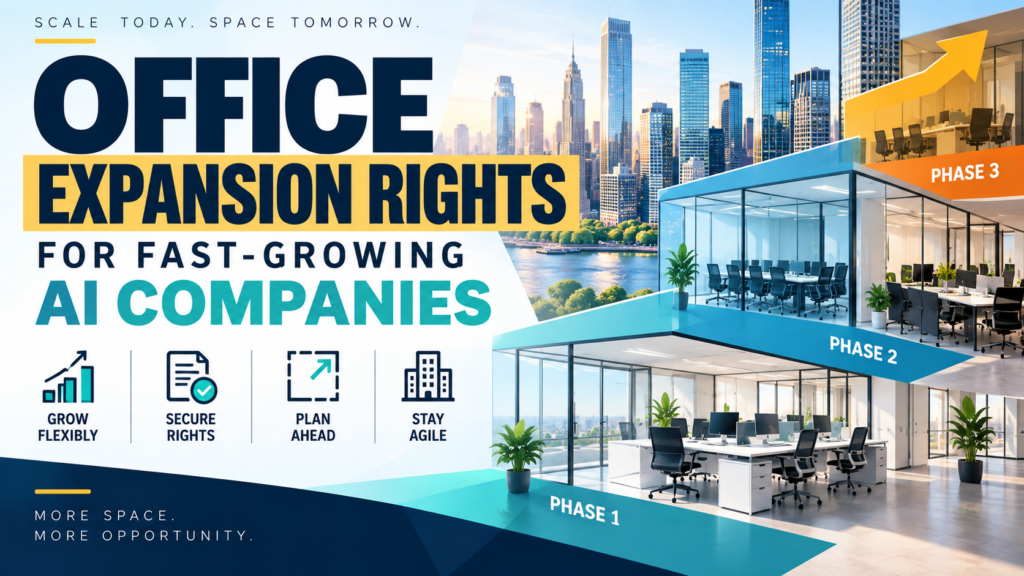
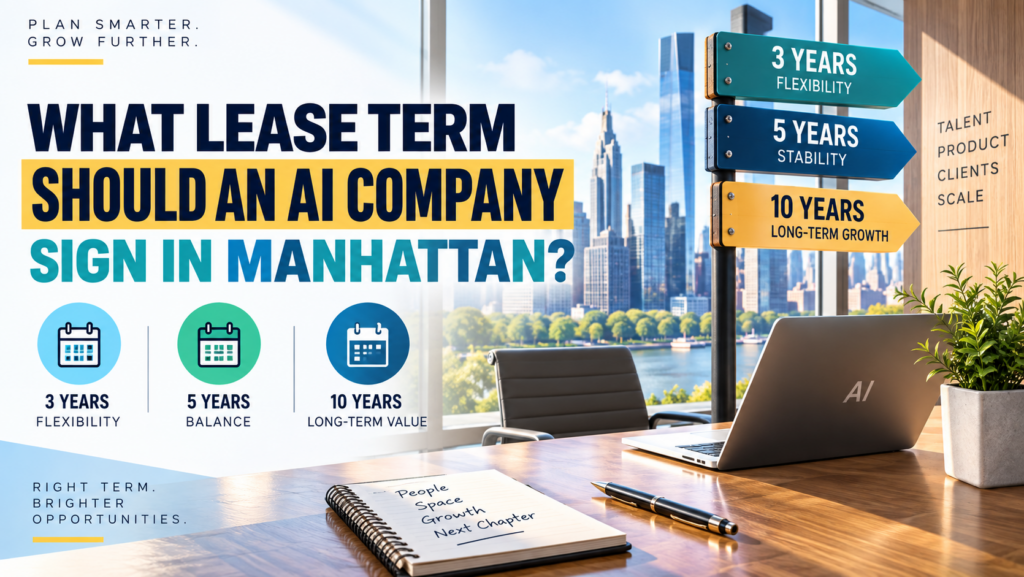
Office Expansion Rights for Fast-Growing AI Companies
Fast-growing artificial intelligence companies create an unusual office leasing problem. A space that works today can become too small within several hiring cycles. Taking excessive space early creates the opposite problem, since unused offices consume capital without helping the business.
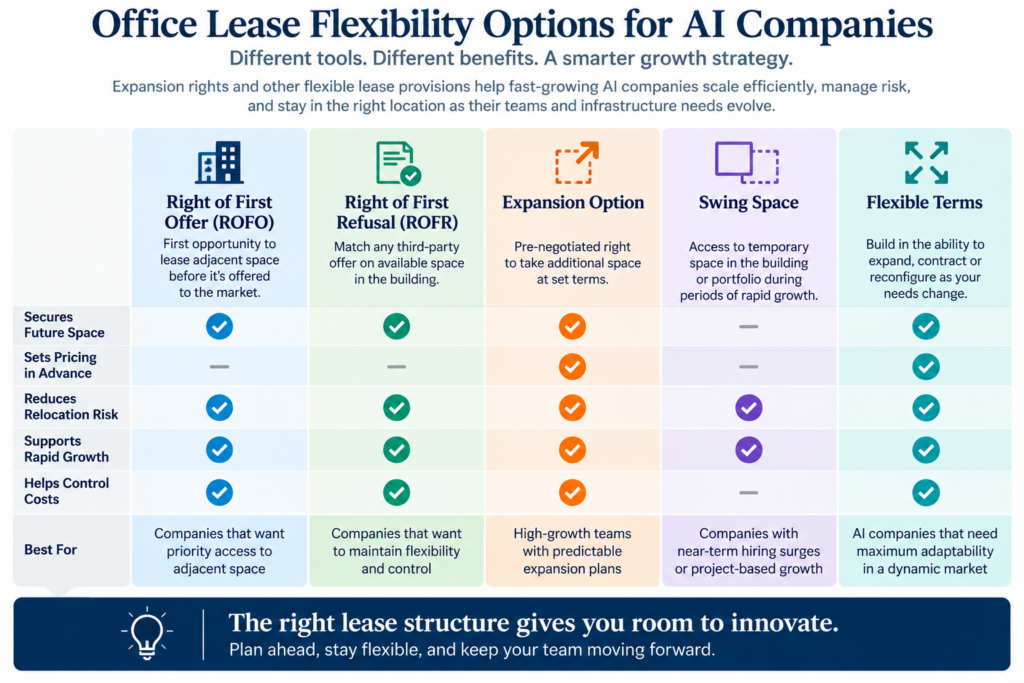
The answer is not simply signing a shorter lease. The stronger approach combines a right-sized initial office with contractual paths for future growth. Those paths can include expansion options, rights of first offer, rights of first refusal, swing space, sublease rights, and contraction protections.
Manhattan tenants also need to think beyond square footage. Power, cooling, connectivity, after-hours access, meeting capacity, and future floors can affect expansion just as much. The lease should therefore protect both physical growth and operational growth.
As of August 2026, Manhattan office availability had tightened to 12.5%. Total available inventory had fallen to about 65.4 million square feet. Sublease supply had also dropped to roughly 10.07 million square feet.
Artificial intelligence companies have helped accelerate that tightening. During the first half of 2026, AI firms leased about 1.50 million Manhattan square feet across 63 transactions. Midtown South captured 75.1% of technology leasing during that period.
Those conditions make future space harder to treat as an afterthought.
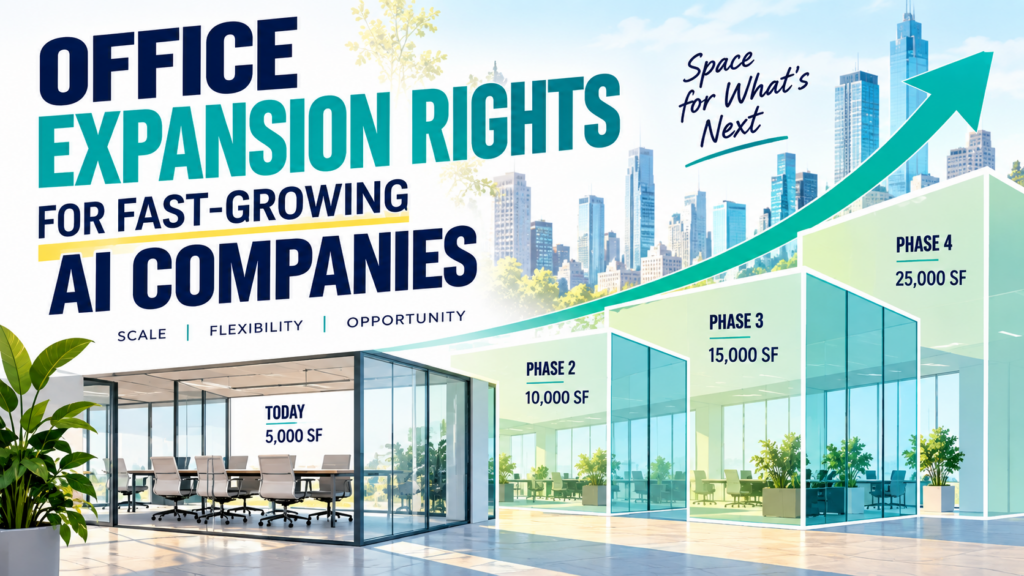
Why Fast-Growing AI Companies Need Different Expansion Rights
A conventional office lease assumes a relatively predictable business. Many artificial intelligence companies do not fit that assumption.
Funding can accelerate hiring within months. A product launch can change staffing requirements just as quickly. Enterprise contracts may create new sales, implementation, security, and customer-support teams.
At the same time, automation can reduce some staffing needs. Therefore, an AI company can face expansion and contraction risk during the same lease term.
That volatility creates two expensive mistakes.
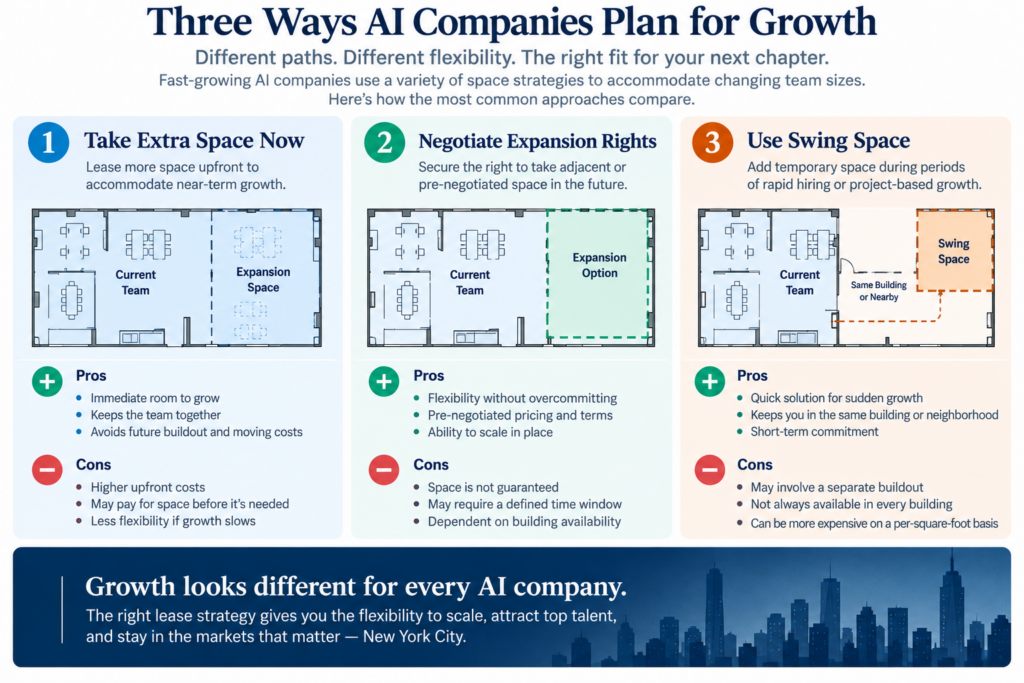
Under-leasing happens when a company takes only enough space for current headcount. Growth then forces a second location, split teams, or an early relocation.
Over-leasing creates another problem. The company pays rent, electricity, furniture costs, and operating expenses for capacity it may never use.
A strong lease tries to avoid both outcomes.
The goal is not maximum square footage. The goal is maximum control over future square footage.
That difference matters.
Consider a 60-person company expecting significant hiring. Taking enough space for 150 employees may appear prudent. However, the company could instead lease a smaller core office with expansion rights covering adjacent space.
That structure can preserve capital while protecting growth.
Another tenant might expect irregular hiring rather than constant growth. A nearby furnished floor could provide temporary capacity. That floor becomes swing space while the tenant evaluates longer-term requirements.
Teams considering this approach can compare a 3,150-square-foot Flatiron office with flexible direct terms against larger future options nearby. A growing tenant can then preserve its preferred neighborhood without immediately carrying excessive rent.
At a larger scale, a 20,222-square-foot furnished Hudson Yards office offers another planning model. The current layout supports an estimated 133 people. Its longer available term can suit companies with greater headcount visibility.
Neither strategy automatically works for every AI company.
The correct structure depends on hiring certainty, funding runway, employee attendance, business volatility, and available expansion inventory.
Growth speed changes the lease decision
Technology occupiers now show unusually strong expansion behavior. Among the largest recent technology leases nationally, 78 of 100 transactions increased the occupier’s footprint. AI and AI-adjacent companies accounted for 49 of those expansions.
That does not mean every startup should lease aggressively.
Instead, the figures show why future-growth provisions deserve attention before the initial lease gets signed.
A landlord has little reason to surrender valuable future space after a tenant becomes trapped. Negotiating leverage usually peaks before lease execution.
For that reason, expansion planning should start during the building search.
Do not wait for lease comments.
The Expansion Rights That Actually Protect a Growing Tenant
The phrase office expansion rights covers several different lease structures. They do not provide equal protection.
Some create firm rights. Others provide only an opportunity to negotiate.
Understanding that distinction can prevent an expensive surprise.
| Expansion Structure | What It Can Do | Main Tenant Risk |
|---|---|---|
| Fixed expansion option | Gives a contractual right to take defined space | Tenant must follow deadlines exactly |
| Right of First Offer | Requires the landlord to offer defined space first | Landlord may control much of the pricing structure |
| Right of First Refusal | Lets the tenant match a competing deal | Response windows can become extremely short |
| Must-take space | Automatically adds future square footage | Growth may slow before the obligation begins |
| Swing space | Provides temporary room during growth | Availability may disappear without firm documentation |
| Contraction right | Allows some space to return to the landlord | Fees and timing restrictions can reduce its value |
| Termination option | Creates an agreed early exit | Exercise costs may become substantial |
| Sublease rights | Lets the tenant market excess space | Consent, recapture, and profit-sharing clauses may interfere |
A fixed expansion option usually gives the greatest certainty.
The lease can identify the space, exercise date, delivery condition, pricing method, and commencement date. That clarity makes workforce planning easier.
However, landlords rarely give valuable expansion options without conditions.
The tenant might need to exercise twelve months early. Rent could reset to market pricing. Another existing tenant might hold an older superior right.
Therefore, the headline clause matters less than its mechanics.
A Right of First Offer, or ROFO, provides less certainty.
Under a well-structured ROFO, the landlord must approach your company before marketing specified space elsewhere.
That can work well when future vacancy remains uncertain.
Yet tenants should define what happens after declining an offer. Otherwise, the landlord could later complete a materially cheaper deal without returning to the tenant.
A Right of First Refusal, or ROFR, works differently.
The landlord can negotiate with an outside tenant first. Your company then receives the opportunity to match that transaction.
This right sounds powerful. In practice, fast response requirements can create problems.
Senior management may have only several days to approve millions of dollars in additional lease obligations.
Why expansion language needs precise boundaries
An expansion clause should identify exactly which premises qualify.
Words such as “adjacent space” can create ambiguity.
Does adjacent mean the next suite? Does it include the floor above? What happens when another tenant controls part of that floor?
A stronger clause might identify:
Suite A, the balance of the floor, one specified floor above, and any contiguous space becoming available during the term.
Larger users can seek broader rights.
For example, a company may negotiate rights covering several designated floors. Another tenant might seek first access anywhere within the building.
Some companies can negotiate portfolio rights covering nearby buildings under common ownership.
That structure can create an expansion corridor without forcing an immediate headquarters relocation.
Must-take space deserves special caution
A must-take provision can solve one problem while creating another.
The tenant agrees today to occupy additional space later. Therefore, availability becomes predictable.
However, the financial obligation usually arrives regardless of actual headcount.
That structure can make sense when hiring has high certainty.
It becomes dangerous when growth depends on future funding, regulatory approvals, or speculative revenue.
For an AI company, optional growth usually provides more protection than mandatory growth.
How to Build an Office Portfolio That Can Expand Without Relocating
The building search should start with future occupancy, not merely present availability.
A beautiful 10,000-square-foot office can become strategically weak when every surrounding floor carries long-term leases.
Conversely, an ordinary available floor can become much more valuable when adjacent space has predictable rollover dates.
That difference makes a building’s stacking plan important.
A stacking plan shows who occupies each floor. It also shows lease expirations, available suites, subleases, and future vacancies.
Growing tenants should ask several questions before submitting an offer.
What space could realistically become available during our term?
Next, ask whether another tenant already controls that space.
Then determine whether ownership expects any major occupants to expand, renew, contract, or leave.
Finally, compare those dates against your own growth model.
A building with several possible expansion paths provides more strategic value than one isolated vacancy.
Think in expansion corridors
An expansion corridor can take several forms.
The simplest corridor involves the rest of your floor.
Another version covers the floor directly above or below.
Large companies may target several consecutive floors.
Other tenants might combine a permanent office with temporary overflow elsewhere in the property.
Vertical expansion usually creates better operational continuity than scattered suites.
Employees can share reception areas, meeting rooms, infrastructure, kitchens, and internal staircases.
Adjacent horizontal expansion also works well. It can let a company knock through a demising wall and create one connected workplace.
That possibility should receive technical review before lease execution.
Structural columns, fire separations, elevator lobbies, plumbing, and emergency egress can limit connections.
Manhattan buildings offer very different scaling patterns
Midtown South often suits companies that want technology talent, creative layouts, and neighborhood energy.
A fully furnished 11,239-square-foot Flatiron full floor offers one example of an intermediate growth step. It currently provides 48 workstations, with stated expansion potential to approximately 90.
Nearby larger buildings can support a very different strategy.
Headquarters-scale office space overlooking Madison Square Park offers unusually large floor plates for Midtown South. Many lower floors exceed 70,000 square feet.
That scale can support companies planning several growth stages without changing neighborhoods.
Hudson Square provides another expansion model. Larger floor plates and converted industrial buildings often support collaborative layouts.
Teams evaluating that neighborhood can review Hudson Street office space with large base floors. The property combines approximately 38,000-square-foot base floors with smaller tower floors.
For smaller requirements, a 3,191-square-foot furnished Hudson Square office can illustrate an earlier growth stage.
A company may therefore remain within one broader submarket while changing building scale.
Midtown can support infrastructure-heavy growth
Midtown remains important for companies prioritizing transit, power, large floor plates, and institutional building operations.
Large Park Avenue floor plates can reach roughly 30,000 to 40,000 square feet.
Another Grand Central-area headquarters tower provides floors ranging from roughly 24,000 to 47,000 square feet.
Companies needing even greater density can examine large Third Avenue office floors. Lower floors there can approach 35,000 to 40,000 square feet.
These buildings do not automatically guarantee expansion rights.
However, their scale can create more possible pathways than a fully occupied boutique property.
Downtown can provide another growth path
Downtown often combines institutional infrastructure with comparatively lower asking rents.
One major tower offers office configurations ranging from small suites to very large blocks. Tenants can explore World Trade Center office space while comparing future floor availability.
Downtown Class A asking rents remained materially below Midtown South Class A averages during mid-2026. That pricing difference can become meaningful at 50,000 square feet or more.
A lower starting rent can also create budget room for infrastructure, security, or additional growth capacity.
The important question remains the same.
Can this building support the company you may become, not only the company you are today?
How Much Space Should a Fast-Growing AI Company Lease Now?
Headcount alone should not determine office size.
Attendance patterns matter.
So do meeting-room demand, engineering density, sales call requirements, visitor traffic, collaboration style, and specialized hardware.
A company with 100 employees does not necessarily need 100 dedicated desks.
At the same time, designing around average attendance can create serious overcrowding on peak days.
A better process models several scenarios.
| Planning Case | Purpose | Real Estate Response |
|---|---|---|
| Current case | Today’s reliable requirement | Lease the core office |
| Base growth case | Most probable hiring path | Build modest spare capacity |
| Strong growth case | Faster approved growth | Cover through expansion rights |
| Breakout case | Exceptional hiring surge | Use swing space or another floor |
| Downside case | Hiring slows or reverses | Protect sublease or contraction rights |
This method separates space you need to pay for now from space you only need access to later.
That distinction protects capital.
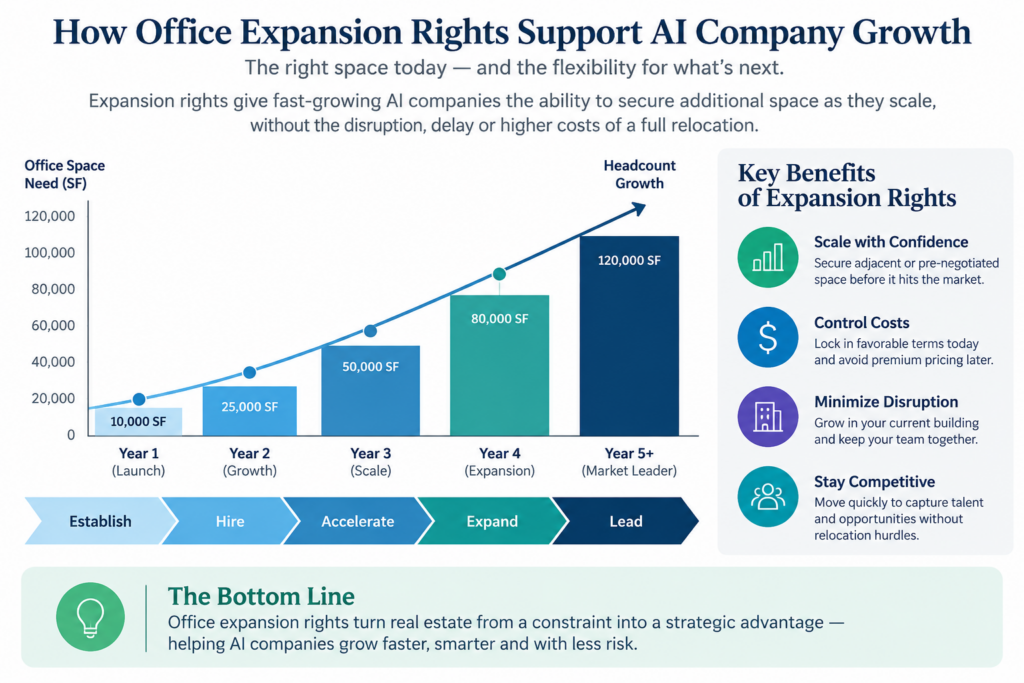
Do not simply double the headcount forecast
A company with 80 employees might expect 160 within two years.
Leasing immediately for 160 sounds conservative.
Yet that strategy makes several assumptions simultaneously.
Hiring must occur on schedule. Office attendance must remain stable. Department ratios cannot change significantly.
Instead, the company might lease for 100 to 120 people.
Contractual rights could then cover the next growth stage.
A separate overflow option could protect a more aggressive scenario.
Our AI startup office space roadmap examines growth from smaller startup offices toward 25,000-to-40,000-square-foot headquarters requirements.
Treat departments differently
Engineering teams often need concentrated collaboration areas.
Sales organizations may require more phone rooms.
Customer-facing groups may need presentation space and visitor circulation.
Research teams can create different power and equipment demands.
Executive groups usually need privacy without isolating themselves from the organization.
Therefore, seat count alone provides an incomplete answer.
Program the office around work patterns first. Convert that program into square footage second.
Preserve room for organizational change
A growing company rarely maintains the same departmental structure.
New product groups appear.
Sales teams split by vertical.
Customer support may grow rapidly after commercialization.
Security, legal, finance, and recruiting functions often increase later than engineering.
Flexible layouts can absorb these changes.
Open work areas help, but flexibility does not mean eliminating rooms.
Instead, create rooms that can change functions.
A twelve-person conference room might later become a project room.
Two smaller offices could become interview rooms.
Furniture should move without construction wherever possible.
Teams needing an intermediate footprint can examine a 7,687-square-foot furnished Union Square office. Its mixture of workstations, offices, conference space, and kitchen space illustrates a balanced mid-stage layout.
Another option is an 8,264-square-foot furnished full-floor office near Madison Square. Full-floor control can simplify security and future internal reconfiguration.
What AI Companies Should Negotiate Before Signing the Lease
Expansion rights only work when the surrounding lease language supports them.
One poorly drafted provision can neutralize another.
For example, a tenant may receive a strong expansion right while facing an unusually large security increase. That financial requirement could make exercising the right impractical.
Another company may secure adjacent space but lack sufficient electrical capacity.
Therefore, the expansion package should function as one integrated system.
Expansion rent needs a formula
Future rent can follow several approaches.
The lease might continue the original rent schedule.
Another clause may use a fixed price.
Some agreements reset rent to fair market value.
Each method creates different risks.
A fair-market structure needs a clear determination process.
Otherwise, an expansion right can become a future pricing dispute.
Consider defining the valuation date, comparable buildings, concession treatment, arbitration process, and assumptions about improvements.
Delivery condition matters
Future space might arrive fully built.
Alternatively, ownership could deliver it demolished.
Another tenant may leave furniture and cabling behind.
The expansion clause should state the expected condition.
It should also address construction responsibility.
Do not assume today’s landlord contribution automatically applies to tomorrow’s expansion space.
Tenant improvement allowances should appear expressly.
Free rent should also receive treatment.
Where possible, negotiate consistent economics across the original premises and future space.
Expansion should not reset every unfavorable lease term
Adding space can trigger amendments.
Those amendments create opportunities for hidden changes.
Watch renewal dates, operating expense bases, security deposits, insurance requirements, guaranties, and restoration obligations.
A simple expansion should not quietly weaken unrelated tenant protections.
Watch existing superior rights
Another tenant may already hold a ROFO, ROFR, renewal right, or expansion option.
Your lease should identify superior rights whenever possible.
Without that knowledge, an apparently valuable expansion clause may cover space your company can rarely obtain.
Tenants should also ask what happens after a superior right expires.
Your expansion right should move into position automatically.
Calendar every deadline
Expansion options usually require advance notice.
Depending on the deal, notice can begin many months before the desired occupancy date.
Our guide to notice periods for exercising lease expansion options explains why these deadlines need attention at signing.
Do not rely on institutional memory.
Put every notice date into multiple calendars.
Finance, legal, operations, and executive leadership should receive reminders.
Start internal decisions well before the formal notice period.
Protect assignment and sublease flexibility
Growth does not always move upward.
A product change might reduce staffing needs.
Acquisitions can consolidate offices.
An AI company may also reorganize subsidiaries or create new affiliated entities.
The lease should therefore provide practical assignment and sublease rights.
Pay close attention to landlord consent standards.
Also review recapture rights.
A landlord recapture clause can let ownership take back space when you request permission to sublease.
That possibility affects downside planning.
Affiliate transfers need special treatment as well.
Corporate reorganizations should not automatically trigger transfer restrictions.
Our analysis of sharing office space with affiliates and partners covers that issue in greater detail.
AI Infrastructure Can Limit Expansion Before Square Footage Does
An available neighboring floor does not guarantee usable expansion space.
AI companies can place unusual demands on office infrastructure.
Some teams rely almost entirely on cloud computing.
Others maintain specialized workstations, local development hardware, security equipment, testing environments, or high-density technical areas.
Those differences affect building selection.
Electrical capacity should match future density
Ask how much electrical capacity reaches the premises.
Then determine whether that figure supports the future layout.
A standard office installation might work comfortably for ordinary laptops.
Higher-performance workstations can change that calculation.
Local hardware can create additional load.
Kitchen equipment, conference technology, supplemental cooling, and server closets add more demand.
Do not evaluate only the initial floor.
Determine whether future expansion areas offer similar capacity.
Cooling deserves separate review
Office HVAC and technical cooling solve different problems.
A standard central system may work during normal business hours.
However, technical rooms can require cooling overnight.
Engineering teams may also operate late.
That makes after-hours HVAC pricing relevant.
Ask about service hours, overtime rates, zones, supplemental systems, and condenser-water availability.
A low face rent can become less attractive when after-hours cooling becomes expensive.
Connectivity needs redundancy
Reliable fiber matters for almost every modern company.
AI firms may have even less tolerance for outages.
Ask which carriers serve the building.
Determine how fiber enters the property.
Two carriers do not necessarily provide true physical redundancy.
They could share the same conduit or street entrance.
Network due diligence should examine the complete path.
Expansion space should also connect cleanly with the original premises.
A vertical stack may support private inter-floor connections.
Separated floors can require different network architecture.
Building access must match work culture
Some artificial intelligence teams operate long hours.
Others work across global time zones.
That makes 24/7 access a real operational issue.
Ask how security works after hours.
Visitors, deliveries, freight, bicycle access, and HVAC should also receive review.
Building staffing levels can affect late-night operations.
Expansion-friendly buildings need physical capacity and technical capacity
A large floor plate solves only one dimension.
The strongest building offers enough space, infrastructure, elevators, security, cooling, telecom options, and future availability.
For companies seeking newer systems, a furnished 23,324-square-foot Hudson Yards space provides one current example of large-format inventory.
Firms prioritizing much larger future floor plates can review modern Hudson Yards tower space with floors reaching beyond 35,000 square feet.
Midtown South provides alternatives with a different character. A 5,594-square-foot Flatiron prebuilt office offers individual air-conditioning control and a full-floor layout.
The right answer depends on the company’s technical profile.
An AI office should support computing workflows without turning the office itself into a data center.
When to Expand, When to Take Swing Space, and When to Relocate
An expansion option should not force an automatic decision.
Every exercise date creates a fresh capital-allocation question.
The company should compare expansion against relocation, overflow space, and maintaining the current footprint.
A useful decision begins with utilization.
Look at peak occupancy rather than average attendance.
Then compare meeting-room demand, hiring commitments, and planned organizational changes.
Expand when the core office still works
Expansion usually makes sense when the location remains attractive.
The building should also meet technical requirements.
Existing improvements should still have useful life.
Most importantly, the expansion space should connect operationally with the current office.
When those conditions exist, expanding can avoid major disruption.
Teams keep the same commute.
Furniture and infrastructure can remain in place.
Management avoids rebuilding an entire headquarters.
Use swing space when timing remains uncertain
Swing space bridges a temporary gap.
A company may know it needs more room but lack enough information for a permanent commitment.
Another business might await funding.
Others may need twelve months before permanent expansion space becomes available.
In those cases, a nearby furnished suite can reduce risk.
A 6,825-square-foot West 14th Street sublet provides an example of smaller overflow capacity near Midtown South.
Swing space can also protect a company during construction.
Employees move temporarily while the permanent office gets expanded.
Once construction finishes, the temporary space disappears from the portfolio.
Relocate when the building becomes the constraint
Expansion does not always deserve priority.
A building can become obsolete for your company even when more space exists.
Electrical capacity might fall short.
Floor plates might fragment teams.
Commutes may hinder recruiting.
Security could become inadequate.
The economics might also stop working.
In those situations, preserving a weak location simply to avoid moving can become expensive.
A relocation can create access to more appropriate expansion capacity.
Hudson Square, Flatiron, NoMad, Grand Central, Downtown, and Hudson Yards each provide different growth patterns.
The best neighborhood depends on your workforce.
Compare total occupancy cost
Base rent offers only one number.
Expansion decisions should also include:
Operating expenses. Electricity. After-hours HVAC. Furniture. Construction. Cabling. Security. Moving costs. Free rent. Improvement allowances. Professional fees.
A lower-rent relocation can still cost more after construction.
Conversely, an expensive-looking expansion may save money by avoiding a headquarters move.
Calculate each scenario on the same time horizon.
Net present cost analysis can help compare uneven lease structures.
Start before the problem becomes urgent
A company that reaches 95% practical capacity has already lost time.
Expansion negotiations can take months.
Construction adds another period.
Legal documentation also takes time.
Therefore, growing companies should review capacity quarterly.
Look ahead at least 12 to 24 months.
Track hiring against the base, strong, and breakout cases.
When actual hiring begins following the strong case, start testing expansion options.
Do not wait until employees run out of desks.
Frequently Asked Questions About AI Office Expansion Rights
How can an AI company lease space without getting trapped by rapid growth?
Lease the reliable core requirement first. Then secure contractual access to additional space.
Combine expansion rights with sublease flexibility and a practical overflow plan.
Avoid depending on a single forecast.
Which expansion right gives a tenant the most certainty?
A fixed option covering identified space usually provides greater certainty than a ROFO or ROFR.
Its value still depends on pricing, timing, delivery, and superior rights.
Review every condition before treating the space as guaranteed.
Is a ROFO better than a ROFR?
Neither structure wins in every situation.
A ROFO lets the tenant enter the conversation before outside marketing.
A ROFR allows the market to establish terms first.
However, a ROFR can create very short decision periods.
How far ahead should an AI company plan office growth?
Maintain a rolling 12-to-24-month space plan.
Update it quarterly.
Fast-growing companies should track headcount, attendance, utilization, funding, and departmental changes together.
Should a growing AI company take extra space immediately?
Some buffer space can help.
Too much unused space creates unnecessary carrying costs.
A better structure often combines moderate internal capacity with future expansion rights.
How much growth buffer should a company build into its current office?
No universal percentage works for every company.
A stable enterprise can forecast differently from a venture-backed startup.
Base the buffer on hiring certainty, attendance, lease term, and expansion availability.
Are short leases always better for fast-growing companies?
No.
Short terms provide flexibility, but they can also reduce pricing leverage.
A longer lease with strong expansion, contraction, assignment, and termination rights may provide greater control.
Evaluate the full package rather than term alone.
Can a company expand before its option date?
Possibly.
The landlord and tenant can negotiate an early expansion.
However, the tenant has much greater leverage when the lease already addresses early availability.
What happens when another tenant already controls the neighboring floor?
Your right may remain subordinate.
That is why the building’s existing rights matter.
Request as much information as possible before signing.
Can expansion rent differ from the original rent?
Yes.
Future rent may follow a fixed schedule or reset to market.
The lease should explain the formula clearly.
Ambiguous pricing can weaken an otherwise useful option.
Should an AI company negotiate contraction rights too?
Rapid-growth companies should consider them.
Growth projections can change.
A contraction option creates a downside pathway when hiring slows.
What is the biggest expansion mistake?
Waiting until the current office becomes full.
Urgency destroys leverage.
Landlords and competing tenants gain negotiating power once your alternatives disappear.
Does available space in a building guarantee future expansion?
No.
Another tenant may lease it tomorrow.
Ownership may combine it with another block.
Existing tenants may also hold superior rights.
Only contractual protection creates meaningful control.
Should an AI company use a sublease as its first Manhattan office?
A sublease can provide speed and furnished space.
It can also provide a shorter commitment.
However, the master lease term limits long-term control.
Expansion rights may also remain weaker.
When does a direct lease make more sense?
Direct leasing becomes stronger when the company needs customization, longer occupancy, infrastructure improvements, or contractual growth rights.
Larger requirements can also justify direct negotiations.
The answer still depends on business certainty.
How should a company evaluate a building for rapid expansion?
Study the entire building.
Review floor sizes, tenant expirations, connectivity, electrical systems, HVAC, elevators, access, ownership strategy, and neighboring availability.
Then map those factors against your growth schedule.
What Manhattan areas should fast-growing AI companies consider?
Midtown South remains important for technology leasing.
Hudson Square offers larger creative floors.
Hudson Yards provides modern infrastructure.
Midtown offers scale and transportation.
Downtown can provide institutional buildings with comparatively favorable economics.
No neighborhood fits every artificial intelligence company.
What should happen before an expansion option gets exercised?
Reforecast headcount.
Review utilization.
Inspect the future premises.
Confirm infrastructure.
Model total costs.
Then compare the expansion against relocation and temporary alternatives.
Do expansion rights belong in the letter of intent?
Yes.
The major business terms should appear as early as possible.
Waiting until lease drafting reduces leverage.
Define the space, timing, pricing concept, delivery condition, and major restrictions in the LOI.
Does an expansion option eliminate relocation risk?
No.
It reduces one risk.
A company still needs protection against changing infrastructure, economics, staffing, and business strategy.
The strongest lease preserves several paths.
For a fast-growing AI company, the best office lease does not predict the future perfectly. It preserves useful choices when the future changes.
A Manhattan office should support today’s team without making tomorrow’s growth unnecessarily expensive. Expansion rights can protect that objective when the lease defines them carefully. Our current Manhattan building inventory provides a practical starting point for identifying properties with the scale, floor plates, and future capacity that growing teams need.
Receive an AI Office Space Report
We represent office tenants, not landlords, in Manhattan searches and lease negotiations. Our role centers on protecting tenant flexibility, leverage, and long-term occupancy economics. Find expansion-friendly buildings that can support your next growth stage without forcing an unnecessary move.
Fill out our 📋 online form or give us a call today 📞 212-967-2061 — let’s find the right options for your business.