AI Office Subleases in Manhattan
AI office subleases in Manhattan give growing teams a faster route into private, built, furnished workspace. The strongest options combine reliable infrastructure, efficient layouts, strong transit, and enough room for near-term hiring. They can also reduce the time and capital required before a team can work from its own office.
That combination matters more in 2026. Manhattan’s sublease supply has contracted sharply while technology companies continue taking high-quality space. By August, Manhattan had only 10.07 million square feet of sublet inventory. That represented a 22.3% annual decline and the lowest sublet supply since August 2019.
Artificial intelligence companies have contributed materially to that demand. During 2026’s first half, AI companies leased 1.50 million square feet across 63 Manhattan transactions. Those transactions represented more than one-third of technology-sector leasing demand.
The result changes how tenants should approach a search. A good furnished sublease can still provide significant value. However, the strongest spaces now require faster decisions and better preparation.
Are furnished office subleases better for AI startups? Often, yes. They work especially well when speed, flexibility, and capital preservation matter more than a custom construction program.
A direct lease can still make more sense for a company seeking extensive customization or a long occupancy horizon. Likewise, a managed office can suit very small teams needing maximum flexibility. The right choice depends on headcount, growth expectations, privacy requirements, infrastructure, timing, and lease length.

What an AI office sublease in Manhattan actually means
An AI office sublease is not a separate legal type of Manhattan real estate. It is a commercial office sublease taken by an artificial intelligence company or AI-focused business unit.
The existing tenant holds the primary lease. Your company takes occupancy through a sublease agreement with that tenant. Consequently, the primary lease affects your rights, obligations, use, access, and occupancy period.
Most commercial leases also require the building owner’s written consent before the subtenant can occupy. New York commercial lease disputes show that consent provisions depend heavily on the actual lease language. Courts can examine financial responsibility, permitted use, occupancy type, and building suitability when reasonableness matters.
That structure differs from several other products that can appear beside office subleases.
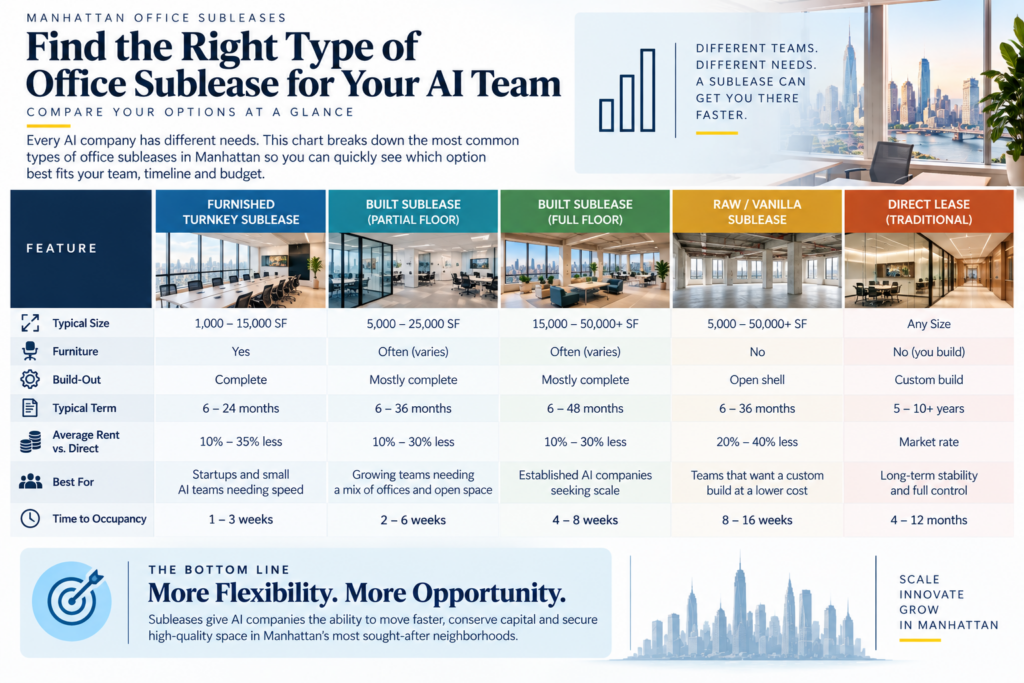
A direct office lease creates a direct landlord-tenant relationship. It usually provides more control and a longer runway. However, raw or unfinished space can introduce construction, furniture, wiring, and project-management costs.
A furnished sublease usually starts with an existing installation. Desks, meeting rooms, pantries, cabling, and offices may already exist. Yet every included item should appear clearly in the transaction documents.
A managed private office can provide private space through a shorter service or license structure. That product can reduce operational work. Still, it does not necessarily provide the control or economics of a commercial sublease.
Coworking usually emphasizes shared infrastructure and shorter commitments. It can solve an early-stage occupancy problem. However, it may provide less privacy, identity, security control, and long-term cost efficiency.
A residential sublet has nothing to do with this transaction. New York’s statutory residential subletting process expressly concerns tenants renting residences. Commercial office tenants instead need to focus on their lease documents and negotiated rights.
That distinction matters because broad questions about “sublets” often mix apartments and offices. An AI company seeking Manhattan headquarters space needs commercial information, not residential guidance.
AI office space also does not mean a data center. Many AI companies run production computing workloads through cloud or specialized infrastructure. Their Manhattan offices may require normal commercial power with unusually strong connectivity and security.
Other teams maintain testing hardware, development systems, or larger equipment rooms onsite. Those occupiers should investigate electrical capacity, cooling, risers, supplemental HVAC, and building access before signing.
Why a furnished sublease can fit an AI startup unusually well
Rapidly growing companies often face a basic forecasting problem. Today’s headcount rarely matches the headcount expected eighteen months later.
A furnished sublease can bridge that uncertainty. Teams can avoid paying for a full custom buildout while securing more privacy than shared workspace provides.
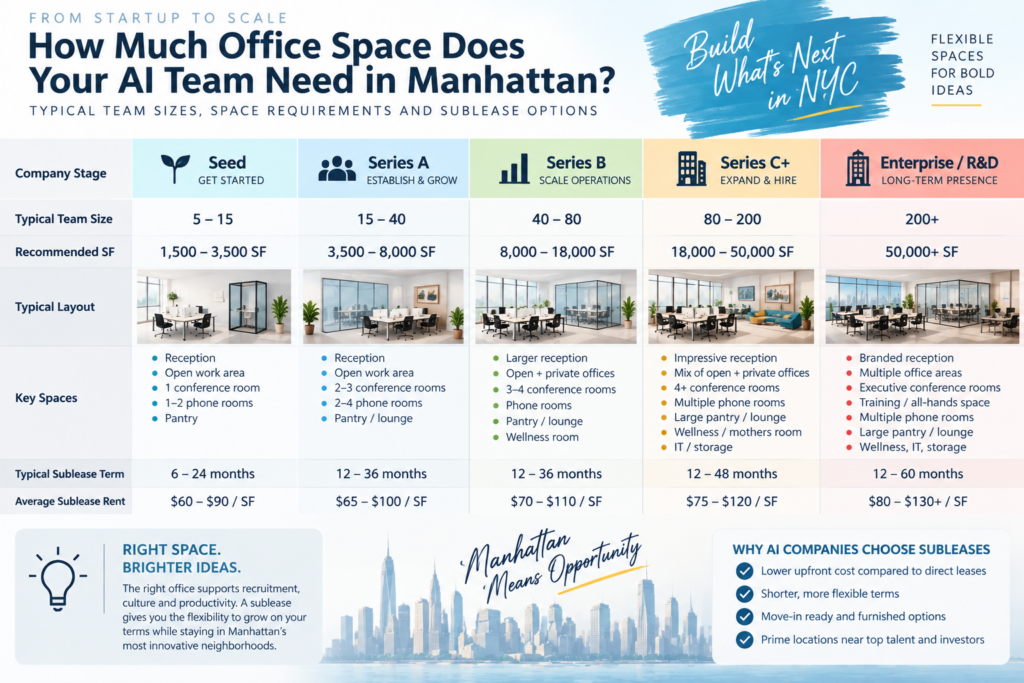
Consider a company with 25 employees today and plans for 45. A fully occupied 25-seat office could become obsolete within months. Conversely, a huge headquarters can consume capital without improving daily operations.
The better approach starts with functional capacity rather than today’s payroll count.
Ask how many people will work onsite during peak attendance. Then add realistic hiring capacity, meeting rooms, call rooms, collaboration areas, storage, and circulation.
Our office space calculator lets tenants model offices, workstations, meeting rooms, circulation, and rentable area. It provides a useful starting point before tours.
Furnished space becomes especially attractive when the existing plan already matches those needs. Every conference room you can reuse eliminates another potential construction expense. Each installed workstation can also reduce furniture lead time.
However, furniture alone should never decide the transaction. A beautiful office with poor connectivity can create operational problems immediately.
The same concern applies to an impressive loft with weak acoustics. AI engineering, sales, product, and leadership teams may spend hours on confidential video calls.
The right furnished office removes friction. The wrong furnished office merely contains furniture.
Why AI companies are changing the Manhattan sublease market
Manhattan no longer carries the enormous secondhand office surplus that defined the early post-pandemic market.
Different research firms use different inventory methodologies. Nevertheless, every major recent dataset shows the same direction. Sublease availability has fallen substantially.
By August 2026, Manhattan’s overall availability rate had fallen to 12.5% under one major market methodology. Total available inventory reached its lowest level since September 2020. Sublet inventory dropped to 10.07 million square feet.
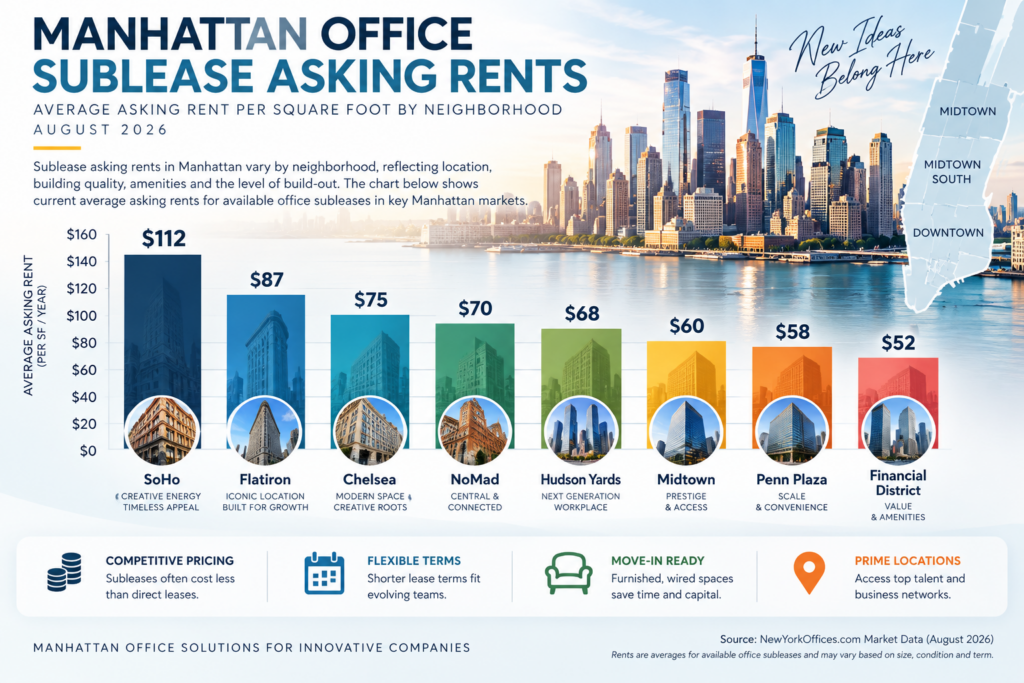
Another September market dataset placed Manhattan sublease availability at only 2.4%. Its average sublease asking rent stood at $58.44 per square foot.
Those numbers do not mean every sublease suddenly commands a premium. They mean tenants have fewer interchangeable alternatives.
A dark, inefficient office can still linger. By contrast, a furnished floor with natural light and good transit can attract attention quickly.
AI demand now reaches far beyond tiny startup suites
Artificial intelligence leasing no longer represents only ten-person teams seeking lofts.
During the first half of 2026, Manhattan technology companies leased 4.15 million square feet. That volume marked a record first half for the sector. AI companies accounted for 1.50 million square feet across 63 deals.
Midtown South captured 75.1% of all technology leasing during that period. The area’s concentration reflects strong demand around Manhattan’s established technology corridors.
Earlier research also showed 670,000 square feet of AI leasing during 2026’s first quarter alone. That compared with 790,000 square feet throughout 2025 under the same dataset.
Measurement methods differ across research groups. Therefore, tenants should not combine every published AI leasing figure into one total.
The useful conclusion remains straightforward. AI occupiers now represent a meaningful source of Manhattan office demand.
Why that matters to a tenant seeking a sublease
First, strong turnkey space can disappear while a company debates relatively minor differences.
Second, some landlords can reclaim or reposition former sublease inventory. Improving direct-leasing conditions give owners more reason to pursue direct transactions.
Third, a tenant should compare subleases against direct opportunities at the same time. The cheapest quoted rent does not always produce the lowest occupancy cost.
Finally, companies need better preparation before touring. Decision-makers should agree on budget, size, location, and term beforehand.
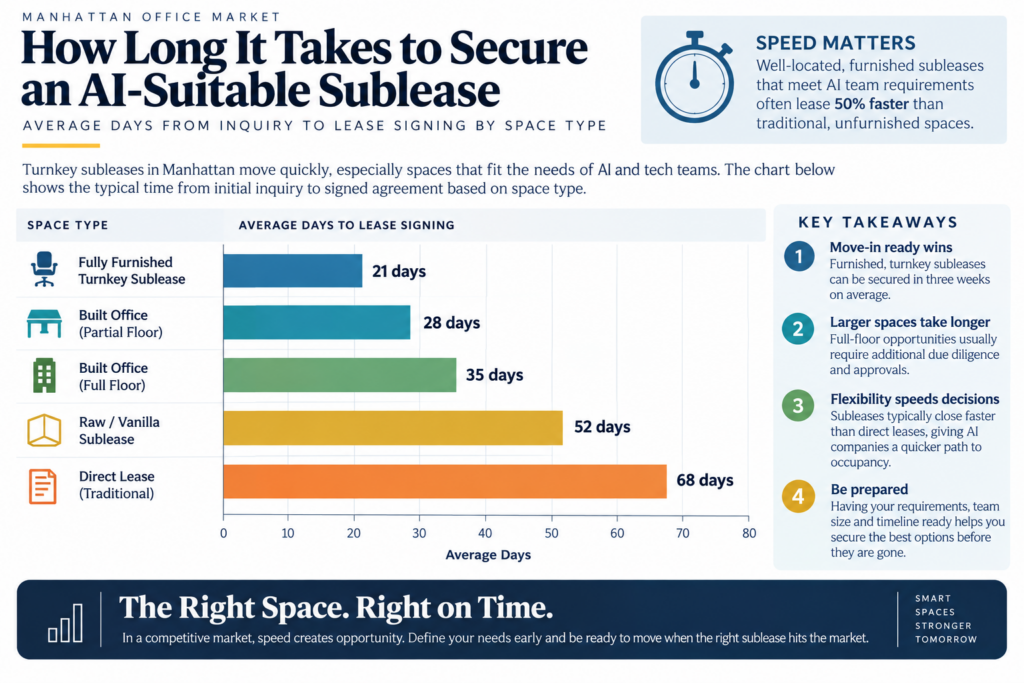
Our guide to how fast an AI company can lease Manhattan office space explains the timing issue in greater depth. Prepared companies can often execute move-in-ready transactions within several weeks. Construction, consent, connectivity, or documentation can extend that timeline.
A fast process should never become a careless process. Speed comes from preparation, not skipped diligence.
What makes a sublease suitable for an AI company
The phrase “AI-suitable office” can sound more technical than necessary.
Many artificial intelligence companies need the same fundamentals as other modern technology businesses. They want dependable connectivity, privacy, collaboration areas, natural light, and good transit.
However, several characteristics deserve extra scrutiny.
Connectivity comes first. Ask which internet carriers currently serve the building. Then confirm which carriers actually reach the suite.
A wired building does not automatically mean your preferred service already reaches the floor. Likewise, an existing cable does not guarantee an active circuit.
For mission-critical operations, investigate redundant connectivity. Teams may want separate carriers, different building entry paths, or wireless backup.
Do not accept “wired” as a complete technical answer.
Security and confidentiality
AI companies can handle proprietary models, confidential datasets, regulated client information, or sensitive commercial material.
Accordingly, inspect physical security as carefully as internet service.
Does your team control suite access? Can employees manage visitors without relying entirely on a shared reception system?
Look at elevator access, keycards, after-hours entry, reception, freight access, and guest procedures. Private phone rooms and enclosed meeting areas can also protect confidential discussions.
Security needs vary enormously. A consumer software startup may need standard office controls.
Meanwhile, a company serving financial, legal, defense, or healthcare clients can require much tighter protocols. The lease search should reflect that difference from the beginning.
Power, cooling, and equipment
Not every AI company maintains significant computing hardware inside its Manhattan office.
Still, some teams need more than laptops and displays. Engineering environments may include test equipment, local servers, high-powered workstations, or specialized development systems.
Ask what electrical service reaches the suite. Then identify any dedicated circuits, server rooms, supplemental cooling, and emergency-power capabilities.
A server closet without adequate heat removal can become useless. Similarly, a supplemental cooling unit needs building approval, maintenance rights, and operating access.
One current 8,701-square-foot Downtown sublease illustrates the point. It includes a substantial cooling installation plus supplemental capacity for its server room.
That infrastructure will exceed many startups’ requirements. Nevertheless, it demonstrates why tenants should inspect the existing systems rather than assume every office performs equally.
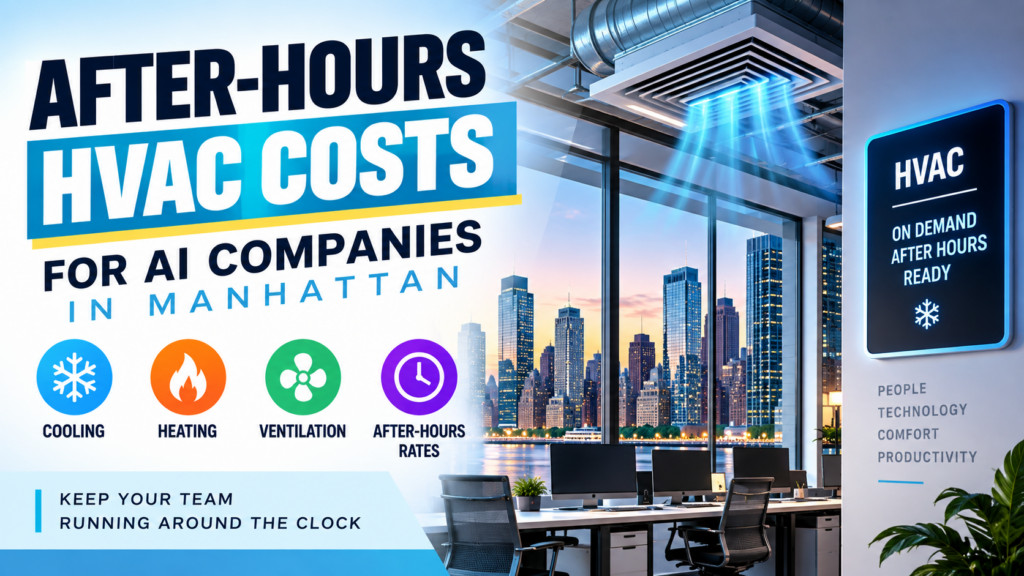
After-hours HVAC
AI teams can work outside conventional office hours.
Product launches, customer support, engineering cycles, and global collaboration can extend late into evenings. Some companies also maintain weekend schedules during critical periods.
Therefore, confirm standard HVAC hours before signing. Next, ask about overtime HVAC charges and request procedures.
Tenant-controlled HVAC can provide additional flexibility. For example, a current 5,606-square-foot Financial District furnished sublease includes tenant-controlled HVAC and a move-in-ready installation. It also offers expansion potential within the property.
The right answer depends on actual working patterns. A company should not pay for elaborate 24-hour systems it will never use.
Acoustics matter more than open space photographs suggest
Open offices photograph well. They can perform poorly when everyone joins calls simultaneously.
A practical AI office usually needs several acoustic environments.
Engineers may need concentrated work areas. Sales teams can need frequent call capacity.
Leadership needs privacy. Product groups require collaboration space.
Client-facing teams need conference rooms that support reliable video meetings.
Phone booths can help, but capacity matters. Two booths may not support a forty-person team with heavy call volume.
Instead, compare the number of enclosed rooms against actual daily behavior. Count interview calls, sales meetings, standups, executive sessions, and customer demonstrations.
A current 11,239-square-foot furnished Flatiron sublease shows a useful mixed layout. It includes 48 installed workstations, several huddle rooms, two larger meeting rooms, and movable phone booths. The layout can support additional seating.
Growth capacity should remain usable
Extra square footage only helps when a company can actually use it.
A floor with 40 existing desks and theoretical capacity for 80 can work well. However, doubling density can reduce meeting space, circulation, and comfort.
Another approach uses adjacent expansion.
The Financial District suite with expansion capacity starts at 5,606 square feet. Current marketing indicates potential expansion up to 15,752 square feet.
That structure may suit a team expecting material hiring. It can preserve flexibility without forcing the company to occupy maximum space immediately.
Large growth-stage teams have other options. A 16,515-square-foot Midtown East full-floor sublease can accommodate approximately 110 people. Its layout combines four open work areas with numerous enclosed rooms.
Furnished does not always mean turnkey
A furnished office can contain desks yet still require significant work.
Check the network cabling. Inspect conference-room equipment. Test existing screens and audiovisual systems.
Next, confirm furniture ownership. Some furnishings belong to the outgoing tenant, while other items may come from another source.
Your documents should identify what remains. They should also address removal obligations at expiration.
Review access cards, signage, kitchen equipment, storage, locks, data rooms, and any specialized improvements.
Finally, budget the move itself. Insurance, connectivity, security systems, computers, movers, and minor alterations can still require time.
A better term is operationally turnkey. That means your team can perform its normal work shortly after receiving possession.
Where AI teams should look in Manhattan
There is no single “AI neighborhood” that works for every company.
Midtown South has captured the largest share of recent technology leasing. Yet Midtown, Downtown, and the Far West Side can offer compelling alternatives.
The correct location depends on talent, clients, founders, investors, commute patterns, budget, and available inventory.
Flatiron, Union Square and NoHo
This corridor remains one of the clearest starting points for AI companies.
It combines loft-style office stock, modern Class A buildings, strong subway access, restaurants, hotels, and a dense technology ecosystem. Recent technology leasing data confirms Midtown South’s outsized role in current demand.
For a team seeking an established installation, consider the 11,239-square-foot furnished Flatiron full-floor sublease. It comes wired and furnished, with room to increase seating. The current term runs through May 2028.
Larger teams can examine a 14,739-square-foot furnished NoHo full-floor office. The current installation supports approximately 98 people. It includes numerous glass rooms, open work areas, and a private terrace.
Closer to Union Square, this furnished full-floor sublease of roughly 7,000-plus square feet includes more than 30 workstations. It also provides conference, executive, and kitchen areas.
Those three spaces illustrate how varied Midtown South inventory can become. One team may prioritize density. Another may value enclosed rooms or outdoor space.
Chelsea, Hudson Square and the West Side
West Side neighborhoods can appeal to companies recruiting from both Manhattan and Brooklyn.
Creative buildings often provide larger windows, exposed ceilings, terraces, and nontraditional layouts. Newer developments can provide stronger amenities and building systems.
Availability can vary sharply by block and building quality.
Companies that need substantial scale can also consider the Far West Side. A current 20,222-square-foot furnished Hudson Yards sublease supports approximately 133 people. Current marketing offers a negotiable term extending into 2032.
A larger address can make sense for late-stage teams with more predictable hiring.
Early-stage companies should avoid choosing a neighborhood because larger AI companies cluster there. Your own workforce should drive the decision.
Midtown East, Grand Central and the Plaza District
Midtown can work particularly well for AI companies selling into finance, professional services, healthcare, enterprise software, or large corporations.
Transit also carries enormous weight here. Regional commuters can access Grand Central and nearby subway connections without crossing the city.
Current Midtown market data shows a 12.1% overall availability rate. Sublease availability stands at just 2.1%. The average Midtown sublease asking rent reached $59.88 per square foot in August.
Current inventory spans several price points.
A 7,367-square-foot furnished Midtown East sublease currently asks $45 per square foot. It includes 22 workstations, private rooms, meeting space, and wiring.
At the higher end, a 5,750-square-foot Madison Avenue sublease currently asks $85 per square foot. Its positioning and finishes target tenants seeking a more premium environment.
Larger occupiers can evaluate the 16,515-square-foot furnished Midtown East full floor. Its existing layout supports approximately 110 people, with a term extending into 2034.
That range demonstrates why neighborhood averages never tell the whole story.
Financial District and Lower Manhattan
Downtown can provide a compelling combination of value, transportation, modernized buildings, and larger floorplates.
August market data placed Downtown’s average asking rent at $62.01 per square foot. The average sublease asking rent stood at $47.59. Sublease availability measured 3.4%.
Several currently marketed spaces illustrate that value.
A 6,517-square-foot furnished and wired Downtown sublease currently asks $39 per square foot. It includes 30 workstations, five conference rooms, a pantry, and lounge space.
Another 9,500-square-foot Broadway sublease currently asks $46 per square foot. Its broader floor can accommodate more open seating and meeting functions.
Smaller growth companies can consider the 5,606-square-foot furnished Financial District office. It supports about 37 employees and provides a path toward a larger footprint.
A 7,561-square-foot furnished Broad Street sublease offers another mid-sized alternative. Current marketing estimates capacity near 50 people.
Teams seeking waterfront surroundings can review a 6,466-square-foot furnished Battery Park office. Its current layout includes 38 desks plus breakout and private space.
Downtown should not automatically mean “budget office.” Many properties now provide extensive amenities and modern infrastructure.
Nevertheless, the district still offers meaningful pricing differences against certain Midtown South locations.
Location should follow the company’s operating map
Founders often start with a neighborhood preference. A stronger search starts with people and operating needs.
Plot where leadership lives. Do the same for existing employees and likely hires.
Then consider clients. Enterprise teams that host regular customer meetings may value proximity differently from engineering-heavy companies.
Next, measure transit rather than simply naming neighborhoods. A five-minute subway advantage can matter more than a fashionable address.
Finally, compare the same requirement across multiple submarkets.
A company committed only to Flatiron may overlook better space fifteen minutes away. Conversely, a company chasing Downtown savings can lose recruiting convenience.
The ideal office balances talent access, client access, infrastructure, space quality, and economics.
What AI office subleases cost in Manhattan
No universal “AI rent” exists.
Building quality, submarket, floor height, light, term, condition, amenities, and sublandlord motivation determine pricing. Infrastructure can also change the economics for technology-heavy occupiers.
Current September market data provides a useful starting framework. The figures below reflect August 2026 market conditions.
| Manhattan market | Overall average asking rent | Average sublease asking rent | Sublease availability |
|---|---|---|---|
| Manhattan overall | $80.05/SF | $58.44/SF | 2.4% |
| Midtown | $85.55/SF | $59.88/SF | 2.1% |
| Midtown South | $86.26/SF | $71.39/SF | 2.3% |
| Downtown | $62.01/SF | $47.59/SF | 3.4% |
These figures represent market averages, not quoted rents for every available office. Inventory composition differs between overall and sublease categories. Therefore, the difference should not become an automatic discount assumption.
Still, the data shows why tenants continue evaluating subleases. Current averages place sublease asking rents meaningfully below overall asking rents across all three major markets.
Convert annual asking rent into a monthly number
Manhattan commercial office rents usually appear as annual dollars per rentable square foot.
Use this simple formula:
Rentable square feet × annual rent per square foot ÷ 12 = approximate monthly base rent
For example:
| Space | Annual asking rent | Approximate monthly base rent |
|---|---|---|
| 5,000 SF | $50/SF | $20,833 |
| 5,000 SF | $60/SF | $25,000 |
| 7,500 SF | $60/SF | $37,500 |
| 10,000 SF | $60/SF | $50,000 |
| 10,000 SF | $70/SF | $58,333 |
| 15,000 SF | $60/SF | $75,000 |
That calculation does not necessarily equal total occupancy cost.
Electricity can sit outside base rent. Insurance also adds expense.
Some arrangements include operating expense or tax obligations. Others use a modified structure.
Internet, security, after-hours HVAC, cleaning, furniture changes, and minor construction can add further costs.
Therefore, compare total occupancy economics, not just asking rent.
A furnished sublease can save money outside the rent line
Suppose two 10,000-square-foot options carry similar effective rents.
The first includes 60 desks, six meeting rooms, cabling, kitchen equipment, and finished collaboration areas. The second requires furniture, wiring, and significant alterations.
Those offices do not have equal economics.
A sublease can transfer the value of an existing installation to the incoming tenant. Yet that value only matters when the layout fits.
Unused private offices do not create savings. Neither do 100 inherited desks when the company needs 45.
The best financial comparison assigns realistic costs to every required change.
Our Manhattan AI office cost guide examines rent alongside layout, building quality, location, and deal structure.
Compare sublease, direct lease, and private managed space on the same timeline
A sublease may offer a lower starting rent. However, it can provide fewer years of occupancy.
A direct lease can carry a higher face rate. Yet free rent or landlord-funded improvements can narrow the effective difference.
Managed private space usually bundles more services. Consequently, its monthly price can look high against a conventional lease.
The correct comparison uses the same occupancy period.
Calculate rent throughout that period. Then add furniture, construction, connectivity, deposits, moving, operating costs, and restoration.
Next, estimate the financial value of flexibility.
A three-year sublease can hold enormous value for a company uncertain about year-four headcount. A ten-year commitment can become expensive if the business changes direction.
Conversely, a stable company can value control more than short-term optionality.
Cheap space becomes expensive when it cannot support the business
A low rent does not compensate for unreliable connectivity.
Likewise, a bargain office loses value when every client meeting requires rented conference space elsewhere.
The same principle applies to recruiting. A difficult commute can create hidden staffing costs.
Poor acoustics can reduce productivity. Limited access hours can disrupt teams with global schedules.
Inadequate cooling can create technical problems. An inflexible expiration date can force another move during a critical growth period.
Therefore, the real question is not simply, “How cheap is the sublease?”
A better question asks, “What does this office cost after we make it work?”
How to secure a sublease without avoidable risk
A Manhattan office sublease involves more than finding a furnished floor and agreeing on price.
Three relationships matter.
The building owner sits at the top. The primary tenant holds the main lease.
Your company occupies through the sublease. That hierarchy makes document review essential.
Start with the business requirement
Before touring, establish four numbers.
Know today’s headcount. Estimate realistic peak attendance.
Set a twelve-to-thirty-six-month hiring range. Then define a maximum monthly occupancy budget.
Next, identify non-negotiable requirements.
Those might include private offices, multiple conference rooms, private bathrooms, a terrace, supplemental cooling, dedicated internet options, or 24-hour access.
Separate preferences from requirements.
Exposed brick may feel attractive. Redundant connectivity may actually affect operations.
A thoughtful requirement can also reduce unnecessary tours. Our commercial leasing guide provides broader context for planning Manhattan office transactions.
Search subleases and direct options together
Do not assume a sublease automatically wins.
A highly motivated landlord can sometimes compete with a sublandlord. Likewise, a sublease with an awkward expiration can create expensive future disruption.
Compare furnished direct spaces too. Completed prebuilts can sometimes provide fast occupancy without the contractual layer of a sublease.
Confidential requirements also deserve a broader search. Some companies do not want hiring plans, fundraising, relocation strategy, or identity widely circulated.
Our guide to confidential Manhattan office searches for AI companies explains how those searches can work.
Tour for operations, not appearance
Bring the requirement to every tour.
Count usable seats. Count enclosed rooms.
Check where teams would actually sit. Examine how employees enter and move through the space.
Stand inside phone rooms. Test acoustics.
Look at the kitchen during the workday. Ask whether restrooms sit inside or outside the premises.
Find the IT room. Identify cooling and power.
Check window exposures. Determine whether glare could affect monitors.
Walk from the nearest transit station. Repeat the route during commuting hours when practical.
An attractive office can fail operationally within ten minutes of careful inspection.
Confirm the master lease early
The sublease does not exist in isolation.
Your attorney should review the primary lease and every relevant amendment alongside the proposed sublease.
Key provisions can govern permitted use, access, alterations, insurance, assignment, signage, building rules, restoration, and surrender.
Landlord consent also deserves early attention.
New York commercial leases often contain specific consent procedures. When a lease requires reasonable consent, courts can consider objective factors like financial strength and permitted use.
Do not import residential subletting rules into this process. New York’s statutory residential procedures expressly concern residential tenants.
Investigate the sublandlord
Your rights depend partly on the primary tenant continuing to perform its lease obligations.
Therefore, understand who holds the lease. Ask counsel how a default above your sublease could affect occupancy.
Review available financial information where appropriate. Examine the remaining lease term and termination rights.
Also ask whether the building owner will provide direct recognition or another protection.
Not every landlord will agree. Still, the subject belongs in serious sublease diligence.
Your attorney should structure the requested protection around the actual documents and transaction.
Verify legal office use
A Manhattan office cannot become a lawful residence simply because someone stays there overnight.
New York City’s Certificate of Occupancy establishes a building’s legal use and permitted occupancy. A change in use or occupancy can require an amended certificate.
That point answers a common question directly:
No, normal Manhattan office space should not function as an apartment unless the property legally permits residential occupancy.
The same diligence matters when a company plans unusual activities. A conventional software office creates fewer use questions than a space involving laboratories, public events, manufacturing, or specialized equipment.
Tell counsel and the broker how you actually plan to use the premises.
Define exactly what comes with the office
“Fully furnished” needs a schedule.
List the desks. Identify chairs.
Document conference tables, televisions, monitors, appliances, storage, phone booths, and audiovisual equipment.
Next, clarify cabling and IT.
Does the existing tenant leave network equipment? Can you use installed cabling?
Who owns server racks? Does the suite include access-control hardware?
Record the condition of everything that matters.
This process prevents disputes at move-in and expiration.
Understand the remaining term
A sublease cannot casually promise occupancy beyond the rights supporting it.
Verify the primary lease expiration. Then examine any early termination, recapture, or renewal provisions that could affect your plans.
Long-term subleases do exist.
For example, the current 16,515-square-foot Midtown East furnished sublease markets a term through January 2034.
By contrast, the 11,239-square-foot Flatiron furnished sublease currently runs through May 2028.
Those options address completely different business horizons.
A two-year term can work beautifully for a rapidly changing startup. It can frustrate a company that expects stable occupancy for seven years.
Address growth before signing
Ask what happens when your company hires faster than expected.
Can the suite hold additional workstations? Does the building contain adjacent space?
Would the landlord consider a future direct lease? Can another floor provide overflow?
Some companies deliberately take more room than current headcount requires. That choice can prevent an early relocation.
However, speculative growth space needs discipline.
Model a realistic hiring range. Then identify the month when current space becomes constrained.
That approach creates a rational growth buffer instead of an expensive symbol.
Treat move-in timing as a project
A furnished sublease can remove months of construction. It cannot eliminate every operational dependency.
Legal review takes time. Landlord consent can take time.
Insurance must start before occupancy. Access cards require setup.
Internet installation can become the critical path. Security vendors may need building access.
Furniture alterations can also require coordination.
A prepared company can often execute a move-in-ready Manhattan transaction within roughly two to four weeks. Actual occupancy can take longer when connectivity, consent, or other dependencies remain.
Start those workstreams in parallel whenever the transaction permits.
Frequently asked questions about AI office subleases in Manhattan
Are furnished office subleases better for AI startups?
Often, yes.
A furnished sublease can conserve capital, reduce construction exposure, and accelerate occupancy. It also suits companies whose headcount can change quickly.
However, a direct lease may suit companies needing extensive customization, long-term control, or substantial infrastructure changes.
The deciding factor should remain operational fit.
Where can I find office space for sublease in Manhattan?
Start with current commercial listings rather than residential sublet platforms.
Our inventory includes furnished and unfurnished opportunities throughout Midtown South, Midtown, Downtown, and other Manhattan neighborhoods. Individual spaces can disappear quickly.
For current examples, compare the Flatiron furnished full floor, NoHo full-floor sublease, and Downtown furnished office.
A tenant broker can also broaden the search beyond whichever individual listings remain publicly visible.
What is the best Manhattan neighborhood for an AI company?
No neighborhood wins for every team.
Flatiron, Union Square, NoHo, Chelsea, and nearby Midtown South areas provide strong access to Manhattan’s technology ecosystem. Midtown can work better for enterprise-facing companies.
Downtown can offer stronger value. Hudson Yards can suit larger teams seeking newer buildings and extensive amenities.
Recent leasing data confirms Midtown South’s unusually high concentration of technology demand.
Your workforce, clients, budget, and infrastructure should ultimately choose the address.
How much does an AI office sublease cost in Manhattan?
As of August 2026, the Manhattan-wide average sublease asking rent stood at $58.44 per square foot. Midtown averaged $59.88, Midtown South averaged $71.39, and Downtown averaged $47.59.
Individual deals can fall well above or below those averages.
A current Downtown listing asks $39 per square foot. Another Downtown option asks $46.
Meanwhile, a premium Madison Avenue sublease currently asks $85.
Building quality, term, size, condition, and sublandlord motivation drive the actual number.
Are Manhattan office subleases cheaper than direct leases?
They often carry lower asking rents, but not always.
Current market averages show a meaningful gap between overall asking rents and sublease asking rents. Midtown South shows a smaller difference than Midtown or Downtown.
However, averages compare different groups of available spaces.
A premium furnished sublease can cost more than an older direct office. Likewise, direct concessions can narrow apparent differences.
Compare effective occupancy costs rather than applying a universal percentage discount.
How quickly can an AI company move into a Manhattan sublease?
A prepared company can sometimes execute a move-in-ready transaction within two to four weeks. Existing furniture and construction can remove significant project time.
Landlord consent, legal review, internet, insurance, and security can extend actual move-in timing.
A company facing a hard deadline should start with spaces that already support its layout.
How long can an office sublease last?
The available term depends on the underlying lease and negotiated sublease.
Some opportunities offer only short remaining terms. Others extend for many years.
Current Manhattan inventory demonstrates both possibilities. One Midtown East furnished full-floor sublease offers occupancy through January 2034.
The ideal term should match your business horizon.
Can an AI startup take more office space than it needs today?
Yes, provided the economics make sense.
Growth headroom can prevent a disruptive move after a funding round or hiring surge. However, excess capacity creates real carrying costs.
Estimate peak attendance first. Add a reasoned hiring buffer afterward.
Do not size the office from another AI company’s headline lease.
How much growth space should an AI company take?
There is no reliable percentage for every company.
Start with your likely peak daily attendance during the next 18 to 36 months. Then model hiring scenarios.
Add the rooms needed for interviewing, sales calls, executive work, collaboration, and customer meetings.
Our office space calculator helps convert those functions into a preliminary square-foot requirement.
Does every AI company need special power and cooling?
No.
Cloud-based teams can operate from conventional high-quality offices. Heavy local compute requirements can change that answer.
Companies using substantial onsite equipment should investigate electrical capacity, cooling, supplemental HVAC, and equipment-room conditions.
Never pay for infrastructure solely because the company works in AI.
Does every AI company need redundant internet?
Not necessarily, but many should evaluate it.
An outage can halt engineering, sales, support, demonstrations, and customer communications.
The cost of redundancy should reflect that operational exposure.
Ask about carriers, risers, suite connectivity, installation timing, and backup options before signing.
What does “plug-and-play” office space actually mean?
The phrase usually describes an office requiring relatively little physical preparation.
A genuine plug-and-play option should provide an appropriate layout, usable furniture, working cabling, and ready building access.
Internet service may still require activation.
Likewise, tenant-specific cybersecurity and access systems usually remain your responsibility.
Should an AI company choose open space or private offices?
Most teams benefit from a mix.
Engineering groups often appreciate collaboration while still needing quiet concentration. Sales teams need call capacity.
Leadership requires privacy. Customers need professional meeting rooms.
Therefore, evaluate the ratio of workstations to enclosed rooms.
A pure open floor can create call congestion. An office-heavy layout can waste space for collaborative teams.
Are phone booths important for AI offices?
They can become extremely valuable.
Small confidential rooms support recruiting interviews, customer calls, investor discussions, and focused video meetings.
Count expected simultaneous calls rather than simply checking whether booths exist.
Two booths for seventy employees can create daily friction.
Should an AI startup stay in coworking instead?
Coworking can suit very small teams, temporary projects, or companies needing extreme flexibility.
A dedicated sublease becomes more compelling when privacy, brand identity, security, meeting capacity, and predictable occupancy matter more.
Per-person economics can also change as headcount grows.
Companies should compare both structures using the same expected occupancy period.
Is a managed private office the same as a sublease?
Not necessarily.
A managed office can use a service, license, lease, or other occupancy structure. The agreement determines your rights.
A traditional commercial sublease generally sits beneath an existing primary lease.
Review the actual contract rather than relying on marketing terminology.
Is commercial office subleasing legal in New York City?
Yes, commercial subleasing can form a valid occupancy structure.
However, the primary lease controls whether the tenant may sublease and under what conditions.
Written landlord consent commonly matters. Commercial case law also shows that the exact lease language governs consent standards.
Have a commercial real estate attorney review the documents.
Do residential NYC sublet rules apply to an AI office?
No.
New York’s well-known statutory subletting procedure specifically addresses residential tenants.
Commercial office rights arise primarily from the lease documents and applicable commercial law.
Do not use apartment guidance to structure an office transaction.
Can you live in a Manhattan office sublease?
A normal commercial office does not provide residential occupancy rights.
New York City’s Certificate of Occupancy establishes legal use and occupancy. Changes in legal use can require an amended certificate.
Companies should use office premises only for permitted activities.
Can someone go to jail simply for an unauthorized commercial sublease?
An ordinary consent dispute centers on lease rights and remedies.
Unauthorized occupancy can create serious contractual consequences, including default claims. Separate fraudulent or illegal conduct can create different legal issues.
Because the facts and documents control, obtain legal advice before occupying without required consent.
Does taking a commercial sublease hurt a company’s credit?
The sublease itself does not inherently damage credit.
Financial problems can arise when a company defaults, leaves obligations unpaid, triggers guarantees, or becomes subject to judgments.
Review deposit and guaranty exposure before signing.
The transaction should fit the company’s realistic cash runway.
What happens if the primary tenant stops paying the landlord?
That situation represents one of the key sublease risks.
Your company’s occupancy sits beneath the primary lease. A problem with that lease can therefore threaten the sublease.
Ask counsel about recognition, non-disturbance, cure rights, notice rights, and other possible protections.
Also investigate the primary tenant’s stability before committing.
Can an AI company stay after the sublease expires?
Not automatically.
A company wanting to remain should discuss future options before the sublease ends.
The building owner may consider a new direct lease. Another arrangement may also become possible.
Do not assume a desirable address will remain available later.
Can an AI company sublease only part of another tenant’s office?
Yes, when the primary lease and landlord consent permit that structure.
Partial subleases can work well for smaller teams.
However, shared reception, bathrooms, entrances, kitchens, conference rooms, and security need clear rules.
A physically separate suite usually provides cleaner operations than an informal shared floor.
Can an AI company later sublease part of its own office?
That depends on its lease.
Fast-growing companies should negotiate assignment and subletting rights with future flexibility in mind.
Other provisions can address landlord consent, recapture, transaction costs, and permitted transferees.
Our guide to office lease clauses for fast-growing AI companies covers these issues in greater depth.
What is a long-term Manhattan office sublease?
There is no single legal duration that creates a “long-term” category.
In practical terms, tenants often use the phrase for multi-year subleases rather than temporary occupancy.
Current Manhattan opportunities can extend five years or longer. Some reach well beyond that point.
Longer terms can provide stability while retaining an existing buildout.
Why would a company choose a sublease instead of signing directly with a landlord?
Speed represents one reason.
Existing construction represents another. Furniture can provide additional value.
A shorter commitment can also match uncertain growth.
Finally, the asking rent may sit below competing direct opportunities.
Those advantages matter most when the existing layout already works.
Why might a direct lease still beat a sublease?
A direct lease can offer more control.
Landlords may fund construction, provide free rent, or offer longer terms.
Direct tenants can also negotiate expansion, renewal, signage, and other rights directly with ownership.
Companies requiring a long-term headquarters should compare both paths.
Should a seed-stage AI startup sign a five-year office commitment?
Possibly, but only after stress-testing headcount and cash needs.
A five-year term can protect a scarce office and reduce relocation risk.
It can also outlive the company’s current operating plan.
Subleases with shorter terms can create useful optionality during rapid growth.
What should a Series A or Series B AI company prioritize?
Growth flexibility usually rises in importance.
A team should consider densification, adjacent expansion, meeting capacity, hiring plans, and lease expiration.
Customer-facing requirements can also increase at this stage.
Infrastructure should support the company you expect to become, not just today’s team.
What should a larger AI company prioritize?
Larger occupiers should look beyond furniture and rent.
Building systems, redundancy, security, vertical transportation, amenity capacity, visitor flow, and expansion rights become more important.
Large teams also need careful commute analysis.
A 100-person office magnifies every operational weakness.
Are outdoor terraces valuable for AI companies?
They can improve employee experience and informal collaboration.
However, tenants should not sacrifice core functionality for outdoor space.
A terrace rarely compensates for insufficient meeting rooms, poor transit, or weak infrastructure.
Treat it as an amenity, not the foundation of the requirement.
Should an AI company choose a trophy office?
Only when the business case supports it.
High-end space can strengthen client experience, recruiting, executive convenience, and brand perception.
Still, those benefits need an economic value.
A premium address should serve the company’s strategy rather than imitate another startup’s real estate choice.
Why are furnished Manhattan subleases becoming harder to find?
Overall sublet inventory has declined significantly.
By August 2026, one major dataset tracked 10.07 million square feet of Manhattan sublease supply. That was 22.3% below the prior year.
Technology and AI companies have also increased leasing activity materially.
The strongest furnished offices face additional competition because tenants can use them quickly.
Is Midtown South still the main area for AI companies?
It remains extremely important.
Midtown South captured 75.1% of Manhattan technology leasing during 2026’s first half.
However, AI companies also occupy Midtown, Downtown, Hudson Square, Hudson Yards, and other districts.
A company should not force itself into Midtown South when another location serves the team better.
Is Downtown Manhattan good for an AI startup?
It can be.
Current Downtown sublease asking rents average below Midtown and Midtown South levels. August 2026’s Downtown sublease average stood at $47.59 per square foot.
Downtown also offers substantial transit and a wide range of building types.
Companies should compare commute patterns before choosing solely on rent.
Is Flatiron good for an AI startup?
Flatiron can work exceptionally well for teams wanting Midtown South access and technology-oriented surroundings.
Current furnished inventory ranges from smaller loft-style offices to full-floor installations.
The 11,239-square-foot furnished Flatiron sublease provides one current example. It combines workstations, huddle rooms, larger meeting areas, phone booths, and strong connectivity options.
The neighborhood usually commands stronger pricing than lower-cost Downtown alternatives.
Can a five-person AI startup find a private Manhattan office?
Yes.
However, conventional sublease inventory may not always produce the smallest economically sensible suite.
Very small teams should compare small private offices, partial-floor subleases, managed offices, and short direct leases.
Privacy requirements often determine the best solution.
A team expecting rapid hiring should also avoid signing something it will outgrow immediately.
Can a 20-person AI company find furnished space?
Yes.
Twenty-person teams fall within a common range for existing furnished offices.
Focus on usable workstation count rather than marketed capacity.
Also inspect conference rooms, phone rooms, pantry capacity, IT areas, and future seating.
A nominal 30-person office can feel constrained when its meeting areas cannot support actual usage.
What about a 50-person AI company?
That size can unlock a broad range of full-floor and partial-floor subleases.
For example, a current 7,561-square-foot Broad Street furnished office markets capacity around 50 people.
A 50-person team should also model growth toward 65 or 75 employees.
Moving twice within two years can erase an otherwise attractive rent advantage.
What about a 100-person AI company?
Teams near 100 employees should prioritize building and floorplate efficiency.
One current 14,739-square-foot NoHo furnished full floor supports approximately 98 people.
Another 16,515-square-foot Midtown East sublease markets capacity around 110.
At that scale, expansion strategy and commute patterns deserve as much attention as rent.
How should an AI company compare two furnished subleases?
Start with total occupancy cost.
Then compare term, usable capacity, infrastructure, meeting rooms, commute, privacy, and expansion.
Next, examine legal risk and move-in work.
Score each factor using the company’s own priorities.
A $5-per-square-foot difference should not outweigh a serious operational mismatch.
What should we ask about internet during a tour?
Ask which carriers serve the building.
Then ask which carriers currently reach the suite.
Confirm whether any existing circuits can transfer. Investigate installation lead times and riser access.
Companies needing resilience should ask whether diverse routing exists.
Finally, involve the internal technical team before finalizing the transaction.
What should we ask about HVAC?
Confirm standard operating hours.
Ask how after-hours HVAC works. Determine its hourly cost.
Check whether tenant-controlled or supplemental systems exist.
Server and equipment rooms deserve separate attention.
Also establish who maintains supplemental units during the sublease term.
What should we ask about security?
Review suite locks, keycards, elevator controls, lobby procedures, visitor management, and after-hours entry.
Companies handling sensitive information should evaluate physical separation from neighboring tenants.
Ask whether cameras cover common corridors.
Then coordinate these findings with your own cybersecurity and compliance requirements.
What should we ask about furniture?
Identify every item that stays.
Check desk dimensions and workstation power.
Test adjustable desks where relevant. Inspect conference tables and chairs.
Clarify who owns screens, televisions, whiteboards, appliances, and phone booths.
Put the final inventory into the transaction documents.
What should we ask about the building’s legal use?
Confirm that your intended office use fits permitted occupancy.
New York City’s Certificate of Occupancy identifies lawful use and occupancy.
Specialized activities can require additional review.
Companies planning unusual equipment, laboratories, public gatherings, or other nonstandard operations should raise those plans early.
What should we ask about the sublandlord?
Understand its remaining lease obligations and term.
Ask why the space is available.
Review financial strength where appropriate.
Determine whether the company plans to maintain another presence in the building.
Counsel should also examine how its default could affect your occupancy.
Do we need a commercial real estate attorney?
A Manhattan office sublease involves significant contractual obligations.
Commercial counsel can review the primary lease, sublease, consent documents, guaranties, insurance requirements, and surrender obligations.
A broker handles the real estate search and commercial negotiation.
The attorney handles legal interpretation and document protection.
Do we need a tenant broker?
A company can contact listings directly, but representation can broaden comparison and improve transaction management.
A tenant-focused broker can compare subleases with direct opportunities, examine current alternatives, coordinate tours, and negotiate business terms.
That role becomes more useful when inventory tightens.
Our contact page covers Manhattan requirements ranging from startup-sized offices to larger transactions.
What information should an AI company prepare before starting?
Four items can accelerate the entire process.
Know your approximate rentable square footage. Set a maximum occupancy budget.
Choose several acceptable neighborhoods. Establish your earliest and latest move dates.
After that, define term, infrastructure, layout, privacy, and growth requirements.
A well-defined search produces a better shortlist.
What if our company is still fundraising?
Avoid letting an uncertain financing event dictate an irreversible real estate commitment.
Model the requirement under several funding outcomes.
You can also pursue shorter terms or smaller initial footprints when uncertainty remains high.
Conversely, a company with strong visibility into hiring can justify more growth space.
Real estate should support runway rather than compete with it.
What if we expect to double headcount?
Look for both internal and external expansion paths.
Internal growth means adding desks without damaging meeting capacity.
External growth might involve adjacent space or another floor.
Some buildings provide both.
Discuss those scenarios during the search instead of after reaching capacity.
What if we need complete confidentiality during the search?
Use a controlled process.
Limit identifying information during early inquiries when appropriate.
Tour through a representative and disclose details as negotiations require.
Our guide to confidential AI office searches in Manhattan addresses this situation directly.
What if our team needs a Manhattan satellite office rather than headquarters?
A sublease can work particularly well.
Satellite teams often value fast occupancy and shorter commitments over extensive customization.
The ideal space should connect well with the employees using it.
Our guide to opening a Manhattan satellite office for an AI company covers that requirement in more detail.
Is there an “Airbnb for office space”?
Hourly and daily workspace products exist, but they solve a different problem.
They can work for meetings, temporary projects, or occasional team gatherings.
A company seeking a secure private workplace for months or years needs a more durable occupancy structure.
That may mean a sublease, direct lease, or managed private office.
What is the best way to find a long-term office sublease?
Start the search before your deadline becomes urgent.
Long terms require enough remaining time under the primary lease.
Broaden geography when necessary.
Also compare direct leases, because a long-term direct deal can become competitive after concessions.
Current examples show that Manhattan subleases can extend several years and sometimes much longer.
Should we wait for more inventory?
Waiting can help when your requirement remains flexible.
However, current supply data provides little evidence of a growing Manhattan sublease surplus.
Sublet inventory reached its lowest level since August 2019 during August 2026.
Companies with a real move requirement should evaluate viable space as it appears.
Speculating about future supply rarely improves a fixed move deadline.
Should we sign the first good furnished office we see?
No.
Fast decision-making should follow comparison and diligence.
A useful process creates a focused shortlist, tours credible alternatives, compares economics, and reviews legal risks.
Once one option clearly wins, unnecessary delay can become expensive.
Preparation lets the company move quickly without lowering standards.
How current are online office listings?
Commercial inventory can change rapidly.
A listing may remain visible while negotiations progress with another tenant.
Terms can also change before a page updates.
Therefore, verify availability, rent, term, furniture, and possession date before relying on any individual listing.
The specific spaces linked throughout this page represent currently marketed examples rather than guaranteed future availability.
What is the single most important thing to remember about an AI office sublease?
Do not buy the category. Buy the fit.
“AI office” does not create special square footage. Likewise, “furnished” does not guarantee operational readiness.
The best sublease fits your team, infrastructure, hiring plan, budget, timeline, and risk tolerance.
A space that achieves those goals can provide exceptional flexibility.
Ready for an Office Space Report
We represent office tenants and subtenants across Manhattan, so our search starts with your operating plan rather than one building’s vacancy. We compare current and credible off-market options, then pressure-test rent, term, layout, infrastructure, growth capacity, and consent risk. See available AI-suitable subleases and send us your headcount, move date, preferred neighborhoods, budget, and target term.
Fill out our 📋 online form or give us a call today 📞 212-967-2061 — let’s find the right options for your business.