Should a FinTech Company Buy an Office Condo in Manhattan?
A FinTech company can benefit from buying an office condo in Manhattan, but ownership does not fit every growth plan. The strongest candidates have predictable headcount, durable capital, and a long expected occupancy period. Fast-changing companies usually gain more value from keeping their real estate flexible.
Should a FinTech Company Buy or Lease Its Manhattan Office?
For most FinTech companies, the decision starts with one question.
How confident are you about the office footprint you will need several years from now?
That question matters more than whether your current rent feels high.
A company with stable space requirements can convert occupancy spending into ownership. Meanwhile, a rapidly scaling company may value expansion rights more than real estate equity.
Ownership therefore works best when the operating company and the property have similar time horizons.
The practical answer: Buy when your company expects to use essentially the same Manhattan footprint for many years. Lease when headcount, capital needs, location strategy, or workplace policy could change significantly.
The current Manhattan market strengthens both sides of that argument.

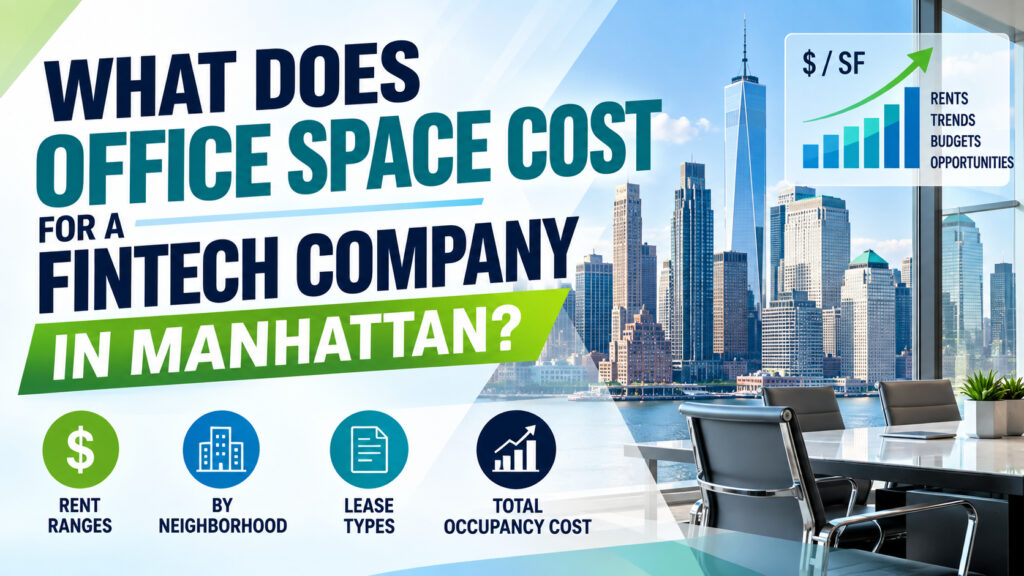
August 2026 data placed overall Manhattan office availability at 13.7%. Average asking rent reached about $80.05 per square foot. Midtown averaged $85.55, while Midtown South reached $86.26. Downtown remained much lower at $62.01 per square foot.
Another major market survey calculated Manhattan availability at 12.5% during August. Its methodology differs, but the direction matches. Available office supply continues tightening while leasing remains historically strong.
Those conditions matter because leasing and buying compete for the same corporate capital.
A tenant choosing a ten-year lease may secure concessions and preserve liquidity. Conversely, an owner-user may lock down a scarce asset and remove future renewal risk.
Buying usually fits these FinTech companies
An established FinTech company should examine ownership closely when it expects a stable Manhattan presence.
That does not require flat headcount. Instead, leadership needs reasonable visibility into long-term space requirements.
A 65-person company might buy space supporting 85 people. That buffer could absorb ordinary growth without forcing another transaction.
The case becomes stronger when management expects Manhattan to remain central to recruiting, client meetings, compliance, and leadership operations.
Ownership also makes more sense when the company can fund its equity contribution without starving higher-return business initiatives.
After all, buying an office has an opportunity cost.
Every dollar committed to real estate cannot simultaneously fund engineering, acquisitions, marketing, regulatory expansion, or product development.
Leasing usually fits these FinTech companies
Earlier-stage FinTech companies often need options more than permanence.
Consider a company with 40 employees today and plans for 120 within four years. A perfectly sized office condo could become an operational constraint before ownership economics mature.
Another company might grow through acquisitions. That firm may not know which Manhattan submarket will suit the combined workforce.
Hybrid workplace strategy adds another uncertainty.
A FinTech employer requiring four office days could need far more space than one operating around flexible attendance.
Leasing transfers much of that uncertainty to the landlord.
You can negotiate expansion rights, contraction rights, sublease rights, assignment provisions, and renewal options. Ownership requires solving those changes through another real estate transaction.
The strongest ownership profile
Office condo ownership becomes particularly compelling when these conditions converge:
| Business issue | Strong ownership signal | Strong leasing signal |
|---|---|---|
| Manhattan commitment | Long-term headquarters plan | Location remains unsettled |
| Headcount | Predictable growth | Rapid or uncertain growth |
| Workplace policy | Established attendance pattern | Policy still evolving |
| Capital | Strong balance sheet | Cash has higher internal uses |
| Space configuration | Specialized and durable | Requirements change frequently |
| Timing | Seven-plus-year horizon | Short or uncertain horizon |
| Control | High priority | Flexibility matters more |
| Exit plan | Resale or rental strategy exists | No appetite for property management |
The supplied market benchmark reaches a similar core conclusion. Stable companies receive more potential value from ownership than rapidly growing startups.
However, that rule should start the analysis rather than finish it.
A good office condo in the wrong growth plan remains a bad purchase.
Likewise, a flexible lease in an inferior building can create hidden operating costs.
What Does Owning a Manhattan Office Condo Actually Mean?
An office condominium gives the buyer a deeded ownership interest in a specific commercial unit.
That structure differs fundamentally from leasing.
Instead of paying a landlord for temporary possession, your ownership entity holds the real estate. Shared components remain under condominium governance and building management.
Office condos remain a small part of Manhattan’s overall office inventory. Current industry estimates place the segment around 2% of the office market. One market inventory counts approximately 106 condominium office buildings and roughly 12 million square feet.
Scarcity creates an important limitation.
A tenant searching for leased offices might compare dozens of viable alternatives. An owner-user can face a much smaller universe.
Therefore, the best office condo may not sit on your preferred block.
You might instead choose between location, layout, price, ownership structure, and building quality.
An office condo is not the same as an office co-op
Manhattan buyers often encounter both products.
They should not treat them interchangeably.
With a commercial condo, the buyer acquires real property. With a commercial co-op, the buyer generally acquires shares and occupancy rights through a proprietary lease.
That distinction affects financing, governance, closing mechanics, and exit strategy.
It can also affect transactional taxes. For example, New York City mortgage recording tax applies when qualifying mortgages on real property get recorded. Co-op financing generally uses a different collateral structure.
This distinction matters because commercial sale listings sometimes use loose terminology.
A FinTech buyer should confirm the legal ownership structure before comparing two prices.
Ownership does not eliminate occupancy costs
Buying removes base rent.
It does not create a free office.
Owners still need to budget for common charges, real estate taxes, insurance, utilities, financing, maintenance, and capital assessments.
For example, our current 7,000-square-foot NoHo office condo asks $6.86 million. Its published annual common charges total $35,344. Annual real estate taxes add $50,648.
A current 3,909-square-foot downtown penthouse office condo asks $3.75 million. Its listed taxes total $43,414 annually. Common charges add another $36,819.
Those figures demonstrate why purchase price alone tells very little.
Your finance team should calculate the complete annual occupancy cost.
Common charges deserve serious scrutiny
Common charges fund shared building operations.
They can cover management, lobby operations, cleaning, elevators, mechanical systems, insurance, staffing, security, and other shared expenses.
Yet every condominium allocates expenses differently.
A low common charge does not automatically signal a bargain.
Perhaps the building maintains limited reserves. Maybe major capital work sits ahead. Conversely, a higher charge might support better systems and healthier reserves.
Request several years of budgets and financial statements.
Then determine why expenses changed.
The condo board’s capital planning deserves equal attention.
A pending facade project, elevator modernization, roof replacement, chiller replacement, or lobby renovation can produce assessments after closing.
Real estate taxes remain an ownership expense
Most commercial property falls within New York City Tax Class 4.
The city lists the tax-year 2026 Class 4 rate at 10.848%. However, owners do not simply multiply that percentage by their purchase price. Assessment rules determine taxable value through a separate process.
Therefore, a buyer should obtain the unit’s actual tax history.
Review current taxes, assessed values, pending challenges, exemptions, and recent changes.
Never underwrite taxes from a broker estimate alone.
Owning can remove one leasing-specific tax exposure
Certain Manhattan tenants face the Commercial Rent Tax.
The tax generally concerns commercial tenants south of 96th Street whose annualized gross rent reaches the applicable threshold. Current city guidance uses $250,000 as the principal threshold, subject to credits and exemptions.
Ownership can change that analysis because the company may no longer pay rent to an unrelated landlord.
However, related-party occupancy structures require professional review.
The city specifically addresses situations involving related ownership and affiliated companies.
That detail matters when the operating company rents from a property-holding affiliate.
You gain control, but not unlimited control
Condo ownership gives a FinTech company more permanence than a conventional lease.
Still, the board and governing documents continue to matter.
Alteration agreements can regulate construction.
Building rules may limit work hours, supplemental cooling, roof access, penetrations, generators, signage, deliveries, and equipment.
Your board may also control insurance requirements and contractor access.
Consequently, “we own it” never means “we can do anything.”
The correct question becomes:
Does the condominium structure allow this company to operate the office it actually needs?
How Does Buying Compare With Leasing Financially?
The most common mistake involves comparing purchase price with annual rent.
That comparison mixes a capital asset with an operating expense.
Instead, build two complete occupancy models.
One model should calculate lease economics. The second should calculate ownership economics.
Then apply the same occupancy period.
Build the lease model first
Start with your base rent.
For broader budgeting, our current FinTech office cost guide places many Manhattan FinTech requirements around $60 to $110-plus per square foot annually. Premium offices can move well above that range.
Current third-party market data supports that general positioning.
August averages reached $85.55 per square foot in Midtown and $86.26 in Midtown South. Downtown averaged $62.01. These averages cover broad inventories, so specific high-quality offices can cost substantially more.
However, quoted rent only starts the calculation.
A lease model should also include escalation clauses, electricity, overtime HVAC, tax increases, operating expense increases, insurance, and security deposits.
Add construction costs that exceed the landlord contribution.
Include furniture, data infrastructure, moving expenses, and professional fees.
Then subtract free rent and landlord-funded improvements.
That produces a more realistic net occupancy cost.
Build the ownership model separately
Ownership requires another cost stack.
| Ownership component | Why it matters |
|---|---|
| Purchase price | Establishes initial asset cost |
| Equity contribution | Consumes company or shareholder capital |
| Debt service | Determines recurring financing burden |
| Common charges | Funds shared operations |
| Real estate taxes | Remain material in commercial condos |
| Insurance | Protects unit and ownership exposure |
| Utilities | Vary by building and metering |
| Repairs | Shift more responsibility toward ownership |
| Capital assessments | Can materially change annual costs |
| Build-out | May create lasting property value |
| Closing costs | Raise initial investment |
| Resale costs | Reduce eventual exit proceeds |
| Opportunity cost | Measures alternative use of equity |
The opportunity-cost line deserves special attention for FinTech.
A mature professional company may earn moderate returns on retained capital.
A venture-backed FinTech might reasonably expect internal capital to fund much faster growth.
That difference can completely change the buy-versus-lease answer.
Current Manhattan office condo asking prices vary dramatically
There is no single Manhattan office condo price.
Even nearby units can trade at very different prices per square foot.
Among current listings on our site, examples cover a wide range.
A 6,758-square-foot full-floor Midtown South condo asks $3.379 million. That equals about $500 per square foot.
A 5,122-square-foot Grand Central office condo asks $2.76588 million. That equals $540 per square foot.
Our 5,570-square-foot Chelsea office asks $3.375 million. That works out near $606 per square foot.
A 4,850-square-foot Flatiron-area office asks $3.45 million. The indicated price sits around $711 per square foot.
Meanwhile, our 7,000-square-foot NoHo condo asks $980 per square foot.
A modern 2,000-square-foot Midtown condo asks approximately $1,194 per square foot.
Another 3,344-square-foot Midtown office condo carries an asking price near $1,495 per square foot.
These examples do not establish a universal market average.
Instead, they show how strongly quality, size, building, location, floor position, security, and condition affect pricing.
Purchase price per square foot can mislead you
Suppose Condo A costs $550 per square foot.
Condo B costs $775.
The cheaper condo appears better.
Now examine the details.
Condo A might need a complete build-out. It could carry high taxes and an upcoming capital assessment.
Perhaps Condo B already contains the layout you need. Lower carrying costs and modern systems could improve its ten-year economics.
Suddenly, the higher purchase price may produce the lower occupancy cost.
This explains why owner-users should compare total basis, not merely acquisition price.
Total basis includes purchase, construction, technology, furniture, closing costs, and immediate capital obligations.
Rent savings are not automatically investment returns
Ownership advocates sometimes describe every rent dollar as “wasted.”
That framing oversimplifies corporate finance.
Rent buys flexibility.
It also transfers property value risk to someone else.
A lease can protect capital for operating growth.
Ownership instead provides an asset, but that asset can rise or fall in value.
The Manhattan office market has demonstrated both outcomes.
Top-quality offices have attracted intense demand, while obsolete buildings have suffered significant valuation pressure. The supplied benchmark describes this sharply divided market.
Current leasing data shows the same quality preference.
Manhattan supply has tightened during 2026, while top-tier office demand has remained especially strong.
Therefore, your underwriting should never assume automatic appreciation.
Do not use a single break-even year
People often ask whether buying becomes cheaper after five, seven, or ten years.
No universal year exists.
The crossover changes with financing, price, taxes, rent, concessions, appreciation, maintenance, capital expenditures, and resale value.
Run several scenarios instead.
Use a conservative case, expected case, and strong case.
Then stress-test the assumptions.
What happens if resale value falls 15%?
What happens if your company outgrows the unit during year four?
How does the model change if rents rise faster than expected?
What happens if your condominium imposes a major assessment?
A robust purchase should survive more than the optimistic scenario.

Where Should a FinTech Company Consider Buying in Manhattan?
Location affects more than prestige.
It changes commuting patterns, employee recruitment, client access, price, building stock, and resale depth.
FinTech companies also differ from one another.
A payments platform serving financial institutions may favor a different location than a consumer finance startup.
Likewise, a capital-markets technology company can prioritize different adjacencies than a digital lending business.
Grand Central and Midtown East
Grand Central remains one of Manhattan’s strongest owner-user locations.
The transportation network supports employees commuting from Manhattan, the outer boroughs, Westchester, and Long Island.
Midtown also carries Manhattan’s tightest major office availability.
August 2026 availability stood near 12.1%, according to one current market series. Average asking rent reached $85.55 per square foot.
Ownership can therefore appeal to a company that expects a durable Midtown presence.
Our Grand Central office condo for sale offers 2,450 square feet at $2.55 million. It includes four windowed offices, conference space, an open work area, and dedicated IT space.
Companies needing more room can examine the 5,122-square-foot East 40th Street office condo. Its current asking price stands at $2,765,880.
Larger owner-users have another scale of opportunity.
The 44,779-square-foot full-floor condo near Third Avenue currently carries guidance around $620 per rentable square foot.
Smaller companies can also examine Third Avenue office condos with units beginning around 1,100 square feet. Multiple units can create an expansion path within one building.
That last feature deserves attention.
Buying adjacent units can reduce one traditional ownership weakness.
A company may purchase additional units later without abandoning its original office.
Still, future availability cannot be guaranteed.
Flatiron, Chelsea, and Midtown South
Midtown South attracts companies that want technology talent, transit, restaurants, and a less traditional office environment.
Demand has increased sharply.
August 2026 Midtown South availability fell to 16.4% under one current research series. Average asking rent stood at $86.26 per square foot.
Another quarterly series measured even tighter availability earlier in 2026. Different research boundaries explain part of the variation. Both datasets show strong recent demand.
FinTech companies considering ownership here have several product types.
The West 24th Street full-floor opportunity offers 4,850 square feet near Madison Square Park. Its layout includes private offices, open areas, meeting rooms, and a shower.
A Chelsea full-floor condo provides 5,570 square feet with oversized windows and an open loft layout. Its current asking price stands at $3.375 million.
Another 6,000-square-foot West 27th Street opportunity asks $2.95 million.
A FinTech company wanting a larger architectural statement can examine the 14,939-square-foot Broadway duplex. The current asking price totals $13 million.
Penn Station and the West Side
Penn Station access can broaden the recruiting map considerably.
That factor matters when employees commute from New Jersey, Long Island, or other regional locations.
A company should model employee origin points before choosing the neighborhood.
The 4,600-square-foot Penn Station area office condo currently asks $2.399 million. It offers a full-floor layout near major transit connections.
For a larger team, the West 45th Street office condo offers 11,252 square feet. Its listed asking price totals $5.626 million.
That price equals roughly $500 per square foot.
However, a FinTech company should not choose it merely because the acquisition basis looks attractive.
Leadership still needs to evaluate employee commuting, client patterns, building systems, and future liquidity.
NoHo, SoHo, and Downtown creative corridors
A product-led FinTech company may prefer a downtown or creative neighborhood.
These locations can support recruiting from technology, design, product, and engineering communities.
Our NoHo 7,000-square-foot office condo includes an open loft configuration and server-room potential.
A larger Broadway full-floor condo offers approximately 11,000 square feet near SoHo. The published asking price stands at $9.85 million.
Another 5,000-square-foot Mott Street office opportunity provides a smaller alternative in the same general downtown ecosystem.
These locations can work particularly well for companies combining finance and technology cultures.
Yet ownership should follow the workforce.
Do not buy a fashionable location that creates a worse commute for your actual employees.
Financial District and Lower Manhattan
Downtown can provide a compelling financial comparison against Midtown.
Average asking rent reached $62.01 per square foot in August 2026. Availability stood at 16.1%. Both figures remained meaningfully different from Midtown.
That spread matters when comparing buying with leasing.
A company might discover attractive downtown ownership pricing.
However, the same company might also secure an economical lease.
Therefore, a lower purchase price alone does not establish the better strategy.
The Rector Street office condo offers 8,813 square feet and a simultaneous sale-or-lease structure. That creates a particularly useful real-world comparison.
Our 4,650-square-foot Broadway office condo provides another downtown ownership example at $3.5 million.
Sale-or-lease opportunities deserve special attention.
They let a company evaluate the same physical office under two capital structures.
That removes many variables from the comparison.
Midtown premium ownership
Some FinTech companies want institutional-quality ownership.
Larger balance sheets can also support larger full-floor purchases.
A current 31,153-square-foot Fifth Avenue office condo lists at $26,480,050. That equals approximately $850 per square foot.
Another 12,402-square-foot high-floor Midtown office condo asks $12.5 million.
A nearby 3,344-square-foot office condo creates a smaller ownership entry point within modern Class A inventory.
These offices serve a different ownership objective than inexpensive loft product.
Here, the buyer may prioritize building quality, security, client experience, and long-term corporate image.
The relevant comparison should use equivalent leased quality.
Comparing premium ownership against an inexpensive Class B lease produces misleading economics.
What Should a FinTech Company Inspect Before Buying?
Buying requires broader due diligence than leasing.
A lease gives your company contractual rights inside someone else’s asset.
Ownership gives you an asset and its associated obligations.
That difference requires deeper investigation.
Start with the condominium itself
Obtain the declaration, bylaws, offering plan, amendments, rules, and financial statements.
New York maintains an offering-plan database containing filings and amendments for qualifying condominium offerings.
Your attorney should review transfer restrictions.
Ask about rights of first refusal.
Determine whether the board can restrict occupants or uses.
Study alteration provisions.
Review financing restrictions.
Examine insurance requirements.
Check whether the board has pending litigation.
Then examine several years of meeting minutes.
Minutes often reveal issues that financial summaries hide.
Repeated elevator complaints, water intrusion, facade problems, cooling disputes, and assessment discussions can signal future costs.
Review reserves and capital projects
A beautiful lobby cannot compensate for weak finances.
Ask how much cash the condominium maintains.
Then compare reserves with upcoming projects.
Exterior facade work can become expensive.
Elevator modernization can also create substantial assessments.
Roofing, boilers, cooling towers, chillers, pumps, life-safety equipment, and electrical infrastructure deserve review.
A professional engineer can help evaluate major systems.
Meanwhile, your attorney and accountant can examine how the condominium allocates costs.
Verify the Certificate of Occupancy and permitted use
Do not assume an office-looking space permits your intended use.
Review the Certificate of Occupancy.
Confirm zoning.
Check open violations and permits.
Verify whether prior alterations received proper approvals.
A FinTech office usually creates fewer specialized use issues than medical or manufacturing space.
Still, construction history matters.
An attractive conference room means little if previous work created unresolved compliance problems.
Test the physical layout against real FinTech operations
Square footage alone does not tell you whether the office works.
Count usable seats.
Measure meeting-room demand.
Examine executive privacy.
Plan interview rooms.
Check phone-booth capacity.
Determine how employees circulate through the space.
Then model future headcount.
A 6,000-square-foot office with poor columns can function worse than a well-planned 5,000-square-foot unit.
Ceiling heights and natural light also affect usability.
Likewise, an efficient center-core floor can support more flexible planning.
Investigate power and cooling
FinTech companies often depend on substantial technology infrastructure.
Modern cloud architecture has reduced the need for large internal server rooms.
However, network equipment, trading infrastructure, security systems, supplemental cooling, and specialized hardware can still matter.
Ask about electrical capacity.
Confirm whether power reaches the unit directly.
Review emergency power options.
Determine whether the building supports supplemental HVAC.
Check operating hours for central systems.
Then price any upgrades before signing a contract.
Test telecommunications before buying
Internet service deserves more attention than many buyers give it.
Identify carriers serving the building.
Confirm actual pathways into the unit.
Determine whether diverse fiber entrances exist.
Ask where telecommunications risers run.
Investigate whether both connections ultimately rely on one vulnerable pathway.
FinTech operations can depend on consistent connectivity.
Therefore, redundancy should exist physically, not merely on an invoice.
Examine physical security
Different FinTech businesses face different regulatory and contractual requirements.
Some companies handle sensitive financial information.
Others operate under financial-services licenses.
New York’s financial-services cybersecurity framework covers entities operating under specified Banking, Insurance, or Financial Services Law authorizations.
Consequently, regulated companies should involve security and compliance teams during property review.
Consider lobby controls.
Assess visitor procedures.
Review elevator access.
Check after-hours entry.
Study loading and freight procedures.
Evaluate surveillance coverage.
Then examine whether private areas can remain separated from visitor zones.
Do not wait until design development to discover security limitations.
Understand building environmental exposure
Large Manhattan buildings may fall under city emissions requirements.
Current rules generally cover buildings exceeding 25,000 gross square feet, subject to exceptions. Certain condominium combinations also meet coverage thresholds.
The rules impose building-level emissions requirements.
Noncompliance can create financial exposure for building ownership.
An office condo buyer should therefore ask about compliance planning.
Review historical energy performance.
Ask whether capital upgrades appear likely.
Determine how the condominium allocates related expenses.
A low current common charge can look less attractive if major energy work sits ahead.
Understand the board before you understand the furniture
Turnkey furniture can save money.
A healthy condominium can save much more.
Prioritize the legal and financial structure before cosmetic finishes.
A FinTech company can replace desks easily.
It cannot easily replace dysfunctional condominium governance after closing.
How Should a FinTech Company Finance and Structure the Purchase?
Financing can change the ownership analysis dramatically.
Two companies buying identical units may face completely different economics.
Credit quality, leverage, ownership, profitability, collateral, and lender requirements all matter.
Conventional commercial financing
A conventional commercial mortgage provides the most familiar route.
The lender will review the borrower, asset, valuation, cash flow, and loan structure.
Rates and leverage change with market conditions.
Therefore, leadership should obtain financing indications early.
Do not negotiate a purchase using a leverage assumption nobody has validated.
An appraisal can also affect the transaction.
A lender may value the unit below the negotiated purchase price.
That gap can force the buyer to contribute more equity.
SBA financing can matter for eligible owner-users
Some qualifying businesses can use government-backed financing for owner-occupied commercial real estate.
The 504 program supports qualifying building purchases and improvements. Current program guidance allows long-term fixed-rate financing for major fixed assets.
A typical 504 structure can involve a private lender financing up to 50% of project cost. A development-company component can cover up to 40%. The borrower generally contributes at least 10%, although transaction specifics can require more.
Current SBA guidance lists a maximum 504 loan amount of $5.5 million. Real estate maturities can extend to 25 years.
The 7(a) program can also support acquiring, refinancing, or improving business real estate.
However, FinTech founders need to review eligibility carefully.
Federal lending rules changed during 2026, including ownership and citizenship requirements. Current guidance restricts SBA-backed borrowing where foreign-national ownership creates ineligibility.
That issue could matter significantly for globally owned FinTech companies.
Never assume eligibility from an older article.
Financing costs extend beyond interest
New York City imposes mortgage recording tax on qualifying recorded mortgages.
The applicable rate depends on the transaction and mortgage amount. The city directs filers toward its official calculation system.
That tax can create a material closing cost.
Legal fees, appraisal fees, lender fees, title costs, due diligence, and recording charges also add to acquisition basis.
Therefore, compare the cash needed to close with your lease security requirement.
Do not compare merely the down payment against one month’s rent.
Should the operating company own the condo directly?
Not automatically.
Some buyers place commercial property in a separate ownership entity.
The operating company can then occupy the premises under a related agreement.
That approach can create liability, tax, financing, and accounting consequences.
It may also affect how lenders underwrite the transaction.
Furthermore, city taxes can treat related-party occupancy differently from a simple unrelated lease.
Legal and tax professionals should design the structure before contract signing.
The structure should follow the company’s actual goals.
Avoid creating an entity merely because another business used one.
Depreciation can affect ownership economics
Commercial real estate can create depreciation deductions.
Under current federal rules, nonresidential real property generally uses a 39-year recovery period under the general depreciation system.
However, the land portion does not follow the same depreciation treatment.
Improvements and personal property can also have different recovery periods.
Recent federal tax changes created additional rules for certain qualifying production property. Those rules do not automatically convert an ordinary FinTech office into accelerated-depreciation property.
For that reason, never apply a generic tax-benefit percentage.
Ask your tax adviser to model the actual acquisition.
Interest and other deductions require company-specific review
Financing may create deductible interest.
Property taxes and operating expenses may also receive tax treatment.
Yet limitations can depend on entity structure and tax profile.
Companies with losses, carryforwards, unusual capitalization, or international ownership can produce very different outcomes.
Tax value therefore belongs in the model.
Still, it should not drive the purchase before the business case works.
Do not assume appreciation
Manhattan real estate has a powerful long-term brand.
That does not guarantee every office condo appreciates.
The market remains highly selective.
Current evidence shows strong demand for quality offices while weaker assets face a less forgiving environment.
The benchmark materials also highlight the narrow nature of office-condo demand. They describe a market where limited supply meets a relatively specialized buyer pool.
That combination can create opportunities.
It can also create liquidity risk.
A rare asset does not automatically equal a liquid asset.
Plan the exit before buying
A FinTech buyer should answer four questions before signing.
Who might eventually buy this unit?
Could another company lease it economically?
Could our company remain here if growth slows?
What happens if we outgrow it quickly?
Those questions define your exit strategy.
A well-located 5,000-square-foot full-floor unit may appeal to many professional owner-users.
A highly customized 40,000-square-foot installation could have a narrower resale audience.
Specialized construction can increase operating value while reducing buyer depth.
Balance both objectives.
Leasing the condo later can provide another exit
Suppose your FinTech company grows beyond the condo.
Selling is not the only possible response.
You might retain the property and lease it.
That strategy can preserve ownership while allowing operations to move elsewhere.
However, becoming a landlord creates another business activity.
It also exposes the ownership entity to vacancy, brokerage commissions, tenant improvements, lease negotiations, and management responsibilities.
Condominium rules must allow the intended leasing structure.
Lender restrictions may also apply.
Therefore, “we can always rent it” should never substitute for an actual exit model.
What Is the Best Decision Framework for a FinTech Office Condo?
The best answer does not begin with whether Manhattan prices will rise.
It begins with operating certainty.
Real estate should support the FinTech company.
The company should not reorganize itself around a premature property purchase.
Start with your five-year headcount plan
Model low, expected, and high growth.
Do not use the fundraising presentation.
Use realistic workforce planning.
Separate Manhattan employees from remote workers.
Then estimate peak daily attendance.
Add meeting rooms, collaboration space, client areas, support space, and circulation.
Only then determine your target square footage.
Extend that model beyond five years
Ownership typically deserves a longer horizon than a short lease.
Ask whether the company could occupy the same unit for seven, ten, or more years.
A “yes” strengthens buying.
A “maybe” requires more analysis.
A clear “no” usually favors leasing.
The benchmark supplied with this project also emphasizes long occupancy as a central ownership requirement.
Compare the right lease against the right purchase
Do not compare an average lease with your favorite condo.
Build a real shortlist.
Perhaps the company needs 6,000 square feet around Grand Central.
Compare several actual leases against available condos in the same quality range.
Maybe the correct ownership comparison includes the East 40th Street condo and nearby lease alternatives.
A Flatiron team might instead compare the West 24th Street office against equivalent leased floors nearby.
A larger Midtown operation could examine the 31,153-square-foot Fifth Avenue condo against institutional lease options.
Comparing real alternatives produces actionable answers.
Measure flexibility as a financial value
Flexibility sounds abstract until you price it.
Suppose ownership saves $500,000 over ten years.
Now suppose the company has a meaningful chance of outgrowing the unit in year four.
Selling early could incur brokerage, legal, financing, moving, and construction costs.
The ownership advantage can disappear quickly.
Alternatively, a lease containing strong expansion rights may carry substantial strategic value.
Put a number on that value.
Do not leave flexibility outside the spreadsheet.
Measure control as a financial value too
The reverse also applies.
Leasing can create renewal risk.
A landlord can seek higher economics when the term ends.
Your company may need to relocate after investing heavily in its office.
Moving can disrupt employees and clients.
Construction requires management time.
Technology infrastructure must move.
Address changes ripple through operations.
Ownership can reduce those risks.
Therefore, control has real financial value.
Consider the value of permanent improvements
A FinTech company may invest heavily in conference technology, acoustics, secure areas, supplemental HVAC, upgraded power, and custom interiors.
Under a lease, that investment remains inside someone else’s property.
A renewal failure can strand part of the improvement value.
Ownership changes that equation.
Your company may justify more durable construction because the property remains yours.
Nevertheless, improvements do not always return dollar-for-dollar during resale.
Design for both operations and future marketability.
Buy quality, not merely discount
The cheapest Manhattan office condo can become very expensive.
A poor building may create employee dissatisfaction.
Weak infrastructure can require upgrades.
Bad governance can create assessments.
Obsolete systems can hurt resale.
A difficult location can narrow the buyer pool.
Current Manhattan office conditions reinforce that lesson.
High-quality assets continue capturing outsized demand, while older product faces greater challenges.
Consequently, price discount should never replace building quality analysis.
Pay attention to size liquidity
Smaller office condos often have broader owner-user audiences.
That does not mean small always wins.
Instead, recognize that buyer depth can decline as unit size grows.
The office-condo market itself remains small compared with Manhattan’s lease market.
A 3,500-square-foot unit could appeal to many professional firms.
A 35,000-square-foot office requires a much larger buyer.
Your own exit assumptions should reflect that difference.
Expansion capability can make one condo much more valuable
Look beyond the unit.
Could adjacent units become available?
Does one owner control nearby floors?
Can the condominium legally combine units?
Would building systems support expansion?
Our Third Avenue office condo selection illustrates this concept. Current offerings range from smaller suites to larger combined configurations.
An expansion path can extend the usable life of ownership.
That flexibility deserves value in your comparison.
Think about contraction too
FinTech companies do not only grow.
Products change.
Markets change.
Automation changes staffing.
Acquisitions consolidate teams.
Regulations affect business models.
An owned office should survive downside scenarios.
Could you occupy part and lease part?
Does the layout support subdivision?
Would the board permit that arrangement?
Could separate entrances preserve privacy?
A divisible unit can provide resilience that an indivisible floor lacks.
Do not let prestige decide the transaction
A Manhattan address can support credibility.
Still, companies rarely fail because they rented instead of owning an office.
They can suffer when capital gets trapped in the wrong asset.
Likewise, a mature company can lose significant money through repeated relocations and rent resets.
Prestige should remain secondary.
Operations, capital allocation, talent, and long-term economics should decide.
Frequently Asked Questions About FinTech Office Condos in Manhattan
Are office condos a good investment for a FinTech company?
They can be.
The strongest case involves owner-occupation over a long period.
Ownership can create equity, control, and protection from lease-renewal risk.
However, the company also accepts property-value risk and reduced mobility.
A FinTech company should therefore judge the condo first as an operating asset.
Investment return comes second.
How long should a FinTech company expect to stay before buying makes sense?
A seven-to-ten-year horizon often creates a more credible ownership case than a short stay.
That is not a guaranteed break-even period.
Financing, purchase basis, lease alternatives, improvements, appreciation, taxes, and exit costs can shift the result.
Model the actual transaction rather than relying on a standard year count.
The submitted benchmark likewise identifies a longer holding period and stable headcount as core ownership factors.
Is buying automatically cheaper than leasing?
No.
Ownership can become cheaper over time, but the initial capital requirement can be substantial.
Common charges and taxes continue after closing.
Financing adds another expense.
Capital improvements can also arise.
Meanwhile, landlords may offer free rent and construction allowances.
Compare complete costs on both sides.
How much do Manhattan FinTech offices cost to lease?
Many FinTech tenants can begin budgeting around $60 to $110-plus per square foot annually.
Actual rents vary considerably by location, building, quality, size, condition, and term. Our detailed FinTech office cost guide explains those variables.
Current August 2026 averages reached approximately $85.55 in Midtown and $86.26 in Midtown South. Downtown averaged about $62.01.
How much does a Manhattan office condo cost?
There is no dependable borough-wide price for an individual office condo.
Current examples on our inventory range from roughly $500 per square foot to well above $1,000.
The spread reflects building quality, location, size, condition, security, floor level, and ownership structure.
Browse the current Manhattan office condos for sale before building a purchase budget. The inventory changes as units enter and leave the market.
Is Midtown better than Downtown for FinTech ownership?
Neither submarket wins automatically.
Midtown provides strong transportation, client proximity, and institutional office inventory.
Downtown can provide lower occupancy economics and strong financial-sector access.
Current asking-rent averages show a considerable pricing gap between those markets.
The best location follows your employees, clients, and long-term business plan.
Is Flatiron a good location for a FinTech office?
It can be excellent for companies competing heavily for technology and product talent.
Midtown South recorded strong leasing demand during 2026, while available supply tightened.
However, strong demand also raises the importance of comparing ownership against available leases.
A desirable neighborhood does not automatically make buying the best capital decision.
Should a FinTech startup buy an office condo?
Usually only after a demanding stress test.
Startups often experience rapid headcount changes.
Funding cycles can also alter real estate plans.
A startup that expects dramatic expansion could outgrow a purchased office quickly.
An unusually well-capitalized company with predictable growth may reach a different answer.
Can a FinTech company finance an office condo with an SBA loan?
Some qualifying businesses can.
The 504 program can finance qualifying owner-occupied fixed assets, including commercial real estate. The 7(a) program can also support real estate acquisition.
Eligibility depends on business size, ownership, use, underwriting, and current program rules.
Recent 2026 citizenship changes make current eligibility review particularly important.
Can the company buy more space than it currently needs?
Possibly.
However, financing requirements, building rules, cash flow, and leasing plans matter.
Buying moderate growth capacity can prevent premature relocation.
Purchasing dramatically excess space creates carrying costs and landlord responsibilities.
Model the vacant area until a tenant actually signs.
Can a FinTech company rent out part of its office condo?
Many commercial condos allow leasing.
Specific governing documents can impose requirements or restrictions.
A lender can also restrict certain arrangements.
Your attorney should confirm subdivision, leasing, assignment, and occupancy rights before closing.
Do not assume flexibility merely because the unit has multiple entrances.
What happens if the company outgrows the condo?
Several paths may exist.
The company can sell the unit.
It can retain the property and lease it.
Leadership might occupy the existing condo while adding nearby space.
Adjacent-unit acquisition could also work where inventory permits.
Each solution creates different operational and financial consequences.
Therefore, the expansion strategy belongs in the original purchase analysis.
What happens if the company shrinks?
An efficiently divisible office may allow partial leasing.
Alternatively, the company can continue occupying excess space.
It could also sell and relocate.
Smaller ownership units may offer easier exits than highly specialized large floors.
Again, condominium documents and physical configuration determine actual flexibility.
Is an office condo safer than leasing during a strong rental market?
Ownership removes landlord renewal risk.
It does not remove real estate risk.
The building can require capital work.
Taxes can change.
Common charges can increase.
Property values can fall.
Your company can also outgrow the unit.
Ownership trades one group of risks for another.
Does owning protect the company from rising rent?
Yes, in the narrow sense that the company no longer negotiates base rent with an unrelated landlord.
However, ownership expenses can still rise.
Taxes, insurance, utilities, common charges, repairs, and assessments remain variable.
Debt costs can also change when financing resets or refinances.
Think of ownership as greater cost control, not perfectly fixed occupancy cost.
Should we buy a renovated office condo or build one ourselves?
Turnkey space can reduce time and upfront construction.
It also lets you inspect the finished product.
However, somebody else’s layout may not fit your operations.
A shell can provide greater design control.
Construction adds cost, permitting, professional fees, and execution risk.
Compare total basis and delivery timing.
How important is internet redundancy for a FinTech office condo?
It can be critical.
Review actual carrier availability and physical pathways.
Two service contracts do not guarantee true redundancy.
Both lines could enter through the same vulnerable route.
Your technology team should validate connectivity before contract signing.
How important is building security?
That depends on your operations and regulatory status.
Many FinTech companies handle confidential financial or customer information.
Some fall under financial-services cybersecurity rules.
Evaluate lobby security, visitor controls, elevators, freight access, cameras, and after-hours procedures.
Your office design should support any required internal controls.
Do energy rules matter to an office condo buyer?
Yes.
Large buildings may fall under city emissions requirements.
Compliance costs can ultimately affect common charges or capital assessments.
Ask the board about current compliance and planned upgrades.
Do this before calculating long-term carrying costs.
What records should we request before buying?
Request the governing documents, financial statements, budgets, insurance information, capital plans, assessments, minutes, and tax history.
Also review building violations and permitted use.
Your attorney should investigate title and transfer requirements.
An engineer should evaluate relevant building systems.
Your finance team should review every recurring expense.
Should we compare office condos with only other office condos?
No.
The real decision is not Condo A versus Condo B.
It is buying versus the best realistic leasing alternative.
Your company might discover an excellent condo.
A nearby lease could still produce better strategic economics.
Conversely, expensive leasing terms might strengthen ownership.
Is 2026 a good time to buy a Manhattan office condo?
The answer depends more on the asset than the calendar.
Manhattan leasing strengthened significantly through 2026.
Available office supply also tightened.
At the same time, quality differences remain enormous.
A well-priced, well-located office can attract strong demand.
An obsolete or poorly governed property can remain difficult.
The current market rewards careful selection rather than blanket assumptions.
So, should a FinTech company buy an office condo in Manhattan?
Yes, when ownership solves a long-term operating problem and the financial model supports it.
The strongest buyer has predictable space needs, adequate liquidity, and a durable Manhattan commitment.
That buyer also selects a building with sound governance, functional infrastructure, and credible resale demand.
Lease instead when flexibility carries greater value.
A fast-growing FinTech company should hesitate before converting uncertain space requirements into a permanent asset.
Likewise, a business with valuable alternative uses for its capital should measure those returns honestly.
The correct outcome may also change by property.
One Manhattan condo can make financial and operational sense while another fails completely.
That is why the process should compare actual available condos against actual leases.
Browse our current office condos for sale throughout Manhattan, then compare them with direct lease alternatives. We can evaluate the same requirement from both directions.
The goal is not to make your FinTech company an office owner. The goal is to determine whether ownership gives your company a better Manhattan office strategy.
Find an Office Condo Today
We represent office tenants and owner-users across Manhattan, so we approach ownership from the occupier’s side. Our job is to compare buying with leasing before your company commits capital or flexibility. That means testing the space, building, financing, growth plan, and exit strategy together.
Fill out our 📋 online form or give us a call today 📞 212-967-2061 — let’s find the right options for your business.