How Fast Can an AI Company Lease Office Space in Manhattan?
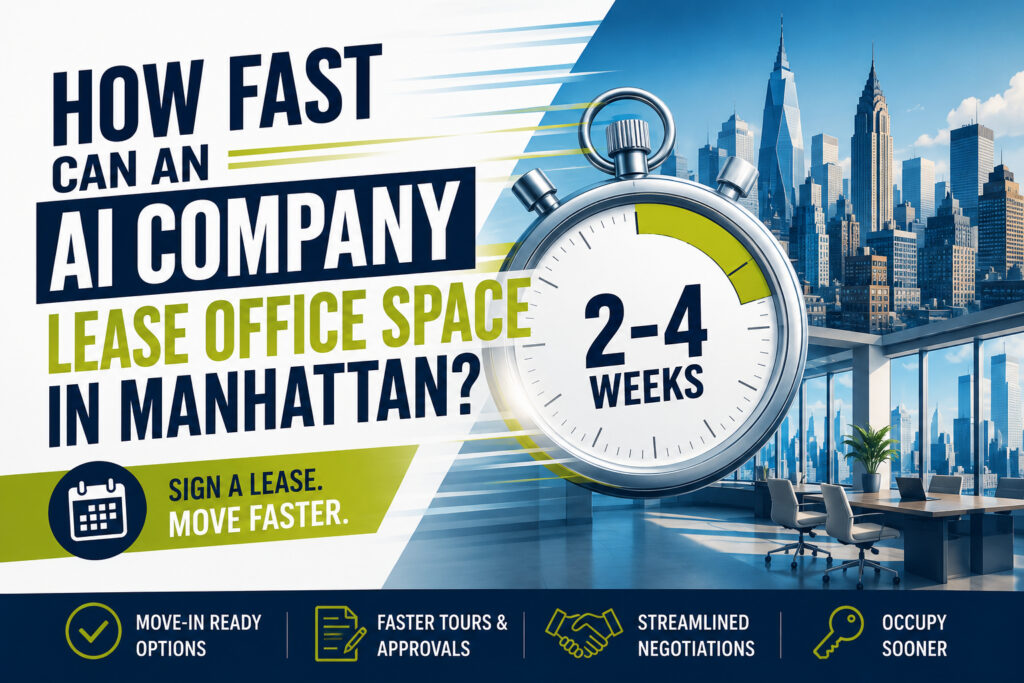
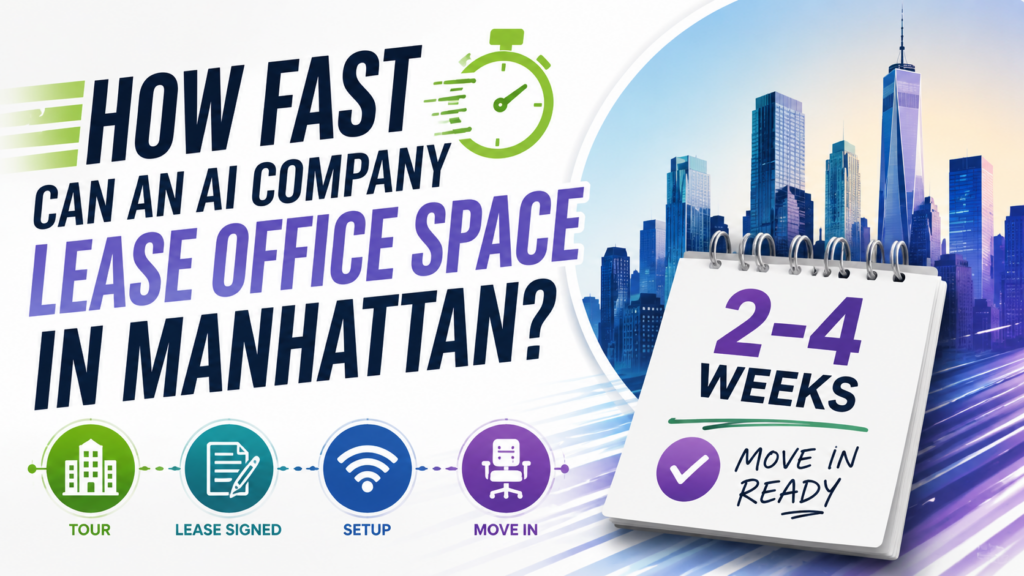
An AI Company Can Lease Manhattan Office Space in About Two to Four Weeks
A prepared AI company can often sign a Manhattan office lease within two to four weeks. The fastest deals involve furnished subleases, completed prebuilt suites, or existing offices that need almost no construction.
That answer needs one important distinction. Signing a lease and occupying an office are not always the same event.
A company may execute documents within three weeks. However, internet installation, insurance, access cards, furniture, security, or minor work can delay actual occupancy.
Conversely, a fully furnished office may support an extremely fast move. A prepared tenant could tour Monday and choose a space that week. Negotiations and legal work could then run simultaneously.
The Manhattan office market rewards that preparation today. AI companies leased about 1.50 million square feet across 63 Manhattan transactions during the first half of 2026. That nearly doubled their total activity during all of 2025.
Meanwhile, Manhattan availability continues to tighten. One major Q2 2026 market survey placed availability at 14.4% and average asking rent at $80.17 per square foot.
Another major survey reported 13.0% availability and a $78.03 overall asking-rent average. Different research firms use different building sets and methodologies.
Those differences matter less than the direction. Well-located, high-quality, move-in-ready space has become harder to replace after another tenant takes it.
The realistic timing ranges
Use these ranges as planning benchmarks rather than guarantees.
| Office strategy | Lease or agreement timing | Practical occupancy timing | Best fit |
|---|---|---|---|
| Furnished existing office with simple documents | About 1–3 weeks | About 1–4 weeks | Urgent smaller team |
| Furnished sublease | About 2–4 weeks | About 2–6 weeks | Fast-growing company |
| Completed landlord prebuilt | About 2–5 weeks | About 3–8 weeks | Team needing stability |
| Second-generation direct space | About 3–6 weeks | About 4–10 weeks | Team accepting minor work |
| Space needing moderate alterations | About 4–8 weeks to lease | About 2–4 months | Defined layout requirements |
| Major custom build-out | About 1–3 months to lease | About 4–9+ months | Larger headquarters |
| Raw or technically complex premises | Variable | Often 6–12+ months | Specialized requirements |
Our broader NYC office leasing timeline and move-in plan explains the traditional schedule. A conventional Manhattan search often deserves nine to twelve months of runway. Large custom projects can justify twelve to eighteen months.
An AI company with a hard deadline should not confuse the fastest possible deal with the safest planning schedule.
A two-week sprint can work. Yet the tenant must remove almost every avoidable variable before touring.
What “fast” should mean to the tenant
Speed has at least four separate meanings during an office search.
Search speed measures the time between defining requirements and identifying viable spaces.
Transaction speed covers proposals, landlord review, negotiations, legal documents, and execution.
delivery speed concerns construction, cleaning, furniture, wiring, access, and other physical preparation.
Operational speed measures when employees can actually work normally inside the office.
That final definition matters most.
A signed lease does little for a team without reliable connectivity. Likewise, beautiful furniture does not solve an unresolved security requirement.
Therefore, the real question becomes:
How quickly can the company secure the right Manhattan office and operate there without creating an expensive problem later?
That question produces a better leasing decision.
What Actually Controls the Search-to-Occupancy Timeline
No landlord can make every Manhattan office transaction move at the same speed. The space, tenant, ownership, lawyers, infrastructure, and business requirements all affect timing.
Still, several factors consistently separate a three-week transaction from a three-month transaction.
Space condition usually creates the largest difference
A furnished office eliminates many tasks that consume time.
Existing workstations can remove a furniture procurement cycle. Installed conference rooms eliminate partition construction. An existing pantry avoids another construction scope.
Wiring can provide another head start. However, your technology team should test it before relying upon it.
Consider a 2,550-square-foot furnished West 21st Street sublease, for example. The published offering describes the space as furnished, wired, and move-in ready.
A 2,600-square-foot Fifth Avenue sublease also offers move-in-ready conditions. Its existing rooms, workstations, pantry, private bathrooms, and tenant-controlled air conditioning reduce physical preparation.
Those characteristics matter more to an urgent tenant than decorative finishes.
Every improvement that already exists removes another dependency from the critical path.
A clear requirement can save an entire week
Teams lose time when they start touring before answering basic questions.
A fast search needs a written requirement before the first appointment.
| Decision | Know this before touring |
|---|---|
| Headcount | Current employees and realistic growth |
| Size | Minimum and maximum rentable area |
| Timing | Hard occupancy date and preferred date |
| Location | Acceptable neighborhoods and commute boundaries |
| Budget | Asking-rent range and total occupancy ceiling |
| Term | Minimum acceptable commitment |
| Layout | Workstations, meeting rooms, offices, phone rooms |
| Technology | Connectivity, power, cooling, security needs |
| Access | Hours, weekends, visitors, deliveries |
| Growth | Adjacent space, expansion, assignment, sublease needs |
Without that brief, every tour creates new questions.
With it, the tenant can reject unsuitable inventory before anyone loses an afternoon.
Our commercial leasing guide provides broader context for the full Manhattan leasing process.
Decision-makers must join early
A founder should not tour ten offices alone when four executives hold veto power.
That approach almost guarantees second tours.
Instead, identify the final decision group immediately. Bring the critical people into the short list before proposals begin.
Finance should approve the economic range. Operations should review functionality. Technology should flag infrastructure problems.
Counsel should understand the deadline before documents arrive.
Fast transactions happen when different workstreams run together rather than sequentially.
Landlord underwriting can become the invisible bottleneck
A landlord usually wants evidence that the tenant can perform its obligations.
An established company may provide strong financial statements and operating history. A newly funded company may have substantial cash but little historical revenue.
That distinction can affect underwriting.
AI companies should organize their financial package before submitting serious proposals. The package may include financial statements, capitalization information, funding evidence, banking information, and entity documents.
The exact request varies by landlord.
Early preparation lets ownership evaluate the tenant while business terms move forward.
Security negotiations can slow an otherwise simple deal
A young company may trigger more discussion about security than an established corporation.
The landlord could request cash, a letter of credit, a guaranty, or another structure. The final package depends on credit, landlord investment, term, and overall risk.
Manhattan commercial security deposits do not follow the residential one-month deposit rule. Commercial parties negotiate their own protection within the lease framework.
This page should not turn a timing question into another security-deposit guide. For speed, the important lesson is simple: resolve the security structure early.
Waiting until final lease comments can cost valuable days.
The letter of intent should settle business points
A rushed tenant sometimes treats the proposal stage casually.
That mistake pushes unresolved economics into lease drafting.
A strong term sheet should address rent, term, commencement, concessions, work, furniture, security, expansion, and important flexibility rights.
It should also identify unusual technology requirements.
The lawyers can then focus on legal language rather than renegotiating the entire transaction.
Attorneys need the deadline before the lease arrives
Commercial leases can contain substantial operating and financial obligations.
The tenant therefore needs experienced counsel. The city maintains a commercial lease assistance program for qualifying small businesses.
Speed does not require careless legal review.
Instead, counsel can prioritize critical issues and circulate comments quickly. The landlord’s attorney can then respond without guessing which points actually matter.
A three-week deal usually demands rapid communication from both sides.
Construction changes everything
Most meaningful commercial alteration work requires proper design, approvals, and permits.
New York City requires licensed professionals for many construction filings. The Department of Buildings also requires permits for most construction work.
Minor cosmetic work creates a different schedule.
Paint, furniture changes, and limited non-permit work can move quickly. New partitions, mechanical changes, electrical work, plumbing, or occupancy changes can create larger dependencies.
Professional certification can accelerate some qualifying filings because plans avoid initial departmental plan review. The city notes that this route can save weeks.
Once meaningful construction enters the transaction, “How fast can we sign?” stops being the only important question.
The better question becomes, “When can employees legally and practically occupy the completed office?”
Which Manhattan Lease Path Gets an AI Company in Fastest?
The fastest transaction structure depends on what the company needs after move-in.
A five-person seed-stage team has different risks from an 80-person growth company. A 150-person headquarters search creates another set of constraints.
Furnished subleases often create the strongest speed-and-control combination
A quality sublease can provide furniture, conference rooms, cabling, kitchen facilities, and existing infrastructure.
That combination removes construction and procurement.
Subleases also offer shorter commitments in many cases. The remaining term comes from the existing lease.
However, speed depends on the underlying documents.
The tenant must understand consent requirements. Building access also needs confirmation. Restoration obligations deserve careful review.
A sublease can therefore move quickly without becoming casual.
For teams near Madison Square, compare this 4,125-square-foot furnished West 20th Street office. It includes 30 workstations, meeting rooms, a conference room, pantry space, and existing wiring.
Larger teams can review this 11,239-square-foot furnished Flatiron full floor. The installation includes 48 workstations and expansion potential within the existing layout.
The published sublease term runs through May 2028. That structure can suit a company that expects another space decision relatively soon.
A prebuilt direct lease can combine speed with greater stability
Some tenants want direct landlord relationships without waiting for a custom build-out.
A completed prebuilt office can solve that problem.
The physical space already exists. Yet the parties can negotiate a direct lease and longer occupancy.
Consider this 11,907-square-foot furnished Hudson Yards office. The current direct offering describes a move-in-ready prebuilt floor for roughly 79 people.
A smaller company could compare this 2,530-square-foot furnished Hudson Square office. The direct prebuilt offering includes an open work area, kitchen, conference room, and approximately 32-person capacity.
Direct space can create stronger long-term control than a sublease.
The trade-off often involves a longer commitment and more extensive lease negotiations.
Second-generation office space can still move quickly
“Second generation” generally means another tenant previously occupied the premises.
The existing build-out may already match most requirements.
Perhaps the new tenant only needs paint, limited flooring work, additional phone rooms, or minor cabling.
That space can create an excellent compromise.
The tenant gains some customization without accepting a full construction cycle.
Before assuming a second-generation office is nearly ready, price every required change.
Small design requests can become larger projects after mechanical, electrical, fire-safety, or building standards enter the discussion.
White-box space can look deceptively fast
A clean open floor can appear simple during a tour.
Yet an unfinished or minimally finished premise may need more work than expected.
For example, this 5,370-square-foot Flatiron white-box office currently offers several subdivision possibilities. The direct offering provides a flexible starting point rather than a completed engineering-team installation.
That flexibility has value.
However, a tenant facing a 30-day deadline should compare the construction schedule against completed alternatives.
Raw space rarely supports a true emergency move
Raw space provides maximum design freedom.
It also introduces architects, engineers, construction documents, pricing, approvals, permitting, procurement, inspections, and installation.
That sequence can make sense for a long-term headquarters.
It rarely makes sense for a company that needs desks next month.
A fast-growing AI company can instead use staged occupancy.
The company might secure interim space first. It can then build the long-term headquarters without letting the construction schedule control hiring.
Managed space can solve an emergency, but it answers a different question
A managed private office can sometimes accommodate a team faster than a traditional lease.
That does not make it the correct long-term answer.
The tenant usually sacrifices some control over identity, alterations, infrastructure, access policies, and economics.
Therefore, treat managed space as one possible bridge.
Do not let a temporary occupancy solution quietly become a permanent real-estate strategy.
Our NYC furnished and turnkey office guide compares existing furnished options across Manhattan.
AI-Specific Requirements That Can Speed Up or Derail the Deal
An AI company does not automatically need a fundamentally different office.
Many teams mainly need desks, meeting rooms, reliable connectivity, privacy, and normal office systems.
However, some AI businesses bring technical requirements that ordinary office searches miss.
The key is identifying those requirements before the lease reaches signature.
Internet service needs two separate checks
First, determine what carriers already serve the building.
Next, determine what infrastructure reaches the actual suite.
Those are different questions.
A building may advertise multiple telecommunications providers. Still, your selected floor might require additional cabling or cross-connect work.
Ask the technology team to inspect the space early.
Do not wait until lease execution.
Existing cabling can save time. However, old cabling does not guarantee suitable performance or security.
Our broader guide to AI-ready offices in Manhattan explains these infrastructure questions in more detail.
Do not mistake an office for a data center
This distinction deserves special attention.
Most Manhattan office buildings support normal workplace technology. They do not automatically support dense, heat-producing compute infrastructure.
A cloud-based AI company may need little unusual electrical capacity.
Another company may want local development hardware, testing systems, racks, or high-powered workstations.
Those requirements can change the building search.
Tell the broker exactly what hardware the company plans to operate inside the premises.
Do not simply request an “AI-ready building.”
That phrase means little without measurable requirements.
Electrical capacity should become a number
Ask your technical team for actual needs.
How many high-draw workstations will operate simultaneously? Will the company install racks? Does specialized hardware require dedicated circuits?
What expansion does the team expect?
The engineer or electrician can then test those requirements against the building.
That approach prevents vague discussions about “extra power.”
Cooling can become more important than electrical service
Equipment produces heat.
A building may provide adequate electricity but insufficient after-hours cooling.
Determine standard HVAC hours first. Then ask how supplemental cooling works.
The lease should also address relevant access and installation rights.
Teams operating ordinary laptops may need nothing unusual.
Companies placing concentrated hardware inside the office need deeper diligence.
Twenty-four-hour access does not always mean twenty-four-hour HVAC
Many Manhattan offices advertise 24/7 tenant access.
That does not guarantee unlimited building services.
After-hours cooling can involve additional charges. Freight access can require scheduling.
Visitor procedures can change after normal hours.
A team expecting late engineering sessions should verify these details before submitting a final proposal.
Security requirements can narrow the inventory
Confidential development work may require controlled entry.
Enterprise customers may also impose security expectations through their vendor requirements.
Ask whether the suite can support private access controls.
Then examine visitor handling, loading access, telecommunications rooms, and building staff procedures.
A small company should not overengineer the requirement.
Still, discovering a hard security limitation after signing creates a worse outcome.
Furniture can save weeks
A furnished office eliminates sourcing, lead times, deliveries, installation, and disposal decisions.
That makes furniture an operational asset during a compressed search.
However, count usable seats rather than advertised capacity.
A “40-person office” may only contain 24 existing workstations. Meeting rooms and private offices can drive the larger theoretical number.
Compare actual furniture against day-one headcount.
Then determine what the layout supports after the next hiring round.
Conference rooms matter more than nominal density
AI and technology teams often combine focused engineering work with product meetings, customer calls, recruiting, and collaboration.
A dense room full of desks does not solve those needs.
Count enclosed rooms during every tour.
Phone booths also matter.
A slightly larger office with existing meeting infrastructure can become operational faster than a cheaper empty floor.
Expansion rights can protect a fast decision
Speed creates a natural concern.
What happens when the company doubles?
The lease can address some of that uncertainty.
Adjacent-space rights, rights of first offer, assignment provisions, and workable sublease rights can provide flexibility.
A tenant may also consider a shorter commitment where appropriate.
Our Manhattan lease-term guide explains the broader relationship between term length and landlord economics.
Do not solve a 30-day occupancy problem by creating a ten-year headcount problem.
Where to Look in Manhattan When the Move-In Deadline Matters
The best neighborhood depends on employee commutes, customers, budget, building requirements, and available inventory.
For a time-sensitive AI company, another factor rises to the top.
How many acceptable move-in-ready alternatives can the neighborhood produce today?
Midtown South captured 75.1% of Manhattan technology leasing during the first half of 2026. AI companies represented more than one-third of technology demand.
That concentration helps explain heavy demand around Flatiron, NoMad, Chelsea, Hudson Square, and surrounding technology corridors.
Yet a hard deadline should widen the map when necessary.
Flatiron and the Madison Square area
Flatiron offers a deep mix of loft buildings, prebuilt suites, subleases, and direct opportunities.
Many floors provide open layouts that suit collaborative teams.
Transit access also supports employees arriving from several directions.
Current examples include:
| Current option | Size | Structure | Why it deserves a fast-search review |
|---|---|---|---|
| 224 Fifth Avenue move-in-ready sublet | 2,600 SF | Sublease | Existing workstations, conference room, pantry and 24/7 access |
| West 21st Street furnished loft | 2,550 SF | Sublease | Furnished and wired installation |
| Furnished 21st Street office | 3,038 SF | Direct | Furnished office with existing meeting areas |
| West 20th Street turnkey office | 4,125 SF | Sublease | 30 workstations and multiple meeting rooms |
| West 24th Street full-floor office | 6,250 SF | Direct | Renovated loft with large open workspace |
| Park Avenue South furnished office | 10,439 SF | Sublease | Existing furnished installation |
| Full-floor Flatiron office | 11,239 SF | Sublease | Furnished, wired, 48 existing workstations |
| Flatiron full-floor direct space | 18,500 SF | Direct | Existing furnished floor with more than 100 seats |
These published listings span several growth stages. Availability and economics can change before the page does.
A serious search should therefore verify every option before scheduling around it.
Hudson Square and SoHo
Hudson Square and SoHo can work particularly well for teams seeking loft character and strong west-side access.
Inventory can become competitive.
Therefore, companies facing a hard deadline should compare several buildings immediately.
Current examples include this 2,530-square-foot furnished Hudson Square direct office. It offers an existing open work area, conference room, pantry, and approximately 32-person capacity.
A larger team can review this 7,000-square-foot furnished SoHo office. The published sublease runs through August 2027 and provides about 47-person capacity.
Another 8,012-square-foot furnished Broadway office provides an existing 48-workstation layout, private offices, meeting rooms, and a larger boardroom.
Companies considering direct occupancy can also compare this 12,500-square-foot furnished Spring Street floor. The existing prebuilt condition removes much of a traditional construction cycle.
Hudson Yards and the West Side
Newer West Side buildings can offer stronger base-building systems and modern floorplates.
Those advantages can help technically demanding tenants.
Pricing usually reflects building quality.
For roughly 79 people, this 11,907-square-foot furnished Hudson Yards direct office provides a move-in-ready prebuilt option.
Larger companies can compare this 20,222-square-foot furnished Hudson Yards sublease. Its published term can extend through 2032.
Another 23,324-square-foot furnished Hudson Yards space provides an existing large-team installation with extensive workstation capacity.
The best building does not automatically produce the fastest lease.
Institutional ownership can conduct detailed underwriting. Larger transactions also create longer documents.
Nevertheless, finished physical space can remove months of construction.
Financial District
Downtown deserves serious consideration when timing and value outweigh a narrow neighborhood preference.
The submarket offers furnished suites, modern towers, older upgraded buildings, and several transportation options.
Q2 2026 research placed Downtown average asking rent at $61.34 per square foot. The same survey measured overall Manhattan asking rent at $80.17.
Individual spaces can sit far above or below those averages.
A current 2,573-square-foot furnished Financial District sublease publishes a $39-per-square-foot asking rate. The suite includes a conference room, private offices, pantry, and furnished open workspace.
Another 2,573-square-foot furnished Downtown office publishes a term through February 2028. It offers a move-in-ready layout with furniture available.
Teams seeking a longer bridge can review this 3,138-square-foot Liberty Street sublease. The published offering runs through December 2030 and comes furnished and wired.
For larger requirements, our inventory extends well beyond these examples.
Midtown and Midtown East
Midtown can become attractive when employee access outweighs the desire for a traditional technology-cluster address.
Grand Central connectivity can help distributed metropolitan teams.
Class A buildings also provide extensive building services.
CBRE measured Midtown availability at 12.7% during Q2 2026. Average asking rent reached $86.18 per square foot.
That does not mean every Midtown office costs $86.18.
Floor, building quality, term, ownership, build-out, and concessions affect each deal.
The speed advantage comes from the volume and diversity of inventory.
Do not choose a neighborhood before testing employee commutes
A founder may prefer one district.
The team may tell a different story.
Plot employee home locations before narrowing the search.
Then test subway, rail, PATH, and bus access.
A somewhat less fashionable address can reduce commute friction for dozens of employees.
A fast lease has little value when the location creates a persistent hiring problem.
How to Compress a Manhattan AI Office Search Without Cutting Corners
Speed comes from preparation rather than recklessness.
The best compressed search removes waiting time between tasks.
Start with a one-page requirement
The first document should explain exactly what the company needs.
Include headcount, size, neighborhoods, budget, move date, term, layout, and technical requirements.
Add three categories:
Must have. The company cannot occupy without these items.
Strong preference. These features influence the decision.
Nice to have. These features should never derail a good transaction.
This hierarchy prevents minor preferences from consuming precious days.
Create a broad market set before the first tour
Do not tour one space at a time.
Build the initial inventory first.
Then compare it by size, condition, economics, location, term, and infrastructure.
Our Manhattan office listings cover direct leases, subleases, furnished offices, and other configurations.
A compressed search should target a workable universe rather than a favorite building.
That keeps leverage alive.
Reduce the list before touring
Review floor plans first.
Check the advertised condition.
Examine seating capacity, enclosed rooms, and major building characteristics.
Reject obvious mismatches.
A well-built first tour can cover several relevant options during the same day.
That produces better comparisons while impressions remain fresh.
Score every space during the tour
Memory becomes unreliable after several offices.
Use the same criteria everywhere.
| Category | Fast-search question |
|---|---|
| Layout | Can we work here without meaningful construction? |
| Seats | How many actual workstations exist now? |
| Meetings | Are there enough enclosed rooms? |
| Internet | Which providers serve this floor? |
| Power | Does our equipment fit current capacity? |
| Cooling | What happens after normal business hours? |
| Security | Can we meet our access requirements? |
| Term | Does the commitment match our growth horizon? |
| Expansion | What happens after another funding round? |
| Move | What must occur before employees arrive? |
Take notes before entering the next building.
That discipline can prevent another round of tours.
Bring technology diligence into the first short list
Do not ask the IT team to inspect ten offices.
Instead, bring technical diligence into the final three or four.
Confirm connectivity and cabling.
Review power and cooling requirements where relevant.
Check telecom access procedures.
Determine whether the team needs separate secure infrastructure.
A technically unsuitable office should leave the shortlist immediately.
Request competing proposals together
Competition helps both economics and timing.
Ask several finalists for proposals within the same window.
Then compare complete economics.
Base rent alone gives an incomplete picture.
Free rent, escalations, electricity, operating charges, taxes, construction contributions, furniture, and deposit requirements can change the result.
For broader budgeting context, our 2026 Manhattan office leasing overview tracks current market conditions. The page currently notes tighter supply and stronger premium-space demand.
Negotiate business issues before lease drafting
Resolve the large points at the proposal or term-sheet stage.
Rent belongs there.
So do term, security, concessions, possession, landlord work, furniture, and expansion concepts.
Technology requirements should also enter early when they affect the building.
That discipline makes lease drafting more efficient.
It also reduces the chance of discovering a major disagreement after counsel spends days negotiating.
Order corporate documents before ownership asks
Make a transaction folder before choosing the final office.
It can hold formation documents, financial information, insurance contacts, and authority information.
The appropriate content depends on the company.
A recently funded business should know how it plans to demonstrate financial strength.
Preparation can turn a landlord question into a same-day response.
Start insurance early
The lease and building may impose insurance requirements.
Send those requirements to the insurance team immediately after identifying the likely deal.
Do not wait for move week.
Certificates, endorsements, and building requirements can create avoidable friction.
Start connectivity before signing when the transaction allows it
Ask potential carriers about lead times during diligence.
Determine whether service already reaches the suite.
Identify required access.
The tenant should avoid making unauthorized alterations or binding commitments before securing appropriate rights.
Still, early investigation can expose a dangerous schedule before signing.
Build a day-one occupancy plan
Work backward from the employee arrival date.
The plan should cover access cards, internet, insurance, furniture, movers, cleaning, signage, and technology.
Include any required landlord approvals.
A furnished suite may need very little.
A more complex space may need several parallel workstreams.
Separate day-one requirements from post-move improvements
This tactic can save weeks.
Suppose the office works immediately but lacks two desired phone booths.
Move first when the lease and building allow it.
Install the booths afterward.
Perhaps the company wants decorative improvements.
Those can often wait.
A fast-moving tenant should never let nonessential perfection delay functional occupancy.
Keep a fallback alive until execution
Do not discard the second-best option too early.
Deals can stall over underwriting, security, lease language, or another tenant.
Keep an alternative alive until the transaction has genuine certainty.
That protects the deadline.
It also protects negotiating leverage.
Questions AI Companies Should Answer Before Committing to a Fast Manhattan Lease
Can an AI company really lease Manhattan office space in two weeks?
Yes, under unusually favorable conditions.
The company needs a clear requirement, fast decision-makers, acceptable financials, responsive counsel, and nearly ready physical space.
The landlord must also move quickly.
Two weeks should represent an achievable fast case, not the default planning assumption.
Three to six weeks gives a furnished traditional transaction more breathing room.
Can a company sign within days?
A company can choose a space and agree to major business terms within days.
Fully executing a traditional commercial lease within that window is more difficult.
Legal documents, underwriting, security, insurance, and corporate approvals still need attention.
A simple occupancy agreement may move faster than a conventional lease, but it creates different rights.
What is the fastest traditional office option?
A furnished, wired, legally usable existing office usually offers the shortest path.
Subleases can work particularly well.
Completed direct prebuilts can also move quickly.
The exact winner depends on landlord approvals and document complexity.
Is a sublease always faster than a direct lease?
No.
A sublease may introduce consent requirements and another contractual layer.
A simple direct prebuilt deal could therefore move faster.
Conversely, a furnished sublease with cooperative parties can eliminate construction and furniture procurement.
Compare the complete process.
What takes longer: finding the space or negotiating the lease?
Either stage can become the bottleneck.
A well-defined 3,000-square-foot requirement may produce several options quickly.
Negotiations could then consume most of the schedule.
A highly specific 50,000-square-foot requirement presents the reverse problem.
The legal process may move efficiently, but suitable inventory could prove scarce.
How early should an AI company start looking?
Start earlier than the minimum timeline whenever possible.
A smaller turnkey search can move within weeks.
Yet four to six months gives a sub-3,000-square-foot tenant more choice and leverage.
Larger requirements deserve more runway.
Our tenant guidance generally recommends six to twelve months for many Manhattan office searches. Custom headquarters can require considerably more.
Starting early does not require signing early.
It simply preserves options.
Does a funding round make landlord approval easier?
Fresh capital can strengthen a tenant’s financial story.
However, funding does not automatically answer every underwriting question.
Landlords can consider cash, financial history, term, requested construction dollars, security, and entity structure.
A company should present its financial position clearly.
Should an AI startup lease extra space for hiring?
Some growth cushion can make sense.
Too much unused space creates burn.
The better strategy depends on hiring visibility, funding, lease term, and expansion alternatives.
Look for adjacent availability and negotiated growth rights before simply increasing the initial footprint.
How much space should the company take?
Start with the actual operating model.
Count employees who will use the office.
Then add meeting rooms, circulation, collaboration areas, kitchen space, and realistic growth.
Do not use a generic employee multiplier without testing the floor plan.
A 5,000-square-foot loft can function very differently from a 5,000-square-foot tower suite.
Our AI startup office-space roadmap provides additional sizing context across different growth stages.
Does an AI company need Class A space?
Not automatically.
Building class should follow business requirements.
A quality loft can provide excellent light, layout, access, connectivity, and culture.
A modern tower may offer more sophisticated building systems and services.
Infrastructure quality matters more than the letter attached to the building class.
The company should buy the capabilities it needs.
Is Flatiron always the best location?
No neighborhood wins every requirement.
Flatiron can suit a technology-focused team.
Hudson Square can provide larger loft environments.
SoHo can support brand-driven companies.
Midtown offers broad transit access and significant Class A inventory.
Downtown can provide attractive economics and strong connectivity.
Hudson Yards can deliver newer building infrastructure.
Search across several districts before making location part of the company identity.
What Manhattan market condition matters most for a fast-moving AI tenant?
Quality supply deserves attention.
Manhattan recorded strong leasing during the first half of 2026. Availability also declined across major market reports.
Tech demand reached 4.15 million square feet during that half-year period. AI companies accounted for 1.50 million square feet across 63 transactions.
The practical implication is straightforward.
A desirable move-in-ready floor can disappear while a slow tenant holds another internal meeting.
That does not justify reckless decisions.
It just rewards preparation.
Why do published Manhattan vacancy and availability figures differ?
Researchers measure office markets differently.
Some reports track vacancy.
Others report availability, which can include space becoming available later.
Building universes and lease-counting methodologies can also differ.
For example, one Q2 2026 report measured Manhattan availability at 14.4%. Another measured 13.0%.
A separate report measured overall vacancy at 19.3%. It used its own methodology and market universe.
Do not treat those percentages as contradictions.
Use one methodology when comparing periods.
How much does Manhattan office space cost in 2026?
The borough-wide average only provides context.
One Q2 2026 report placed Manhattan average asking rent at $80.17 per square foot. Midtown averaged $86.18, while Downtown averaged $61.34.
Another major report placed the borough average at $78.03.
Individual listings vary dramatically.
Current inventory includes value-oriented furnished subleases below those averages. Premium Class A and trophy floors can cost substantially more.
The lease structure also affects effective economics.
Therefore, compare full occupancy cost instead of multiplying one headline rent by square footage.
Does paying more guarantee a faster move?
No.
A premium new office may still require legal negotiations, underwriting, or technology work.
Meanwhile, a lower-cost furnished sublease could support faster occupancy.
Condition drives speed more directly than asking rent.
Ownership responsiveness also matters.
What should an AI company refuse to sacrifice for speed?
Do not sacrifice legal review.
Never ignore technical diligence.
Avoid an unsuitable commute merely because a floor looks impressive.
Do not accept a term that conflicts with realistic growth.
Never assume internet, cooling, or electrical capacity without verification.
Finally, do not confuse furniture with readiness.
The fastest good office is the one that already solves the company’s real requirements.
What can the tenant do today to create the fastest possible process?
Define the requirement today.
Build the inventory set immediately.
Tour the best options together.
Bring decision-makers into the process from the beginning.
Prepare financial information before proposals.
Alert counsel before choosing a finalist.
Send technical staff into the shortlist early.
Negotiate several options at once.
Keep one fallback alive.
Then work backward from the required occupancy date.
What is the bottom line?
Two to four weeks can be enough for an AI company to secure a move-in-ready Manhattan office. The best candidates usually need little construction and come with useful existing infrastructure.
A more complicated direct lease may require four to eight weeks before practical occupancy.
Custom construction can stretch the process into several months. City filing, permit, inspection, contractor, and building requirements add dependencies that a furnished suite avoids.
Current Manhattan conditions make preparation increasingly valuable. Office availability tightened during 2026, while AI companies sharply increased their leasing activity.
Start with the deadline, not the neighborhood.
Then identify spaces that can actually meet that date.
From there, compare economics, infrastructure, lease flexibility, and growth capacity before committing.
Review Available Office Options
We represent Manhattan office tenants, not landlords, and we approach fast searches from the tenant’s side of the table. We can compress the market survey, tours, proposals, building diligence, and negotiation without hiding the trade-offs. Our job is to help your company reach occupancy quickly while protecting the flexibility it may need after its next stage of growth.
Fill out our 📋 online form or give us a call today 📞 212-967-2061 — let’s find the right options for your business.