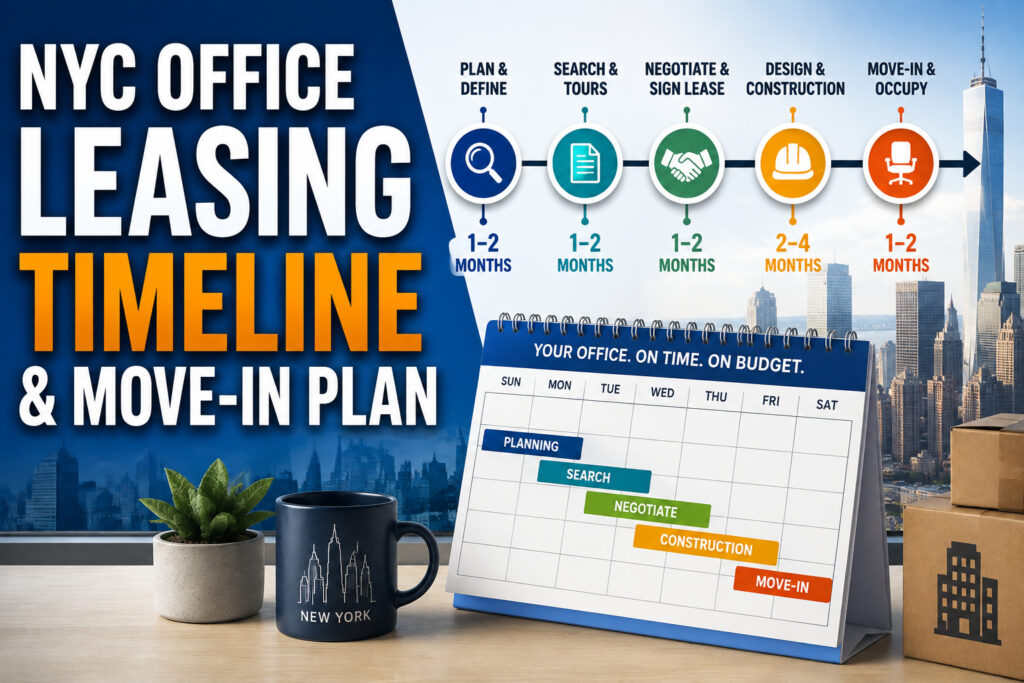
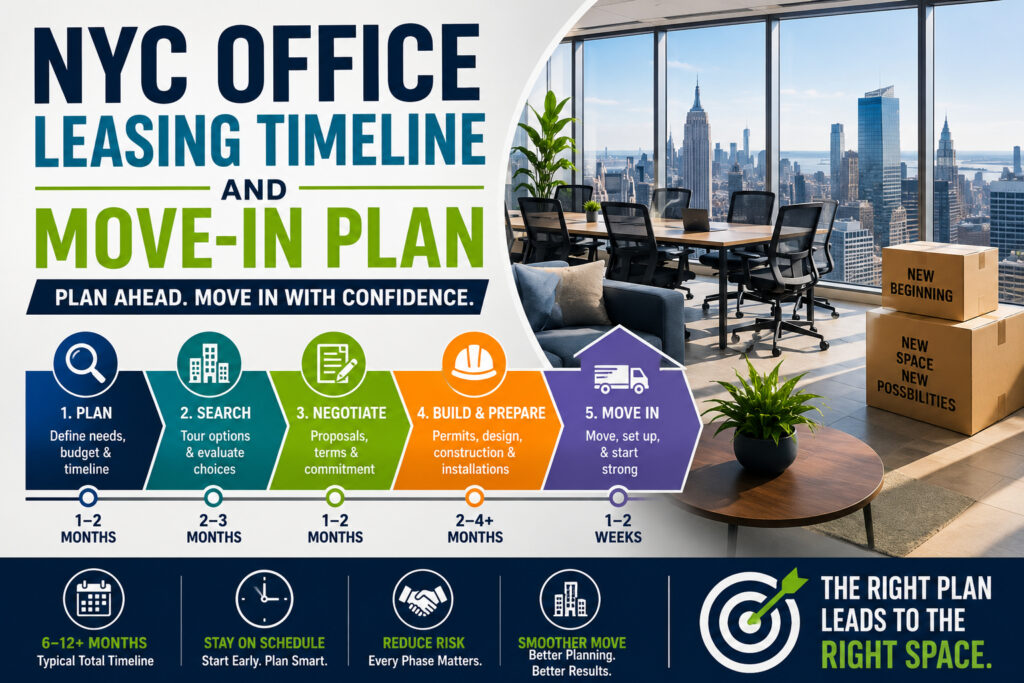
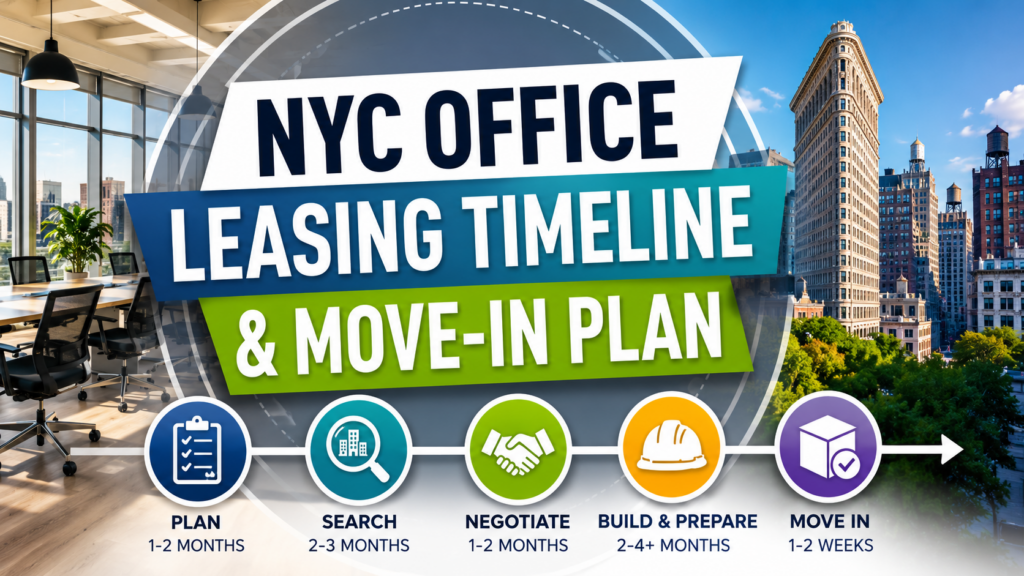
A New York City office lease can take six to nine months from early planning through occupancy. Custom construction, larger requirements, or complex approvals can extend the process beyond 12 months. Furnished or prebuilt spaces can shorten the schedule when they need little construction.
The safest approach starts with your required move-in date and works backward. Each phase should protect the next phase, rather than simply pushing the deal toward signature.
Planning rule:Most NYC office tenants should begin nine to 12 months before their desired occupancy date. Larger headquarters and custom build-outs often justify a 12-to-18-month lead time.\
How Long Does It Take to Lease and Move Into an NYC Office?
No single timeline fits every office requirement. The space condition usually creates the biggest difference.
A furnished sublease might already contain desks, conference rooms, cabling, and a working pantry. Meanwhile, a raw direct lease could require architecture, permits, construction, inspections, furniture, and technology installation.
For that reason, separate the leasing timeline from the occupancy timeline. Signing the lease does not mean your team can start working there.
Office requirement
Sensible planning window
Main timeline issue
Furnished, move-in-ready space
2–4 months
Negotiation, consent, IT, moving
Prebuilt direct lease
4–7 months
Search, lease documents, light alterations
Typical direct lease with improvements
6–9 months
Design, permits, construction
Significant custom build-out
9–12+ months
Architecture, approvals, construction
Large or complex headquarters
12–18+ months
Multiple workstreams and long-lead decisions
These ranges serve as planning allowances, not guaranteed completion dates. Scope, building rules, negotiations, permits, and procurement can change them quickly.
Current conditions also favor earlier decisions on high-quality space. Manhattan availability fell to 14.4% during Q2 2026. Average asking rent reached $80.17 per square foot during that quarter.
Prime Midtown inventory has tightened even further. Prime vacancy reached 2.2% during Q2 2026 under one major market methodology. Therefore, tenants targeting top buildings should create enough time to compare viable alternatives.
The first phase should answer one question: What office does your company actually need on opening day?
Start with headcount, attendance patterns, private office needs, meeting demand, and future growth. Next, identify acceptable neighborhoods, transit priorities, building quality, and your total occupancy budget.
Avoid creating requirements from square footage alone. Two offices with the same rentable area can function very differently.
A 5,000-square-foot floor with poor geometry may provide less useful space than a smaller efficient layout. Accordingly, review usable area, columns, perimeter offices, conference capacity, and circulation.
How many people need seats on peak attendance days?
Growth
What headcount must the office support later?
Layout
Open plan, offices, conference rooms, or a combination?
Location
Which transit hubs and neighborhoods remain acceptable?
Budget
What total annual occupancy cost can the business support?
Timing
What date must the new office operate fully?
Condition
Can you accept existing construction?
Term
How long can the business commit confidently?
At this stage, also review your existing lease. Check expiration, renewal rights, notice deadlines, restoration obligations, and holdover provisions.
Do not wait until the renewal deadline before comparing relocation options. Your landlord gains leverage when you lack enough time to leave.
A tenant representative should now build a complete market survey around your requirements. That survey should include direct leases, subleases, prebuilt offices, and upcoming availability.
Search, Tour, Compare Proposals, and Negotiate the LOI
A productive office search rarely means touring every available space. Instead, narrow the market before committing executive time to tours.
The first survey should eliminate spaces that fail on size, economics, location, timing, or building quality. Then compare the surviving options through the same criteria.
During tours, look beyond furniture and finishes. Confirm natural light, usable layout, HVAC service, electrical capacity, freight access, bathrooms, and internet infrastructure.
Also ask what the landlord will deliver before possession. A beautiful office can still carry an expensive construction problem.
Create competition before selecting your preferred space. Request proposals from several credible alternatives whenever possible. That process exposes differences in rent, concessions, construction contributions, security, and possession timing.
A proposal should cover more than the asking rent. Compare total economics across the entire term.
Free rent, annual increases, improvement allowances, electricity, operating expenses, and construction responsibility can change the real cost significantly.
Once one space leads the comparison, negotiations usually move toward an LOI or term sheet. Treat that document as a serious business negotiation.
The LOI should address rent, term, free rent, security, improvements, possession, and renewal rights. It should also address assignment, subletting, guarantees, and construction responsibilities where relevant.
Important operational issues belong here too. Include necessary HVAC arrangements, access, signage, expansion rights, and unusual infrastructure requirements.
Waiting until the lease draft creates unnecessary friction. Major business points become harder to reopen after the parties settle the LOI.
Lease Review, Design, Landlord Approval, and NYC Permits
The next phase often contains several parallel workstreams. Legal review, design, budgeting, and building diligence should not wait for each other unnecessarily.
Your attorney reviews the landlord’s lease and confirms the negotiated business terms. Meanwhile, the architect can refine the test fit and construction scope.
Contractors can also price early plans before design reaches completion. That step helps expose budget problems while you still have choices.
Allow several weeks for lease drafting and negotiation on a conventional transaction. Complex guarantees, construction language, or operating issues can require longer.
Do not confuse four important dates. Your lease may treat possession, lease commencement, rent commencement, and occupancy as separate events.
Define each one clearly. Also define what happens when the landlord misses an agreed delivery milestone.
Construction introduces another timeline. Most substantial NYC office alterations require permits, and licensed design professionals handle the applicable filings.
The city uses different alteration categories depending on the project. Work affecting use, egress, or occupancy can trigger a different filing path.
Design professionals generally submit alteration filings through the city’s online building platform. That system also supports permitting, inspections, and other project actions.
Never assume the government review represents your only approval. Building ownership may require separate architectural, engineering, insurance, and construction reviews.
Build-Out, Furniture, Cabling, Internet, and Technology
Construction often becomes the critical path after lease execution. However, tenants can prevent many delays before demolition starts.
Finish major layout decisions early. Late changes can affect drawings, pricing, permits, electrical work, furniture, and scheduled trades.
Order long-lead items before they threaten occupancy. Custom furniture, millwork, lighting, doors, specialty equipment, and technology hardware can create unexpected delays.
Your contractor should maintain a schedule that identifies every critical dependency. Ask which decision could delay move-in if your team postpones it today.
Technology deserves its own schedule. Do not treat internet and cabling as moving-week tasks.
Confirm available carriers, fiber access, demarcation points, riser access, and required building approvals. Then map workstation locations, wireless coverage, conference systems, security devices, printers, and specialty equipment.
Cabling should coordinate with furniture and architectural plans. Otherwise, outlets and data locations can end up behind millwork or in unusable positions.
Construction teams may overlap design and procurement to save time on suitable projects. Integrated planning can shorten certain build-out schedules substantially.
Still, speed should never replace proper approvals. Start permitted work only after the necessary permissions support that work.
Completion also involves more than the contractor leaving the site. Required inspections and project closeout can continue after physical construction ends.
Therefore, place inspections, punch-list work, cleaning, furniture, and technology testing before your employee occupancy date.
The Final Eight Weeks Before Your NYC Office Move
The physical relocation should now operate as a separate project. Appoint one internal move leader with authority to coordinate decisions.
Six to eight weeks before moving, confirm the commercial mover and both buildings’ requirements. Many managed NYC buildings restrict moves to specific freight elevator windows.
Friday evenings and Saturdays often provide practical move periods. However, each building sets its own access rules.
Confirm both buildings, not only the destination. Your current property can impose different insurance, elevator, loading, and protection requirements.
The mover may need Certificates of Insurance before either property grants access. Therefore, request each building’s exact insurance template early.
Reserve freight elevators and loading access as soon as your target move becomes firm. Summer dates and month-end periods can create greater scheduling pressure.
Four to six weeks out, finalize furniture placement and workstation numbers. Give movers a destination plan before packing begins.
At the same time, prepare access cards, reception procedures, telephone routing, security systems, mail handling, and conference technology.
Two weeks before moving, test internet service inside the new office. Never accept an installation confirmation as proof that every workstation works.
Next, test Wi-Fi, conference rooms, printers, phones, access control, and remote connections. Correct failures before employees arrive.
Your old office also needs a shutdown plan. Schedule furniture removal, technology disconnection, cleaning, repairs, and required restoration.
Finally, update relevant business records after the relocation. New York City provides processes for updating business and billing addresses when applicable.
Build Your Move-In Date Backward From Day One
The best timeline starts with Day One, not lease signing.
Choose the date when employees must work normally from the new office. Then work backward from that deadline.
Do not make construction completion your move-in date. Create a buffer for inspections, punch-list work, furniture, technology, cleaning, and final testing.
A practical backward plan might look like this:
Time before occupancy
Primary objective
12–18 months
Large headquarters planning or major custom projects
The timeline can compress when you choose a furnished or previously built office. Several construction tasks disappear in that scenario.
A sublease can also shorten the physical preparation period. However, prime landlord consent and document review may introduce another approval step.
Direct leases usually offer greater control over improvements and lease structure. Yet extensive customization creates more tasks before occupancy.
Tenants who prioritize speed should first examine existing conditions. Search current New York office space listings for spaces that already match your functional requirements.
Use the Office Space Calculator before touring. Better sizing decisions reduce wasted tours and unnecessary redesign later.
How early should I start looking for office space in NYC?
Most tenants should start nine to 12 months before their target occupancy. A simpler requirement may need less time.
Large requirements and significant construction can justify 12 to 18 months. Early planning also protects negotiating leverage.
Can I lease and move into an NYC office within three months?
Yes, under the right conditions. A furnished sublease or completed prebuilt office can support a much faster timeline.
The space should need little construction. Lease documents, approvals, internet, insurance, furniture, and moving logistics must also stay on schedule.
What usually causes the biggest office move delays?
Construction scope creates many delays. Late design changes, building approvals, permits, long-lead materials, and technology installation can also affect occupancy.
Lease negotiations can create delays before construction even begins. Therefore, manage legal and physical workstreams together whenever possible.
Should I sign a lease before getting a construction estimate?
Avoid entering a major build-out without understanding likely costs. Engage design and construction professionals early enough to test the economics.
A low rent can become expensive when the space requires extensive improvements.
When should I order internet for the new office?
Begin carrier diligence during space evaluation. Place the final order as soon as the address and occupancy plan allow.
Some installations need building access, riser coordination, or new infrastructure. Waiting until moving month creates unnecessary business continuity risk.
When should I hire the commercial mover?
Start mover planning about six to eight weeks before relocation. Reserve earlier when your building offers limited freight windows.
Summer and month-end moves deserve additional scheduling room.
How much lease overlap should I plan between offices?
Build enough overlap for your actual risk profile. Custom construction needs more protection than an existing furnished installation.
A short overlap can prevent one construction delay from creating an operational emergency. Your lease economics should account for that insurance.
What should happen before employees arrive?
Complete the punch list, cleaning, furniture placement, and technology testing first. Confirm internet, phones, Wi-Fi, conference systems, access cards, and security.
Staff should enter a functioning workplace, not an active construction project.
Does lease signing mean I can move in immediately?
No. The lease may separate possession, commencement, rent commencement, and permitted occupancy.
Construction and building access can create additional conditions. Review each date before signing the lease.
How can I shorten my NYC office leasing timeline safely?
Choose existing conditions that already support your layout. Make decisions quickly, maintain competing options, and engage professionals before problems become urgent.
Run legal, design, budgeting, technology, and moving workstreams in parallel where practical. Never compress necessary diligence merely to reach a target date.
What should I do first when my current NYC office lease has one year remaining?
Review your existing lease before touring anything. Confirm expiration, renewal deadlines, restoration duties, guarantees, and other exit obligations.
Next, define your future requirements and compare renewal economics against relocation alternatives. Starting early gives both choices credibility.
When does an NYC office relocation actually finish?
The project finishes when the new office works and the old office closes correctly. Physical moving represents only one milestone.
Final work can include punch items, construction closeout, restoration, old-office surrender, invoices, and business address changes.
Time to Find Space?
We represent office tenants, not landlords, throughout the leasing and relocation process. Our role starts with requirements and continues through proposals, lease economics, build-out coordination, and move-in planning. Review what a tenant broker should actually do before setting your occupancy date.
Fill out our 📋online form or give us a call today 📞212-967-2061 — let’s find the right options for your business.