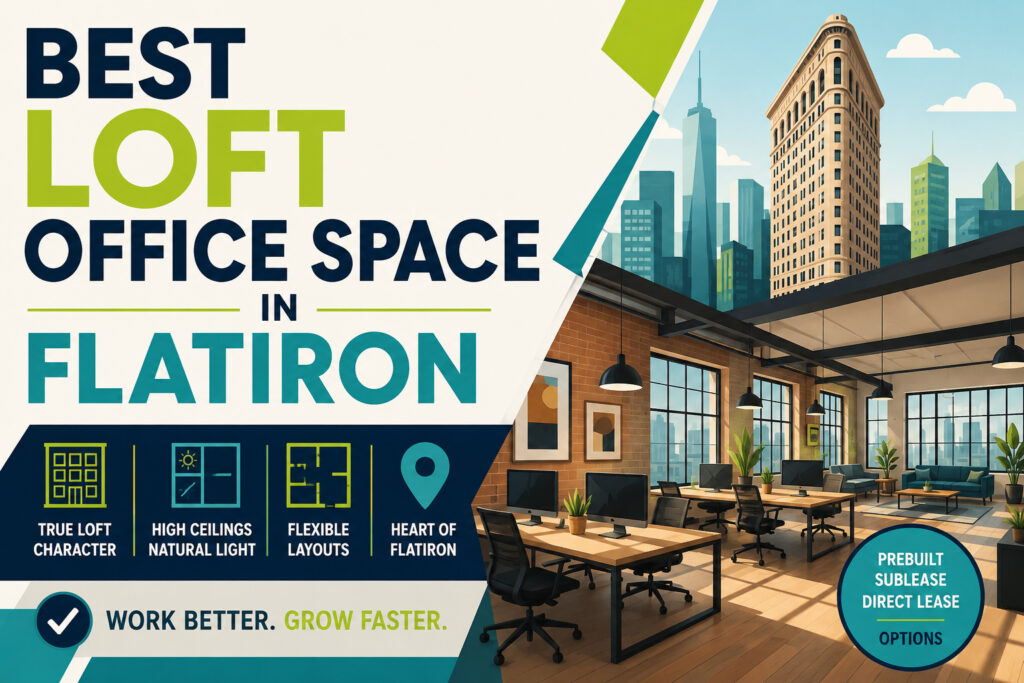
Best Loft Office Space in Flatiron
If you want the best loft office space in Flatiron, you are not chasing a generic office. You want ceiling height, light, identity, and a floor plan that helps your team work better. Just as important, you need modern basics to function without friction, including strong HVAC, real power, clean cabling paths, useful meeting rooms, and a layout that supports growth instead of fighting it. Flatiron still delivers that mix better than almost anywhere in Midtown South. Current inventory, active leasing, and recent market reports all point to the same conclusion: good loft space in this pocket remains desirable, limited, and worth understanding before you tour.
A lot of pages that surface for this topic do not actually answer the tenant’s question. Some are broad district roundups. Others are inventory filters. A few are really about short-term furnished suites rather than true loft leasing. None of that helps if you need to decide between a polished prebuilt loft, a raw full floor, a short-term sublease, or a direct lease that you will grow into. This page focuses on the actual product. It explains what makes a Flatiron loft worth paying for, what it should cost today, how the best blocks differ, and how to avoid signing a space that photographs well yet works badly.
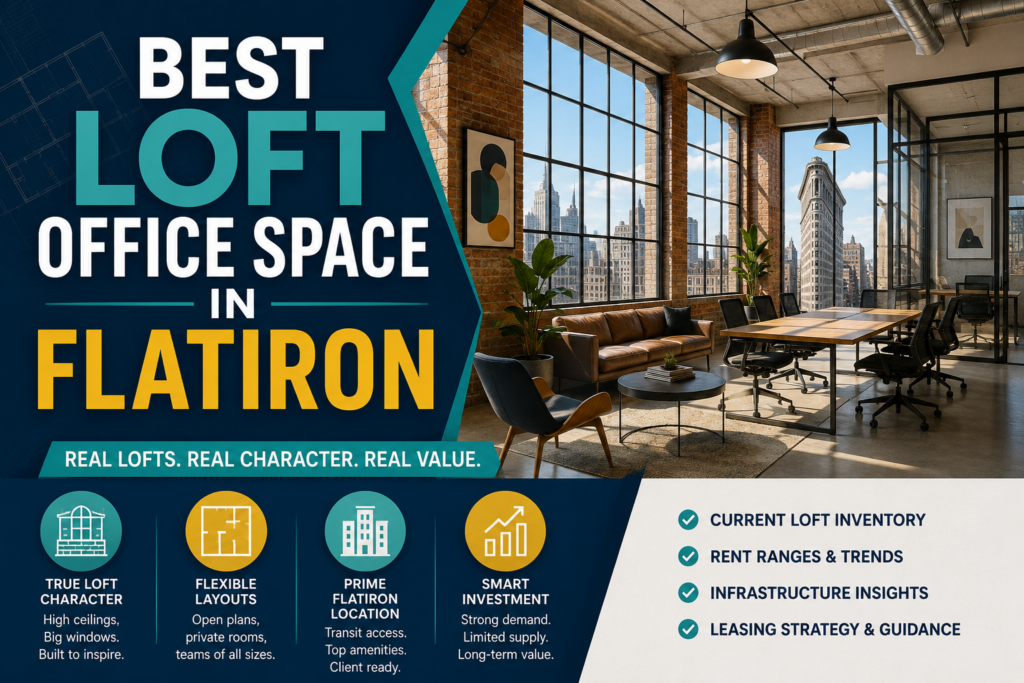
The short answer starts here. The best Flatiron loft office is the one that gives you character without operational compromise. That usually means higher ceilings, large operable windows, wood or polished concrete floors, strong natural light, and an efficient open plan. Yet looks alone do not make a great office. The best lofts also deliver quiet HVAC zones, enough electrical capacity, real fiber access, conference rooms that sit where people will use them, private restrooms when possible, a pantry that feels central, and elevators that do not slow down everyday use. In Flatiron, the winning spaces tend to sit on Fifth Avenue, Broadway, Park Avenue South, and the West 18th through West 24th Street band, where prewar loft stock still defines the neighborhood’s office identity.
What counts as a real loft here? In Flatiron, a real loft office usually lives in a prewar commercial building with deeper floor plates, stronger window lines, and more architectural texture than a standard tower floor. You will often see exposed structure, finished wood floors, open ceilings, oversized windows, keyed elevator identity, or full-floor presence. Some buildings deliver a classic rawer version of that experience. Others give you a repositioned version with cleaner lobbies, better systems, and more polished common areas. Both can work. The best choice depends on whether your priority is image, budget, speed, or infrastructure.
Why Flatiron still leads for loft product. The neighborhood sits in the strongest part of Midtown South for teams that value creative layout, fast transit, and a true mixed-use workday. Market reports show Midtown South asking rents at roughly $81 to $88 per square foot in 2026, depending on source and quarter, while Flatiron and Union Square availability has remained tighter than broader district averages. That matters because space quality rises when owners can lease good floors quickly. It also matters because tighter submarkets reward tenants who know exactly what they need before they tour. Put simply, Flatiron remains active because tenants still want authentic loft inventory in a central location with real amenities outside the building.
What loft space costs today. No single number tells the story. Current listing and market sources show a wide band. Portal data for currently listed space places typical Flatiron rents around the upper $50s to upper $80s per square foot, while broader Flatiron and Union Square market averages sit higher. Smaller value suites on side streets can still price materially below the neighborhood headline. Premium full floors, park-adjacent space, and highly improved loft product climb well above the average. Therefore, the right way to think about price is not “What does Flatiron cost?” but “What does this level of finish, light, identity, and infrastructure cost on this block?” That question leads to a much better search.
Current size bands are practical, not theoretical. Boutique lofts in this submarket still show up around 1,000 to 3,000 square feet. Midsize direct lofts and polished prebuilts often land around 4,000 to 7,500 square feet. Full-floor options commonly start around 5,000 square feet and can move beyond 10,000 square feet when the building supports it. Larger blocks exist, but they are not the everyday norm for core loft inventory. That is why Flatiron stays so attractive to agencies, design teams, software groups, advisory firms, and growing companies that want something better than a commodity office without taking a massive headquarters floor.
The best blocks are not all the same. Fifth Avenue and Broadway usually give you the strongest brand-forward loft identity. Park Avenue South trends more polished and more expensive. West 18th through West 24th Street often gives you the most natural-feeling loft layouts, full-floor presence, and value flexibility. That distinction matters. Teams that want a finished, client-facing environment may lean east or toward major avenues. Firms that care more about authentic loft proportions and stronger value often do well on the side streets. Either way, Flatiron rewards careful block-by-block shopping more than broad neighborhood averages.
If your team wants to see the range inside the neighborhood, start with our broader Flatiron office space overview and then compare it against our more specific best buildings for office space in Flatiron guide. Those two pages help frame the difference between a loft search and a general district search.
What makes a loft office in Flatiron worth the rent
The best lofts solve five problems at once. First, they give your team a better daily environment. Second, they create a stronger first impression for clients and hires. Third, they support hybrid work with useful collaboration space. Fourth, they reduce build-out waste by starting with good bones. Fifth, they keep you in a part of Manhattan where employees can actually enjoy the office day. Flatiron does all of that when the floor is right. It fails at all of that when a tenant picks a “pretty” loft with weak air, poor wiring, bad acoustics, or a layout that forces everyone into one long bullpen.
Light and window line. Great loft offices feel bigger than their square footage. Long perimeter exposure, tall windows, and decent ceiling height change the room immediately. They improve morale, support benching, and make even smaller suites feel open. By contrast, a deep floor with weak perimeter access can look good in photos yet feel flat at noon. When you tour, stand away from the glass and ask yourself whether the middle of the floor still feels alive. If not, the space may underperform once desks, storage, and meeting rooms go in.
Layout reality. Tenants often say they want “open loft space,” but that phrase hides major differences. One open plan may comfortably fit 24 desks, two meeting rooms, one board room, two phone rooms, and a generous pantry. Another may feel chopped up by columns, awkward entrances, odd core placement, or dead zones that waste usable square footage. Good loft product usually handles mixed work styles well. It gives you an open center, perimeter meetings or offices, and a social spine around the pantry or lounge. If the floor cannot do that cleanly, it will start to fight your headcount plan.
HVAC and comfort. This is where many “beautiful” lofts break down. Older buildings can carry charm and still struggle with cooling, after-hours access to air, uneven temperature zones, or dated controls. Ask whether the unit has tenant-controlled HVAC, how many zones exist, what after-hours air costs, and whether the current build-out already solved warm interior pockets. Tenants rarely regret asking these questions early. They often regret skipping them. The best Flatiron loft is not merely atmospheric. It also works on the hottest day in July.
Power, fiber, and cabling. Loft users now need stronger infrastructure than the neighborhood required twenty years ago. A compelling space should support modern internet redundancy, clean cabling paths, and enough power for dense workstation use, conference technology, and ongoing equipment changes. That does not mean every team needs data-center muscle. It does mean your office should not depend on awkward patchwork fixes after move-in. Fast-growing companies, media teams, design groups, and advisory firms all benefit from buildings that already know how to carry modern bandwidth through older bones.
Identity and client perception. Loft space still wins because it feels specific. A well-run Flatiron loft can project energy without feeling temporary. It can feel polished without becoming generic. That is why so many tenants prefer it over a boxy standard floor. They are not paying only for style. They are paying for the way the office supports hiring, client meetings, brand culture, and employee attendance. A great loft makes the commute feel justified. A mediocre one just makes the rent feel high.
If you want live examples across several size bands, compare a 2,500 square foot furnished loft in Flatiron, a 4,125 square foot furnished office on West 20th Street, a 5,377 square foot full-floor loft on West 18th Street, and a 9,979 square foot full-floor office on West 17th Street. Those examples show how dramatically layout, finish, and identity can change from one loft to the next, even within the same neighborhood.
How to choose the right loft without overpaying
Start with the decision that many tenants skip: Do you need speed, control, or flexibility? That answer determines the right leasing structure before you ever select a floor.
A direct lease works best when you want the strongest control, a longer term, and the option to tailor layout over time. This path fits companies that know their headcount direction and want stable occupancy. In Flatiron, many of the best authentic loft opportunities still sit in this lane. Direct space also tends to make the most sense if your company wants identity, signage presence, or a customized client experience. When the lease term matches your growth plan, direct space is usually the strongest long view.
A sublease works best when speed matters more than customization. This route often gives tenants furniture, wiring, existing conference rooms, and a shorter remaining term. Those advantages can translate into a faster move and a lower all-in cost. Yet subleases also require discipline. Make sure the inherited layout matches your plan, the term is long enough to matter, and the space does not force you into someone else’s workflow. A good sublease can be a bargain. A mismatched one becomes an expensive compromise.
A managed or flexible suite solves a different problem. These results appear because some searchers want short commitments, smaller rooms, and immediate occupancy. That can make sense for tiny teams, swing space, or project-based occupancy. Still, it is not the same product as a true leased loft office. If your search is really for the best loft office space in Flatiron, flexible suites belong on the fringe of the comparison set, not at the center of it. They answer the need for speed. They do not replace the value of a real loft lease with full brand control.
Prebuilt or raw? A polished prebuilt loft wins when timing matters and the build-out already reflects how your team works. You get faster occupancy, fewer surprises, and easier budgeting. A raw or lightly built loft wins when your workflow is specific, your brand identity matters deeply, or the economics justify a custom plan. Neither option is automatically better. The smarter move depends on schedule, term length, cash outlay, and whether the existing build actually saves you money. Too many tenants assume “move-in ready” means “good.” Sometimes it only means “finished.”
Loft office or traditional tower floor? A loft usually wins on identity, natural light, collaboration, and memorability. A traditional floor often wins on standardized systems, denser perimeter office planning, and simpler back-of-house operations. Flatiron is strongest when your team values openness, culture, and flexible layout rather than a fully standardized tower environment. Creative firms, product teams, media groups, design studios, consulting teams, and modern professional services users often do well here. Organizations with highly rigid room counts or unusual mechanical demands may need a more conventional building type.
What amenities actually matter in a loft. Focus on the ones that change daily use. That list starts with attended access, good elevators, strong HVAC, private or clean shared restrooms, a useful pantry, secure fiber access, and enough meeting space. After that, look at freight timing, package handling, bike storage, showers, and outdoor space if your team values them. Ignore the fluff. In this product type, operational basics matter more than glossy marketing language. The best office is the one that performs every day, not the one that sounds best in a brochure.
Where many tenants misread the market. They assume all of Flatiron now trades at one premium rate. It does not. Current sources show a split market. Certain higher-profile corridors and polished assets lease at premium levels. Meanwhile, side-street loft stock can still offer a far better value. That gap is why touring the right inventory matters so much. A tenant who shops the neighborhood carefully can still find real loft character without paying the top of the market. The tenant who shops by headline alone usually over-tours and under-learns.
For smaller teams, our page on why Flatiron works for small businesses shows where the neighborhood still makes sense below the giant-floorplate level. For larger occupiers, a full-floor loft on West 21st Street or a furnished 5,370 square foot loft on West 20th Street helps illustrate how midsize and full-floor searching diverge in practice.
Tenant representation note
We represent tenants, not landlords. That lets us compare loft options across Flatiron, pressure-test the asking rent, and flag HVAC, wiring, layout, and concession issues before you commit. In most direct lease transactions, the landlord pays the brokerage commission, so tenants typically gain representation without adding a separate fee line to the deal.
If you want the best loft office space in Flatiron, start with clarity. Know your headcount, delivery preference, and must-have infrastructure before you tour. Then focus on the lofts that match those needs, not the ones that simply photograph well.
Fill out our 📋 online form or give us a call today 📞 212-967-2061 — let’s find the right options for your business.