Hudson Yards Offices Near the 7 Train
Hudson Yards Offices Near the 7 Train
We represent tenants, not landlords. That matters from the first call. Instead of steering you toward one address, we compare access, layouts, timing, and leverage so your team lands in the right office near the 7 train.
Hudson Yards works best when the commute works first. A polished lobby never fixes a bad arrival path. Teams that rely on the 7 train need more than a Hudson Yards address. They need the right kind of proximity, the right building entry, and the right backup access to Penn Station, buses, and the west side pedestrian network.
That is why this guide starts with access before rent, views, or amenities. Some offices sit right on top of the station. Others connect below grade. A few stand across the entrance. Several more still qualify as legitimate options, yet they feel different during rain, rush hour, or winter wind. The right answer depends on where your staff starts, how often clients visit, and whether your lease needs a prebuilt suite, a furnished sublet, a full floor, or a true headquarters block.
Why Near the 7 Means More Than One Thing
Most tenants use this phrase in three different ways. Some want a literal station connection. Others want any office with a fast walk to the train. Another group wants the simplest regional commute, which means the 7 train and Penn Station both matter.
That distinction changes the shortlist. A station-connected office helps east-west subway riders most. By contrast, a Penn-adjacent path may matter more for New Jersey, Long Island, or Amtrak commuters. Meanwhile, smaller teams often search this phrase because they want the neighborhood, yet they do not need a trophy-scale floorplate. In practice, one query covers geography, commute design, and product type at the same time.
For tenants, the cleanest way to make sense of Hudson Yards is simple. First, sort offices by access tier. Next, match the building to your labor shed. Then compare layouts, rent structure, and term. That order protects you from paying a premium for the wrong kind of convenience.
What Counts as True 7 Train Access in Hudson Yards
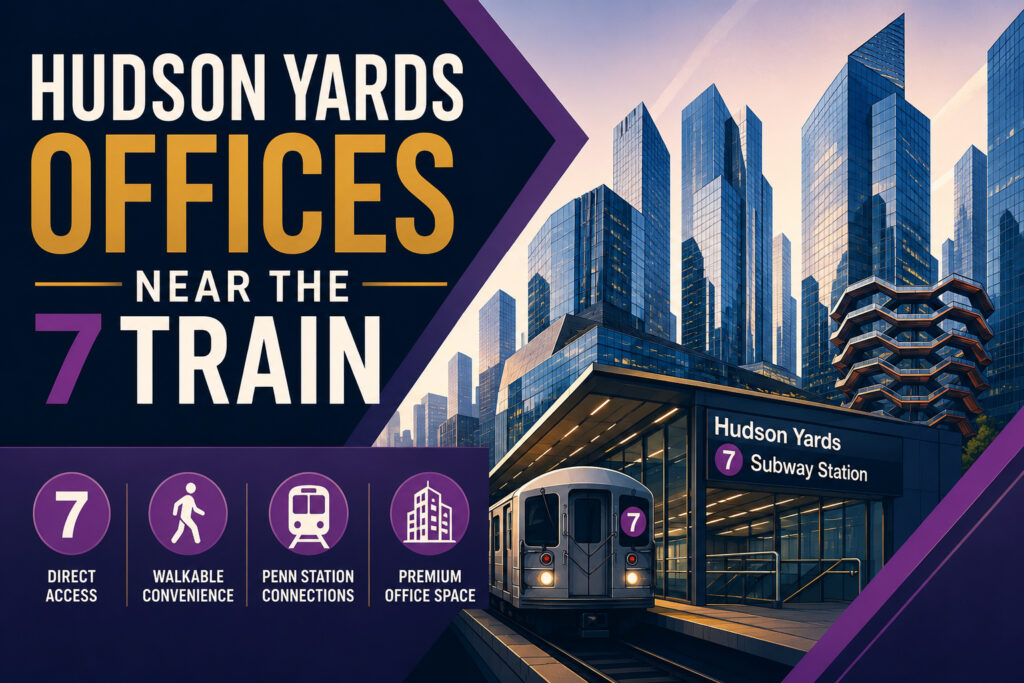
The 7 train terminates at 34th Street–Hudson Yards. It gives direct service from Times Square, Grand Central, and Queens. Official neighborhood guidance also places Penn Station two blocks east, notes nearby M34-SBS, M12, and M11 service, and highlights PATH to 33rd Street as another useful New Jersey route. Travel times published for Hudson Yards put the ride at about six minutes from Times Square, about eight minutes from Grand Central, and roughly twelve to fifteen minutes from Court Square.
Inside Hudson Yards, “near the 7 train” breaks into four tenant-relevant tiers.
Direct station access means the building ties into the station in a literal way. One full-block office tower provides direct access to the No. 7 station and entrances on Hudson Boulevard, Tenth Avenue, and both 33rd and 34th Streets. That is as strong as this category gets.
Direct underground connection means the office does not open straight into the platform area, yet it links below grade in a way that still shortens the arrival. One supertall Hudson Yards tower at 33rd Street and Tenth Avenue fits that description. Its official building page calls out a direct underground connection to the No. 7 station.
Across the station entrance still performs well for many tenants. One park-front office tower sits just across from the No. 7 subway entrance. In everyday use, that can feel almost as convenient as a true connection, especially for firms that value a classic lobby arrival and still want station-front positioning.
Short-walk access remains valid, yet tenants should treat it as its own tier. One tower at West 30th Street and Tenth Avenue integrates with the High Line and the Public Square and Gardens. Another mixed-use building deeper in the campus sits about a two-to-three minute walk from the station and under ten minutes to Penn Station. Those are strong options, but they are not the same as direct station access. That difference matters on a daily commute.
A future office tower also belongs in the conversation. It sits adjacent to the No. 7 entrance and is fully integrated into the neighborhood amenities. Still, that solves a future occupancy need rather than an immediate one, since move-ins are anticipated in late 2028.
The practical takeaway is clear. If your team says “near the 7,” ask a sharper question next: Do you need direct access, a weather-protected arrival, station-front presence, or simply a quick walk with Penn as backup? Hudson Yards offers all four, but they are not interchangeable.
How the Commute Plays Out From Every Direction
For Queens and Midtown East commuters, the 7 train often drives the whole decision. Workers can ride straight in from Times Square, Grand Central, and the 7 line corridor without a transfer. That makes true station access, underground connection, or a very short walk the highest-value move for firms with a strong east-west employee map.
Metro-North users also fit that logic. They can arrive at Grand Central and transfer directly to the 7. Because the ride from Grand Central to Hudson Yards runs about eight minutes, many east side and Connecticut commuters still treat Hudson Yards as a highly workable office district when the building sits close to the station entrance.
New Jersey, Long Island, and intercity riders create a different pattern. Penn Station sits two blocks east of Hudson Yards. Hudson Yards also points to PATH riders using 33rd Street and then walking or taking one stop on the 7. In addition, the Moynihan Connector creates a direct pedestrian route from Moynihan Train Hall to Hudson Yards and the High Line. For those commuters, the best office may balance the 7 train with the Penn walk rather than prioritize the station alone.
Downtown and Brooklyn users usually reach the district through Penn Station lines first. That is why nearby A, C, E and 1, 2, 3 access still matters in this conversation. On paper, every Hudson Yards office looks west-side convenient. In real life, some addresses feel much better for a mixed commuter base because they sit within easy reach of both the 7 and Penn Station.
Local west-side commuters gain another option set. The High Line connects into Hudson Yards. The Hudson River Greenway runs beside it. Ferry service reaches the Midtown terminal at West 39th Street. Citi Bike docks also sit near West 34th Street, West 33rd Street, and West 30th Street. That gives many Hudson Yards offices a strong non-subway arrival profile, especially for hybrid teams.
Here is the tenant-forward rule. If most of your headcount rides the 7, buy the closest possible access tier. If your team spreads across New Jersey, Long Island, and Midtown East, prioritize the office that handles both the station and the Penn walk with the least friction.
Which Layouts Fit Different Tenant Needs
Hudson Yards near-station inventory skews large. That is not an accident. The district’s primary office towers were built for scale, dense occupancy, and major corporate floorplates. One official building page notes the ability to seat more than 500 people per floor. Another tower now under construction will serve as a major corporate headquarters and totals about 1.4 million square feet. Even the more boutique park-front option still carries about 1.3 million square feet. In short, true station-front Hudson Yards product serves larger users first.
Smaller teams should not read that as a dead end. Instead, they should chase the right product type. In Hudson Yards, that usually means a prebuilt suite, a furnished direct lease, a furnished sublet, a carved full-floor opportunity, or a mixed-use short-walk suite rather than a giant raw block. That is where current inventory becomes useful.
If you need a polished direct lease with minimal front-end delay, a current prebuilt suite near the station offers about 10,680 square feet. A current furnished direct lease in a direct-access tower offers about 11,907 square feet and is move-in ready. A current furnished station-area sublet with terrace access offers about 10,853 square feet.
For firms that want more room without jumping straight to a headquarters block, the district currently shows meaningful middle-market options. A current furnished Hudson Yards sublet near the High Line and the 7 offers about 20,222 square feet. Another current furnished sublet with larger team capacity offers about 23,324 square feet and cites capacity for roughly 133 people. These are useful for firms that need speed, image, and real scale, but not a multi-floor commitment.
Full-floor control remains available too. A current full-floor option near the station totals about 30,314 square feet and is built around a furnished headquarters-style installation. That works well for firms that need privacy, internal identity, and stronger client handling without taking excess square footage.
At the top end, Hudson Yards still delivers true headquarters inventory. A current headquarters block with immediate station access totals about 45,942 square feet across two floors and ties into major on-site amenity infrastructure. A current larger multi-floor rental in the district totals about 67,058 square feet. Those options matter for firms that need branding, scale, and long-term growth inside a commute-friendly west side address.
Budget still matters, of course. Hudson Yards commands premium pricing because the product is new, the floorplates are large, and the access package is unusually strong. Our broader neighborhood inventory notes current Hudson Yards office asking levels around $120 per square foot on average, while newer Hudson Yards premium content on our site puts trophy asking levels in the mid-$90s to mid-$150s depending on product, floor, and deal structure. That means tenants should compare face rent, concessions, term, and build-out cost together, not headline rent alone. For a deeper pricing breakdown, see our Hudson Yards office space cost page and our broader Hudson Yards sublease office space guide.
Common Questions About Offices Near the 7 Train
Is the 7 train the only reason to choose Hudson Yards?
No. The 7 is the headline route, but Penn Station, Moynihan, PATH access through 33rd Street, nearby crosstown and north-south buses, ferry access, bike routes, and the west side pedestrian network all widen the catchment. The best Hudson Yards office handles more than one commute path.
What does “near” really mean when I tour space?
Treat it as a physical test, not just a map label. Ask whether the building has direct station access, a below-grade connection, a station-front entrance, or a short outside walk. Then walk the route at rush hour. You will feel the difference immediately.
Does direct 7 access matter if my team mainly uses Penn Station?
Sometimes yes, but not always. Penn Station sits only a couple of blocks east. Therefore, many suburban commuter teams care more about the Penn walk plus modern West Side product than a literal station connection. When your staff mixes New Jersey, Long Island, and Midtown East origins, the best answer usually balances both.
Are furnished and prebuilt offices actually available in this area?
Yes. Current examples on our site include prebuilt and furnished options around 10,680 square feet, 10,853 square feet, 11,907 square feet, 20,222 square feet, and 23,324 square feet. That is why Hudson Yards can work for midsize tenants even though the district was built around larger institutional floorplates. Browse a current prebuilt Hudson Yards suite, a current furnished direct lease, and a current furnished sublet.
Can Hudson Yards still work for a full-floor or headquarters user?
Absolutely. Current examples on our site include a 30,314-square-foot full-floor option, a 45,942-square-foot headquarters block, and a 67,058-square-foot larger multi-floor opportunity. That is part of the district’s appeal. It can handle both a prestige move today and long-term growth tomorrow. See a current full-floor Hudson Yards option, a current headquarters block, and a larger multi-floor rental.
How accessible is the station?
The 34th Street–Hudson Yards station is elevator-equipped. It also uses long escalator runs because the platform sits deep below grade. Published design references place the platform about 125 feet below street level. For tenants with accessibility concerns, that makes elevator status and entry path especially important during tours.
Is parking part of the conversation here?
It can be. Official Hudson Yards guidance points to parking at West 30th Street locations and lists designated rideshare and taxi zones near the main development entries. Some current building inventory also references valet, garage, or dedicated parking components. That matters most for senior leadership, client visits, and teams with regular car service needs.
What if I want Hudson Yards quality but my budget or size points elsewhere?
Then compare the real commute, not the brand halo. Sometimes a short-walk Hudson Yards suite wins. In other cases, an edge address or a nearby Penn-adjacent option gives you a better rent profile with almost the same commute utility. If that is your situation, start with our Hudson Yards offices overview, our best Hudson Yards office buildings for tenants guide, and our Hudson Yards vs Manhattan West comparison.
If your goal is the smartest west side lease near the 7, keep the framework simple. Start with the access tier. Next, map the labor shed. Finally, compare layouts, timing, and economics. That sequence leads to better decisions than chasing the flashiest tower first.
When a team gets this choice right, the benefit shows up every morning. Arrival feels easier. Attendance gets less fragile. Client visits run smoother. Most of all, the office starts to support the business instead of asking the business to work around the commute.