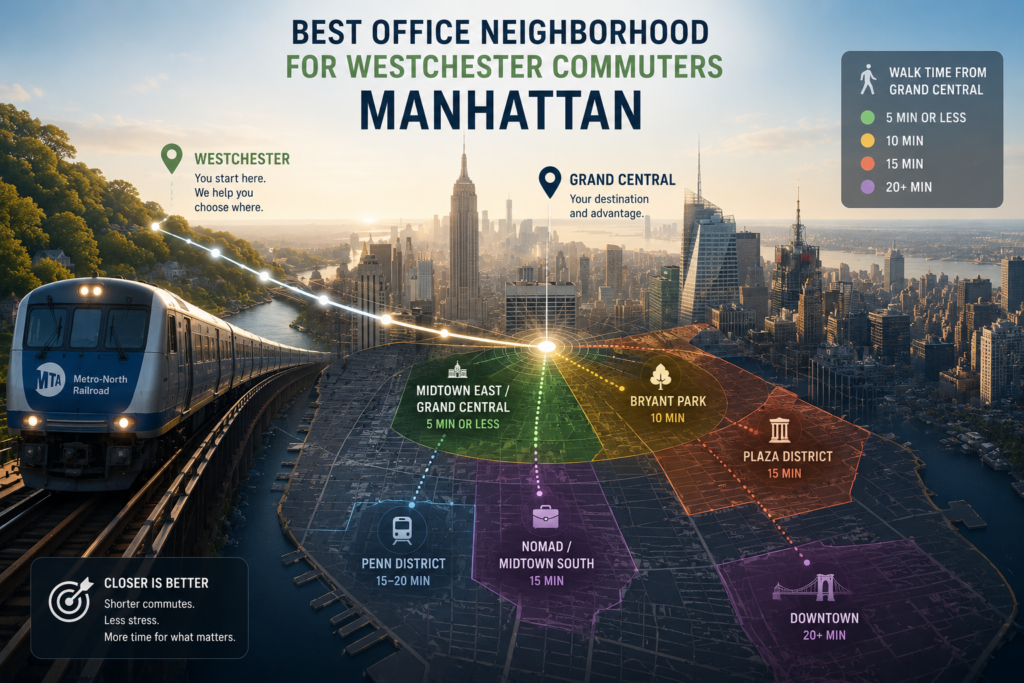
Best Office Neighborhood for Westchester Commuters Manhattan
The best tenant answer is simple: put the office where the train ride ends, or very close to it. For most Westchester-heavy teams, that points first to Grand Central and Midtown East, then to Bryant Park, then to select north Midtown options if brand, clients, or team mix justify the extra cost or extra walk.
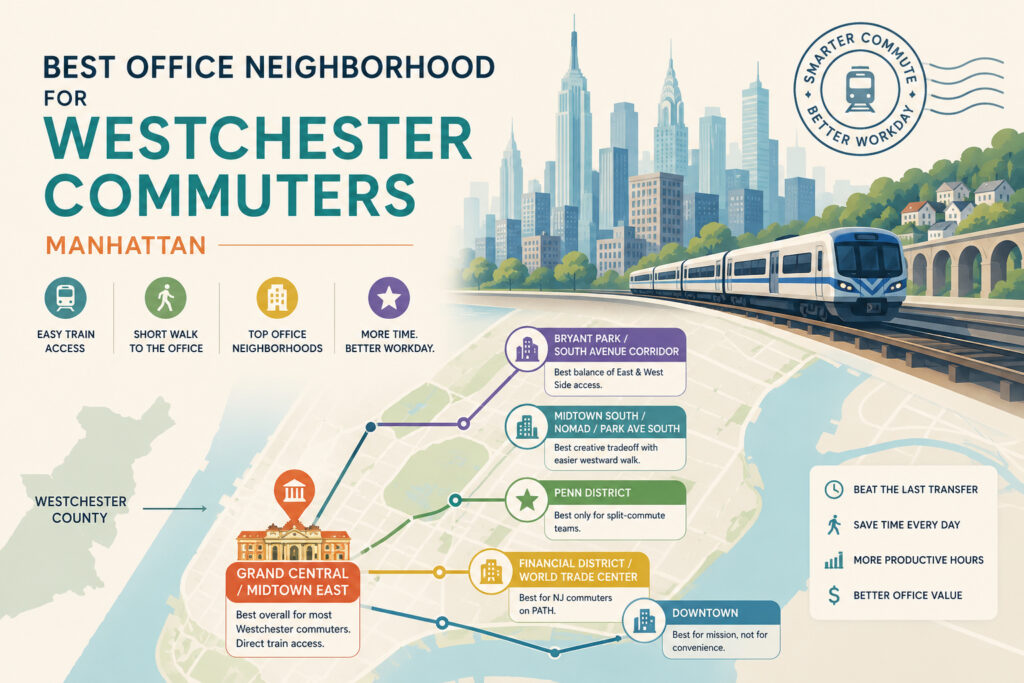
Why Grand Central usually wins
Westchester commuters on the Harlem, Hudson, and New Haven lines arrive at Grand Central Terminal today. From that same terminal, riders also connect directly to the 4, 5, 6, 7, and Shuttle lines. That setup makes the East Side the natural starting point for any office search built around Westchester convenience.
The terminal’s north-side circulation makes north Midtown easier than many older guides suggest. Grand Central North provides exits between 45th and 48th Streets, and a new accessible entrance opened at 45th Street and Madison Avenue in May 2026. As a result, the north half of Midtown East and parts of the Plaza core feel closer in practice than a simple street map suggests.
The real metric is not just train time. It is door-to-desk time. Current Westchester commuter guides stress that most riders should add roughly 20 to 35 minutes for the walk or drive to the station, parking, the platform buffer, and the last leg from Grand Central to the office. Once you accept that math, every avoidable transfer matters.
Guide-level commuter data and current rail schedules tell the same story. Southern Westchester stops can reach Grand Central in roughly the high-20s to mid-30s on strong peak runs, while larger hubs such as White Plains, Scarsdale, Yonkers, Tarrytown, and New Rochelle often land in a broad 30 to 45 minute band depending on the train pattern. That is exactly why a one-seat arrival should not end with a second forced commute across Manhattan.
Bryant Park becomes the runner-up because the 42nd Street corridor still works hard for you. The Grand Central and Times Square Shuttle connection stays free, the 42nd Street corridor has seen major circulation upgrades, and the terminal’s line mix keeps westward movement manageable when you truly need it. Still, the cleanest commute normally remains the office district closest to Grand Central itself.
Best Manhattan neighborhoods for Westchester commuters
| Neighborhood | Why it works | Q1 2026 asking rent | Q1 2026 availability |
|---|---|---|---|
| Grand Central / Midtown East | Best pure commute efficiency | $75.56/SF | 12.0% |
| Bryant Park / Sixth Avenue corridor | Best balance of East and West side access | $100.90/SF | 12.1% |
| Plaza District | Best premium East Side choice | $107.38/SF | 12.5% |
| Midtown South / NoMad / Park Avenue South | Best creative-value tradeoff | $88.32/SF | 16.9% |
| Penn District | Best only for split-commute teams | $74.27/SF | |
| Downtown | Best for mission, not for convenience | $62.81/SF | 19.0% |
For apples-to-apples comparison, the rent and availability figures above use one Q1 2026 submarket set. Penn screens much pricier in some other reports because newer west-side trophy stock heavily influences that district’s numbers.
Grand Central / Midtown East is the best overall choice. This district preserves the one-seat arrival, gives the deepest true commute advantage, and still offers a broad rent band. Current local guidance shows many direct options in the roughly $55 to $90 per square foot range, with discounted subleases dropping into the low $30s to mid $40s and higher-prestige direct product rising above $100. That flexibility matters for law, finance, consulting, recruiting, advisory, and other client-facing groups that care about both image and commute reliability.
Bryant Park / Sixth Avenue is the best compromise choice. Choose it when you want Midtown polish, easier westward movement, and a stronger balance for a team that also pulls from Queens, Brooklyn, or the west side. It is not the fastest answer for a pure Westchester group, but it is the cleanest hybrid answer. That logic gets even stronger because current live inventory includes furnished and plug-and-play Bryant Park product, including a 13,208 square foot option at $66 per square foot and larger full-floor installations with immediate possession.
Plaza District is the premium East Side upgrade. It keeps you on the right half of Midtown for Westchester, but it asks for a much richer budget. Q1 2026 asking rent there averaged $107.38 per square foot, and local Plaza pricing guidance still places trophy product in the $150 to $200-plus band, with Class A non-trophy space often in the $110 to $140 range and boutique prewar suites often in the $95 to $120 range. Pick this district when clients visit often, brand perception matters, and your budget can absorb the premium without harming the rest of the occupancy plan.
Midtown South, NoMad, and Park Avenue South are the value-and-culture alternatives. These neighborhoods work when you want more creative layouts, more loft product, or a softer image than a formal East Side tower. They do not beat Grand Central on pure commute math, yet they often beat it on vibe, layout character, and sublease choice. Current live examples include a 1,500 square foot Flatiron direct lease, a 5,000 square foot furnished NoMad office, and a healthy short-term market where many prebuilt or furnished suites cluster in the six- to twenty-four-month range.
Penn District is now a real office destination, but it is not the best pure Westchester destination. The district captured more than 3.5 million square feet of relocations from 2023 through 2025 and has become one of Manhattan’s most dynamic office zones. That said, Westchester commuters still arrive first at Grand Central today, not Penn, so the district adds a cross-town leg unless your broader labor pool or client pattern gains enough from Penn to offset that penalty. In other words, Penn can win, but only when the team is truly split.
Downtown is the mission-driven exception. It offers the lightest headline rent among the major business cores in this comparison, and it also carries materially higher availability. That can help cost-sensitive tenants. Yet Downtown remains a transfer market from Grand Central, so it rarely wins on speed or simplicity for a Westchester-led office search. Choose it when your work must sit Downtown, not when you simply want the best commute outcome.
Current pricing and live office options
Neighborhood labels alone will not save you money. Product type matters just as much. In the Grand Central area, current live examples already show that spread clearly, from a $25 per square foot sublease in one building to $72 direct space in that same corridor, to $95 space in another East Side tower, to $105 to $115 direct product in higher-end stock. Tenants who compare only neighborhoods, and not deal structure, leave money on the table.
If commute speed matters most, start with Grand Central office space for rent, Grand Central station office space for rent, and flexible office spaces for rent in Grand Central Station. Those pages show the right product spread for a Westchester-heavy tenant, from conventional leases to furnished, serviced, prebuilt, and sublease options. They also confirm that flexible inventory remains unusually deep near the terminal, with more than 390 private-office options around the district and average private-office pricing around $755 per desk monthly.
If you want the strongest small-team play, use small offices near Grand Central as a starting point. Current examples include private suites from roughly 1,040 to 1,649 square feet in the Grand Central and adjacent Bryant Park orbit, with realistic smaller-suite pricing often running from the mid-$40s to the low-$70s per square foot, though some value pockets trend lower and more image-driven product trends higher. That is a meaningful advantage for boutique firms that want a real office instead of a serviced suite.
If you want a short westward shift without a full Penn compromise, look at Bryant Park office sublet rental, furnished Bryant Park office, and Bryant Park full floor sublet. Current live examples include a 2,902 square foot furnished sublease, a 13,208 square foot plug-and-play office at $66 per square foot, and a larger high-end installation with immediate possession and extensive meeting space. That gives Bryant Park unusual range for companies that want a more central Midtown feel.
If brand image drives the brief, move next to Plaza District offices, current Plaza District pricing, and full floor Plaza District office. That set gives you the right tenant progression, from neighborhood overview, to pricing realism, to an actual larger-floor example. The tradeoff is clear: you gain polish and prestige, but you usually pay materially more than Grand Central.
If you want creative value and faster occupancy, review small Flatiron district office space, furnished Nomad district office, and move-in-ready offices at the heart of Manhattan. Current Midtown South guidance shows strong demand, but it also shows a still-meaningful availability cushion. That combination helps tenants who want character, shorter-term flexibility, or prebuilt product without paying Plaza District numbers.
If Penn still belongs on the tour list, start with Penn Station office space for lease and furnished Penn Plaza office space. Current examples include a 7,675 square foot direct lease and a furnished Penn Plaza option with immediate occupancy and a term running into 2027. Use these only when the larger workforce mix truly supports Penn, because the district solves a different labor map than a purely Westchester-centered one.
How to choose the right neighborhood
Start with a simple formula: home-to-station, platform buffer, train ride, terminal exit, then office walk. Most tenants spend too much time debating the middle of that chain and too little time shrinking the last two pieces. For Westchester commuters, the cleanest savings usually come from shortening the terminal exit and office walk, not from chasing a neighborhood with a slightly cheaper face rent.
If more than half of your daily staff rides the Harlem, Hudson, or New Haven lines, stay at Grand Central or within a very short East Side walk of it. That is the cleanest answer for recruiting, retention, and daily ease. The district also gives you real inventory choice, which matters because good commute logic is only useful when the product mix can still serve your budget and size requirement.
If Westchester matters, but your broader workforce also draws heavily from Brooklyn, Queens, or a west-side subway funnel, Bryant Park becomes the balancing play. It stays central, supports a wider train-and-subway mix, and still avoids the full cross-town penalty of Penn for most Westchester staff. Many mixed-commute tenants land here for exactly that reason.
If your office functions like a client stage set, the Plaza District deserves the premium discussion. Do not choose it just because it sounds important. Choose it when in-person client perception, high-end building quality, and a polished north Midtown address will materially help the business enough to justify the rent gap. Otherwise, Grand Central often gives a better prestige-to-value ratio.
If speed to occupancy matters, put furnished, prebuilt, and sublease product at the top of the search. Manhattan’s short-term and move-in-ready market remains active, especially in Midtown East, Midtown South, Flatiron, and NoMad. That route can cut build-out time, preserve cash, and get your team operating faster.
If budget dominates the decision, do not assume the west side is cheaper. Current submarket data shows Grand Central in the mid-$70s, Midtown South in the high-$80s, Bryant Park’s Sixth Avenue proxy around $100.90, and the Plaza District above $107. Meanwhile, some Grand Central and adjacent subleases run far below those averages, which is why a tenant should compare direct, sublease, and furnished options side by side before ruling any district out.
For team sizing, conventional planning around 150 square feet per person still works for many users. On current Grand Central local pricing, that can put a 10-person tenant near 1,500 square feet and a 20-person tenant near 3,000 square feet before you refine the layout for conference needs, collaboration, client hosting, or hybrid attendance. That planning step matters because the right neighborhood choice and the right space size should move together.
A practical tour stack works best. See one direct prebuilt in Grand Central. Add one furnished or plug-and-play Bryant Park option. Finish with one value alternative in NoMad, Murray Hill, or a Grand Central sublease. That side-by-side sequence usually clarifies the right answer faster than touring five similar spaces in the same district.
Questions tenants ask before they sign
Is Grand Central always the best answer?
Not always. It is the best answer for most Westchester-heavy teams because that is where the commuter train ride ends. Bryant Park can beat it for a mixed labor map, and Penn can beat it only when the workforce split is real enough to outweigh the cross-town leg for Westchester riders.
Can Bryant Park beat Grand Central?
Yes, in the right brief. Bryant Park wins when you want a more central Midtown position, stronger westward reach, and a broader subway balance, while still keeping the East Side commute manageable. It is the best compromise, not the fastest pure commute play.
Is Penn now a serious contender?
Yes, but for a different reason. Penn has become one of Manhattan’s strongest relocation stories, with heavy tenant migration and modernized stock, yet Westchester riders still arrive first at Grand Central today. That means Penn is a workforce-balance decision, not a pure Westchester-convenience decision.
Is Downtown worth the cheaper rent?
Sometimes. Downtown offers a lighter headline rent and more availability than the Midtown districts in this comparison. Even so, it stays a transfer market from Grand Central, so it usually loses on simplicity and speed unless the business itself needs a Downtown address.
Can a small team still lease privately near Grand Central?
Absolutely. Current examples around the Grand Central orbit include private suites from roughly 1,040 to 1,649 square feet, and the broader small-suite inventory still runs deep enough to support boutique firms that want their own front door instead of a shared flex product.
Are short-term deals realistic right now?
Yes. Current Manhattan guidance shows prebuilt and furnished suites with one- to two-year remaining terms, plus a meaningful pool of plug-and-play space in Midtown East, Midtown South, Flatiron, and NoMad. That structure fits swing offices, project teams, fast relocations, and tenants who want optionality.
What is the best value neighborhood for a Westchester commuter?
Grand Central often wins that title because it combines the strongest commute logic with a wide pricing band. Value-oriented subleases can sit far below trophy direct product, and East-leaning alternatives in Murray Hill, Park Avenue South, and NoMad can also make sense when you accept a slightly longer last mile.
What should a tenant tour first?
Tour Grand Central first. Add Bryant Park second. Use NoMad, Murray Hill, or Penn only as comparison cases that test whether culture, workforce mix, or pricing really improves the answer. For most Westchester-led searches, the winner becomes obvious once those three commute patterns sit side by side.
The tenant-forward conclusion is clear. For most teams coming in from Westchester, Grand Central and Midtown East remain the best office neighborhood in Manhattan. Bryant Park is the strongest compromise, Plaza is the premium upgrade, Midtown South is the culture-and-value alternative, and Penn or Downtown only make sense when the business case is bigger than the commute case.
Fill out our 📋 online form or give us a call today 📞 212-967-2061 — let’s find the right office for your business.