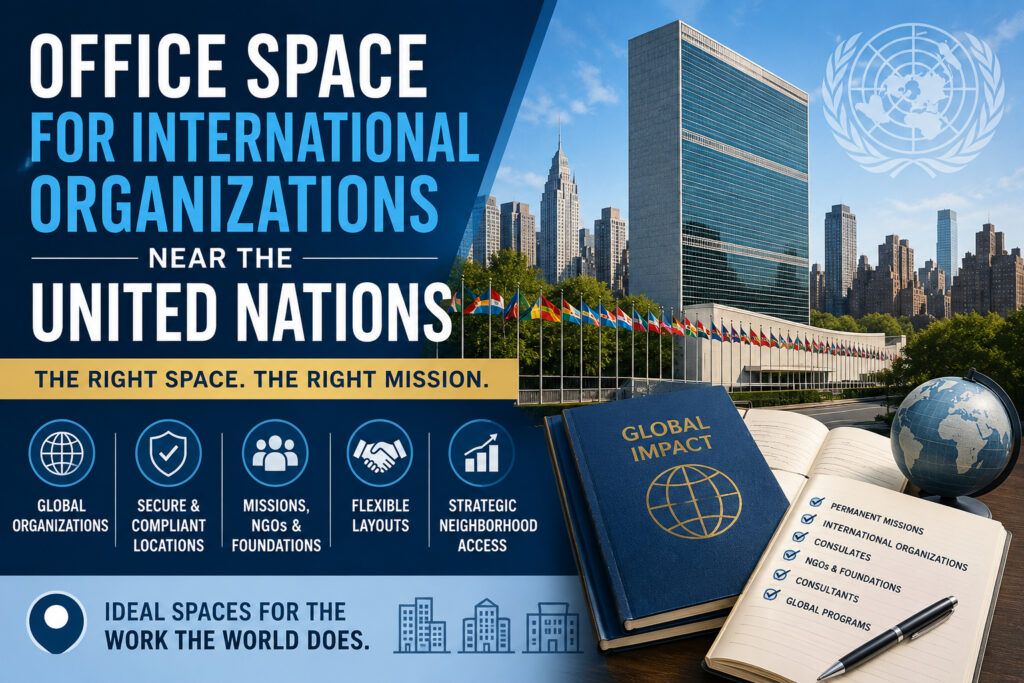
Office Space for International Organizations Near the United Nations
Office space near the United Nations serves many different types of global organizations. Each tenant brings distinct security, meeting, ownership, staffing, and budgeting requirements.
The strongest location may sit beside the campus, several blocks west, or near Grand Central. Your operating model should determine that choice.
This guide explains the available locations, office types, layouts, costs, approvals, and leasing decisions. It covers every common interpretation of this specialized office requirement.
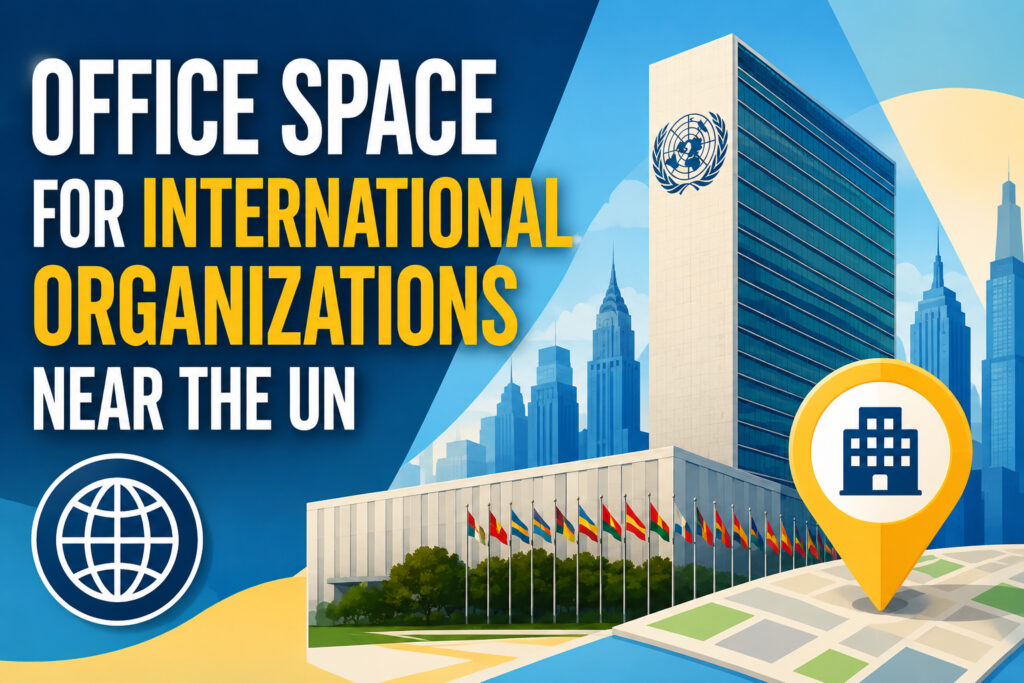
What Office Space for International Organizations Near the United Nations Means
The phrase describes commercial workspace serving organizations with international mandates, relationships, programs, or constituencies.
However, it does not describe one uniform tenant category. A permanent mission operates differently from an NGO, foundation, consulate, association, or intergovernmental office.
That distinction affects the entire real estate search.
A permanent mission represents a national government in matters involving the United Nations. It may require formal reception areas, delegation offices, secure records, and controlled visitor circulation.
A consular office may support citizens, visas, trade, cultural affairs, or diplomatic administration. Its visitors often need clearer public access than mission staff require.
An intergovernmental organization may coordinate programs among several member states. Its workspace may prioritize conferences, interpretation, policy teams, and visiting delegations.
A nongovernmental organization may advocate, conduct research, manage programs, or participate in accredited meetings. It usually receives no automatic diplomatic status.
A foundation or international association may need a global address without daily campus access. Such tenants often value affordability, transit, and meeting quality.
A liaison or project office may support temporary negotiations, assemblies, working groups, or grant programs. Its ideal lease could last months rather than years.
| Organization type | Primary office function | Common real estate priorities |
|---|---|---|
| Permanent mission | Government representation | Security, proximity, formal reception, privacy |
| Observer office | Representation without full membership | Meeting access, delegation support, flexible rooms |
| Consular office | Public and administrative services | Visitor flow, document security, accessible entrance |
| Intergovernmental organization | Multinational program delivery | Conference capacity, technology, growth flexibility |
| NGO or advocacy group | Policy, research, outreach | Cost control, meeting rooms, public transportation |
| Foundation | Grants, programs, governance | Boardroom, private offices, institutional image |
| Trade or cultural office | Economic and cultural representation | Event space, reception, storage, flexible use |
| Temporary delegation | Short-term meetings and coordination | Furnished space, immediate occupancy, short commitment |
A nearby commercial office does not become part of the United Nations campus. The lease also does not provide credentials, security clearance, or special access.
Instead, proximity reduces travel time between the workplace, meetings, hotels, and related offices. It also supports rapid schedule changes during busy diplomatic periods.
The campus spans the eastern edge of Midtown around First Avenue. Visitor and credentialed entrances follow separate access procedures, which can change during holidays or heightened security.
Tenant takeaway: Define your organization before defining your office. Legal status, visitor volume, and meeting patterns matter more than a prestigious address alone.
Where International Organizations Should Look Near the United Nations
Most tenants begin with Turtle Bay and the eastern portion of Midtown East. Yet several nearby micro-locations serve very different operating needs.
First Avenue and the United Nations Plaza frontage
This area offers the shortest walk to campus entrances. It suits organizations with frequent meetings, daily delegate movement, or senior officials who value proximity.
Many offices here provide East River views and direct diplomatic context. However, major events can create vehicle restrictions, checkpoints, demonstrations, and delivery delays.
The closest address does not always produce the smoothest daily operation. Security zones may complicate car service, freight access, and visitor arrivals during major sessions.
Second Avenue and the diplomatic corridor
Second Avenue creates a practical balance between proximity and accessibility. Staff can reach the campus quickly without occupying the most security-sensitive frontage.
This corridor contains office buildings, commercial condominiums, professional suites, and smaller floor plates. Those choices support missions, NGOs, consular teams, and regional offices.
Organizations seeking ownership should examine this area carefully. A Second Avenue office condominium can provide long-term control near the campus.
Third Avenue and the Grand Central edge
Third Avenue usually offers larger buildings, stronger transit access, and deeper office inventory. It also provides more restaurants, hotels, services, and meeting venues.
Employees commuting from Westchester, Connecticut, Long Island, or northern Manhattan may prefer this location. The added walk can improve recruitment and retention.
A recently marketed Turtle Bay furnished office illustrates this location’s appeal. The 7,367-square-foot suite combines furniture, meeting rooms, workstations, and immediate occupancy.
Smaller organizations may consider a turnkey Third Avenue office. Larger teams can evaluate a full-floor Third Avenue opportunity.
Tudor City and the East Forties
Tudor City and nearby side streets can provide quieter surroundings and smaller office options. These blocks often suit nonprofits, consultants, media teams, and project offices.
Some buildings offer fewer amenities than major avenue towers. Nevertheless, a lower occupancy cost may outweigh that limitation.
Comparing the main location choices
| Location | Campus access | Transit access | Typical advantage | Primary concern |
|---|---|---|---|---|
| First Avenue frontage | Closest | Moderate | Fast delegate movement | Event-related restrictions |
| Second Avenue | Very close | Moderate | Diplomatic concentration | Limited subway proximity |
| Third Avenue | Close | Strong | Inventory and commuter access | Longer campus walk |
| Grand Central edge | Moderate | Excellent | Regional transportation | Higher premium-building rents |
| Tudor City and side streets | Close | Moderate | Quiet, smaller spaces | Variable building quality |
Grand Central connects Midtown East with regional rail and several subway services. That network makes the western edge attractive for organizations with distributed workforces.
Conversely, First and Second Avenue offices rely more heavily on walking, buses, and vehicle access. Teams should test actual employee commutes before choosing a building.
Annual high-level meetings require additional planning. During the 2025 General Assembly period, authorities closed sections of First Avenue and several connecting streets. Midtown traffic also fell below four miles per hour during the busiest period.
Location rule: Choose the closest office for frequent campus access. Choose Third Avenue when workforce access carries equal importance.
Choosing the Right Office and Occupancy Structure
International organizations can rent, sublease, license, manage, or purchase their workspace. Each structure creates different rights, risks, and costs.
Direct lease
A direct lease creates a relationship between the organization and building ownership. Most established tenants choose this structure for long-term occupancy.
Direct leases offer the strongest control over construction, branding, security, and renewal rights. They also require greater financial disclosure and longer negotiations.
Landlords usually reserve substantial construction spending for longer commitments. Therefore, a ten-year term may produce better improvements than a three-year term.
A direct lease works best when the organization expects stable funding and staffing. It also suits tenants that need custom security or specialized meeting facilities.
Furnished sublease
A sublease can reduce move-in time and preserve flexibility. Many subleases include furniture, cabling, conference rooms, and existing workstations.
However, the prime lease controls the subtenant’s rights. A subtenant should review consent requirements, restoration duties, remaining term, and default provisions.
Shorter terms can support grant-funded programs or temporary delegations. Yet a short commitment may provide no renewal path.
Review the differences between a sublease and direct lease before comparing rent alone.
Prebuilt or turnkey direct space
A prebuilt suite combines direct tenancy with faster occupancy. The landlord completes a standard layout before securing a tenant.
These spaces often include private offices, conference rooms, pantry areas, and open workstations. Modifications may remain possible during negotiations.
Turnkey direct space suits organizations that need speed without sublease risk. It also reduces uncertainty around construction pricing.
Managed private office
A managed private office can bridge a temporary requirement. The arrangement may bundle furniture, internet, cleaning, reception, and meeting access.
This format works for small liaison teams, visiting delegations, and early-stage programs. It rarely provides the control required for a major mission.
Before signing, review privacy, signage, guest policies, data security, and after-hours access. Shared facilities can conflict with confidential operations.
Office condominium ownership
Office condominiums provide a rare alternative to leasing. The buyer owns a defined commercial unit and shares common building expenses.
Ownership may stabilize long-term occupancy costs. It can also protect an organization from relocation after lease expiration.
However, buyers must evaluate financing, transfer approval, common charges, capital assessments, resale liquidity, and renovation rights.
Foreign government property may qualify for specific real estate tax treatment. Eligibility depends on ownership, authorized use, reciprocity, and federal approval.
Federal guidance generally covers qualifying property that a foreign government owns and occupies for approved mission purposes. It does not create a blanket exemption for every international organization.
Temporary conference or event space
Temporary meeting space can support assembly weeks, negotiations, receptions, or visiting teams. It should supplement a permanent office rather than replace one.
Organizations should confirm guest capacity, security screening, audiovisual systems, catering rules, and evening access. Building management may restrict political events or demonstrations.
| Occupancy structure | Best use | Main advantage | Main risk |
|---|---|---|---|
| Direct lease | Stable long-term office | Control and renewal rights | Longer commitment |
| Furnished sublease | Immediate short-term need | Speed and lower setup costs | Dependence on prime lease |
| Prebuilt direct suite | Fast stable occupancy | Reduced construction burden | Limited customization |
| Managed private office | Small temporary team | Bundled services | Privacy and control |
| Office condominium | Permanent institutional presence | Ownership and cost control | Capital and resale exposure |
| Event or meeting license | Temporary conference need | Flexible duration | Restricted office functionality |
Decision point: Compare occupancy structures through total cost, control, timing, and continuity. Base rent provides only one part of that comparison.
Planning the Correct Size, Layout, and Meeting Capacity
International organizations often require more space per person than ordinary open-plan offices. Meetings, security, archives, and visiting delegations increase the footprint.
A dense administrative layout may use 100 to 125 rentable square feet per person. Balanced offices often require 125 to 175 square feet.
Private-office layouts can require 200 to 250 square feet per person. Those figures include a share of common building areas.
Review our office size planning guide before setting a search range. The smallest acceptable suite may not support real meeting demand.
Headcount planning ranges
| Regular headcount | Efficient administrative layout | Balanced international office | Private and meeting-heavy layout |
|---|---|---|---|
| 5 people | 750–1,000 RSF | 1,000–1,500 RSF | 1,500–2,000 RSF |
| 10 people | 1,250–1,750 RSF | 1,750–2,500 RSF | 2,500–3,500 RSF |
| 20 people | 2,500–3,250 RSF | 3,250–4,500 RSF | 4,500–6,000 RSF |
| 30 people | 3,500–4,750 RSF | 4,750–6,500 RSF | 6,500–8,500 RSF |
| 50 people | 5,500–7,000 RSF | 7,000–9,500 RSF | 9,500–13,000 RSF |
| 75 people | 8,000–10,000 RSF | 10,000–14,000 RSF | 14,000–19,000 RSF |
| 100 people | 10,500–13,000 RSF | 13,000–18,000 RSF | 18,000–25,000 RSF |
These ranges provide starting points rather than fixed standards. Room requirements can change the result dramatically.
Reception and visitor control
The reception area should separate guests from private work zones. A controlled door between reception and staff areas improves confidentiality.
Consular teams may need queueing space, document counters, interview rooms, and accessible waiting areas. Missions may prefer a smaller formal reception with escort procedures.
Visitor-heavy organizations should test lobby capacity and elevator access. A beautiful office cannot solve a congested building entrance.
Conference rooms and delegation space
A ten-person staff may still host twenty-person meetings. Therefore, headcount alone cannot determine the office size.
Most international offices benefit from several meeting scales:
- One boardroom for formal meetings
- One medium conference room
- One or two small interview rooms
- Private offices that support confidential calls
- A flexible room for visiting personnel
Retractable partitions can combine adjoining rooms. However, acoustic separation often suffers after repeated reconfiguration.
Interpretation and audiovisual requirements
Interpretation may require dedicated booths, portable systems, or remote platforms. The room needs clear sightlines, stable power, strong connectivity, and acoustic control.
Hybrid meetings demand more than a wall-mounted screen. Microphones, cameras, lighting, speakers, and room geometry affect participation.
Organizations should test video calls during tours. Weak cellular coverage can also affect credentialing, transportation, and security coordination.
Records, storage, and technology
Secure storage may support treaties, case files, visas, grants, personnel records, or financial documentation. Open shelving rarely provides enough protection.
The office may need a dedicated IT room, equipment storage, secure shredding, mail processing, and archive space. Plan these functions before selecting a suite.
Staff welfare and resilience
A pantry, wellness room, and informal collaboration area support long operating days. Major meetings can create early mornings and late evenings.
Teams should also consider emergency supplies, backup connectivity, and alternate meeting locations. International work often continues despite local disruptions.
Test-fit principle: Ask an architect to place every room before signing. A quoted square footage does not guarantee a workable plan.
Current Rent, Monthly Budget, and Total Occupancy Cost
Midtown office pricing strengthened through the first half of 2026. The district recorded an $86.18 per-square-foot average asking rent during the second quarter.
Availability reached 12.7%, while average sublease asking rent measured $63.19 per square foot. Different market reports may show different vacancy figures because their methods vary.
Those district averages provide context, not a quote for every United Nations-area building. Turtle Bay includes older value properties, renovated Class A towers, and premium view spaces.
Current offerings can therefore vary from the $40s into triple digits. Building quality, floor height, views, condition, term, and tenant credit drive the result.
Our Midtown East office rent guide explains these pricing differences. It also shows why avenue and building class matter.
Illustrative monthly base rent
The figures below exclude concessions and additional occupancy costs.
| Annual asking rent | 2,500 RSF | 5,000 RSF | 10,000 RSF |
|---|---|---|---|
| $45 per RSF | $9,375 monthly | $18,750 monthly | $37,500 monthly |
| $65 per RSF | $13,542 monthly | $27,083 monthly | $54,167 monthly |
| $85 per RSF | $17,708 monthly | $35,417 monthly | $70,833 monthly |
| $105 per RSF | $21,875 monthly | $43,750 monthly | $87,500 monthly |
The calculation follows a simple formula:
Rentable square feet × annual rent ÷ twelve = monthly base rent
A 5,000-square-foot office at $65 per square foot produces $325,000 in annual base rent. That equals approximately $27,083 each month.
Asking rent versus effective rent
Asking rent represents the advertised annual price. Effective rent accounts for free rent, improvement allowances, and other negotiated value.
Suppose a landlord grants twelve free months during a ten-year lease. That concession reduces the rent paid during the original term.
A construction allowance can provide additional value. Yet it only helps when it covers the required work.
Organizations should compare every proposal through a cash-flow model. The model should show annual payments, escalations, concessions, construction, and exit costs.
Costs beyond base rent
A complete budget may include:
| Cost category | Questions to answer |
|---|---|
| Electricity | Does the landlord submeter usage or charge a fixed amount? |
| Cleaning | Does rent include nightly cleaning? |
| Overtime HVAC | What does evening or weekend service cost? |
| Operating expenses | Which increases can ownership pass through? |
| Real estate taxes | What base year controls future payments? |
| Security | Does the organization need supplemental guards or systems? |
| Insurance | Which limits and endorsements does the lease require? |
| Technology | Who pays for cabling, internet, equipment, and redundancy? |
| Furniture | Will existing furniture remain after occupancy? |
| Legal and design | What professional fees will the transaction create? |
| Moving | Does the building restrict move hours or elevator access? |
| Restoration | Must the tenant remove walls, wiring, or security systems? |
Rentable space and usable space
Manhattan landlords usually quote rent using rentable square feet. That figure includes an allocation for shared building areas.
Usable square feet describes the approximate area behind the tenant’s door. A building’s loss factor explains the difference.
Two offices with equal rentable size may offer different usable capacity. Therefore, tenants should compare measured plans and test fits.
The Manhattan loss factor guide provides a fuller explanation.
Value should reflect the operating model
A lower-rent office can become expensive after major construction. Conversely, a higher-rent furnished office may save time and capital.
International organizations should assign financial value to proximity, security, furniture, meeting capacity, and staff commuting. Those factors affect the total occupancy decision.
Budget rule: Compare the complete occupancy cost over the expected term. Never compare two spaces using asking rent alone.
Security, Campus Access, Transportation, and Major Events
An international office must support both ordinary operations and exceptional periods. Security, visitor access, and transportation require early planning.
Campus credentials remain separate
A commercial lease near the United Nations does not provide a campus pass. Each visitor, employee, journalist, NGO representative, or delegate must follow the applicable process.
The campus uses different entrances for different credential categories. Procedures can also change during holidays and heightened security.
Visitors generally use the entrance around East 46th Street and First Avenue. Registration requirements apply before arrival.
Organizations should identify the entrance their teams use most often. The office route should work during normal operations and restricted periods.
Building security requirements
A diplomatic-ready office may need several security layers:
- An attended lobby
- Electronic turnstiles
- Destination-dispatch elevators
- Card-controlled office entry
- Visitor preregistration
- Camera coverage
- Package screening
- Secure records storage
- Private executive circulation
- Emergency communication systems
Not every organization needs every feature. Excessive security can also delay guests and increase costs.
A written risk assessment should guide the decision. The assessment should address people, property, information, public access, and reputation.
Ground-floor and separate-entrance offices
Consular functions may benefit from a ground-floor entrance. Public visitors can enter without crossing private employee areas.
However, ground-floor offices can create security exposure. They may also attract queues, deliveries, demonstrations, and photography.
Before signing, confirm zoning, legal occupancy, accessibility, egress, and permitted use. The lease should expressly allow the intended public-facing activity.
Vehicular access and official arrivals
Senior officials may require secure drop-off, garage access, or protected waiting areas. Building loading zones should not serve as assumed diplomatic entrances.
Teams should map primary and alternate arrival routes. The plan should also consider vehicle height, curb restrictions, and building rules.
First Avenue access can change during high-security events. The FDR Drive may also experience rolling restrictions.
General Assembly operations
Major September meetings create the area’s most demanding operating conditions. Street closures can cover First Avenue and several east-west blocks.
Security checkpoints may affect deliveries, taxis, bicycles, and visitors. Rolling closures can also disrupt routes beyond Turtle Bay.
During the 2025 event, officials closed First Avenue between East 42nd and East 48th Streets. They also restricted several connecting blocks.
Organizations should create an annual operating plan before September. That plan should address:
| Operational issue | Recommended preparation |
|---|---|
| Employee arrivals | Encourage rail, subway, walking, and flexible arrival times |
| Visitors | Issue route instructions and allow extra screening time |
| Deliveries | Complete major shipments before restricted periods |
| Meetings | Confirm remote alternatives and backup venues |
| Executive travel | Maintain several approved routes |
| Catering | Confirm vendor access and loading procedures |
| Staff communications | Use a central alert and contact system |
| Critical records | Maintain secure digital access |
| Building access | Confirm event-week policies with management |
| Demonstrations | Establish safe entry and exit procedures |
Transportation trade-offs
Grand Central provides the strongest regional access. Employees can connect with commuter rail, subway services, taxis, and buses.
The easternmost blocks offer less direct subway access. Nevertheless, they provide strong bus, walking, vehicle, and riverfront connections.
A commute study should use employee home locations. Assumptions based on a map can produce poor results.
Hotels and visiting delegations
Visiting teams may stay near the campus, Grand Central, or the broader Midtown East area. Office location should reduce repeated cross-neighborhood travel.
Organizations should also evaluate evening dining and meeting options. Delegates may need secure private rooms outside normal office hours.
Data and communications security
Physical proximity does not replace digital security. International organizations may handle sensitive personal, policy, financial, or governmental information.
The building should support multiple internet providers where possible. Internal systems should include access controls, encryption, backups, and response procedures.
Conference rooms need secure wireless networks and reliable audiovisual systems. Public guest networks should remain separate from operational systems.
Security principle: Select a building that supports your risk profile. Then create procedures that match the building’s actual capabilities.
How to Search, Negotiate, Approve, and Complete the Lease
A successful office search starts with internal decisions. Touring buildings before those decisions usually wastes time.
Establish the requirement
Create a written program covering headcount, visitors, rooms, security, location, budget, and timing. Include future staffing under realistic scenarios.
The program should identify nonnegotiable requirements. It should also separate preferences from operational necessities.
Organizations with several stakeholders should assign one decision leader. A clear approval path prevents delays after negotiations begin.
Confirm authority and entity structure
The signing entity must possess authority to enter the lease. Landlords will request organizational documents, financial information, and authorized signatory evidence.
Governmental and international entities may require additional approvals. Their counsel should address immunity, enforcement, notice, and governing-law provisions.
Nonprofits may need board resolutions or grant-related approvals. Associations may need authorization under their governing documents.
A lease can fail after months of work when authority remains unclear. Resolve that question before submitting a final proposal.
Build the shortlist
The initial shortlist should compare location, building quality, size, condition, economics, and timing. Avoid creating an endless inventory list.
Five to ten serious options usually provide enough market evidence. The group should include different structures when appropriate.
For example, a shortlist could include:
- A direct prebuilt suite on Second Avenue
- A furnished sublease on Third Avenue
- A custom Class A floor near Grand Central
- A commercial condominium near the campus
- A managed private office for temporary occupancy
This comparison reveals the real cost of flexibility and control.
Our consulate office space guide provides additional context for diplomatic and public-facing requirements.
Tour with decision-makers
Tours should include representatives from operations, leadership, technology, and security. Legal counsel does not usually need to attend early tours.
Use a standard scorecard for every property. Otherwise, impressions can replace objective comparison.
Record the following details:
| Tour category | What to examine |
|---|---|
| Arrival | Street conditions, drop-off, entrance, lobby screening |
| Vertical access | Elevator speed, access control, freight procedures |
| Layout | Usable capacity, columns, windows, room placement |
| Security | Visitor separation, cameras, access points |
| Technology | Carrier options, equipment rooms, cellular coverage |
| Operations | HVAC hours, cleaning, deliveries, after-hours access |
| Building services | Management, engineering, emergency procedures |
| Neighborhood | Campus route, transit, food, hotels, meeting venues |
Request architectural test fits
A test fit converts the program into an actual floor plan. It should show furniture, circulation, doors, storage, and room capacities.
The plan must account for code requirements and accessibility. It should also address acoustics and security.
A landlord’s marketing plan may overstate capacity. Never assume that every displayed workstation will support your operations.
Compare proposals through one model
Every proposal should use the same assumptions. Standardize lease term, escalation, commencement, construction, and occupancy costs.
Calculate the net present value where appropriate. Also calculate the cash requirement before occupancy.
A low effective rent may still require substantial early spending. Grant-funded organizations often need predictable annual cash flow.
Negotiate the business terms
The letter of intent should address more than rent. It should define the full commercial agreement before lease drafting.
Key terms include:
- Premises and measurement
- Lease term and options
- Base rent and escalations
- Free rent
- Construction allowance
- Delivery condition
- Early access
- Permitted use
- Signage and directory rights
- Security modifications
- Assignment and subletting
- Affiliate occupancy
- Operating expense increases
- Real estate tax increases
- Utilities and cleaning
- Overtime HVAC
- Insurance
- Restoration
- Renewal and expansion
- Termination rights
- Building access
- Brokerage
Organizations with affiliates should negotiate sharing rights. A standard lease may restrict occupancy by related entities.
The affiliate occupancy guide explains why this language matters.
Complete legal and technical diligence
Legal counsel should review the lease, title structure, authority, compliance, and remedies. Technical consultants should review building systems when the project requires major work.
A condominium purchase requires additional diligence. Buyers should review the declaration, bylaws, common charges, assessments, financial statements, and board approval rights.
Mission-related buyers should also confirm federal authorization and tax treatment. Do not assume that international activity alone creates an exemption.
Plan the schedule backward
A custom office can require design, permits, procurement, construction, inspection, and technology installation. Large or secure projects need more time.
Prebuilt suites move faster because much of that work already exists. Furnished subleases can move faster still.
A practical schedule may use these planning ranges:
| Office solution | Typical planning range |
|---|---|
| Furnished managed office | Several weeks to three months |
| Furnished sublease | Two to five months |
| Prebuilt direct lease | Three to seven months |
| Modified prebuilt suite | Five to nine months |
| Custom partial floor | Seven to twelve months |
| Secure custom full floor | Nine to eighteen months |
| Office condominium purchase | Four to twelve months |
Actual schedules vary by approvals, construction, and landlord response. An approaching lease expiration should not control the entire strategy.
Manage the move and first day
The final stage includes insurance, access cards, furniture, technology, signage, movers, and employee communications. Building rules can limit work hours.
Create a day-one checklist for every department. Confirm visitor procedures before hosting the first external meeting.
Temporary overlap between old and new offices can protect continuity. That overlap may also support technology testing and secure record transfers.
Process rule: Start with operations, confirm authority, and model every cost. The address should support the organization’s mission rather than define it.
Frequently Asked Questions About Office Space Near the United Nations
Where should an international organization locate near the United Nations?
Frequent campus users often choose First or Second Avenue. Commuter-focused organizations may prefer Third Avenue or the Grand Central edge.
The correct location depends on meeting frequency, staffing, visitors, security, and budget. A five-minute difference can materially affect rent and transportation.
Is Turtle Bay the same as Midtown East?
Turtle Bay forms part of Midtown East. The name usually describes the eastern blocks around the United Nations and nearby residential streets.
Commercial descriptions may use Turtle Bay, United Nations Plaza, Midtown East, or Grand Central. Building searches should include all four terms.
How close can a private office get to the United Nations campus?
Commercial offices sit directly across First Avenue and along nearby streets. Many additional options lie within several blocks.
The closest building may face the greatest event-week disruption. Evaluate both walking time and operational access.
Does leasing nearby provide United Nations credentials?
No. A commercial lease does not provide campus access, accreditation, passes, or diplomatic status.
Each organization and visitor must follow the applicable credentialing process. Access rules can change during major meetings or holidays.
Which organizations commonly lease nearby?
Permanent missions, observer offices, consulates, NGOs, foundations, associations, policy groups, and international program offices use the area.
Professional advisers, media teams, translators, and temporary delegations may also seek nearby workspace.
How much space does a small mission or NGO need?
A ten-person organization may need 1,750 to 3,500 rentable square feet. Meeting-heavy or private-office layouts require the upper range.
A twenty-person organization may need 3,250 to 6,000 square feet. Visitor and delegation needs can increase that figure.
What does office space near the United Nations cost?
Pricing varies widely across building classes and corridors. Older spaces may quote in the $40s or $50s per square foot.
Renovated Class A space may reach the $80s, $90s, or more. Premium floors with views and amenities can exceed those ranges.
Midtown averaged $86.18 per square foot during the second quarter of 2026. That figure provides context rather than a guaranteed local quote.
Should an international organization lease or buy?
Leasing preserves capital and provides more relocation flexibility. Ownership provides greater control and may stabilize long-term occupancy.
Buying requires careful analysis of taxes, approvals, common charges, liquidity, and future space needs. Foreign missions should confirm federal authorization before relying on tax treatment.
Can an NGO receive the same tax benefits as a permanent mission?
Not automatically. Diplomatic, nonprofit, and tax-exempt classifications follow different legal rules.
The organization should seek qualified legal and tax advice. Its mission, ownership, occupancy, and official status may all matter.
Can the office include a consular service counter?
Possibly, when the building, legal occupancy, lease, and applicable rules permit that use. Public visitor volume changes the real estate requirement.
The organization should address access, accessibility, security, queues, restrooms, and emergency egress before signing.
Can an international organization share space with an affiliate?
The lease may restrict that arrangement. Many assignment clauses cover affiliates, partners, or licensed occupants.
Negotiate express sharing rights during the proposal stage. Later consent can cause delays and legal costs.
Is a furnished sublease appropriate for a permanent mission?
It may support a temporary mission, overflow team, renovation period, or urgent relocation. Long-term missions usually need stronger control.
Review the prime lease, landlord consent, security rights, remaining term, and restoration duties.
Should an organization use coworking space?
A small liaison team may use a private managed office temporarily. Confidential operations require stronger privacy and access controls.
Shared reception and meeting facilities may not suit a mission, consulate, or sensitive program. Treat flexible space as one option, not the default.
Can staff legally live in rented office space?
Usually not. An office lease does not authorize residential occupancy or sleeping use.
Housing requires lawful residential occupancy, building compliance, and lease permission. Review the commercial office residential-use guide for more detail.
Which transportation option works best?
Grand Central serves regional commuters and several subway connections. First and Second Avenue locations offer faster campus access but longer subway walks.
Organizations should compare actual employee addresses. A commute analysis can reveal differences that a neighborhood map hides.
How does the General Assembly affect nearby offices?
Security operations can restrict streets, vehicles, deliveries, and visitors. Employees should expect slower travel and changing access procedures.
Organizations should plan remote options, alternative routes, early deliveries, and flexible schedules. Annual preparation reduces disruption.
How early should an organization begin its office search?
A furnished short-term office may require several weeks. A custom secure office can require a year or longer.
Begin early when the requirement involves government approvals, construction, public access, or specialized security.
Do tenants need their own broker?
A tenant representative protects the organization’s location, financial, and lease objectives. The building’s representative protects ownership.
Confirm brokerage terms before starting. In many Manhattan direct leases, ownership funds the tenant representative’s commission.
What should the organization prepare before touring?
Prepare the headcount, room list, budget, timing, legal entity, and decision process. Also identify security and public-access requirements.
A clear requirement produces a focused shortlist. It also strengthens negotiations because landlords receive consistent information.
What makes an office “diplomatic-ready”?
No universal certification defines that term. The phrase usually describes suitable security, privacy, reception, meeting, and access features.
The organization must still evaluate each building. One mission’s security standard may not suit another mission.
What is the best first step?
Create a written requirement before reviewing listings. Define who will use the office, how they will use it, and when they need access.
Next, compare several locations and occupancy structures. That process often identifies better options than an address-first search.
Find Office Space Near the United Nations
We represent office tenants, not landlords, throughout Manhattan. We compare direct leases, subleases, and purchase options around the United Nations. Our team manages the search, financial analysis, negotiations, and occupancy planning from first tour through move-in.
Fill out our 📋 online form or give us a call today 📞 212-967-2061 — let’s find the right options for your business.