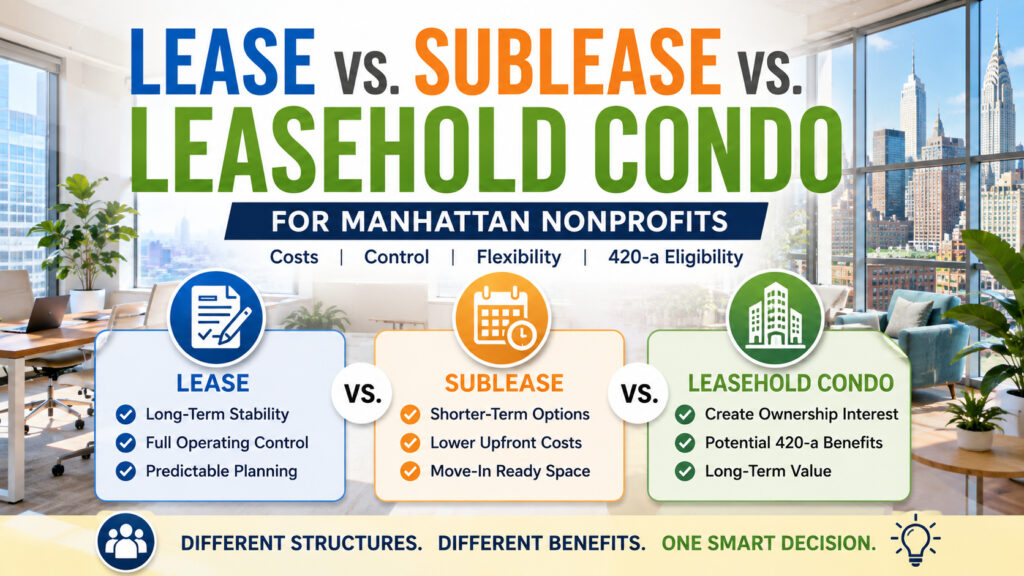
Lease vs. Sublease vs. Leasehold Condo for Manhattan Nonprofits
A Manhattan nonprofit choosing office space must make two decisions, not one. First, the organization needs the right physical office. Then, it needs the right legal and financial structure for occupying that office.
A direct lease, sublease, and leasehold condominium can place a nonprofit behind similar office doors. However, each structure creates very different obligations, risks, costs, control rights, and time horizons.
The simplest distinction looks like this:
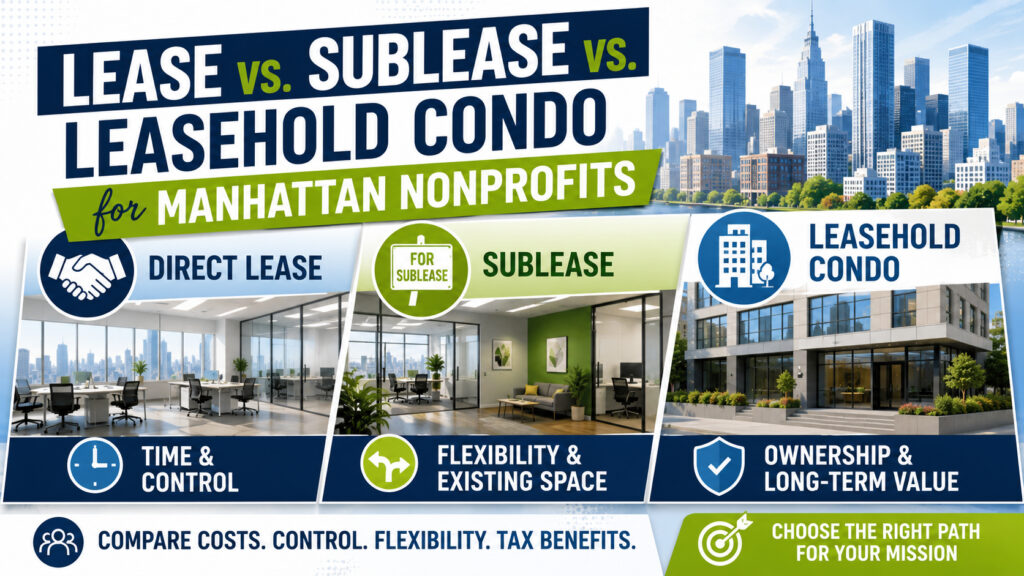
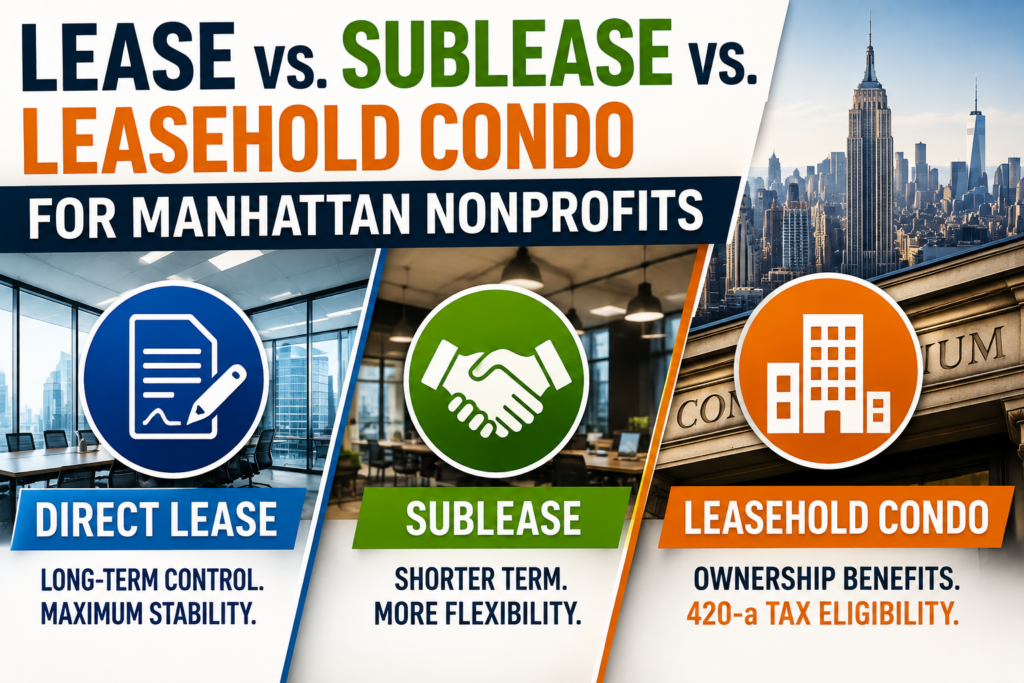
A direct lease buys time and operating control. A sublease buys flexibility and existing infrastructure. A leasehold condominium can create an ownership interest for a qualifying long-term nonprofit.
That last distinction matters in New York. State condominium law recognizes certain nonresidential leasehold interests with at least 30 years remaining as condominium property. Meanwhile, qualifying nonprofit ownership can support a real property tax exemption under Section 420-a.
However, a leasehold condominium does not mean every 30-year lease becomes tax-exempt. The nonprofit needs the proper ownership structure, qualifying organizational purpose, qualifying property use, and approved exemption.
The decision in one view
For most Manhattan nonprofits, the choice starts with one question:
How long does the organization genuinely expect to need this location?
A growing nonprofit with uncertain staffing may value flexibility above everything else. An established institution may value permanent control and predictable occupancy costs. Another organization may need an intermediate solution with landlord-funded construction and renewal rights.
Those situations point toward different structures.
| Issue | Direct Lease | Sublease | Leasehold Condominium |
|---|---|---|---|
| Contracting party | Building owner | Existing tenant | Condominium ownership structure |
| Typical objective | Stable office occupancy | Flexibility and lower initial cost | Long-term control and possible tax benefits |
| Commitment | Often medium or long | Usually limited by master lease | Long-term by design |
| Space condition | Raw, prebuilt, or furnished | Often already built | Varies significantly |
| Construction control | Usually negotiable | Usually more limited | Potentially extensive |
| Landlord concessions | Often available | Usually limited | Different economic structure |
| Furniture | Sometimes included | Frequently included | Usually separate |
| Expansion flexibility | Can negotiate rights | Usually limited | Depends on ownership structure |
| Early exit | Requires negotiated rights | Ends with sublease term | Difficult and transaction-dependent |
| Tax exemption | Standard tenancy alone usually does not satisfy ownership | Standard subtenancy does not satisfy ownership | May support qualifying exemption |
| Transaction complexity | Moderate | Moderate | High |
| Best general fit | Five-to-ten-year planning | Shorter or transitional need | Stable long-term institutional use |
The table shows an important point. The lowest quoted rent does not automatically produce the lowest occupancy cost.
A direct landlord proposal may include construction money, free rent, and new infrastructure. Meanwhile, a cheaper sublease may require modifications at the nonprofit’s expense.
Likewise, a leasehold condominium can create major long-term tax advantages. Yet legal work, condominium creation, financing, construction, and governance can increase upfront costs.
Manhattan’s current market makes the comparison more important
Manhattan office availability has tightened materially from its post-pandemic peak. One major Q2 2026 dataset reported a 14.4% availability rate and an $80.17 average asking rent. That same dataset placed average sublease asking rent at $59.94 per square foot.
Those figures create an approximate 25% asking-rent difference between the two categories. However, asking rent alone does not capture concessions, construction, electricity, taxes, operating escalations, or furniture.
Another major market dataset uses different definitions and reported a 19.3% vacancy rate for Q2 2026. It reported $72.83 overall asking rent and $84.79 for Class A space. Therefore, nonprofits should compare individual spaces rather than treat one market average as a budget.
For perspective, 10,000 square feet at $80.17 equals about $801,700 in annual asking rent. The same area at $59.94 equals about $599,400.
That $202,300 difference looks significant. Still, the comparison changes after concessions, buildout costs, pass-throughs, and remaining lease term enter the calculation.
Consequently, a nonprofit should compare effective occupancy cost, not headline rent.
Direct lease: control without real estate ownership
A direct commercial lease creates a contractual relationship between the nonprofit and the building owner.
The nonprofit becomes the tenant of record. Therefore, it can negotiate directly over rent, construction, permitted use, expansion rights, signage, renewal options, assignment rights, and sublease rights.
That structure remains the standard answer for many Manhattan nonprofit offices.
What a direct lease actually gives the nonprofit
A direct lease gives the organization possession for a defined period. It does not normally give the organization legal title to the property.
That distinction matters because New York’s nonprofit property tax framework focuses heavily on ownership and qualifying use. Federal nonprofit status alone does not create an automatic New York City property tax exemption.
A qualifying nonprofit may therefore occupy a normal office lease and still indirectly bear real estate taxes. The lease may pass tax increases through as additional rent.
For that reason, nonprofit executives should never compare proposals using base rent alone.
A direct lease budget should consider:
Base rent + scheduled increases + tax escalations + operating escalations + electricity + overtime HVAC + construction + furniture + technology + professional costs.
Meanwhile, concessions can offset a substantial part of those expenses. Longer leases often support stronger construction packages because the owner has more time to recover its investment.
Why nonprofits choose direct leases
Direct leases work especially well when the organization knows its future better than its permanent future.
For example, a nonprofit may understand its expected staffing for seven years. However, it may not know whether its mission requires the same location for 30 years.
A direct lease can bridge that gap.
The organization can negotiate a controlled term without taking ownership risk. It can also negotiate renewal rights, expansion rights, contraction options, and sublease flexibility.
Furthermore, a landlord can sometimes deliver a new office to agreed specifications. That can protect nonprofit capital when the alternative requires self-funded construction.
Consider a current 5,077-square-foot direct lease at 675 Third Avenue. The listing includes a built and furnished installation for a smaller office team.
A nonprofit needing a larger Grand Central footprint can compare an 11,335-square-foot direct opportunity at 420 Lexington Avenue. That space combines offices, workstations, conference rooms, and Grand Central access.
Different workplace styles can also lead elsewhere. A nonprofit with a more creative program can review a 2,530-square-foot Hudson Square direct lease.
These spaces illustrate physical choices. They do not determine which legal structure the nonprofit should select.
What should a nonprofit negotiate in a direct lease?
Rent naturally gets attention first. However, several less visible provisions can matter more over a long term.
Assignment and subletting rights deserve early attention. A nonprofit may merge, reorganize, shrink, expand, or create affiliated entities.
A restrictive clause can make those organizational changes expensive.
Renewal rights also matter. A successful nonprofit should not discover nine years later that its headquarters has no protected extension mechanism.
Expansion rights can reduce future relocation risk. Rights of first offer or first refusal may help an organization secure nearby space later.
Construction obligations require equal attention. The lease should identify who designs, builds, pays, approves, and maintains each improvement.
Restoration provisions can create major end-of-term costs. Therefore, the organization should negotiate those obligations before construction begins.
Permitted use language should also cover actual programs. Administrative office use may not describe education, counseling, healthcare, public assembly, training, or community services.
Zoning and building compliance require separate professional review.
When a direct lease usually makes sense
A direct lease deserves strong consideration when the nonprofit expects a medium-term or long-term Manhattan presence.
It also fits organizations that need meaningful construction, customized security, specialized rooms, or greater operating control.
The approach becomes stronger when the nonprofit needs predictable renewal rights. Likewise, direct occupancy can help an organization that expects future expansion in the same building.
A current 5,500-square-foot Flatiron direct lease at 30 West 21st Street shows another variation. Its published terms permit a broad term range.
Similarly, a nonprofit seeking a prominent Midtown location can examine prebuilt space at 75 Rockefeller Plaza.
Downtown organizations can compare prebuilt Financial District direct space and office space at 55 Broadway.
The goal is not to select a building first. Instead, match building, economics, and occupancy structure together.
Sublease: flexibility and infrastructure with layered risk
A commercial sublease creates a second layer between the nonprofit and building ownership.
The building owner leases space to the primary tenant. That primary tenant then subleases some or all of its premises to the nonprofit.
The nonprofit becomes the subtenant. It does not replace the primary tenant.
That fact separates a sublease from an assignment.
A lease assignment is not the same thing
Generic explanations sometimes confuse a direct lease, assignment, and sublease.
A lease assignment generally transfers the tenant’s leasehold interest to another party. Depending on the documents, the original tenant may retain obligations.
A sublease works differently. The original tenant keeps its master lease while granting occupancy rights to the subtenant.
Therefore, a nonprofit comparing office choices should use four separate labels:
direct lease, sublease, assignment, and leasehold condominium.
Only the first three involve ordinary leasehold occupancy concepts. The fourth creates a condominium ownership interest from a long-term leasehold estate.
Why subleases attract nonprofit tenants
Subleases often solve three problems quickly.
First, they can reduce immediate capital spending. Existing tenants frequently leave furniture, cabling, conference rooms, kitchens, and offices behind.
Second, a sublease may offer a shorter commitment. That can help organizations facing funding uncertainty or changing staffing.
Third, the subrent may sit below competing direct rents. Current Manhattan market data still shows a material gap between overall and sublease asking rents.
That combination can make subleases especially useful for transitional headquarters.
However, Manhattan’s sublease supply has tightened significantly. One Q2 2026 dataset placed the sublease availability rate at just 2.6%.
Another market tracker reported 12.1 million square feet of sublease supply. That represented its lowest quarterly total since Q2 2020.
Consequently, nonprofits should not assume that plentiful pandemic-era sublease inventory still exists.
The master lease controls more than many subtenants expect
A nonprofit cannot evaluate a sublease by reading only the sublease document.
The team also needs the master lease.
That document may control permitted use, alterations, access, signage, insurance, operating rules, subletting rights, and restoration requirements.
Landlord consent may also matter.
Therefore, the nonprofit’s attorney should review how the master lease and sublease interact. The organization should also confirm the primary tenant’s remaining term.
A sublease cannot provide reliable occupancy beyond the rights supporting it.
The credit risk works in both directions
A subtenant depends partly on another tenant’s lease remaining intact.
Suppose the nonprofit pays every sublease obligation. Problems could still arise if the primary tenant defaults under its master lease.
The nonprofit should therefore examine available protections against that scenario.
Likewise, the organization should understand where rent goes. Some structures require payment to the primary tenant, while others create different mechanisms.
These are legal issues rather than brokerage assumptions. Counsel should address them before execution.
Construction can erase part of a sublease discount
A beautifully furnished sublease may save six figures in construction.
An unsuitable installation can do the opposite.
Consider a 10,000-square-foot sublease priced substantially below direct alternatives. The nonprofit may still need several new conference rooms, private offices, accessibility work, security, and technology.
Those changes require money.
Moreover, the primary tenant and building owner may need to approve alterations. Short remaining terms can make major capital investment difficult to justify.
For that reason, the ideal sublease usually matches the nonprofit’s intended layout already.
Manhattan sublease examples for comparison
A nonprofit needing a substantial Hudson Yards presence can review a 20,222-square-foot furnished sublease at 10 Hudson Yards. The published term can extend into 2032.
Midtown organizations can compare an 11,500-square-foot full-floor sublease at 510 Madison Avenue. Its current asking rent appears at $64 per square foot.
A smaller nonprofit can review a 4,072-square-foot sublease at 780 Third Avenue. The existing layout includes offices, workstations, meeting rooms, and a kitchen.
Another Midtown comparison comes from 3 Columbus Circle, where a 5,227-square-foot furnished option can support a moderate-sized team.
Union Square users can examine a furnished full-floor sublease at 853 Broadway. Downtown users can compare 7,280 square feet on Exchange Place.
A nonprofit with tighter economics can also review Sixth Avenue sublease space at $48 per square foot.
These examples demonstrate why sublease analysis must begin with the space itself.
A cheap sublease with the wrong installation can become expensive. Meanwhile, a slightly higher-priced turnkey office may conserve unrestricted nonprofit capital.
When a sublease usually makes sense
Subleasing deserves serious consideration when the nonprofit values speed, flexibility, and existing improvements.
It can work especially well for a new program. The same applies to an organization waiting for a permanent headquarters.
A sublease can also serve as swing space during construction.
Growing nonprofits may use one to test a new Manhattan location before making a longer commitment.
However, organizations should approach very short terms carefully. Moving costs, legal costs, technology costs, and staff disruption can outweigh a temporary rent discount.
Leasehold condominium: long-term control and the nonprofit tax question
A leasehold condominium is not simply a long lease with a different name.
It creates a condominium ownership interest from a leasehold estate.
New York’s Condominium Act expressly allows exclusively nonresidential condominium property to arise from qualifying leases or subleases. The relevant leasehold term must have at least 30 unexpired years when the declaration gets recorded.
That statutory framework creates an unusual Manhattan opportunity for certain nonprofits.
Why the structure matters for nonprofits
Section 420-a can exempt qualifying nonprofit-owned property from real property taxation.
The organization must fall within qualifying purposes. These include charitable, educational, religious, hospital, and qualifying moral or mental improvement purposes.
The nonprofit must also use the property for qualifying purposes.
Most importantly, ordinary tenant status does not create the same ownership position.
A leasehold condominium can bridge that gap because the nonprofit acquires ownership of a condominium unit. The underlying estate still comes from a long-term lease.
That combination makes the structure particularly relevant to this exact question.
The 30-year rule needs careful wording
A nonprofit should not hear “30 years” and conclude that any 30-year office lease qualifies.
New York condominium law requires the necessary remaining lease term for qualifying nonresidential leasehold property. Separately, published New York City guidance for nonprofit leasehold condominium structures includes additional requirements.
Those requirements have included:
the condominium’s exclusively nonresidential use;
at least 30 years remaining on the underlying leasehold interest when the nonprofit acquires the unit;
responsibility for applicable land and building real estate taxes; and
satisfaction of the nonprofit ownership and use requirements.
Therefore, “sign a 30-year lease and eliminate property taxes” is an unsafe oversimplification.
The transaction needs the correct legal structure from the beginning.
A 501(c)(3) designation does not settle the issue
Federal tax status and New York City property tax exemption are different questions.
New York City specifically states that federal nonprofit status does not automatically create the property exemption. Legal title and qualifying use remain important.
That fact should influence early real estate planning.
Before spending heavily on a leasehold condominium structure, the organization should have qualified counsel analyze its eligibility.
The team should examine:
organizational purpose, proposed use, title structure, condominium documents, tax responsibilities, and exemption process.
This review needs to happen early.
Otherwise, a nonprofit could spend significant time creating a structure that does not produce the expected exemption.
Section 420-a and Section 420-b are not interchangeable
Some organizations fall within Section 420-a’s mandatory exemption categories.
Others may fall within Section 420-b categories. Those categories include several additional nonprofit purposes.
The legal treatment can differ.
Consequently, a nonprofit should not assume that another organization’s exemption strategy transfers directly to its own mission.
Religious, educational, charitable, healthcare, cultural, scientific, historical, and other organizations may face different statutory questions.
The space must support the exempt use
Ownership alone does not finish the analysis.
New York requires qualifying use as well.
A portion serving a nonqualifying purpose can lose exemption treatment for that portion. Likewise, unused areas require separate analysis.
That issue matters when nonprofits lease more space than they currently need.
For example, an organization may want a 40,000-square-foot headquarters while initially occupying only 28,000 square feet.
The remaining area needs a documented strategy.
Likewise, subletting part of exempt property introduces another layer of exemption analysis. New York guidance allows some continued exemptions in defined nonprofit-to-nonprofit circumstances. Rent and use restrictions can matter.
Therefore, future flexibility requires tax planning, not only lease planning.
What happens when the underlying lease ends?
A leasehold condominium does not last forever.
The underlying lease defines the duration of the leasehold estate. When that estate ends, the leasehold condominium interest can also end.
The fee owner retains the ultimate reversionary interest.
That feature separates a leasehold condominium from fee simple ownership.
Consequently, a nonprofit board should not value the unit as though it owns the Manhattan land forever.
The organization owns a defined leasehold condominium interest for the term established by the structure.
A leasehold condo differs from a fee office condo
This distinction causes frequent confusion.
A fee office condominium gives its owner a fee ownership interest in the unit and common elements.
A leasehold condominium gives its owner a condominium interest derived from an underlying leasehold estate.
Therefore, an ordinary office condo listing does not automatically represent a leasehold condominium opportunity.
For example, 44,779 square feet at 633 Third Avenue currently represents a fee office condominium sale opportunity. The listing asks approximately $620 per rentable square foot.
Likewise, commercial condominium space at 104-110 East 40th Street represents a fee ownership comparison. The current listing shows 5,122 square feet at $2,765,880.
A nonprofit can use these fee condominium examples to compare ownership economics. However, they should not get mislabeled as leasehold condominiums.
How a leasehold condominium can get created
The process can involve several coordinated real estate documents.
Typically, the parties first establish a long-term qualifying leasehold estate. The sponsor then creates the condominium regime from that interest.
Next, the transaction can create separate condominium units. The nonprofit ultimately takes ownership of the appropriate leasehold condominium unit.
Tax maps, declarations, financing documents, and recorded instruments may also enter the process.
New York City’s property-recording system maintains deeds, leases, mortgages, and related real estate records. Condominium-within-a-condominium structures also have a defined recording process.
That explains why ACRIS often appears around this topic.
ACRIS does not determine whether an office strategy makes business sense. Instead, it provides access to recorded Manhattan real property documents and related property information.
Existing condominiums can add another structural layer
Some nonprofit transactions involve space inside an existing fee condominium.
In those situations, the parties may need a condominium-within-a-condominium structure.
Current city guidance explains how a new condominium can arise inside an existing condominium. It also describes tax-lot and recording procedures for that structure.
Earlier structuring guidance highlighted the need to preserve enough tax lots in the parent condominium. That issue can affect transaction feasibility before the nonprofit ever negotiates economic terms.
Therefore, building structure matters as much as building location.
A nonprofit cannot select any Manhattan floor and assume counsel can transform it into a leasehold condominium afterward.
When should a nonprofit seriously evaluate a leasehold condominium?
The structure becomes most relevant when several conditions align.
The nonprofit expects a very long Manhattan commitment.
Its mission requires stable control of a specific location.
The organization can support long-term financial obligations.
Its qualifying use appears compatible with the exemption rules.
The property owner will support the required structure.
The building can accommodate the condominium mechanics.
Finally, expected tax and control benefits must justify the additional complexity.
When those conditions do not align, a direct lease may create a better result.
How Manhattan nonprofits should compare total occupancy cost
Rent per square foot gives a convenient starting point.
It does not give the answer.
A nonprofit board should instead compare each structure across the expected occupancy period.
Build three different cost models
A direct lease model should include:
Base rent + rent increases + tax escalations + operating increases + electricity + HVAC + construction + furniture + technology + security + professional fees − concessions
A sublease model should include:
Subrent + inherited pass-throughs + consent costs + modifications + technology changes + furniture adjustments + restoration exposure + professional fees
A leasehold condominium model should include:
Acquisition or structured occupancy cost + ground lease obligations + common charges + financing + construction + condominium costs + legal costs + recording costs + nonexempt taxes − approved property tax savings
These formulas force an apples-to-apples comparison.
They also expose hidden costs.
Free rent does not make rent disappear
A direct landlord may quote $80 per square foot and provide significant free rent.
Another landlord may quote $72 with less abatement.
The first proposal can still produce the better effective deal.
Similarly, landlord construction can have meaningful value.
A 10,000-square-foot nonprofit might otherwise spend heavily on architectural work, construction, cabling, furniture, security, and project management.
Therefore, financial analysis should spread each cost across the nonprofit’s realistic occupancy period.
A cheap sublease can become expensive after two moves
Suppose an organization takes a three-year sublease.
It pays lower rent and avoids major construction.
Three years later, it must search again, negotiate again, move again, and reinstall technology.
Those repeated costs matter.
Staff disruption also matters, although accounting statements may not capture it cleanly.
A five-year direct lease could therefore outperform a three-year sublease despite a higher face rent.
Conversely, a sublease can win decisively when the organization truly needs temporary space.
Context determines value.
Leasehold condominium savings need a long horizon
A leasehold condominium requires a completely different calculation.
The organization can incur greater legal and structural expenses at the beginning.
However, qualifying real estate tax treatment can change long-term occupancy economics materially.
The correct question is not:
“How much tax do we save next year?”
Instead, ask:
“What is the present value of all occupancy costs during our expected holding period?”
Then stress-test that answer.
What happens if staffing falls 25%?
What happens if staffing grows 40%?
What happens if the organization merges?
Could another qualifying nonprofit use surplus space?
What happens if financing costs rise?
How much capital will remain tied to the facility?
Those questions turn a tax structure into a real estate strategy.
Think in mission horizons
A simple planning framework can help.
| Expected occupancy horizon | Structure to examine first | Why |
|---|---|---|
| Under three years | Sublease | Maximum flexibility |
| Three to five years | Sublease and direct lease | Compare infrastructure against concessions |
| Five to ten years | Direct lease | Better control and landlord economics |
| Ten to twenty years | Direct lease plus fee ownership comparison | Long-term stability matters more |
| Thirty years or more | Direct lease, fee ownership, and leasehold condominium | Ownership and tax structure deserve analysis |
| Permanent mission location | Fee ownership and qualifying leasehold condominium | Long-term control becomes central |
These ranges do not create legal rules.
Instead, they provide a practical order for analysis.
A short-term organization can still sign a direct lease. A stable nonprofit can still choose a sublease for temporary swing space.
The important point is alignment.
Board accounting should separate restricted and unrestricted capital
Nonprofit real estate decisions often involve a second budget question.
Which dollars can the organization responsibly commit to real estate?
A sublease may preserve capital because furniture and construction already exist.
A direct lease may preserve capital through landlord-funded improvements.
A condominium structure may require more capital at closing.
However, ownership may create different balance-sheet treatment and long-term value.
Those accounting and funding questions require the organization’s financial advisors.
Real estate negotiations should nevertheless incorporate them early.
The cheapest neighborhood may not produce the cheapest mission delivery
Location affects staff recruitment, volunteer access, donor meetings, client access, and program delivery.
Therefore, a nonprofit should compare more than rent.
A Downtown office may offer meaningful price advantages against certain Midtown submarkets. Q2 2026 market data showed substantially lower average asking rents Downtown than Midtown.
However, transportation patterns can outweigh part of that difference.
An organization drawing staff from Westchester or Connecticut may value Grand Central access.
Another nonprofit serving Downtown communities may prefer Lower Manhattan.
A third may prioritize Penn Station access.
The best occupancy structure cannot rescue the wrong location.
Manhattan office examples to compare across the three strategies
Nonprofits should compare real buildings while evaluating these concepts.
However, the physical market and the legal structure require separate analysis.
A direct lease listing demonstrates ordinary landlord tenancy. A sublease demonstrates secondary occupancy.
Meanwhile, an office condominium sale demonstrates fee ownership economics. It does not automatically demonstrate a leasehold condominium structure.
That distinction prevents a common category error.
Direct lease buildings worth using as benchmarks
Grand Central provides several useful comparisons.
At 420 Lexington Avenue, organizations can compare multiple suite sizes within one major office property. Current inventory includes both direct and other leasing options.
A nonprofit seeking a smaller footprint can review 2,094 square feet at 420 Lexington Avenue. Another organization can examine 3,542 square feet in the same building.
That comparison helps a board understand one advantage of direct occupancy: future growth inside the same property may become possible.
Nearby, 675 Third Avenue provides another current built direct option.
A larger institutional user can also examine 200 Madison Avenue as a direct leasing benchmark.
Further west, 75 Rockefeller Plaza provides a useful high-quality Midtown comparison.
Downtown, 55 Broadway and Broad Street office space demonstrate different Lower Manhattan price and scale points.
Sublease buildings worth comparing
Sublease analysis benefits from a broad sample.
10 Hudson Yards shows how a large nonprofit can obtain a furnished institutional-quality installation without building from scratch.
510 Madison Avenue provides a contrasting full-floor Midtown example.
A smaller organization can examine 780 Third Avenue or 3 Columbus Circle.
Midtown South creates another choice through 853 Broadway.
Downtown, nonprofits can compare Exchange Place, 75 Broad Street, and One Whitehall Street.
These examples matter because “sublease” describes a legal relationship.
It does not describe one quality level, one neighborhood, or one price range.
Fee office condos provide a useful ownership benchmark
A nonprofit considering leasehold condominium treatment should also understand fee ownership.
Current Manhattan fee office condominium inventory provides useful financial benchmarks.
633 Third Avenue currently includes several office condominium sale opportunities.
The largest current example includes 44,779 square feet on a full floor.
Smaller ownership comparisons include 5,122 square feet at 104-110 East 40th Street and 2,410 square feet at 820 Second Avenue.
Midtown ownership candidates can also examine 420 Fifth Avenue and larger contiguous condominium floors there.
Chelsea provides another smaller benchmark through 3,361 square feet at 305 Seventh Avenue.
Downtown organizations can consider a 6,295-square-foot furnished condominium at 40 Rector Street.
Another Midtown ownership benchmark appears through 3,344 square feet at 50 West 47th Street.
Again, these links show fee condominium ownership.
A leasehold condominium requires separate legal structuring. A nonprofit should never treat those terms as interchangeable.
Questions nonprofit boards and executive teams should resolve
The legal documents come later.
The hardest questions should come first.
Should a nonprofit lease, sublease, or use a leasehold condominium?
Choose the structure that matches the organization’s realistic time horizon, capital, mission, and flexibility requirements.
A sublease often fits temporary or transitional occupancy.
A direct lease often fits stable medium-term occupancy.
A leasehold condominium deserves evaluation when a qualifying nonprofit expects very long-term use and can support the structure.
No single answer applies to every nonprofit.
Is a leasehold condominium fee simple?
No.
A leasehold condominium derives its ownership interest from a leasehold estate.
Fee simple ownership involves a fundamentally different ownership interest.
New York law recognizes qualifying nonresidential leasehold estates as condominium property when statutory requirements apply.
What is the difference between a condo and a leasehold condo?
An ordinary commercial condominium usually involves fee ownership of the unit.
A leasehold condominium instead creates condominium ownership from a long-term leasehold interest.
Both can create separately transferable units. However, the leasehold unit ultimately depends on the underlying leasehold estate.
Does a nonprofit automatically avoid NYC property taxes?
No.
Federal nonprofit status alone does not establish New York City’s property tax exemption.
The city examines ownership, organizational purpose, and property use.
Why does Section 420-a matter?
Section 420-a covers qualifying nonprofit-owned property serving specified exempt purposes.
Those purposes include charitable, educational, religious, hospital, and qualifying moral or mental improvement uses.
That ownership requirement explains the importance of the leasehold condominium structure.
Can a normal office lease qualify simply because it lasts 30 years?
Do not assume so.
A leasehold condominium requires condominium ownership, not merely a long lease term.
The underlying lease also needs to support the condominium structure and applicable exemption requirements.
Can a nonprofit use only part of its premises for exempt purposes?
Potentially, but mixed use creates additional analysis.
New York guidance contemplates partial exemptions when only part of a property satisfies qualifying requirements.
Therefore, the nonprofit should map each proposed use before completing the structure.
What happens to unused space?
Vacant property does not automatically receive exemption merely because a nonprofit owns it.
New York City recognizes a contemplated-use framework where the nonprofit can demonstrate genuine future qualifying plans.
That rule makes growth space a planning issue.
Can an exempt nonprofit sublease extra space?
Possibly.
However, the exemption analysis depends on the subtenant, use, rent, and statutory framework.
New York guidance describes circumstances where qualifying nonprofit use can preserve exemption treatment. It also limits rental economics in certain situations.
Therefore, future subleasing rights need tax review and lease review.
Does a nonprofit need landlord consent to sublease Manhattan office space?
Often, the governing lease requires consent.
Commercial office rights depend heavily on the negotiated master lease rather than residential subletting rules.
Therefore, a nonprofit should read the commercial master lease before relying on generic New York sublet information.
Why do residential subletting rules appear around this topic?
The word “sublease” covers many property types.
Residential apartments, cooperatives, condominiums, and commercial offices follow different documents and legal frameworks.
A Manhattan nonprofit seeking office space should focus on commercial lease documents and commercial property law.
Residential apartment sublet rules do not answer the nonprofit office question.
Why do generic leasehold-condo explanations create confusion?
Many generic explanations discuss residential buildings where owners lease the underlying land.
That concept exists, but it does not fully answer this nonprofit office question.
Here, the important structure involves a nonresidential leasehold condominium that can create condominium ownership for a long-term institutional occupant.
That ownership distinction drives the 420-a analysis.
What does ACRIS have to do with a leasehold condo?
ACRIS maintains New York City recorded property documents for Manhattan and several other boroughs.
Users can review deeds, leases, mortgages, and other recorded instruments there.
A condominium-within-a-condominium also enters the city’s property recording system through defined procedures.
Therefore, ACRIS becomes relevant during legal and title diligence.
It does not replace legal review.
Is a leasehold condominium always better than a direct lease?
No.
Tax savings cannot compensate for a structure that conflicts with the organization’s future.
A nonprofit expecting major contraction may value exit flexibility more than long-term tax treatment.
Likewise, an organization with uncertain funding may not want a 30-plus-year real estate commitment.
The correct structure maximizes mission flexibility after occupancy cost, not one tax line.
Is a sublease always cheaper?
No.
Published Manhattan averages currently show lower sublease asking rents. However, individual transactions can produce a different result.
A direct lease can include free rent and significant construction contributions.
A sublease can also require expensive modifications.
Therefore, compare effective cost over the planned occupancy period.
Is a direct lease always more flexible?
Not necessarily.
A ten-year direct lease can create more long-term liability than a three-year sublease.
However, a well-negotiated direct lease can offer expansion, renewal, assignment, and sublease rights.
Flexibility comes from both term length and document language.
Should a nonprofit buy an ordinary fee office condo instead?
Sometimes.
Fee ownership may appeal to an organization seeking permanent control and long-term asset ownership.
However, the nonprofit must compare acquisition cost, financing, common charges, capital repairs, future sale liquidity, and mission requirements.
Current Manhattan inventory ranges from small commercial units to entire office floors. Examples include 820 Second Avenue, 104-110 East 40th Street, and 633 Third Avenue.
Fee ownership and leasehold condominium ownership deserve separate financial models.
Does coworking belong in this comparison?
Not directly.
Flexible workspace can solve very short-term needs. However, it represents a service-heavy occupancy product rather than the ownership and lease structures addressed here.
A nonprofit needing a handful of desks for months may still consider it.
An organization evaluating a permanent Manhattan headquarters should compare the underlying real estate economics first.
How early should a nonprofit start planning?
Earlier than most organizations expect.
A straightforward sublease can move quickly when documents and space align.
A new direct lease can require design, negotiation, permitting, construction, technology installation, and relocation planning.
A leasehold condominium adds substantially more structural work.
Therefore, nonprofits should start from their required occupancy date and work backward.
Who should review a leasehold condominium?
A tenant-side real estate team should coordinate with qualified real estate counsel.
Tax counsel may also need to review exemption eligibility.
Depending on the transaction, the nonprofit can also need accounting, architectural, engineering, construction, financing, title, and condominium expertise.
The broker should coordinate the real estate economics.
Attorneys should determine legal and tax conclusions.
A tenant-first decision path for Manhattan nonprofits
The best decision process starts with the nonprofit rather than available buildings.
First, define how the organization expects to operate.
Document current staffing, expected staffing, visitors, volunteers, private offices, meeting rooms, program rooms, storage, security, accessibility, and technology.
Next, determine the realistic commitment period.
Do not use the longest period leadership can imagine. Use the period the board can responsibly support.
Then establish the maximum annual occupancy budget.
That budget should include more than rent.
Add utilities, taxes, escalations, buildout, furniture, technology, security, moving, and professional costs.
Afterward, decide how much capital the organization can invest upfront.
That answer can quickly change the structure ranking.
A sublease may rise when capital preservation dominates.
A landlord-built direct lease can rise for the same reason.
Leasehold condominium ownership may rise when long-term economics dominate instead.
Compare the structures before touring too many spaces
Many organizations reverse the process.
They tour a beautiful office first. Then, they attempt to make its transaction structure fit their needs.
That approach reduces leverage.
Instead, establish an initial hierarchy.
For example:
Need under four years + uncertain staffing + limited construction budget = start with subleases.
Another nonprofit may reach a different answer:
Need seven to ten years + custom program rooms + growth expectations = start with direct leases.
A third institution may conclude:
Mission-critical headquarters + 30-plus-year horizon + potential 420-a eligibility = test leasehold condominium feasibility immediately.
These starting positions prevent wasted tours.
Test at least one alternative structure
Even when the first answer seems obvious, price an alternative.
A nonprofit favoring a direct lease should price comparable subleases.
A nonprofit favoring a sublease should request at least one direct proposal.
An organization considering a leasehold condominium should also model a conventional long-term lease and fee condominium purchase.
Competition creates information.
Information creates negotiating leverage.
Compare buildings by total mission value
Neighborhood prestige should not decide the transaction.
Instead, score each option across several dimensions.
Consider employee commutes, program access, client access, donor convenience, lease economics, construction, flexibility, ownership potential, and long-term risk.
For example, Grand Central users can compare 420 Lexington Avenue against 633 Third Avenue. One provides broad leasing inventory, while the other also provides fee condominium comparisons.
Midtown users can compare 75 Rockefeller Plaza against current 510 Madison Avenue sublease space.
Downtown organizations can compare a direct lease on Broad Street against furnished sublease space at 75 Broad Street and fee condominium space at 40 Rector Street.
That three-way comparison gets much closer to the real decision.
Treat flexibility as something worth money
Organizations often calculate rent precisely while treating flexibility as an abstract benefit.
That approach undervalues real options.
A renewal option has value.
An expansion right has value.
A favorable sublease clause has value.
A termination option has value.
The ability to sell a fee condominium has potential value.
Likewise, long-term tax-exempt ownership can have material value.
The nonprofit should price those differences whenever possible.
Run a downside case before board approval
The base case assumes expectations come true.
Boards should also review a downside case.
Reduce staffing.
Reduce funding.
Increase construction costs.
Delay occupancy.
Assume an expansion never happens.
Test a merger.
Model an early relocation.
Then ask which structure remains manageable.
A seemingly attractive deal can fail this test quickly.
Do not confuse tax savings with free occupancy
Even an approved property tax exemption does not eliminate every office cost.
The nonprofit can still face ground rent, common charges, operating expenses, utilities, construction, financing, maintenance, insurance, and professional costs.
A leasehold condominium should therefore compete on total cost and control.
Its purpose is not simply to eliminate one expense category.
Make the final choice in this order
Start with mission requirements.
Then compare the commitment horizon.
Next, establish capital limits.
After that, compare effective occupancy economics.
Finally, review legal and tax structure.
Only then should the board select the preferred transaction.
For many nonprofits, that process will lead to a conventional direct lease.
Others will find a sublease offers the best bridge.
A smaller group of stable, qualifying organizations may discover that a leasehold condominium solves a long-term Manhattan occupancy problem particularly well.
There is no reason to force all three structures into equal consideration.
The goal is to identify which one supports the organization’s mission with the least avoidable real estate risk.
We represent Manhattan office tenants and evaluate direct leases, subleases, fee ownership, and qualifying long-term structures from the tenant’s side. We can compare current buildings, financial terms, flexibility, and physical requirements before a nonprofit commits to one path. Our role remains the same throughout that process: protect the organization’s occupancy economics while keeping its mission and future flexibility in control.
Fill out our 📋 online form or give us a call today 📞 212-967-2061 — let’s find the right options for your business.