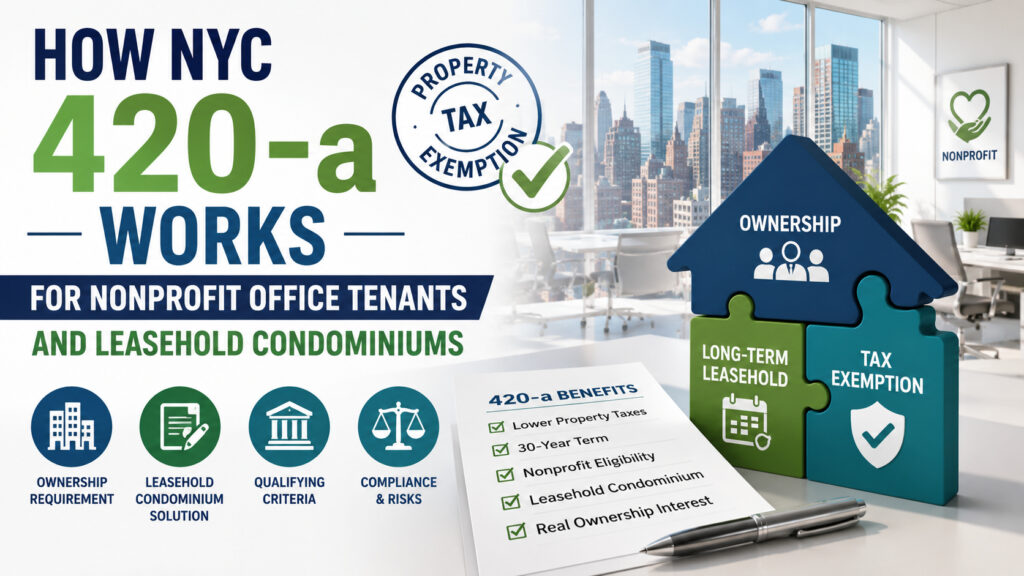
How NYC 420-a Works for Nonprofit Office Tenants and Leasehold Condominiums
A nonprofit leasing Manhattan office space usually cannot claim a 420-a property tax exemption through an ordinary office lease. The ownership requirement creates the problem. A qualifying leasehold condominium can provide a solution by creating an ownership interest from a long-term leasehold.
That distinction matters because a tax exemption does not follow nonprofit status alone. The nonprofit must satisfy organizational, ownership, property-use, and documentation requirements. Federal 501(c)(3) status, by itself, does not guarantee New York City property tax exemption.
For an office tenant, the real question therefore becomes more precise:
Can the transaction create qualifying real-property ownership while preserving the economics and occupancy rights of a long-term lease?
In the right transaction, the answer can be yes. However, a leasehold condominium requires much more than adding special wording to a lease.
The parties must create the condominium interest correctly. They also must allocate taxes correctly, convey title correctly, and maintain qualifying use afterward. Current law also imposes a significant term requirement for nonresidential leasehold condominiums.
This page focuses only on that real estate and property-tax mechanism. For broader office leasing issues, start with our NYC Commercial Leasing Guide.
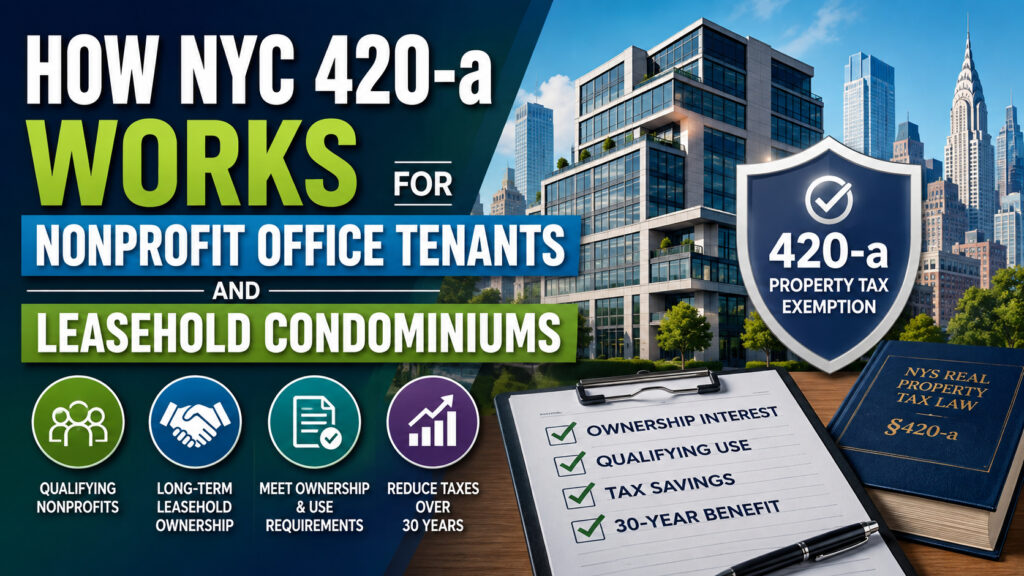
The Core Rule Behind 420-a for a Nonprofit Office Tenant
New York Real Property Tax Law §420-a grants a mandatory property tax exemption to certain qualifying nonprofit property owners. The statute covers organizations operating for specified exempt purposes. Those purposes include charitable, educational, hospital, religious, and qualifying moral or mental improvement activities.
Two words drive almost every office-space analysis: owned and used.
The statute starts with real property that a qualifying organization owns. It then looks at how that organization uses the property. Those requirements explain why a conventional Manhattan office lease creates a fundamental problem.
Why nonprofit status does not make ordinary leased office space tax-exempt
An ordinary commercial tenant owns contractual lease rights. However, it generally does not hold legal title to the parcel.
Meanwhile, the landlord remains the real-property owner. Property taxes therefore attach to the landlord’s taxable real estate.
The lease may then shift part of that economic burden to the tenant. For example, the lease might require tax escalations or other real-estate-tax payments.
Paying the tax does not itself solve the ownership problem. Section 420-a requires qualifying ownership in addition to qualifying use.
That distinction can surprise nonprofit tenants.
A nonprofit may use every square foot for charitable purposes. It may also pay a large annual real-estate-tax charge through its lease.
Nevertheless, those facts do not automatically convert an ordinary tenant into a qualifying property owner.
A leasehold condominium addresses the ownership problem
New York condominium law recognizes certain long-term nonresidential leasehold interests as condominium property. The parties can therefore create condominium units from qualifying leasehold interests.
The nonprofit can then acquire title to a leasehold condominium unit.
City property-tax rulings have recognized that arrangement for Section 420-a purposes. They also recognize leasehold condominium ownership where the nonprofit pays taxes attributable to its unit.
The nonprofit does not necessarily buy the underlying land or building.
Instead, the fee owner can retain its ownership. The nonprofit owns the condominium unit created from the long-term leasehold estate.
That is the key legal distinction.
| Structure | What the nonprofit holds | Can the ownership requirement potentially work? | Key issue |
|---|---|---|---|
| Standard office lease | Contractual leasehold rights | Generally not through the lease alone | Nonprofit lacks qualifying title |
| Fee condominium purchase | Permanent condominium ownership | Potentially yes | Organization and use must qualify |
| Leasehold condominium | Condominium ownership created from a long-term leasehold | Potentially yes | Formation, term, tax, use, and title rules must work |
A leasehold condominium therefore does not create an exemption by itself. It creates an ownership form that may allow an eligible nonprofit to satisfy the ownership requirement.
The exemption analysis still continues from there.
What “mandatory class” really means
Section 420-a calls these qualifying organizations a “mandatory class.” That does not mean every nonprofit automatically receives an exemption.
Instead, qualifying property receives the statutory exemption when the required conditions exist. Those conditions include qualifying ownership, organization, conduct, and property use.
The nonprofit must also apply through the applicable property-tax process. New York City requires the applicant to establish its ownership and exempt use.
In other words, 420-a eligibility belongs to the qualifying property arrangement, not merely the organization’s federal tax status.
An office can qualify as exempt-use property
Office use does not disqualify a property merely because employees work at desks.
Current city guidance expressly recognizes offices used for charitable purposes. Examples include philanthropic and artistic charitable activities.
An administrative headquarters can therefore present a valid case when its functions advance the organization’s qualifying mission.
The analysis still depends on actual operations.
Finance, fundraising, executive, program, legal, educational, clinical-support, or administrative functions may support an exempt mission. However, the nonprofit should document that connection.
A generic statement that “we are a nonprofit” provides a weaker record.
A stronger record explains what employees do inside the premises. It then connects those activities to the organization’s exempt purposes.
Do not confuse this structure with other programs using similar terminology
New York property-tax terminology creates several easy points of confusion.
One city housing program also uses the “420-a” label. That program concerns qualifying nonprofit-controlled housing with social-service components. It does not describe the commercial leasehold condominium mechanism discussed here.
Likewise, residential condominium and cooperative abatements involve different rules. They do not create the nonprofit leasehold-condominium exemption discussed on this page.
For Manhattan office tenants, the relevant issue is RPTL §420-a ownership and use through commercial real property.
That distinction keeps the transaction focused from the beginning.
What a Leasehold Condominium Actually Changes
The phrase “leasehold condominium” can sound contradictory.
A lease usually describes temporary possession. A condominium usually suggests ownership.
New York law allows both concepts to operate together.
For qualifying nonresidential property, a long-term leasehold estate can become the property submitted to condominium ownership. The condominium declaration then divides that leasehold estate into one or more units.
The result creates a very different legal position from an ordinary office lease.
The underlying fee ownership can remain unchanged
Imagine a landlord owns a Manhattan office building.
The landlord does not need to sell its fee ownership simply because a nonprofit wants 420-a treatment.
Instead, the transaction can establish a sufficiently long underlying leasehold estate. The condominium structure then sits within that leasehold estate.
The nonprofit acquires the resulting condominium unit.
Therefore, two property interests can coexist:
The landlord keeps the underlying fee interest.
The nonprofit owns the leasehold condominium unit for the duration of the underlying estate.
That structure explains why “owning” a leasehold condominium does not mean owning the building forever.
The 30-year requirement is a formation rule, not a slogan
For a standard condominium devoted exclusively to nonresidential purposes, state condominium law contains a specific timing rule.
The relevant lease or sublease must have at least 30 years of unexpired term when the condominium declaration gets recorded.
That wording matters.
A tenant should not assume that signing a 30-year lease automatically satisfies the requirement.
Suppose the parties sign exactly 30 years before recording. Several months then pass during documentation and approvals.
The remaining term may fall below the statutory threshold by the recording date.
Consequently, sophisticated transactions usually need enough term to absorb formation time. Counsel should calculate the required cushion before signing.
An unexercised renewal option should not become the tenant’s only rescue plan. The transaction team should confirm how each term counts before relying on it.
Why the tax obligation appears inside the structure
A strange feature appears when tenants first study these deals.
The nonprofit seeks an exemption from property taxes. Yet the documents must make the unit owner responsible for taxes attributable to its unit.
That apparent contradiction has a legal purpose.
New York condominium law treats each ordinary condominium unit as a separate parcel for assessment and taxation. For leasehold units, the declaration must require the unit owner to pay all taxes attributable to that unit.
City letter rulings also identify that tax-payment obligation in recognized nonprofit leasehold condominium structures.
So the structure first establishes the nonprofit as the responsible unit owner.
The nonprofit then seeks exemption for that separately recognized property interest.
The structure does not avoid ownership of the tax obligation. It creates ownership first, then applies the exemption to qualifying ownership.
That distinction should shape every lease negotiation.
A leasehold condominium is not a “tax clause” inside an ordinary lease
The parties cannot usually achieve the same result through one paragraph saying the tenant owns its space.
Condominium ownership requires an actual condominium structure.
That structure typically requires a declaration, unit descriptions, common-interest allocations, tax-lot work, recordable instruments, and conveyance documents.
The transaction also must coordinate those instruments with the underlying lease.
If one document conflicts with another, the conflict can affect taxes, control rights, financing, remedies, or termination.
Therefore, the lease, declaration, deed, tax documentation, and building agreements must tell the same story.
The unit has a finite life
Fee condominium ownership can continue indefinitely.
A leasehold condominium cannot outlive the leasehold estate that supports it.
When that underlying estate ends, the leasehold condominium interest also reaches its endpoint.
This characteristic affects far more than exemption eligibility.
It affects amortization, improvements, financing, surrender obligations, renewal rights, restoration duties, and long-term occupancy planning.
A nonprofit considering this structure should therefore evaluate the entire economic term, not only the initial exemption.
What happens when only part of a building is involved
A nonprofit does not necessarily need an entire office tower.
A leasehold condominium can potentially address one or more floors, a large block, or another legally defined commercial area.
However, the documents must create workable boundaries and property interests.
The building’s existing ownership structure matters enormously.
A conventional fee-owned building presents one formation path. An existing fee condominium can require a more complicated internal condominium arrangement.
City tax rulings have recognized leasehold condominium property formed within an existing condominium unit.
That possibility expands the universe of buildings. It also increases the need for early technical review.
The Eligibility Tests a Nonprofit Office Tenant Must Pass
A leasehold condominium only addresses part of the 420-a puzzle.
The nonprofit must still satisfy several independent requirements.
A strong transaction examines those requirements before the tenant commits substantial time or money.
The organization test
Section 420-a covers organizations organized or conducted exclusively for specified exempt purposes.
Those purposes include religious, charitable, hospital, educational, and qualifying moral or mental improvement purposes.
The statute also restricts private pecuniary profit.
Reasonable compensation for services does not create the same issue. However, the organization cannot operate as a pretext for private profit.
Federal nonprofit recognition remains relevant evidence.
Still, the city expressly warns that federal 501(c)(3) status does not automatically establish property-tax eligibility.
The property-tax inquiry stands on its own.
The ownership test
Current city guidance requires legal title to the parcel under consideration in the applicant organization’s name. The applicant must own the property interest seeking exemption.
That requirement creates the reason for the leasehold condominium.
An ordinary tenant usually lacks the required property title.
After proper formation and conveyance, the nonprofit owns the condominium unit created from the leasehold estate.
City rulings have recognized such ownership for 420-a purposes.
Title must therefore land in the correct entity.
A transaction that puts title in the wrong affiliate can undermine an otherwise strong exemption plan.
The use test
The nonprofit must use the property for qualifying exempt purposes.
Section 420-a also addresses partial nonqualifying use. A portion used for other purposes can remain taxable while qualifying portions stay exempt.
Current city guidance follows the same concept.
Areas without exempt use can lose eligibility. Portions leased to commercial, nonexempt organizations also do not qualify.
This rule matters in modern offices.
A nonprofit may occupy most of a floor while subleasing excess offices. Another organization may operate a café, store, clinic, studio, or private business there.
Those arrangements need separate analysis.
“Exclusive use” does not necessarily mean every second involves direct program delivery
New York courts have not always treated the word “exclusively” with absolute literalism.
The focus generally concerns the property’s principal or primary qualifying use.
However, separate areas used for commercial purposes can still become taxable. The statute itself expressly supports partial taxation.
That nuance helps office tenants.
A conference room does not stop qualifying because employees occasionally discuss administrative matters there.
Likewise, a kitchen, mailroom, reception area, storage room, or executive office can support the exempt enterprise.
The stronger question asks what function the premises principally serves.
The nonresidential condominium test
The standard 30-year leasehold condominium provision applies to a condominium devoted exclusively to nonresidential purposes.
Traditional office space fits naturally within that category.
Residential components introduce other statutory issues.
A mixed-use building does not automatically prevent an office unit from working. However, the particular condominium structure requires careful review.
The nonprofit should establish the proposed unit boundaries before treating the building as eligible.
The tax-payment test
The declaration must support separate taxation of the leasehold unit.
For the standard leasehold condominium framework, the declaration requires the unit owner to pay taxes attributable to its unit.
City rulings likewise recognize structures where the nonprofit unit owner bears those taxes.
This provision needs coordination with the lease.
A typical office lease might only charge increases above a base year.
That formula does not mirror the leasehold condominium concept.
The transaction therefore needs a tax provision built for the structure rather than copied from a conventional lease.
The actual-use test continues after closing
Approval does not freeze the facts forever.
The tenant’s actual operations matter throughout the exemption period.
Changing a program floor into commercial rental space can change the tax outcome.
A corporate restructuring can also create questions about ownership.
Likewise, an assignment or sublease can introduce a new user whose activities do not qualify.
The tenant should therefore treat 420-a compliance as an ongoing property-management issue.
Vacant space and construction require planning
A nonprofit may acquire a leasehold condominium before completing its buildout.
Current city rules recognize a contemplated-use exemption for qualifying vacant property when the nonprofit has concrete future-use plans. Applicants need supporting documentation.
That can matter during major renovations.
However, mere ownership does not establish contemplated use.
The nonprofit should maintain board approvals, project plans, construction schedules, budgets, and other evidence supporting the intended exempt occupancy.
Once construction finishes, the city may require a new application reflecting actual use.
Legal occupancy still matters
A property-tax exemption does not legalize an otherwise unlawful use.
Recent New York appellate authority continues to recognize zoning compliance as relevant to exemption disputes.
Therefore, the tenant should review zoning, legal use, occupancy permissions, and construction requirements before relying on 420-a.
This point belongs early in the transaction.
Finding a tax solution for space that cannot legally accommodate the nonprofit’s operations solves the wrong problem.
How the Structure Comes Together Before the Lease Is Signed
A nonprofit should evaluate 420-a feasibility before it treats the lease as an ordinary transaction.
Retrofitting the structure after signing can create leverage problems.
The landlord may already control every approval. Its lender may have separate consent rights.
Likewise, the initial lease term might prove too short for condominium formation.
Early planning protects the tenant.
For broader transaction sequencing, our guide to planning a Manhattan office lease covers the surrounding leasing process.
Start with organizational eligibility
The first question should not concern floor plans.
The tenant should ask counsel whether its organization falls within Section 420-a.
Next, it should document the intended office functions.
That review should identify any commercial activities, affiliates, outside users, subtenants, retail components, or shared facilities.
The result gives the real estate team a clear eligibility hypothesis.
Without that step, the tenant can spend months structuring a condominium around a use that never qualified.
Test the building before negotiating only rent
A good candidate must satisfy more than location and price.
The owner must cooperate with a highly structured transaction.
Existing debt documents may require lender approval. Prior condominium documents can also affect feasibility.
Likewise, title conditions, tax-lot configuration, and building violations can complicate the process.
A tenant should therefore compare prospective buildings across two dimensions:
Occupancy suitability and 420-a structural suitability.
The lowest quoted rent may produce the weakest overall transaction.
Put the concept into the term sheet
A letter of intent cannot create the condominium.
Still, it can establish the business framework.
The tenant should identify 420-a cooperation as a material transaction assumption.
Important business points may include:
| Term-sheet issue | Why the nonprofit should address it early |
|---|---|
| Leasehold condominium cooperation | Prevents later disputes about the owner’s obligations |
| Minimum term | Protects the statutory formation threshold |
| Recording cooperation | Ensures documents can reach city land records |
| Lender approvals | Identifies third-party consent risk |
| Tax allocation | Defines responsibility before exemption starts |
| Formation expenses | Prevents unexpected cost shifting |
| Violations | Creates incentives to cure conditions threatening eligibility |
| Exemption denial | Establishes economic fallback rights |
| Tax notices | Gives the tenant direct information about its unit |
| Renewal and extensions | Aligns long-term occupancy with the condominium’s life |
| Assignment rights | Prevents later transfers from destroying the intended structure |
| Restoration and surrender | Addresses the end of the leasehold estate |
Those points should then flow into the definitive documents.
Our discussion of office lease terms provides additional context for conventional lease provisions.
Build enough term into the deal
The parties must preserve at least 30 years of unexpired lease term at declaration recording for the standard nonresidential structure.
Therefore, an exactly 30-year signed term can create unnecessary risk.
Formation takes time.
Negotiations, title review, surveys, drawings, lender approvals, governmental filings, signatures, and recording all consume part of the term.
The better business approach provides a practical buffer.
Counsel should calculate that buffer for the specific transaction.
Design the condominium around how the nonprofit will actually occupy
Unit boundaries should follow real operational needs.
The tenant might occupy an entire building, several floors, or only one defined office area.
Mechanical rooms, elevators, lobbies, loading areas, shafts, roofs, terraces, storage, and building systems may remain common elements.
The declaration then allocates rights and common interests.
That allocation must match the lease.
A nonprofit should avoid a structure where its tax unit and economic premises describe materially different spaces.
Discrepancies can complicate tax allocation, repairs, insurance, casualty rights, and surrender.
Coordinate the underlying lease with condominium documents
The underlying lease establishes the leasehold estate.
The declaration submits that estate to condominium ownership.
Other documents then convey the nonprofit’s unit.
Those instruments cannot operate independently.
For example, the lease may grant expansion rights.
The condominium documents must determine whether those rights affect unit boundaries.
Similarly, the lease may impose repair duties on the landlord while condominium documents place them elsewhere.
Every material inconsistency can become a future dispute.
Complete the required formation and recording work
Leasehold condominium creation requires formal real estate documentation.
Depending on the structure, that work can involve state-level condominium review procedures, title work, tax-lot materials, declarations, plans, and recorded conveyance documents.
The exact path changes when the property already sits inside another condominium.
City property-tax rulings recognize both direct leasehold condominium structures and units formed within existing condominium property.
A nonprofit should therefore use professionals familiar with both condominium formation and nonprofit property-tax exemption.
Our guide to the professionals involved in an office lease explains the broader team.
Convey the unit before treating the exemption as complete
Formation alone does not make the tenant the qualifying owner.
The nonprofit must acquire the relevant condominium ownership.
City guidance focuses on legal title in the applicant’s name.
Consequently, the closing sequence matters.
A deal can contain an executed long-term lease and recorded declaration without completing the ownership step.
The tenant should track each stage separately:
Underlying lease → condominium creation → unit conveyance → exemption application → approval → annual compliance.
Skipping one stage can undermine the intended result.
Apply for the property-tax exemption
The nonprofit owner must establish its qualification after it holds the relevant property interest.
Section 420-a expressly contemplates an owner application for exemption.
The city then evaluates ownership, organizational purpose, use, and supporting documentation.
That review makes tax-allocation language critical.
The tenant needs a contractual answer for taxes accruing before approval.
It also needs an answer if the application gets delayed, challenged, reduced, or denied.
Do not promise a fixed formation timeline
Leasehold condominium transactions involve more moving pieces than ordinary leases.
A standard office lease can close while architectural planning continues.
A 420-a leasehold condominium requires additional title, condominium, tax, and recording work.
Existing condominium ownership can add another layer.
Consequently, tenants should negotiate milestones and responsibilities, not depend on an optimistic calendar.
A long-stop date may still help.
However, the documents should also explain what happens when a third-party approval takes longer than expected.
How Taxes, Rent, and Occupancy Costs Work
The financial case for a leasehold condominium can be significant.
However, tenants should model the exemption correctly.
Section 420-a does not turn office occupancy into a cost-free arrangement.
It addresses qualifying real property taxation.
Everything else still requires separate analysis.
First understand the tax burden under a normal office lease
Commercial office leases allocate real-estate taxes in different ways.
Some tenants pay increases over a base tax year.
Others pay a proportionate share through another escalation formula.
A net lease can shift even more tax responsibility to the occupier.
Therefore, the value of 420-a depends partly on the tax economics of the proposed building.
A tenant should begin with actual assessed-value and tax information.
It should then model its contractual share under the proposed lease.
The leasehold condominium changes the tax unit
New York condominium law generally treats each condominium unit and its common interest as a separate parcel.
For a leasehold condominium unit, the declaration must impose attributable taxes on the unit owner.
This structure isolates the nonprofit’s property interest for tax treatment.
The nonprofit can then seek the exemption for its qualifying unit.
It does not need every other occupier in the building to qualify.
That distinction makes mixed ownership possible.
Separate for-profit units do not automatically destroy the nonprofit unit
City letter rulings recognize qualifying nonprofit leasehold condominium ownership within structures containing other interests. They also recognize formation within an existing condominium unit.
The important line usually runs around the nonprofit’s own exempt property.
A for-profit business elsewhere in the tower does not turn the nonprofit’s office into commercial space.
By contrast, a for-profit subtenant inside the nonprofit’s exempt unit presents a direct use issue.
That portion may become taxable.
The exemption does not eliminate rent
A landlord still expects economic consideration for its real estate.
A nonprofit may continue making payments under the leasehold transaction.
Those payments compensate the property owner for the underlying economic deal.
The property-tax exemption operates separately.
Therefore, nonprofit tenants should avoid shorthand such as, “420-a means we do not pay rent.”
It does not.
The real question asks how much property-tax expense disappears from the total occupancy cost after approval.
The exemption does not eliminate common charges or ordinary operating costs
A condominium has common expenses.
New York condominium law defines common expenses broadly around operation and other amounts established through condominium documents.
Accordingly, the nonprofit may still bear costs for building operations.
Those expenses can include cleaning, security, repairs, utilities, management, insurance, shared building systems, and other agreed costs.
A property-tax exemption should never substitute for a full occupancy model.
The tenant should compare total annual cash obligations before deciding whether the structure creates enough value.
Use an occupancy-cost equation instead of focusing on face rent
A simple framework helps:
Ordinary lease occupancy cost
Base economic payment + operating expenses + tax charges + utilities + other lease costs
Leasehold condominium occupancy cost
Leasehold economic payment + common expenses + nonexempt operating costs + residual taxes + utilities + formation/compliance costs
The second structure becomes attractive when the property-tax savings exceed its additional transaction and compliance costs.
That calculation should cover the entire expected occupancy term.
Do not assume every government-related property charge disappears
Section 420-a directly concerns real-property taxation.
The statute also addresses certain special ad valorem levies and assessments through related provisions.
However, nonprofits should not treat every municipal bill as “property tax.”
Water, sewer, permit, service, and other charges can follow separate exemption rules.
Current city guidance confirms that some nonprofit fee reductions require their own eligibility analysis.
The lease should therefore define “Taxes” carefully.
A broad contractual definition can reach obligations beyond the statutory exemption.
Build the tax gap into the transaction economics
The exemption may not become effective on the lease-signing date.
The condominium first needs formation.
The nonprofit then needs ownership.
Afterward, the exemption process must reach the required result.
Taxes can arise during that interval.
A careful transaction identifies who pays those taxes.
It should also address later adjustments, refunds, credits, interest, and reconciliation.
Otherwise, the parties may agree on the concept while fighting over the transition period.
Model partial exemption risk
Suppose a nonprofit owns 50,000 square feet through its leasehold condominium.
It uses 45,000 square feet for qualifying operations.
Then it leases 5,000 square feet to a private commercial business.
Section 420-a permits taxation of nonqualifying portions while qualifying portions remain exempt.
The tenant should therefore model the tax consequences before approving a commercial sublease.
The immediate rental income may look attractive.
However, the resulting property-tax cost can change the net economics.
Compare the savings against formation costs and inflexibility
Leasehold condominiums require more legal and technical work than normal leases.
They also need a very long underlying term.
That means an organization trades some flexibility for potential tax efficiency.
A nonprofit expecting rapid headcount changes may value flexibility more heavily.
Another nonprofit planning a permanent headquarters may view the long term differently.
Neither conclusion follows automatically from nonprofit status.
The correct comparison measures tax savings against transaction costs, term commitment, expansion risk, contraction risk, and exit constraints.
Special Structures, Mixed Use, Affiliates, and Existing Condominiums
Not every nonprofit leasehold condominium follows the simplest model.
Some transactions involve affiliates.
Others involve an existing condominium building.
A nonprofit may also occupy only part of a larger property.
Those variations do not automatically disqualify the structure, but they require more precise planning.
A nonprofit can own a fee condominium without using a leasehold structure
A leasehold condominium solves an ownership problem.
It is unnecessary when the nonprofit directly purchases a qualifying fee condominium unit.
If the nonprofit owns that fee unit and uses it for qualifying purposes, Section 420-a can potentially apply directly.
The same organization and use requirements still matter.
Therefore, nonprofit tenants comparing a leasehold condominium with a purchase should separate two questions:
Do we want permanent real estate ownership?
Do we want long-term occupancy that preserves the landlord’s fee ownership?
A fee condominium addresses the first objective.
A leasehold condominium can address the second.
An existing condominium can require a condominium-within-a-condominium structure
Some Manhattan office buildings already contain fee condominium units.
The nonprofit may want space inside one existing unit.
Simply leasing that unit does not necessarily give the nonprofit title.
City property-tax rulings recognize a structure where qualifying leasehold condominium property forms within an existing condominium unit.
Practitioners often describe this arrangement as an internal condominium or condominium within a condominium.
It solves one ownership issue by creating another layer of condominium property.
That extra layer increases document and tax-map complexity.
The tenant should identify existing condominium ownership before signing its business terms.
Mixed-use buildings can still work
A nonprofit does not need every tenant in the building to operate a charitable organization.
Separate commercial space can remain taxable.
The nonprofit’s qualifying unit can receive different treatment when ownership and use support the exemption.
The statutory framework allows taxation of nonqualifying portions without necessarily taxing the remaining exempt property.
That separation is one reason condominium ownership can work well.
It gives the tax system a defined unit to analyze.
A for-profit subtenant creates a different problem
Outside businesses elsewhere in the building present one issue.
A for-profit user inside the nonprofit’s exempt property presents another.
New York’s highest court has confirmed that Section 420-a does not exempt property used for a nonexempt for-profit tenancy merely because a nonprofit owns it.
Current city guidance reaches the same practical conclusion.
Portions leased to commercial, nonexempt organizations do not qualify.
Therefore, every sublease clause should consider the exemption.
A standard right to sublease “for any lawful office use” may create more risk than the tenant expects.
Leasing to another qualifying nonprofit can receive different treatment
Section 420-a contains provisions for qualifying nonprofit use by another exempt organization.
The statute also restricts the amount paid for such use in applicable circumstances.
Current city guidance describes a similar framework.
Property rented to another qualifying nonprofit can remain eligible when rent stays within maintenance, depreciation, and carrying-cost limits.
That creates an important distinction:
Commercial sublease: potentially taxable.
Qualifying nonprofit occupancy: potentially exempt, subject to statutory requirements.
The tenant should never assume the second category applies automatically.
Affiliate ownership structures require special care
City rulings have recognized certain structures involving a nonprofit subsidiary holding a leasehold condominium unit.
Those rulings depend on specific ownership, leaseback, rent, and exempt-use facts.
That precedent creates flexibility.
It does not create a blanket rule that any affiliate can own the unit.
The transaction team must test the exact entity.
A holding company, single-member entity, charitable affiliate, joint venture, or operating subsidiary can produce different results.
Entity selection should therefore happen before the deed gets prepared.
Shared office arrangements require caution
A nonprofit might want outside organizations to share conference rooms or excess desks.
The tax result depends on the nature and extent of that use.
Occasional incidental use does not necessarily equal a commercial tenancy.
However, dedicated private space for a nonexempt business creates a much clearer risk.
Documentation matters.
The nonprofit should know who occupies each area, what they do there, and what consideration they pay.
A leasehold condominium should not become an informal coworking operation without tax review.
Expansion space needs its own plan
A long-term nonprofit headquarters may reserve more space than it needs immediately.
Vacant space can create exemption questions.
Current city rules recognize contemplated exempt use when the owner shows active plans and supporting documentation.
However, indefinite speculative vacancy presents a weaker case.
The tenant should document expected growth.
Board approvals, hiring projections, buildout phases, budgets, and architectural plans can help demonstrate a genuine future exempt use.
Programmatic revenue does not automatically equal nonexempt commercial use
Nonprofits can charge fees while pursuing exempt missions.
Hospitals bill for healthcare.
Schools charge tuition.
Museums sell admissions.
The existence of revenue therefore does not answer the property-use question by itself.
Section 420-a focuses on organizational purpose, property use, and impermissible pecuniary profit.
Still, an unrelated commercial operation can change the analysis.
A tenant should distinguish mission revenue from space leased or operated for a separate commercial purpose.
Where 420-a Deals Fail or Lose Their Expected Benefit
The greatest 420-a mistake occurs before anyone files an exemption application.
A nonprofit finds attractive office space.
It negotiates a conventional lease.
Only afterward does someone ask whether the property can receive nonprofit tax treatment.
At that stage, the signed transaction may contain the wrong term, tax clauses, consent rights, or ownership structure.
Early screening avoids that problem.
Failure point: the nonprofit signs a normal lease and expects exemption anyway
A conventional net lease can make the tenant economically responsible for taxes.
That obligation still does not necessarily create qualifying property ownership.
Section 420-a starts with ownership. Current city guidance likewise requires title in the applicant’s name.
Tenant protection: treat leasehold condominium formation as part of the transaction structure.
Do not treat it as an accounting adjustment after closing.
Failure point: the term falls below the statutory minimum before recording
The statutory test examines unexpired term at declaration recording.
For the standard nonresidential leasehold condominium, at least 30 years must remain then.
A precisely 30-year lease therefore leaves no formation cushion.
Tenant protection: negotiate enough additional term to cover documentation and recording.
Counsel should confirm the calculation before execution.
Failure point: the wrong entity receives title
A nonprofit group may contain several related entities.
The operating organization may sign the occupancy agreement.
Another affiliate may acquire the condominium unit.
That arrangement can work in some carefully structured cases. City rulings confirm specific qualifying affiliate structures.
Still, a random entity choice can undermine the application.
Tenant protection: establish the proposed owner before drafting deeds, declarations, and tax applications.
Failure point: the office use does not match the exemption theory
The application might describe charitable headquarters use.
Actual occupancy may later include unrelated commercial functions.
A significant portion may also go to a private subtenant.
Section 420-a permits taxation of nonqualifying portions.
Tenant protection: review space-use changes before implementing them.
Facilities, finance, legal, and real estate teams should share responsibility for compliance.
Failure point: hazardous building conditions jeopardize approval or renewal
Current city guidance says property-tax reviewers examine immediately hazardous conditions.
These include Class 1 building violations, stop-work orders, and full or partial vacate orders. Such conditions can threaten new or renewal applications.
This issue creates unusual landlord risk for a nonprofit unit owner.
The violation may arise outside the tenant’s premises.
Yet the condition can still disrupt the exemption process.
Tenant protection: negotiate notice, cure, cooperation, access, and economic remedies for building-level violations.
Failure point: the tenant misses annual renewal
The benefit does not simply run untouched for the entire 30-year lease.
Current city rules require nonprofit property-tax exemption recipients to renew annually.
The regular renewal deadline is January 5 for the tax year beginning the following July 1.
Late-filing policies can change.
The safe practice uses the regular deadline as the compliance target.
Tenant protection: place annual renewal on a permanent governance and real estate calendar.
Failure point: a commercial sublease creates taxable space
A nonprofit may eventually have excess capacity.
The obvious solution involves subleasing it.
However, commercial subtenancy can make that portion taxable. Current city guidance expressly excludes portions leased to commercial nonexempt organizations.
Tenant protection: model both the rental income and resulting tax consequences.
The highest nominal subrent may not produce the highest net recovery.
Failure point: the tenant assumes exemption covers all occupancy expenses
420-a addresses qualifying real-property taxation.
It does not automatically erase rent, common charges, utilities, insurance, operating costs, or every municipal charge.
Separate city programs may address some nonprofit fees. Those programs have their own rules.
Tenant protection: create a line-item occupancy model.
Mark each cost as exempt, potentially exempt, reduced, or fully payable.
Failure point: the building cannot legally support the intended use
Tax qualification and land-use compliance answer different questions.
A nonprofit may pursue an exempt charitable activity while occupying property under an improper zoning or occupancy condition.
New York precedent treats unlawful property use as capable of defeating an exemption claim.
Tenant protection: complete zoning, occupancy, and building-code diligence before commitment.
Do not let tax planning outrun basic real estate diligence.
Failure point: the landlord’s mortgage blocks the structure
A leasehold condominium changes the legal organization of an interest within the mortgaged property.
A building lender may therefore hold approval rights under existing loan documents.
The nonprofit cannot assume landlord enthusiasm equals lender consent.
Tenant protection: identify required third-party approvals in the term sheet.
Create deadlines and cooperation duties for obtaining them.
Failure point: casualty or condemnation documents ignore the condominium structure
Long leases need casualty and condemnation provisions anyway.
Leasehold condominiums add another property interest.
Insurance proceeds, restoration rights, awards, termination rights, and unit ownership need consistent treatment.
Tenant protection: coordinate those provisions across every controlling document.
A conventional office lease clause may not address the resulting ownership structure.
Failure point: renewal options do not align with the condominium
A tenant may negotiate a 30-year initial term and several extension options.
However, the condominium documents also depend on the underlying leasehold estate.
An extension should therefore work across the entire structure.
Tenant protection: coordinate lease extensions, condominium duration, recording requirements, and property-tax documentation.
Do not assume a lease extension automatically updates every related instrument.
Failure point: the exemption disappears and the lease offers no economic fallback
No sophisticated tenant should assume approval forever.
Use can change.
Ownership can change.
Annual filings can fail.
Hazardous conditions can intervene.
Law and administrative interpretation can also evolve.
Tenant protection: negotiate what happens when taxes become payable.
The lease should address responsibility, notice, challenge rights, cooperation, payment timing, and any negotiated termination or restructuring rights.
For a broader discussion of contractual risk, see limiting business and personal risk in an office lease.
The Questions a Nonprofit Tenant Should Resolve Before Committing
Can a nonprofit leasing Manhattan office space qualify for 420-a?
Potentially, yes. However, an ordinary lease generally does not satisfy the ownership requirement by itself.
A properly formed leasehold condominium can give the nonprofit a qualifying ownership interest. The organization, use, term, tax, and documentation tests still apply.
Does the nonprofit need to buy the entire building?
No.
The fee owner can retain the underlying real estate. The nonprofit can own a condominium unit created from a qualifying leasehold estate.
That difference sits at the center of the structure.
Does the nonprofit need to occupy an entire building?
Not necessarily.
A nonprofit can potentially own a defined condominium unit within a larger building.
City rulings also recognize leasehold condominium property formed on an existing condominium unit.
Partial-building transactions require especially careful unit boundaries and document coordination.
Can one floor qualify?
Potentially.
The transaction must create a valid real-property unit covering the intended space.
The parties cannot merely label a leased floor a “condominium.”
Counsel must confirm that the underlying ownership, declaration, tax-lot work, and conveyance support the unit.
Does 420-a work for nonprofit headquarters offices?
It can.
Current city guidance identifies offices for charitable uses as potentially exempt property.
The nonprofit should show how headquarters functions support its qualifying mission.
The name “headquarters” alone does not determine the result.
Does 501(c)(3) status guarantee qualification?
No.
New York City expressly states that federal 501(c)(3) status does not automatically qualify property for its nonprofit property-tax exemption.
Ownership and use still matter.
Is a 30-year lease always enough?
Not necessarily.
For the standard exclusively nonresidential leasehold condominium, at least 30 years must remain when the declaration gets recorded.
A lease signed for exactly 30 years can therefore become too short before recording.
The structure should contain a practical timing cushion.
Does a 30-year term guarantee 30 years of exemption?
No.
The nonprofit must continue satisfying the applicable exemption requirements.
Current city rules also require annual renewal.
Property use, ownership, violations, and other facts can change during the term.
Can a 20-year lease qualify as a standard nonresidential leasehold condominium?
Not under the 30-year statutory framework described above.
The condominium law requires at least 30 unexpired years when the declaration gets recorded.
Adding an extension later does not retroactively solve an invalid formation.
Can the nonprofit simply negotiate a property-tax waiver from the landlord?
The landlord can negotiate rent and reimbursement obligations.
However, a private contract does not create a statutory property-tax exemption.
The city taxes the property under applicable law.
A landlord’s economic concession therefore differs from 420-a exemption treatment.
Why must the nonprofit agree to pay taxes when it seeks exemption from taxes?
Because the leasehold condominium framework first creates a separately taxable unit.
For a leasehold unit, the declaration must require the unit owner to pay all taxes attributable to that unit.
The qualifying nonprofit then seeks exemption for that ownership interest.
Does 420-a eliminate the landlord’s base rent?
No.
The underlying economic payment remains whatever the parties negotiate.
420-a concerns qualifying property taxation.
A tenant should model rent and tax savings separately.
Does it eliminate common charges?
No.
Condominium common expenses remain part of the property structure. New York law recognizes common charges as each unit’s allocated share of common expenses.
The nonprofit must review those charges separately from property taxes.
Does the entire building become exempt?
No.
The exemption follows qualifying ownership and use.
Other units can remain taxable.
Section 420-a also allows nonqualifying portions of otherwise exempt property to remain taxable.
Can a for-profit company occupy another unit in the building?
Potentially, yes.
Separate commercial ownership elsewhere does not automatically determine the nonprofit’s unit treatment.
The nonprofit’s own ownership and use remain the central questions.
City leasehold condominium rulings support unit-specific exemption treatment.
Can a for-profit company sublease part of the nonprofit’s unit?
That creates a much greater problem.
Current city rules say portions leased to commercial nonexempt organizations do not qualify.
New York’s highest court has likewise rejected exemption for property portions used through nonexempt for-profit tenancy.
Can another nonprofit sublease part of the space?
Potentially.
The other nonprofit must satisfy applicable qualifying criteria.
The payment arrangement can also matter because Section 420-a limits payments in qualifying nonprofit-use situations.
Counsel should review that sublease before execution.
Can an affiliate own the leasehold condominium?
Certain carefully structured affiliate arrangements have received favorable city property-tax rulings.
However, those rulings depend on specific facts.
A tenant should never substitute “our affiliate is also nonprofit-related” for entity-level analysis.
Can a new nonprofit qualify?
Age alone does not define 420-a eligibility.
The organization must satisfy the statutory organizational and operational requirements.
It must also own qualifying property and use it for exempt purposes.
A newly created entity can create additional evidentiary and structuring questions.
What if the nonprofit is still constructing its office?
Current city rules provide a contemplated-use path for qualifying vacant property.
The nonprofit needs active plans and supporting documentation showing future exempt use.
Completed construction can trigger another application requirement.
What if the nonprofit holds excess space for future growth?
Document the plan.
Indefinite vacancy can weaken the exemption case.
Current rules distinguish concrete contemplated exempt use from unused property without qualifying plans.
Growth schedules and board-level documentation can become important evidence.
What if the nonprofit sells or transfers its unit?
Ownership changes can require a new exemption application.
Current city renewal guidance specifically says a new qualifying owner must submit a new application after a sale.
Transfer restrictions should therefore account for property-tax consequences.
What if the nonprofit moves before the leasehold expires?
The answer depends on the documents.
Assignment, surrender, sale of the unit, and termination rights require coordinated treatment.
The nonprofit should evaluate exit rights before entering a decades-long structure.
This is one reason long-term flexibility belongs in the original negotiation.
What happens when the underlying lease expires?
The leasehold estate ends.
Because the condominium rests on that leasehold estate, the leasehold ownership cannot operate like perpetual fee ownership.
The transaction documents should address surrender, termination, restoration, records, and remaining obligations.
Can the landlord terminate the underlying lease after a tenant default?
Potentially, depending on the negotiated documents.
That risk matters more here because terminating the leasehold estate can threaten the condominium interest itself.
The tenant should therefore examine cure rights, notice periods, lender rights, and cross-default provisions carefully.
Can the nonprofit finance improvements inside the unit?
Potentially.
However, financing a long-term leasehold condominium differs from financing fee-owned real estate.
The lender will care about remaining term, lease defaults, casualty, condemnation, assignment, and the underlying landlord relationship.
Financing plans should surface before final documentation.
Can the landlord’s mortgage remain in place?
Potentially, but existing loan documents may require lender consent.
A tenant should not assume a landlord can modify property interests without its lender.
Consent conditions belong in the transaction schedule from the beginning.
Does an existing building condominium prevent 420-a?
Not necessarily.
City property-tax rulings recognize leasehold condominium property created from an existing condominium unit.
However, that structure adds technical complexity.
The tenant should identify existing condominium ownership during initial building diligence.
Does 420-a cover a coworking membership or short flexible office agreement?
Ordinarily, that arrangement does not solve the ownership requirement discussed here.
A short membership gives the occupier flexibility rather than condominium title.
The leasehold condominium mechanism depends on long-term real-property structuring.
That makes it fundamentally different from flexible-office occupancy.
Does a nonprofit need 420-a to lease office space?
No.
Many nonprofits lease conventional offices without a leasehold condominium.
The question is whether the potential property-tax savings justify the additional structure, duration, costs, and administration.
Our broader nonprofit office tenant guide addresses ordinary occupancy considerations outside this tax mechanism.
When should the tenant investigate 420-a?
Before final site selection whenever possible.
At minimum, investigate before signing a binding lease that assumes conventional ownership and tax treatment.
Early review gives the tenant more leverage over term, cooperation, tax allocation, and lender conditions.
What information should the tenant request from a prospective landlord?
Start with ownership information, current tax data, existing mortgages, building violations, and any condominium documents.
The tenant should also request documents affecting legal occupancy and property boundaries.
Counsel can then identify additional title and formation requirements.
What should the financial model include?
Use actual property-tax figures whenever available.
Then compare the ordinary lease tax burden against the expected exempt-unit position.
Include formation costs, professional fees, common charges, operating expenses, buildout costs, and ongoing compliance.
Finally, stress-test a year when exemption does not apply.
What should happen if 420-a approval never arrives?
The lease should already answer that question.
Possible outcomes include proceeding under taxable economics, reallocating costs, restructuring, or exercising a negotiated exit right.
The appropriate solution depends on transaction leverage.
Silence produces the weakest tenant position.
Who should monitor the exemption after occupancy begins?
Assign responsibility rather than assuming counsel will remember forever.
Someone should track annual renewal, tax notices, building violations, changes in use, subleases, and ownership changes.
Current city rules require annual renewal by January 5 for the following July tax year.
Can a building violation really affect an otherwise qualified nonprofit?
Yes.
Current city guidance says immediately hazardous conditions can affect new and renewal applications.
The identified conditions include Class 1 violations, stop-work orders, and vacate orders.
This makes building-level compliance a direct tenant concern.
Should the tenant accept full tax risk if a landlord causes the exemption problem?
That becomes a negotiation issue.
A tenant should distinguish failures caused by its own organization from failures caused by property conditions.
Landlord-controlled violations, missing consents, or defective building documents present different risks from tenant-created commercial use.
The lease can allocate those categories differently.
What is the most important 420-a lease provision?
No single clause can carry the structure.
The term, tax obligation, cooperation covenant, title structure, violation provisions, use clause, assignment rights, and fallback economics work together.
Treating one “420-a clause” as sufficient misunderstands the transaction.
What is the most important question before signing?
Ask this:
Will the nonprofit actually own a properly formed qualifying unit, use it for qualifying purposes, and preserve that position throughout occupancy?
Everything else follows from that answer.
A leasehold condominium can transform the property-tax economics of a long-term nonprofit office transaction.
It can also create decades of unnecessary complexity when the organization, building, term, or use does not fit.
The correct approach begins with qualification, tests the building, models the taxes, and then negotiates the documents around those conclusions.
Discuss Nonprofit Options
We represent office tenants, not landlords. We help nonprofit occupiers test buildings, compare occupancy economics, and negotiate real-estate terms around potential 420-a structures. Start with our NYC Commercial Leasing Guide before committing to a long-term Manhattan office transaction.
Fill out our 📋 online form or give us a call today 📞 212-967-2061 — let’s find the right options for your business.