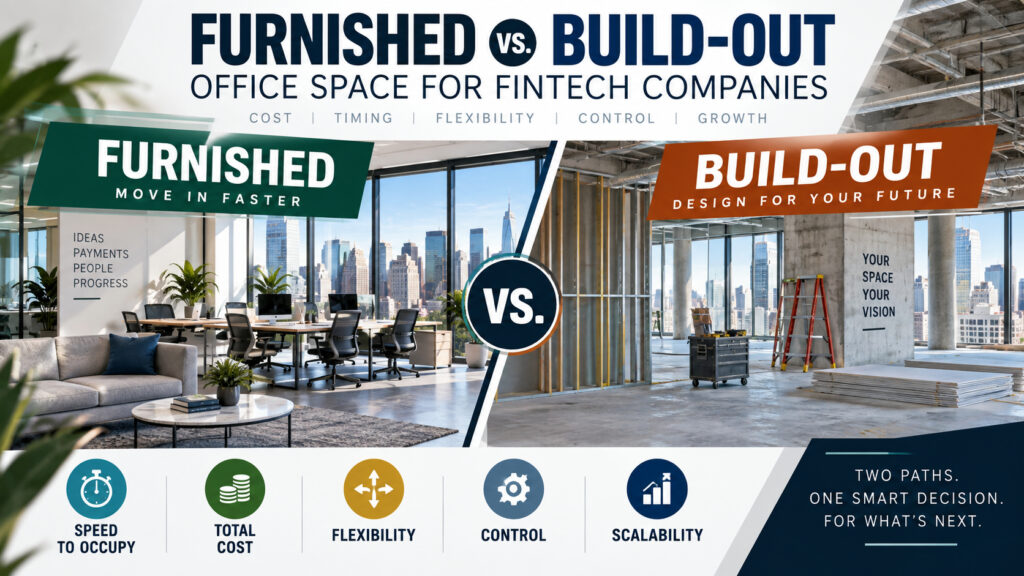
Furnished vs. Build-Out Office Space for FinTech Companies
The decision in plain English
Should a FinTech startup lease a furnished office or build its own office?
For many FinTech companies, furnished or prebuilt space makes sense when speed and capital flexibility matter most. A custom build-out becomes stronger when operational requirements justify construction and a longer commitment.
Funding stage alone should not decide the answer. Neither should employee count.
Instead, focus on six variables:
| Decision factor | Furnished or turnkey office | Custom build-out |
|---|---|---|
| Occupancy deadline | Strong advantage | Requires more lead time |
| Upfront capital | Usually lower | Usually higher |
| Layout control | Existing conditions limit changes | Maximum control |
| Technology scope | Verify existing infrastructure | Design around exact requirements |
| Privacy needs | Can work very well | Easier to optimize |
| Headcount certainty | Protects flexibility | Rewards accurate forecasting |
| Branding | Moderate to strong | Maximum control |
| Long-term control | Depends on lease structure | Usually stronger |
| Construction exposure | Low to moderate | High |
| Furniture responsibility | Often reduced | Tenant controls procurement |
Those factors also dominate the broader furnished-versus-build-out decision tenants encounter today.
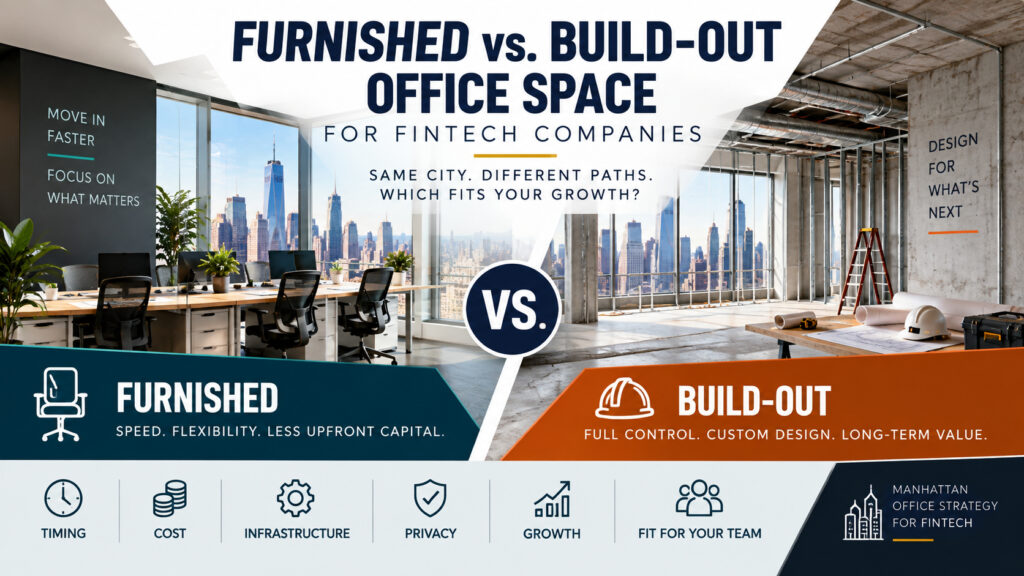
A furnished FinTech office in NYC does not automatically mean coworking. It can mean a private sublease, direct lease, prebuilt suite, or full-floor office.
Likewise, a traditional lease does not automatically require major construction. A landlord may already offer an excellent prebuilt installation.
That distinction changes the entire comparison.
The real question is not furnished versus unfurnished. It is whether an existing office can satisfy your business without unnecessary capital, delay, or compromise.
For example, a team facing a 45-day relocation should approach the search differently from a long-range headquarters project.
Likewise, a payments company may prioritize restricted areas and resilient infrastructure. Another FinTech team may need mostly private calls, meeting rooms, and reliable connectivity.
The smartest choice matches condition, term, infrastructure, economics, and operational risk.
The fastest decision rule
Choose an existing furnished or prebuilt office when it already delivers most critical requirements.
Choose a custom build-out when existing inventory forces compromises that matter for several years.
Consider a lightly modified second-generation office when neither extreme makes financial sense.
That middle option often deserves much more attention.
A private office with existing rooms, cabling, furniture, and infrastructure may need only targeted modifications. That approach can preserve speed without accepting an unsuitable layout.
Our NYC furnished and turnkey office guide explains that broader inventory category in detail.
Do not let the furniture decide the lease. Let the operating requirements decide the office.
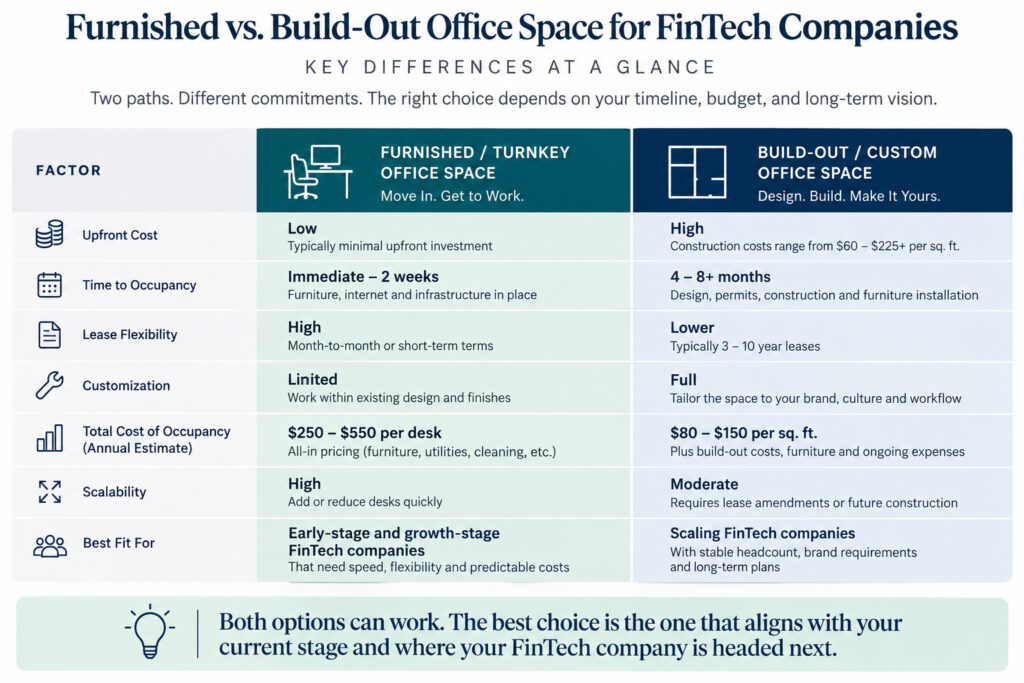
What the office condition terms actually mean
FinTech tenants encounter several terms that sound interchangeable. They are not.
Understanding them prevents a major comparison error.
Furnished office
A furnished office contains desks, chairs, conference furniture, or other workplace furnishings.
However, furniture tells you very little about the lease itself.
A furnished office might involve a direct landlord lease. Another could involve a sublease from an existing tenant.
Some furnished options occupy private full floors. Others occupy partial floors or smaller suites.
Therefore, ask two separate questions:
What condition does the office come in?
What legal structure controls the occupancy?
Those questions reveal more than the furnished label.
Turnkey or plug-and-play office
Turnkey usually describes an office that requires relatively little physical work before occupancy.
The suite may already contain workstations, meeting rooms, a pantry, cabling, and finished interiors.
Yet “turnkey” does not guarantee true operational readiness.
Your company may still need firewalls, circuits, access systems, Wi-Fi equipment, insurance, or security modifications.
A turnkey office can still require significant technology planning.
For that reason, FinTech tenants should treat move-in ready and business ready as different standards.
Prebuilt office
A prebuilt office already has walls, ceilings, lighting, flooring, HVAC distribution, and a working layout.
The landlord may have constructed it before securing a tenant.
Another tenant may have created the original installation.
Furniture may remain, disappear, or become negotiable.
For example, this 6,100-square-foot Downtown prebuilt office currently quotes $39 per square foot. The direct space already contains conference facilities, a kitchen, and an open plan.
That option sits between a furnished sublease and a ground-up build-out.
Second-generation office
Second-generation space contains an existing installation from prior occupancy.
It may already have private offices, meeting rooms, electrical distribution, ceilings, and a pantry.
This category can create excellent value when the existing plan closely matches your requirements.
Small modifications could cost far less than complete reconstruction.
However, inspect the installation carefully.
Existing infrastructure has value only when your team can actually use it.
White-box office
A white box provides a finished starting point without a completed tenant layout.
The space generally still requires planning, approvals, construction, cabling, furniture, and operational setup.
It gives tenants more flexibility than a finished suite.
However, it also carries meaningful timing and capital exposure.
Our white-box office guide explains why this condition often suits longer commitments.
Raw or shell space
Shell space offers the greatest design freedom.
It also creates the largest project.
The tenant may need substantial mechanical, electrical, architectural, technology, and furniture work.
For most fast-moving FinTech teams, raw space needs a compelling reason.
A headquarters project might provide that reason.
A six-month bridge requirement usually does not.
Flexible and managed offices
Flexible offices represent another legal and operating model.
They may bundle furniture, services, meeting rooms, and shorter agreements.
That model can work for very small teams or temporary requirements.
However, flexible office and furnished private office are not synonyms.
A company seeking dedicated access, controlled technology, and private meeting space may prefer a furnished direct lease or sublease.
That option can provide move-in speed without a shared workplace model.
Build-out office
A build-out means construction changes the premises for your occupancy.
The scope may range from light alterations to complete reconstruction.
A FinTech build-out could add:
- private meeting and diligence rooms;
- controlled-access technology areas;
- stronger acoustic separation;
- additional electrical capacity;
- supplemental cooling;
- specialized conference technology;
- additional phone rooms;
- reception and visitor-control areas.
A build-out does not need lavish finishes to justify itself.
Operational requirements create the strongest case for construction.
What furnished and build-out options cost in Manhattan
Rent represents only one part of office economics.
That fact matters especially when comparing furnished space against custom construction.
As of September 2026, Manhattan’s average asking rent reached $80.05 per square foot. Average sublease asking rent stood at $58.44 per square foot. Overall availability measured 13.7%, following a substantial year-over-year decline.
Different Manhattan submarkets show very different economics.
| Manhattan market | Average asking rent | Average sublease asking rent | Availability |
|---|---|---|---|
| Manhattan overall | $80.05/SF | $58.44/SF | 13.7% |
| Midtown | $85.55/SF | $59.88/SF | 12.1% |
| Midtown South | $86.26/SF | $71.39/SF | 16.4% |
| Downtown | $62.01/SF | $47.59/SF | 16.1% |
September 2026 market reporting supports those figures.
These averages do not represent the price of every furnished office.
Existing installation, term, floor height, building quality, views, concessions, and sublease structure all influence economics.
Current individual listings illustrate that point.
A 2,573-square-foot furnished Financial District office currently quotes $39 per square foot. It includes two private offices, a conference room, open workspace, reception, and pantry.
A 6,517-square-foot furnished Downtown office also quotes $39 per square foot. It includes 30 workstations and five conference rooms.
Meanwhile, this 7,367-square-foot furnished Midtown East office currently asks $45 per square foot. The installation includes 22 workstations, three offices, two conference rooms, and another meeting room.
Why build-out cost changes the comparison
Custom construction can materially increase the amount of cash committed before occupancy.
A 2026 NYC fit-out model places hard construction costs at approximately $220.62 per square foot. Its broader all-in model reaches $330.92 per square foot.
That broader calculation includes soft costs, technology, audiovisual systems, furniture, and miscellaneous project expenses.
Not every project costs that much.
A strong second-generation office may need paint, furniture changes, cabling, and limited partitions.
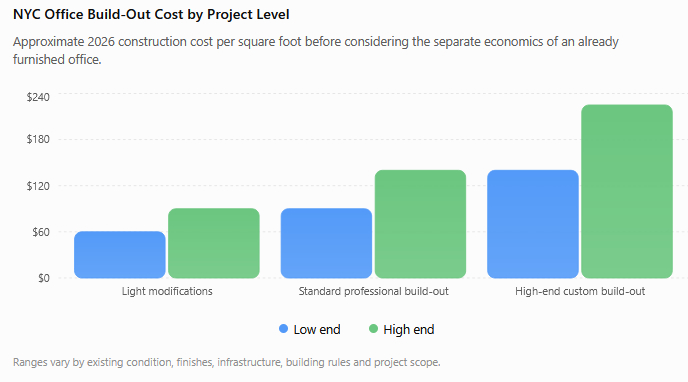
Our 2026 NYC build-out budget guide separates those project levels.
Current working ranges include roughly $60–$90 per square foot for light work. Standard professional build-outs can run roughly $90–$140 per square foot. High-end custom work can exceed $140–$225 per square foot.
Those figures cover different scopes than the all-in industry model.
That distinction matters.
Compare the complete occupancy budget
A useful calculation starts here:
Base rent + additional rent + construction + furniture + technology + security + relocation + professional costs + operating costs + exit obligations
Then subtract landlord contributions and other negotiated credits.
For furnished space, examine a different cost stack.
Rent + additional rent + technology changes + furniture changes + services + relocation + restoration + exit obligations
This approach exposes false savings.
A lower rental rate can lose its advantage after substantial construction.
Conversely, a furnished office with unnecessary premium pricing can cost more across a long term.
Tenant improvement allowances can change the answer
A landlord may contribute toward construction through a tenant improvement allowance.
However, tenants should never assume that allowance covers everything.
Furniture, structured cabling, security systems, AV equipment, Wi-Fi, and technology closets may fall outside the work letter. Our technology and furniture budgeting guide covers those exclusions.
Therefore, compare the tenant’s net cash requirement, not the headline allowance.
Time also has a financial cost
Construction can create rent overlap, delayed occupancy, project management work, and contingency exposure.
Move-in-ready space reduces many of those risks.
However, speed also has value beyond direct cost.
A company signing a new team may need desks immediately.
Another business may face a fixed lease expiration.
During those situations, preserving three months can matter more than several rent points.
The cheapest office on paper can become expensive when it misses the operating deadline.
How FinTech security and infrastructure change the answer
A FinTech office should never rely on a generic “tech office” checklist.
Financial businesses can combine confidential conversations, sensitive information, payment activity, regulated operations, and demanding technology requirements.
That changes due diligence.
Secure does not automatically mean compliant
No office condition creates regulatory compliance by itself.
A furnished office does not create noncompliance either.
The real question concerns whether the premises support your company’s required controls.
For example, New York’s cybersecurity framework applies to covered entities under relevant state financial-services laws. Its current framework includes extensive cybersecurity obligations for regulated organizations.
Federal privacy requirements can also affect certain financial institutions. Current rules cover specified broker-dealers, investment advisers, investment companies, funding portals, and transfer agents.
Payment-card environments can add physical-access considerations.
Current payment-security guidance specifically addresses restricted access around areas containing sensitive cardholder-data systems.
Your compliance, legal, and information-security teams should define the required controls.
Then the real estate search should support them.
Start with physical access
Ask who can enter the floor, suite, technology room, conference areas, and support spaces.
Determine whether the office supports controlled entry without disrupting normal work.
For a furnished sublease, identify which access systems remain after occupancy.
Next, confirm who administers credentials.
A landlord-controlled building card does not necessarily replace tenant-level access control.
Inspect the network environment
“Wired” can mean many things.
It might mean usable structured cabling.
Alternatively, it may simply mean a previous tenant left cables behind.
FinTech tenants should verify:
| Infrastructure question | Why it matters |
|---|---|
| Which carriers serve the building? | Carrier choice affects redundancy and procurement |
| Where does the demarcation occur? | It affects installation planning |
| Who controls the network equipment? | Shared equipment may not fit security policies |
| Can you deploy your own firewall? | Security teams may require it |
| Does the suite have usable cabling? | Existing wiring can reduce setup time |
| Can you add dedicated circuits? | Dense technology loads can need more capacity |
| Does the IT room have adequate cooling? | Equipment creates heat |
| Does the building offer generator support? | Resilience requirements vary |
| Can you create restricted zones? | Some workflows need controlled areas |
Do not rely on marketing terms.
Have the appropriate technology team inspect the space before commitment.
Acoustic privacy matters too
Cybersecurity receives attention, but conversations can also expose sensitive information.
Open benching can create problems during customer calls, diligence meetings, interviews, and internal risk discussions.
FinTech teams should count private rooms against actual meeting demand.
A floor with 50 desks and two conference rooms may perform poorly.
Another floor with fewer desks could support the business better.
Therefore, evaluate usable privacy per employee, not only workstation capacity.
Build-out offers precise control
Custom construction lets the team position secure rooms, conference areas, workstations, and visitor zones deliberately.
You can also coordinate cabling, power, cooling, access controls, and acoustic work.
That control can justify construction.
Yet an existing office can deliver the same outcome when its infrastructure already matches your requirements.
Do not build a custom headquarters merely because the business handles financial data.
Build when the existing market cannot provide the required operating environment.
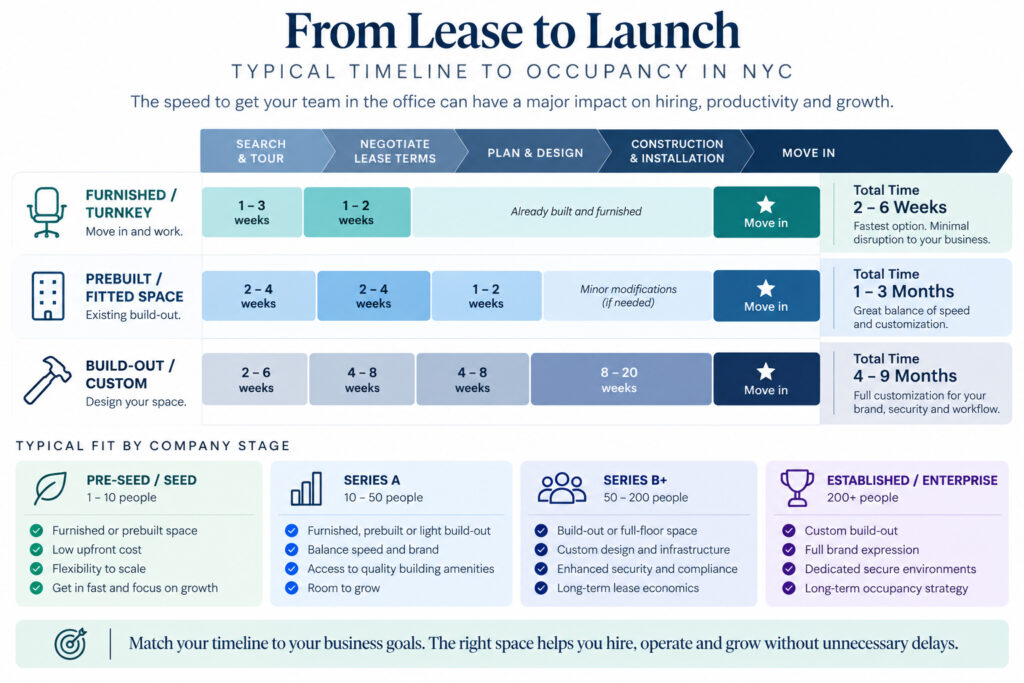
How growth, timing, and lease structure change the answer
Startups often hear a simple rule.
Use furnished space early, then build a headquarters after raising more capital.
That rule can help, but it oversimplifies the decision.
A mature company may still need furnished swing space.
A younger company may have unusual infrastructure requirements that justify construction.
Instead, connect the office decision to forecast confidence.
When furnished FinTech office space usually wins
A move-in-ready office becomes especially attractive when headcount remains uncertain.
It also works well when the occupancy deadline approaches quickly.
For example, consider a company with 24 employees today.
Management expects somewhere between 35 and 60 employees within eighteen months.
That forecast creates a wide range.
An expensive custom build designed around 60 people carries one risk.
Building around 35 employees creates another.
Existing furnished space can reduce the amount of capital exposed to that uncertainty.
When build-out usually becomes stronger
Construction gains value when several conditions align.
The company expects a sustained occupancy period.
Leadership can forecast peak attendance with reasonable confidence.
Operational requirements cannot fit efficiently within available installations.
The company also values control enough to justify the project.
Branding alone rarely provides a complete economic case.
Functional requirements create a much stronger argument.
Size for peak attendance, not payroll alone
Hybrid schedules complicate office sizing.
A 100-person company does not always need 100 assigned desks.
Likewise, 60 desks may fail when most employees attend on Tuesdays.
Start with expected peak simultaneous attendance.
Then add meeting rooms, circulation, pantry space, technology areas, storage, and growth.
A practical planning range often starts around 125 to 175 rentable square feet per employee. Lean hybrid teams can run tighter. Room-intensive organizations may need considerably more.
The layout still matters more than a universal ratio.
Lease structure deserves equal attention
Two equally furnished offices can create very different risks.
A direct lease may offer stronger long-term control.
A sublease can offer attractive existing improvements and furniture.
However, the sublease cannot extend beyond the underlying lease.
It also introduces another contractual layer.
Accordingly, review consent rights, restoration obligations, extension possibilities, and furniture ownership.
A short furnished sublease can serve as excellent bridge space.
For example, this 5,000-square-foot furnished NoMad office supports more than 35 seats. Its published sublease term runs through September 2027.
That remaining term may suit a temporary requirement better than a long-term headquarters.
Conversely, this 11,091-square-foot turnkey Midtown office carries a published term through August 2034. It offers a much longer planning horizon.
Expansion rights can outweigh extra square footage
Growth companies should examine adjoining space and future expansion paths.
A slightly imperfect office can become attractive with meaningful expansion rights.
A perfect suite can become problematic when no growth path exists.
Potential protections include rights on adjoining premises, renewal options, assignment rights, and sublease flexibility.
Negotiated contraction or termination rights may also matter.
These rights depend on the building, term, landlord, and tenant profile.
Neighborhood should follow operating patterns
Downtown often deserves attention from FinTech tenants seeking strong transit access and financial-district positioning.
Its September 2026 average asking rent also remained below Midtown’s broad average.
Midtown South can appeal to teams balancing technology recruitment with central access.
Midtown provides broad transportation choices and significant high-quality inventory.
Hudson Yards can accommodate larger teams seeking modern building infrastructure.
Do not choose a district solely because other technology or finance companies occupy it.
Employee commute patterns, customer meetings, budget, and inventory should drive the map.
Move-in-ready Manhattan options to compare now
The furnished FinTech office NYC market includes much more than shared workspace.
Current inventory spans compact private suites, furnished subleases, landlord prebuilts, and large institutional installations.
The following examples show how different those choices can look.
Availability, pricing, and deal terms can change during negotiations.
Smaller move-in-ready offices
A company seeking compact Financial District space can compare this 2,573-square-foot furnished office.
The current listing quotes $39 per square foot. Its plan includes open workspace, two private offices, a ten-person conference room, reception, and pantry.
That configuration may suit a team needing privacy without excessive room count.
Another Financial District option offers approximately 4,677 square feet.
This full-floor furnished Downtown office currently quotes $42 per square foot. Current availability includes prebuilt floors and furnished interiors.
Those options demonstrate an important point.
Small furnished offices can still provide dedicated private premises.
A tenant does not need to default to coworking merely because the team remains compact.
FinTech offices around 5,000 to 7,500 square feet
This size range offers many useful comparisons.
| Move-in-ready option | Size | Current structure | Useful characteristic |
|---|---|---|---|
| Furnished NoMad office | 5,000 SF | Sublease | 35+ open seats and six offices |
| Furnished Pine Street office | 5,606 SF | Sublease | Expansion potential to 15,752 SF |
| Downtown sublet office | 6,098 SF | Sublease | 14 perimeter rooms and boardroom |
| Downtown prebuilt office | 6,100 SF | Direct lease | Existing conference and kitchen facilities |
| Downtown furnished office | 6,517 SF | Sublease | 30 workstations and five meeting rooms |
| Midtown East furnished office | 7,367 SF | Sublease | Offices, sit-stand desks, and meeting rooms |
Published listing details confirm those current configurations.
The differences matter more than the similar square footage.
A sales-heavy FinTech business may value conference capacity.
An engineering-heavy team may prefer greater open seating.
An executive-heavy financial company may need more perimeter rooms.
Therefore, compare functional capacity, not size alone.
Expansion without an immediate build-out
The 5,606-square-foot Pine Street furnished office presents a useful growth example.
Its current plan supports approximately 37 employees. The published offering also allows expansion up to 15,752 square feet.
That growth path could matter more than taking a larger office immediately.
Expansion flexibility can preserve capital while protecting future capacity.
Larger furnished offices for established teams
Move-in-ready inventory extends well beyond startup-sized suites.
This 10,115-square-foot furnished Financial District full floor offers a direct lease. The layout contains twenty perimeter rooms and two larger open areas.
A more meeting-intensive team can review this 11,091-square-foot turnkey Midtown suite.
It includes executive offices, a boardroom, additional conference rooms, and open workstations. The published term extends through August 2034.
That option challenges another common assumption.
Furnished does not necessarily mean temporary.
A well-structured turnkey transaction can support a substantial occupancy horizon.
Larger modern office requirements
Teams requiring much more space can evaluate this 20,222-square-foot furnished Hudson Yards office.
The current offering supports an estimated capacity of 133 people. It offers immediate occupancy and a minimum five-year term.
The suite already contains a high-end installation, workstations, meeting areas, and staff facilities.
That type of opportunity can change the build-versus-furnished calculation significantly.
A company could gain a sophisticated environment without recreating every improvement.
However, existing quality does not remove technical due diligence.
Teams should still examine network architecture, power, access control, acoustics, and expansion potential.
Prebuilt space can provide the overlooked middle ground
Suppose you like a direct lease but dislike the construction timeline.
A completed prebuilt office may solve that problem.
The 6,100-square-foot Downtown prebuilt office currently asks $39 per square foot.
It already contains a functioning office installation.
A tenant could then add furniture, technology, security, and modest modifications.
That approach may provide more control than a furnished sublease.
It can also avoid the cost profile of a complete build-out.
For many FinTech tenants, the strongest comparison has three columns: furnished, prebuilt, and custom build-out.
How to inspect, negotiate, and choose the right space
A polished office can still hide expensive problems.
FinTech tenants should conduct operational due diligence before choosing based on appearance.
Start with the actual installation.
Count what the team can use
A workstation count does not equal comfortable capacity.
Measure desk sizes and circulation.
Next, count private rooms.
Determine which rooms truly work for video calls, interviews, customer discussions, and executive meetings.
A room with glass walls may offer visual privacy without acoustic privacy.
Similarly, a large conference room may not replace several small call rooms.
Verify the furniture
Ask exactly which items remain.
Confirm who owns them.
Then determine whether the furniture transfers with the transaction.
Check chairs, desks, monitor arms, conference tables, storage, and reception pieces.
Furniture photos can become outdated.
Inspect the actual pieces during the tour.
Also determine who handles broken or missing items before possession.
Test the technology assumptions
A “wired” suite still needs verification.
Inspect data cabling, outlets, telecom closets, risers, carrier access, Wi-Fi locations, electrical capacity, and cooling.
Confirm installation lead times before establishing the move date.
A fast real-estate transaction cannot overcome a delayed circuit installation.
Likewise, existing cabling has little value when it conflicts with your network design.
Ask what the landlord will permit
Furnished does not have to mean untouched.
Some deals allow substantial modifications.
A tenant may negotiate signage, additional partitions, access control, sound treatments, supplemental cabling, or furniture changes.
Other agreements heavily restrict alterations.
Request those rules before comparing the space against a custom build-out.
Examine the HVAC schedule
Technology teams often work outside standard building hours.
Confirm normal HVAC hours and overtime costs.
Also evaluate the temperature needs around network equipment.
An office can look perfect at noon and become operationally inconvenient at night.
Review the lease horizon against the growth plan
Map three headcount cases.
Use a conservative case, expected case, and high-growth case.
Then test each space against all three.
A good office should survive reasonable forecasting errors.
Avoid paying today for speculative growth several years away.
However, do not create another relocation six months after occupancy.
Build a move-in schedule before signing
Work backward from the required operational date.
Include legal review, insurance, access credentials, furniture, technology, security, moving, and employee communications.
Custom construction needs additional stages.
Those stages include design, approvals, permitting, procurement, construction, inspections, punch-list work, and commissioning.
A conventional office fit-out can require several months.
Complex projects can run longer.
That makes timeline contingency essential.
Compare the furnished office against a real build-out budget
Never compare a finished suite against an imaginary construction figure.
Price the actual alternative.
Start with architectural changes.
Add mechanical and electrical work.
Then add furniture, IT, security, AV, professional services, moving, and contingency.
Current NYC benchmarks show why this exercise matters. Hard construction can exceed $200 per square foot before broader project costs.
A lighter second-generation modification can cost substantially less.
That is why the condition of the competing build-out option matters so much.
Put the decision into a weighted scorecard
A FinTech tenant can simplify the final comparison with a weighted model.
| Category | Suggested question |
|---|---|
| Occupancy | Can we operate by the required date? |
| Capital | How much cash leaves the business before occupancy? |
| Term | Does the commitment match planning visibility? |
| Growth | Can the office absorb realistic headcount changes? |
| Privacy | Can employees hold sensitive conversations properly? |
| Technology | Can our infrastructure team deploy the required environment? |
| Access | Can we control employee and visitor movement? |
| Resilience | Does the building support our continuity requirements? |
| Layout | Does the room mix match daily work? |
| Culture | Will employees actually use this workplace? |
| Client use | Does the office support external meetings? |
| Exit | What happens when we leave or outgrow it? |
Assign greater weight to the factors that can disrupt operations.
For a regulated FinTech company, security and technology might carry substantial weight.
For a recently funded growth business, flexibility could matter more.
For an established headquarters, layout and long-term economics may dominate.
Watch the exit obligations
Construction gets attention at move-in.
Restoration gets attention too late.
Review what must happen when the term ends.
A tenant might need to remove cabling, signage, access equipment, furniture, or specialty installations.
Subleases can create different surrender requirements.
Furnished transactions also need clear furniture language.
Therefore, model the end of occupancy before starting it.
An office decision lasts longer than the move-in day.
Frequently asked questions for FinTech office tenants
Should a FinTech startup lease furnished space or build its own office?
Choose furnished or prebuilt space when speed, capital preservation, and uncertainty dominate the decision.
Choose construction when important operational requirements cannot fit within existing inventory.
The strongest choice depends on your occupancy horizon and actual requirements.
A Series A label does not automatically require furnished space.
Likewise, later-stage funding does not automatically justify construction.
Is a furnished FinTech office less secure than a custom office?
Not necessarily.
A private furnished office can support strong access, network, and privacy controls.
However, tenants need to inspect what already exists.
Custom construction offers more control when the business needs specialized restricted zones or infrastructure.
The security program matters more than who purchased the desks.
Does a furnished office mean coworking?
No.
Furnished space can involve a private direct lease, private sublease, managed suite, or shared-office arrangement.
Those structures offer very different levels of control.
A company seeking privacy can therefore pursue move-in-ready space without accepting a shared environment.
That distinction matters greatly for financial businesses.
What is the difference between furnished and turnkey office space?
Furnished describes the presence of furniture.
Turnkey describes a broader level of readiness.
A turnkey office may include existing rooms, finishes, cabling, pantry facilities, and furniture.
However, neither label guarantees your technology stack can operate immediately.
Always verify infrastructure independently.
What is the difference between a prebuilt office and furnished office?
A prebuilt office contains a completed physical installation.
It may or may not include furniture.
A furnished office includes furniture, but the underlying installation may vary greatly.
Therefore, a prebuilt direct lease can provide an excellent middle option.
It offers speed while preserving more control over furniture and technology.
Can a FinTech startup build out a prebuilt office?
Yes, subject to the lease and landlord approvals.
Many tenants modify existing space instead of rebuilding everything.
You might add phone rooms, access control, cabling, sound treatments, or another conference room.
That targeted approach can preserve useful existing improvements.
It also limits unnecessary demolition.
How quickly can a FinTech company occupy a furnished Manhattan office?
A completed office can dramatically shorten the physical preparation period.
However, lease negotiations, legal review, insurance, technology, and access setup still take time.
Signing and operating remain separate milestones.
A prepared tenant can sometimes complete a straightforward Manhattan transaction within several weeks.
Technology procurement can still extend the true move date.
How long does an office build-out take?
Project timing depends on design complexity, approvals, procurement, building rules, and construction scope.
A substantial custom project commonly requires several months from planning through occupancy.
Complex infrastructure can extend that period.
Small modifications to existing offices can proceed much faster.
Therefore, identify the required work before applying a generic timeline.
How much does an office build-out cost in NYC?
Scope creates enormous variation.
Current 2026 NYC industry benchmarking puts hard fit-out costs around $220.62 per square foot. A broader all-in model reaches approximately $330.92 per square foot.
That broader model includes furniture, technology, audiovisual equipment, soft costs, and other items.
Lighter projects can cost far less.
Our NYC office build-out budgeting guide breaks down lighter and more customized projects.
Is furnished office space always more expensive per square foot?
No.
A furnished office may carry a premium when furniture and services add value.
A sublease can also quote well below broad market averages.
Current Manhattan examples demonstrate both possibilities.
The correct comparison uses net occupancy economics across the planned term.
Furniture alone cannot determine value.
What hidden costs should a FinTech company include?
Include technology, security, legal work, moving, insurance, cabling, furniture changes, and after-hours HVAC.
Custom projects also need design, project management, permitting, AV, contingency, and construction costs.
Lease exit costs deserve attention too.
A complete budget should also account for rent overlap during relocation.
How should a FinTech company calculate total office cost?
Start with rent and additional rent.
Then add all capital required to reach operational readiness.
Include technology, furniture, security, relocation, professional expenses, and operating costs.
Subtract landlord contributions and negotiated credits.
Finally, include expected exit obligations.
Compare the result across the same occupancy period.
When does custom build-out become financially reasonable?
It becomes easier to justify when the company expects a longer occupancy.
Stable headcount also strengthens the case.
Existing inventory must fail important requirements before construction becomes necessary.
Strong landlord contributions can improve the economics.
Reusable furniture and technology may also reduce long-term cost.
Should a FinTech startup use funding stage to choose an office?
Funding stage provides context, not an answer.
Runway, hiring certainty, occupancy horizon, and operating requirements provide better decision inputs.
A well-funded startup can still face uncertain headcount.
A profitable smaller business may know its long-term needs precisely.
Use business visibility instead of labels.
How much space does a FinTech company need per employee?
There is no universal number.
A working range often starts around 125 to 175 rentable square feet per employee.
Hybrid teams can operate below that range.
Meeting-heavy or private-office layouts can require substantially more.
Peak attendance offers a better starting point than payroll headcount.
How should hybrid work affect office size?
Measure the busiest expected office day.
Next, determine how many employees need assigned desks.
Then calculate meeting, phone-room, pantry, collaboration, storage, and support needs.
Do not simply multiply total headcount by a square-footage ratio.
Hybrid schedules can create intense peak-day demand.
What are the disadvantages of an open FinTech office?
Open layouts can create noise, distractions, visual exposure, and insufficient call privacy.
Those problems become more important during sensitive financial conversations.
A strong open plan needs sufficient enclosed rooms.
Phone rooms also help with frequent individual calls.
Acoustic treatment can improve performance without eliminating collaboration.
Does office design affect FinTech productivity?
Yes, because layout changes how employees focus, collaborate, meet, and communicate.
However, attractive design alone does not create productivity.
Room availability matters.
Acoustics matter too.
Technology reliability, daylight, comfort, circulation, and workstation density also influence everyday usability.
What should FinTech teams inspect in furnished furniture?
Test the actual workstations.
Check desk dimensions, chair adjustability, storage, and monitor capacity.
Confirm the furniture quantity matches the floor plan.
Ask whether desks can move.
Determine who owns each major item.
Finally, document the agreed inventory before possession.
What should a FinTech company inspect in the IT room?
Start with power and cooling.
Then examine physical access, rack space, cable pathways, and carrier connections.
Confirm whether old equipment stays or leaves.
Determine who controls each piece of infrastructure.
Your technology team should approve the condition before commitment.
Does “wired” mean a FinTech company can move in immediately?
No.
Existing cabling may save significant time.
However, the network still needs configuration, security controls, equipment, and provider service.
Previous wiring may also lack documentation.
Therefore, test rather than assume.
“Wired” describes infrastructure, not operational readiness.
Should FinTech companies care about redundant internet carriers?
Some businesses need more resilience than others.
A company supporting critical customer operations may prioritize carrier diversity.
Another team may tolerate a simpler setup.
Define business-continuity requirements before the search.
Then verify which providers and pathways the building can support.
How does FinTech regulation affect office build-out capital?
Applicable controls can expand technology and physical-security requirements.
Restricted rooms, access control, additional cabling, monitoring, and network infrastructure can add scope.
Privacy requirements may also influence room design.
However, regulatory status varies by company and activity.
Your compliance team should define requirements before construction budgeting.
Should a FinTech company buy an office condo instead?
Buying represents a separate capital-allocation decision.
Ownership can suit companies with long planning horizons and a strong preference for real-estate control.
Leasing generally preserves greater relocation flexibility.
It also preserves capital for other corporate uses.
Compare ownership against leasing only after establishing long-term space certainty.
What office expansion rights should a FinTech company negotiate?
Useful rights can include renewal options and access to adjoining premises.
Rights of first offer may also create future capacity.
Assignment and sublease flexibility can protect against unexpected change.
Some tenants also negotiate contraction or termination mechanisms.
The right package depends on leverage and deal structure.
Can a company repurpose an existing office instead of completing a full build-out?
Often, yes.
Second-generation space can support highly targeted modifications.
Keep useful offices, meeting rooms, ceilings, lighting, plumbing, and cabling where possible.
Then change the areas that interfere with operations.
That approach can reduce cost, construction waste, and occupancy delays.
What happens when furnished space has the wrong furniture?
Do not reject the office automatically.
First, determine whether the furniture can leave.
Some owners or sublessors will remove unwanted pieces.
Another deal may allow a partial replacement.
Compare that cost against rejecting an otherwise strong installation.
Desks are easier to change than walls and infrastructure.
Is a short furnished sublease always better for a startup?
No.
A short term limits commitment.
It can also force another relocation sooner than expected.
Moving twice creates real cost and disruption.
Evaluate whether the remaining term provides enough runway beyond the expected growth milestone.
A bridge should actually reach the next bridgehead.
Can a long-term FinTech headquarters still use furnished space?
Absolutely.
Existing high-quality installations can support long commitments.
Furniture ownership can also transfer or change during negotiations.
The question is whether the premises fit long-term requirements.
For example, the current 11,091-square-foot turnkey Midtown office carries a published term through August 2034.
Furnished condition alone does not make an office temporary.
How should a FinTech company compare Downtown against Midtown?
Start with commute patterns, customer locations, building requirements, and budget.
Downtown currently carries lower broad asking-rent averages than Midtown.
However, individual opportunities can depart significantly from market averages.
A furnished sublease can also price differently from direct inventory.
Tour both districts when operating requirements permit.
Does location matter more than office condition?
Sometimes.
A perfect office in the wrong location can hurt attendance and recruiting.
Likewise, an ideal address does not fix an unusable layout.
Treat location and condition as separate variables.
Then compare each against cost, commute, customers, and business needs.
Will office space become obsolete for FinTech companies?
Hybrid work changes how companies use offices.
It does not eliminate the functions offices perform.
Teams still need collaboration, private conversations, meetings, onboarding, culture, technology, and customer interaction.
The important shift concerns utilization.
Companies increasingly need the correct office rather than the maximum office.
How much should a company spend on office space?
No universal revenue percentage works for every FinTech business.
A company should relate occupancy costs to cash flow, runway, hiring plans, and strategic value.
Model downside scenarios as well as expected growth.
A lease should remain manageable when hiring slows.
Likewise, extreme underinvestment can create operational problems.
What role does coworking play for a FinTech startup?
It can solve a small or temporary requirement quickly.
The model may suit founders, temporary project teams, or market-entry groups.
However, shared environments can complicate privacy and infrastructure preferences.
A private furnished lease can provide a useful middle path.
Evaluate the actual operating environment instead of the category label.
When should a FinTech company leave flexible space for a private office?
Cost can provide one trigger.
Privacy can provide another.
Growing meeting demand also matters.
Teams often reconsider shared environments when dedicated rooms and controlled access become operational priorities.
The transition should follow business requirements rather than an arbitrary employee threshold.
Which is better for client meetings?
Either office condition can work.
A furnished suite with quality conference rooms may outperform a newly constructed open office.
A custom build can deliver a more deliberate visitor experience.
Meeting frequency should influence the room count.
Confidentiality and acoustics should influence the room design.
What is the biggest mistake when choosing furnished office space?
Judging the space by appearance.
A beautiful installation can have poor meeting capacity, weak infrastructure, or an unsuitable term.
Furniture can also distract from expensive lease obligations.
Start with operations.
Then examine economics.
Aesthetics should follow both.
What is the biggest mistake when choosing a build-out?
Overbuilding for projected growth.
Forecasts change.
Every additional room, finish, workstation, and technology feature consumes capital.
Build around credible operating requirements.
Protect future growth through lease rights where possible.
Optionality can offer more value than unused construction.
What is the best middle ground between furnished and custom build-out?
A strong prebuilt or second-generation office often provides that middle ground.
The existing installation handles expensive foundational work.
Your team then modifies selected areas.
This approach can combine private occupancy, faster delivery, lower capital exposure, and meaningful customization.
For many FinTech searches, it deserves comparison before choosing either extreme.
What should we compare before touring FinTech offices?
Define the peak in-office population first.
Then establish the required occupancy date.
Set the acceptable term range and complete capital budget.
Next, document meeting, privacy, technology, and security requirements.
Finally, identify preferred neighborhoods and acceptable alternatives.
This preparation prevents attractive but unsuitable offices from consuming the search.
What should we compare after touring?
Compare usable seat count, room mix, infrastructure, term, expansion options, and all-in economics.
Then compare the cost of reaching operational readiness.
An imperfect furnished office may need modifications.
A raw office needs substantially more work.
Put those costs on the same timeline.
That comparison usually makes the answer much clearer.
We represent office tenants, not landlords, across Manhattan leasing decisions.
We compare furnished, prebuilt, sublease, and build-out options through one occupancy model.
Our goal is to protect your timeline, capital, flexibility, and negotiating leverage.
Discuss Space and Receive Report
We can help you compare furnished, prebuilt, and build-out office opportunities based on your team size, budget, timeline, and growth plans. Send us your requirements, and we’ll prepare a customized NYC Office Space Report with available spaces that match your specific needs.
Fill out our 📋 online form or give us a call today 📞 212-967-2061 — let’s find the right options for your business.