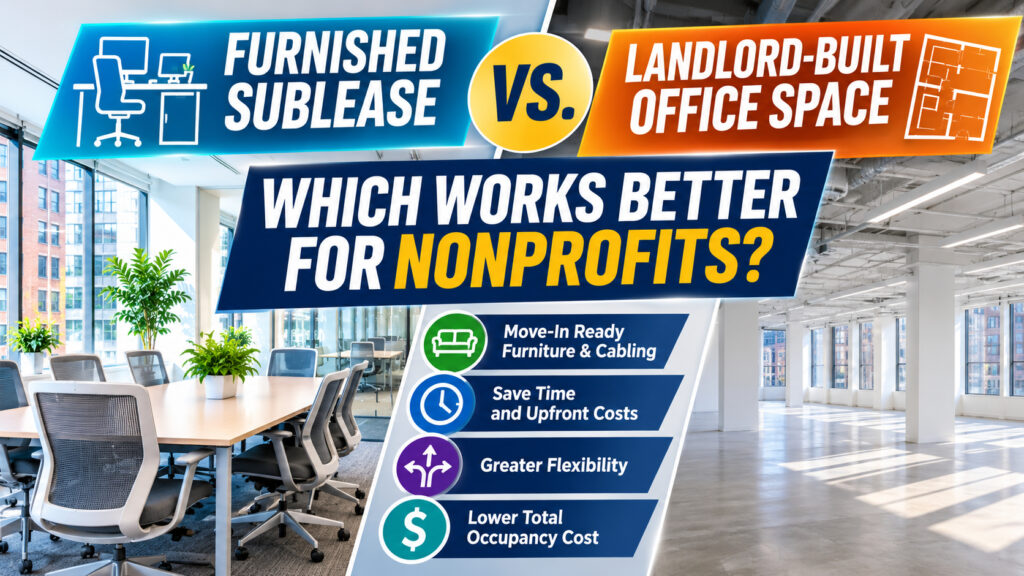
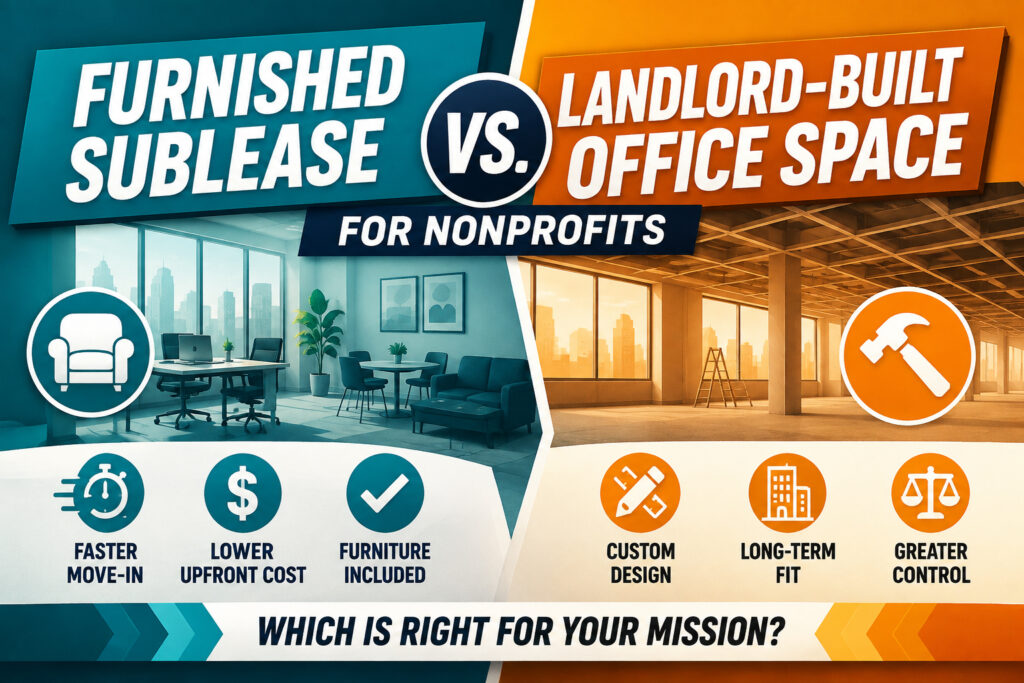
Furnished Sublease vs. Landlord-Built Office Space for Nonprofits
For most nonprofits, a furnished sublease requires less cash before move-in than a custom office buildout. Furniture, conference rooms, cabling, and existing construction can already sit in place. Sublease rent may also fall below broader Manhattan asking rents.
However, that comparison needs one important distinction.
A landlord-built office does not always mean an empty office requiring months of construction. Many landlords offer finished prebuilt suites. Some landlord prebuilts even include furniture and can compete directly with furnished subleases.
Therefore, nonprofits should compare three choices rather than two. Those choices include furnished subleases, landlord prebuilts, and custom landlord-built offices.
The cheapest asking rent does not always produce the cheapest occupancy. A nonprofit should compare initial cash, full-term cost, lease flexibility, and operational fit. Renewal rights, funding certainty, construction exposure, furniture, and relocation risk also matter.
For organizations protecting program dollars, that broader comparison can change the answer completely.
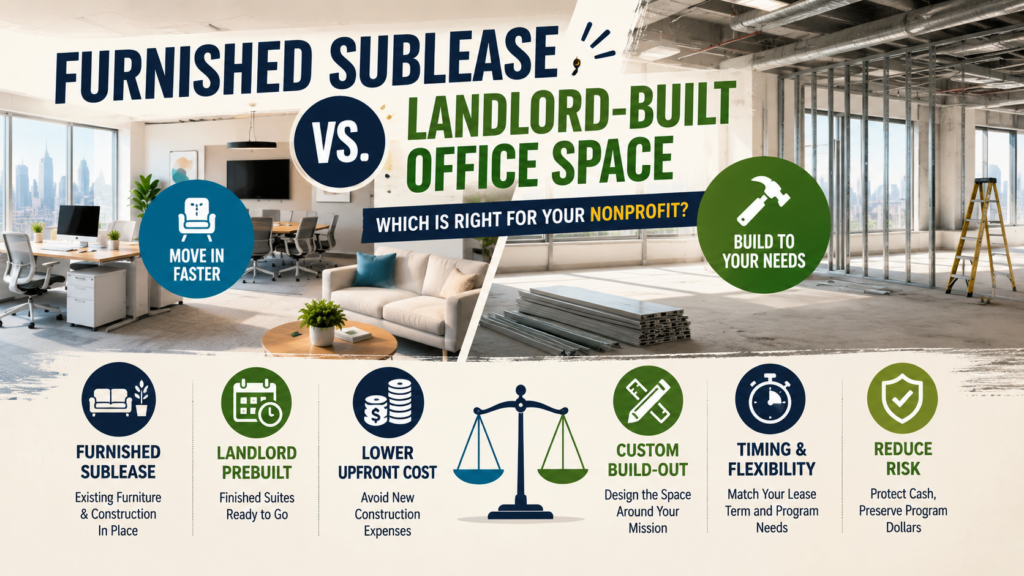
The Real Answer: Is a Furnished Sublease Cheaper Than Building Out an Office?
Usually, yes, when the alternative requires a meaningful new buildout.
A furnished sublease lets the nonprofit inherit an existing office environment. Desks, offices, conference rooms, kitchens, and cabling may already exist. Consequently, the organization avoids many costs that accompany a new installation.
Current Manhattan pricing also supports the economic case.
During the second quarter of 2026, Manhattan sublease asking rent averaged $59.94 per square foot. The broader Manhattan asking-rent benchmark averaged $80.17 per square foot. Sublease availability represented 2.6% of the market under the same methodology.
That pricing difference equals roughly 25% before considering furniture or construction savings.
Consider a simple 5,000-square-foot comparison:
| Cost measure | 5,000 SF at $59.94/SF | 5,000 SF at $80.17/SF |
|---|---|---|
| Annual asking rent | $299,700 | $400,850 |
| Monthly equivalent | $24,975 | $33,404 |
| Annual difference | $101,150 |
These figures provide market benchmarks rather than quotes for any particular building. Building class, neighborhood, floor quality, term, and concessions can move actual economics substantially.
Our Manhattan office pricing guide explains why quoted rent alone rarely tells the whole story. Tenants should compare effective occupancy costs instead.
Construction creates the second major difference.
A 2026 New York fit-out benchmark places hard construction costs near $220.62 per square foot. Adding soft costs, technology, audiovisual systems, furniture, and related expenses raises the planning benchmark near $330.92 per square foot.
At 5,000 square feet, those benchmarks equal approximately:
| Planning category | Approximate benchmark |
|---|---|
| Hard construction | $1,103,100 |
| Broader all-in fit-out | $1,654,600 |
A nonprofit should not assume it must write a check for those entire amounts.
Landlords can absorb construction through existing improvements, work letters, or negotiated contributions. A finished prebuilt suite may require almost no meaningful construction. Likewise, a direct lease can include valuable rent concessions.
Our office buildout and furniture budget guide breaks those components apart.
Where the simple “sublease is cheaper” rule fails
A furnished sublease can lose its financial advantage when several conditions appear together.
The layout may need expensive changes. The remaining term could force another move within two years. Technology may require replacement despite existing wiring. A landlord prebuilt could also offer stronger concessions and a longer useful life.
Conversely, a good furnished sublease can create exceptional value.
Imagine that the existing layout already matches the nonprofit’s program. Furniture remains in place, cabling works, and the lease term matches funding visibility. In that situation, the organization can preserve capital and begin operating quickly.
The correct comparison therefore has two separate questions:
Which option requires less cash before occupancy?
A well-fitted furnished sublease usually wins.
Which option costs less throughout the nonprofit’s required occupancy period?
Either option can win.
That second question deserves the greater weight.
What Furnished Sublease and Landlord-Built Office Space Actually Mean
The phrases describe different parts of an office transaction.
“Sublease” describes the contractual relationship.
“Furnished” describes the physical condition.
“Landlord-built” describes who delivered or funded the office improvements.
Those categories can overlap.
For example, a landlord can build a prebuilt office and furnish it. A nonprofit could sign that office directly from the owner. Current Manhattan inventory includes both furnished direct prebuilt space and new landlord prebuilt space with furniture.
Likewise, a sublease may arrive furnished but still need technology or security work.
That distinction matters because tenants often compare the wrong categories.
The three practical choices
| Question | Furnished sublease | Landlord prebuilt direct lease | Custom landlord-built direct lease |
|---|---|---|---|
| Who holds the primary landlord relationship? | Existing tenant | Nonprofit | Nonprofit |
| Existing construction | Usually substantial | Usually complete | May require substantial work |
| Furniture | Often included | Sometimes included | Usually negotiated separately |
| Cabling | Often remains | Varies | Designed around tenant needs |
| Customization | Limited | Moderate | Highest |
| Lease term | Cannot exceed master lease | Negotiated directly | Usually supports longer occupancy |
| Renewal rights | No automatic continuation | Negotiable | Negotiable |
| Expansion rights | Usually limited | Potentially negotiable | Potentially negotiable |
| Move-in speed | Often fast after approvals | Can also be fast | Usually slowest |
| Upfront capital exposure | Usually lowest | Low to moderate | Potentially highest |
| Contractual control | Lowest | Higher | Highest |
A subtenant sits underneath another tenant’s master lease. Therefore, the sublease cannot create rights beyond that underlying agreement.
Direct tenants negotiate with the building owner instead. They can address renewal, expansion, work, signage, and operating requirements directly.
The uploaded comparison material shows the same core distinction. Subleases favor speed and existing improvements, while direct leases provide greater control.
What “turnkey” should mean to a nonprofit
Turnkey should mean more than desks sitting inside an office.
A useful turnkey office should support normal operations without a major construction project. Furniture should fit the proposed headcount. Conference rooms should support actual meeting needs. Cabling must work with the nonprofit’s technology.
Security also needs testing.
A counseling organization may require strong acoustic privacy. An education nonprofit may need training rooms. A membership organization could need event space. Another group may value donor-facing conference rooms over workstation density.
Our guide to furnished subleases and prebuilt suites explains why finished space has become increasingly important.
The physical fit matters more than the label.
A beautifully furnished office that requires major demolition offers little turnkey value. Meanwhile, an unfurnished prebuilt could require only desks and technology.
For that reason, tour every option as an operating environment rather than a marketing category.
The Nonprofit Cost Comparison: Rent, Buildout, Furniture, and Concessions
A nonprofit should evaluate office choices through three financial lenses.
First, calculate cash required before opening. Next, calculate total occupancy cost throughout the planned term. Finally, measure the cost of leaving or relocating.
That process creates a much clearer comparison than asking rent alone.
Cash required before occupancy
A furnished sublease can reduce several immediate expenses:
| Cost item | Furnished sublease | Landlord prebuilt | Custom landlord build |
|---|---|---|---|
| Construction | Often limited | Usually limited | Potentially substantial |
| Desks and chairs | Often included | Sometimes included | Usually separate |
| Conference furniture | Often included | Sometimes included | Usually separate |
| Existing cabling | Common | Varies | New installation |
| Kitchen installation | Existing | Existing | May require work |
| Architect and design | Usually minimal | Usually minimal | Often required |
| Move coordination | Required | Required | Required |
| Security deposit | Likely | Likely | Likely |
A furnished office does not remove every move-in expense.
Internet service may need activation. Existing cables may not satisfy current standards. Access control can require changes. AV equipment may not remain.
Therefore, create a written inventory before valuing any “included” infrastructure.
Furniture has real economic value
Furniture transfers can materially reduce move-in spending.
However, the sublease should identify exactly what remains. The agreement should address desks, task chairs, conference tables, storage, appliances, and reception furniture.
Ownership also matters.
Ask whether the nonprofit receives ownership or merely usage rights. Clarify who removes damaged items. Determine what happens when the sublease expires.
A photograph alone provides poor protection.
Instead, attach a detailed furniture exhibit to the agreement. Test mechanical desks, conference equipment, televisions, and appliances before possession.
Direct space can fight back through concessions
A direct lease may carry higher face rent yet produce competitive effective economics.
The landlord may deliver completed construction. Free rent can reduce early occupancy costs. A tenant-improvement package may offset required alterations.
An owner might also modify an existing prebuilt suite.
For example, the Garment District full-floor prebuilt offers an existing installation where landlord modifications may remain possible. That structure differs significantly from leasing raw space.
Therefore, compare net cost after landlord contributions, not simply asking rent.
Full-term cost matters more than first-year rent
Suppose a nonprofit needs the same Manhattan location for seven years.
A two-year discounted sublease may look inexpensive today. Yet the organization then faces another search, another move, legal expenses, and possible downtime.
A five-year or seven-year direct prebuilt could cost more annually. Nevertheless, continuity may lower the total cost of accomplishing the mission.
The opposite situation also occurs.
A three-year grant-funded program should not automatically accept a seven-year obligation. Paying more for long-term control can waste resources when the occupancy horizon remains uncertain.
Match the lease liability to the funding horizon.
Commercial Rent Tax deserves nonprofit-specific review
New York City generally applies Commercial Rent Tax rules to qualifying commercial occupancy south of 96th Street. City guidance defines tenants broadly enough to include sublessees. Certain nonprofit religious, charitable, and educational organizations qualify for exemptions.
Other nonprofit circumstances can require additional qualification.
Consequently, do not assume the tax applies. Likewise, do not assume exemption without confirming the organization’s status.
Have the lease budget reflect the actual treatment before board approval.
Use one financial model for every space
For each candidate, calculate:
Rent + escalations + operating charges + electricity + insurance + construction + furniture + technology + moving + restoration – concessions.
Then divide the result across the expected occupancy period.
That number provides a far better comparison.
A furnished sublease may win immediately. A completed landlord prebuilt may win over a longer horizon.
Either outcome can make sense.
Speed, Layout, Technology, and Mission Operations
Nonprofits often focus on rent because rent appears on every proposal.
Yet an office can fail even when its economics look excellent.
The bigger question asks whether staff can deliver the mission from that space without costly changes.
Move-in timing
Furnished subleases remove much of the construction timeline. The physical office already exists, so legal review and consent often become the critical path.
Landlord consent commonly forms part of commercial sublease transactions. Master-lease provisions can also create recapture or approval rights.
A completed landlord prebuilt can also move quickly.
That point deserves emphasis because direct space does not always mean construction.
For instance, this 6,252-square-foot Grand Central prebuilt already contains a completed installation. Likewise, this 4,830-square-foot Park Avenue prebuilt offers existing offices, conference space, and pantry infrastructure.
A custom landlord build creates a different timeline.
Design, pricing, permits, construction, furniture, technology, and punch-list work can all affect possession. Fit-out costs and labor pressures also remain significant in 2026.
Headcount does not tell the whole space story
Two nonprofits with 30 employees may need completely different offices.
One organization may operate quietly with hybrid administrative staff. Another could host clients, volunteers, board members, and community programs throughout the week.
Therefore, calculate more than workstation count.
Client-facing nonprofits should review: reception privacy, acoustics, waiting areas, confidential rooms, accessible circulation, and visitor security.
Education and training groups should review: classroom capacity, AV systems, movable furniture, storage, and evening access.
Advocacy organizations should review: meeting rooms, press capability, board rooms, collaboration areas, and secure records.
Service organizations should review: interview rooms, sound separation, staff safety, and predictable building access.
A generic workstation ratio can miss these requirements completely.
After-hours operations can change the economics
Many nonprofits host evening board meetings, weekend programs, or events.
That schedule can create additional building costs.
Before comparing two spaces, confirm standard HVAC hours. Ask about after-hours HVAC charges. Review security access, freight rules, and weekend elevator operations.
A cheaper office becomes less attractive when program hours trigger substantial operating charges.
Accessibility requires physical due diligence
Do not assume an attractive prebuilt satisfies every program requirement.
Walk the route from the building entrance to the suite. Review elevator access, door clearances, restroom access, and internal circulation.
Program-specific accessibility can also matter.
A nonprofit serving older adults may value shorter walking routes. Another organization may require private accessible interview rooms.
The office should support actual users rather than merely satisfy an abstract floor plan.
Technology can erase a “turnkey” advantage
Existing cabling only creates value when it works.
Inspect data closets. Identify cabling categories. Confirm power density. Test conference-room infrastructure. Determine whether server equipment remains.
Cybersecurity requirements can make inherited systems unusable.
Similarly, a furnished office may contain obsolete AV hardware. Treat working technology as valuable only after verification.
Privacy deserves special attention
Acoustic privacy can matter greatly for legal services, healthcare-adjacent programs, counseling, fundraising, and human resources.
Glass offices may look impressive without controlling sound adequately.
During tours, listen.
Stand outside proposed confidential rooms while someone speaks normally inside. Review door seals, ceiling construction, and sound transfer.
That simple test often reveals more than a floor plan.
Lease Risk, Control, Renewal, and Legal Protections
A furnished sublease can reduce real-estate costs while adding contractual dependencies.
The nonprofit does not replace the original tenant. Instead, it occupies space through that tenant’s leasehold interest.
That structure creates risks that do not appear in the same form under a direct lease.
Read the master lease before treating the sublease as complete
The master lease can control use, alterations, building access, insurance, assignment, restoration, and other occupancy rights.
A sublease cannot safely stand on its own.
Counsel should review the master lease together with the proposed sublease. Relevant consent provisions also deserve attention.
For nonprofits, the permitted-use clause deserves particular care.
Broad administrative office use may fit one organization. Another nonprofit may host classes, clients, public programs, or frequent visitors.
Confirm that the actual mission activity fits the permitted use.
Review the sublandlord’s financial stability
A nonprofit can pay every sublease invoice and still face risk from the tenant above it.
The master tenant remains responsible to the landlord. Financial distress or default can threaten the chain supporting the sublease.
Therefore, financial diligence should run in both directions.
The sublandlord may ask for nonprofit financial statements. The nonprofit should also understand the sublandlord’s ability to perform.
A dramatic rent discount cannot compensate for an unstable occupancy structure.
Ask about recognition or non-disturbance
A recognition arrangement can improve protection if the master tenant’s lease ends unexpectedly.
Availability depends on the landlord and deal structure.
Raise the issue early rather than after documents reach final form. The nonprofit’s attorney can determine which protection fits the transaction.
Never assume renewal rights
A sublease ends no later than the master lease.
Remaining term therefore controls the nonprofit’s occupancy horizon. A discounted sublease with 17 months remaining solves a different problem than one offering four years.
No automatic right guarantees continued occupancy afterward.
If long-term continuity matters, discuss a possible direct lease path before signing. Nothing requires a landlord to provide that future arrangement.
Restoration can create an unpleasant final-year surprise
Sublease economics often focus on move-in savings.
Exit obligations deserve equal attention.
The master lease may impose surrender requirements. Alterations can trigger removal duties. Furniture disposal can also create costs.
Identify responsibility before signing.
The sublease should state who handles restoration, cabling removal, furniture, signage, and damage. Outside counsel should align those obligations with the master lease.
Deposits and guarantees require careful structuring
A direct landlord and sublandlord can evaluate credit differently.
Nonprofits should expect requests for financial statements, budgets, reserves, grant information, or other credit materials. Security structures vary by transaction.
Our guide to deposits and lease guarantees explains the principal alternatives.
Avoid concentrating unnecessary cash in a security package when liquidity supports programs.
At the same time, presenting organized financials can strengthen negotiations.
Sublease versus assignment
These terms do not mean the same thing.
Under a sublease, the original tenant generally remains between the nonprofit and landlord. An assignment transfers lease rights differently and can change the contractual relationship.
An assignment also does not automatically release the original tenant from every obligation. The master lease and landlord agreement control that issue.
A nonprofit seeking long-term control should understand which structure it actually receives.
A practical risk comparison
| Issue | Furnished sublease | Direct landlord-built office |
|---|---|---|
| Master tenant dependency | Yes | No |
| Landlord consent layer | Often | Not for the initial direct lease |
| Direct renewal negotiation | Usually absent | Available for negotiation |
| Existing condition risk | High importance | High importance |
| Custom alteration control | Usually limited | Greater |
| Restoration exposure | Must trace master lease | Defined in direct lease |
| Expansion rights | Usually limited | Potentially negotiable |
| Financial commitment | Often shorter | Often longer |
| Address continuity | Less certain | Usually stronger |
Neither structure eliminates risk.
They simply move risk into different places.
Our short-term sublease versus direct lease guide provides additional context for tenants balancing flexibility against control.
How Nonprofits Should Choose by Funding Horizon and Program Needs
The best office structure usually follows the nonprofit’s funding visibility, mission requirements, and occupancy horizon.
A simple decision rule helps.
Choose flexibility when uncertainty dominates. Choose control when continuity dominates.
A funded program with a defined end date
Consider a nonprofit launching a three-year initiative.
Headcount comes from a specific funding commitment. Leadership does not know whether the program continues afterward.
A furnished sublease with a closely matched expiration can make strong sense.
The organization avoids overcommitting beyond known funding. Existing furniture also protects capital for program delivery.
However, the space still needs the correct layout. A bargain cannot compensate for inadequate training or client rooms.
A stable headquarters with a long horizon
Another nonprofit may have recurring funding, stable leadership, and predictable staffing.
Its headquarters supports donors, board meetings, staff, and public identity.
A landlord prebuilt can offer a better balance.
The organization gets direct landlord control without necessarily funding a new construction project. Renewal and expansion discussions can also occur directly.
A high-end Third Avenue prebuilt illustrates the finished direct-office category.
A nonprofit with specialized program rooms
Some organizations need more than conventional offices.
Counseling rooms, classrooms, recording spaces, interview rooms, libraries, and specialized storage can dictate the layout.
In those cases, a custom landlord build may create more value.
Construction costs increase, but the organization gains control over room sizes and adjacencies. Technology and privacy requirements can also enter the design from the beginning.
A long occupancy horizon helps justify that effort.
A nonprofit expecting growth
Headcount growth creates a different problem.
A short sublease may offer immediate capacity. Yet the organization could outgrow the floor before expiration.
Direct space may support expansion rights or adjacent growth.
When touring, ask about the building rather than only the current suite.
Could the nonprofit add space later? Does the landlord control neighboring offices? Can an existing floor support denser seating?
Those questions can protect against another premature move.
An organization protecting unrestricted cash
A furnished sublease can serve organizations that place high value on immediate liquidity.
Furniture and construction savings may keep more unrestricted cash available.
Nevertheless, cheap space should still support mission operations.
Do not select an inefficient 8,000-square-foot office merely because its rent looks attractive. A well-designed 6,000-square-foot prebuilt may produce lower total occupancy costs.
Efficiency can matter as much as rate.
A nonprofit with uncertain funding
Uncertainty should affect lease duration.
A five-year lease does not become safe simply because today’s budget covers year one.
Model realistic revenue scenarios. Include rent escalations and operating costs. Consider what happens if a major funding source disappears.
Board members should understand the full obligation before approval.
A practical decision scorecard
| Priority | Furnished sublease generally favors | Landlord prebuilt generally favors | Custom direct build generally favors |
|---|---|---|---|
| Lowest initial cash | ★★★ | ★★ | ★ |
| Fast occupancy | ★★★ | ★★★ | ★ |
| Short commitment | ★★★ | ★★ | ★ |
| Layout customization | ★ | ★★ | ★★★ |
| Direct landlord control | ★ | ★★★ | ★★★ |
| Renewal potential | ★ | ★★★ | ★★★ |
| Furniture included | ★★★ | ★★ | ★ |
| Specialized rooms | ★ | ★★ | ★★★ |
| Long-term continuity | ★ | ★★★ | ★★★ |
| Temporary program use | ★★★ | ★★ | ★ |
| Headquarters identity | ★★ | ★★★ | ★★★ |
Stars show general tendencies rather than guarantees.
Individual transactions can reverse them.
A furnished direct prebuilt can deliver both speed and long-term control. A heavily discounted sublease can offer enough term for a stable headquarters.
Compare the actual spaces, not stereotypes about the lease category.
Manhattan Furnished and Prebuilt Offices to Compare Right Now
Availability can change quickly. Use these spaces as practical comparison points, then verify each option before scheduling decisions.
The examples also show why “furnished” and “landlord-built” should not function as opposing categories.
Furnished sublease and turnkey comparison options
A nonprofit seeking minimal installation work can start with these current Manhattan examples.
| Furnished office | Approximate size | Why it matters for comparison |
|---|---|---|
| 712 Fifth Avenue furnished office | 3,414 SF | Furnished and wired; current sublease term extends through August 2027. |
| 650 Fifth Avenue furnished office | 10,793 SF | Furnished space with capacity for a larger team; current term extends through March 2027. |
| 88 Pine Street furnished office | 5,606 SF | Furnished and wired, with expansion potential to 15,752 SF; current term extends through September 2029. |
| 28 Liberty Street furnished office | 3,138 SF | Fully furnished and wired; current sublease term extends through December 2030. |
| Penn Plaza furnished office | 4,776 SF | Furnished sublease with a current term extending through July 2027. |
| Bryant Park furnished office | 7,040 SF | Furnished availability with a current term extending through November 2028. |
| West 57th Street furnished office | 2,600 SF | Fully furnished space with a current term extending through March 2028. |
| 5 Bryant Park sublet | 15,116 SF | Two furnished floors create a larger turnkey comparison; current term extends through April 2027. |
| 535 Madison Avenue furnished floor | Full-floor format | Furnished layout supports approximately 98 people; current term extends through March 2030. |
| Flatiron furnished full floor | 11,239 SF | Furnished and wired, with substantial workstation capacity; current term extends through May 2028. |
| Grand Central furnished full floor | 10,500 SF | Furnished layout for approximately 70 people; current term extends through February 2027. |
| Furnished Broadway office | 12,400–18,324 SF | Larger furnished availability with a marketed term through July 2029. |
| 375 Park Avenue furnished office | 2,387 SF | Partially furnished space with a current term extending into November 2028. |
| Chelsea furnished office | 4,722 SF | Full-floor furnished option with a current term through December 2027. |
| 91 Fifth Avenue furnished sublet | 8,000 SF | Furnished full-floor option with a current term extending through January 2027. |
| 40 Fulton Street furnished office | 4,021 SF | Turnkey furnished layout supporting approximately 27 people; current term extends through August 2029. |
| Union Square furnished office | About 7,000 SF | Furnished space with more than 30 workstations provides a Midtown South comparison. |
| East Side furnished office | 3,084 SF | Turnkey furnished layout marketed for approximately 39 people. |
| West 20th Street furnished office | 4,125 SF | Furnished and wired office supporting roughly 30 people. |
| Turtle Bay furnished office | 7,367 SF | Furnished and wired with workstations, private offices, and meeting rooms. |
| Battery Park furnished office | 3,851 SF | Prebuilt, wired, and furnished with approximately 24 workstations. |
This range illustrates the variety within the furnished market.
Small nonprofits can evaluate offices below 4,000 square feet. Larger organizations can compare full floors and multi-floor options.
More importantly, remaining terms vary substantially.
A nonprofit that expects to stay until 2030 should not spend equal time evaluating a 2027 expiration. The right first filter combines size and term.
Landlord prebuilt and direct-office comparisons
Finished direct space provides the most useful comparison against a furnished sublease.
| Landlord-built or direct option | Approximate size | Why it matters |
|---|---|---|
| Park Avenue prebuilt office | 6,020 SF | Brand-new direct prebuilt marketed at $70 per square foot. |
| Grand Central creative prebuilt | 6,252 SF | Fully prebuilt direct office with little initial construction exposure. |
| 400 Park Avenue prebuilt | 4,830 SF | Existing private offices, conference room, and kitchen create a useful turnkey comparison. |
| West 29th Street furnished prebuilt | 6,810 SF | Direct landlord space that combines a new prebuilt installation with furniture. |
| Midtown West prebuilt | 5,711 SF | Direct prebuilt option for organizations seeking finished space without sublease dependency. |
| Third Avenue high-end prebuilt | 7,518 SF | Finished direct suite offers a useful long-term control comparison. |
| Times Square prebuilt | 4,667 SF | Direct prebuilt illustrates that landlord space can also avoid a full construction cycle. |
| Park Avenue prebuilt rental | 8,187 SF | Existing direct installation near Grand Central supports a larger team. |
| Furnished Times Square prebuilt | 4,157 SF | Direct space combines prebuilt condition with furniture. |
| 666 Third Avenue prebuilt | 6,058 SF | Fully prebuilt direct office offers another sublease alternative. |
| Chrysler Building prebuilt | 3,547 SF | Landlord prebuilt program provides a smaller direct-office comparison. |
| Midtown West full-floor prebuilt | 13,388 SF | Immediate direct space provides a larger full-floor alternative. |
| Garment District full-floor office | 8,810 SF | Existing prebuilt with potential landlord modifications can bridge prebuilt and custom requirements. |
| Full-floor Park Avenue prebuilt | 11,175 SF | Direct prebuilt gives larger nonprofits another finished-office benchmark. |
These direct examples expose an important misconception.
A nonprofit does not always choose between a cheap furnished office and an expensive construction project.
The actual choice may involve two finished offices.
One sits under another tenant’s lease. The other creates a direct landlord relationship.
When both options arrive ready for occupancy, term and control become much more important.
Questions Nonprofits Should Answer Before Signing
Is a furnished sublease cheaper than building out an office?
Usually, a good furnished sublease requires less upfront capital than a substantial new buildout. Existing furniture, construction, and cabling create immediate savings. Manhattan sublease asking rents also remain below broader asking benchmarks in current 2026 data.
However, compare that sublease against landlord prebuilts too. A finished direct office can avoid most construction while offering stronger long-term control.
Is landlord-built office space always unfurnished?
No.
A landlord prebuilt can arrive furnished. Current Manhattan examples include both furnished Times Square prebuilt space and furnished West 29th Street landlord space.
Therefore, treat furniture and lease structure as separate variables.
How long can a nonprofit occupy a sublease?
The sublease cannot extend beyond the underlying master lease.
Available terms therefore depend on how much time remains. Current furnished Manhattan options show expirations ranging from 2027 through 2030.
A nonprofit needing long-term continuity should screen remaining term before touring.
Can we customize a furnished sublease?
Sometimes, but expect less freedom than a custom direct deal.
The sublease and master lease can restrict alterations. Landlord consent may also apply.
Small changes may still work. Major demolition can destroy the financial reason for choosing a furnished sublease.
What happens if the master tenant defaults?
The nonprofit can face occupancy risk because its rights sit beneath the master tenant’s lease.
Review the master tenant’s financial condition. Ask counsel about recognition protections. Understand what happens to deposits and furniture after a default.
Can a nonprofit remain after the sublease expires?
Not automatically.
A sublease does not create an automatic renewal beyond the master lease. A future direct arrangement requires landlord agreement.
Raise that possibility early when location continuity matters.
Should we sublease the furniture too?
The better question asks what rights the nonprofit receives.
Furniture might transfer permanently, remain available during occupancy, or require return. The agreement should identify every material item.
Confirm ownership, condition, replacement obligations, and end-of-term treatment.
Does existing wiring make a sublease truly turnkey?
Not by itself.
Test cabling, internet capacity, power, AV systems, and data rooms. Confirm whether equipment remains.
A network installation designed for another organization may not satisfy your requirements.
Which option works better for confidential nonprofit services?
Physical design should control that decision.
Private offices need adequate sound separation. Visitor circulation should protect staff areas. Secure records may require dedicated storage.
Neither “sublease” nor “prebuilt” guarantees privacy.
Which choice works better for nonprofits with evening programs?
Either structure can work.
Confirm building access, HVAC schedules, security, elevator operation, and after-hours charges. Those operating rules may matter more than furniture.
What should a nonprofit compare when two spaces have similar rent?
Compare total cash before occupancy first.
Then examine term, escalations, concessions, operating costs, furniture, technology, restoration, renewal, expansion, and relocation exposure.
Finally, score each space against mission requirements.
When should a nonprofit favor a furnished sublease?
A furnished sublease deserves priority when speed, capital preservation, and shorter commitment dominate.
It also works well for temporary programs, transition offices, and uncertain headcount.
The layout still needs to fit without expensive alterations.
When should a nonprofit favor landlord prebuilt space?
A landlord prebuilt becomes attractive when the nonprofit wants finished space and direct landlord control.
It can also support renewal, expansion, and address continuity.
The category deserves particular attention for stable organizations that do not require highly specialized construction.
When should a nonprofit consider a custom landlord build?
Custom construction makes more sense when physical requirements drive the search.
Examples include substantial training programs, unusual room layouts, specialized security, or extensive privacy needs.
A longer occupancy horizon helps justify the installation.
Should asking rent determine the winner?
No.
Asking rent only measures one component. Full-term effective occupancy cost provides the more meaningful comparison.
Current Manhattan sublease rates can look compelling. Nevertheless, moving twice can erase part of that advantage.
What should the board see before approving a lease?
Present more than the first-year rent.
The board should see expected term cost, required move-in cash, security, construction exposure, funding assumptions, and exit obligations.
A scenario showing reduced funding can also reveal excessive lease risk.
How should a nonprofit compare Midtown, Midtown South, and Downtown?
Start with staff and constituent access rather than prestige.
Current 2026 market data shows meaningful pricing differences among Manhattan submarkets. Midtown, Midtown South, and Downtown also contain different concentrations of direct and sublease inventory.
A cheaper neighborhood does not help when commuting problems damage attendance.
What is the biggest mistake nonprofits make with furnished space?
Treating “furnished” as a substitute for due diligence.
Desks do not guarantee operational readiness. The layout, technology, legal rights, building rules, and remaining term still require review.
What is the biggest mistake with landlord-built space?
Assuming every direct lease requires expensive custom construction.
Many Manhattan landlords already offer finished prebuilts. Some spaces can also include furniture.
Compare those spaces against subleases before choosing a construction-heavy route.
What should happen before making an offer?
Create a written requirement covering size, term, budget, program rooms, privacy, technology, accessibility, and operating hours.
Then compare furnished subleases and direct prebuilts side by side.
Only introduce custom construction where existing layouts fail the mission.
The practical conclusion is simple: a furnished sublease usually wins the immediate cash comparison against a new custom build. A landlord prebuilt can compete closely when it already meets the nonprofit’s needs. Long-term control can also outweigh a temporary rent discount.
Find Furnished & Pre-Built Space Today
We represent office tenants, not landlords, throughout the Manhattan leasing process. We compare furnished subleases, landlord prebuilts, and custom direct options using the same financial model. Our role is to protect your nonprofit’s cash, flexibility, and mission before any lease creates a long-term obligation.
Fill out our 📋 online form or give us a call today 📞 212-967-2061 — let’s find the right options for your business.