After-Hours HVAC Costs for AI Companies in Manhattan
We represent office tenants, not landlords. That matters when late-night engineering schedules turn a simple HVAC clause into a recurring occupancy cost. Our role is to compare buildings on total operating cost before you sign.
What After-Hours HVAC Really Costs an AI Office in Manhattan
For planning purposes, an AI company should test Manhattan after-hours HVAC at roughly $80 to $150 per hour, per billable zone. Actual charges can fall below or above that range. The lease, building system, zone configuration, minimum charge, and operating schedule determine the real number.
That hourly rate can look harmless during a tour. However, recurring evening use can create a five-figure or six-figure annual expense.
The most important distinction comes first.
After-hours HVAC does not usually mean an emergency repair.
Here, after-hours HVAC means landlord-provided heating, ventilation, or cooling beyond the lease’s included building hours. A broken compressor presents a different issue. So does an emergency technician call.
Likewise, “AI” refers to the office tenant in this discussion. It does not refer to automated call answering for HVAC contractors. Current query results mix those completely different subjects.
That distinction matters because each expense follows different economics.
| Question | Tenant-focused answer |
|---|---|
| Who pays? | Usually the requesting office tenant, according to the lease. |
| What creates the charge? | HVAC use beyond included building operating hours. |
| Where does it apply? | Often by zone, floor, unit, or other defined service area. |
| When does it start? | Whenever the lease’s included HVAC period ends. |
| How does billing work? | Hourly rates, minimums, increments, markups, or metered usage may apply. |
| Why does the landlord charge it? | The system consumes energy and may require staffing, equipment operation, and administration. |
A Manhattan lease may define regular HVAC hours around 8:00 a.m. through 6:00 p.m. on weekdays. Yet those hours never deserve assumption. Your executed lease controls the obligation.
Some buildings also include Saturday service. Others exclude every weekend hour.
Certain leases distinguish continuous weekday extensions from separate weekend activations. Minimum charges can also change under those circumstances. Publicly filed commercial leases show how dramatically these provisions can differ.
Tenant rule: Never ask only, “Does the building offer 24/7 access?”
Ask, “What operates at 10:00 p.m., 2:00 a.m., Saturday afternoon, and on holidays?”
That question becomes especially important for artificial intelligence companies.
A late-working engineering team can enter a building while the central cooling system remains off.
The quoted hourly rate is only one part of the cost
Imagine one building quotes $95 per hour. Another quotes $120.
The $95 building does not automatically cost less.
Perhaps it requires two billable zones for your office. The $120 building may serve the whole premises through one independent zone.
Now add minimums.
Suppose the first property bills a two-hour minimum. The second bills actual one-hour evening extensions.
Suddenly, the apparently cheaper HVAC rate produces the larger invoice.
The useful comparison therefore looks like this:
Annual HVAC cost = billable activations × billable hours × billable zones × hourly rate + additional fees
The word billable matters throughout that formula.
Actual occupancy time and billable HVAC time can differ substantially.
A useful Manhattan underwriting range
Broad commercial benchmarks can run from roughly $25 to $150 hourly for one zone or floor. Manhattan commonly sits toward the upper portion of that spectrum. Current tenant-focused Manhattan guidance uses approximately $80 to $150 hourly for planning.
That range does not replace a building quote.
Instead, use it to pressure-test an office before negotiations advance.
A $65 quote deserves one analysis. A $125 quote deserves another.
A $150 quote with a two-hour minimum deserves very careful modeling.
Moreover, a $125 rate can still produce the better deal. The answer depends on system configuration and actual operating hours.
For a broader explanation of the mechanics, review our guide to Manhattan overtime HVAC charges.
How Manhattan Buildings Turn Late Work Into an HVAC Bill
Two Manhattan offices can have similar rent and radically different after-hours operating costs.
The reason sits behind the walls.
A tenant rarely buys “one hour of cold air.” Instead, the building activates equipment necessary to condition a defined area.
That activation could involve one small tenant-controlled system. Alternatively, it may involve pumps, air handlers, controls, and central plant equipment.
Older configurations can require broader system operation than the tenant expects.
Modern controls may isolate loads more precisely.
Therefore, the mechanical system affects economics before the lease language enters the discussion.
Standard hours define the starting line.
Your lease should identify the hours when normal HVAC service comes with occupancy.
For many Manhattan offices, weekday service centers around conventional business hours. Current Manhattan leasing guidance commonly uses 8:00 a.m. through 6:00 p.m. as a reference point.
Yet “common” never means guaranteed.
A tenant working from 9:00 a.m. until 9:00 p.m. might need three extra HVAC hours daily.
Another lease could provide service until 7:00 p.m. That difference removes five chargeable hours each week.
Across 52 weeks, one extra included hour creates 260 hours of potential savings.
At $120 hourly, that difference represents $31,200 annually for one zone.
Per-zone billing can matter more than the rate
Many leases quote HVAC on a per-zone or per-floor basis.
Those terms do not mean the same thing.
A 6,000-square-foot office might occupy one controllable zone. Another 6,000-square-foot office could require two.
One floor can also contain several HVAC zones.
Conversely, one large zone can serve more space than your premises occupy.
Ask the building engineer what equipment must actually operate.
Next, ask management what the lease calls a billable zone.
Then compare both answers.
A thermostat count does not necessarily equal a zone count.
Likewise, multiple thermostats do not prove multiple independent systems.
Minimum charges can punish short evenings
Minimums often create the biggest budgeting surprise.
Assume your team stays one hour late every weekday.
The office uses five extra HVAC hours weekly.
Now assume the lease applies a two-hour minimum to every activation.
You no longer pay for five hours.
Instead, you may pay for ten.
At $120 per hour, that schedule produces $62,400 annually.
Without the minimum, the same actual usage would cost $31,200.
One sentence in the lease doubled the expense.
Public commercial lease language also shows four-hour minimums in some situations. Other clauses exempt continuous weekday extensions from those minimums.
Consequently, ask exactly when the minimum applies.
“Two-hour minimum” provides incomplete information.
Holidays deserve their own line in the model
Your employee calendar and the building calendar may differ.
A company might work on a day when building-standard HVAC remains unavailable.
International teams create additional complications.
An AI company serving global customers may follow operational dates that differ from conventional Manhattan business schedules.
Product launches rarely care about the building holiday calendar.
Neither do incident responses.
Therefore, obtain the building’s excluded holiday list before signing.
Price every expected working date separately.
Advance notice can become an operating constraint
Some leases require advance HVAC requests.
The required notice can range from same-day scheduling to a prior business day.
Weekend service may have earlier deadlines.
Public lease examples include weekday cutoffs and Friday deadlines for weekend requests.
That requirement matters during an unexpected late-night deployment.
Money alone does not solve the problem when management has closed the request window.
Ask whether an employee can activate cooling through a tenant portal.
Then ask whether the building permits unscheduled extensions.
Finally, determine what emergency override procedures exist.
Administrative charges can sit above the hourly rate
The headline HVAC rate may not equal the invoice rate.
A lease can permit overhead, administrative fees, or other cost additions.
Some agreements tie changes to operating costs. Others allow annual increases under a defined formula.
The tenant therefore needs a complete price definition.
Consider four questions together:
What is the hourly rate? What does that rate include? How can it increase? What gets added afterward?
Without those answers, two building quotes remain impossible to compare.
Access hours and HVAC hours are separate
Round-the-clock building entry sounds ideal for an AI company.
However, 24/7 access may mean exactly that.
The doors open.
Your keycard works.
The elevator reaches your floor.
Nothing in that description guarantees cooling.
Our guide to 24/7 office requirements for AI engineering teams separates access, HVAC, technical cooling, electricity, and building operations.
That distinction should become part of every AI office tour.
Why AI Companies Can Have Unusually High After-Hours HVAC Exposure
Artificial intelligence companies do not share one operating profile.
That fact matters more than the industry label.
A cloud-first software company may create an ordinary office cooling load.
Another company could run specialized hardware locally.
A third may keep engineers working across several global time zones.
Those businesses should not evaluate HVAC the same way.
People create one load. Equipment creates another. Working hours create a third.
The lease must accommodate all three.
Cloud-first AI offices can still need long HVAC hours
Most office employees do not require unusual cooling.
Their schedule can still create unusual costs.
Consider an engineering group collaborating with teams overseas.
Morning calls can begin before normal building hours.
Development continues throughout the day.
Product work may continue late into the evening.
Suddenly, the office needs conditioning from 7:00 a.m. until 10:00 p.m.
The technical equipment may remain ordinary.
Yet the operating schedule generates seven chargeable hours daily under an 8-to-6 HVAC schedule.
This distinction helps prevent overengineering.
An AI company should not demand data-center infrastructure merely because it develops artificial intelligence.
Instead, define actual heat loads and operating periods.
Network rooms do not follow employee schedules
Employees leave.
Switches, routers, firewalls, storage devices, telecommunications equipment, and local servers continue operating.
A small network closet can therefore face a different cooling requirement from the main office.
Building comfort cooling usually targets occupied workspace.
It may stop after regular business hours.
Dedicated technical areas often require supplemental systems when continuous cooling matters. Our server-room and supplemental-cooling guide explains that distinction.
Never solve a 24/7 server-room requirement by blindly purchasing central overtime HVAC for an entire floor.
That approach can become extremely expensive.
Instead, investigate a dedicated cooling solution for the heat-producing room.
Local compute changes the requirement quickly
Some AI teams keep most computation outside the Manhattan office.
Those companies can evaluate space much like other technology tenants.
Local hardware creates a different analysis.
High-powered workstations, test servers, robotics equipment, specialized development hardware, and dense lab areas can increase heat loads.
The same applies to machine rooms supporting specialized devices.
Before touring serious finalists, create an equipment schedule.
Include equipment quantities, expected power draw, operating hours, and redundancy requirements.
Then let the building’s engineer evaluate the load.
Do not rely on a leasing brochure.
A server room and an office have different comfort goals
People need comfortable working conditions.
Technical equipment needs stable operating conditions.
Those goals overlap, but they are not identical.
The main office may tolerate overnight temperature drift after employees leave.
A hardware room may not.
Therefore, separate occupied-space cooling from mission-critical cooling in the budget.
Current Manhattan tenant guidance estimates supplemental cooling as a distinct cost category. Installation, electricity, and maintenance can become material expenses.
That cost may still beat years of central overtime charges.
Twenty-four-hour operations can destroy hourly economics
A true 24/7 requirement deserves a completely different strategy.
Imagine standard HVAC runs ten hours each weekday.
That leaves 118 hours weekly outside the included schedule.
At $120 hourly, one zone would theoretically create about $736,320 of annual overtime exposure.
That example uses a simplified full-year calculation. It excludes additional charges and assumes continuous need.
The lesson matters more than the exact number.
A company needing constant comfort cooling should not casually accept ordinary hourly overtime pricing.
Negotiate a different structure.
A dedicated tenant-controlled system may work better.
A flat monthly arrangement may also work.
Some buildings can offer extended base hours.
Others simply do not fit a continuous operation.
Four AI office profiles produce four different HVAC strategies
| AI office profile | Main HVAC concern | Better diligence question |
|---|---|---|
| Cloud-first software team | Long employee hours | How many office cooling hours fall outside the lease schedule? |
| Global engineering team | Early mornings and late nights | Can recurring extensions avoid daily minimums? |
| Hardware-heavy AI team | Equipment heat | What electrical and dedicated cooling capacity exists? |
| Mission-critical technical operation | Continuous cooling | Can the building support independent 24/7 cooling with redundancy? |
A tenant should classify itself before comparing buildings.
Otherwise, every property tour starts with the wrong questions.
For broader AI office planning, review our guide to artificial intelligence companies and Manhattan tenancy.
What Different After-Hours Schedules Can Cost
The easiest way to understand HVAC exposure involves converting the hourly rate into annual occupancy cost.
Consider three planning rates.
Use $80 hourly as a lower Manhattan underwriting case.
Use $120 hourly as a middle case.
Then stress-test the office at $150 hourly.
These figures align with current Manhattan tenant benchmarks. They are planning assumptions, not quotes for a specific building.
The table below assumes one billable zone.
It also assumes no minimum, markup, holiday premium, or separate activation fee.
| After-hours HVAC use | At $80/hour | At $120/hour | At $150/hour |
|---|---|---|---|
| 20 hours monthly | $1,600/month | $2,400/month | $3,000/month |
| 40 hours monthly | $3,200/month | $4,800/month | $6,000/month |
| 80 hours monthly | $6,400/month | $9,600/month | $12,000/month |
| 160 hours monthly | $12,800/month | $19,200/month | $24,000/month |
| Annual cost at 40 hours monthly | $38,400 | $57,600 | $72,000 |
| Annual cost at 80 hours monthly | $76,800 | $115,200 | $144,000 |
| Annual cost at 160 hours monthly | $153,600 | $230,400 | $288,000 |
Now add a second zone.
Every figure doubles under straight per-zone billing.
That simple multiplication explains why zone configuration needs investigation before lease signing.
Two late evenings each week
Assume employees stay four extra hours on two nights each week.
That equals eight overtime hours weekly.
At $120 hourly, the annual cost approaches $49,920 for one zone.
Two billable zones push that figure toward $99,840.
Nothing about that schedule sounds like a 24-hour business.
Yet the annual expense already approaches six figures.
Five one-hour extensions can cost like ten hours
Consider a team that works until 7:00 p.m. every weekday.
The office needs five actual overtime hours weekly.
Now apply a two-hour daily minimum.
The tenant may pay for ten hours.
At $120 per hour, annual HVAC becomes $62,400 for one zone.
A two-zone configuration reaches $124,800.
That is why minimum language can matter more than a ten-dollar difference in hourly rates.
One late evening plus Saturday work
Suppose the office needs three extra weekday hours.
Then employees work four hours every Saturday.
That produces seven actual extra hours weekly.
Two zones at $100 hourly create approximately $72,800 in yearly HVAC charges.
Again, the calculation excludes administration and other fees.
A building that includes several Saturday hours could produce a much lower number.
Therefore, compare service schedules before comparing HVAC rates.
HVAC can erase a rent advantage
Consider a real Manhattan pricing benchmark.
A 4,125-square-foot furnished Flatiron office has advertised rent starting around $60 per square foot. The listing also describes tenant-controlled central air conditioning.
At $60 per square foot, annual base rent equals $247,500.
Now compare an office that requires 80 monthly overtime hours at $120.
That hypothetical HVAC bill reaches $115,200 annually.
The HVAC expense equals almost 47% of that illustrative base rent.
This comparison does not say the linked Flatiron office carries that HVAC charge.
Quite the opposite.
The example demonstrates why HVAC design can change total occupancy economics.
A space with higher face rent can cost less overall when its systems fit your schedule.
Think in cost per occupied hour, not quoted hourly rate
A tenant often asks:
“Which building has the cheapest overtime HVAC rate?”
A better question sounds different:
“What will each building charge to support our actual operating calendar?”
That shift changes the comparison.
Building A might charge $90 hourly with two zones.
Building B may charge $125 with one zone.
Assume both require 40 monthly hours.
Building A costs $7,200 monthly.
Building B costs $5,000.
The more expensive rate created the cheaper occupancy result.
Now add minimums.
Then add included Saturday hours.
Finally, add tenant-controlled cooling.
The simple hourly comparison can become almost meaningless.
The Building Systems That Can Lower or Raise Your Cost
A prospective AI office should receive an operational review, not merely a visual tour.
Glass conference rooms look impressive.
An attractive pantry can help recruiting.
Neither feature answers what happens at 11:30 p.m.
HVAC infrastructure often hides the more important difference between two otherwise comparable offices.
Central building HVAC offers simplicity during included hours.
The landlord operates the system.
Tenants receive conditioned air under the building schedule.
After-hours service can become expensive when the system must restart for one user.
Tenant-controlled systems change that equation.
An independently controlled unit may let the tenant operate cooling directly.
The tenant still pays energy and maintenance costs.
However, the office may avoid conventional hourly central-plant charges.
Every system requires its own diligence.
Tenant-controlled cooling deserves serious attention
A current small Bryant Park office offers a useful example.
The 1,649-square-foot direct space describes tenant-controlled HVAC operating around the clock.
That feature deserves more attention than the phrase “24/7 access.”
For a small team working late, independent HVAC control can materially change occupancy economics.
Still, verify electric responsibility.
Confirm maintenance obligations too.
Ask what happens when the system needs repair.
Finally, determine whether the quoted lease structure includes any separate HVAC charges.
“Tenant-controlled” does not mean “free.”
Loft offices can produce another HVAC model
Midtown South attracts many AI companies because the area offers flexible loft inventory.
Those buildings can use very different mechanical systems.
For example, this 5,664-square-foot furnished Flatiron office includes a newer water-cooled air-conditioning installation and 24/7 access.
A water-cooled unit changes the diligence questions.
Does the building provide condenser water continuously?
Does it charge for condenser-water use?
Who maintains the tenant unit?
How does electricity reach the equipment?
Does the building permit overnight operation?
Could the system support additional heat loads?
The phrase “water-cooled AC” starts the discussion. It does not finish it.
Central air can still provide tenant control
The 4,125-square-foot Flatiron office referenced earlier describes tenant-controlled central air and round-the-clock tenant access.
That combination may appeal to a late-working engineering group.
However, the lease must still explain cost responsibility.
Determine whether “tenant-controlled” means unrestricted operation.
Ask whether central components follow a separate schedule.
Confirm who pays electricity.
Then check maintenance obligations.
Building marketing language and lease language must tell the same story.
Dedicated server cooling deserves separate diligence
A general office may feel comfortable while a technical room overheats.
Therefore, map persistent heat sources before choosing space.
Include telecommunications closets.
Add networking hardware.
Include local servers and specialized workstations.
Hardware-testing areas need review too.
Then determine whether each load can rely on ordinary comfort cooling.
Some technical rooms need dedicated split systems.
Others use water-cooled units tied to condenser-water infrastructure.
Larger loads may need purpose-built cooling.
Our supplemental cooling guide covers those approaches in greater detail.
Zoning determines whether you cool 2,000 or 20,000 square feet
Suppose ten engineers work late in one corner.
A modern zoned system might condition only that area.
An older configuration could require much broader equipment operation.
The landlord’s cost can therefore depend on system architecture.
So can your charge.
Ask whether your premises has independently controlled zones.
Next, identify their physical boundaries.
Then learn what equipment serves each one.
Finally, understand the billing unit.
This exercise can reveal a major operating-cost difference before attorneys start drafting the lease.
The cheapest building may have the most expensive late-night system
Base rent measures only one part of occupancy.
Imagine two 8,000-square-foot offices.
The first asks $65 per square foot.
The second asks $72.
That creates a $56,000 annual face-rent difference.
Now suppose the cheaper building requires $85,000 of annual overtime HVAC.
The more expensive building needs only $20,000.
The apparent rent bargain disappeared.
Electricity, cleaning, escalations, operating expenses, and HVAC all belong in the comparison.
Our guide to the true monthly cost of Manhattan office space expands that full-cost approach.
Energy rules add another reason to ask about efficiency
New York City now limits greenhouse-gas emissions for many larger buildings.
Most covered buildings exceed 25,000 gross square feet, subject to statutory exceptions. Stricter emissions requirements also arrive in later compliance periods.
The law does not automatically set a tenant’s overtime HVAC price.
However, it increases the importance of efficient building operations.
A landlord may care more about unnecessary plant runtime.
Tenants should therefore expect building efficiency to remain an important operating issue.
Do not assume a building’s compliance costs automatically become your HVAC charge.
Review the lease’s pass-through language separately.
Lease Terms That Control After-Hours HVAC Exposure
A strong HVAC clause answers operational questions before they turn into invoices.
The best time to negotiate that language comes before lease execution.
Once a company occupies the office, its alternatives shrink.
A tenant that already installed furniture, cabling, and security systems has far less practical leverage.
Start with the definition of standard HVAC hours.
Write the days and times clearly.
Do not accept vague references to “business hours” without a definition.
Include Saturdays when available.
Address holidays explicitly.
Then determine whether the hours can change during the lease.
Fix the starting rate in writing
“Landlord’s then-current rate” gives the tenant limited cost certainty.
A stated starting rate provides a measurable baseline.
However, the lease also needs an adjustment mechanism.
Can the landlord raise the rate every year?
Does a defined index control increases?
Does actual utility cost drive the adjustment?
Can administrative charges increase separately?
Public lease examples demonstrate both defined escalation formulas and landlord-controlled structures.
A tenant should know the formula before signing.
Define the billing unit
The clause should explain whether the landlord charges by:
| Billing method | Tenant concern |
|---|---|
| Per zone | How many zones serve the premises? |
| Per floor | Does one request trigger the whole-floor rate? |
| Per unit | Which mechanical unit serves your office? |
| Metered consumption | What meter and tariff determine the amount? |
| Flat activation | How long does each purchased block last? |
Avoid language that leaves “zone” undefined.
Get an operating diagram when the cost warrants it.
A large AI tenant may benefit from a meeting between its technical team and the building engineer.
That meeting can uncover problems no lease abstract reveals.
Negotiate the minimum, not just the rate
Many tenants focus on lowering $120 to $110.
That saves $10 hourly.
A two-hour minimum can cost far more.
For a company expecting frequent short extensions, reducing the minimum may produce greater savings.
Continuous weekday extensions deserve special attention.
Try to avoid a restart minimum when HVAC simply continues beyond regular hours.
Weekend activations present a separate question.
Ask whether each Saturday request triggers two hours, four hours, or actual usage.
Seek free hours when usage looks predictable
A monthly HVAC credit can convert variable expenses into a more manageable budget.
Suppose the team expects twenty overtime hours monthly.
Ten included hours cut the exposure in half.
At $120 hourly, that credit carries $14,400 of annual value.
Two zones could make the economic value much larger.
That concession deserves comparison against free rent and other deal terms.
A landlord may resist changing base rent while accepting an HVAC credit.
Tenants should value both concessions numerically.
Cap annual increases
A favorable first-year rate loses value when the landlord can increase it without limitation.
Try to define a cap or objective adjustment formula.
The correct structure depends on the property.
Some leases connect increases to electricity costs.
Others use an inflation measure.
Certain agreements estimate actual incremental costs.
The key point remains consistent.
The tenant should understand what can change, when it can change, and by how much.
Address administrative markups
Ask whether the published rate already includes administration.
If not, identify the percentage.
Then determine what cost base receives that percentage.
An administrative fee applied only to electricity differs from one applied to the entire service charge.
Small drafting differences can produce large recurring costs.
Current commercial lease guidance commonly treats this distinction as a material negotiation point.
Negotiate scheduling rights that fit engineering reality
An AI engineering team may not know at noon that work continues until midnight.
A rigid 24-hour notice requirement can therefore become operationally impractical.
Seek same-day digital ordering when building systems support it.
For recurring schedules, arrange standing reservations.
Also define cancellation rules.
A tenant should not pay for Saturday cooling after canceling Friday morning, unless the lease clearly requires it.
Ask how management records requests.
Electronic confirmation makes later invoice review easier.
Deal with shared zones before the invoice arrives
Two tenants may benefit from one mechanical activation.
That does not guarantee either receives a discount.
The lease may still charge both users fully.
Ask management how overlapping requests work.
Then document the answer.
Large multi-floor tenants should also examine whether each floor creates a separate full charge.
Public lease history shows that multi-floor pricing can differ materially from single-floor pricing.
Scale can therefore create leverage.
Preserve rights for supplemental cooling
An AI tenant may discover that central overtime HVAC solves only part of its problem.
The lease should address dedicated equipment when technical rooms need continuous cooling.
Determine whether the tenant can install a supplemental unit.
Confirm condenser-water access when relevant.
Address roof access or exterior equipment rights when required.
Include electrical pathways.
Clarify maintenance.
Then consider redundancy.
A mission-critical technical room may need backup cooling rights, not merely one permitted unit.
Separate repairs from overtime service
This distinction deserves explicit treatment.
After-hours comfort HVAC means running an available system outside included hours.
Emergency repair means fixing failed equipment.
Those costs should not become interchangeable.
A tenant-controlled unit may make the tenant responsible for maintenance under the lease.
A landlord-owned central system can create different responsibilities.
Supplemental equipment creates another category.
Therefore, ask who repairs each system.
Next, determine who pays.
Then review response obligations.
Finally, examine business-interruption remedies when cooling failure becomes serious.
Do not use emergency contractor pricing to estimate landlord overtime HVAC.
Current query results frequently blur these separate cost lanes.
Compare the lease language, not the marketing sheet
A property brochure may say “24/7 access.”
Another may say “tenant-controlled air.”
Neither statement defines your legal cost.
The lease should confirm the operational promise.
The building manual should support it.
Engineering discussions should match both.
Any contradiction deserves resolution before execution.
The following structure gives an AI tenant a useful comparison:
| Lease point | Higher-risk structure | Better tenant structure |
|---|---|---|
| Standard hours | Vague “business hours” | Exact days and times |
| Hourly rate | “Then-current rate” | Stated initial rate |
| Escalation | Landlord discretion | Capped or defined formula |
| Billing unit | Undefined zone | Identified zone or unit |
| Minimum | Two to four hours always | Actual time or limited minimum |
| Short extension | Full restart minimum | Continuous extension pricing |
| Free usage | None | Monthly or annual hour bank |
| Ordering | Long advance notice | Portal or same-day ordering |
| Cancellation | Undefined | Defined cancellation deadline |
| Shared operation | Tenant pays full amount | Clear allocation method |
| Technical rooms | No special rights | Supplemental cooling rights |
| Records | Summary invoice only | Request and usage detail |
A tenant does not need every favorable term.
However, the economics should match the company’s working pattern.
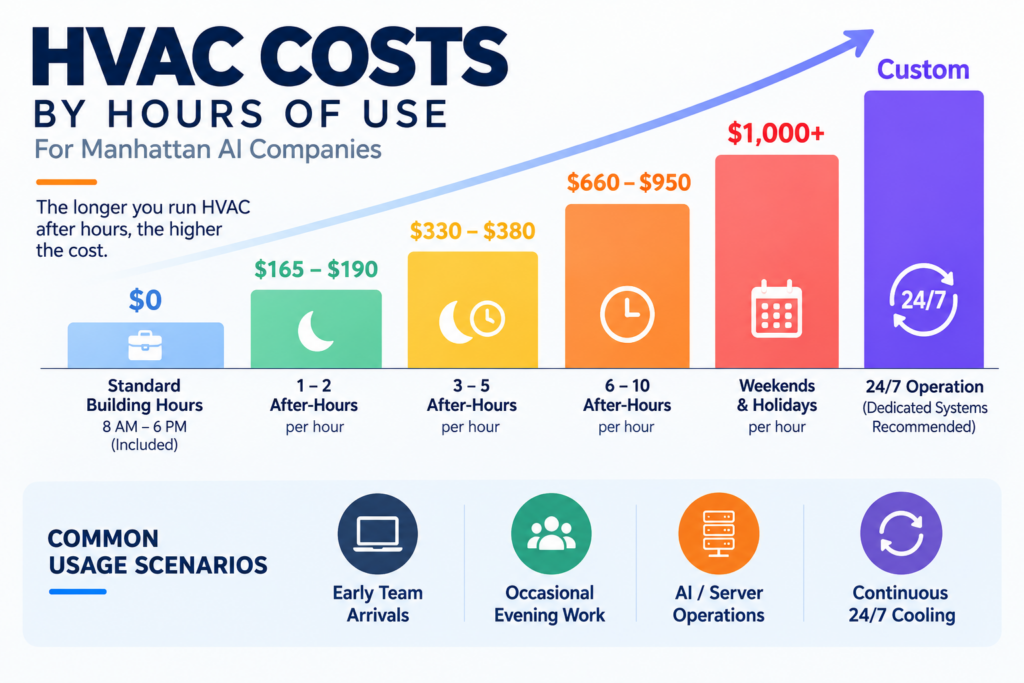
Compare Building Operating Costs Before You Compare Offices
An AI office requirement should begin with an operating calendar.
Do not begin with an hourly HVAC quote.
Write down when employees actually expect to work.
Include early mornings.
Add ordinary evenings.
Identify recurring late deployment nights.
Mark Saturdays.
Include Sundays when relevant.
Then map the company holiday calendar against the building schedule.
The resulting gaps become your expected overtime HVAC requirement.
Next, divide the office by cooling need.
The main workspace creates one category.
Conference facilities create another pattern.
Technical rooms deserve separate treatment.
Hardware labs may need their own analysis.
A small server closet should not automatically force central cooling across the whole premises.
Ask every finalist the same questions
Consistency makes a building comparison useful.
Ask when normal cooling starts.
Confirm when it stops.
Identify included Saturday hours.
Request the holiday calendar.
Get the current overtime rate.
Determine the billing unit.
Confirm minimums.
Ask about billing increments.
Identify administrative charges.
Learn how rates increase.
Then investigate scheduling and cancellation.
These answers create a far better comparison than base rent alone.
Use actual office inventory to test different HVAC models
Current Manhattan inventory shows how much building systems can differ.
A small Bryant Park office describes around-the-clock tenant-controlled HVAC.
A 4,125-square-foot Flatiron office describes tenant-controlled central air.
Another 5,664-square-foot Flatiron office uses a newer water-cooled air-conditioning system.
Those differences matter because AI companies often work beyond conventional hours.
They also demonstrate why “24/7 building access” cannot serve as an HVAC specification.
Listings create a starting point.
Lease and engineering diligence provide the final answer.
Convert every HVAC proposal into annual dollars
Do not compare $90 against $115.
Compare annual operating exposure.
Assume one building costs $90 hourly across two zones.
Another charges $125 across one zone.
A third offers tenant-controlled cooling but makes the tenant pay electricity and maintenance.
Price all three over the same operating calendar.
Then add base rent.
Add escalation.
Include electricity.
Account for cleaning.
Include operating expense exposure.
Add technical cooling where required.
The resulting number reflects the real occupancy decision.
Compare quiet, normal, and peak months
One annual estimate can hide operating volatility.
Build three scenarios.
The quiet case reflects light after-hours use.
Your normal case reflects regular operations.
The peak case should include product launches, deadlines, hiring periods, and unusual weekend work.
That peak case matters for an AI company.
Growth rarely follows a perfectly smooth calendar.
Neither does engineering work.
A lease needs enough flexibility for both.
Do not assume an AI company needs 24/7 HVAC
Some tenants overcorrect.
They hear “AI” and assume every prospective office needs continuous cooling.
That can waste money.
A cloud-based twenty-person company may require no unusual infrastructure.
Perhaps employees leave by 8:00 p.m.
Maybe one network cabinet needs dedicated cooling.
In that case, ordinary office HVAC plus one targeted technical solution may work well.
Define the load before buying the solution.
Do not assume cloud computing eliminates the issue either
Cloud infrastructure removes many local compute loads.
It does not remove people.
Nor does it cool network equipment.
Cloud computing also does not change a global company’s working hours.
A team serving Europe and Asia may begin early.
Employees supporting the West Coast may remain late.
Therefore, schedule can create more HVAC exposure than hardware.
Is $50 per hour for after-hours HVAC reasonable?
It can occur.
Broad commercial examples include rates around that level.
However, current Manhattan planning benchmarks frequently sit higher.
Never judge the rate without its billing unit.
A $50 whole-suite charge can look attractive.
A $50 charge across four zones becomes $200 hourly.
Minimums can further alter the answer.
What are HVAC overtime charges for Class A Manhattan offices?
Premium Manhattan buildings commonly deserve underwriting near the upper part of the market range.
Yet building class alone does not determine the invoice.
Modern systems can provide more precise zoning.
That precision may offset a higher hourly rate.
Conversely, a lower-class building with independent tenant HVAC can sometimes suit late-working teams better.
Compare system design, not labels.
What counts as “after hours” for office HVAC?
The lease determines after hours.
A common reference schedule uses weekday service around 8:00 a.m. through 6:00 p.m.
Some properties provide longer weekday periods.
Others include Saturday service.
Holidays frequently follow separate rules.
Your lease schedule controls the answer.
What is a tenant after-hours HVAC service?
It means requested heating, ventilation, or air conditioning outside included building HVAC hours.
The tenant usually requests the service through building management or an operating system.
Management then charges according to the lease.
This charge does not necessarily indicate a repair.
Does a broken air conditioner count as after-hours HVAC?
Not in the same sense.
A breakdown creates a repair and maintenance issue.
Requested overtime HVAC involves operating functioning equipment beyond standard hours.
Your lease determines repair responsibility.
Supplemental tenant-owned equipment may follow different rules from the central building system.
Does the “$5,000 HVAC rule” apply here?
No practical Manhattan leasing analysis should use that rule to price overtime office HVAC.
The phrase generally concerns repair-versus-replacement decisions for equipment.
After-hours office HVAC concerns service hours and operating charges.
Those are different questions.
Can an AI company negotiate free after-hours HVAC?
Potentially.
The transaction may support free hours, longer standard hours, a rate cap, or another concession.
Negotiating leverage varies by building, requirement size, lease term, credit, and competing demand.
Put a dollar value on every concession.
Ten free monthly hours at $120 equal $14,400 annually for one zone.
That benefit can become significant across a longer lease.
Is tenant-controlled HVAC always better?
No.
Tenant control improves scheduling flexibility.
However, the tenant may assume electricity, service contracts, maintenance, and replacement exposure.
Central landlord HVAC can remove some of those responsibilities.
The correct choice depends on operating hours and system condition.
Compare lifecycle cost rather than control alone.
What should an AI company ask before touring a Manhattan office?
Start with your actual operating profile.
Define peak daily attendance.
Identify evening use.
Estimate weekend work.
List technical equipment.
Specify any continuous cooling loads.
Then investigate buildings.
Our AI tenant broker guide explains how those requirements translate into a building search.
What is the biggest after-hours HVAC mistake?
The biggest mistake involves treating HVAC as a small utility item after choosing the office.
For a conventional nine-to-five tenant, that approach may create only modest risk.
For an AI company working long hours, it can become expensive.
A recurring $10,000 monthly HVAC line equals $120,000 annually.
Over five years, that simple charge reaches $600,000 before escalation.
That deserves attention before the lease gets signed.
The most important comparison is not rent versus rent.
It is total occupancy cost versus total occupancy cost.
Review overtime HVAC charges alongside supplemental technical cooling before narrowing your shortlist. Then compare those costs with your full Manhattan occupancy budget.
We represent tenants and evaluate these expenses from the occupier’s side. We compare HVAC structures before an attractive asking rent hides an expensive operating schedule. We also negotiate the business terms that determine what your company actually pays.
Compare building operating costs before committing to an AI office in Manhattan.
Receive a Customized Office Report
Fill out our 📋 online form or give us a call today 📞 212-967-2061 — let’s find the right options for your business.