What Lease Term Should an AI Company Sign in Manhattan?
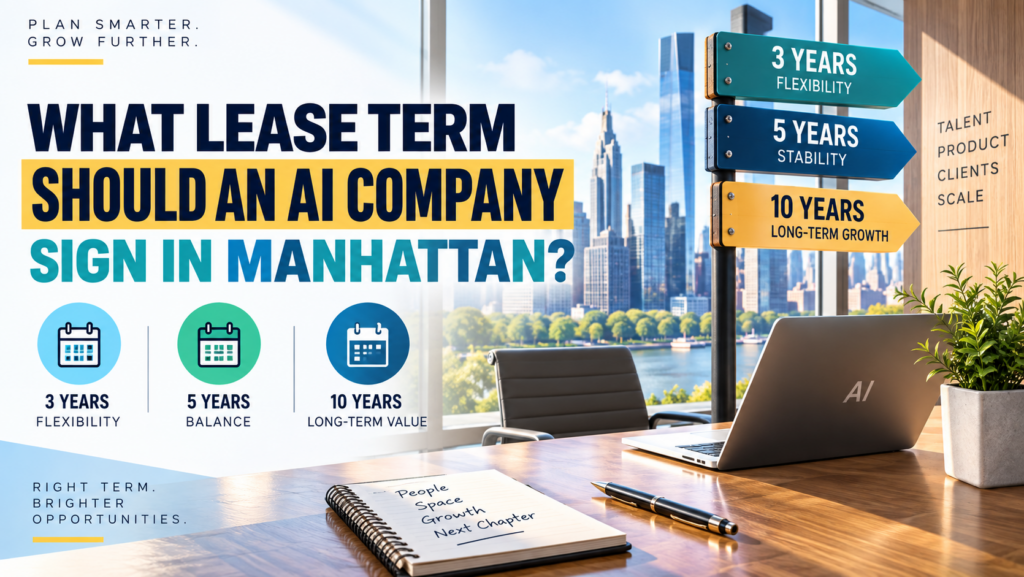
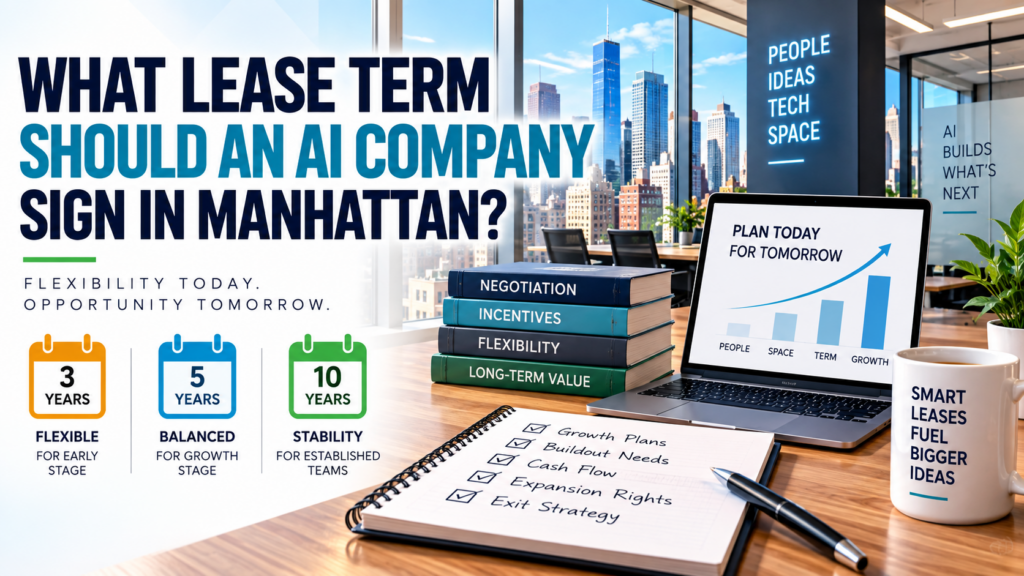
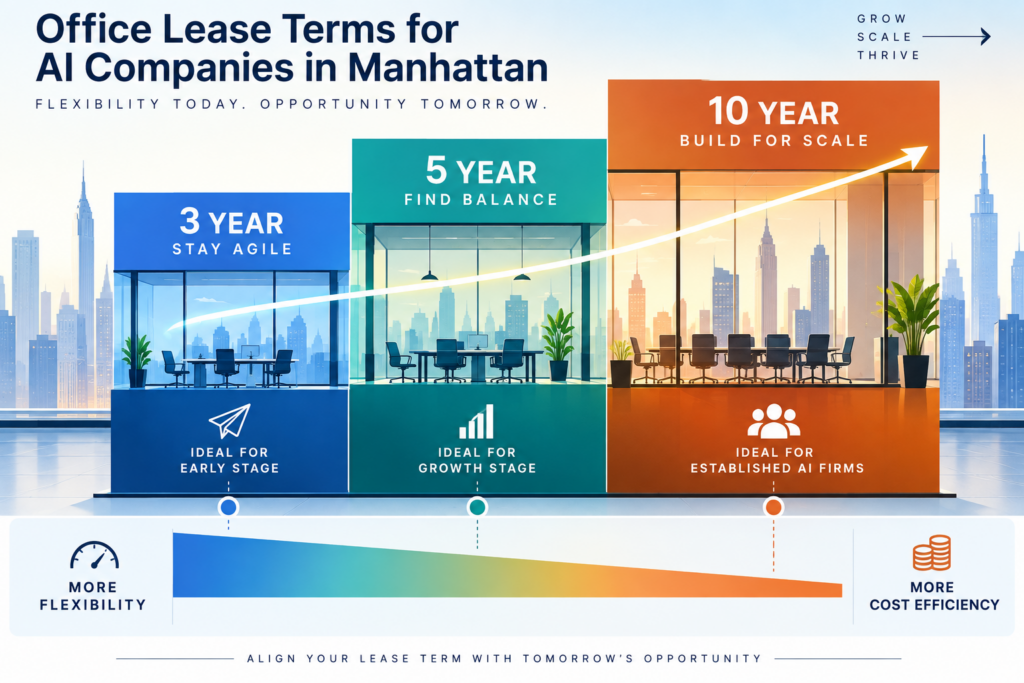
For most growing AI companies in Manhattan, a three-to-five-year office lease provides the strongest starting point. That range balances flexibility, occupancy stability, and landlord participation without creating an unnecessarily long liability.
However, there is no universal term that every AI company should sign. A two-to-three-year commitment may suit an unpredictable early-stage company. Meanwhile, a seven-to-ten-year lease can work for a well-capitalized company with strong location certainty.
The real decision involves more than choosing an expiration date. Your company must match the lease term to its reliable planning horizon. It should then negotiate options that protect the company when growth moves faster, slower, or differently than expected.
That distinction matters in Manhattan right now. AI companies leased about 1.50 million square feet across 63 transactions during the first half of 2026. That volume almost doubled their entire 2025 total. Midtown South captured 75.1% of Manhattan technology leasing during the same period.
At the same time, Manhattan office availability tightened to 12.5% in August 2026. Sublease inventory fell to 10.07 million square feet, its lowest level since August 2019. Therefore, strong spaces can disappear before a growing company reaches perfect certainty.
The goal is not simply to sign the shortest possible lease.
Instead, an AI company should secure the shortest responsible commitment that still supports its desired space, economics, buildout, and growth rights.
The Best Lease Term Depends on How Far Your Company Can Reliably See
An AI company should begin the lease-term decision with one question.
How long can we reasonably predict our Manhattan office requirement?
That question matters more than the latest funding round. It also matters more than an ambitious hiring target.
Capital can accelerate growth. However, capital does not guarantee that current hiring assumptions will remain correct.
A company may double revenue without doubling Manhattan headcount. Another team may hire faster than expected after launching a new product. An acquisition can change everything within months.
Consequently, the ideal lease term should reflect the company’s visibility horizon, not its optimism.
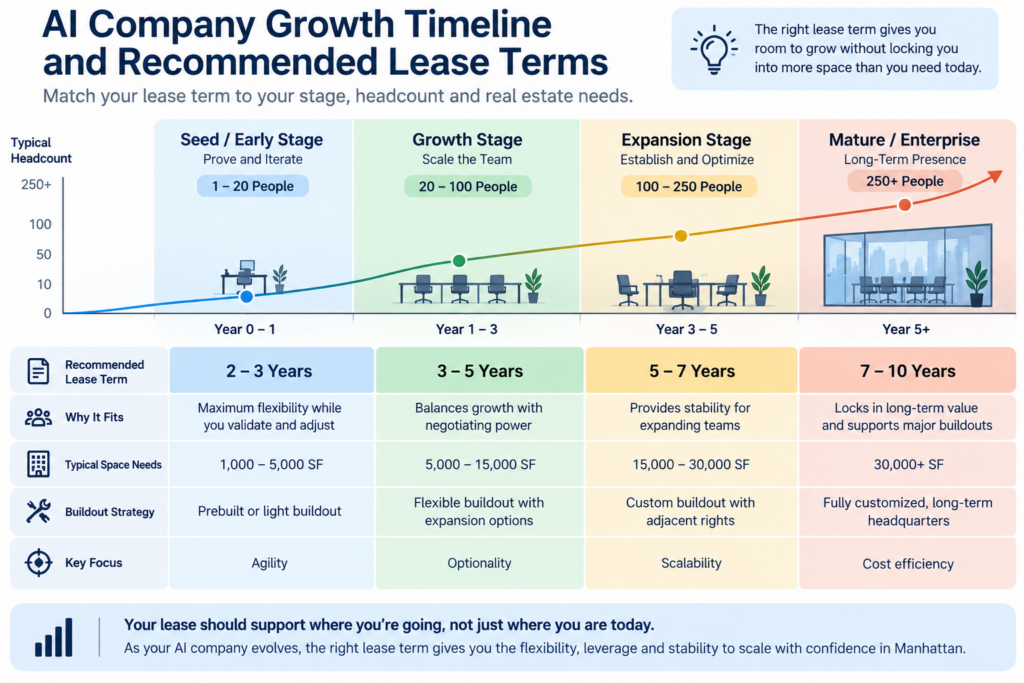
Think in planning horizons rather than fundraising labels.
A seed-stage company may already possess unusually clear hiring plans. By contrast, a later-stage company may face major uncertainty after restructuring its product strategy.
Therefore, funding stage can inform the decision. It should not dictate it.
Current Manhattan leasing guidance generally places startup and fast-growth commitments within shorter and mid-length ranges. Traditional direct leases often extend farther. Longer commitments usually support greater landlord investment and stronger concessions.
A practical framework looks like this:
| Planning situation | Lease structure worth testing | Main objective |
|---|---|---|
| Highly uncertain growth | One to two years | Preserve maximum mobility |
| Early-stage growth | Two to three years | Control downside while establishing an office |
| Growing company with improving visibility | Three to five years | Balance flexibility and economics |
| Established Manhattan operation | Five to seven years | Gain stability and support larger improvements |
| Long-term headquarters | Seven to ten years or longer | Lock location and justify significant investment |
These ranges describe decision frameworks, not fixed rules. Building quality, lease structure, credit, size, and existing improvements can change the outcome.
A three-to-five-year term deserves special attention.
For many AI companies, three years creates enough time to establish an office without making a decade-long prediction.
Five years goes further. It can support better concessions while reducing near-term relocation pressure.
That middle range also gives management time to observe several hiring cycles. The company can see whether Manhattan remains central to recruiting, collaboration, sales, and customer relationships.
A current 5,500-square-foot Flatiron direct lease with terms ranging from two to ten years illustrates another important point. The same physical office can support very different commitment strategies.
The space does not determine the term by itself.
Your operating plan does.
Separate commitment length from control length.
An AI company may want five years of location control without accepting five years of unconditional exposure.
For example, a three-year base term could include a documented renewal option. That structure may extend control without creating the same initial obligation.
Likewise, a five-year lease might include a negotiated termination right after a defined date.
Neither structure automatically produces a better deal. Renewal rent, termination payments, notice deadlines, and other conditions matter.
Still, this distinction changes the discussion.
Instead of asking, “How many years should we sign?” ask:
How many years must we guarantee, and how many years should we control?
That question creates a much stronger foundation for an AI company office lease term.
Three Years, Five Years, or Ten Years: The Real Trade-Off
Should an AI startup sign a three, five, or ten-year Manhattan office lease?
The answer depends on what the company receives for accepting each additional year of obligation.
Longer terms can support free rent, tenant improvements, customized construction, renewal rights, and stronger landlord participation. However, those benefits only create value when the company actually needs them.
Current Manhattan guidance commonly associates shorter terms with limited landlord improvements. Mid-length leases can support moderate concessions. Seven-to-ten-year leases can support much greater landlord investment, especially in higher-quality properties.
Choose roughly two to three years when uncertainty dominates.
A two-to-three-year term can make sense when your company faces several unknowns.
Perhaps Manhattan headcount could move sharply after the next product cycle. Maybe the company has not established its long-term neighborhood preference.
Your workplace strategy may also remain unsettled.
In those situations, paying for flexibility can make sense.
Current options include a 1,500-square-foot furnished SoHo office with a two-to-three-year term. That structure reduces the need to predict a distant workplace requirement.
A 2,902-square-foot furnished Midtown sublease with a two-to-three-year term provides another example. It combines an existing installation with a limited commitment period.
Shorter terms work especially well when the existing office already meets your needs.
Otherwise, the economics can deteriorate quickly.
Five years often provides the strongest middle ground.
A five-year commitment suits companies that expect Manhattan to remain important.
It also suits businesses that need some landlord work without requiring a highly customized headquarters.
Five years gives ownership more time to amortize transaction costs. Therefore, the landlord may have greater reason to improve the premises.
Meanwhile, the company avoids predicting its requirements a full decade forward.
For many software-focused AI companies, this balance makes five years worth testing against shorter alternatives.
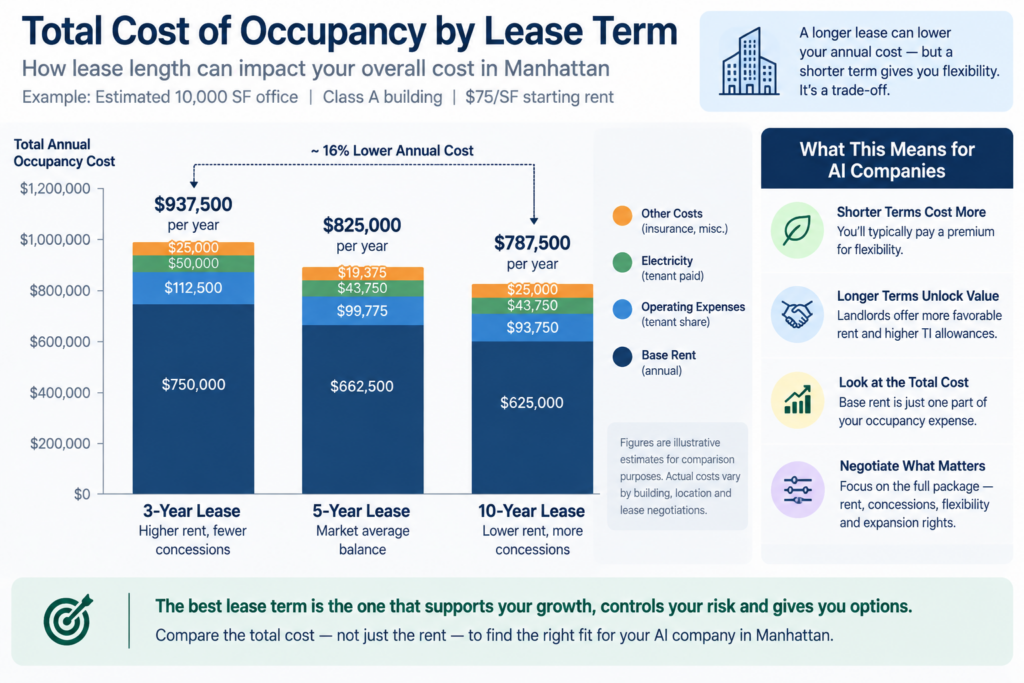
The final decision should compare effective cost, not simply starting rent.
Seven to ten years requires a higher confidence threshold.
Long leases become more logical when several conditions align.
The company expects a durable Manhattan presence. Its location preference appears unlikely to change.
Headcount also has reasonable long-term visibility.
Furthermore, the space may require significant construction, infrastructure, security, power work, or specialized improvements.
Current Manhattan guidance shows why landlords value these commitments. Longer terms can support materially larger free-rent periods and tenant-improvement contributions. Those concessions vary substantially by building, credit, market conditions, and construction scope.
However, a concession never eliminates the underlying obligation.
Twelve months of free rent does not make an unwanted ten-year commitment flexible.
Compare liability before comparing concessions.
Consider a simple illustration using 5,000 rentable square feet at $80 per square foot.
That rate sits near Manhattan’s recent overall asking-rent range. One Q2 2026 dataset placed the borough average at $78.03 per square foot.
| Initial lease term | Approximate annual face rent | Approximate base commitment |
|---|---|---|
| Three years | $400,000 | $1,200,000 |
| Five years | $400,000 | $2,000,000 |
| Ten years | $400,000 | $4,000,000 |
Those figures exclude escalations, electricity, taxes, operating expenses, construction, and other occupancy costs.
They also exclude concessions.
Nevertheless, the comparison exposes the decision clearly.
Moving from five years to ten years creates another $2 million of illustrative base-rent exposure.
Therefore, the company should receive something meaningful for that additional commitment.
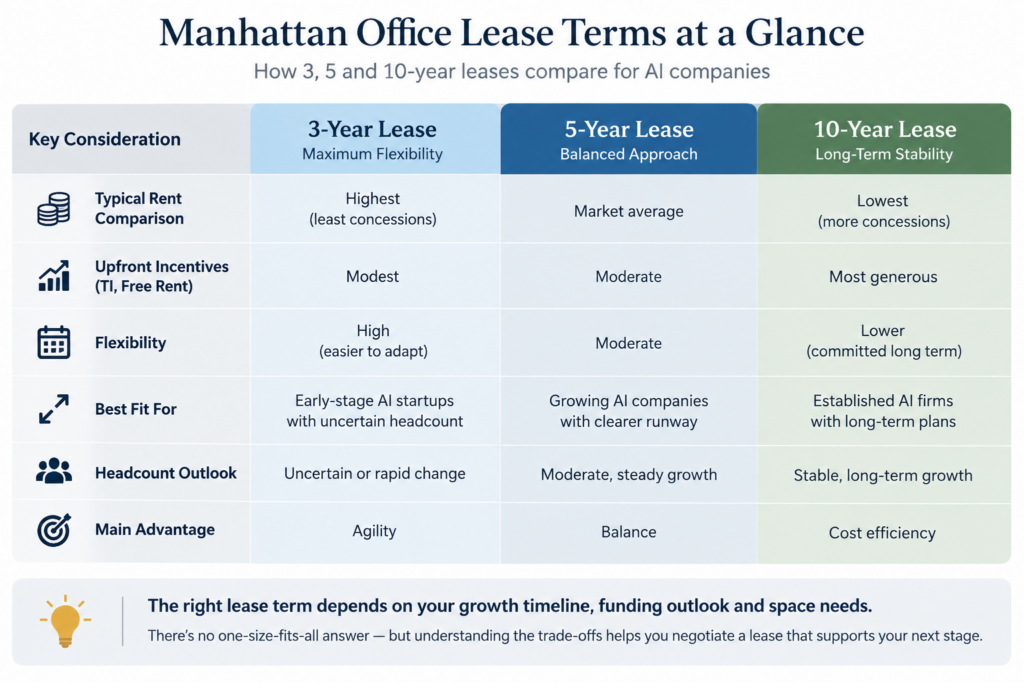
Match the Lease Structure to Growth, Capital, and Office Condition
Lease term should reflect the space itself.
A move-in-ready furnished office creates a very different economic problem from a raw floor requiring substantial construction.
That difference matters because an AI company should not spend years amortizing improvements it never needed.
Turnkey space can make a shorter lease economically rational.
Furnished subleases and completed prebuilts can reduce initial capital requirements.
They may already contain conference rooms, kitchens, cabling, workstations, and collaboration areas.
Consequently, the company can preserve cash and shorten its required occupancy horizon.
Our guide to plug-and-play Manhattan office space explains why existing improvements can change the entire cost calculation.
A current furnished Bryant Park office extending through November 2028 shows how a sublease can create a defined bridge period. The premises already contain collaborative and private areas.
That can work well for a company expecting another major space decision within several years.
Custom construction pushes the analysis toward more term.
Suppose a company needs secure rooms, extensive acoustic work, dedicated cooling, specialized electrical distribution, or substantial alterations.
Those improvements cost money.
Someone must fund them.
A landlord has more reason to contribute significant capital when it can spread that investment across a longer commitment.
Likewise, a tenant may hesitate to invest heavily in a space it must vacate three years later.
Therefore, custom requirements can make a longer lease economically sensible.
Our AI office lease-clause guide explains how power, cooling, connectivity, access, alterations, and security can affect the transaction.
Software companies and hardware teams may reach different answers.
Many AI companies run compute-intensive workloads outside their Manhattan offices.
Their local workplace may mainly support engineering, product, management, recruiting, sales, and customer meetings.
Those tenants may need conventional office infrastructure.
A robotics, hardware, or testing team can face different requirements.
Equipment may affect power, cooling, freight access, floor loading, ventilation, permitted use, security, or physical layout.
Consequently, a hardware-intensive company may justify more investment.
That investment can support a longer term.
Still, the company should complete technical diligence before increasing its commitment.
Do not lease tomorrow’s entire headcount today without testing alternatives.
Fast growth creates an understandable temptation.
A 25-person company expects 75 employees within two years. Management therefore leases for 75 people immediately.
That approach works when the hiring forecast proves correct.
However, unused square footage creates a real carrying cost.
At an illustrative $80 per square foot, 1,000 unused square feet costs about $80,000 annually before additional expenses.
Instead, compare immediate overleasing against expansion rights.
A smaller initial office plus contractual growth rights can sometimes produce better capital efficiency.
Our guide to leasing after an AI funding round focuses on that distinction.
Model attendance rather than payroll headcount alone.
A 100-person company does not automatically require 100 assigned desks.
Conversely, a 40-person company with daily attendance and frequent visitors may need substantial collaboration space.
Use expected peak attendance.
Then add meeting demand, recruiting activity, client visits, phone rooms, kitchens, secure areas, circulation, and reasonable growth capacity.
The result should drive square footage.
Square footage should then influence term.
Not the other way around.
Protect Flexibility Through the Lease, Not Just the Expiration Date
A short lease is one type of flexibility.
It is not the only type.
A well-negotiated five-year lease can sometimes create more practical flexibility than a poorly structured three-year lease.
The stronger lease gives your company defined ways to grow, transfer, shrink, renew, or exit.
Start with expansion rights.
Rapidly growing AI companies should examine fixed expansion options, rights of first offer, and rights of first refusal.
Each tool works differently.
A fixed expansion option can provide the strongest certainty when it identifies specific future premises.
A right of first offer gives the tenant an early opportunity to negotiate qualifying available space.
Meanwhile, a right of first refusal can let the tenant match defined third-party terms.
None of these rights helps when the language remains vague.
The lease should identify covered space, notice procedures, timing, economics, and priority against competing rights.
This approach can prove more efficient than leasing large amounts of vacant space from day one.
Consider phased occupancy when growth looks likely but not immediate.
Some companies know additional hiring will occur.
They simply do not need the entire future footprint today.
A negotiated phased structure can stagger possession or rent commencement.
For example, the company could occupy one portion now.
Another portion could commence after a defined period.
This structure can match rent obligations more closely with expected growth.
However, the agreement must define delivery dates and remedies.
Otherwise, the future space remains uncertain.
Protect the downside through assignment and subleasing.
An assignment generally transfers the tenant’s lease interest.
A sublease generally creates a secondary occupancy arrangement beneath the original lease.
Both mechanisms can matter after a restructuring, acquisition, relocation, or headcount reduction.
The lease should address landlord consent, approval timing, recapture rights, transfer conditions, and permitted affiliate transactions.
Avoid assuming that a generic sublease provision creates an easy exit.
It may not.
Landlord recapture rights or restrictive consent language can reduce practical flexibility.
Therefore, negotiate transfer language while the landlord still wants the transaction.
Treat a termination option as a separate economic asset.
A true termination right can let the tenant end the lease after satisfying agreed conditions.
The landlord may require a termination payment.
That payment often reflects unamortized concessions or other transaction costs.
The important point is predictability.
A formula negotiated today can prove far more useful than requesting a lease buyout during a future crisis.
For example, a five-year lease with an exercisable termination right after year three creates a different risk profile.
The headline still says five years.
The economic architecture says something more nuanced.
Do not confuse a Good Guy Guaranty with a company termination right.
These structures address different risks.
A Good Guy Guaranty can limit a guarantor’s future exposure after satisfying negotiated surrender conditions.
However, the tenant entity can remain liable under the underlying lease.
Therefore, founders should not treat guaranty language as an automatic corporate exit clause.
Commercial lease counsel should review the final structure.
Renewal rights also create flexibility.
A three-year lease with a well-defined renewal option can create a longer occupancy pathway.
Still, renewal language must explain the rent-setting process.
It should also define the option period and exercise deadline.
“Fair market rent” without adequate mechanics can create uncertainty.
Likewise, an option provides little value after the tenant misses its notice deadline.
Calendar every critical date immediately after signing.
That includes renewal, expansion, termination, and security-reduction dates.
Use Manhattan’s Current Market to Set the Term, Space, and Timing
The right lease term does not exist in a vacuum.
Market conditions affect what landlords will accept, which spaces remain available, and how aggressively tenants can negotiate.
Manhattan has tightened materially during 2026.
August leasing reached 3.25 million square feet. Year-to-date volume reached 29.91 million square feet.
Availability dropped to 12.5%.
Meanwhile, total sublet inventory declined 22.3% year over year.
That environment changes term strategy.
A shorter lease only works when suitable short-term inventory exists.
A company may decide that two years represents its perfect theoretical term.
However, its preferred building may require five years.
Another landlord may offer two years but provide the wrong layout.
A third option might offer ideal economics while requiring too much construction.
Therefore, decide both your target term and your acceptable term range before touring.
For example:
Target: three years
Acceptable: two to five years
Longer commitment: only with documented expansion rights and stronger economics
That framework gives your broker room to negotiate without losing the company’s risk parameters.
Midtown South deserves attention, but it should not become an automatic answer.
AI and technology demand continues to cluster heavily in Midtown South.
During the first half of 2026, that submarket captured 75.1% of Manhattan technology leasing activity.
Flatiron, NoMad, Chelsea, and nearby corridors therefore attract significant attention from growing technology teams.
However, concentration can create competition for well-built space.
The company should compare culture against economics and optionality.
A 5,500-square-foot Flatiron office offering two-to-ten-year direct terms creates one type of choice.
A furnished Midtown sublease creates another.
Neither structure wins automatically.
Midtown can solve transit and recruiting problems.
Companies drawing employees from multiple boroughs, New Jersey, Westchester, Connecticut, or Long Island may value central transportation.
That advantage can improve recruiting and attendance.
A highly accessible location can also reduce relocation pressure.
Therefore, a company with greater neighborhood confidence may feel more comfortable extending its term.
Current Midtown office listings should still undergo the same lease-term analysis as Downtown or Midtown South alternatives.
Location confidence supports longer commitments.
It does not replace economic discipline.
Downtown can change the cost-versus-term equation.
Companies should not assume every AI office belongs in Midtown South.
Downtown can provide larger floor plates, modern infrastructure, and different pricing opportunities.
Current Manhattan data also show meaningful submarket pricing differences.
Overall Manhattan asking rent averaged $78.03 per square foot during Q2 2026. However, individual neighborhoods, buildings, and floors can diverge significantly.
Therefore, a five-year Downtown lease may compete economically with a shorter lease elsewhere.
Compare total occupancy cost and workplace usefulness.
Do not compare neighborhood labels alone.
The strongest market also rewards preparation.
A prepared AI company can sometimes execute a Manhattan office lease within roughly two to four weeks.
Move-in-ready subleases and completed prebuilts create the fastest paths.
Actual occupancy can still take longer because of legal, insurance, internet, security, furniture, and access requirements.
Review our Manhattan AI office leasing timeline before timing an existing lease expiration.
Speed should not mean carelessness.
Preparation creates speed.
A Practical Decision Framework for AI Founders and Operators
The most useful lease-term analysis starts with scenarios.
Create a downside case, expected case, and accelerated-growth case.
Then test every candidate lease against all three.
This process turns an abstract term decision into an operating decision.
Start with the next two years.
Ask how many Manhattan employees the company reasonably expects after 12, 18, and 24 months.
Then separate committed hires from aspirational hires.
Review peak daily attendance.
Consider whether employees need assigned desks.
Add recruiting, client meetings, visitors, collaboration, private calls, and secure work.
Next, identify events that could change the forecast.
Those events might include another financing, acquisition, product launch, regulatory development, or organizational restructuring.
The more uncertainty those events create, the more valuable shorter commitment becomes.
Then examine years three through five.
This horizon often reveals whether a three-year or five-year lease makes more sense.
Can management reasonably imagine remaining in the same neighborhood?
Would the current floor still function?
Could nearby expansion solve growth?
Would a relocation after three years create major operational disruption?
The answers matter.
A company that already expects another move should avoid paying heavily for a five-year custom installation.
By contrast, a company expecting stability may find three years unnecessarily short.
A flexible direct Flatiron office with a broad two-to-ten-year term range gives a tenant room to test these trade-offs during negotiation.
Only then evaluate a seven-to-ten-year commitment.
Long terms require stronger evidence.
Ask whether the company would still want the location after a slower growth period.
Consider whether the floor works after faster growth.
Examine whether an acquisition could change headquarters strategy.
Review whether the business truly needs a custom installation.
Then examine the proposed landlord contribution.
A longer lease should create enough value to justify the additional obligation.
That value might include a substantial buildout, better economics, growth rights, renewal control, or another strategic benefit.
“More free rent” alone rarely answers the question.
Stress-test total occupancy cost.
Do not model only the first-year asking rent.
Include scheduled rent increases.
Add electricity, after-hours HVAC, taxes, operating costs, cleaning, insurance, technology work, furniture, construction, and restoration exposure.
Current Manhattan asking-rent averages provide useful market context. They do not determine a particular office’s final cost.
Then subtract negotiated concessions.
Compare the effective occupancy cost across the entire term.
Our Manhattan AI office-cost guide provides the broader cost framework.
Compare term structures side by side.
A useful lease comparison should look beyond rent.
| Question | Three-year structure | Five-year structure | Ten-year structure |
|---|---|---|---|
| Headcount certainty needed | Lower | Moderate | High |
| Location certainty needed | Lower | Moderate | High |
| Relocation risk | Earlier | Moderate | Lower during term |
| Landlord buildout participation | Usually lower | Often stronger | Potentially substantial |
| Exposure to future renewal pricing | Earlier | Later | Much later |
| Mismatch risk | Lower | Moderate | Highest |
| Best fit | Rapidly changing company | Growing company with visibility | Stable headquarters strategy |
| Critical protection | Renewal and sublease rights | Expansion and exit rights | Expansion, transfer, contraction, renewal, and exit rights |
The best choice is not necessarily the cheapest first year.
It is the structure that produces the best risk-adjusted occupancy plan.
Negotiate the business framework before the long lease draft arrives.
The letter of intent should address more than rent and years.
Include the lease term, commencement, free rent, escalations, security, tenant improvements, and delivery condition.
Address expansion and renewal rights.
Cover assignment, subleasing, termination, and guaranty structure.
Identify major technical issues.
Our complete Manhattan commercial leasing guide explains how these business points fit into the broader transaction.
A well-negotiated lease term can lose value when the surrounding provisions work against the tenant.
Therefore, evaluate the entire structure as one package.
Frequently Asked Questions About AI Office Lease Terms in Manhattan
What lease term should an AI company sign in Manhattan?
Most growing AI companies should begin by comparing three-to-five-year structures.
A two-to-three-year lease may suit a company with uncertain growth.
Seven-to-ten years can work when headcount, location, capital, and construction needs look unusually stable.
The correct answer depends on commitment risk, not company category alone. Current Manhattan lease structures commonly span from one-to-three-year shorter commitments through seven-to-ten-year long-term leases.
Should an AI startup sign a three, five, or ten-year lease?
Choose three years when flexibility matters more than maximizing landlord contributions.
Consider five years when the company expects to stay and has reasonable growth visibility.
Evaluate ten years only when long-term location confidence and investment requirements justify the commitment.
Also compare contractual flexibility.
A five-year lease with strong options can outperform a rigid three-year lease.
Is a five-year lease the standard choice for a Manhattan startup?
Five years remains an important direct-lease benchmark.
However, growing companies increasingly evaluate shorter alternatives, especially when they can use existing improvements.
Current Manhattan guidance places many startup transactions within three-to-five-year ranges.
Building quality and condition can change what landlords will consider.
Can an AI startup get a two-year Manhattan office lease?
Yes.
Two-year opportunities can appear through subleases, prebuilt offices, and selected direct transactions.
For example, current inventory includes two-to-three-year furnished sublease opportunities.
Availability varies by building and neighborhood.
Therefore, a two-year requirement can reduce the number of viable choices.
Is a twelve-month Manhattan office lease standard?
No.
A one-year commitment can exist, but it does not represent the usual traditional direct-lease structure.
Short commitments appear more often when an existing installation supports immediate occupancy.
Our short-term Manhattan office guide for AI startups explains how those arrangements differ from longer direct leases.
A company seeking twelve months should compare flexibility against renewal risk and limited landlord investment.
Can a commercial office lease run month to month?
A month-to-month occupancy arrangement can exist.
However, it generally functions differently from a conventional Manhattan direct office lease.
Companies seeking a durable headquarters usually need more control than month-to-month occupancy provides.
The important question involves the business objective.
A temporary project team needs different protections from a headquarters operation.
Why do landlords prefer longer office leases?
Longer leases create more predictable income.
They also give ownership more time to recover brokerage, construction, free rent, and other transaction costs.
That can support stronger concessions.
Current Manhattan guidance shows materially greater landlord contributions on longer commitments.
However, tenants should compare the value received against additional years of liability.
Does a longer lease always mean lower rent?
No.
Lease length affects economics, but it does not guarantee a lower face rent.
A longer commitment may instead improve free rent, tenant improvements, construction, expansion rights, or other terms.
Building demand also matters.
Therefore, compare effective rent and total occupancy cost.
Do not judge the proposal using asking rent alone.
How much free rent can a longer Manhattan lease receive?
Current market guidance associates one-to-three-year terms with relatively limited free rent.
Three-to-five-year terms may support more.
Seven-to-ten-year transactions can sometimes support much larger abatements.
However, these are negotiation ranges rather than entitlements.
Building quality, tenant credit, construction, vacancy, size, and market competition affect every deal.
How does the lease term affect tenant improvement money?
Landlords usually have greater ability to fund improvements when they can amortize that investment over additional years.
Therefore, short terms often favor existing installations.
Longer terms can support more substantial construction.
Current Manhattan guidance places significant Class A improvement contributions primarily within longer-term structures.
Always compare the allowance against actual construction cost.
A large allowance does not automatically cover the entire project.
Should an AI company lease extra space for future hiring?
Some growth capacity can make sense.
However, leasing large amounts of unused space creates immediate carrying costs.
Compare extra space against contractual expansion rights.
A right to neighboring space can sometimes provide growth capacity without requiring immediate rent.
Our AI office lease-clause guide explains expansion structures in greater detail.
How much growth space should an AI company build into its initial lease?
Start with likely peak attendance rather than maximum aspirational headcount.
Then test expected hiring over the reliable planning period.
Add a rational cushion where economics allow.
However, do not confuse physical capacity with legal flexibility.
An office that can hold another 30 desks does not create a right to expand beyond its walls.
What happens when an AI company outgrows its office before expiration?
Expansion rights may provide access to additional space.
A company can also evaluate an internal relocation, lease restructuring, or additional nearby premises.
In some cases, a landlord may support an early extension tied to expansion.
The best solution depends on building inventory and existing lease language.
Planning these possibilities during the original negotiation gives the tenant more control.
What happens when the company has too much space?
Subleasing may provide one response.
A negotiated contraction option can offer another.
An early termination right may also solve the problem.
Each structure carries different conditions and economics.
Therefore, the lease should anticipate slower growth before slower growth actually occurs.
What is the difference between assignment and subleasing?
An assignment generally transfers the tenant’s lease interest.
A sublease creates a secondary occupancy arrangement while the original lease remains in place.
Landlord consent provisions can affect both.
Recapture rights can also matter.
Commercial lease counsel should review the exact language.
Can an AI company break a Manhattan office lease?
Not automatically.
The company needs a contractual right, negotiated agreement, or another legally available path.
Subleasing and assignment may reduce economic exposure.
A true termination option creates more direct control.
Therefore, discuss exit structures before signing rather than after circumstances change.
Does a Good Guy Guaranty let the company cancel the lease?
Not necessarily.
A Good Guy Guaranty generally addresses the guarantor’s future liability after specified surrender conditions.
The tenant entity can still retain obligations under the lease.
Do not treat that guaranty as a substitute for an actual termination option.
Have lease counsel review both provisions.
Should a company negotiate a renewal option on a short lease?
Usually, the option deserves consideration.
A short base term preserves flexibility.
The renewal can extend occupancy when the office continues to work.
However, the option needs meaningful economics and clear procedures.
Define the term, notice deadline, rental methodology, and other key conditions.
When does a ten-year AI office lease make sense?
A ten-year lease can make sense for a durable Manhattan headquarters.
The company should have strong location confidence and credible long-term capital resources.
Large construction requirements can strengthen the case.
So can scarce space that would prove difficult to replace.
Still, the tenant should negotiate growth and transfer provisions.
A decade creates too much uncertainty to rely on current headcount alone.
When is a three-year lease too short?
Three years can prove inefficient when the company needs substantial custom construction.
It can also create unnecessary relocation risk.
Repeated brokerage, legal, IT, furniture, moving, and operational work carries real cost.
Furthermore, the next renewal may occur during a stronger rental market.
A longer term can reduce those risks when the underlying office requirement appears stable.
Can a short lease become more expensive than a longer lease?
Yes.
Shorter terms may provide less free rent and less landlord-funded construction.
The company may also face another relocation sooner.
Therefore, lower contractual exposure does not always equal lower occupancy cost.
Compare each alternative through the expected period of use.
Does an AI company need a special type of lease?
No separate commercial lease category exists simply because the tenant develops artificial intelligence.
However, the business can create unusual operating requirements.
Power, cooling, security, connectivity, after-hours services, hardware testing, and alteration rights may need attention.
Our guide to AI-focused Manhattan lease clauses covers those issues.
Do robotics and hardware AI companies need longer leases?
Not automatically.
However, specialized installations can make longer occupancy periods more economical.
A robotics team may require different power, equipment, freight, testing, or permitted-use provisions.
Those requirements can increase initial investment.
Therefore, conduct technical diligence before deciding whether additional term creates value.
Does the neighborhood affect the right lease term?
Yes, indirectly.
A company with strong confidence in its location can tolerate a longer commitment more comfortably.
Supply also matters.
Midtown South has captured substantial recent technology leasing activity.
Still, neighborhood popularity should never replace company-specific analysis.
Compare Flatiron, NoMad, Chelsea, SoHo, Midtown, and Downtown against hiring, transit, economics, and future flexibility.
Should an AI company favor a direct lease or sublease?
Neither structure wins universally.
A direct lease can provide longer control, direct landlord relationships, and greater customization.
A sublease can provide furnished space, shorter remaining terms, and faster occupancy.
However, subleases also depend on the underlying lease.
Our Manhattan commercial leasing guide explains the broader comparison.
How quickly can an AI company lease an office in Manhattan?
A prepared company can sometimes sign within approximately two to four weeks.
Move-in-ready offices usually support the fastest transactions.
Construction and technical requirements extend the timeline.
Review our AI office leasing timeline before setting a move date.
How early should a company start thinking about lease expiration?
Start before the expiration becomes urgent.
A complex relocation can require search, negotiation, legal work, construction, technology installation, and physical moving.
Renewal discussions also benefit from alternatives.
The tenant gains leverage when it has enough time to leave.
Waiting until expiration approaches can reduce that leverage.
What should the company decide before touring offices?
Establish current headcount, peak attendance, expected growth, preferred neighborhoods, and budget.
Then define the target term and acceptable term range.
Identify technical requirements.
Decide how much buildout the company can tolerate.
Finally, rank expansion, renewal, sublease, assignment, and termination rights by importance.
That preparation makes the search substantially more efficient.
What should the company compare before choosing the winning proposal?
Compare more than annual rent.
Review the full term, escalations, concessions, construction, security, operating costs, and commencement date.
Then examine expansion and renewal options.
Review assignment, subleasing, termination, guaranty, and restoration language.
Finally, model downside and accelerated-growth scenarios.
The winning lease should still make sense when the forecast changes.
What is the simplest rule for choosing an AI company office lease term?
Do not commit longer than your business can reasonably forecast unless the lease compensates for that uncertainty.
Use contractual options to extend control beyond your reliable planning horizon.
Choose existing improvements when flexibility matters more than customization.
Use a longer lease when durable occupancy and substantial investment genuinely justify it.
Most importantly, negotiate for the company you may become.
We represent office tenants, not landlords, and we structure searches around growth risk rather than today’s vacancy list. We compare direct leases, subleases, renewal rights, expansion options, and exit provisions before you commit. Share your headcount, budget, target neighborhoods, and planning horizon through our tenant broker services for Manhattan AI companies to compare the right lease structures.
Fill out our 📋 online form or give us a call today 📞 212-967-2061 — let’s find the right options for your business.