FinTech Office Subleases in Manhattan
A FinTech office sublease in Manhattan can provide something a conventional office search often cannot. You may secure furnished, wired, already-built space without starting a long construction project. More importantly, you can match the remaining term to a business plan that may still change.
That combination attracts payment firms, financial software teams, trading operations, data businesses, lending platforms, investment technology companies, and related financial services users. Yet a good FinTech sublease requires more than open desks and attractive conference rooms.
Technology infrastructure matters. Physical security matters. Privacy matters. Continuity matters. The remaining term matters as well.
Manhattan also presents very different office environments within a few miles. A compact Flatiron loft solves a different problem than a trading-ready Midtown floor. Likewise, a furnished Financial District suite offers different economics than a trophy-quality West Side office.

The central question therefore goes beyond “Where can we find a furnished FinTech office?”
A better question asks:
Which Manhattan office gives our FinTech company the right combination of term, security, infrastructure, layout, cost, location, and future flexibility?
That is the question this guide answers.
What a FinTech Office Sublease Actually Gives You
A current office tenant creates a sublease by offering some or all of its leased premises to another business. The incoming company becomes the subtenant. Meanwhile, the original tenant remains responsible under its master lease.
That structure separates a true sublease from several products that may look similar.
A furnished direct lease comes straight from the building owner. A serviced office usually operates through a license or service agreement. Flexible workspace may offer monthly access to private rooms or shared facilities.
A true Manhattan office sublease sits underneath an existing commercial lease.
That distinction affects everything from legal rights to the move-in schedule. It also changes how you should compare costs. Different short-term office products can satisfy similar timing needs, despite having very different legal structures.
| Office structure | What you occupy | Typical advantage | Main limitation |
|---|---|---|---|
| Office sublease | Another tenant’s leased premises | Built space, shorter remaining term, possible furniture | Rights depend partly on the master lease |
| Direct lease | Space leased from the owner | Greater long-term control | Longer commitment and possible construction |
| Furnished direct office | Owner-controlled built space | Faster direct occupancy | Economics may reflect turnkey condition |
| Flexible or serviced office | Managed workspace under a license | Very short commitment | Less control and weaker office identity |
A sublease often gives FinTech tenants something especially valuable: existing infrastructure.
Conference rooms may already contain displays and wiring. The pantry may already function. Offices may already have glass fronts. Workstations can remain installed. Data cabling may run beneath the floor or through ceiling pathways.
Some installations go much further.
For example, a current 22,559-square-foot turnkey Midtown office includes a dedicated technology room with supplemental cooling. The existing plan also includes 120 trading positions, additional workstations, private offices, and conference rooms.
That type of installation demonstrates why square footage alone tells you very little.
A 20,000-square-foot generic office may require extensive modifications. Conversely, a similarly sized trading-ready installation might support operations much sooner.
Why furnished matters differently for FinTech companies
Furniture normally represents convenience and avoided capital spending. For FinTech companies, however, a furnished office can deliver another benefit.
Furniture can preserve an existing operational design.
Trading benches may already align with electrical capacity. Monitors can sit near existing data locations. Meeting rooms may already support conferencing equipment. Phone rooms can separate calls involving financial or customer information.
Therefore, “furnished” should never mean only desks and chairs.
Ask what actually remains.
Your furniture schedule should identify workstations, task chairs, conference tables, storage, lounge furniture, reception pieces, appliances, and specialty equipment. The agreement should also identify ownership.
Technology needs separate documentation.
Plug-and-play does not always mean technology-ready
The phrase plug-and-play FinTech office NYC sounds straightforward. In practice, different landlords and sublandlords use that phrase differently.
One space may offer furniture and internet cabling. Another may include fiber service, supplemental cooling, a dedicated technology room, card access, and redundant power infrastructure.
Those differences can determine whether your company moves efficiently.
Before treating any office as plug-and-play, verify:
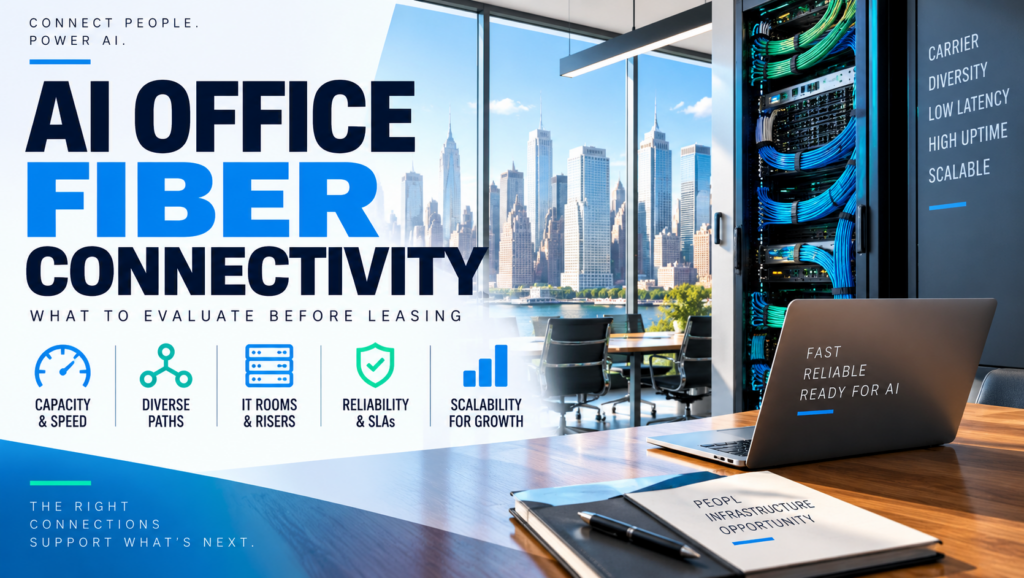
Connectivity: Which telecommunications carriers serve the building?
Riser access: Can another carrier reach your floor?
Cabling: What type of horizontal cabling already exists?
Technology rooms: Does the suite have dedicated equipment space?
Cooling: Can equipment rooms operate after normal business hours?
Power: Does the floor support your workstation and equipment density?
Backup systems: What building systems operate during an outage?
Access control: Can your company control employee and visitor access?
After-hours operations: What do HVAC, security, and building access cost?
Those checks matter even for businesses without trading floors.
Payment processing teams, financial software developers, customer-service operations, and data companies can all require reliable connectivity. Privacy also changes how these companies use meeting rooms and open seating.
A sublease can eliminate months of unnecessary work
A raw office requires decisions before anybody occupies it.
Design comes first. Construction pricing follows. Permitting, procurement, cabling, furniture, audiovisual systems, signage, and move coordination can then extend the schedule.
Existing space removes many of those steps.
Current Manhattan inventory includes offices that already provide private rooms, conference facilities, pantries, data infrastructure, workstations, reception areas, and employee amenities. Our current Manhattan office sublet inventory spans multiple neighborhoods and size categories.
That benefit matters most when timing carries financial consequences.
Perhaps your existing lease expires soon. Maybe a funding event accelerated hiring. A merger could also create an immediate team requirement.
In those situations, time represents part of the economics.
The cheapest rent can become expensive when a construction schedule delays occupancy.
Where FinTech Companies Should Look in Manhattan
There is no single FinTech office district in Manhattan.
Instead, financial technology companies cluster around several business environments. Each area offers a different mix of clients, talent, transit, building quality, cost, and office character.
Current market conditions also favor tenants who compare neighborhoods. Manhattan availability fell to 12.5% during August 2026. Total available supply reached 65.40 million square feet, its lowest level since September 2020. Sublet supply also fell to its lowest level since August 2019.
That tightening matters because the best furnished offices can disappear quickly.
A company that limits itself to one intersection may lose negotiating leverage. In contrast, a company comparing several compatible districts can negotiate from a stronger position.
Flatiron, NoMad, and Union Square for technology-driven teams
Midtown South remains a natural fit for many FinTech companies.
Flatiron and nearby districts combine technology culture with strong transportation. They also offer loft buildings, renovated commercial properties, boutique full floors, and modern towers.
Current options illustrate the range.
A 2,600-square-foot move-in-ready Flatiron sublet provides a private full-floor environment. The existing plan includes glass-fronted meeting rooms, open work areas, a pantry, private bathrooms, and secure access.
For a larger requirement, a 5,000-square-foot plug-and-play Flatiron sublet offers an open-plan environment for a growing team.
Another 7,687-square-foot furnished Union Square office combines open workstations with private offices and larger meeting areas.
These environments often work well for product teams and engineering-heavy businesses.
They also suit companies that want an office atmosphere closer to technology businesses than traditional corporate finance.
However, Midtown South carries premium pricing.
During the second quarter of 2026, overall Midtown South asking rents averaged $81.14 per square foot. Class A asking rents averaged $104.50 per square foot. Those figures describe direct-market asking rents, rather than individual sublease pricing.
That distinction matters.
A furnished sublease should compete through its total economics, not a simplistic percentage discount.
Grand Central and Midtown East for finance-facing operations
Some FinTech businesses need more traditional financial-office functionality.
That requirement can shift the search toward Grand Central, Midtown East, Fifth Avenue, Madison Avenue, and surrounding corridors.
These locations can support frequent client meetings, senior recruiting, executive travel, and commuter access.
They also contain some of Manhattan’s deepest corporate office inventory.
A current furnished Midtown office near Bryant Park provides 7,040 square feet. Its layout includes glass-partitioned rooms, open workstation areas, and a large staff kitchen. The current sublease runs through November 2028.
Teams needing specialized density should compare very different layouts.
The previously noted 22,559-square-foot turnkey office demonstrates the opposite end of that spectrum. Its existing configuration supports a substantial trading environment.
For FinTech businesses, that comparison raises an important point.
Neighborhood matters, but installation can matter more.
A beautiful address cannot compensate for inadequate technology infrastructure. Likewise, a lower rent cannot fix a floor that requires major reconstruction.
Midtown’s Q2 2026 overall asking rent averaged $76.98 per square foot. Class A space averaged $88.50 per square foot.
Meanwhile, Midtown availability has tightened substantially. One Q2 2026 market report placed Midtown availability at 12.3%, its lowest supply level since June 2020.
Financial District for value, infrastructure, and finance proximity
Lower Manhattan remains particularly relevant to FinTech office searches.
The district provides a financial identity without requiring Plaza District economics. It also offers a wide range of building vintages and office types.
Current direct asking rents demonstrate that value gap.
Downtown overall asking rents averaged $56.66 per square foot during Q2 2026. Class A rents averaged $63.60 per square foot.
Those averages do not tell you what any specific sublease will cost.
Still, they provide a useful starting benchmark against Midtown and Midtown South.
Our current inventory includes a 3,138-square-foot furnished Financial District sublease. The office comes furnished, wired, and move-in ready. Its stated sublease term extends through December 2030.
Another 2,573-square-foot furnished Downtown sublet offers open areas, private offices, and a glass-front conference room. Its listed term extends through February 2028.
Larger teams can examine a 6,517-square-foot furnished Downtown installation. Its existing plan includes multiple meeting rooms, open workstations, and collaborative space.
Those differences make Downtown especially useful for budget-sensitive searches.
A FinTech company can compare several building classes while remaining inside the same broader financial district.
Hudson Yards and the Far West Side for premium growth
FinTech businesses seeking newer office product should also evaluate Hudson Yards.
Modern towers can provide efficient floor plates, strong building infrastructure, contemporary security, employee amenities, and institutional-quality environments.
Subleases can open those buildings without requiring a completely new installation.
For example, a 10,853-square-foot furnished Hudson Yards sublet currently offers turnkey space for an estimated 47 people. The suite includes private rooms, collaborative space, and outdoor access.
A larger 20,222-square-foot furnished Hudson Yards sublease provides a high-end existing installation. Its current terms allow a negotiated arrangement through May 2032.
Another 23,324-square-foot furnished West Side option includes substantial open seating, meeting areas, and a cafe-style pantry. The listed term can also run through May 2032.
Larger occupiers can go considerably further.
A current 45,942-square-foot headquarters sublease spans two floors. Its stated sublease term runs through June 2034.
Therefore, “short term FinTech office” does not always mean a tiny suite.
A sublease can cover 3,000 square feet or an institutional headquarters.
What a Manhattan FinTech Sublease Really Costs
Rent represents only one part of your occupancy cost.
This principle becomes especially important when comparing a sublease against direct space.
Manhattan’s overall Q2 2026 asking rent averaged $72.83 per square foot. Class A asking rent averaged $84.79 per square foot.
Those figures provide market context, not a universal price sheet.
Sublease pricing depends on the master lease, remaining term, building, condition, sublandlord motivation, furniture, and timing.
Moreover, different market reports use different inventory definitions. One report placed Manhattan Q2 vacancy at 19.3%. Another measured Q2 availability at 13.0%. These numbers describe different concepts and methodologies.
For tenants, the practical lesson remains simple.
Never compare two office opportunities using headline rent alone.
Start with annual rent per rentable square foot
Traditional Manhattan offices commonly quote rent as annual dollars per rentable square foot.
Suppose a 10,000-square-foot office asks $70 per square foot annually.
The simple base-rent calculation looks like this:
10,000 × $70 = $700,000 annually
Divide that figure by twelve.
$700,000 ÷ 12 = approximately $58,333 monthly
However, that amount may not equal your full occupancy cost.
Operating expenses, electricity, overtime HVAC, cleaning, insurance, telecommunications, and other obligations can change the result.
Then price the build-out you are avoiding
A good sublease may contain substantial embedded value.
Imagine that the existing office already has twenty workstations. It also includes six offices, two conference rooms, a pantry, reception, and cabling.
A direct alternative might require you to create those features.
That means architecture, construction, furniture, technology work, permits, audiovisual equipment, and professional coordination.
You should therefore assign financial value to inherited improvements.
Do not automatically value everything at replacement cost.
Used furniture has a different value from new furniture. An existing conference room matters only when your team actually needs it.
Still, ignoring usable improvements can distort the comparison.
Calculate cost per usable seat
FinTech companies should also compare occupancy cost per functional employee position.
A 10,000-square-foot office with 45 effective seats may outperform an 8,000-square-foot office with 25 effective seats.
Room mix can explain that difference.
Large executive offices consume more area. Oversized boardrooms reduce workstation capacity. Thick core walls can reduce useful floor area.
Meanwhile, an efficient open layout can accommodate substantially more employees.
Therefore, ask three separate questions:
What is the rentable square footage?
How many employees can we realistically place here?
How many seats can we use without compromising operations?
The third answer matters most.
A nominal desk count means little when your company needs several conference rooms, privacy rooms, technology areas, or secure departments.
Treat remaining lease term as an economic variable
A lower rent can still become a poor deal when the term does not fit your business.
Suppose your company expects significant growth within eighteen months. A large fixed sublease lasting five more years may create future inefficiency.
The opposite problem also occurs.
A rapidly growing company can secure a perfect office with only twelve months remaining. It then faces another move just after completing the first one.
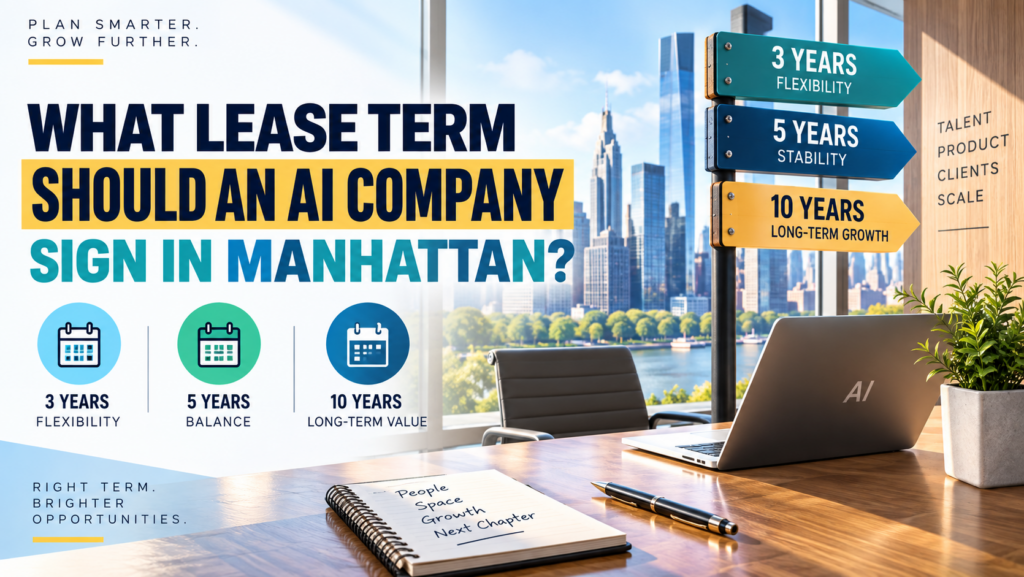
The correct term should align with your planning horizon.
For many FinTech companies, the key uncertainty involves headcount rather than survival.
A business might have strong financing and still lack visibility into future staffing.
Product launches change teams. Regulatory projects expand operations. Acquisitions can alter space needs quickly.
That makes term flexibility part of the price.
Furnished space can reduce the cash required before occupancy
Startups frequently focus on monthly rent while overlooking pre-opening capital.
Yet occupancy can require substantial cash before the first employee arrives.
Furniture costs money. Cabling costs money. Moving costs money.
Conference technology, access systems, signage, deposits, legal work, and insurance also require spending.
A genuinely furnished sublease can reduce several of those costs.
Current Manhattan short-term office comparisons commonly separate true subleases from flexible and serviced products because each carries different cost structures.
That distinction helps explain why per-desk pricing can mislead.
A managed office price may include services. Traditional sublease rent may not.
Therefore, compare total occupancy cost over the full intended period.
Beware of the universal “subleases are always cheaper” rule
A sublease can offer exceptional value. It does not automatically beat every direct lease.
Direct landlords sometimes offer aggressive concessions.
A landlord may contribute toward improvements. Free rent can reduce effective cost. Existing landlord-built suites can also eliminate construction.
Consequently, every serious FinTech search should compare subleases against strong direct alternatives.
The purpose is not to “win” a sublease.
The objective is to secure the best office transaction for the business.
That mindset protects tenants from choosing the wrong structure simply because its headline rent looks lower.
How to Evaluate a Plug-and-Play FinTech Office
FinTech companies should inspect offices differently from ordinary administrative users.
A generic tenant may prioritize reception, conference rooms, natural light, and pantry quality.
Those features still matter.
However, financial technology operations can add requirements involving information security, reliability, controlled access, acoustics, and technology infrastructure.
A proper tour should therefore function like an operational inspection.
Begin with the technology room
Find the technology room before admiring the views.
Look at its location, cooling, electrical service, existing racks, cable pathways, and physical security.
Ask how supplemental cooling works.
Then determine what happens after standard building hours.
Some companies need only basic networking equipment. Others operate much heavier infrastructure.
A trading-focused business may need significantly more.
Our turnkey trading-oriented Midtown sublease demonstrates the upper end. Its current installation includes a dedicated technology room, supplemental cooling, and structured cabling.
Verify telecommunications rather than assuming connectivity
“High-speed internet available” tells you almost nothing.
Your technology team should identify available carriers. It should also confirm how service reaches the floor.
Ask whether another provider can enter the building.
Determine whether multiple paths exist.
Next, inspect the existing cabling.
A room full of abandoned wiring does not equal usable infrastructure.
Your team should identify cable categories, labeling, patching, rack condition, and pathways.
Ownership also matters.
The sublandlord may own some equipment. A service provider may own other components.
Clarify everything before signing.
Examine physical security from the sidewalk inward
Financial businesses often handle sensitive information.
That makes visitor movement important.
Start outside the building. Follow the exact path a guest would take.
Who controls lobby entry?
Does building security verify visitors?
Can employees enter after hours?
How does the elevator reach your floor?
A full-floor office may offer additional separation.
Boutique offices can also provide strong privacy through keyed elevators and controlled access.
For instance, the current 2,600-square-foot Flatiron full-floor sublet includes key-fob access and a keyed elevator.
Interior design then becomes part of the security plan.
Reception should prevent visitors from wandering into work areas. Sensitive departments may need separate access zones.
Inspect acoustics before confidential calls begin
Glass looks polished. Unfortunately, glass can also create poor acoustic privacy.
Spend several minutes inside each conference room.
Have another person speak outside.
Then repeat the exercise in phone rooms and executive offices.
Payment discussions, investor meetings, personnel conversations, legal calls, and customer issues can all require privacy.
Acoustic performance should therefore influence layout decisions.
Adding film, seals, sound masking, or other treatments after occupancy can cost money.
Count meeting rooms by function
Do not count every enclosed room as equal.
A six-person conference room serves a different purpose from a phone booth.
Likewise, a boardroom cannot replace several small meeting spaces.
FinTech teams often combine software development, finance, compliance, sales, operations, and executive functions.
These groups use rooms differently.
Product teams may need short collaboration sessions. Salespeople need call privacy. Management teams require formal conference space.
A useful inventory might contain:
Small focus rooms for one or two people.
Huddle rooms for short team meetings.
Standard conference rooms for internal and external meetings.
Larger rooms for investors, clients, training, or leadership.
You should count each type before comparing offices.
Review workstation density honestly
A listing may describe an estimated capacity.
Treat that figure as a starting point.
Your company could need larger desks. Traders might require several monitors.
Engineering teams may prefer different workstation dimensions.
Circulation also matters.
Packing people into every available position can damage acoustics, privacy, and employee experience.
Instead, test the actual plan against your operating model.
Current inventory illustrates how widely those models vary.
A 10,853-square-foot furnished West Side office estimates capacity around 47 people.
Meanwhile, a 20,222-square-foot furnished office estimates capacity around 133 people.
Those ratios differ because layouts differ.
Your company should not inherit another tenant’s density assumptions without testing them.
Check power where people actually sit
Power capacity rarely looks exciting during a tour.
Yet inadequate workstation power can create immediate operational problems.
Walk the workstation rows.
Identify electrical distribution. Ask about supplemental circuits.
Then consider the equipment your employees use.
Multiple monitors, docking stations, specialized computers, television displays, conferencing equipment, servers, and kitchen appliances all draw power.
Your technology team should confirm actual requirements.
Understand generator and emergency systems
A building generator does not automatically power your entire suite.
Some systems may support elevators. Others may cover emergency lighting or life-safety equipment.
Tenant systems can require separate arrangements.
Therefore, ask exactly what the generator supports.
Also determine whether additional backup power can serve technology equipment.
FinTech businesses with continuity requirements should treat this as operational due diligence.
Evaluate heating and cooling after hours
Many Manhattan buildings provide standard HVAC during defined business hours.
Extra service can create significant operating costs.
A FinTech company with extended trading, development, or support schedules should ask about overtime HVAC immediately.
Technology rooms deserve separate attention.
Server and network equipment produce heat even when employees leave.
Confirm the cooling arrangement before treating any office as technology-ready.
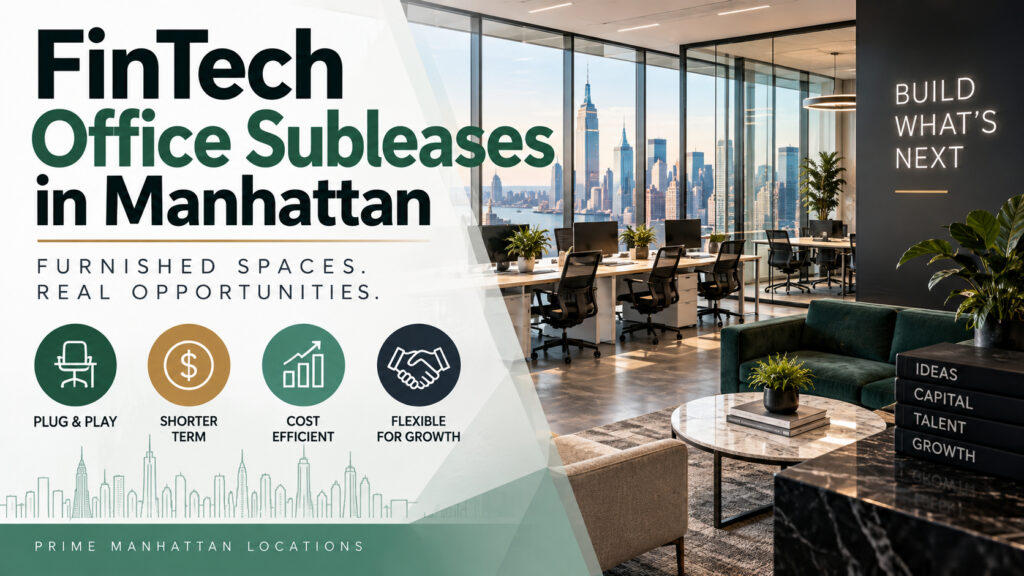
Should a FinTech Startup Lease or Sublease Office Space?
This question does not have one universal answer.
A FinTech startup should sublease when the sublease fits its actual planning horizon. The existing office must also support operations with limited modification.
Choose a direct lease when long-term control creates greater value.
That distinction becomes clearer when you test specific business conditions.
| Business condition | Sublease often fits better | Direct lease often fits better |
|---|---|---|
| Headcount remains uncertain | Yes | Sometimes |
| Immediate move matters | Yes | Only with ready space |
| Existing layout already works | Yes | Possible |
| Major custom construction needed | Usually no | Yes |
| Strong branding requirements | Sometimes | Yes |
| Long-term control matters | Less often | Yes |
| Expansion rights matter greatly | Sometimes | Yes |
| Furniture reduces startup costs | Yes | Depends |
| Shorter planning horizon | Yes | Less often |
| Specialized existing infrastructure | Yes | Depends |
Sublease when flexibility has measurable value
FinTech businesses rarely grow in perfectly straight lines.
Funding can accelerate hiring. Automation can reduce staffing needs.
Acquisitions may add employees. Product changes can reorganize departments.
A shorter remaining term can therefore protect optionality.
That does not mean “take the shortest term possible.”
Moving offices consumes management time and money.
Instead, seek a term long enough to justify the relocation.
Sublease when the existing build solves an expensive problem
Suppose you find an office with appropriate security, cabling, private rooms, and conference infrastructure.
That existing installation can create substantial value.
The value becomes even greater when another option requires major construction.
A trading operation provides a clear example.
Building a dense trading floor from a conventional office can require specialized electrical and technology work. Existing infrastructure can dramatically simplify that process.
Likewise, a software-focused FinTech may value open seating, phone rooms, and collaborative areas.
Choose the office that already resembles your operating model.
Lease directly when control matters more than flexibility
A direct lease becomes more attractive when your company expects long-term occupancy.
You may want significant branding. Another tenant might need specialized construction.
Perhaps your company requires expansion options.
A direct relationship with the landlord can also simplify long-term planning.
However, direct does not automatically mean raw construction.
Manhattan contains landlord-built and furnished direct offices.
Therefore, compare all move-in-ready possibilities.
Lease directly when the sublease end date creates a cliff
Every sublease sits beneath a master lease.
That creates an outer limit.
Your sublease cannot simply continue forever because your company likes the office.
An awkward end date can create serious problems.
Imagine signing a three-year sublease while expecting a major product expansion during year three.
Your company could face relocation at exactly the wrong moment.
Longer-term direct control may prove more valuable.
Consider a flexible office only when the requirement truly calls for one
Very small teams sometimes need something shorter than a conventional sublease.
A new market-entry team may need a handful of desks. A project team could need several months.
In those cases, flexible or serviced space can serve a legitimate purpose.
However, that arrangement should not become the default recommendation for every startup.
Growing FinTech companies often need privacy, identity, technology control, meeting capacity, and predictable access.
A true office can satisfy those requirements more effectively.
The supplied market benchmark shows why these products frequently overlap within the same tenant journey. Users compare short-term offices, serviced suites, furnished spaces, and true subleases together.
Your decision should therefore start with the business problem.
Do you need temporary desks, or do you need an actual company office?
Those represent different searches.
How a Manhattan FinTech Office Sublease Gets Done
Finding the office represents only the first phase.
A commercial sublease involves several parties and documents.
The process can move efficiently when everybody prepares early. Conversely, missing financial or technical information can delay the transaction.
Start with your business requirements.
Define the requirement before touring
Set a realistic size range.
Then establish your earliest and latest acceptable move dates.
Your requirement should also identify:
Headcount: current, expected, and peak.
Layout: open seating, offices, conference rooms, and special spaces.
Technology: connectivity, equipment rooms, cooling, power, and redundancy.
Security: access control, visitor management, and internal privacy.
Term: minimum useful period and maximum desired commitment.
Budget: base rent and total occupancy cost.
Neighborhoods: preferred locations and workable alternatives.
Transit: employee commuting requirements.
This preparation prevents attractive offices from distracting the team.
Search by configuration instead of square footage alone
Two offices with identical square footage can function completely differently.
One may contain thirty private offices.
Another could offer a nearly open floor.
Therefore, search for layout and infrastructure together.
Our Manhattan office sublet inventory provides a starting point across multiple size bands.
FinTech teams should also consider specialized requirements.
For example, a trading-heavy requirement should identify dense open floors and technology support. A product company may prioritize collaborative space and small meeting rooms.
Build a genuine shortlist
Touring thirty mediocre offices creates confusion.
Instead, identify a smaller group that meets non-negotiable requirements.
Compare them on the same framework.
A simple matrix works well:
| Factor | Weight | Office A | Office B | Office C |
|---|---|---|---|---|
| Total economics | High | |||
| Existing layout | High | |||
| Technology | High | |||
| Security | High | |||
| Remaining term | High | |||
| Commute | Medium | |||
| Building quality | Medium | |||
| Amenities | Medium | |||
| Views and image | Variable |
That framework prevents aesthetics from controlling the decision.
Views can influence recruiting and brand perception.
They should not outrank inadequate technology infrastructure.
Tour with operations and technology in mind
Bring the right people into the process early.
A senior executive may understand strategic priorities. Operations personnel know workplace requirements.
Technology staff can identify infrastructure problems.
Legal review comes later, but major issues should surface before proposal negotiations.
Take photographs and notes.
Count actual rooms.
Inspect workstations.
Measure questionable areas.
Ask for floor plans.
A good tour answers questions rather than creating a photo album.
Request the master lease and relevant documents
The master lease controls the original tenant’s rights.
Therefore, it can also affect the subtenant.
Review permitted use, access, building services, alterations, signage, insurance, operating charges, assignment provisions, and sublease requirements.
Landlord consent commonly forms part of the process.
Exact obligations depend on the master lease and negotiated sublease. Our broader Manhattan subleasing guide explains the basic relationship among landlord, sublandlord, and subtenant.
Your attorney should review the documents for your specific transaction.
Investigate the sublandlord
A subtenant does not occupy space in a vacuum.
The original tenant still has obligations to the landlord.
Therefore, understand the sublandlord’s financial situation.
Ask whether rent remains current.
Review relevant representations and protections with counsel.
A financially troubled sublandlord can create risks even when your company pays every sublease invoice on time.
This point separates sophisticated sublease analysis from simple listing comparison.
Document furniture and equipment
Never rely on phrases like “furniture included.”
Prepare a schedule.
Identify what stays.
Then specify condition and ownership.
Do the same for audiovisual systems, televisions, appliances, access equipment, racks, and other technology.
Photographs can support the schedule.
That documentation reduces disputes before move-in and move-out.
Negotiate restoration responsibilities
Who removes cabling at expiration?
Who restores walls?
What happens to supplemental cooling?
Must the subtenant remove signage?
Questions involving restoration can create substantial end-of-term costs.
Address them before signing.
The same principle applies to alterations.
A sublease may restrict significant changes.
If your company needs construction, identify that requirement before completing the deal.
Coordinate consent and move planning at the same time
Do not wait until the final signature to plan the move.
Your operations team can begin telecommunications coordination earlier.
Furniture inventories can start early as well.
Insurance, movers, access cards, and technology schedules also require lead time.
Sublease execution still depends on required approvals.
Yet parallel planning can reduce the period between final consent and occupancy.
That speed represents one of the primary advantages of a furnished sublease.
Current FinTech Office Sublease Choices by Team Profile
The right office depends more on operating requirements than industry labels.
Still, several FinTech team profiles repeatedly appear in Manhattan searches.
Instead of treating every company identically, match the office to the way people actually work.
Early-stage FinTech team seeking privacy
A smaller company leaving shared workspace may need its first independent office.
The priorities usually include controlled access, one good conference room, several private rooms, and enough open seating for growth.
Large corporate amenities may matter less.
A current 2,600-square-foot Flatiron sublet fits that general scale. It combines open work areas with glass-fronted rooms and private full-floor access.
A 3,138-square-foot furnished Downtown option provides another structure. It offers turnkey space with a substantially longer remaining term.
The decision between those examples should involve more than neighborhood preference.
Term matters.
So does growth.
Product-led FinTech company with hybrid attendance
Product and engineering teams often need open work areas plus many smaller meeting spaces.
Hybrid schedules can reduce daily attendance while increasing room demand.
That sounds contradictory, but it makes sense.
Fewer employees may sit at desks every day.
Meanwhile, more video calls and mixed-location meetings require enclosed rooms.
A 7,040-square-foot furnished Midtown sublet provides six glass-partitioned rooms alongside open workstation areas.
A larger 7,687-square-foot Union Square option offers substantial collaborative and private space.
Evaluate both according to room demand rather than employee count alone.
Trading or market-oriented FinTech operation
These teams can require higher workstation density.
They may also need multiple screens, technology infrastructure, strong communications, dedicated equipment rooms, and longer operating hours.
Existing specialized space becomes especially valuable.
Our 22,559-square-foot turnkey trading-oriented office currently includes 120 trading positions and 18 additional workstations. It also provides private offices, conference rooms, a technology room, supplemental cooling, and structured cabling.
A generic creative loft cannot provide the same functionality without substantial work.
Therefore, these tenants should search according to infrastructure first.
Growth-stage company needing institutional quality
A larger FinTech company may need a more polished environment for recruiting, clients, financing relationships, and executive meetings.
West Side and premium Midtown subleases can address that requirement.
A 10,853-square-foot furnished Hudson Yards office offers immediate turnkey occupancy.
Larger teams can compare that space against the 20,222-square-foot furnished option.
Still more scale appears within a 23,324-square-foot furnished sublease.
The important point involves progression.
FinTech sublease inventory does not stop when the company reaches institutional scale.
Headquarters-stage FinTech company
Large organizations may need contiguous floors, branding opportunities, dedicated reception, extensive meeting facilities, executive space, and employee amenities.
At that point, sublease versus direct becomes a major strategic decision.
A current 45,942-square-foot West Side headquarters opportunity provides an example of large-format sublease inventory. The listed term extends through June 2034.
That remaining term changes the traditional notion of a sublease.
This is not temporary startup space.
Instead, it can support a major long-term operation.
Satellite office or Manhattan market-entry team
An established FinTech business entering New York may prefer a furnished sublease before committing to a permanent headquarters.
That approach creates time to learn.
Where do employees live?
Which clients visit most often?
How often does leadership travel?
What departments will grow locally?
An interim office can answer those questions through actual experience.
However, choose enough remaining term to make the move worthwhile.
Extremely short occupancy can create unnecessary disruption.
FinTech companies with commuter-heavy workforces
Transit can become one of the strongest employee amenities.
A company recruiting from Westchester or Connecticut may prioritize Grand Central.
Long Island or New Jersey commuter patterns can favor Midtown West and Penn Station.
Downtown can offer strong subway connectivity and regional access.
Therefore, map employee origins before selecting a neighborhood.
The office with the shortest average commute may outperform the office with the best rooftop.
That benefit can affect attendance, recruiting, lateness, and employee satisfaction.
FinTech Office Sublease Questions Tenants Should Answer Before Signing
What makes an office a FinTech office?
No legal office category called “FinTech office” exists. The term describes space suited to financial technology operations.
Suitable space usually combines technology capacity, privacy, security, reliability, meeting infrastructure, and an appropriate workplace layout.
A software-driven payment company may need an open technology office.
Conversely, a market-facing operation may need a dense trading installation.
The business model determines the office.
Are FinTech office subleases always furnished?
No.
Many Manhattan subleases include furniture because the outgoing tenant wants a faster transaction.
Others transfer furniture separately.
Some spaces arrive completely empty.
Always confirm the furniture schedule before comparing economics.
Does plug-and-play mean internet already works?
Not necessarily.
The office may contain cabling without active service.
Likewise, an existing telecommunications provider might not meet your requirements.
Verify carrier availability, activation timing, equipment ownership, and cabling condition.
Can a FinTech company move into a sublease immediately?
Physical space can sometimes support immediate occupancy.
The legal transaction still requires documentation and any necessary consent.
Technology activation can also affect timing.
Therefore, distinguish “available now” from “operational tomorrow.”
How much Manhattan office space does a FinTech company need?
There is no universal formula.
Start with actual headcount.
Then add required rooms, circulation, support functions, technology areas, and growth capacity.
A trading business may use space differently from a software company.
Use functional seats instead of arbitrary square-foot rules.
Should a startup take extra space for growth?
Usually, some growth capacity helps.
Too much unused space creates unnecessary fixed cost.
The correct buffer depends on hiring visibility and lease term.
A shorter sublease can justify a smaller growth cushion.
Is a Financial District sublease cheaper than Midtown?
Current district-level direct asking averages suggest a meaningful cost difference.
Q2 2026 Downtown overall asking rents averaged $56.66 per square foot. Midtown averaged $76.98 per square foot. Midtown South averaged $81.14 per square foot.
Individual subleases can differ materially from those averages.
Condition, building quality, term, and motivation can outweigh the neighborhood average.
Why do FinTech companies also consider Flatiron and NoMad?
Technology talent and financial services do not operate inside separate worlds anymore.
Many FinTech companies combine engineering, product, sales, finance, and operations.
Midtown South offers an environment that can support that mix.
Its pricing reflects strong demand for quality space.
Why does Midtown remain important for FinTech?
Midtown offers extensive corporate inventory and strong transportation.
It can also place teams near financial and professional-services relationships.
Current inventory includes both conventional executive layouts and specialized trading installations.
That diversity supports many FinTech operating models.
Is Hudson Yards only appropriate for large FinTech companies?
No.
Current furnished sublease examples range from roughly 10,853 square feet to more than 45,000 square feet.
Still, its office stock tends toward larger, premium-quality environments.
Smaller companies should compare total occupancy needs carefully.
What is the biggest advantage of a furnished FinTech sublease?
Speed often provides the strongest advantage.
The second advantage usually involves avoided capital spending.
A useful existing office can eliminate furniture purchases, substantial construction, and part of the technology installation.
That combination can preserve capital for the business.
What is the biggest risk?
The master lease relationship creates one important layer of risk.
Your rights do not exist independently from every underlying lease issue.
The remaining term can also create a future relocation requirement.
Therefore, legal and financial due diligence matter.
Can the landlord reject a subtenant?
The governing documents determine consent rights and procedures.
Many Manhattan commercial leases require landlord consent for subletting.
Review the specific master lease instead of relying on assumptions.
Should we ask for a direct lease instead?
Sometimes.
A direct transaction may offer better long-term control, expansion rights, or custom construction.
It may also produce competitive effective economics through landlord concessions.
Compare both structures before committing.
Is flexible workspace the same as a FinTech office sublease?
No.
Flexible office arrangements commonly use licenses or service agreements.
A true sublease gives the subtenant rights to defined premises beneath an existing lease.
Each format solves different business problems.
How important is the building’s image?
Image matters when clients, investors, recruits, or counterparties visit frequently.
However, image should follow operational suitability.
A prestigious tower with inadequate infrastructure can become a poor FinTech office.
Should we prioritize rent or commute?
Compare both financially.
A modest rent saving can lose value when a difficult commute hurts recruiting or attendance.
Transit convenience can function like a workplace amenity.
That effect becomes especially important for hybrid teams.
What should we bring to a FinTech office tour?
Bring your headcount plan and room requirements.
Technology personnel should join tours involving specialized infrastructure.
Also carry a list of non-negotiable security, connectivity, and operational requirements.
That preparation makes each tour more productive.
What documents should we request before signing?
Request the proposed sublease and applicable master lease materials.
Also obtain floor plans, furniture schedules, and relevant operating information.
Technology documentation may include carrier, riser, cabling, cooling, and power details.
Your advisers can then review the transaction as one package.
How should we compare three competing subleases?
Normalize the economics first.
Then compare usable seats, term, technology readiness, layout, security, commute, and future flexibility.
Finally, estimate the cost of making each office operational.
The lowest asking rent rarely answers the whole question.
Can FinTech companies find short-term Manhattan offices without using shared workspace?
Yes.
True subleases often provide shorter commitments than conventional direct leases.
Remaining terms vary widely.
Current examples include offices running into 2028, 2030, 2032, and 2034.
That range allows companies to target a planning horizon instead of accepting one standard term.
What does “turnkey” mean during negotiation?
Define it precisely.
Furniture, cabling, technology equipment, audiovisual systems, access systems, and appliances should each receive separate treatment.
A vague turnkey promise can create expensive misunderstandings.
How current is Manhattan sublease availability?
Supply continues to tighten.
August 2026 Manhattan availability fell to 12.5%, while sublet inventory reached its lowest level since August 2019. Year-to-date leasing reached 29.91 million square feet.
Another Q2 measure placed sublease supply at 12.1 million square feet, down 5.1% during that quarter.
Those figures use different market methodologies.
Both point toward the same practical development: stronger second-generation space faces more competition.
When should we begin looking?
Start before timing becomes an emergency.
Subleases can avoid long construction schedules, but legal and operational work still takes time.
Earlier preparation also creates more neighborhood choices.
Most importantly, it gives you leverage to reject a bad deal.
What should a FinTech company prioritize above everything else?
Fit.
The right office should fit the people, operating model, technology requirements, budget, and business horizon.
Prestige without fit wastes money.
Cheap space without functionality wastes time.
Get current furnished FinTech office subleases in Manhattan
Our role stays on the tenant side. We compare furnished subleases, turnkey offices, direct opportunities, and alternative structures against your requirements. Then we help negotiate the option that best supports your company.
Tell us your headcount, target move date, preferred neighborhoods, technology requirements, and budget. We can then narrow the market around offices that genuinely fit those criteria.
Start with our current Manhattan office sublets, or examine specialized inventory such as the turnkey trading-oriented Midtown office, furnished Midtown sublease, move-in-ready Flatiron office, furnished Financial District sublease, and furnished Hudson Yards offices.
The best FinTech office sublease is not simply the cheapest furnished space in Manhattan.
It is the office that lets your company operate securely from day one. It should also support your people without forcing unnecessary capital spending.
Finally, the term should match where the business expects to go next.
Get current furnished subleases
FinTech Customized Office Report
We represent office tenants throughout Manhattan. Our work starts with your business requirements, not a building owner’s leasing agenda. That approach helps protect your budget, timing, technology needs, flexibility, and negotiating position.
Fill out our 📋 online form or give us a call today 📞 212-967-2061 — let’s find the right options for your business.