FinTech Office Space in Hudson Square and SoHo
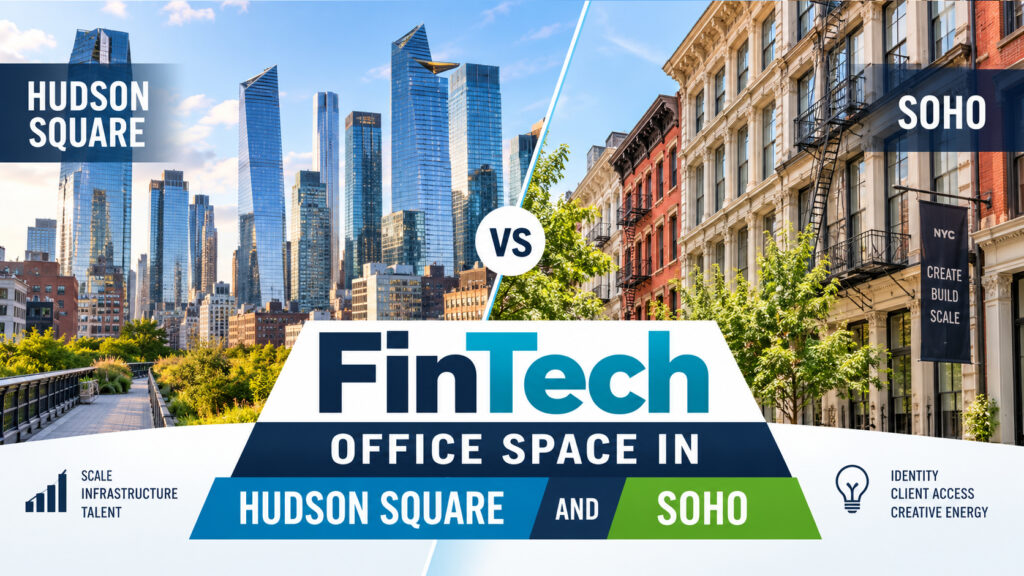
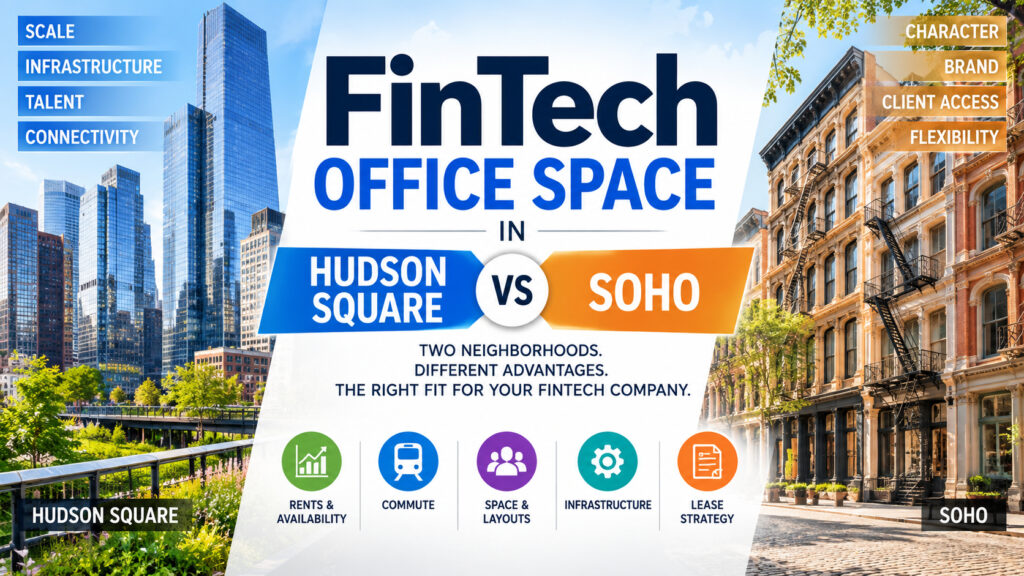
FinTech companies choosing between Hudson Square and SoHo face two very different office decisions.
Hudson Square usually wins when expansion capacity, efficient floor plates, infrastructure, and larger teams matter most. SoHo often wins for smaller headquarters seeking identity, client appeal, and classic Manhattan loft character. Neither neighborhood offers the right answer for every FinTech business.
The difference matters because financial technology companies rarely choose offices on rent alone. Security, recruiting, data infrastructure, privacy, client access, and future headcount can change the answer.
Today’s market also rewards early planning. Midtown South office availability continues to contract while leasing activity remains strong. August 2026 availability reached 16.4%, down 360 basis points from one year earlier. Average asking rent reached $86.26 per square foot.
Hudson Square has also recorded several major technology and financial-technology commitments. One digital payments business recently committed to 261,000 square feet there for ten years. That transaction demonstrates the district’s ability to support major corporate FinTech operations.
SoHo serves a different requirement. Its smaller loft inventory can support growing firms that value design, visibility, executive access, and neighborhood identity.
This guide compares both markets from the tenant’s side of the table.
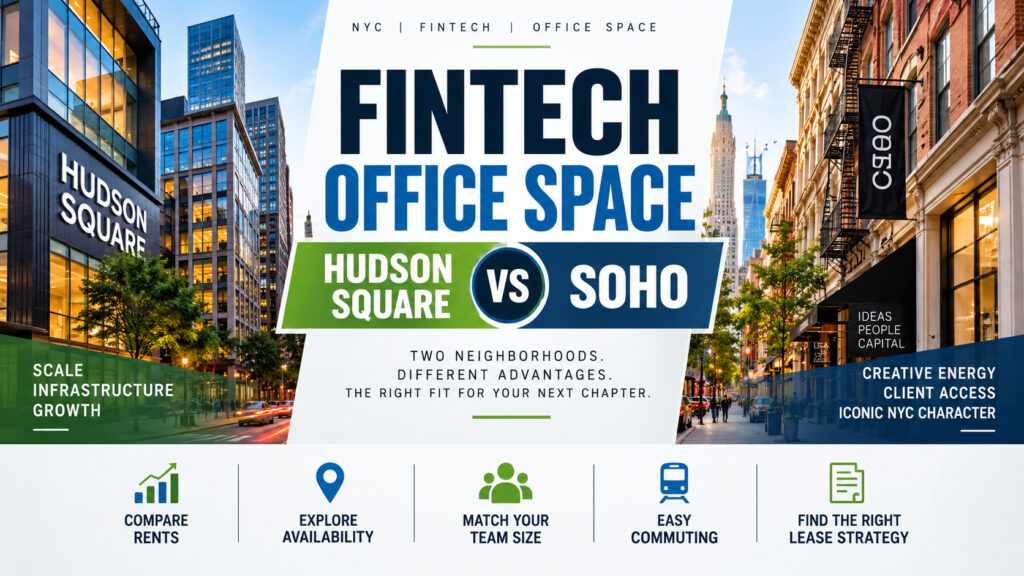
Is Hudson Square or SoHo Better for a FinTech Company?
Start with the business model rather than the neighborhood name.
A 20-person payments startup does not need the same office as a 300-person financial infrastructure company. Likewise, a client-facing wealth technology business may prioritize different features than an engineering-heavy platform.
Hudson Square generally provides more room to scale horizontally. Its former printing buildings often contain broad floors, high ceilings, and substantial windows. Modernized properties add contemporary mechanical systems, amenities, outdoor spaces, and technology infrastructure.
SoHo offers a different form of value. Historic lofts create recognizable workplaces with strong visual character. Smaller and midsized floors can also give growing companies greater identity within a building.
| Decision factor | Hudson Square | SoHo |
|---|---|---|
| Large team growth | Excellent fit | More limited |
| Small boutique headquarters | Good | Excellent fit |
| Large contiguous floors | Major advantage | Less common |
| Historic loft character | Strong | Defining strength |
| Technology-oriented building stock | Very strong | Building-specific |
| Client-facing prestige | Strong | Very strong |
| Horizontal collaboration | Excellent | Depends on floor |
| Privacy and executive rooms | Easy on larger floors | Strong in divided lofts |
| Near-term expansion options | Generally stronger | Often tighter |
| Retail and street energy | Moderate | Very high |
| River and greenway access | Major advantage | Western SoHo benefits |
| Brand-forward environment | Strong | Major advantage |
| 100-plus-person requirement | Usually better | Requires more searching |
| 10-to-40-person requirement | Strong | Very strong |
The practical answer: choose Hudson Square when the office must function as operational infrastructure.
Choose SoHo when workplace identity carries unusually high value.
A growth-stage FinTech company may also combine both priorities. In that case, focus on the overlapping Varick Street and western SoHo corridor.
Hudson Square sits between Canal Street and Clarkson Street, west of Sixth Avenue. The district meets SoHo along its eastern and southeastern edges.
That geography creates useful crossover inventory. Some Varick Street offices deliver Hudson Square floor economics with immediate SoHo access.
For example, a current 1,211-square-foot Varick Street office includes an open work area, conference room, and furnished installation. A larger team can consider a 2,530-square-foot furnished Hudson Square office with an existing conference room and open workspace.
The important distinction involves how the workplace needs to perform, not which neighborhood sounds better.
What “FinTech Office Space” Actually Means in Hudson Square and SoHo
FinTech office space does not describe a special legal building category.
Instead, it describes office space that fits financial-technology operations. That distinction matters.
A payments company, digital lending platform, trading-technology firm, blockchain company, and insurance-technology startup may share an industry label. Their physical requirements can differ sharply.
Current coverage around this topic reflects that complexity. Tenants encounter traditional leases, subleases, flexible offices, neighborhood inventory, major leasing news, and technology-market reporting.
For tenants, those choices fall into several practical categories.
| Space type | Best use | Main advantage | Main concern |
|---|---|---|---|
| Direct lease | Established or growing company | Control and longer runway | Larger commitment |
| Prebuilt direct lease | Company seeking speed | Lower construction burden | Less layout customization |
| Turnkey office | Fast-moving growth team | Faster occupancy | Existing design may constrain growth |
| Sublease | Uncertain headcount | Potential furniture and shorter term | Less control over lease structure |
| Raw or white-box space | Large custom headquarters | Maximum design control | Longer construction timeline |
| Flexible office | Very early stage or bridge requirement | Minimal commitment | Higher cost per workstation |
| Office condominium | Long-term owner-user | Ownership and control | Capital requirement and reduced flexibility |
Flexible offices receive significant visibility because they solve an immediate problem. However, they do not automatically solve a FinTech company’s long-term real estate needs.
A ten-person startup may value a six-month solution. Meanwhile, a 100-person operation may need private infrastructure, branding, secured access, and expansion rights.
That distinction becomes more important after financing events. New capital can change headcount expectations within months.
Direct leases favor control. A tenant can negotiate construction, signage, access, electrical needs, HVAC, security, and renewal rights.
Subleases favor flexibility. Existing furniture and wiring can reduce startup costs. Nevertheless, the underlying lease controls many important rights.
Turnkey space favors speed. The best turnkey offices let teams avoid lengthy design and construction programs.
For example, this 2,691-square-foot SoHo turnkey office includes an existing open area, private offices, kitchen, and tenant-controlled HVAC.
At a larger scale, a 30,000-square-foot furnished full floor offers an existing high-density workstation layout. The current listing describes capacity approaching 200 people.
That range illustrates the real meaning of FinTech office SoHo inventory. One neighborhood can support both startup teams and institutional occupiers.
Where FinTech fits within New York’s broader technology economy
New York supports more than an office market.
City economic-development data identifies more than 25,000 technology-enabled startups and 1,200 active venture firms citywide. The city also ranks among the world’s largest technology and venture ecosystems.
A long-running New York FinTech accelerator further connects emerging businesses with financial institutions and venture firms. Its 2026 class included businesses focused on automation, fraud, compliance, digital assets, secure AI, and data management.
Since 2010, that program has supported 130 technology companies. Its graduates have raised more than $3 billion and created more than 3,000 jobs.
For an office tenant, that ecosystem changes location strategy.
Finance no longer occupies one geographic corridor. Engineering, product, compliance, sales, and institutional relationships increasingly overlap.
That overlap helps explain the appeal of Hudson Square and SoHo.
Current FinTech Office Rents, Availability, and Budget Math
Office pricing requires context.
One average cannot tell you what a specific floor should cost. Building quality, floor condition, term, size, views, ownership, and concessions all affect economics.
Research firms also define submarkets differently.
For example, one major research firm reported Midtown South availability at 12.7% during Q2 2026. Another measured 16.4% in August. Their methodologies and inventory universes differ.
Therefore, treat market averages as directional benchmarks rather than pricing guarantees.
One Q2 2026 neighborhood analysis produced the following readings:
| Market | Availability | Average asking rent |
|---|---|---|
| Hudson Square | 17.6% | $88.35/SF |
| SoHo | 15.2% | $93.13/SF |
| Midtown South | 12.7% | $79.41/SF |
| Manhattan | 13.0% | $78.03/SF |
Those figures come from one standardized Q2 2026 dataset. Individual suites can sit far above or below them.
Another major brokerage reported Midtown South overall asking rent at $81.14 during Q2. Class A averaged $104.50 per square foot.
That spread matters.
A tenant should never assume a $90 asking rent means a $90 economic rent.
What the quoted rent means
Commercial office asking rents usually appear as annual dollars per rentable square foot.
At $90 per square foot, a 5,000-square-foot office carries $450,000 in annual base rent. That equals $37,500 monthly before other obligations.
Using the neighborhood averages above produces these illustrations:
| Office size | Hudson Square at $88.35/SF | SoHo at $93.13/SF |
|---|---|---|
| 2,500 SF | $18,406/month | $19,402/month |
| 5,000 SF | $36,813/month | $38,804/month |
| 10,000 SF | $73,625/month | $77,608/month |
These examples show base asking rent only.
Actual occupancy expenses may include electricity, cleaning, after-hours HVAC, taxes, operating escalations, insurance, and telecommunications.
Construction can change the economics even more.
A raw office asking less than a finished office may still cost more overall. Design fees, furniture, cabling, construction, and delayed occupancy can erase the apparent discount.
Conversely, a landlord-funded installation may justify a higher face rent.
Why quality matters more in 2026
Manhattan tenants continue to favor stronger buildings and better installations.
During Q2 2026, tightening Class A supply pushed more tenants toward high-quality Class B alternatives.
That trend fits Hudson Square especially well.
Many former industrial properties now combine older architecture with modernized building systems. This creates a middle ground between traditional loft space and conventional towers.
Demand has also removed large blocks quickly. Midtown South recorded 5.05 million square feet of Q2 leasing. That marked its strongest quarter since late 2001.
By August, Midtown South had logged 5.68 million square feet of year-to-date leasing. Sublease availability had fallen to 2.3%.
For tenants, one conclusion follows: good space can disappear while a company debates the average rent.
Use market reports to set the range. Use comparable proposals to negotiate the actual deal.
How Much Office Space Does a FinTech Company Need?
Headcount offers a starting point, not an answer.
FinTech teams often require more enclosed rooms than general software companies. Compliance, finance, legal, executive, and customer conversations create privacy requirements.
Engineering teams may push in the opposite direction. They often benefit from larger collaborative areas and flexible project rooms.
Therefore, start with operating functions.
| Team size | Useful starting range | Typical requirement |
|---|---|---|
| 5–10 people | 1,000–2,000 SF | Open work area plus meeting room |
| 10–20 people | 1,500–3,500 SF | Conference room, phone rooms, pantry |
| 20–35 people | 2,500–5,000 SF | Mixed collaboration and private rooms |
| 35–60 people | 5,000–9,000 SF | Multiple meeting rooms and departments |
| 60–100 people | 8,000–15,000 SF | Larger open plan plus secured zones |
| 100–150 people | 15,000–25,000 SF | Full-floor strategy often makes sense |
| 150–250 people | 25,000–40,000+ SF | Large floor or multi-floor requirement |
| 250+ people | 40,000+ SF | Expansion rights become critical |
These ranges serve as planning guidance. Layout efficiency can change them substantially.
A long rectangle with perimeter windows may outperform a larger irregular floor.
Likewise, excessive columns can reduce workstation efficiency. Deep interior areas may work well for conference rooms, studios, kitchens, and support functions.
Use our office space sizing guide before comparing rents.
Smaller FinTech teams
A startup with 10 employees should not automatically lease space for 50.
Instead, calculate realistic hiring against the expected lease term.
A 1,211-square-foot Varick Street office currently offers a furnished direct-lease example. The existing plan supports approximately 11 desks.
For more room, this 2,530-square-foot Hudson Square office provides an existing open area and enclosed conference space.
SoHo also offers smaller prebuilt choices. This 2,691-square-foot turnkey office includes open seating, two private offices, and a kitchen.
Growing FinTech companies
Once headcount passes roughly 30 employees, layout planning becomes more important.
A current 5,115-square-foot Broadway office offers an example of midsized direct SoHo inventory.
Nearby, a 5,539-square-foot Broadway office provides another direct-lease example. Its current offering allows lease terms from three to ten years.
Those term options can matter more than a small rent difference.
A company expecting another funding round may value a shorter commitment. Meanwhile, a profitable operation may prefer longer control.
Larger FinTech headquarters
At 100 employees or more, Hudson Square’s underlying building stock becomes increasingly compelling.
Large former printing buildings can provide broader floors than many traditional SoHo lofts.
A current 30,000-square-foot furnished Spring Street floor illustrates that larger end of the market.
Major recent leases reinforce this advantage. One financial-technology tenant committed to 261,000 square feet across three floors in Hudson Square.
Another rapidly growing technology tenant leased an entire 465,630-square-foot Hudson Square building during 2026.
Those deals do not mean every FinTech company needs trophy space.
They show that Hudson Square can support growth from a small loft to institutional scale.
Building Infrastructure, Security, and Layout Requirements for FinTech Tenants
A beautiful office can still fail a FinTech company.
The building must support the technology, privacy, uptime, and employee experience behind the business.
Start due diligence before negotiating final economics.
Internet resilience matters first. Ask which fiber carriers serve the building. Then determine whether separate entry paths exist.
Two service contracts offer limited protection when both depend on the same physical pathway.
Next, investigate riser access, demarcation points, installation timelines, and landlord approval procedures.
Electrical capacity also matters. Confirm power requirements before signing. High workstation density can increase demand beyond an ordinary office layout.
Server rooms create another concern. Ask how much heat the proposed equipment generates.
A standard building system may not cool a server room overnight. Supplemental cooling may require separate equipment and approvals.
After-hours HVAC deserves its own line in the proposal. Determine the operating schedule, hourly charge, minimum billing period, and activation process.
FinTech businesses should also examine generator access. However, generator capacity alone does not guarantee business continuity.
Tenants should confirm what the emergency system actually powers.
Physical security and confidential work
Visitor management matters for companies handling sensitive financial operations.
Evaluate lobby controls, card access, elevator security, camera coverage, loading procedures, and after-hours entry.
Inside the suite, consider separate access zones.
Compliance, legal, finance, executive, and security teams may require controlled rooms. Customer support and sales teams may need acoustic separation.
Conference-room placement matters too.
A client should not cross an engineering floor to reach a private meeting.
Likewise, employees should not conduct sensitive conversations beside open workstations.
Why older loft buildings can still work
Building age does not determine technology performance.
Hudson Square contains many former printing and manufacturing properties. Owners have modernized significant portions of that stock for contemporary office tenants.
One major interconnected Hudson Square complex now combines a 1931 industrial building with newer construction. The completed project includes all-electric systems and a shared geothermal loop.
That example illustrates a broader lesson.
Inspect the actual systems rather than judging the façade.
A modern glass building can have weak tenant controls. An older masonry building can contain excellent infrastructure.
FinTech office due-diligence checklist
| Requirement | What the tenant should confirm |
|---|---|
| Fiber | Providers, routes, installation timing |
| Power | Existing capacity and expansion capability |
| Backup systems | What emergency power actually supports |
| HVAC | Standard hours and overtime costs |
| Server room | Cooling, drainage, power, permits |
| Access control | Lobby, elevators, suite, after-hours entry |
| Privacy | Acoustic rooms and secured departments |
| Visitors | Reception and conference-room path |
| Cabling | Existing condition and reuse rights |
| Roof rights | Antenna or equipment rights when needed |
| Data equipment | Location, weight, ventilation |
| Deliveries | Freight elevator and loading procedures |
| Business continuity | Building access during disruptions |
| Insurance | Required limits and cyber-related coordination |
| Expansion | Adjacent space or contractual rights |
Do not leave these questions until construction begins.
A favorable rent cannot compensate for an office that fails operationally.
Commute, Hiring, Client Access, and Everyday Work
The two neighborhoods sit beside each other, yet their commuting patterns differ.
Hudson Square generally runs from Clarkson Street south to Canal Street. Sixth Avenue forms the eastern edge, while West Street forms the western boundary.
That places the district beside SoHo, the West Village, Tribeca, and the Hudson River.
The 1 train serves the western side through Houston and Canal Street. The C and E provide access from Spring Street.
Farther east, SoHo gains additional subway choices.
Prince Street serves Broadway. Broadway-Lafayette and nearby stations connect several north-south and crosstown routes.
For employers, that network affects recruiting.
A team concentrated in Brooklyn may favor different blocks than a team commuting from northern Manhattan.
Meanwhile, suburban employees usually need a transfer from regional rail.
Neither neighborhood contains a major commuter-rail terminal.
Hudson Square commuting strengths
Hudson Square gives employees easy access to the West Side.
Its location works particularly well for downtown Manhattan residents. West Village and SoHo employees can often walk.
The Hudson River Greenway also creates a useful north-south bicycle route.
Public-realm improvements continue to add pedestrian space, greenery, and cycling infrastructure throughout the district.
That feature can matter for hiring.
Employees increasingly evaluate the entire workday, not just their desks.
A quieter street, outside space, bicycle access, lunch choices, and walking routes all influence office use.
SoHo commuting strengths
SoHo offers denser subway coverage as you move east.
That makes Broadway and Lafayette Street useful for teams distributed across several boroughs.
The neighborhood also provides immediate client-facing energy.
Restaurants, retail, galleries, hotels, and street activity can turn the surrounding district into an extension of the office.
That feature helps sales-led FinTech companies and businesses that host investors or institutional customers.
However, activity creates trade-offs.
Crowded sidewalks, retail traffic, delivery congestion, and tourism can affect daily operations.
Hudson Square generally feels calmer during much of the workday.
Think about employee geography before prestige
A fashionable address cannot fix a poor commute.
Map employee home locations before signing a lease.
Then test the trip at actual commuting times.
Senior management should also compare future hiring patterns.
The existing team may live in lower Manhattan today. New engineering hires may come from Brooklyn or Queens.
Similarly, finance and compliance hires may commute from suburban markets.
The best FinTech office therefore connects current staff, future talent, clients, and leadership.
That analysis often narrows the search faster than discussing countertops or roof decks.
How to Compare FinTech Leases Without Overpaying
The asking rent represents only one variable.
A strong tenant decision compares the complete financial obligation.
Start with effective rent.
Free rent, landlord work, improvement allowances, electricity, operating expenses, and escalation structures all change the result.
A nominally cheaper office may become more expensive after construction.
Conversely, a higher asking rent may include a finished installation that saves months of work.
Compare every proposal on the same basis
Build one lease-comparison model.
| Lease item | Why it matters |
|---|---|
| Starting rent | Establishes the face cost |
| Annual increases | Determines future occupancy expense |
| Free rent | Reduces early-term cash burden |
| Improvement allowance | Offsets construction costs |
| Landlord work | Can reduce project risk |
| Electricity | May sit inside rent or outside it |
| Tax escalation | Can become material over longer terms |
| Operating expenses | Vary by lease structure |
| Cleaning | May require separate contracting |
| HVAC overtime | Matters for long workdays |
| Security deposit | Affects working capital |
| Letter of credit | Can constrain liquidity |
| Personal guarantee | Creates founder exposure |
| Renewal option | Protects future occupancy |
| Expansion rights | Supports growth |
| Assignment rights | Protects corporate flexibility |
| Sublease rights | Creates an exit path |
| Termination rights | Reduce long-term risk |
| Restoration | Can create expensive exit work |
For FinTech businesses, assignment and change-of-control language deserves special attention.
Capital raises, reorganizations, acquisitions, and mergers can alter ownership.
Lease language should not unnecessarily interfere with ordinary corporate events.
Sublease rights deserve equal attention.
A high-growth company can outgrow space quickly. Another business may reduce space after changing its operating model.
Either event creates a real estate problem without a workable exit clause.
Security deposits can become a major negotiation
Early-stage companies often lack long operating histories.
A landlord may therefore request substantial security.
Negotiate the release structure alongside the initial amount.
For example, a tenant may seek reductions after reaching financial milestones.
The lease should define those milestones clearly.
Do not wait until legal documentation to discuss security.
Large deposits can materially change the economics for venture-backed companies.
Expansion rights can outweigh rent savings
Suppose one office costs $3 more per square foot.
That difference equals $15,000 annually on 5,000 square feet.
Now suppose the cheaper building cannot support another 5,000 square feet.
A forced relocation could cost far more than the original savings.
Therefore, growing FinTech companies should investigate adjacent floors, expansion options, and upcoming expirations.
Ask which tenants may leave during your term.
Then negotiate rights before other occupants control those spaces.
Direct lease or sublease?
Choose a direct lease when control matters most.
Direct agreements usually provide stronger rights around renewal, expansion, construction, and building services.
Choose a sublease when flexibility carries greater value.
Subleases can also reduce setup time when furniture and cabling remain in place.
However, confirm the remaining term and underlying lease obligations.
Some online listings retain outdated availability details after circumstances change. We verify status before recommending a tour.
The broader Midtown South sublease market has tightened substantially. August 2026 sublease availability measured only 2.3%.
That makes attractive plug-and-play opportunities worth evaluating quickly.
How long should the process take?
Small furnished offices can move quickly.
Larger direct leases require more time.
A tenant may need to complete market research, tours, proposals, financial review, lease negotiations, design, construction, cabling, and furniture installation.
Build backward from the desired occupancy date.
Do not start from the current lease expiration date.
Large custom requirements need the longest runway.
A delayed move can create holdover exposure or expensive temporary space.
For broader preparation, review our New York office space guide before entering negotiations.
FinTech Office Space in Hudson Square and SoHo: Common Questions
Is Hudson Square or SoHo better for a FinTech company?
Hudson Square usually fits larger or faster-growing FinTech businesses better. Its building stock supports broad floors and larger contiguous requirements. SoHo often suits smaller headquarters that prioritize identity, client experience, and loft character. Large recent technology commitments reinforce Hudson Square’s growing role as a scaling location.
How much does FinTech office space cost in Hudson Square?
One Q2 2026 dataset put Hudson Square’s average asking rent near $88.35 per square foot. Individual buildings can differ substantially. Premium offices can exceed that average, while older lofts may cost less.
How much does FinTech office space cost in SoHo?
The same Q2 dataset measured SoHo around $93.13 per square foot. However, building condition and floor size create wide differences.
Why do different office market reports show different rent numbers?
Research firms use different geographic boundaries, inventory sets, property classifications, and calculation methods. One Q2 report measured Midtown South at $79.41. Another measured the market at $81.14.
Use those figures as benchmarks. Building-level comparable proposals provide better negotiating evidence.
Is New York still an important FinTech market?
Yes. New York combines a major financial-services base with one of the world’s largest technology ecosystems. City economic-development data identifies more than 25,000 technology-enabled startups and 1,200 active venture firms.
A dedicated New York FinTech accelerator has supported 130 technology companies since 2010. Its graduates have raised more than $3 billion.
Why has Hudson Square become important for financial technology?
The district combines proximity to downtown finance with large West Side office floors. Modernized industrial buildings also provide layouts that suit technology teams. A major payments business recently committed to 261,000 square feet for a new flagship workplace there.
Strong technology demand has reinforced that pattern. Midtown South recorded its strongest quarterly leasing volume since 2001 during Q2 2026.
Is Hudson Square part of SoHo?
Not formally.
Hudson Square generally sits west of Sixth Avenue between Canal and Clarkson Streets. SoHo occupies the neighboring district to the east.
Commercial listings sometimes use terms such as “West SoHo” for overlapping market recognition. That language can make the distinction seem less clear.
Where should a FinTech startup with fewer than 20 employees look?
Start with furnished offices between roughly 1,200 and 3,500 square feet.
Hudson Square and western SoHo both offer useful choices at that scale. A 1,211-square-foot Varick Street office currently provides a small direct-lease example.
A 2,691-square-foot SoHo turnkey office provides a larger existing installation.
What works for a 30-to-60-person FinTech company?
Target roughly 4,000 to 9,000 square feet initially.
Then adjust for conference rooms, private offices, hiring, and workstation density.
A 5,115-square-foot Broadway office shows current SoHo inventory within that range.
Can Hudson Square handle a large FinTech headquarters?
Yes.
Recent transactions demonstrate requirements above 100,000 square feet. One major financial-technology commitment reached 261,000 square feet.
Hudson Square’s converted printing buildings can also provide unusually broad floor plates.
Does a FinTech company need Class A space?
No.
Building class matters less than infrastructure, condition, efficiency, security, and economics.
Current Manhattan trends also show tenants considering high-quality Class B offices as Class A supply tightens.
A renovated loft can outperform a nominally higher-class building for a particular company.
Should FinTech companies consider furnished office space?
Yes, especially when speed matters.
Existing furniture can reduce procurement time. Existing cabling may also lower setup work.
Still, test the layout against real headcount.
Furniture becomes worthless when the configuration forces unnecessary square footage.
Should a FinTech company choose coworking instead?
Coworking can solve a short-term problem.
It works best for very small teams, temporary projects, market entry, and bridge periods.
However, larger businesses may need stronger branding, privacy, infrastructure control, and dedicated access.
Compare the full annual workstation cost against a conventional lease.
What office features matter most for a FinTech business?
Prioritize fiber diversity, electrical capacity, controlled access, acoustic privacy, and reliable HVAC.
Next, evaluate meeting rooms, server cooling, visitor management, and business-continuity needs.
Growth companies should also inspect expansion opportunities.
Do FinTech companies need server rooms anymore?
Some do, while others rely heavily on cloud infrastructure.
Nevertheless, local networking, security equipment, testing hardware, and telecommunications can still require dedicated rooms.
Determine those needs before choosing a suite.
Does SoHo offer enough privacy for financial companies?
Yes, with the right layout.
Loft architecture can support enclosed conference rooms and executive offices.
However, open plans require deliberate acoustic design.
Never assume glass partitions provide adequate sound privacy.
Which neighborhood offers better employee amenities?
SoHo offers greater retail and street activity.
Hudson Square provides a calmer office environment with strong access to the waterfront and West Side cycling infrastructure.
Public-space improvements have also expanded pedestrian and outdoor amenities within Hudson Square.
Which neighborhood offers better client access?
That depends on the client.
SoHo works especially well for businesses that host frequent meetings and value a recognizable downtown setting.
Hudson Square remains convenient to downtown finance while providing a more campus-like work environment.
Should a FinTech business choose Hudson Square because other technology businesses lease there?
Neighboring companies provide useful evidence of market acceptance.
They should not determine your lease.
A prestigious address cannot compensate for inadequate infrastructure, poor commute patterns, or excessive occupancy costs.
Can a company buy office space instead of leasing?
Yes. Manhattan includes commercial condominium opportunities.
Ownership can suit businesses with stable long-term requirements and sufficient capital.
However, buying reduces flexibility and concentrates capital in real estate.
Compare the ownership horizon against likely headcount changes.
How far ahead should a FinTech company begin looking?
Start earlier as size and complexity increase.
Small turnkey requirements can move quickly.
Large headquarters require more time for proposals, legal work, construction, cabling, and furniture.
Current market tightening makes additional lead time prudent. Manhattan availability reached 13.7% in August 2026, down 330 basis points year over year.
Are office rents falling in Midtown South?
The answer depends on building class and measurement period.
One Q2 2026 report showed Midtown South average asking rent declining slightly to $79.41. Another showed overall rents rising to $81.14.
Meanwhile, Class A rents remained above $100 in one major dataset.
The better question asks whether your target buildings have competing tenants.
Is there still negotiating leverage for tenants?
Yes, but leverage varies dramatically.
Older space can provide more flexibility than highly desirable finished offices.
Larger commitments may also create stronger negotiating power.
However, shrinking availability limits leverage in the best buildings. Midtown South availability has declined materially from recent peaks.
What should a tenant compare before touring?
Set five numbers first: headcount, target square footage, budget, desired term, and occupancy date.
Next, identify non-negotiable infrastructure requirements.
Then compare Hudson Square offices against SoHo offices. Both pages contain current direct, furnished, and sublease opportunities across several size ranges.
What matters most when choosing between Hudson Square and SoHo?
Choose the office that supports the company’s next stage rather than its current image.
Hudson Square usually wins for scale, operational efficiency, and expansion.
SoHo often wins for boutique identity, client experience, and neighborhood energy.
The strongest decision combines economics, infrastructure, people, and flexibility.
Find Space for FinTech
We represent office tenants, so our job starts with your requirements rather than a landlord’s inventory. We compare direct leases, subleases, and suitable alternatives across Hudson Square and SoHo. Then we negotiate the economics, flexibility, and protections that matter before you commit.
Fill out our 📋 online form or give us a call today 📞 212-967-2061 — let’s find the right options for your business.