Artificial Intelligence Companies Tenancy
What Artificial Intelligence Companies Mean in Manhattan Today
The phrase artificial intelligence companies covers far more than businesses developing large language models.
It includes companies working in machine learning, generative media, healthcare, legal technology, financial services, cybersecurity, robotics, marketing, logistics, data infrastructure, and automation.
That distinction matters when choosing office space.
A cloud-based software company may need excellent connectivity and meeting rooms. A robotics company can require power, freight access, storage, testing areas, and different floor loading.
Healthcare AI teams may prioritize privacy and secure meeting environments. Legal AI companies can require substantial client-facing conference capacity.
Meanwhile, enterprise software companies often emphasize recruiting, collaboration, and direct access to major customers.

Manhattan now supports all these groups.
Colliers found that technology companies leased 4.15 million square feet during the first half of 2026. That represented 18.2% of Manhattan office leasing.
Artificial intelligence companies alone accounted for 1.50 million square feet across 63 transactions. Their volume nearly doubled the total recorded throughout 2025. AI represented more than one-third of technology-sector leasing demand.
Those figures reveal something important.
Artificial intelligence has moved beyond a small startup niche. The category now includes major institutional office users and tiny venture-backed teams.
However, the largest leases should never become sizing benchmarks for smaller companies.
A six-person startup does not need an office because Anthropic leased hundreds of thousands of square feet. Likewise, a Series A company should not copy Harvey, Clay, or EliseAI.
Instead, their decisions reveal where the ecosystem is forming and what buildings increasingly attract technology companies.
Manhattan has become a collection of AI clusters
Midtown South remains especially important.
During the first half of 2026, Midtown South captured 75.1% of Manhattan technology leasing activity. That concentration includes Hudson Square, Chelsea, Flatiron, NoMad, Union Square, and surrounding areas.
Yet artificial intelligence companies increasingly occupy Midtown and Downtown locations too.
One World Trade Center now houses several AI businesses. Madison Square has developed another significant concentration.
Fifth Avenue contains both major expansions and smaller startup offices. Chelsea continues attracting growing software companies.
Hudson Square has become relevant for very large requirements. Midtown West provides another route for companies that value transportation and lower occupancy costs.
Consequently, Manhattan no longer has one correct “AI neighborhood.”
The right location depends on what your company actually does.
“AI company” can describe several different businesses
For office-planning purposes, it helps to separate the market into practical groups.
Frontier and generative AI companies develop foundational models, multimodal systems, generative content tools, or advanced research platforms.
Vertical AI companies apply artificial intelligence to fields such as healthcare, insurance, law, finance, real estate, logistics, or marketing.
AI infrastructure companies support data, analytics, cloud computing, model deployment, observability, or machine-learning operations.
AI-enabled software businesses use artificial intelligence as an important product layer without making foundational models their main business.
Robotics and physical-AI companies connect software with sensors, machines, manufacturing, utilities, or other physical systems.
Each category can create a different office requirement.
Therefore, “AI-ready office space” should never mean one standard product.
The lease-accounting meaning is different
Some businesses use phrases such as “AI leasing” to describe software that analyzes leases or automates property operations.
That is a separate subject.
Here, artificial intelligence companies means the businesses building or applying AI technologies and occupying Manhattan offices.
For tenants, the relevant questions involve where those companies work, how much space they take, and how their footprints change.
The answers increasingly affect Manhattan availability, pricing, recruiting patterns, and neighborhood identity.
The Manhattan Artificial Intelligence Company Landscape
The Manhattan AI ecosystem reaches much farther than the handful of companies that produce headline office leases.
Our current company research contains hundreds of New York-area businesses associated with artificial intelligence, machine learning, automation, computer vision, natural-language processing, and generative AI. Published business addresses provide useful clustering evidence, although an address does not always prove a direct office lease.
That distinction deserves emphasis.
A published company location might represent a direct lease, sublease, furnished office, managed suite, registered address, or another arrangement.
Therefore, confirmed transactions provide the strongest evidence about actual leasing behavior.
Broader address data remains valuable for understanding ecosystem density.
Generative AI, software, models, and infrastructure
Manhattan includes companies such as Hume AI, Galileo, Parloa, PolyAI, Qloo, Warp, Superblocks, Astronomer, AlphaSense, Dataminr, Datadog, Collibra, Sprinklr, Sisense, Accrete AI, Adaptive ML, Arthur, Beam AI, Evertune AI, Prove AI, Sequen AI, Thread AI, Verneek, Viggle, Mirage, Estuary, Finout, Forecast, Flexor, Flip, Headstart AI, Niva, Rebar, Remarkable AI, ResoluteAI, Revv, and Sinequa.
Their published Manhattan locations span Madison Square, Park Avenue South, Broadway, Fifth Avenue, Hudson Street, Varick Street, Crosby Street, and Lower Manhattan.
The distribution illustrates a broader point.
AI infrastructure does not require every company to occupy an office beside a physical data center.
Many software companies run substantial computing workloads elsewhere.
Their Manhattan office may instead focus on engineering, product development, sales, executive leadership, and customer relationships.
Legal AI has become a distinct Manhattan category
Legal artificial intelligence provides one of the clearest examples of vertical specialization.
Harvey, Legora, Norm AI, Centari, Crosby, LexCheck, Justpoint, and other legal-technology businesses illustrate the breadth of this segment.
The largest companies now occupy institutional-quality buildings.
Harvey expanded to 185,326 square feet at One Madison Avenue during 2026. Its earlier lease covered 92,663 square feet, before the company doubled its footprint.
Clay, an AI-driven sales platform rather than legal AI, also reinforced the Madison Square cluster. It signed 163,095 square feet at 11 Madison Avenue under a ten-year lease.
Legora then signed 98,420 square feet at the same building during July 2026. The transaction followed an earlier, smaller New York presence.
Norm AI chose another strategy.
Its new headquarters covers 64,313 square feet at One World Trade Center, with an option that could expand the footprint.
These companies did not simply choose “tech buildings.”
They chose offices capable of supporting sophisticated employees, major customers, confidential work, and substantial organizational growth.
Healthcare and life-sciences AI form another major group
Manhattan’s AI-healthcare ecosystem includes AiCure, Alaffia Health, Amigo, Antidote Health, Brellium, Clarion Health, Covera Health, EvolutionIQ, Ezra, Formation Bio, H1, Healthee, Hyro, Imagen Technologies, Kaia Health, Koios Medical, Navina, Owkin, Precision Neuroscience, Prosper AI, Spring Health, Vi, Vocca, Amperos Health, Granted, Evvy, Osmo.ai, Standard Practice, and DirectShifts.
Several appear around Madison Avenue, Park Avenue South, Chelsea, and Midtown West.
Healthcare changes the office brief.
Confidential conversations can matter more. Recruiting clinical specialists may alter location priorities.
Enterprise customers may expect professional conference space. Security requirements can influence guest circulation and room placement.
Meanwhile, companies combining software with physical devices may require different infrastructure.
That variation shows why an AI company should define its actual operating model before defining its neighborhood.
Financial AI and data businesses create another dense network
New York’s financial-services ecosystem naturally supports AI companies serving banks, asset managers, insurers, and corporate finance teams.
Examples include Aiera, Canoe, Collective[i], EZOPS, Fraud.net, Gynger, Kafene, Kasisto, Liquidity Group, Moment, Nominal, Numeric, Preql, Raylu, Sapien, Stuut, Trullion, Xceptor, January, Safekeep, SmartStream Technologies, Cypris, Ayyeka, FinTech Collective, Highbeam, Next Alpha, and Seven Research.
Many published locations sit near Madison Square, Flatiron, Midtown East, Grand Central, and Downtown.
That geography makes practical sense.
A company selling AI to financial institutions may value customer access differently from a consumer application company.
Grand Central can matter because regional rail expands the recruiting radius.
Downtown may matter because customers already work there.
Madison Square can provide a compromise between Midtown institutional access and Midtown South technology culture.
Marketing, sales, commerce, and customer AI have their own concentration
Artificial intelligence has also spread deeply through advertising, sales technology, and commerce.
Manhattan examples include Agentio, AdTheorent, Attentive, Black Crow AI, CHEQ, Chatdesk, Clinch, Dashmote, Evertune, GumGum, Holler, Markup AI, PandoLogic, Regal, Rokt, Salesken, Simon AI, Stylitics, Start.io, Bluefish, Peerbound, Chalice AI, Eulerity, and Yext.
These companies often combine engineers with client-facing sales and customer teams.
Therefore, their offices can require more meeting rooms than a pure research organization.
Call-heavy departments may also increase acoustic demands.
A dense benching plan can become counterproductive when half the office spends the day speaking with customers.
Cybersecurity and AI security add another office profile
The current Manhattan company set includes AegisAI Security, Actuate, BreachLock, DataDome, Dune Security, Noma Security, Patronus AI, Prime Security, Reality Defender, Supply Wisdom, Cyberwrite, and ReactiveCore.
Security companies may care intensely about network architecture.
However, physical office design can matter too.
Visitors should not necessarily cross engineering work areas. Conference rooms may need better acoustic separation.
Screens can require greater visual privacy. Sensitive discussions may favor enclosed rooms rather than exposed glass boxes.
Those requirements can make an otherwise attractive creative loft less suitable.
Robotics, computer vision, industrial AI, and physical systems require different buildings
Another Manhattan group includes Fauna Robotics, Intenseye, Treeswift, Tensorflight, Mirror Physics, Sensorum Health, Meridian Aerospace, Xscape Photonics, amizen Labs, Nantum AI, Skyline Robotics, and Ampcontrol.
Physical technology changes real-estate diligence.
Freight access may matter. So can elevators, electrical service, floor loading, storage, testing areas, supplemental cooling, and equipment delivery.
A robotics company should not select an office using the same checklist as a cloud-based sales platform.
That sounds obvious.
However, broad “tech office” marketing often ignores those differences.
Real estate itself has become an AI vertical
New York companies also apply artificial intelligence to property operations, construction, energy, insurance, and related industries.
Examples include Cambio AI, Keyway, Nantum AI, Okapi, Paces, Skyline AI, Skyline Robotics, Uniti AI, Bowery Analytics, and UpTop.
For these companies, Manhattan can serve two functions.
It provides a talent market.
Equally important, it places the business near owners, developers, investors, lenders, architects, consultants, and prospective customers.
The office therefore becomes part workplace and part customer-development infrastructure.
Where Artificial Intelligence Companies Are Leasing in Manhattan
The most useful way to understand Manhattan’s AI landscape involves following actual transactions.
Those deals now extend from SoHo to Midtown and from Hudson Square to the World Trade Center.
They also span radically different sizes.
A startup can occupy one boutique floor. Another company might absorb an entire office building.
That diversity matters more than any single neighborhood label.
Hudson Square has become a major AI growth corridor
Anthropic created the largest recent example.
Its July 2026 commitment at 330 Hudson Street covered approximately 466,000 square feet. That transaction helped Midtown South generate 1.90 million square feet of July leasing.
For a smaller tenant, Anthropic’s size offers little direct guidance.
However, the location carries information.
Hudson Square offers larger floorplates than many traditional Flatiron loft buildings. It also connects SoHo, Tribeca, Greenwich Village, and the West Side.
Tennr provides another growth example.
The healthcare technology company took approximately 124,733 square feet at 345 Hudson Street after previously operating from Chelsea.
Together, these deals show how companies can migrate west as their footprint requirements increase.
A 10,000-square-foot business has many neighborhood choices.
A company seeking 100,000 contiguous square feet has fewer.
SoHo and the Lafayette corridor support another form of AI identity
OpenAI established its first New York office in the Puck Building at 295 Lafayette Street, taking approximately 90,000 square feet.
SoHo and nearby NoHo appeal for different reasons than institutional Midtown.
Buildings can offer historic architecture, distinctive layouts, high ceilings, and strong brand identity.
That environment can work especially well for creative AI, media technology, consumer software, and companies using workplace design in recruiting.
However, older buildings require careful diligence.
Floor efficiency varies.
Cooling can differ dramatically between properties. Fiber availability should also receive verification rather than assumption.
Flatiron, Madison Square, Union Square, and NoMad form a dense AI corridor
Few areas illustrate current AI expansion better.
Harvey occupies 185,326 square feet at One Madison Avenue. Clay signed 163,095 square feet at 11 Madison Avenue. Legora added another 98,420 square feet at 11 Madison.
EliseAI offers another example nearby.
The company signed a 109,000-square-foot, ten-year lease at 401 Fifth Avenue. Reported asking rent for that transaction stood at $80 per square foot.
At the opposite end of the size spectrum, Thinking Machines Lab entered Manhattan this August.
Its first New York office covers 21,500 square feet at 79 Fifth Avenue, near Union Square. The company took an entire floor.
That one corridor therefore supports organizations ranging from first-office entrants to major institutional occupiers.
It also contains many smaller published AI company addresses.
Examples include AiCure, Amigo, Astronomer, BranchLab, CHEQ, Clinch, Collective[i], Evertune, H1, Hume AI, Kalepa, Kasisto, Loris AI, Magnetic, Niva, NWO.AI, Okapi, Optimal Dynamics, Precision Neuroscience, Prove AI, Salesken, Stuut, and Starbridge.
For tenants, the important lesson involves optionality.
A company can remain within the broader Midtown South ecosystem while moving through several office sizes.
Chelsea accommodates the middle of the growth curve especially well
AirOps provides a useful example.
The AI content platform leased 13,504 square feet at 218 West 18th Street during February 2026. Its office occupies an entire prebuilt floor.
Hightouch followed another middle-market path.
The company moved into 18,000 square feet at 275 Seventh Avenue. The office became its New York operational base for several functions.
These transactions matter because 13,000 to 20,000 square feet can represent a critical stage.
The company has outgrown a small founder office.
However, it may not need an institutional headquarters.
At this stage, full floors often become attractive.
A single-floor identity can improve security, culture, acoustics, visitor handling, and branding without requiring a massive footprint.
Downtown increasingly supports serious AI headquarters
One World Trade Center now demonstrates that pattern.
Scale AI arranged an 80,000-square-foot sublease there after occupying approximately 27,000 square feet in Chelsea. The new location provided substantially greater seating capacity.
Norm AI then committed to 64,313 square feet, with a potential expansion pathway.
Mercor signed another 25,550 square feet on the 77th floor during July 2026.
Other AI-related occupants in the building reinforce that concentration.
Downtown can appeal for several reasons.
Large towers often provide strong building systems.
Floorplates can accommodate institutional growth. Security and visitor handling can also suit enterprise-facing companies.
Meanwhile, asking rents remain lower on average than Midtown.
Midtown remains relevant even without a startup stereotype
Treeswift illustrates this point.
The AI-powered infrastructure technology company leased 7,487 square feet at 256 West 38th Street for its Manhattan headquarters.
The four-year transaction involved an entire floor. Reported asking rent stood at $39 per square foot.
That deal matters because not every AI company wants a trophy tower.
Some teams benefit more from an efficient floor, manageable commitment, central transit, and reasonable occupancy cost.
Artificial intelligence companies also appear throughout Bryant Park, Grand Central, Rockefeller Center, and the Sixth Avenue corridor.
Published address data places businesses such as Aptivio, Graphen, Known, Scienaptic AI, Twenty, Wisor.ai, Xceptor, Pypestream, BreachLock, Fraud.net, and Cambio AI within those Midtown districts.
The Manhattan AI map is therefore much broader than Flatiron.
What Recent AI Office Leases Teach Growing Companies
Large AI transactions attract attention because the numbers look dramatic.
The useful lessons are quieter.
They concern timing, growth probability, buildout, lease structure, location, and the value of future options.
There is no standard AI office size
Recent leases span extraordinary extremes.
Thinking Machines Lab took 21,500 square feet. AirOps signed for 13,504 square feet. Hightouch took 18,000.
Mercor chose 25,550 square feet. Norm AI selected more than 64,000.
EliseAI reached 109,000. Tennr approached 125,000.
Clay crossed 163,000. Harvey reached 185,326.
Anthropic then committed to roughly 466,000 square feet.
One label connects these companies.
Their real-estate needs do not.
Therefore, your company should not begin by asking, “How much space does an AI company need?”
A better question asks how your specific organization uses an office.
Growth can justify leasing ahead, but only when probability supports it
Some AI companies deliberately take more space than current headcount requires.
That decision can support future hiring.
It can also prevent another relocation within eighteen months.
However, vacant desks create real costs.
Beyond rent, excess capacity can increase electricity, cleaning, furniture, insurance, and operating expenses.
Recent reporting has documented well-funded AI startups leasing offices far larger than immediate staffing levels require. Some use the office as a recruiting and credibility tool.
That strategy can work.
It can also become expensive when hiring slows.
Instead of automatically leasing excess space, compare three alternatives.
First, calculate the cost of paying for vacant capacity.
Next, estimate the disruption and expense of moving again.
Finally, determine whether expansion rights can protect growth without paying full rent immediately.
Our AI startup office-space roadmap addresses that progression in greater detail.
Expansion can happen through several real-estate structures
Growth does not always require a larger direct lease.
A company can occupy an adjacent suite.
Another team may sublease extra capacity temporarily.
Certain companies can take one full floor and secure rights over another.
Others use furnished interim space while their permanent office plan becomes clearer.
A direct lease offers stronger control.
A sublease can offer speed and shorter remaining term.
Prebuilt direct space can combine landlord control with faster occupancy.
Furnished space can reduce furniture and construction exposure.
For companies facing rapid headcount uncertainty, the underlying structure can matter as much as square footage.
Downsizing can be strategic too
Artificial intelligence does not guarantee perpetual office expansion.
A company may adopt a more hybrid work model.
Another business might automate functions and reduce staffing.
A merger can create duplicate locations.
Certain departments may relocate.
Management could also discover that attendance falls below the assumptions used when signing the lease.
Therefore, responsible growth planning includes a downside case.
Our analysis of why Manhattan leases are becoming smaller and more flexible addresses that broader tenant shift.
Flexibility does not necessarily mean shared coworking.
It can mean a shorter direct term, sublease, smaller private suite, expansion right, contraction option, or assignment flexibility.
Those are different tools.
An office can change functions as the company matures
Early-stage teams usually prioritize desks, basic meeting space, and speed.
Later, organizational complexity appears.
Sales teams require phone rooms.
Recruiting needs interview capacity.
Finance requires confidentiality.
Executives need private meeting areas.
Enterprise customers expect professional conference rooms.
Engineering teams still need focused work environments.
Consequently, the office may need more functional space even when headcount grows slowly.
A fifty-person organization can require substantially more complexity than a twenty-five-person startup.
The difference is not simply another twenty-five desks.
Full floors become more valuable as operational complexity increases
A full floor provides one controlled entrance.
It can simplify visitor circulation.
Employees receive a clearer identity.
Conference rooms, secure areas, kitchens, and collaboration zones become easier to organize.
For those reasons, many growing technology companies target complete floors once their requirements reach the right size.
Flatiron provides many examples between roughly 5,000 and 20,000 square feet.
Chelsea also contains boutique floorplates.
Larger Midtown towers can produce floors exceeding 20,000 square feet.
Therefore, building geometry should remain part of the size discussion.
A highly efficient 12,000-square-foot full floor can outperform a poorly arranged 15,000-square-foot suite.

How Much Office Space an AI Company Actually Needs
Funding stage can provide context.
It should never dictate office size.
The more reliable calculation starts with expected attendance.
Then it adds functional requirements.
Finally, the company tests that footprint against runway and lease flexibility.
Start with people who will actually use Manhattan
Company-wide headcount can mislead.
A business might employ 100 people while only 55 regularly work in New York.
Hybrid attendance can reduce peak simultaneous occupancy further.
Conversely, a forty-person Manhattan team may need capacity for more than forty people.
Candidates visit.
Customers arrive.
Remote executives travel into New York.
Investors, advisors, vendors, and partners need meeting space.
Therefore, establish peak realistic attendance before choosing a square-foot target.
Separate committed hiring from aspirational hiring
Rapid-growth forecasts often contain several confidence levels.
Signed employees belong in the base case.
Approved positions under active recruitment deserve meaningful space planning.
Possible hires deserve flexibility.
Positions dependent upon future revenue should receive less weight.
Acquisition-related growth may require another scenario entirely.
This method prevents an ambitious hiring slide from becoming a fixed seven-year liability.
Funding changes hiring capacity.
It does not make every planned hire inevitable.
Our guide to leasing after an AI startup funding round examines that narrower decision.
Smaller funded teams often begin around a few thousand square feet
A private team office around 2,000 to 3,500 square feet can work for many small companies.
That size can support desks, a conference room, several private rooms, and a pantry.
Layout efficiency becomes critical.
For example, a current 2,600-square-foot Fifth Avenue sublet near Madison Square Park includes meeting rooms, workstations, private bathrooms, tenant-controlled air conditioning, and 24-hour access. The listing was current in August 2026.
That type of office can serve as a genuine company headquarters.
It does not need to function like temporary coworking.
Five thousand square feet can support an early expansion stage
At this size, tenants gain significantly more layout flexibility.
A company may fit 25 to 35 people comfortably.
Alternatively, it can use fewer desks and create more meeting rooms.
A current 5,000-square-foot West 21st Street office illustrates this category.
The furnished direct space can support approximately 33 people and offers a full workplace environment.
Another company might use 5,000 square feet for only twenty people.
That arrangement could make sense when customer meetings dominate.
The same footprint could also accommodate a larger hybrid workforce with desk sharing.
Ten thousand to twenty thousand square feet often marks the scaling-company range
This is where workplace design becomes more consequential.
Departments begin forming.
Management requires privacy.
Teams need different acoustic conditions.
More customers visit.
Recruiting activity can consume conference rooms.
An AI company at this stage should think beyond workstation count.
A full-floor plan with 70 desks may perform worse than a 55-desk layout containing excellent support areas.
Accordingly, tour spaces by functional capacity rather than landlord seat count.
Twenty-five thousand to forty thousand square feet can create an emerging headquarters
Companies approaching this level should think about expansion strategically.
One question concerns neighboring space.
Another concerns vertical growth inside the building.
Future floors may prove more valuable than additional space leased today.
Current Flatiron inventory illustrates the scale.
The 30,450-square-foot opportunity at 71 Fifth Avenue contains two floors of roughly 15,250 square feet each.
Meanwhile, 39,900 square feet at 130 Fifth Avenue spans three connected floors.
Each floor measures approximately 13,300 square feet, and an internal stair connects the space.
Those configurations provide alternatives to one enormous floor.
Teams can separate departments while retaining internal connectivity.
Forty thousand square feet changes the negotiation
Larger requirements begin narrowing building choice.
Contiguous growth becomes harder.
Construction decisions grow more important.
Lease terms often lengthen.
Financial security receives more attention.
Future assignment and sublease rights matter more because liability grows.
At this stage, even small efficiency differences have significant financial consequences.
Saving five rentable square feet per employee across hundreds of employees can matter materially.
Likewise, one unnecessary floor can cost millions over the lease term.
Hybrid work should change the model, not simply shrink it
Hybridization creates a common mistake.
Management sees 60% average attendance and immediately cuts the office 40%.
That calculation ignores peak days.
Employees often choose the same Tuesday, Wednesday, and Thursday attendance patterns.
Consequently, average utilization can remain low while peak occupancy approaches capacity.
Meeting demand may also rise in hybrid organizations.
Employees who work remotely several days often schedule more collaborative activity when they arrive.
The right hybrid office therefore needs fewer dedicated desks but potentially more shared support space.
That distinction should drive planning.
What Makes a Manhattan Office Work for AI Teams
No building becomes suitable for artificial intelligence because its marketing materials say “tech.”
The correct technical profile depends on the tenant.
Most cloud-based AI businesses do not need extraordinary electrical capacity.
However, many need dependable connectivity, secure networking, consistent cooling, and after-hours access.
Hardware and robotics companies can require much more.
Connectivity comes first for many software teams
Do not stop after confirming that fiber exists.
Identify which carriers serve the building.
Ask whether the preferred provider already reaches the floor.
Confirm riser availability.
Understand installation lead time.
Determine whether a second carrier can provide redundancy.
A company should also examine where network equipment will sit.
Small server or communications rooms can generate significant heat.
The main building HVAC may shut down after normal business hours.
Therefore, technical diligence needs to happen before lease execution.
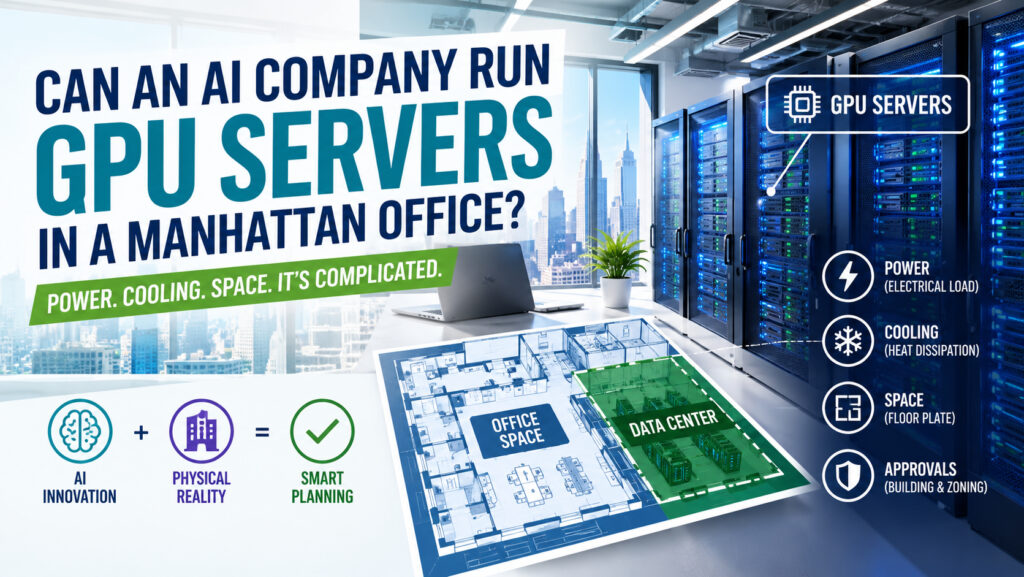
Our guide to AI-optimized office space in Manhattan examines these building requirements in more detail.
Cooling can matter more than many founders expect
Engineering teams often work beyond standard office hours.
Network equipment operates continuously.
Certain devices create concentrated heat loads.
Older Manhattan buildings can provide excellent creative offices while offering limited after-hours cooling.
That does not automatically eliminate the property.
Instead, investigate the HVAC schedule.
Ask about overtime charges.
Review supplemental cooling options.
Determine whether condenser water exists when required.
The operating cost deserves attention too.
A technically workable solution can still become uneconomic when after-hours HVAC costs thousands each month.
Power requirements depend on the business model
A cloud-first software startup may use ordinary office electrical service.
Robotics presents another case.
Local model development can also change requirements.
Video production, specialized workstations, hardware testing, and on-premise equipment create different loads.
Therefore, the CTO or technical lead should define equipment requirements before final building selection.
Do not pay for extraordinary infrastructure simply because the company works in AI.
Similarly, do not discover a genuine power problem after signing.
Twenty-four-hour access and twenty-four-hour services are different things
Many Manhattan buildings provide round-the-clock tenant entry.
That does not mean every service operates continuously.
HVAC may require overtime activation.
Freight elevators may follow restricted schedules.
Visitor procedures can change after hours.
Weekend staffing may differ.
Cleaning occurs at designated times.
A company with engineers working late should investigate the building’s actual operations.
“24/7 access” provides only the first answer.
Acoustic privacy deserves more attention
Artificial intelligence companies can combine contradictory uses.
Engineers need concentration.
Salespeople need to speak.
Recruiters conduct interviews.
Customers discuss confidential information.
Executives hold sensitive meetings.
Glass walls and open ceilings can look impressive while transmitting sound everywhere.
Therefore, test the actual rooms.
Stand outside the conference room while someone speaks inside.
Check phone-room quantities.
Look for doors with proper seals.
Evaluate where visitors travel through the floor.
For legal, healthcare, financial, and security-focused AI companies, privacy can become a fundamental design requirement.
Security involves the physical layout too
Cybersecurity is not merely a network problem.
Visitor circulation matters.
Screen visibility matters.
Access-controlled areas can matter.
A guest should not necessarily pass through engineering areas to reach a conference room.
Certain companies may want separate customer-facing and internal zones.
Full floors can simplify that arrangement.
However, a well-designed partial floor can also work.
The plan matters more than the building’s marketing category.
Floor efficiency can outweigh nominal square footage
Manhattan office rents usually reference rentable square feet.
Employees experience the usable interior.
Building geometry affects the difference dramatically.
Columns can interfere with desk planning.
Deep interiors can reduce natural light.
Elevator cores can fragment circulation.
Odd shapes can create unusable corners.
Therefore, two offices marketed at 10,000 square feet can support very different headcounts.
Tour with a preliminary test fit whenever the decision becomes serious.
A lower asking rent does not help if poor efficiency forces the company to rent more space.
Expansion rights can provide the cheapest growth capacity
Rapid-growth companies often face a binary choice.
Take extra space now or risk running out later.
A third approach exists.
Negotiate future access.
Adjacent-suite rights can help.
Rights involving another floor can also matter.
A right of first offer may provide useful protection.
Other agreements can establish expansion options under specified conditions.
The exact legal structure requires careful negotiation.
However, the business principle remains straightforward.
Option value can cost less than vacant office space.
Assignment and sublease rights protect against unexpected change
Fast-growing companies change corporate structures.
Acquisitions happen.
Subsidiaries form.
Investors change.
Teams consolidate.
Hybrid policies evolve.
A lease should anticipate that reality.
Review assignment rights carefully.
Examine sublease consent standards.
Understand recapture provisions.
Look at profit-sharing requirements.
Consider affiliate occupancy.
These issues seem abstract during a successful funding cycle.
They become very real when the company’s plan changes.
Current Manhattan Costs, Availability, and Office Options
Manhattan enters late August 2026 with much stronger office demand than tenants experienced during the earlier post-pandemic years.
That does not mean every landlord controls every negotiation.
It means tenants should distinguish scarce, high-quality product from interchangeable inventory.
Availability continues tightening
Manhattan leasing reached 3.87 million square feet during July 2026.
Year-to-date volume reached 26.66 million square feet.
Overall availability fell to 12.7%, while total available supply declined to its lowest level since September 2020.
Sublease inventory also reached its lowest point since August 2019.
Midtown South accounted for almost half of July activity.
Its availability tightened further to 12.2% during the month.
For tenants, those numbers require context.
A 12.7% availability rate does not mean 12.7% of every desirable building sits empty.
Premium floors can remain exceptionally tight.
Older commodity space can still provide choices.
That divergence creates opportunity for tenants willing to compare buildings carefully.
Manhattan’s average asking rent does not describe one office
During the second quarter, Colliers placed the Manhattan asking-rent average at $78.03 per square foot.
Midtown averaged $84.99 per square foot.
Midtown South averaged $79.41.
Downtown averaged $63.76.
Those figures describe broad submarkets.
They do not price your actual office.
Building class matters.
Floor height matters.
Condition matters.
Views matter.
Lease term matters.
Furniture matters.
A landlord’s vacancy position matters.
Concessions matter too.
Consequently, two offices across the street can produce very different economics.
Our 2026 Manhattan office cost guide provides the broader pricing framework.
Asking rent is only the beginning
Suppose a tenant sees two 10,000-square-foot options.
One asks $70 per square foot.
Another asks $80.
The apparent annual difference equals $100,000.
Yet the higher-priced option might contain furniture and completed meeting rooms.
It could also provide better efficiency.
Perhaps the landlord offers stronger free rent.
The cheaper office may require construction, furniture, cabling, and a longer move schedule.
Therefore, compare total occupancy value, not only face rent.
A serious analysis should include base rent, escalations, electricity, cleaning, operating expenses, taxes, HVAC, furniture, moving, technology, and construction.
Security requirements matter as well.
Current small-space options can provide true private headquarters
A small AI company does not need a giant commitment to establish a serious Manhattan presence.
The previously noted 2,600-square-foot Fifth Avenue sublet provides one current example.
Another Flatiron option offers approximately 5,370 square feet at 37 West 20th Street, with smaller divisible configurations.
For Midtown users, a current 4,988-square-foot furnished Fifth Avenue sublet near Bryant Park markets at $49 per square foot.
These spaces demonstrate the breadth available below institutional size.
A ten-person company can operate from a genuine private office.
So can a thirty-person company.
Seven-thousand-square-foot offices open additional location choices
Midtown provides another lane.
A current 7,367-square-foot furnished office at 675 Third Avenue offers a plug-and-play arrangement near Grand Central.
Its advertised asking rent is $45 per square foot.
Rockefeller Center offers a very different product.
A current 7,956-square-foot full floor at 600 Fifth Avenue combines private offices, workstations, phone rooms, a boardroom, and premium building amenities.
Identical size does not create identical value.
The right answer depends on employees, customers, brand, and budget.
Eleven-to-fifteen-thousand-square-foot offices often suit the next growth step
A furnished 11,239-square-foot Fifth Avenue sublet currently offers substantial workstation and meeting capacity in Flatiron.
This category can work well for companies transitioning from startup space into a more permanent headquarters.
It also provides enough scale to separate functions.
Engineering can occupy one zone.
Customer teams can use another.
Conference rooms can sit closer to reception.
Such planning becomes difficult inside a 3,000-square-foot office.
Larger Flatiron inventory can preserve neighborhood continuity
Companies do not necessarily need to leave Flatiron once they become large.
The current 30,450-square-foot opportunity at 71 Fifth Avenue provides two full floors.
Likewise, 39,900 square feet at 130 Fifth Avenue offers three connected furnished floors.
Those examples matter for growing AI tenants.
A startup can begin with several thousand square feet near Madison Square.
Later, the same company can pursue a 15,000-square-foot floor.
Eventually, it may occupy several connected floors without abandoning the district.
That depth helps explain Midtown South’s appeal.
Downtown can create powerful economics at larger sizes
Lower Manhattan’s Q2 average asking rent stood at $63.76 per square foot.
That remained materially below Midtown’s $84.99 average.
The difference grows meaningful as footprints expand.
A $20-per-square-foot spread across 50,000 rentable square feet equals $1 million in annual face rent.
That simple comparison excludes concessions and operating costs.
Still, it demonstrates why Downtown deserves consideration.
Norm AI, Scale AI, Mercor, and other technology companies also show that institutional-quality Downtown buildings can support serious AI operations.
The question should not ask whether Downtown looks like a traditional startup district.
Ask whether it works for your employees and customers.
How to Choose the Right Manhattan Office as Your AI Company Changes
Artificial intelligence companies operate under unusually uncertain growth assumptions.
A successful product launch can accelerate hiring.
Another funding round can change the plan.
Enterprise contracts may require a larger customer-facing presence.
Hybridization can reduce desk demand.
An acquisition could double one department while eliminating another.
Therefore, the best office is rarely the biggest one your company can afford.
It is the office that preserves the strongest future decisions.
Choose the neighborhood for a business reason
Flatiron should not win because other AI companies lease there.
It should win because the area supports your particular company.
Perhaps employees live along subway lines converging near Union Square.
Maybe customers already meet around Madison Square.
Your recruiting team might value the neighborhood.
A full-floor inventory pattern could fit future growth.
Those are reasons.
“Other startups are there” is only context.
Treat every company lease as evidence, not instructions
Thinking Machines Lab demonstrates how a well-funded company can establish its first Manhattan office with a 21,500-square-foot full floor.
AirOps shows how a growing platform can use a furnished 13,504-square-foot Chelsea floor.
Hightouch demonstrates measured expansion into 18,000 square feet.
Norm AI shows the institutional Downtown path.
EliseAI demonstrates a 109,000-square-foot headquarters expansion.
Harvey and Clay show what happens after organizations reach much greater scale.
Anthropic represents another category entirely.
Its 466,000-square-foot Hudson Square lease affects local inventory.
It does not tell your forty-person startup to lease hundreds of thousands of square feet.
Score locations against measurable criteria
Start with employee commuting patterns.
Then consider customer access.
Add hiring.
Evaluate building systems.
Measure usable efficiency.
Examine future expansion.
Compare move timing.
Finally, model economics.
A consumer-facing generative AI company might weight neighborhood identity heavily.
An enterprise legal AI company may emphasize institutional presentation and customer access.
Robotics can put building systems first.
Healthcare may increase privacy requirements.
Financial AI could favor proximity to Midtown or Downtown customers.
No universal scorecard produces the answer.
Your business model determines the weighting.
Make the office survive three futures
Every rapidly changing AI company should model a base case.
Then create an upside case.
Finally, create a downside case.
The base case covers the most likely hiring and attendance outcome.
Your upside case tests what happens when growth exceeds expectations.
The downside case examines slower hiring, hybridization, restructuring, or changed capital conditions.
A good lease should remain workable across all three.
That principle is especially important after fundraising.
Fresh capital can create confidence.
Real-estate obligations can outlast that confidence.
Preserve the next move before signing this one
Ask where another twenty employees would go.
Determine whether an adjacent floor might become available.
Understand sublease rights.
Review assignment language.
Explore affiliate occupancy.
Check renewal rights.
Know what happens if the company leaves early.
Identify restoration obligations.
Then calculate whether the chosen lease leaves enough runway for the operating business.
Those questions often matter more than another roof deck.
Move-in speed has economic value
A raw office may advertise attractive rent.
However, construction can consume months.
Furniture adds another project.
Internet installation can create delays.
Security systems require coordination.
Meanwhile, management time disappears into the move.
A furnished prebuilt office can therefore justify a higher face rent.
AirOps’ Chelsea transaction illustrates the appeal of a completed, furnished floor for a scaling company.
Speed should never eliminate diligence.
Still, it deserves a dollar value.
Keep several credible choices alive
Negotiating leverage disappears once management mentally moves into one office.
Instead, compare several serious alternatives.
One might offer better rent.
Another can provide stronger flexibility.
A third might eliminate construction.
Perhaps the fourth offers future expansion.
Request proposals against the same assumptions.
Then compare economics over the same period.
The cheapest asking rent will not always win.
The strongest overall occupancy decision should.
Watch the companies that may create tomorrow’s opportunities
AI growth does more than absorb Manhattan inventory.
It also moves companies between buildings.
Scale AI left a smaller Chelsea footprint for larger space Downtown.
Hightouch expanded after occupying smaller Chelsea offices.
Tennr moved from Chelsea into roughly 125,000 square feet in Hudson Square.
That movement continually reshuffles inventory.
Yesterday’s headquarters can become tomorrow’s furnished sublease.
A growing tenant should therefore monitor occupiers as carefully as buildings.
Our 2026 Manhattan office lease tracker follows these movements and shows where current demand is concentrating.
Artificial intelligence companies are not one tenant type
The broad Manhattan ecosystem includes AlphaSense, Accrete AI, Adaptive ML, Actively AI, Agentio, AiCure, Aiera, Alaffia Health, Amelia, Amigo, Ampcontrol, Aptivio, Arthur, Astronomer, Attentive, Ayyeka, B12, Base64.ai, Black Crow AI, Bluefish, Brellium, Canoe, Centari, Chatdesk, CHEQ, Clinch, Cognaize, Collective[i], Collibra, ConcertAI, Cypris, Datadog, DataDome, Dataminr, Dune Security, Eigen Technologies, Electric, Estuary, Eulerity, Evertune, EvolutionIQ, Formation Bio, Fraud.net, Galileo, Gloat, GumGum, Gynger, H1, Healthee, Hume AI, Hyro, Imagen Technologies, Indicium, Intenseye, Kafene, Kalepa, Kasisto, Keyway, Kustomer, Legora, Lemonade, LexCheck, Loris AI, Markup AI, Medsender, Mirage, Moment, monday.com, Nantum AI, Nautilus Labs, Navina, Niva, Noma Security, Nominal, Norm AI, Numeric, Okapi, Optimal Dynamics, Owkin, PackageX, Parloa, Patronus AI, PolyAI, Precision Neuroscience, Prove AI, Qloo, Raspberry AI, Reality Defender, Regal, Remarkable AI, Rillet, Rokt, Salesken, Scienaptic AI, Sequen AI, Sisense, SpaceKnow, Spring Health, Sprinklr, Starbridge, Stuut, Stylitics, Superblocks, Supply Wisdom, Tensorflight, Thread AI, Trullion, Twenty, Uniti AI, Verneek, Viggle, Warp, Wisor.ai, Xceptor, XGen AI, Yext, Yogi, and Zeta Global.
Some are startups.
Others have become large companies.
Several apply AI inside established software categories.
Certain businesses occupy traditional corporate towers.
Others choose creative lofts.
A few need sophisticated physical infrastructure.
Many simply need an excellent modern office.
That variety is the central lesson behind Artificial Intelligence Companies in Manhattan.
There is no universal AI building.
There is no universal AI neighborhood.
Likewise, there is no correct lease term for every AI startup.
The market instead provides a continuum.
A founder team can begin with 2,600 square feet near Madison Square.
A scaling operation may move into a 10,000-square-foot full floor.
Another company can combine two floors.
An institutional-stage business may ultimately require 100,000 square feet or more.
At every stage, the correct office should solve today’s operating needs without blocking tomorrow’s decisions.
Receive a Customized Office Report
We represent Manhattan office tenants and evaluate these choices from the tenant’s side of the transaction. We compare direct leases, subleases, furnished offices, expansion paths, building systems, and neighborhood economics. Our goal is to secure an office that supports the business without forcing the business to support the office.
Fill out our 📋 online form or give us a call today 📞 212-967-2061 — let’s find the right options for your business.