Best Flexible Office Options for AI Startups in Midtown Manhattan
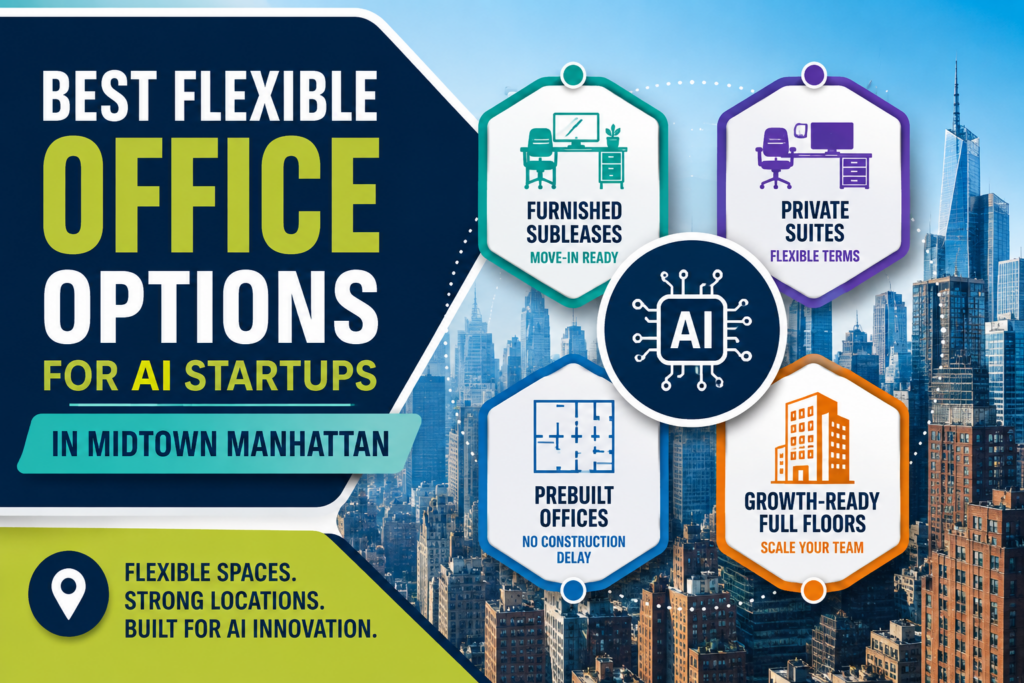
The best flexible office for a Midtown AI startup usually combines privacy, immediate occupancy, strong connectivity, and room to change. The right product may be a furnished sublease, prebuilt suite, private managed office, or flexible direct lease. Coworking can help smaller teams, but it does not define the entire flexible-office category.
Midtown matters because it gives growing teams several distinct office markets within one central business district. Grand Central favors regional access and polished Class A inventory. Bryant Park balances image, transit, and modern prebuilt space. Penn Station gives commuter-heavy teams direct regional rail access. Midtown West can also offer larger furnished blocks and flexible subleases.
The real question, therefore, is not simply, “Which flexible office looks best?” A startup should ask which structure matches its runway, hiring plan, technical requirements, commute pattern, and expected occupancy period.
What “Flexible Office” Should Mean for an AI Startup
Flexible office space describes several different products. Treating them as interchangeable creates poor comparisons.
A two-person private office inside a shared business center differs greatly from a 10,000-square-foot furnished sublease. Likewise, a landlord-built suite does not carry the same obligations as a serviced office agreement.
A managed or serviced private suite usually offers the shortest path to occupancy. The provider normally combines furniture, internet, meeting facilities, and basic services into one agreement. Teams can often avoid construction and several vendor contracts.
That structure can suit founders who need a Midtown base immediately. However, monthly cost per employee can climb as headcount grows.
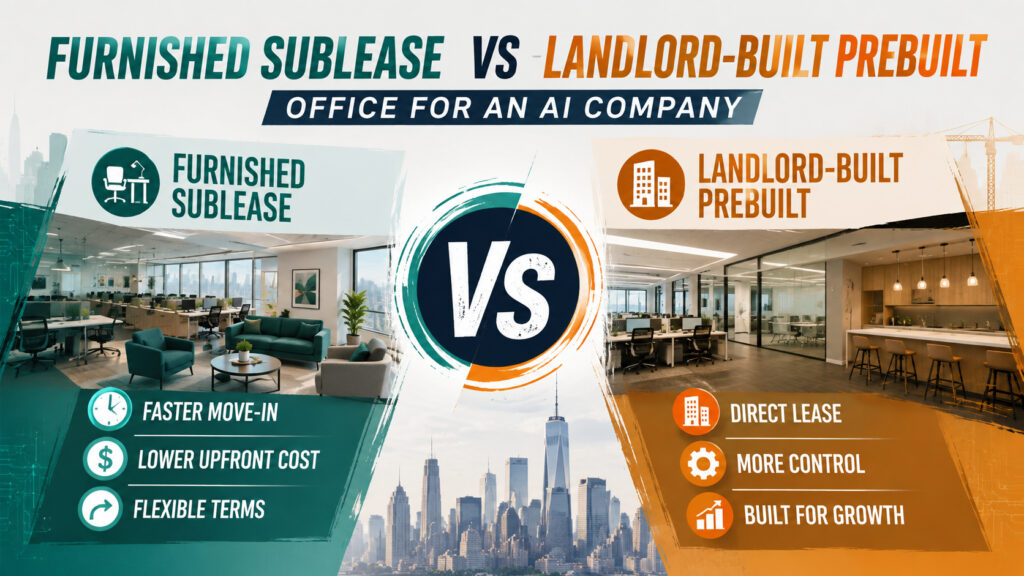
A furnished sublease gives one company private possession of another tenant’s existing office. Furniture, wiring, conference rooms, kitchens, and workstations may remain in place. Midtown currently offers several examples with remaining terms through 2027, 2028, 2029, and 2030.
For many funded AI startups, this structure offers an unusually useful combination. The team receives its own front door while avoiding a complete buildout.
A landlord-prebuilt or spec suite offers another path. The landlord completes the office before signing a particular tenant. That approach can provide modern finishes without inheriting another company’s layout.
Companies expecting several years of stable Midtown occupancy may prefer that structure. They should still compare the economics against furnished subleases.
A flexible direct lease creates a direct relationship with the building owner. It can support branding, future alterations, renewal rights, and expansion negotiations. However, the tenant must review more operating and legal obligations. The NYC commercial leasing guide explains those differences in greater depth.
A full-floor furnished office can serve a later-stage startup that needs privacy across multiple departments. These spaces can support engineering, product, sales, operations, and leadership without sharing internal areas.
Finally, coworking remains one option rather than the default answer. It can work for temporary teams and very small companies. Yet dedicated space usually gives growing technical teams greater control over security, acoustics, meeting capacity, and company culture.
That distinction matters. “Flexible” should describe the commitment and operating model, not whether strangers share your workspace.
Current Midtown Flexible Offices Worth Comparing
The following examples show how widely Midtown’s flexible inventory can vary. These spaces cover small executive suites, engineering-sized offices, full floors, and larger headquarters options.
Rather than selecting by appearance first, compare remaining term, usable layout, workstation count, meeting capacity, infrastructure, and expansion potential.
| Current Midtown example | Approximate size | Structure and timing | Why an AI startup might compare it |
|---|---|---|---|
| West 57th Street furnished office | 2,600 SF | Furnished sublease through March 2028 | Smaller team seeking privacy, offices, conference space, and a longer flexible term |
| Furnished MetLife Building office | 2,731 SF | Prebuilt direct opportunity | Small team prioritizing Grand Central access and a polished Midtown address |
| Seventh Avenue furnished office | 2,982 SF | Move-in-ready direct space | Approximately 15-person team needing Penn Station and Midtown West access |
| Park Avenue office sublease | 3,325 SF | Sublease through September 2027 | Team wanting private rooms, conference space, and a compact Midtown footprint |
| Penn Plaza furnished office | 3,456 SF | Furnished sublease through November 2027 | Open technical team needing 20 workstations, conference space, and an IT room |
| Fifth Avenue furnished office | 3,414 SF | Furnished sublease through August 2027 | Growing team seeking plug-and-play space in the Plaza District |
| Plaza District furnished office | 4,072 SF | Furnished sublease | Team needing a mix of private offices, open desks, and multiple meeting rooms |
| Rockefeller Plaza prebuilt office | 4,724 SF | Prebuilt direct lease | Startup seeking a turnkey Rockefeller-area office with open and private workspace |
| Penn Plaza high-floor furnished office | 4,776 SF | Furnished sublease through July 2027 | Team seeking regional rail access, executive rooms, and larger collaborative areas |
| Turtle Bay furnished office | 7,367 SF | Furnished sublease at $45/SF | Mid-sized team seeking wired space, sit-stand desks, and multiple meeting rooms |
| Lexington Avenue turnkey office | 8,285 SF | Furnished sublease at $42/SF through December 2026 | Short bridge requirement near Grand Central |
| Penn Station furnished office | 9,450 SF | Furnished sublease through December 2027 | Scaling team needing 42 workstations, phone booths, meeting rooms, and strong transit |
| Grand Central full-floor furnished office | 10,500 SF | Furnished sublease at $51/SF through February 2027 | Growing organization seeking a private floor and near-term flexibility |
| Fifth Avenue full-floor furnished office | 10,793 SF | Furnished sublease through March 2027 | Team needing roughly 70 seats without building from scratch |
| Park Avenue two-floor sublease | 21,557 SF | Furnished through October 2027, with extension potential | Larger growth company needing departmental separation and significant meeting capacity |
| Bryant Park full-floor opportunity | 34,251 SF | Furnished sublease through May 2030 | Later-stage company needing approximately 190 workstations and extensive collaboration space |
These examples reflect marketed inventory from recent July and August 2026 updates. Availability can disappear before a page changes.
The variety also shows why a simple coworking comparison misses the real Midtown opportunity.
A startup with twelve employees might compare a 2,600-square-foot furnished sublease against a serviced private suite. Meanwhile, a 40-person company may compare 5,000 to 8,000 square feet of furnished inventory.
A larger team can evaluate private full floors instead. Current examples reach beyond 20,000 square feet without requiring a ground-up headquarters build.
Do not judge a listing from square footage alone. A 5,000-square-foot office with twelve enclosed rooms works differently from an open 5,000-square-foot engineering floor.
Seat count, conference capacity, phone rooms, columns, window lines, and pantry placement all affect practical capacity.
Where in Midtown Should an AI Startup Focus?
Midtown does not operate as one uniform office market. Each corridor gives an AI company a different mix of transit, image, inventory, and economics.
Grand Central and Midtown East work especially well for teams drawing employees from Westchester, Connecticut, Queens, and Long Island. Grand Central also supports several subway lines and regional rail connections.
A startup that meets financial institutions, enterprise customers, insurers, or professional-services firms may also value this location.
Current Grand Central-area flexible inventory includes smaller suites around 2,700 square feet. Options also extend beyond 10,000 square feet.
Bryant Park and the Sixth Avenue corridor suit teams seeking centrality between east and west Midtown. The district provides quick access toward Grand Central, Times Square, and Port Authority.
Larger furnished blocks can appear here. One current example offers 34,251 square feet with 190 workstations and numerous meeting areas.
Penn Station and Midtown West deserve attention when team members commute from New Jersey or Long Island. Penn also connects companies to Amtrak and several subway routes.
Current options illustrate the corridor’s range. A 3,456-square-foot Penn Plaza sublease offers twenty workstations and an IT room. A 9,450-square-foot Penn Station suite supports a much larger organization.
The Plaza District, Park Avenue, and Fifth Avenue suit companies that expect frequent investor, board, or enterprise meetings. Premium location does not automatically make every office technically superior.
Instead, verify the actual suite condition and building systems.
A high-end address cannot compensate for weak connectivity, restrictive HVAC hours, poor acoustics, or an unsuitable electrical plan.
Rockefeller Center and the upper Midtown West corridor can fit client-facing companies seeking strong amenities and a recognized central location. However, founders should compare those benefits against cost and commute patterns.
The prebuilt Rockefeller Plaza office shows how a smaller turnkey suite can fit this market.
Times Square South and the Garment/Penn transition can provide another useful value lane. Older buildings may offer simpler economics and efficient open layouts.
Still, building age alone tells you little about technical suitability. Inspect infrastructure before eliminating or favoring a property.
For a wider geographic comparison, review where to find AI-optimized office space in Manhattan. That guide separates Midtown from other Manhattan AI office markets.
What Makes an Office Actually Work for an AI Team?
An AI startup does not automatically need a specialized “AI building.” It needs an office that supports its real operating model.
Start with what your engineers actually run locally.
A cloud-first software company has different requirements from a team operating large local workstations. Likewise, a company using rack-mounted equipment needs different diligence from a laptop-based product team.
Connectivity comes first. Ask which carriers serve the building and which already reach the suite. “Fiber in the building” does not guarantee an active circuit inside your office.
Confirm installation timing before signing. Also ask whether the building supports a second carrier or backup connection.
A development team can lose meaningful productivity when one circuit becomes a single point of failure.
Electrical capacity requires specific answers. Count local workstations, monitors, lab devices, networking equipment, and any high-load hardware.
Next, inspect the electrical panel and available capacity. Ask an engineer when the planned load exceeds ordinary office use.
Do not assume a polished Class A suite automatically supports unusual equipment.
Cooling matters whenever hardware creates sustained heat. Standard office air conditioning may stop after normal building hours. That creates problems for equipment running overnight.
Ask about base HVAC hours, overtime charges, supplemental cooling, and allowed modifications. The lease should also clarify responsibility for equipment and maintenance.
Twenty-four-hour access requires more than a keycard. Determine how employees enter after hours. Ask about lobby staffing, visitor procedures, freight access, and after-hours HVAC.
Teams working across global time zones may use the office outside conventional Midtown schedules.
Private network control can matter more than community amenities. A startup handling sensitive client information may prefer dedicated network equipment and a private IT room.
Review where switches, routers, and other equipment will sit. Then confirm who can physically access those areas.
Acoustics deserve similar attention. Engineering teams need uninterrupted work. Sales, recruiting, customer success, and founders may spend hours on calls.
A good floor balances open collaboration with enclosed meeting spaces.
Phone booths can relieve call pressure. However, they should supplement proper meeting rooms rather than replace them.
Layout flexibility also protects growth. Furniture should allow teams to add seats without rebuilding the floor.
Look for meeting rooms that can change uses. Private offices may also become focus rooms or small team rooms.
Current Midtown listings show useful examples. The Penn Station furnished office combines 42 open workstations with private offices, conference rooms, and phone booths.
Meanwhile, the Bryant Park full-floor space includes large boardrooms, smaller conference rooms, breakout areas, and ten phone booths.
That variety becomes increasingly important as engineering teams grow into multiple functions.
For broader planning, the AI startup office-space roadmap covers the transition from smaller launch offices into larger headquarters footprints.
How Much Space and Budget Should You Plan?
Flexible office comparisons become difficult because different products quote prices differently.
A conventional office might quote annual rent per rentable square foot. A serviced suite may quote a monthly total. Another option may price each desk.
Therefore, convert every serious option into the same all-in monthly occupancy model.
Start with base rent. Then add electricity, internet, cleaning, furniture, operating escalations, and after-hours services.
Also include any capital spending required before move-in.
The commercial leasing guide explains why base rent alone cannot describe total occupancy cost. Commercial leases may allocate operating expenses, utilities, taxes, and other charges separately.
For a Midtown planning benchmark, spring 2026 guidance placed many conventional Grand Central options around $55 to $90 per square foot annually. Trophy offices can exceed $100 per square foot. Discounted subleases can fall into lower ranges.
Live inventory shows that spread more clearly.
The Lexington Avenue turnkey sublease currently quotes $42 per square foot for 8,285 square feet. That equals roughly $29,000 monthly base rent before additional costs.
The Turtle Bay furnished sublease quotes $45 per square foot across 7,367 square feet. That equals roughly $27,626 monthly before other applicable charges.
A 10,500-square-foot Grand Central full floor quotes $51 per square foot. That produces approximately $44,625 in monthly base rent.
Those numbers also demonstrate why furniture and remaining term matter. A slightly higher rent can still produce a lower overall commitment.
Avoid comparing a furnished sublease directly against an unfurnished direct lease without adding setup costs.
How much space should you target?
Current Midtown examples support a useful planning range near 150 rentable square feet per person for many conventional layouts. Actual density depends heavily on meeting rooms and private offices.
The 34,251-square-foot Bryant Park option estimates capacity near 228 people. That works out near 150 square feet per person.
Similarly, the 9,450-square-foot Penn Station suite estimates capacity around 63 people. Its ratio also reaches roughly 150 square feet per person.
However, do not turn 150 square feet into a rigid rule.
A 15-person team can occupy 2,000 square feet comfortably with an efficient layout. Another 15-person company may need 3,000 square feet because calls dominate the workday.
Hybrid attendance changes the calculation again.
Use peak-day attendance, not total payroll, as the first seating input. Then add expected hiring during the planned occupancy period.
A useful planning matrix looks like this:
| Team profile | Practical starting footprint | Flexible product to compare first |
|---|---|---|
| Founders to 8 regular users | Private managed suite or small furnished office | Serviced private suite |
| Roughly 8–20 regular users | About 1,500–3,500 SF | Furnished sublease or prebuilt suite |
| Roughly 20–40 regular users | About 3,000–6,000 SF | Sublease, spec suite, or flexible direct lease |
| Roughly 40–70 regular users | About 6,000–11,000 SF | Furnished sublease or private full floor |
| Roughly 70–120 regular users | About 10,000–20,000 SF | Full-floor sublease or flexible direct lease |
| Larger growth organization | 20,000 SF and above | Multi-floor or major furnished block |
These ranges provide planning guidance rather than occupancy guarantees. Furniture size, egress, code requirements, and room counts can change actual capacity.
How to Choose Between Coworking, Sublease, Prebuilt, and Direct Space
A strong shortlist begins with the company’s next operational milestone.
Do not start with a favorite building.
Choose a serviced private suite when speed outweighs control. This structure fits a company that needs keys quickly and wants predictable services.
Founders should still ask about dedicated internet options, after-hours access, meeting-room limits, and renewal pricing.
Choose a furnished sublease when privacy and speed both matter. This route often works especially well after a team outgrows shared space.
The office already exists. Therefore, the company can avoid much of the design and construction cycle.
Remaining term creates the main constraint. A great sublease ending in six months may create another relocation too quickly.
On the other hand, a short remaining term can serve as deliberate bridge space.
The 8,285-square-foot Lexington Avenue suite illustrates that bridge strategy. Its term runs only through December 2026.
Choose a prebuilt suite when you want a fresh office without a complete buildout. These spaces can work well for teams planning several years of occupancy.
Review who supplies furniture and data cabling. “Prebuilt” does not always mean “fully operational on day one.”
The 4,724-square-foot Rockefeller Plaza office offers a current example of this product.
Choose a flexible direct lease when long-term control starts creating value. A direct lease can support branding, expansion rights, and more substantial alterations.
However, companies should model the full legal and financial commitment.
A startup should also negotiate flexibility before signing. Useful business points may include renewal rights, expansion opportunities, assignment rights, and sublease rights.
Your attorney should draft or review the final lease language.
Choose a private full floor when confidentiality and departmental control justify it. Full floors reduce shared internal circulation.
They can also support separate engineering, product, meeting, and social zones.
A current 21,557-square-foot Park Avenue sublease offers two connected floors. The term extends through October 2027, with extension potential.
Meanwhile, a 34,251-square-foot Bryant Park floor extends through May 2030. That longer remaining term changes the risk calculation significantly.
Treat virtual offices differently. A business address does not replace operational office space.
Likewise, day offices solve temporary meeting needs rather than a growing team’s daily workplace needs.
This classification prevents a common comparison problem. Products that share the word “flexible” can solve completely different problems.
The Questions to Answer Before Signing
The best Midtown office becomes clear after the team answers a disciplined set of questions.
How many people will actually attend on the busiest weekday? Start there before discussing total headcount.
Next, estimate hires during the first year. Do not lease solely around the company’s best-case hiring forecast.
How long should this office last? A bridge office might only need nine months.
Another team may need two or three years of stability. That difference can completely change the preferred product.
When must the team move? A company facing a thirty-day deadline should favor existing furnished space.
Meanwhile, a company planning six months ahead can compare more direct opportunities.
Where do employees commute from? Map actual home locations and transit routes.
Grand Central can reduce commute friction for east-side regional riders. Penn Station can simplify travel for New Jersey and Long Island commuters.
Who visits the office? Enterprise buyers, board members, candidates, investors, and partners may influence location priorities.
However, prestige should not overwhelm daily employee convenience.
What happens if headcount doubles? Ask whether adjacent suites may become available.
Also investigate assignment, sublease, renewal, and expansion rights.
What happens if headcount falls? Flexibility works in both directions.
A large office with empty desks can waste more runway than a slightly higher flexible rent.
What technology must remain on-site? List every unusual device before touring.
Do not wait until lease negotiations to discover an electrical or cooling constraint.
Does the suite already contain useful cabling? Existing wiring can save time.
Still, test whether it suits your security architecture and bandwidth requirements.
How does HVAC operate after hours? Ask for exact hours and charges.
Teams with late schedules can face unexpected operating expenses in buildings with restricted base service.
How secure is the suite itself? Review locks, access control, visitor management, IT-room access, and after-hours procedures.
Confidential work deserves physical controls as well as software controls.
How many simultaneous calls happen during peak periods? Meeting rooms disappear quickly when every department schedules video calls.
Count phone rooms separately from real conference rooms.
What does the furniture package include? Inventory desks, chairs, conference tables, storage, appliances, and audiovisual equipment.
Put included items into the deal documents.
What must you restore when leaving? A lease can create end-of-term obligations even when move-in costs look low.
Address those obligations before signing. The commercial leasing guide covers surrender, alterations, guarantees, insurance, and other lease risks.
What does the quoted price exclude? Ask about electricity, cleaning, internet, HVAC, taxes, operating expenses, furniture, security, and installation charges.
Then compare every finalist using one monthly cost sheet.
A practical Midtown AI office scorecard
Instead of ranking offices by décor, score each finalist across the factors that affect operations.
Give the heaviest weight to commute, term flexibility, privacy, connectivity, layout, and all-in cost.
Then evaluate technical capacity, after-hours operations, meeting-room supply, furniture, building amenities, and image.
Finally, identify any fatal flaw.
A beautiful office with a bad commute can hurt hiring. An inexpensive suite with inadequate meeting rooms can frustrate employees.
Likewise, a prestigious building with unsuitable HVAC can create avoidable operating problems.
The best flexible office rarely wins every category. It should win the categories that matter most to your company.
Questions AI Startups Commonly Ask About Midtown Flexible Offices
What is the best flexible office option for an early-stage AI startup in Midtown Manhattan?
For many small funded teams, a private furnished sublease or managed private suite provides the strongest starting point.
Both can limit upfront construction spending. A furnished sublease usually offers greater privacy and control.
Very small teams may prefer a managed suite when they need immediate occupancy and simple monthly billing.
Is coworking the same as flexible office space?
No. Coworking represents one flexible product.
Flexible office space can also include private managed suites, furnished subleases, prebuilt offices, and shorter direct leases.
That distinction matters once a startup needs confidential meetings or stronger control over its environment.
How much Midtown office space does a 20-person AI startup need?
A practical first search might include roughly 2,500 to 3,500 square feet.
However, the layout matters more than a simple ratio. Teams with frequent calls may require more enclosed space.
Current Midtown planning guidance often uses about 150 rentable square feet per employee.
How much space does a 50-person AI startup need?
A starting search range near 6,000 to 8,000 square feet can make sense for many layouts.
Teams with extensive meeting requirements may need more. Hybrid teams with lower peak attendance may use less.
Current Midtown inventory provides several furnished examples within that general size band.
Should an AI startup choose Midtown or Midtown South?
Neither location wins automatically.
Midtown offers deep Class A inventory, major commuter hubs, furnished enterprise subleases, and client-facing addresses.
Midtown South often offers loft-style offices and proximity to the broader technology ecosystem.
The Manhattan AI office location guide compares those location strategies.
Is Grand Central good for an AI startup?
Yes, especially when employees or customers use Metro-North or east-side transit.
The area also offers a wide range of furnished and prebuilt office sizes.
Current inventory spans compact suites through full-floor offices.
Is Penn Station better for commuter-heavy teams?
It can be, particularly for employees using New Jersey Transit, Long Island Rail Road, or Amtrak.
Several subway lines also serve the surrounding Penn and Herald Square area.
The 9,450-square-foot Penn Station office demonstrates the type of furnished growth space available there.
Can a startup find a Midtown office for less than one year?
Sometimes.
Short remaining-term subleases can create bridge opportunities. Availability changes constantly, so exact choices depend on the target move date.
The Lexington Avenue example currently runs through December 2026.
Are longer flexible terms available?
Yes.
Current furnished Midtown examples include terms extending into 2027, 2028, 2029, and 2030.
That range lets companies choose between bridge space and multi-year stability.
Should a startup pay more for furniture?
Evaluate furniture as part of total occupancy cost.
Existing furniture can eliminate procurement, installation, moving, and disposal expenses.
However, unsuitable furniture can create a new cost instead of a benefit.
Does an AI company need special electrical infrastructure?
Not automatically.
First identify actual on-site hardware and expected load. Then compare those requirements against the suite’s electrical capacity.
A cloud-first team may have ordinary office requirements. Local compute can change the analysis.
Does every AI startup need dedicated cooling?
No.
Supplemental cooling becomes relevant when equipment creates sustained heat beyond normal office loads.
Always ask about after-hours HVAC when local equipment operates continuously.
What internet questions should we ask?
Ask which carriers serve the building and which already reach the suite.
Then verify installation lead times, available bandwidth, routing, and backup options.
Do not rely solely on a statement that the building “has fiber.”
How important are phone booths?
They become valuable once simultaneous calls increase.
Still, a booth cannot replace every conference room or focus room.
Evaluate the floor during your actual peak-call periods.
Should founders lease extra space for future hiring?
Build some flexibility into the plan, but avoid speculative overleasing.
Expansion rights can provide a better answer than paying immediately for many empty desks.
The AI startup office roadmap explains how office requirements can change through successive growth stages.
What is more important, rent or flexibility?
Neither should stand alone.
A lower rent can become expensive when a company cannot exit, expand, or operate efficiently.
Conversely, excessive flexibility can carry a premium that no longer makes sense after headcount stabilizes.
Compare total expected occupancy cost across the planned term.
What is the most important lease protection for a startup?
There is no universal single clause.
Assignment rights, sublease rights, expansion options, guarantees, security, renewal rights, and surrender obligations can all matter.
Have commercial counsel review the final lease.
How quickly can a furnished Midtown office support occupancy?
Move-in-ready space can shorten the physical preparation process significantly.
However, internet installation, insurance, access credentials, legal documents, and equipment setup still require coordination.
Confirm every dependency before committing to a move date.
When should an AI startup leave coworking?
The answer usually appears when shared space creates operating friction.
Privacy concerns, meeting-room shortages, rising per-seat costs, security requirements, and cultural needs can trigger the change.
Hiring growth can also make a dedicated office more practical.
When should a startup consider a direct lease?
Direct space becomes more attractive when the company expects stable occupancy and values control.
Longer-term teams can also justify branding, alterations, and negotiated expansion rights.
Compare those benefits against the capital and commitment required.
Why do seemingly similar Midtown offices carry very different prices?
Building quality explains only part of the difference.
Floor height, views, suite condition, lease structure, remaining term, furniture, amenities, and landlord economics can all affect pricing.
Location within Midtown also matters.
How should founders compare a $45-per-square-foot sublease against a serviced private office?
Convert both into total monthly cost.
For the sublease, include rent, utilities, internet, cleaning, furniture gaps, and professional costs.
For the serviced option, include base membership and every recurring add-on.
Then compare the same occupancy period.
What makes a Midtown office genuinely “AI-ready”?
The term should describe operational suitability rather than marketing.
Look for reliable connectivity, sufficient power, appropriate cooling, secure access, acoustic control, private meeting areas, and adaptable layouts.
The office must also match the team’s actual technical model.
What should we tour first?
Begin with contrasting options rather than ten similar offices.
Tour one serviced suite, one furnished sublease, one prebuilt direct suite, and one growth option.
That contrast quickly reveals which product structure fits your company.
Should we only tour spaces that appear publicly available?
No.
Flexible inventory can change between publication, inquiry, and tour scheduling.
A tenant-side search should also check newly marketed, quietly marketed, and recently vacated options.
What should we bring to the first office tour?
Bring your headcount plan, target move date, budget range, and must-have technical requirements.
Also identify preferred commute hubs and expected meeting-room demand.
A clear requirement makes every tour more productive.
What should happen after the first tour round?
Reduce the list to financially and operationally credible choices.
Next, compare economics and request deal terms.
Technical and legal diligence should follow before final commitment.
The practical answer
For most growing AI startups, the best Midtown strategy begins with private, move-in-ready space and a commitment that matches business visibility.
A small team may start with a managed private suite. A funded 15-person company may prefer a furnished sublease. A 50-person organization may need a larger private floor. Later-stage teams can compare multi-floor options and flexible direct leases.
Current Midtown inventory supports that entire progression. It ranges from approximately 2,600-square-foot furnished suites to furnished blocks above 30,000 square feet.
The supplied benchmark also shows why broad startup lists and coworking roundups leave substantial questions unanswered. They often mix unlike products and different neighborhoods.
A tenant should receive a clearer answer. Choose the office structure first, choose the Midtown corridor second, and choose the individual suite third.
Find Short-Term AI Office Space
We represent office tenants rather than landlords, so the search starts with your requirements and negotiating position. We compare Midtown inventory across buildings, subleases, prebuilt suites, and direct opportunities before creating a shortlist. Our role continues through tours, proposal comparisons, negotiation, technical diligence, and the path toward lease execution.
Fill out our 📋 online form or give us a call today 📞 212-967-2061 — let’s find the right options for your business.