Short-Term Office Space for AI Startups in Manhattan
The Fastest Route to a Private Manhattan Office
For most AI startups, the best short-term Manhattan office is already built, furnished, wired, and ready for work. That usually means a furnished sublease, turnkey private suite, or completed prebuilt office.
These options remove construction from the critical path. They also preserve flexibility while headcount, funding, and workplace patterns remain uncertain.
A young team may need 2,000 square feet today. Six months later, that same company could need 5,000 square feet. Another startup may pause hiring and need no additional space.
For that reason, flexibility has real financial value.
The practical goal: secure enough office for your reliable peak attendance, plus manageable growth capacity. Avoid paying today for speculative hiring several years away.
Short-term does not mean one specific lease length
In Manhattan, “short-term office space” can describe several different products.
A five-person company might need a private room for three months. Another startup may need 5,000 square feet for 18 months. A funded team could want 12,000 square feet for two years.
Each requirement belongs in the same conversation.
Current choices can include:
| Office format | Common use | Main advantage | Main tradeoff |
|---|---|---|---|
| Private flexible office | Very small or uncertain teams | Extremely fast occupancy | Higher cost per workstation |
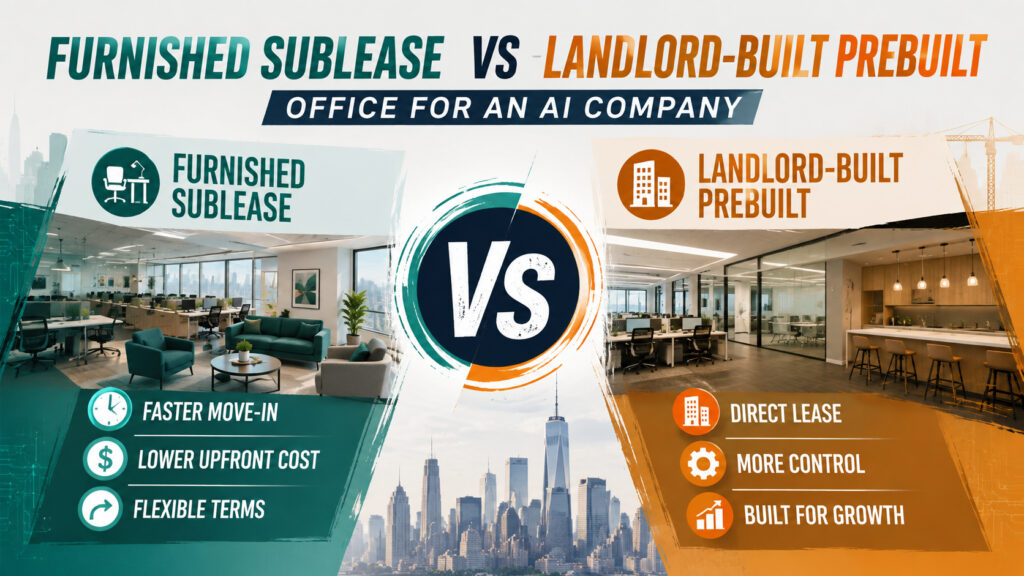
| Furnished sublease | Teams needing a private office quickly | Furniture and build-out already exist | Existing lease controls the term |
| Turnkey direct suite | Teams wanting landlord privity | Cleaner direct relationship | Short terms can reduce concessions |
| Prebuilt office | Teams seeking speed plus control | Little construction required | Furniture may not come included |
| Existing-condition direct lease | Larger or more stable startup | Greater term flexibility | More legal and setup work |
| Custom-built office | Stable growth-stage company | Maximum layout control | Usually conflicts with urgent occupancy |
The current Manhattan market makes that distinction important. AI tenants leased about 670,000 square feet during 2026’s first quarter. That represented more than one-third of technology-sector demand during that period.
Midtown South also captured roughly two-thirds of technology demand across 2025 and early 2026. Therefore, furnished space in core technology districts faces meaningful competition.
By the second quarter, Midtown South availability had fallen to 12.7%. Its average asking rent stood at $79.41 per square foot annually.
Across Manhattan, separate major market methodologies placed availability around 13% to 14.4%. Average asking rents ranged from roughly $78 to $80 per square foot.
That market does not mean every startup should rush.
Instead, it means qualified teams should recognize a strong short-term option when one appears.
What AI startups repeatedly need from temporary space
The phrase “AI startup office” can sound more specialized than the physical requirement actually is.
Most teams still need a good private office first.
However, several priorities occur more often for AI, software, data, and technical teams. Those priorities include reliable connectivity, sufficient power, controlled access, quiet rooms, flexible seating, and fast occupancy.
Private meeting areas matter when teams discuss confidential models, customer data, fundraising, or product strategy. Reliable internet becomes essential when almost every workflow reaches cloud infrastructure.
Phone booths also prevent small conference rooms from becoming permanent call rooms.
The current query landscape consistently blends furnished offices, temporary suites, private flexible workspace, subleases, rapid occupancy, pricing, and technical requirements.
A dedicated AI workspace comparison also places privacy, backup connectivity, meeting access, scaling flexibility, and focused work among key tenant considerations.
Still, “AI-ready” should never replace actual building diligence.
A polished loft can fail your team if connectivity takes eight weeks to install. A beautiful tower can also disappoint when after-hours cooling becomes expensive.
Conversely, a modest furnished sublease can work extremely well when the infrastructure already matches your operations.
Start with the business problem, not the office category
Before touring anything, define five facts:
Peak attendance. How many people will actually work together on the busiest recurring office day?
Move date. When must normal operations begin from the new office?
Commitment horizon. How long can the company confidently carry this location?
Maximum occupancy cost. What can the company spend each month after rent and operating charges?
Operational requirements. Which connectivity, privacy, access, meeting, and cooling needs cannot change?
Those answers determine whether you should pursue flexible space, subleases, or direct options.
They also prevent attractive offices from controlling your decision process.
A startup should not choose five years because a floor looks impressive. Likewise, it should not choose coworking merely because the term looks easy.
The office structure should follow the company’s risk profile.
What Short-Term Office Space Actually Means in Manhattan
A short-term requirement sits between two extremes.
At one end, a company can rent workspace almost immediately. At the other, it can sign a conventional long-term commercial lease.
Between those extremes lies most of the useful inventory for AI startups.
Understanding those middle options can save substantial time and money.
Private flexible offices work best when uncertainty dominates
Private flexible space usually suits founders, very small teams, project groups, and temporary expansion teams.
The principal advantage involves speed.
Furniture, internet, cleaning, reception services, common areas, and meeting rooms may already operate. Consequently, the startup avoids several separate vendor decisions.
The economic structure also differs from a conventional lease.
Rather than pricing only rentable square footage, many flexible arrangements price the entire service package. That makes direct price comparisons difficult.
A private suite may therefore cost more per seat.
However, the premium can make sense when flexibility prevents a larger lease mistake.
Consider a six-person startup expecting rapid funding decisions.
Locking that company into 3,000 square feet could create unnecessary liability. A private flexible office may offer better risk-adjusted economics.
Once staffing stabilizes, the company can move into its own suite.
Furnished subleases often provide the short-term sweet spot
For many teams with 10 to 75 employees, furnished subleases deserve the first serious look.
The previous tenant already spent money building the workplace. Desks, conference rooms, kitchens, cabling, private offices, and phone rooms may remain.
That existing installation can eliminate months of design and construction.
A sublease also inherits a defined expiration date.
For a startup, that date can create useful discipline.
Suppose the existing lease expires in 19 months. A growth company may gain a ready office without accepting five years of long-term liability.
The tradeoff involves legal complexity.
The subtenant does not simply replace the original tenant. The prime lease remains important, and landlord consent may apply. Our office sublease guide explains that structure in greater detail.
Before signing, counsel should review the prime lease and proposed sublease together.
The team should also confirm furniture ownership, restoration duties, building access, and technology arrangements.
Turnkey direct leases solve a different problem
A direct short-term lease can work well when the landlord has already completed the office.
This approach creates a direct relationship with ownership.
That simplifies some operating issues because no existing tenant sits between both parties.
Direct suites may also provide cleaner renewal discussions.
However, landlords often evaluate short-term direct proposals differently from longer commitments. The transaction must still make economic sense for both sides.
A tenant may receive less construction money on a short term.
That matters less when the office already works.
The furnished and turnkey office guide provides a broader framework for comparing existing-condition choices.
Prebuilt suites can bridge flexibility and control
A completed prebuilt suite often includes finished offices, conference rooms, pantry space, lighting, flooring, and HVAC distribution.
Some also include furniture.
Others deliver only the physical installation.
Therefore, never treat “prebuilt,” “turnkey,” and “furnished” as interchangeable terms.
Ask exactly what remains after closing.
A startup might tour an office that appears completely finished. Yet the departing tenant could own every desk and conference table.
Another suite might include furniture but lack active internet service.
Consequently, your proposal should define the included condition clearly.
Short-term direct leases can still require substantial paperwork
A short lease does not eliminate commercial leasing work.
The landlord can still request financial information, entity documents, insurance, security, and guaranty discussions.
Counsel still needs to review the lease.
Your team must also verify dates carefully.
Possession, lease commencement, rent commencement, and permitted occupancy may differ.
A furnished office could physically support employees tomorrow. That does not mean your company can legally occupy tomorrow.
This difference explains why move-in-ready describes physical condition, not guaranteed transaction speed.
Coworking and private office space are not the same thing
Coworking generally emphasizes shared facilities.
Private flexible space gives one company a lockable room or suite inside a managed workplace.
Traditional subleases usually give the company more control behind its own entrance.
These distinctions matter when confidentiality becomes important.
A two-person pre-seed team may enjoy shared space.
A 25-person technical team discussing customer systems may need dedicated meeting rooms and controlled access.
Neither model automatically wins.
The right choice follows the company’s operating needs.
Six months, one year, two years, or three years?
There is no universal best term for an AI startup.
Instead, match the commitment to the most reliable business horizon.
Six to twelve months can suit temporary teams, bridge periods, or highly uncertain headcount.
Twelve to twenty-four months often provides enough runway for a startup to settle into a true private office.
Two to three years can make sense after funding and hiring plans gain more visibility.
Three to five years may work for companies seeking direct leases and stronger long-term control.
Our Flatiron short-term office guide shows how several term structures can coexist within one neighborhood.
The correct question is not, “How short can we sign?”
Ask instead:
How long can we confidently use this office without depending on perfect hiring forecasts?
That question produces better decisions.
Where AI Startups Should Look in Manhattan
Manhattan does not have one official AI district.
However, technology demand concentrates heavily across Midtown South. That broad market includes several neighborhoods favored by software, technology, creative, and growth companies.
Location still should not become a branding exercise.
The best neighborhood aligns four things: employee commutes, suitable inventory, monthly cost, and business relationships.
Flatiron and the Madison Square area
This district offers one of Manhattan’s strongest combinations of technology identity and practical office stock.
The building mix includes classic lofts, renovated commercial buildings, prebuilt suites, and modern offices.
Many floors range from a few thousand square feet upward.
That size profile works particularly well for post-coworking teams.
Transit access also reaches several directions without forcing every employee through one terminal.
For an AI startup, Flatiron’s biggest advantage may come from inventory fit rather than reputation.
A company seeking 3,000 to 10,000 square feet can find open layouts, conference rooms, and furnished subleases within that range.
Yet competition can move attractive options quickly.
Midtown South’s 12.7% second-quarter availability reflects meaningful tightening across the larger market.
Explore several current options below, including a 2,600 RSF move-in-ready loft near Madison Square Park. It includes meeting rooms, workstations, pantry space, private restrooms, and tenant-controlled cooling.
A larger team can compare a 9,979 SF furnished full-floor sublease. The published layout supports 52 workstations, conference rooms, offices, and a dedicated phone room.
Chelsea and the West Side of Midtown South
Chelsea works for teams seeking loft character, west-side commuting, and flexible floor plates.
Inventory can range from boutique offices to large creative floors.
Some buildings offer high ceilings and wide window lines.
Others provide more traditional prebuilt layouts.
The neighborhood also gives startups access to both Midtown South and west-side transportation.
A small technical team can review this 3,250 SF furnished private office with call booths. The published configuration includes 20 workstations and capacity for roughly 22 people.
A company that values a full-floor setting can consider a 5,000 SF furnished office for roughly 33 people. The current listing indicates immediate availability.
Union Square and the southern Midtown South corridor
Union Square can work particularly well when staff commute from several directions.
The area also bridges Flatiron, Greenwich Village, and Downtown access.
That makes it useful for companies drawing employees from Manhattan and the outer boroughs.
Current inventory includes a furnished full-floor office with more than 30 workstations. The published space also includes several private rooms and larger meeting areas.
This type of space can suit a startup that has outgrown a small managed suite.
It provides a private operating environment without requiring a new build-out.
NoMad and the surrounding Midtown South blocks
NoMad gives companies access to Midtown South while keeping several major transit options nearby.
Building inventory mixes loft stock with more polished commercial space.
The district can work well for engineering teams needing an efficient commute.
A larger furnished suite may also support a company between funding rounds.
For example, our 8,390 SF negotiable-term NoMad office offers a larger private footprint.
Another 5,000 SF furnished NoMad office provides open seating, private rooms, conference space, and tenant-controlled cooling.
Published listing details can change, so confirm each option before planning around it.
Hudson Square and the western downtown edge
Hudson Square offers another route for technology teams.
Its inventory often feels different from classic Midtown towers.
Loft-style buildings and wider floor plates can appeal to product and engineering groups.
A smaller company can review this 2,530 RSF prebuilt Hudson Square office. It includes an open work area, conference room, pantry, and high exposed ceilings.
That type of direct space can make sense for a team seeking its own identity.
It also avoids paying solely for a shared-office service package.
Midtown can outperform Midtown South for some startups
An AI startup should not reject Midtown because another district feels more fashionable.
Midtown can solve several important problems.
Commuter access may improve dramatically for staff arriving through major terminals.
Modern towers can also offer strong building systems, larger floor plates, security, and professional meeting settings.
This can matter for enterprise-facing AI companies.
Second-quarter Midtown asking rents averaged roughly $85 to $86 per square foot across two major market methodologies. Availability measured around 12% to 13%.
Current furnished options also exist below headline trophy pricing.
For instance, this 11,500 SF furnished Midtown sublease currently quotes $64 per square foot.
That example illustrates why neighborhood averages should guide comparisons, not price individual offices.
Downtown can create a powerful value alternative
Lower Manhattan deserves serious consideration for cost-sensitive AI startups.
Modern towers, extensive transportation, and a deeper value range can create attractive economics.
During the second quarter, major market reports placed Downtown asking rents near $61 to $64 per square foot. Availability measured roughly 15.5% to 16.6%.
Those averages sit well below Midtown levels.
Current published Downtown sublease asking rent also averaged $47.13 per square foot under one major methodology.
That difference can materially affect runway.
A 30-person company does not automatically gain more productivity from paying a premium neighborhood rent.
For some teams, extra savings belong in payroll, compute, customer acquisition, or product development.
Our current Downtown inventory includes a 2,573 SF move-in-ready furnished option. The published sublease runs through February 2028.
A larger startup can compare this 5,606 SF furnished suite with expansion potential. The current layout supports roughly 37 people.
Compare neighborhoods with the same business test
| Location profile | Strongest reason to consider it | Watch closely |
|---|---|---|
| Flatiron / Madison Square | Midtown South technology cluster and loft inventory | Tighter high-quality supply |
| Chelsea | Creative floors, west-side access, varied sizes | Building quality varies widely |
| Union Square | Multi-directional commuting | Premium small-suite options can move quickly |
| NoMad | Central location and varied office stock | Compare actual usable layouts |
| Hudson Square | Loft character and larger creative stock | East-side commutes can lengthen |
| Midtown | Transit, infrastructure, polished buildings | Higher average asking rents |
| Downtown | Lower market averages and tower value | Test employee commute patterns |
Neighborhood should narrow the search. It should never substitute for a good office.
A perfectly located floor with weak internet and poor acoustics can still fail.
Meanwhile, a less fashionable location can outperform when the office saves $15,000 monthly and shortens employee commutes.
Move-In-Ready Manhattan Offices to Compare Now
A conceptual guide only becomes useful when tenants can connect the concepts to actual space.
Our current published inventory covers small startup offices, growth-stage floors, furnished subleases, direct prebuilts, and larger expansion options.
The following examples illustrate that range.
Availability changes continuously. Confirm possession, remaining term, asking economics, furniture, and consent status before relying on any listing.
Smaller startup offices
| Current option | Size | Published condition | Why an AI startup might consider it |
|---|---|---|---|
| Furnished private loft for a small team | 2,500 SF | Furnished loft | Private, compact, and already configured |
| Move-in-ready loft near Madison Square Park | 2,600 RSF | Move-in ready | Meeting rooms, workstations, pantry, private restrooms |
| Move-in-ready Downtown sublease | 2,573 SF | Furniture optional | Useful term through February 2028 |
| Short-term Flatiron office | 3,000 SF | Existing condition | Published one-to-five-year flexibility |
| Corner Flatiron loft | 3,067 SF | Built loft | Conference room, pantry, restroom, 24/7 access |
| Furnished office with phone booths | 3,250 SF | Furnished | 20 workstations and capacity around 22 |
| Furnished Midtown suite | 3,414 SF | Furnished | Published sublease term into 2027 |
The 2,600 RSF option currently shows move-in-ready condition, meeting rooms, tenant-controlled cooling, pantry space, and 24/7 access.
The 3,250 SF furnished option provides sit-stand desks, call booths, conference pods, internet-related technology, and immediate occupancy.
Meanwhile, the 2,573 SF Downtown sublease offers a significantly different cost-location tradeoff. It currently runs through February 2028.
For a 10-to-20-person startup, these differences often matter more than a neighborhood label.
Offices for roughly twenty to forty peak users
| Current option | Size | Published condition | Useful characteristic |
|---|---|---|---|
| Furnished full-floor Chelsea office | 4,722 SF | Furnished | Shorter terms may remain negotiable |
| Furnished NoMad office | 5,000 SF | Furnished | Open seating plus enclosed rooms |
| Immediate furnished Flatiron office | 5,000 SF | Fully furnished | Published capacity around 33 |
| Furnished Flatiron full floor | 5,418 SF | Fully furnished | Open workspace for up to 36 |
| Furnished Flatiron sublease | 5,664 SF | Turnkey | Mix of open and enclosed workspace |
| Prebuilt flexible full floor | 5,594 SF | Prebuilt | Several offices and conference rooms |
| Furnished Downtown suite with growth room | 5,606 SF | Turnkey | Published expansion potential |
A current 5,418 SF Flatiron listing supports up to roughly 36 employees. It also includes offices, conference space, furnishings, and an existing AV installation.
Another current 5,664 SF option comes fully built and furnished. The published offering also describes secure access and 24/7 building availability.
These spaces illustrate an important point.
Two offices with similar square footage can support very different teams.
One floor may dedicate substantial area to conference rooms. Another might maximize bench seating.
Therefore, compare capacity and function before comparing square feet.
Growth-stage furnished floors
| Current option | Size | Published condition | Potential use |
|---|---|---|---|
| Furnished Union Square full floor | 7,000+ SF | Furnished | 30+ workstations plus meeting rooms |
| Negotiable-term NoMad office | 8,390 SF | Existing Class A installation | Growing team seeking more polish |
| Furnished Flatiron full-floor sublease | 9,979 SF | Furnished | 52 workstations and 67-person capacity |
| Furnished Park Avenue South office | 10,439 SF | Furnished | Shorter remaining sublease horizon |
| Fully furnished Downtown two-year option | 10,000 SF | Furnished | Large workstation count and short commitment |
| Furnished growth-stage Flatiron floor | 11,239 SF | Furnished and wired | Existing 48 seats with densification potential |
| Furnished Midtown South full floor | 11,854 SF | Furnished | Published short remaining term and fixed asking economics |
| Immediate full-floor furnished sublease | 12,530 SF | Furnished | Large collaborative floor with meeting rooms |
The current 9,979 SF option can accommodate roughly 67 people. Its published layout contains 52 workstations, three conference rooms, and a phone room.
A current 11,239 SF furnished option starts with 48 workstations. Its existing plan can support further densification toward roughly 90 seats.
Another 12,530 SF furnished office offers immediate availability and an existing modern installation.
That breadth matters for funded startups.
A team might need 50 seats at move-in but expect 80 within one year. Leasing 80 permanent desks today may create unnecessary cost.
A flexible floor with room to densify can provide a better solution.
Larger temporary headquarters and expansion space
Some AI companies quickly leave the small-startup category.
A newly funded company may add sales, engineering, customer success, operations, and leadership teams during the same year.
At that stage, “short-term” can still mean avoiding a ten-year headquarters commitment.
Current inventory includes a 17,531 SF furnished Downtown office with negotiable shorter terms. The listing shows immediate possession and expansion potential.
Larger teams can also evaluate Midtown inventory when commuter convenience matters.
A furnished full-floor Midtown option offers 11,500 SF at a currently published $64-per-square-foot asking rate.
This kind of inventory changes the short-term decision.
The company no longer compares a few desks against coworking.
Instead, it compares private furnished headquarters alternatives against long-term direct leases.
What “move-in ready” should include
Do not stop at the listing description.
Before calling any office truly move-in ready, confirm:
Furniture. Which desks, chairs, tables, storage pieces, and appliances remain?
Cabling. Does existing cabling work for your workstation plan?
Internet. Does active service transfer, or must your company order new service?
Conference technology. Are screens, cameras, speakers, and control systems included?
Access. Can employees enter 24/7 when required?
Cooling. Does HVAC support your actual occupancy and operating hours?
Security. Can your team control suite access and visitor entry?
Restoration. Must your company remove anything at expiration?
Moving logistics. What insurance and freight requirements apply?
Possession. When can your team legally enter and begin setup?
A furnished office can look turnkey while several operational tasks remain.
Therefore, request a written inventory before executing the agreement.
Photograph major furniture and equipment during final diligence.
That simple step reduces confusion later.
How Much Space, Time, and Budget an AI Startup Should Plan
Many startups oversize their office because they begin with total payroll headcount.
Others undersize because they count desks and ignore everything surrounding those desks.
Both mistakes become expensive.
A stronger approach starts with peak simultaneous attendance.
Plan from peak attendance, not total employees
A company may employ 40 people yet seat only 28 on its busiest recurring day.
Another 40-person startup might require all 40 every Tuesday.
Those companies need different offices.
Our NYC headcount and office-space planner recommends separating total headcount, projected headcount, peak attendance, and planned seats.
For a first planning pass, a balanced mixed office can use roughly 125 to 175 usable square feet per peak attendee.
That range includes more than a desk.
It should also support meeting rooms, circulation, collaboration space, pantry needs, and enclosed rooms.
Technical teams often need more enclosed call areas than a basic open bullpen provides.
A useful AI startup sizing range
The table below uses a balanced 125-to-175-USF planning range.
It then illustrates a 25% loss-factor assumption.
Actual buildings require individual measurement review.
| Peak daily attendance | Approximate usable area | Illustrative rentable range at 25% loss |
|---|---|---|
| 10 people | 1,250–1,750 USF | 1,667–2,333 RSF |
| 20 people | 2,500–3,500 USF | 3,333–4,667 RSF |
| 30 people | 3,750–5,250 USF | 5,000–7,000 RSF |
| 50 people | 6,250–8,750 USF | 8,333–11,667 RSF |
The planning assumptions follow our current headcount framework. Actual loss factors and floor efficiency vary by property.
A 20-person startup should not automatically reject a 3,100-square-foot office.
Likewise, it should not automatically accept 4,500 square feet.
The smaller floor might fit efficiently.
The larger floor could waste substantial space around columns and circulation.
Test the floor plan, not just the listing size.
AI companies need room types, not only desks
A useful technical-team office commonly needs several distinct work settings.
Engineers may need uninterrupted focus.
Leadership may require confidential rooms.
Salespeople need places for video calls.
Product teams need small huddle rooms.
Customer meetings may require a larger conference room.
Recruiting adds another stream of private conversations.
Consequently, 25 desks plus one conference room can become dysfunctional quickly.
A better program might include:
| Function | Why it matters |
|---|---|
| Open workstations | Primary engineering and operations seating |
| Phone rooms | Individual calls without occupying conference rooms |
| Small huddle rooms | Product reviews and quick team sessions |
| Larger conference room | Customer meetings and company discussions |
| Private room | Confidential HR, legal, funding, or leadership conversations |
| Pantry / social area | Meals and informal collaboration |
| IT area | Networking hardware and equipment |
| Flexible room | Future office, focus room, or additional meeting room |
Our detailed office-space planning guide explains rentable and usable measurements in greater depth.
How quickly can an AI startup occupy Manhattan space?
A furnished office can dramatically shorten physical preparation.
However, tenants should separate construction speed from transaction speed.
Our current NYC office leasing timeline provides these planning windows:
| Office condition | Sensible planning window |
|---|---|
| Furnished, move-in-ready office | 2–4 months |
| Completed prebuilt direct lease | 4–7 months |
| Direct lease with improvements | 6–9 months |
| Significant custom build-out | 9–12+ months |
| Large complex headquarters | 12–18+ months |
These ranges represent planning allowances, not promises. Lease negotiations, consent, insurance, internet, and moving requirements can alter timing.
Under favorable conditions, a furnished office can move much faster after documents conclude.
The physical move itself may take days.
Yet a serious startup should avoid building its entire timeline around best-case legal execution.
Can a startup really move within one month?
Sometimes.
The candidate office needs to require almost no construction.
Financial approval must also move quickly.
Counsel needs to turn documents promptly.
Internet must already work or install quickly.
Insurance and building access cannot stall.
Any sublease consent must also remain on schedule.
Therefore, a one-month move should start with existing furnished inventory only.
A raw floor does not belong in that search.
Neither does an office requiring major landlord work.
Teams with hard deadlines should maintain a backup option until the transaction reaches certainty.
How Manhattan asking rents translate into monthly budgets
Office asking rents usually quote an annual dollar amount per rentable square foot.
The basic calculation looks like this:
Rentable square feet × annual rent per square foot ÷ 12 = approximate monthly base rent
This does not capture every occupancy expense.
Electricity, operating expenses, tax adjustments, after-hours HVAC, cleaning, internet, insurance, and other charges may apply.
Still, the formula creates a useful first comparison.
Second-quarter market averages provide this illustration for a 3,000-RSF office:
| Market | Q2 average asking rent | Approximate monthly base rent for 3,000 RSF |
|---|---|---|
| Midtown South | $79.41/SF | $19,853 |
| Midtown | $84.99/SF | $21,248 |
| Downtown | $63.76/SF | $15,940 |
These calculations use current second-quarter market averages. Actual suites can price materially above or below them.
That difference demonstrates why a startup should compare total runway impact.
The gap between Midtown and Downtown in this example exceeds $5,000 monthly before other expenses.
Over 18 months, that spread can exceed $90,000.
However, cheaper rent does not automatically mean better value.
A bad commute can damage attendance and recruiting.
An inefficient floor can also erase a lower quoted rate.
Sublease economics deserve a separate comparison
Current Manhattan sublease asking rents can sit below broader market averages.
One second-quarter report placed Manhattan’s average sublease asking rent at $59.94 per square foot. The overall Manhattan asking average measured $80.17.
Midtown sublease asking rents averaged $63.19 under the same methodology. Downtown subleases averaged $47.13.
Those are market averages, not guaranteed discounts.
Individual furnished subleases can ask more because their existing installations hold value.
Others can price aggressively when the current tenant prioritizes liability relief.
That creates opportunities for startups willing to compare alternatives.
A published Midtown South listing demonstrates the calculation directly.
Our 11,854 SF furnished full-floor option quotes about $50 per square foot annually. That equates to roughly $49,392 monthly in base rent.
Look beyond base rent before comparing offers
Short-term tenants should model the entire occupancy cost.
Important items include:
Base rent. The headline rent.
Additional rent. Operating or tax-related charges may apply.
Electricity. Billing structures differ between buildings.
HVAC. Confirm included hours and overtime charges.
Cleaning. Furnished flexible space may include it, while other offices may not.
Internet. Existing wiring does not necessarily mean active service.
Furniture. Determine whether it remains free, sells separately, or disappears.
Moving costs. Freight, insurance, and installation expenses still exist.
Security. A deposit or other credit support can tie up cash.
Legal costs. A short lease still deserves commercial lease review.
Restoration. End-of-term obligations can create a later expense.
For deposit and guaranty issues, use our dedicated security-deposit negotiation guide rather than treating those terms casually.
A startup should preserve cash wherever possible.
Yet it should never exchange a manageable deposit for dangerous lease language without understanding the trade.
What an AI Team Should Verify Before Signing
AI startups should treat the phrase “AI-ready office” carefully.
No single label guarantees suitable power, internet, cooling, privacy, or security.
Your team must translate its technical workflow into specific building questions.
That diligence can remain simple for a cloud-based software company.
A hardware-heavy company may need significantly deeper review.
Connectivity comes first
Ask which carriers currently serve the building.
Next, determine whether service already reaches the suite.
Those are different questions.
A carrier may serve the building without having active infrastructure inside your office.
Confirm the demarcation location.
Ask whether new cabling requires riser access.
Determine how long the chosen carrier expects installation to take.
Your move-in schedule should treat technology as an early workstream, not a moving-week task.
For teams requiring stronger resilience, ask whether a second carrier can provide a truly independent path.
Do not assume two invoices equal real redundancy.
Determine your actual power requirement
Many AI startups run compute workloads remotely.
Those companies may not need extraordinary office electrical capacity.
However, dense workstations, local servers, development hardware, testing equipment, or specialized devices can change the requirement.
Start with an equipment schedule.
Count workstations, monitors, conference systems, network devices, kitchen equipment, and local computing hardware.
Then have the appropriate technical professionals evaluate the candidate office.
Do this before signing.
Otherwise, a low-cost sublease can become expensive after unexpected electrical upgrades.
Check HVAC for how your team really works
Building air conditioning hours matter.
Some offices include standard business-hour service.
Late nights and weekends may require overtime HVAC.
That can create a meaningful operating expense for teams with unusual schedules.
Server closets can create another issue.
A closed equipment room may require dedicated cooling even when the broader office feels comfortable.
Ask who controls the system.
Determine whether the current subtenant installed supplemental equipment.
Finally, clarify who owns and maintains that equipment.
Privacy means more than a locked front door
AI teams can handle confidential product information, customer discussions, personnel matters, and sensitive commercial data.
A private office should support those conversations.
Look at acoustics.
Stand in a conference room while someone talks outside.
Test whether open workstations hear the conversation.
Inspect the front entrance.
Ask how guests enter.
Understand after-hours access.
Determine whether the startup can control employee credentials directly.
A polished shared environment can still create privacy problems.
Conversely, a straightforward private sublease may provide excellent separation.
Conference rooms need realistic capacity
Many startups underestimate meeting demand.
A 30-person office with one six-seat conference room can become frustrating immediately.
Hybrid work often increases video meetings rather than eliminating them.
Product, engineering, recruiting, sales, customer, and leadership meetings may overlap.
Before signing, imagine the busiest normal Tuesday.
Where does every concurrent meeting happen?
If the answer involves people taking private calls from hallways, reconsider the plan.
Phone booths can solve many small-call problems.
Huddle rooms handle short collaboration.
A larger conference room then remains available for true group meetings.
Verify furniture instead of assuming it stays
Furniture creates enormous short-term value when it matches the team.
It becomes nearly worthless when the layout does not work.
Count every workstation.
Measure desk widths.
Check chairs and conference tables.
Confirm sit-stand functionality where promised.
Inspect power distribution.
Ask which pieces belong to the current tenant.
Then attach an agreed inventory to the transaction when appropriate.
The same principle applies to televisions, monitors, whiteboards, appliances, access systems, and phone booths.
“Fully furnished” should become a written list.
Confirm internet and technology ownership
A furnished office may include data cabling.
That does not guarantee active internet.
The departing tenant might cancel service.
A managed office provider might bundle connectivity.
A direct landlord may provide none.
Ask these separate questions:
| Technology question | Why it matters |
|---|---|
| Is internet active today? | Determines immediate usability |
| Who owns the account? | Shows whether service can continue |
| Which carriers serve the suite? | Provides alternatives |
| Who owns the cabling? | Avoids removal confusion |
| Does Wi-Fi cover the entire floor? | Prevents dead zones |
| Who owns network equipment? | Determines replacement needs |
| Can we add a second service? | Supports resilience planning |
Do not make a lease decision based on a speed test alone.
The future service arrangement matters more.
Understand building access and operating rules
Many technical teams work outside conventional hours.
Confirm 24/7 employee access when necessary.
Then ask how visitors enter after hours.
Freight elevator rules also matter.
So do package procedures and weekend access.
A startup moving substantial equipment should ask about loading logistics before move day.
Building security can also affect recruiting events, customer meetings, and late-night work.
The best system protects the workplace without creating daily friction.
Examine the floor for growth potential
Short terms solve lease-duration risk.
They do not automatically solve growth risk.
A startup might double before expiration.
Therefore, ask what happens when the current suite fills.
Could the company add another office nearby?
Does adjacent space exist?
Can the tenant negotiate rights to future contiguous space?
Would the landlord consider a move within the portfolio?
Could the startup sublease the current office after relocating?
Our expansion-rights guide explains how lease language can support future growth.
For uncertain teams, optionality can matter more than squeezing another dollar from the asking rent.
Check sublease and assignment rights carefully
A startup planning only 18 months ahead still needs an exit strategy.
Funding, acquisition, downsizing, or relocation can change the plan.
Assignment and sublease provisions govern some of that flexibility.
The exact rights depend on the agreement.
Therefore, discuss them before signing rather than during a later crisis.
A parent-company change can also raise questions under some lease structures.
The transaction lawyer should review language against likely corporate events.
This matters especially for venture-backed companies expecting future financing or restructuring.
Understand the expiration condition
Short-term space eventually creates another move decision.
Ask what must happen on the last day.
Can furniture remain?
Must cabling come out?
Does the tenant need to patch holes?
Who removes specialty installations?
When must keys and access cards return?
What happens if the company needs another month?
Holdover provisions deserve attention because emergency occupancy can become expensive.
A clear expiration plan prevents the flexible lease from becoming inflexible at the end.
How to Secure Short-Term Manhattan Space Without Losing Leverage
Speed and leverage can coexist.
The common mistake involves confusing urgency with desperation.
A startup with a hard move deadline may still compare several viable choices.
In fact, alternatives become more important when time runs short.
Write the occupancy brief before touring
Begin with one page.
State the target move date.
Add peak attendance.
Define the expected term.
Set a target size range.
Identify preferred neighborhoods.
Establish the maximum occupancy budget.
Then list technical and privacy requirements.
Keep the brief specific enough to screen inventory.
A useful example might read:
Thirty peak users. Five-to-seven thousand RSF. Furnished private office. Midtown South preferred. Eighteen-to-thirty-month commitment. Two conference rooms. Four call rooms. Reliable fiber. 24/7 access. Minimal construction.
That requirement can screen dozens of irrelevant spaces immediately.
Search a range instead of one exact size
Do not demand exactly 5,000 square feet.
A 4,600-square-foot floor may work perfectly.
A 5,600-square-foot office could also deliver superior economics.
Layout efficiency creates those differences.
Our headcount planner recommends using a search range and then testing specific floors.
The same principle applies to neighborhoods.
A company focused on Flatiron should still compare nearby Chelsea, NoMad, and Union Square alternatives.
Those comparisons create negotiating information.
Separate must-haves from preferences
Founders often begin with too many “requirements.”
Then the market reveals that half were preferences.
Create three categories.
Non-negotiable: move date, maximum budget, true security needs, critical infrastructure.
Important: neighborhood, room count, light, furniture style, building quality.
Optional: roof deck, dramatic views, exposed brick, designer pantry, prestige features.
This framework helps the team act quickly when a strong office appears.
It also reduces emotional decision-making.
Tour competing options close together
A startup should not tour one office Monday and another two weeks later.
Conditions change too quickly.
The team also forgets details.
Instead, tour several credible alternatives within a short window.
Use the same scorecard for each.
Rate commute, layout, privacy, technology, expansion, term, and full cost.
Take notes immediately.
Photograph important conditions when permitted.
Then compare the offices the same day.
Request complete economics
Do not compare only asking rents.
A furnished sublease can include substantial existing value.
A direct prebuilt may offer different concessions.
Flexible space may bundle many operating costs.
Therefore, normalize each option into a comparable monthly figure.
Your model should identify:
Fixed monthly rent
Estimated additional rent
Electricity
HVAC assumptions
Cleaning
Internet
Furniture cost
Security requirement
Moving cost
One-time setup
Likely restoration cost
Brokerage arrangement
Only then can the startup compare options fairly.
Negotiate the business terms before becoming emotionally committed
Founders sometimes announce their favorite office too early.
That reduces negotiating discipline.
Keep multiple viable spaces active through the proposal stage.
Ask for the term you actually need.
Clarify possession.
Address furniture.
Discuss security.
Request any needed early access.
Negotiate expansion or contraction protections where realistic.
Identify the required landlord work.
Finally, document each material business point before lease drafting advances.
Our commercial leasing guide explains the broader transaction framework.
Run legal and technical workstreams together
Do not wait for final lease language before investigating connectivity.
Likewise, do not spend weeks engineering a space before business terms become credible.
Run both workstreams in parallel.
Counsel can review lease risk while the technical team checks infrastructure.
Management can price furniture while insurance documents move forward.
IT can begin carrier discussions.
Moving vendors can review access requirements.
This parallel approach saves time without skipping diligence.
Our current leasing and move-in plan recommends managing legal, technology, construction, and moving workstreams together when practical.
Use the tenant broker as an information filter
A tenant broker should do more than forward listings.
The role includes screening inventory, comparing layouts, obtaining proposals, modeling economics, and identifying transaction risk.
A good broker should also explain why one deal structure fits the startup better.
Our tenant broker guide describes that work in detail.
In standard Manhattan office leasing practice, the landlord usually pays the brokerage commission.
Subleases and separate advisory arrangements can differ.
Therefore, confirm compensation and exceptions in writing before the assignment begins.
Never let “off-market” replace due diligence
Some strong offices never receive broad public exposure.
Others appear briefly before another tenant advances.
That can create useful opportunities.
However, scarcity language should never replace investigation.
Ask the same questions regardless of how the space reaches you.
Who controls it?
When can possession occur?
What remains?
What expires?
Which consents apply?
What will the company pay each month?
What happens if the startup grows?
A good opportunity survives those questions.
Decide based on downside, not only upside
Startup forecasts naturally emphasize growth.
Lease analysis should also model weaker outcomes.
What happens if headcount stays flat?
Could the company still afford the office?
What happens after a delayed funding round?
Can the team reduce costs?
What if attendance drops?
Could part of the space support another internal function?
What if hiring explodes?
Can the floor densify temporarily?
Could another suite provide overflow?
The best short-term office works under more than one business outcome.
That is the real meaning of flexibility.
Short-Term AI Office Questions
What qualifies as short-term office space in Manhattan?
There is no single required duration.
The phrase can cover monthly private offices, short flexible agreements, furnished subleases, and direct leases with shorter terms.
For established private offices, six months through three years captures many practical startup requirements.
Some current Manhattan listings also offer one-to-five-year flexibility.
The right duration depends on runway, growth visibility, and the cost of moving again.
What is usually the fastest private option for an AI startup?
A furnished sublease or fully completed private suite usually removes the most physical work.
Desks, rooms, pantry areas, and cabling may already exist.
That can shorten preparation considerably.
However, legal documents, landlord consent, insurance, internet, and building access still need coordination.
Our current planning guidance gives furnished move-in-ready offices a sensible two-to-four-month search and transaction window.
Some straightforward deals can move faster.
Can an AI startup move into Manhattan office space within thirty days?
Yes, under favorable conditions.
Choose space requiring almost no physical work.
The office should already contain the needed layout and furniture.
Counsel must also move quickly.
Any required consent cannot stall.
Internet and insurance need prompt attention.
Maintain a backup option until documents and access reach certainty.
Is coworking always best for an early AI startup?
No.
Coworking works well when flexibility outweighs privacy and control.
A very small team can avoid unnecessary lease obligations.
However, private subleases become attractive as meeting demand, confidentiality, and headcount increase.
Compare total monthly costs before deciding.
The cheapest per-seat answer may change as the team grows.
When should an AI startup leave coworking?
Consider moving when a dedicated office improves economics or operations.
Common triggers include increasing headcount, frequent private meetings, limited call rooms, security concerns, or rising per-seat costs.
Branding and team identity can also matter.
Still, moving solely for appearance rarely justifies higher fixed costs.
What office size should a ten-person AI team consider?
A balanced layout can start around 1,250 to 1,750 usable square feet for ten peak attendees.
An illustrative 25% loss factor raises that to roughly 1,667 to 2,333 rentable square feet.
Actual floor efficiency may change the result.
What office size works for twenty people?
Twenty peak attendees might require roughly 2,500 to 3,500 usable square feet in a balanced mixed plan.
With an illustrative 25% loss factor, that equals about 3,333 to 4,667 rentable square feet.
More conference rooms can increase the requirement.
What about thirty people?
Thirty peak attendees can justify roughly 3,750 to 5,250 usable square feet.
At the same illustrative loss factor, that becomes roughly 5,000 to 7,000 rentable square feet.
Layout geometry still matters.
A good 5,000-square-foot loft can outperform a poorly planned 6,000-square-foot floor.
How much space might fifty people need?
A balanced first-pass range reaches roughly 6,250 to 8,750 usable square feet.
That equates to about 8,333 to 11,667 rentable square feet under the same illustrative assumption.
Several current furnished Manhattan listings occupy exactly this general range.
Should we size the office for future employees?
Yes, but avoid paying for speculative growth twice.
Start with projected headcount during the commitment.
Then calculate expected peak attendance.
Add a reasonable operating cushion.
Address uncertain growth through flexible rooms, densification, expansion rights, or shorter lease duration.
That approach usually beats leasing empty desks for hypothetical employees.
Which Manhattan neighborhood is best for an AI startup?
No neighborhood wins every requirement.
Flatiron and surrounding Midtown South areas offer strong technology demand and useful loft inventory.
Chelsea provides creative stock and west-side access.
Union Square offers broad transit connectivity.
Midtown can improve commuter access and building infrastructure.
Downtown can reduce occupancy cost materially.
Choose around employees, inventory, infrastructure, and economics.
Is Flatiron automatically the best choice?
No.
Its technology concentration makes it a logical starting point.
Yet a startup should compare nearby alternatives.
Current Midtown South availability has tightened to 12.7%, which can limit perfect-fit furnished choices.
A nearby office with better economics or layout may produce greater value.
How much does Manhattan office space cost in 2026?
Market averages depend on geography and methodology.
During 2026’s second quarter, major reports put Manhattan average asking rent around $78 to $80 per square foot annually.
Midtown South averaged $79.41 under one methodology. Midtown averaged $84.99. Downtown averaged $63.76.
Individual subleases can differ dramatically.
Are subleases cheaper than direct office leases?
They can be.
Current market data shows Manhattan sublease asking averages below the overall market asking average.
One second-quarter report showed $59.94 per square foot for subleases versus $80.17 overall.
That does not guarantee a discount on every space.
Furnished installations, remaining term, location, and sublandlord motivation all affect pricing.
Can a furnished office cost more than an empty office?
Yes.
Existing furniture, wiring, construction, meeting rooms, and immediate usability carry value.
A startup should compare the total cost to become operational.
A cheaper empty floor may require substantial capital and several months before occupancy.
Does furnished mean internet comes included?
No.
Furniture and internet are separate issues.
Some arrangements bundle service.
Others provide only cabling.
Always determine who holds the internet account and whether service will continue after possession.
Does turnkey mean employees can start tomorrow?
Not necessarily.
Turnkey usually describes physical condition.
The transaction may still require documents, insurance, access credentials, landlord approvals, and technology work.
Treat physical readiness and legal occupancy as separate milestones.
What does “AI-ready” office space actually mean?
Treat the phrase as shorthand, not a technical certification.
For most teams, it should mean the office supports the company’s real operating requirements.
Those may include strong internet, sufficient electrical service, adequate cooling, private rooms, 24/7 access, and flexible layouts.
Hardware-heavy teams should conduct deeper technical diligence.
Does an AI startup need unusual power capacity?
Not always.
Cloud-first software teams may have conventional office requirements.
Local servers, testing hardware, dense workstations, or specialized devices can increase demand.
Create an equipment list and verify capacity before signing.
Do not pay for infrastructure your company does not need.
Should we require redundant internet?
That depends on the cost of downtime.
Teams with highly time-sensitive operations may justify a second service.
Others can rely on strong primary connectivity plus temporary cellular backup.
When true redundancy matters, confirm independent routing rather than assuming two providers solve the problem.
How many phone booths should an AI startup have?
There is no universal ratio.
Start with expected simultaneous private calls.
Sales-heavy teams usually need more enclosed calling space.
Engineering-heavy groups may need fewer booths but more quiet focus areas.
Tour during a normal working day when possible.
That reveals whether the layout actually supports the team.
Is twenty-four-hour access important?
It can matter greatly for technical teams.
However, confirm whether 24/7 building entry also includes HVAC.
After-hours cooling may carry separate charges.
Visitor procedures may also change outside standard business hours.
Should a startup sign a direct lease or sublease?
Choose based on priorities.
A sublease can provide furniture, shorter duration, and faster physical occupancy.
A direct lease creates a cleaner relationship with the landlord.
Direct space may also provide stronger renewal and expansion opportunities.
Compare both when time permits.
Is a sublease risky?
A sublease introduces another contractual layer.
The original lease remains relevant, and landlord consent may matter.
Review both documents together.
Our sublease guide explains the relationship more fully.
Experienced counsel should review any transaction-specific legal questions.
Can a startup negotiate expansion rights?
Sometimes.
Availability and landlord strategy determine what works.
Ask about adjacent space, first-offer rights, relocation possibilities, and expansion options during initial negotiations.
Our renewal and expansion guide covers those concepts in greater detail.
What happens if the company outgrows a short-term sublease?
Several outcomes may exist.
The team could densify temporarily.
It could lease adjacent overflow.
Another private flexible suite could provide a bridge.
The startup might also relocate before expiration, subject to its agreement.
Planning these contingencies before signing creates better options later.
What happens if headcount falls?
That risk explains why term length matters.
A shorter commitment limits long-duration exposure.
An efficient floor also prevents unnecessary square footage from day one.
Sublease and assignment provisions can provide additional flexibility when negotiated appropriately.
Will a Manhattan landlord require a security deposit from a startup?
Many landlords evaluate financial strength and credit support before approving young companies.
The structure varies by transaction.
Address the issue early because large cash requirements can affect startup runway.
Our security-deposit negotiation guide covers the topic separately.
Should founders personally guarantee an office lease?
That question deserves legal and financial review.
Guarantee structures vary significantly.
Do not treat them as routine boilerplate.
Understand exactly what triggers liability and how any guaranty ends.
Who pays the tenant broker?
In standard Manhattan office leasing practice, the landlord usually pays the brokerage commission.
Subleases and separate consulting arrangements can differ.
Confirm the arrangement in writing before beginning the assignment.
How many offices should we tour?
Tour enough to understand the real alternatives.
A disciplined shortlist usually works better than random volume.
The goal is not to see every available floor.
Instead, compare several credible options that fit the same brief.
That approach preserves speed and negotiating leverage.
Should we wait for the perfect space?
Usually not when the deadline is real.
The current Manhattan market has tightened materially.
Second-quarter availability reached 13% under one major methodology and 14.4% under another.
Midtown South supply tightened to 12.7%.
A strong office that satisfies every critical requirement may deserve action.
Perfection often adds cost without improving operations.
How early should we begin?
For a furnished, move-in-ready requirement, two to four months provides a sensible planning window.
A prebuilt direct lease can justify four to seven months.
Construction-heavy requirements deserve substantially longer lead times.
Hard deadlines should push the search toward existing conditions immediately.
What information should we prepare before requesting options?
Start with five items:
Peak in-office attendance.
Target move date.
Preferred commitment length.
Approximate monthly occupancy budget.
Non-negotiable operating requirements.
From there, the market becomes much easier to filter.
A 25-person startup needing 24/7 access in six weeks requires a different search from a 25-person company planning nine months ahead.
What should we compare first among live listings?
Compare function before finish.
Can the office support the required seats?
Does it contain enough meeting space?
Will the internet work?
Does the term match the business horizon?
Can the company afford the full monthly occupancy cost?
Is growth manageable?
Only then compare design, views, furniture, and amenities.
What is the best current strategy for an AI startup that needs space quickly?
Start with move-in-ready furnished inventory.
Compare several neighborhoods instead of one block.
Use peak attendance to size the requirement.
Prioritize offices requiring little or no construction.
Verify connectivity, privacy, HVAC, furniture, and access immediately.
Negotiate the term around your reliable business horizon.
Keep at least one credible alternative active until the preferred transaction becomes secure.
Most importantly, do not let a temporary office create a long-term business problem.
Start with three numbers: peak in-office headcount, target move date, and maximum monthly occupancy cost.
We can then compare live furnished subleases, prebuilt suites, and direct short-term options across Manhattan.
The objective stays simple: get your team working quickly while preserving flexibility for whatever comes next.
Find Short-Term Office Today
We represent Manhattan office tenants, not landlords. We compare direct leases, subleases, and furnished short-term options across the market. We help your team secure the right space, term, economics, and protections without pushing one building.
Fill out our 📋 online form or give us a call today 📞 212-967-2061 — let’s find the right options for your business.