What Manhattan Neighborhoods Offer the Best Value for Nonprofits
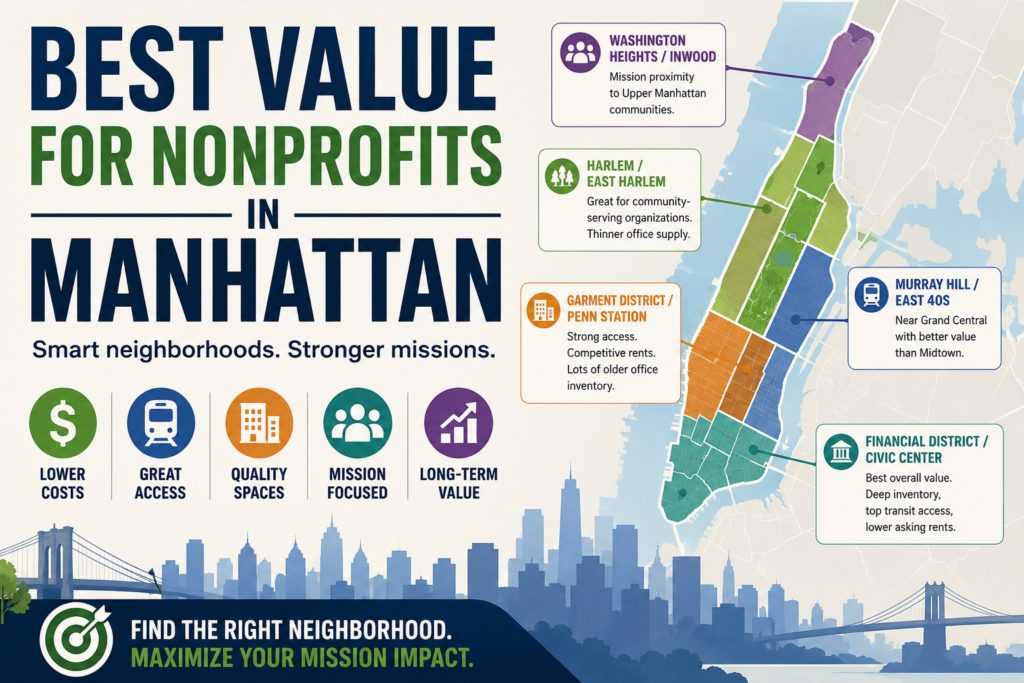
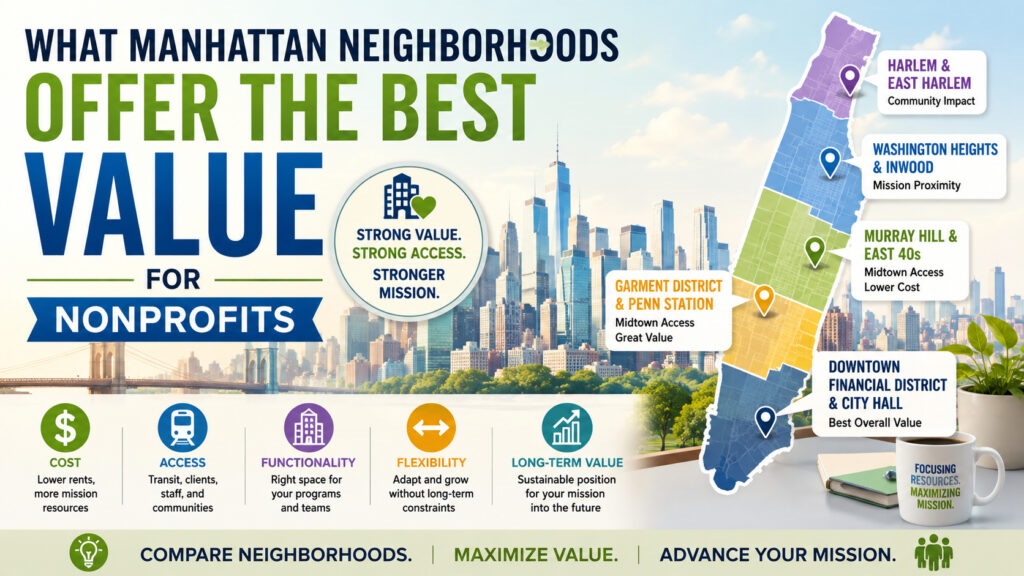
For most nonprofits, Downtown Manhattan offers the strongest starting point for conventional office space value. The Financial District, City Hall, and nearby Civic Center provide substantial office inventory, broad transit access, and comparatively low asking rents.
The Garment District and Penn Station area deserve equal attention when Midtown access matters more. Older office and loft buildings can reduce occupancy costs without pushing staff far from Manhattan’s transportation core.
Murray Hill and the East 40s provide another useful middle ground. These areas place tenants near Grand Central while avoiding some premium Midtown corridors.
Harlem and East Harlem can create greater mission value for community-serving organizations. However, they do not automatically provide the cheapest conventional offices. Traditional office inventory remains much thinner there than Downtown.
Washington Heights and Inwood can work extremely well for organizations serving Upper Manhattan. Yet their value comes mainly from mission proximity and local access. They offer fewer conventional office choices than Downtown or Midtown.
That distinction matters.
The neighborhood with the cheapest real estate is not necessarily the neighborhood offering the best nonprofit office value.
A nonprofit should compare five things together:
| Value factor | What it means for a nonprofit tenant |
|---|---|
| Occupancy cost | Rent, escalations, electricity, cleaning, taxes, and other lease expenses |
| Space efficiency | How much usable workspace the organization receives from each rentable square foot |
| Accessibility | Staff, clients, volunteers, board members, donors, and partners must reach the office easily |
| Mission alignment | The location should support program delivery rather than simply provide an attractive address |
| Lease flexibility | The organization needs enough stability without creating unnecessary long-term financial exposure |
Those factors produce a different answer for every organization.
A national advocacy group may gain more from Downtown than Harlem. A neighborhood health organization may reach the opposite conclusion. An arts nonprofit may prioritize affordable loft space near Penn Station.
Meanwhile, a human-services provider may need ground-floor access more than a skyline view.
The current Manhattan rent gap changes the calculation
As of the second quarter of 2026, Manhattan’s overall asking rent averaged $72.83 per square foot. Midtown averaged $76.98, while Midtown South averaged $81.14.
Downtown averaged only $56.66 per square foot during the same period. Class A Downtown space averaged $63.60, versus $88.50 in Midtown and $104.50 in Midtown South.
Therefore, Downtown’s overall average sat about 26% below Midtown and approximately 30% below Midtown South.
The Class A difference becomes even larger. Downtown Class A averaged about 28% below Midtown Class A and roughly 39% below Midtown South Class A.
Those averages do not mean every Downtown office is inexpensive. Trophy buildings can command substantially higher rents.
Still, the market-wide spread explains why cost-conscious organizations should examine Lower Manhattan before assuming Midtown provides better quality.
A practical first-tour shortlist
For a typical nonprofit seeking a Manhattan administrative office, start with this order:
Financial District / City Hall / Civic Center for the strongest combination of price, inventory, transit, and building choice.
Garment District / Penn Station for Midtown convenience without defaulting to premium Midtown pricing.
Murray Hill / East 40s for Grand Central access, institutional proximity, and older value-oriented buildings.
Harlem / East Harlem for organizations whose programs, clients, employees, or partnerships center on Upper Manhattan.
Washington Heights / Inwood for community-facing organizations whose geography makes northern Manhattan an operational advantage.
Other neighborhoods can still make sense. However, Chelsea, Flatiron, SoHo, Union Square, and premium Midtown generally require stronger reasons to justify their cost.
That does not make those neighborhoods wrong.
It simply means their strategic benefits must compensate for higher real estate costs.
What “Best Value” Really Means for a Nonprofit Office Tenant
A nonprofit should never judge an office solely by asking rent.
The asking rent appears prominently because it offers an easy comparison. Unfortunately, it rarely tells the complete financial story.
Two 8,000-square-foot offices can advertise identical rents and produce radically different occupancy costs.
One landlord may deliver a finished installation. Another may hand over an outdated office requiring substantial construction.
One floor may fit 55 employees efficiently. Another may waste thousands of square feet around corridors, columns, and oversized common areas.
Those differences can overwhelm a small rent advantage.
Start with total occupancy cost
A nonprofit should model every serious option across the expected lease term.
That calculation should include:
Base rent × rentable square footage, plus annual rent increases.
Then add electricity, cleaning, operating expense increases, real estate tax exposure, and other recurring charges.
Next, subtract negotiated free rent and other credits.
Finally, account for buildout expenses that fall outside the landlord’s contribution.
Only then can the organization compare locations fairly.
Consider a simple example.
A 10,000-square-foot office asking $55 per square foot starts around $550,000 annually before other costs.
Another office may ask $60, creating a $50,000 annual headline difference.
However, the second landlord might deliver a better installation and greater concessions.
The second floor could also accommodate more employees within fewer rentable square feet.
In that situation, the supposedly expensive office could cost less over the lease term.
Nonprofit value therefore requires effective-cost analysis, not asking-rent shopping.
Space efficiency can matter more than neighborhood pricing
Rentable square footage does not tell you how efficiently a nonprofit can use the floor.
Deep floorplates may work beautifully for open seating. They can create problems for organizations needing many private counseling rooms.
Narrow loft floors can provide excellent window exposure. Yet they may waste space when a program requires large training rooms.
Older office-intensive suites can save major construction costs for legal services or advocacy groups. Open creative layouts may work better for collaborative organizations.
The correct floor therefore depends on the program.
A 7,500-square-foot efficient floor can outperform an inefficient 9,000-square-foot bargain.
That difference reduces rent every month.
It also reduces furniture, cleaning, electricity, construction, and future restoration exposure.
Before choosing a neighborhood, estimate your actual requirement. Our Manhattan office sizing guidance can help frame that calculation.
Nonprofit tax treatment deserves attention
Qualifying religious, charitable, and educational nonprofits can receive exemption from New York City’s Commercial Rent Tax.
Other nonprofit organizations may also qualify under specific conditions. The organization may need written tax-exemption approval when its use falls outside the automatic categories.
That detail matters because Commercial Rent Tax generally applies to qualifying commercial occupancies south of 96th Street.
A nonprofit should confirm its own status before modeling any exemption. Never assume the organization’s federal nonprofit status settles every local tax question.
Finance staff, accountants, attorneys, and tenant representatives should coordinate this review early.
Construction can destroy a “cheap” deal
Many budget-conscious tenants naturally gravitate toward unfinished or older space.
Sometimes that strategy works.
Other times, it creates enormous capital exposure.
A nonprofit may need private offices, interview rooms, training rooms, storage, accessible restrooms, sound separation, supplemental cooling, or upgraded electrical capacity.
Those requirements can quickly transform an inexpensive raw floor into an expensive project.
Therefore, compare these questions before celebrating a low rent:
What exists already?
What will the landlord build?
Who controls the construction budget?
What happens when costs exceed the allowance?
Who pays architects, engineers, permits, furniture, cabling, security, and moving expenses?
The answers can change the apparent neighborhood hierarchy.
Value also includes financial predictability
Nonprofits often operate under funding cycles that differ from private businesses.
Grants can expire. Government contracts can change. Donor priorities can shift.
Headcount may also follow program funding rather than conventional corporate growth.
Accordingly, an exceptionally low rent does not justify an inflexible lease.
A strong deal should balance present savings with future uncertainty.
Sometimes a direct lease provides that balance.
In other situations, a furnished sublease can avoid construction and preserve capital.
A renewal option may matter more than an amenity floor.
Expansion rights could matter more than a fashionable neighborhood.
The lease should serve the mission rather than force the mission to serve the lease.
Residential affordability does not answer this question
People researching affordable Manhattan neighborhoods often encounter residential pricing information.
That information can create confusion.
Apartment affordability does not predict office affordability.
Washington Heights may offer lower housing costs than Midtown. Yet it has far less conventional office inventory.
Downtown can contain expensive apartments while offering comparatively economical commercial offices.
Similarly, a residentially desirable neighborhood may contain very little usable commercial space.
For a nonprofit office decision, evaluate the commercial market rather than the residential reputation.
The Manhattan neighborhood guide provides broader context on how industries and office inventories differ across the borough.
How Manhattan’s Main Nonprofit Office Neighborhoods Compare
No neighborhood wins every category.
The strongest choice depends on whether the organization prioritizes rent, transit, mission proximity, institutional access, or specialized space.
Financial District: the strongest all-around value candidate
For many organizations, the Financial District should receive the first serious look.
Downtown’s current average asking rents remain substantially below Midtown and Midtown South averages.
That gap creates opportunities at several quality levels.
Older Class B buildings provide economical office space. Renovated prewar buildings can offer modern installations without premium Midtown pricing.
Newer Class A properties provide another option for organizations needing stronger infrastructure.
Most importantly, Downtown provides depth.
A nonprofit can compare small suites, full floors, direct leases, subleases, furnished installations, and larger contiguous blocks.
That inventory depth creates negotiating leverage.
It also lets organizations trade one requirement against another.
A tenant may accept an older lobby for a better floor.
Another group may spend more for a turnkey installation.
A third may prioritize a large conference facility.
Current Downtown availability illustrates that range.
A 2,573-square-foot furnished Financial District office recently carried a $39-per-square-foot sublease asking rate.
A separate 10,120-square-foot Hanover Square office also carried a $39-per-square-foot asking rate.
Meanwhile, direct options include smaller suites such as this 1,903-square-foot Maiden Lane office.
Listings change continuously. These examples show the range rather than guaranteeing future availability.
Best fit: administrative headquarters, associations, advocacy groups, legal-services organizations, foundations, policy organizations, and larger nonprofits.
Main caution: Downtown contains several distinct pricing tiers.
Do not treat trophy towers and older Financial District buildings as one market.
A nonprofit seeking value should compare building quality carefully.
City Hall and Civic Center: overlooked value near government
City Hall and Civic Center deserve special attention from organizations interacting frequently with government agencies, courts, or legal institutions.
These areas sit between the traditional Financial District and neighborhoods farther north.
That position can provide excellent operational value.
The office stock includes older commercial properties that may price below fashionable Downtown alternatives.
Organizations also gain proximity to public institutions without paying premium Midtown rents.
Legal-services nonprofits can find particular value here.
Policy groups, advocacy organizations, and public-sector partners may also reduce travel time substantially.
Those savings rarely appear on a rent comparison.
Yet repeated staff trips across Manhattan create a real operating expense.
An organization sending employees to hearings, meetings, courts, and agencies should price staff time into its location decision.
A location that saves 30 minutes across several weekly trips may outperform a slightly cheaper office elsewhere.
Best fit: legal aid, policy, government relations, civic advocacy, public-interest organizations, and government-funded service providers.
Main caution: building quality varies considerably.
Tour the actual office before judging a building from its address.
Garment District: one of Midtown’s strongest cost-control plays
The Garment District can solve a problem that many nonprofits face.
Staff want central Manhattan. Leadership wants lower occupancy costs.
Older loft and commercial buildings can bridge those goals.
The neighborhood sits near Penn Station, Port Authority, Herald Square, and Times Square transportation.
That connectivity makes it unusually practical for regional workforces.
Employees traveling from New Jersey gain a major advantage.
Long Island commuters can also benefit from the Penn Station area.
Subway access spreads commuting options across the city.
Meanwhile, older building stock often creates a lower-cost alternative to premium Midtown.
The area also provides many flexible floorplates.
Some spaces retain former showroom or manufacturing characteristics.
Others now offer renovated open offices.
Many buildings divide into small and midsized suites.
For a nonprofit, this diversity can matter more than prestige.
The Garment District value guide explains how older loft buildings compete through pricing and flexibility.
Current inventory includes an 8,810-square-foot full-floor office near Eighth Avenue.
Smaller organizations can also examine 3,450-square-foot Garment District office options.
Best fit: arts organizations, associations, education nonprofits, social-services administrators, foundations, and regional organizations.
Main caution: building quality changes rapidly from property to property.
A low rent may accompany older elevators, basic lobbies, limited amenities, or less efficient mechanical systems.
Those compromises may remain perfectly acceptable.
Just make them deliberately.
Penn Station: value through transportation efficiency
Penn Station and the surrounding West 30s deserve separate consideration from the broader Garment District.
Here, the key value driver becomes transportation.
A nonprofit with employees arriving from New Jersey or Long Island may reduce commuting friction dramatically.
Board members and outside stakeholders may also value direct rail access.
That convenience can improve attendance at meetings.
It can also help recruitment.
However, Penn Station contains very different building types.
Premium redevelopments command premium rents.
Older commercial buildings nearby can provide substantially better economics.
Therefore, a nonprofit should avoid shopping by neighborhood label alone.
Move several blocks and the economics can change.
Best fit: regional associations, national nonprofits, membership groups, training organizations, and employers drawing from multiple suburbs.
Main caution: the neighborhood’s newest buildings can erase the value advantage.
Focus on older well-maintained stock when cost control drives the search.
Murray Hill and the East 30s: central without maximum Midtown pricing
Murray Hill provides a useful compromise between Midtown South and traditional Midtown East.
The neighborhood contains older commercial buildings, converted properties, and smaller floorplates.
That stock can serve nonprofit tenants well.
Organizations gain proximity to Grand Central without automatically paying Park Avenue pricing.
Employees can reach the East Side quickly.
Staff can also walk toward NoMad, Madison Square, or the United Nations corridor.
Many buildings suit smaller and midsized tenants.
That distinction matters because large Midtown towers often struggle to divide economically for small organizations.
A nonprofit requiring 2,500 square feet may find more practical options in Murray Hill.
A 25,000-square-foot organization faces a different market.
Best fit: education groups, healthcare-related organizations, small foundations, international organizations, associations, and professional nonprofits.
Main caution: Murray Hill pricing varies substantially as you approach Park Avenue and Madison Avenue.
Do not assume every address represents a value building.
East 40s and Grand Central: pay for access, not just prestige
Grand Central will rarely beat Downtown on pure rent.
However, it can produce exceptional value for the right organization.
Metro-North access helps employees from Westchester and Connecticut.
Regional rail connections also improve broader accessibility.
Multiple subway routes distribute commuters throughout Manhattan.
Furthermore, many stakeholders already use Grand Central as their natural arrival point.
That can simplify meetings.
Older East 40s buildings sometimes create a lower-cost path into this transportation network.
A current 5,992-square-foot East 42nd Street direct lease demonstrates the type of prebuilt inventory available there.
Smaller direct options also appear near the terminal.
One recent 2,208-square-foot East 42nd Street office offered four offices, a conference room, and open workspace.
Best fit: national organizations, international groups, associations, foundations, healthcare organizations, and nonprofits with suburban stakeholders.
Main caution: convenience carries a price.
The organization should calculate how much commuting efficiency actually saves.
United Nations corridor: specialized value for mission-aligned organizations
The East 40s near First and Second Avenues serve a narrower group especially well.
International, diplomatic, humanitarian, policy, and global-development organizations may gain unusual mission value here.
The neighborhood can reduce travel between offices, meetings, institutional partners, and international stakeholders.
Older office stock can also provide more modest economics than prestige Midtown corridors.
However, eastward distance matters.
Grand Central sits nearby, but employees still need to travel several avenues.
That inconvenience affects different teams differently.
A workforce concentrated on the East Side may barely notice.
Employees arriving from New Jersey may care considerably.
Best fit: international affairs, humanitarian work, global policy, diplomacy-related organizations, and advocacy groups.
Main caution: test real commute times rather than relying on a Midtown label.
Harlem and East Harlem: strongest when mission proximity creates the value
Harlem deserves a different evaluation method.
A community-based nonprofit should not ask only, “Is Harlem cheaper?”
The better question asks, “How much operational value comes from being here?”
Organizations serving Harlem residents can reduce staff travel.
Clients may reach programs more easily.
Community partnerships can become easier to maintain.
Local hiring may improve.
Program staff can remain close to the people they serve.
Those advantages can justify a location even when another Manhattan office carries lower effective rent.
However, conventional office inventory remains thinner than Downtown’s supply.
Scarcity can reduce negotiating leverage.
Therefore, Harlem should not automatically sit above Downtown on a cheapest-office ranking.
It belongs near the top when mission geography points north.
Best fit: community development, youth services, education, healthcare, social services, arts, workforce development, and neighborhood advocacy.
Main caution: distinguish program space from office space.
A street-level service center needs different features than an administrative headquarters.
Washington Heights and Inwood: excellent local value, limited conventional office depth
Washington Heights and Inwood can produce strong value for organizations serving northern Manhattan.
Community proximity becomes the central advantage again.
These neighborhoods may also help organizations recruit locally and shorten client travel.
However, office tenants encounter a different inventory structure.
The conventional commercial office market remains much smaller than Downtown or Midtown.
That limits direct comparisons.
An organization may instead encounter mixed-use buildings, community facilities, medical space, storefronts, and smaller commercial properties.
Those options can work exceptionally well for service delivery.
They may work less well for a large administrative headquarters.
Organizations should also evaluate travel to Midtown and Downtown.
A location can save clients substantial time while adding travel for executives or outside stakeholders.
Neither result makes the neighborhood good or bad.
It simply changes the value equation.
Best fit: direct-service providers, neighborhood organizations, community health groups, education programs, cultural organizations, and local advocacy groups.
Main caution: confirm appropriate use, accessibility, layout, and building infrastructure early.
Chinatown and the Lower East Side: mission-driven value in nontraditional space
These neighborhoods often attract community organizations, cultural institutions, and service providers.
They can offer direct access to communities that many nonprofits serve.
Smaller commercial properties may also provide distinctive spaces.
However, tenants should not expect Financial District-style inventory depth.
Older buildings can create accessibility challenges.
Elevator capacity, floor loading, HVAC, and restroom conditions may require additional review.
Organizations using space for public programs should examine those issues before negotiating economics.
Best fit: community services, immigrant services, arts groups, cultural organizations, education programs, and neighborhood advocacy.
Main caution: never assume an attractive low rent means the property supports the intended use.
Flatiron, Chelsea, Union Square, and SoHo: strategic, but rarely budget leaders
These neighborhoods can provide excellent workplaces.
They also attract talent, offer strong amenities, and carry recognizable identities.
Yet they usually do not represent Manhattan’s strongest nonprofit rent value.
Midtown South averaged $81.14 per square foot overall during Q2 2026.
Its Class A average reached $104.50 per square foot.
That makes the district difficult to justify through rent savings alone.
A nonprofit should choose these neighborhoods because the location materially advances another goal.
Perhaps the organization depends on creative talent.
Maybe proximity to cultural institutions matters.
A fundraising operation might value stakeholder geography there.
An arts organization may also prefer loft architecture that directly supports programming.
Those can all constitute value.
Still, paying more for atmosphere without a measurable organizational benefit rarely serves a cost-conscious nonprofit well.
Upper East Side and Upper West Side: specialized rather than inexpensive
Both neighborhoods can make sense for specific organizations.
Healthcare adjacency creates obvious reasons to consider the Upper East Side.
Education, culture, philanthropy, and residential stakeholder geography can support either side.
Nevertheless, commercial office inventory remains limited compared with Manhattan’s core business districts.
Thin supply can make searches difficult.
Smaller floorplates can further restrict options.
As a result, Uptown should not automatically mean cheap.
A nonprofit should start there when its mission or stakeholders demand the location.
It should not start there because the organization assumes rents fall with distance from Midtown.
Match the Neighborhood to the Nonprofit’s Operating Model
The “best Manhattan neighborhood for nonprofit office space” changes when the organization’s daily work changes.
That is why a single universal ranking cannot answer the question completely.
Administrative headquarters
A headquarters usually needs employee access, conference space, visitor convenience, and dependable infrastructure.
Financial District, Garment District, Penn Station, Murray Hill, and Grand Central all deserve consideration.
Downtown often wins the financial comparison.
Garment District can win when regional commuting matters.
Grand Central may win when senior stakeholders arrive from northern suburbs.
The correct answer depends on employee geography.
Human-services organizations
Direct-service organizations need a different office.
Client access can outweigh prestige.
Privacy may matter more than views.
Elevator reliability can matter more than lobby design.
Interview rooms, waiting areas, security, storage, and accessible restrooms may dominate the test fit.
For these groups, Harlem, East Harlem, Washington Heights, Chinatown, and the Lower East Side may create substantial mission value.
City Hall can also work for organizations interacting frequently with agencies.
Downtown may suit administrative teams even when programs operate elsewhere.
That suggests another possibility.
The cheapest overall solution may involve separating headquarters from program space.
An administrative team can occupy efficient office space Downtown.
Program teams can remain near the communities they serve.
That structure does not suit everyone.
However, larger nonprofits should at least model it.
Advocacy, legal, and policy organizations
These organizations should examine City Hall, Civic Center, the Financial District, Grand Central, and the East 40s.
Proximity to institutions can reduce repeated travel.
Legal-service organizations may also benefit from office-intensive layouts already built into older commercial properties.
Existing private offices can save construction money.
Conference rooms also support confidential meetings.
For some groups, Downtown therefore creates both rent value and layout value.
That combination can become powerful.
Arts and cultural nonprofits
Arts organizations often require unusual layouts.
Administrative staff may work efficiently in conventional offices.
Program staff may need rehearsal rooms, exhibition areas, production areas, storage, or freight access.
The Garment District deserves special attention because its older loft stock can accommodate atypical requirements.
Harlem may also create strong mission alignment.
Lower East Side and Chinatown properties can support neighborhood-oriented cultural work.
Chelsea provides extraordinary cultural adjacency but often at a higher cost.
Therefore, separate what the organization needs from what it likes.
A gallery neighborhood does not automatically provide the best arts nonprofit office.
Education nonprofits
Education groups vary dramatically.
An administrative organization may need ordinary office space.
A training organization may need classrooms and assembly areas.
Youth programs can require security, waiting areas, and specialized use approvals.
Garment District, Financial District, Harlem, East Harlem, and Murray Hill can all fit different models.
Transit should carry extra weight when participants travel from several boroughs.
Large elevators may also matter during class changes.
Never evaluate a training facility through office rent alone.
Healthcare and health-related organizations
Healthcare nonprofits should first separate clinical requirements from administrative requirements.
A clinical facility operates under very different physical and regulatory constraints.
Administrative employees may occupy ordinary offices elsewhere.
The Upper East Side can create valuable institutional adjacency.
Murray Hill and Midtown East may provide related access with broader commercial inventory.
Community health organizations may gain greater operational value in Harlem, East Harlem, or Washington Heights.
Again, mission geography should guide the answer.
Associations and membership organizations
Associations often depend on conferences, board meetings, training events, and visitors.
Transportation can therefore matter enormously.
Penn Station, Garment District, Grand Central, and the Financial District deserve close review.
Large conference rooms also change space economics.
An association should not automatically lease a large boardroom used twice monthly.
Some buildings include shared conference facilities.
That amenity can reduce required square footage.
The organization should calculate the annual savings before dismissing a building amenity as unnecessary.
Foundations and grantmaking organizations
Foundations usually need fewer public-facing program areas.
They may prioritize quiet offices, meeting rooms, stakeholder access, and professional presentation.
Downtown can deliver high building quality below many Midtown averages.
Murray Hill can offer smaller-floorplate alternatives.
Grand Central can serve regional board members particularly well.
Premium addresses remain available.
However, fiduciary optics matter.
An expensive trophy office can create questions even when the organization can afford it.
A high-quality building at a disciplined cost often communicates the stronger message.
National and international nonprofits
These groups should pay unusually close attention to airports, rail terminals, hotels, and regional transportation.
Grand Central can work well for organizations with Northeast regional stakeholders.
Penn Station can favor New Jersey and Long Island access.
Downtown can offer broad subway connectivity and PATH access while reducing office costs.
The East 40s may help organizations engaged in international policy.
A national organization does not need Midtown simply because Midtown feels central.
Actual stakeholder travel patterns should decide.
Transit, Clients, Staff, Donors, and Board Members Can Change the Winner
Location creates a recurring cost that never appears on the lease.
Every employee pays it through commuting time.
Every client pays it through travel difficulty.
Visitors experience it before they ever enter the office.
That makes transit part of occupancy economics.
Map where people actually come from
Start with employees.
Do not ask whether a neighborhood has “good transportation.”
Almost every Manhattan office district has substantial transportation.
Instead, ask which neighborhood serves your people.
A team concentrated in Brooklyn may favor Downtown.
New Jersey commuters may prefer Penn Station or Downtown PATH access.
Westchester and Connecticut employees may gain from Grand Central.
Upper Manhattan employees may benefit from Harlem or Washington Heights.
There is no universally best commute.
The organization needs a commute map.
Client geography matters even more for direct-service nonprofits
A nonprofit can save $50,000 annually on rent and still make the wrong decision.
That happens when clients cannot conveniently reach the new office.
Consider mobility limitations.
Consider childcare schedules.
Account for subway transfers.
Think about evening appointments.
Review neighborhood familiarity.
Then examine whether clients can find the entrance easily.
A low-cost high-floor office may suit administrators.
It may fail a walk-in service program.
Conversely, an expensive storefront may waste money when clients visit only by appointment.
Design the location around actual service delivery.
Volunteers create another travel pattern
Volunteer-heavy organizations should study where volunteers live, work, or attend school.
Many volunteers travel after work.
Others participate on weekends.
That makes evening and weekend building access important.
A building with restricted HVAC hours may create hidden costs.
Lobby security policies can also affect volunteer programs.
Freight elevator rules may matter during donation drives or events.
These details belong in the neighborhood comparison because building stock differs across Manhattan.
Board convenience should matter, but not dominate
Board members often influence location decisions strongly.
That influence makes sense.
Board attendance matters.
However, an organization should not overpay indefinitely to save occasional board travel.
Calculate frequency.
A monthly board meeting creates twelve annual trips.
Employees may make hundreds of trips each year.
Clients may make thousands.
Weight the decision accordingly.
A shared meeting facility can also solve the problem.
Sometimes an organization should optimize its daily office for staff and clients.
It can then hold major board meetings elsewhere.
Fundraising meetings do not require a prestige lease
Some nonprofits assume donors expect a premium office address.
That assumption deserves examination.
A professional, accessible, well-maintained office can communicate responsible stewardship more effectively than excess.
Meeting quality depends on privacy, presentation, technology, and convenience.
It does not depend entirely on the street name.
A renovated Downtown building can provide excellent conference facilities.
An older Midtown property can also create the right impression.
Choose the environment needed for the relationship.
Avoid paying continuously for prestige that creates little mission value.
Nearby partners can justify a higher rent
Proximity becomes valuable when employees repeatedly travel between organizations.
A coalition may need regular face-to-face meetings.
A policy group might interact frequently with government.
A health organization can depend on nearby institutions.
An education organization may partner with local schools.
A community nonprofit may collaborate with neighborhood groups.
Measure that interaction.
Then assign it a value.
Location works best when it eliminates operational friction.
Neighborhood grant programs should not drive a long lease
Organizations sometimes assume a neighborhood will unlock local grants.
That strategy carries risk.
Funding priorities change.
Eligibility requirements also change.
Programs may target neighborhoods outside Manhattan during a particular funding cycle.
Accordingly, do not sign a long-term lease because you expect a geographic grant advantage.
Choose the office because the real estate and mission economics already work.
Treat any eligible funding as an additional benefit.
Free and donated space solves a different problem
Libraries, community facilities, institutional partners, and donated rooms can support nonprofit programming.
Those resources may help tremendously.
However, temporary free space usually does not replace a secure administrative headquarters.
Organizations still need records storage.
Employees need reliable work areas.
Technology requires security.
Confidential meetings need privacy.
Mail, insurance, compliance, and operating continuity also matter.
Therefore, free community space works best as a supplement.
It should not automatically become the organization’s office strategy.
How Nonprofits Should Compare Actual Manhattan Office Spaces
Once the neighborhood shortlist becomes clear, the analysis must move from geography to individual buildings.
This stage often changes the winner.
A great neighborhood cannot rescue the wrong office.
Compare effective occupancy cost across the full term
Build one financial model for every serious alternative.
Use the same assumptions.
Include:
Base rent.
Annual increases.
Free rent.
Electricity.
Cleaning.
Operating expenses.
Real estate tax obligations.
Construction costs.
Furniture.
Technology.
Moving.
Professional fees.
Restoration obligations.
Renewal exposure.
Do not allow one proposal to hide costs that another proposal includes.
A consistent model exposes the real difference.
Distinguish direct leases from subleases
A direct lease creates a relationship with the landlord.
It may offer longer-term stability.
The landlord may also provide construction or a tenant-improvement allowance.
However, the transaction can require more time and capital.
A sublease can provide furnished, wired, move-in-ready space.
That can preserve nonprofit cash.
Shorter commitments can also create flexibility.
Yet subleases introduce other risks.
The remaining lease term may be awkward.
The existing installation may not fit perfectly.
A nonprofit also depends on another tenant’s underlying lease.
Neither structure wins automatically.
Compare the specific economics.
Turnkey space can beat the cheapest asking rent
Construction has become too important to treat as an afterthought.
Suppose a furnished office costs $5 more per square foot.
The nonprofit may avoid substantial construction, furniture, wiring, and moving expenses.
That can make the higher-rent option cheaper.
Turnkey space also reduces disruption.
Employees can return to normal operations faster.
Program continuity can carry significant value.
Therefore, nonprofits should tour second-generation and furnished offices early.
Do not save them for the end of the search.
Older buildings can provide exceptional nonprofit value
Many organizations do not need trophy construction.
They need reliable elevators.
They need appropriate HVAC.
Employees need daylight.
Visitors need a professional entrance.
Technology needs dependable connectivity.
Beyond those essentials, expensive building features may contribute little.
Older Class B properties can therefore offer excellent nonprofit value.
Some contain renovated lobbies and modern tenant spaces.
Others remain basic.
Either type can work when the rent reflects the product.
The key involves paying for features the organization actually uses.
The guide to lower-cost Manhattan office space explores several value-oriented building types and neighborhoods.
Accessibility requires a physical review
A public-serving nonprofit should examine the entire arrival experience.
Start outside.
Can a visitor enter without unnecessary barriers?
Then examine the lobby, elevators, corridors, suite entrance, restrooms, meeting rooms, and emergency procedures.
Do not rely only on a floor plan.
Older buildings can vary greatly.
Program needs also differ.
An administrative office may tolerate conditions that a high-volume public program cannot.
Accessibility requirements can involve legal and technical questions.
Bring qualified advisors into the process when needed.
HVAC can become an expensive surprise
Many Manhattan buildings include standard HVAC only during defined business hours.
A nonprofit operating evenings or weekends may need additional service.
That service can cost money.
Program hours therefore matter before lease negotiation.
Ask how the building handles overtime air.
Determine minimum charges.
Confirm notice requirements.
Review whether the existing system can support the organization’s density.
A packed training room places different demands on HVAC than an ordinary office.
Security should match the mission
Some nonprofits handle sensitive cases.
Others serve vulnerable populations.
Advocacy organizations may face unusual security concerns.
The building’s security model should match those realities.
Consider lobby screening.
Review visitor registration.
Check after-hours access.
Understand package procedures.
Ask about cameras and access control.
Then examine how staff reach the office outside normal hours.
Security should protect people without making services inaccessible.
Storage deserves more attention than most office searches give it
Nonprofits can accumulate significant physical materials.
Program supplies need space.
Records may require secure storage.
Event materials can consume closets quickly.
Donation programs create another challenge.
An elegant open office can fail immediately when storage remains inadequate.
Measure current inventory before touring.
Then decide what belongs on-site.
Off-site storage may cost less than leasing prime Manhattan square footage for boxes.
Conference space can create hidden savings
Meeting rooms consume expensive square footage.
A 500-square-foot conference room might cost tens of thousands annually in rent.
Large boardrooms can cost considerably more.
That does not mean nonprofits should eliminate meeting rooms.
Instead, calculate actual use.
A building with shared conferencing can reduce the private requirement.
Nearby rentable meeting space can provide another alternative.
Hybrid meetings may also reduce boardroom demand.
Lease permanent space for permanent needs.
Use flexible resources for occasional needs.
Growth assumptions should remain conservative
Private companies sometimes lease ahead of aggressive growth.
Nonprofits should examine that strategy carefully.
Funding uncertainty can make excess space particularly expensive.
Lease for realistic headcount.
Negotiate expansion rights where possible.
Consider adjacent availability.
Look for contraction flexibility when the market permits.
A strong lease creates options.
It should not require optimistic assumptions to remain affordable.
Test the organization’s future rent before signing
Annual escalations compound.
A manageable first-year rent can become uncomfortable later.
Model every lease year.
Then stress-test the budget.
What happens if headcount stays flat?
What if a major grant expires?
What happens if construction costs exceed expectations?
Could the organization sublease excess space?
Does the lease allow assignment under reasonable conditions?
These questions matter more than decorative finishes.
Ask what the landlord will actually deliver
Words such as “turnkey,” “prebuilt,” and “built-to-suit” can describe very different arrangements.
Get specifics.
Identify every wall.
Confirm flooring.
Specify lighting.
Address pantry equipment.
Review HVAC modifications.
Confirm electrical work.
Define doors, hardware, glass, ceilings, and paint.
Establish the construction schedule.
Then put the agreed work into the lease documents.
A vague construction promise creates financial risk.
Use current listings as market evidence, not isolated answers
An individual listing provides one data point.
A nonprofit needs a competitive set.
For example, Downtown currently shows furnished sublease opportunities alongside smaller direct leases.
The Garment District currently includes both midsized partial floors and larger full-floor options.
Grand Central and the East 40s also show direct prebuilt alternatives at several sizes.
That competition matters.
A tenant should make buildings compete against each other.
Touring only one “perfect” space removes leverage.
Neighborhood first, building second, lease economics third
The process should narrow logically.
First, eliminate neighborhoods that fail the organization’s mission or transportation needs.
Next, compare several buildings within the remaining areas.
Then compare economics across the best spaces.
Finally, negotiate multiple viable options whenever possible.
This approach keeps emotional attachment from controlling the transaction.
A beautiful conference room should not override a weak lease.
Neither should a famous address.
Frequently Asked Questions About the Best Manhattan Neighborhoods for Nonprofits
What Manhattan neighborhood offers the best overall nonprofit office value?
For many conventional office users, the Financial District provides the strongest first comparison.
Current Downtown asking rents remain below Midtown and Midtown South averages.
Downtown also offers substantial inventory, multiple building classes, broad transit, and many floorplate sizes.
However, a community-serving organization may gain greater value near its clients.
Therefore, “best overall” and “best for your nonprofit” can produce different answers.
Is the Financial District really cheaper than Midtown?
On current broad market averages, yes.
Downtown averaged $56.66 per square foot during Q2 2026.
Midtown averaged $76.98 during the same quarter.
The gap does not apply uniformly to every building.
Premium Downtown towers can cost more than older Midtown buildings.
Compare equivalent products whenever possible.
Is Downtown still good for nonprofits that are not financial organizations?
Yes.
Modern Downtown functions as a broad office market rather than a finance-only district.
Its strongest nonprofit advantage comes from the combination of inventory, transportation, and pricing.
Organizations should judge the individual building and commute pattern rather than the neighborhood’s historic identity.
Is Harlem the cheapest Manhattan neighborhood for nonprofit offices?
Not necessarily.
Harlem can provide extraordinary value for organizations serving Upper Manhattan.
However, its conventional office inventory remains smaller than Downtown’s.
Limited supply can reduce the number of choices at any given time.
Choose Harlem because its mission and operating benefits work.
Do not choose it solely because “Uptown” sounds cheaper.
What about East Harlem?
East Harlem can work particularly well for community health, education, social services, and neighborhood-based programs.
The decision should emphasize client access, program requirements, building suitability, and staff geography.
Traditional Midtown office comparisons can become less useful there.
A service center and a corporate-style headquarters solve very different problems.
Are Washington Heights and Inwood good nonprofit locations?
They can be excellent for organizations serving northern Manhattan communities.
Their strongest advantages include local access, mission proximity, and potential workforce alignment.
However, conventional office inventory is more limited.
Organizations requiring large modern office floors may find a shorter list.
What is the best Midtown neighborhood for a budget-conscious nonprofit?
The Garment District deserves an early look.
Older commercial and loft buildings can provide central access at lower costs than premium Midtown corridors.
Penn Station proximity also improves regional transportation.
Murray Hill deserves consideration for organizations favoring the East Side.
Should a nonprofit consider Penn Station?
Yes, especially when employees or stakeholders commute from New Jersey or Long Island.
The transportation savings can outweigh modest rent differences.
Focus carefully on building type.
Premium redevelopment around Penn Station can command much higher rents than nearby older stock.
Is Grand Central too expensive for nonprofits?
Not always.
Premium Grand Central buildings can command substantial rents.
Older East 40s properties create different economics.
Organizations should calculate the value of Metro-North access, subway connectivity, stakeholder convenience, and existing installations.
Paying somewhat more can make sense when the location saves substantial operating time.
Are Chelsea, Flatiron, and Union Square good nonprofit neighborhoods?
They can work, but they rarely lead on pure rent value.
Midtown South currently carries higher broad asking rents than Downtown or Midtown.
Organizations should therefore identify a concrete strategic benefit before accepting the premium.
Talent, cultural adjacency, partnerships, or specialized loft space may provide that benefit.
Is SoHo an affordable nonprofit office neighborhood?
Usually not when compared with value-oriented Downtown or Midtown alternatives.
The neighborhood can offer distinctive loft space and strong identity.
However, organizations should compare the premium against mission value.
A similar physical environment may cost less elsewhere.
Are the Upper East Side and Upper West Side affordable office markets?
Neither should automatically count as a budget district.
Both contain less traditional commercial inventory than Manhattan’s central office markets.
Limited supply can create higher pricing and longer searches.
Their strongest value comes from specific institutional, residential, healthcare, educational, or stakeholder relationships.
Should a nonprofit locate near donors?
Only when donor interaction happens often enough to justify the location.
Employees use the office far more frequently than most donors.
Clients may also visit more often.
Weight each stakeholder group according to actual usage.
A well-connected value building can support fundraising without carrying a prestige premium.
Should a nonprofit locate near its board members?
Board geography deserves consideration, particularly for frequent in-person meetings.
However, occasional meetings should not determine years of occupancy costs.
Compare meeting frequency against daily staff and client travel.
Shared conferencing can also solve occasional boardroom needs.
Should a nonprofit choose a neighborhood because other nonprofits already operate there?
A nonprofit cluster can provide useful evidence.
Similar organizations may have already identified favorable buildings, layouts, transportation, or pricing.
Still, clustering should not replace independent analysis.
Your organization may serve different clients, employ different people, or require different space.
Do nonprofit organizations receive special office rents?
Landlords do not generally price every lease through a universal nonprofit rate.
However, individual owners may compete aggressively for creditworthy organizations.
Existing nonprofit concentrations can also signal suitable building economics or layouts.
Negotiation matters more than labels.
The strongest pricing comes from creating competition between viable buildings.
Do nonprofits pay New York City Commercial Rent Tax?
Qualifying religious, charitable, and educational organizations can receive exemption.
Other nonprofit organizations may also qualify under defined conditions.
Some organizations need written exemption approval from the city.
Review the organization’s exact status with qualified tax advisors.
Does being above 96th Street automatically create tax savings?
Commercial Rent Tax generally concerns commercial occupancy south of 96th Street.
However, qualifying nonprofit status can create separate exemption treatment.
A tax difference should never substitute for a complete real estate comparison.
Rent, transportation, inventory, and mission fit usually represent larger variables.
Should a nonprofit lease Class A office space?
Sometimes.
Downtown’s Class A average remains substantially below Class A averages in Midtown and Midtown South.
That can make a higher-quality building financially reasonable.
However, the nonprofit should use the building’s infrastructure and amenities enough to justify their cost.
Class B can provide excellent value when the organization needs functionality more than prestige.
Is Class C office space always the cheapest choice?
It may carry a lower asking rent.
That does not guarantee a lower total cost.
Older infrastructure, construction needs, inefficient layouts, accessibility limitations, and additional operating costs can offset the rent savings.
Inspect the entire economic package.
Is furnished space better for nonprofits?
Furnished space can protect capital and shorten move-in time.
It becomes particularly attractive when the existing layout closely matches the organization’s needs.
However, unwanted furniture does not create value.
Neither does an unsuitable floorplan.
Compare the avoided construction costs against any rent premium.
Are subleases good for nonprofits?
They can be excellent.
Subleases may provide discounted rent, furniture, wiring, and shorter commitments.
Those features help organizations facing funding uncertainty.
However, review the remaining term and underlying lease carefully.
Also consider whether the organization can remain after the sublease expires.
How much office space does a nonprofit need?
Headcount alone cannot answer that question.
Private offices, counseling rooms, classrooms, storage, meeting areas, reception, and program functions can change the requirement.
Hybrid schedules create another variable.
Build a program before selecting a square footage target.
Then test that program against several actual floors.
Should a nonprofit lease extra space for future growth?
Use conservative growth assumptions.
Unused Manhattan square footage creates recurring costs.
Expansion rights can provide a better solution.
Adjacent space, rights of first offer, or flexible sublease rights may reduce long-term risk.
The best deal creates room to adapt without forcing the organization to overlease today.
How early should a nonprofit begin looking for Manhattan office space?
Start early enough to evaluate alternatives without deadline pressure.
Construction, legal review, board approvals, funding requirements, and internal decision-making can add substantial time.
Larger requirements usually need longer lead times.
A rushed tenant loses negotiating leverage.
What should a nonprofit prioritize during the first tours?
Start with the floor rather than the finishes.
Study layout efficiency.
Check daylight.
Examine meeting rooms.
Review storage.
Inspect restrooms.
Understand elevators and accessibility.
Ask about HVAC.
Then evaluate the building’s transportation and recurring costs.
Decorative finishes come later.
What makes one Manhattan neighborhood a better nonprofit value than another?
The strongest neighborhood reduces the organization’s total cost of accomplishing its mission.
That cost includes much more than rent.
Employee travel matters.
Client access matters.
Construction matters.
Space efficiency matters.
Lease flexibility matters.
Taxes and operating expenses matter.
Program delivery matters most.
The bottom line
For a nonprofit seeking a conventional Manhattan administrative office, Downtown deserves the first comparison today.
The Financial District, City Hall, and Civic Center combine broad inventory with current rents below Midtown averages.
Organizations that need Midtown should examine Garment District, Penn Station, Murray Hill, and the East 40s before defaulting to premium corridors.
Community-serving organizations should give Harlem, East Harlem, Washington Heights, and Inwood much greater weight when mission geography supports them.
Meanwhile, Chelsea, Flatiron, Union Square, SoHo, and premium Midtown should clear a higher bar.
Those neighborhoods can deliver excellent strategic value.
However, their benefits should justify their higher occupancy costs.
The decisive question is therefore not simply:
Which Manhattan neighborhood has the lowest rent?
It is:
Which Manhattan neighborhood lets this nonprofit deliver its mission at the lowest practical total cost, without weakening access, operations, or flexibility?
That question usually produces a better lease.
More importantly, it produces a better long-term real estate decision.
Looking for the Best Value Today
We represent tenants, not buildings, during Manhattan office searches. Our role centers on comparing alternatives, exposing hidden occupancy costs, and negotiating lease economics around your mission. That approach lets a nonprofit choose the right neighborhood before it chooses the right suite.
Fill out our 📋 online form or give us a call today 📞 212-967-2061 — let’s find the right options for your business.