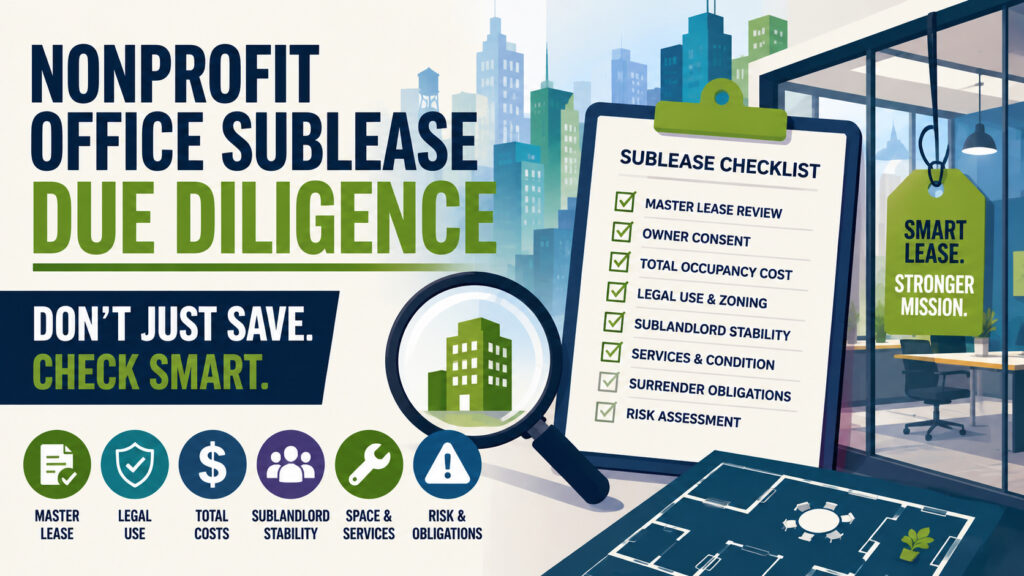
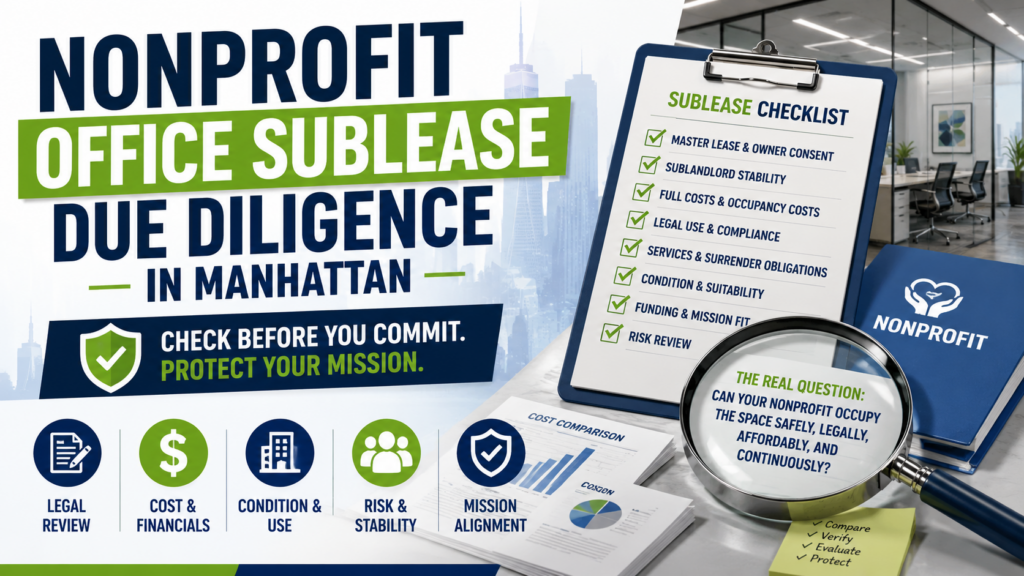
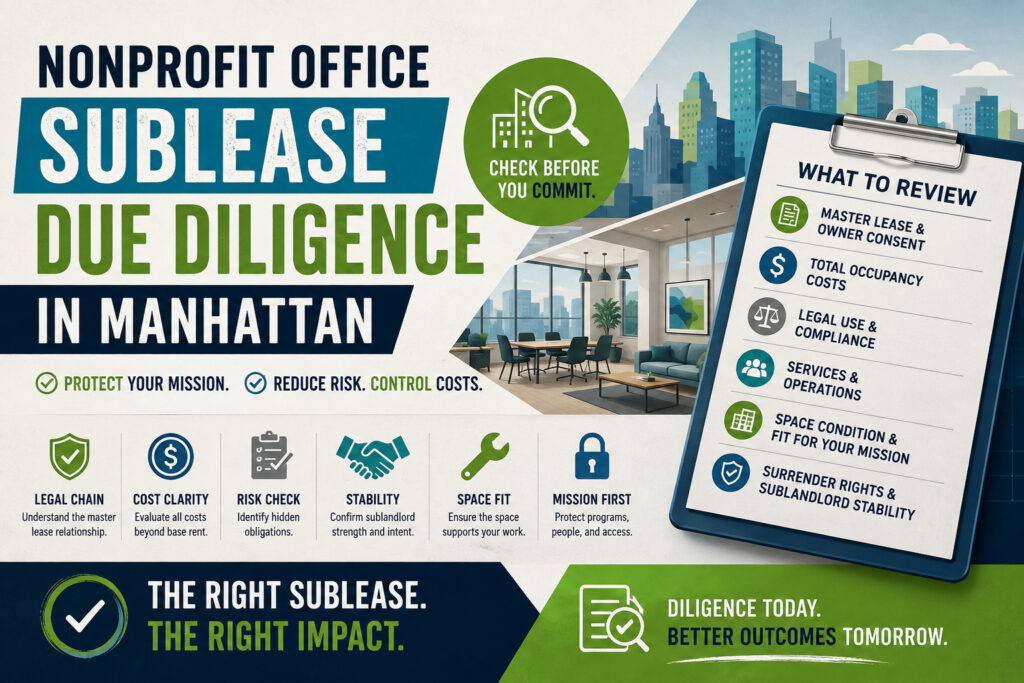
A Manhattan office sublease can reduce cost, shorten commitment, and eliminate much of the usual construction burden. However, nonprofits carry several risks that ordinary office users may not face. Funding cycles, program uses, public access, grants, and governance can all affect the decision.
Due diligence should therefore examine much more than the advertised rent. A nonprofit must investigate the master lease, owner consent, sublandlord stability, occupancy costs, legal use, services, and surrender obligations. The organization should also test whether the space can support its mission throughout the full term.
This guide explains those issues from the nonprofit tenant’s side. It covers legal, financial, physical, operational, and organizational diligence before signing. For broader leasing context, start with our Manhattan commercial leasing guide.
The central question is not whether the sublease looks inexpensive.
The real question asks whether your nonprofit can occupy the space safely, legally, affordably, and continuously.
What Nonprofit Office Sublease Due Diligence Actually Means
A commercial office sublease creates a different relationship than a direct lease. Your nonprofit does not replace the existing tenant. Instead, that tenant becomes your sublandlord while remaining responsible under its master lease.
That structure creates an important legal chain:
Building owner → master tenant → nonprofit subtenant
Your organization normally receives no greater rights than the master tenant already holds. Therefore, an attractive sublease cannot cure a weak master lease.
Likewise, the sublandlord cannot promise services, access, alterations, signage, or occupancy rights that it lacks. Your diligence must follow every important promise upward.
A nonprofit sublease requires several kinds of diligence
Legal diligence examines the master lease, amendments, consent provisions, use clauses, defaults, and termination rights.
Financial diligence calculates the complete occupancy cost. That analysis includes more than base rent.
Operational diligence tests building access, visitors, programs, meetings, deliveries, security, and after-hours services.
Organizational diligence asks whether the term matches grants, reserves, staffing, board plans, and mission needs.
Continuity diligence considers what happens when the sublandlord defaults, restructures, disappears, or loses its master lease.
Common sublease guidance often focuses on five issues. Those include term, consent, default risk, services, and physical condition.
Those five checks form a useful beginning. A nonprofit tenant usually needs a much deeper review.
What this search can mean — and what it does not mean
Several different real estate concepts use the phrase “due diligence.” They should not get mixed together.
Concept
What it actually concerns
Relevance to your nonprofit
Office sublease due diligence
Taking space from an existing tenant
Directly relevant
Property acquisition diligence
Buying an office building or condominium
Different transaction
Residential sublet diligence
Renting an apartment from another tenant
Different law and market
Corporate nonprofit diligence
Investigating an organization or transaction
Different subject
Sublease marketing
A tenant finding someone to take excess space
Opposite side of your deal
Flexible office review
Taking a serviced office or license
Similar occupancy goal, different contract
Lease assignment
Replacing the original tenant under its lease
Different legal structure
Co-location
Sharing space, facilities, or desks
Relevant only when properly structured
A nonprofit searching for a Manhattan office sublease needs subtenant-side commercial real estate diligence.
That distinction matters. Advice written for a property buyer can miss sublandlord default risk entirely. Residential guidance will not address commercial master leases or office services.
Sublandlord-oriented advice also answers the wrong question. It focuses on marketing excess space rather than protecting the incoming occupant.
The 2026 Manhattan context changes the risk calculation
Sublease space can still provide a meaningful pricing advantage. Yet Manhattan’s available sublease pool has tightened considerably.
During Q2 2026, Manhattan’s average office asking rent reached $80.17 per square foot. The average sublease asking rent measured $59.94 per square foot. That represents an asking-price gap of roughly 25%.
However, sublease availability measured only 2.6% during that quarter. Overall office availability measured 14.4% under the same methodology.
Another major market study reported 12.1 million square feet of sublease supply. That total fell 5.1% during Q2 2026. It also reached its lowest quarterly level since Q2 2020.
These statistics do not mean every sublease represents a bargain. They show why good turnkey opportunities can require faster decisions.
Speed should shorten unnecessary delays. It should never shorten diligence.
Start With the Master Lease and the Legal Chain Above You
The master lease should become one of the first documents your nonprofit requests. Do not treat that document as background material.
Your sublease depends upon it.
Ask for the complete master lease package before finalizing business terms. That package should include amendments, riders, commencement agreements, extensions, work letters, and prior relevant consents.
A summary does not provide enough protection. Neither does a broker flyer or landlord email.
Read the master lease as though your organization had signed it
Start with the basic economic and legal provisions.
Confirm the master tenant’s exact premises. Then confirm that your proposed sublease space falls entirely inside those premises.
Check the master lease commencement and expiration dates. Your proposed sublease must fit safely inside that period.
Many parties deliberately end a sublease before the master lease expires. That gap gives the sublandlord time to satisfy surrender duties.
Next, review the permitted use.
A clause allowing ordinary administrative office work may fit one nonprofit perfectly. Another nonprofit may hold classes, counseling sessions, workshops, or frequent public meetings.
Those activities can create different lease and code questions.
Examine operating hours as well. Some documents limit building access, HVAC, freight use, deliveries, or other services.
Finally, inspect all provisions covering assignment and subleasing. These clauses govern whether the transaction can proceed at all.
Owner consent can determine whether the deal exists
Never assume the master tenant possesses an unrestricted right to sublease.
The master lease may require written owner consent. It may also impose conditions before the owner must consider a request.
Those conditions can include financial information, organizational documents, insurance materials, proposed use details, and a signed sublease.
Some master leases also give the owner a recapture right. Recapture can let the owner reclaim proposed sublease space instead.
Therefore, ask these questions early:
Consent question
What your nonprofit needs to know
Does the master lease require consent?
Confirm the exact procedure
Can the owner recapture the space?
Determine that risk before spending heavily
What documents must the nonprofit provide?
Prepare them before negotiations stall
Does another party hold approval rights?
Identify lenders or other consent parties
Who pays consent review costs?
Include those costs in the economics
When does rent start?
Tie commencement to valid consent and delivery
Can consent contain new restrictions?
Review the consent with the sublease
What happens if consent never arrives?
Preserve an exit and deposit return
Do not let your nonprofit pay irreversible rent before satisfying required consent conditions.
Likewise, avoid major moving expenditures before the transaction becomes legally secure.
Investigate the master tenant’s current lease status
A sublandlord’s credit matters for an unusual reason. Your organization may depend upon that party continuing to pay someone else.
Suppose your nonprofit pays every sublease installment on time. The sublandlord could still stop paying its master rent.
That failure can jeopardize the underlying lease. Your perfect payment record might not preserve your occupancy.
Accordingly, ask about the sublandlord’s current status.
Request reasonable evidence that the master lease remains active. Counsel may also request representations concerning existing defaults.
Where circumstances justify it, seek an owner acknowledgement or estoppel. The document can confirm important facts about the underlying lease.
A sophisticated subtenant should also understand why the sublandlord left. Downsizing alone does not create a problem.
Severe financial distress deserves a different analysis.
Recognition and non-disturbance can protect occupancy
A carefully structured agreement may address what happens after a master-tenant default.
Your nonprofit can request direct recognition from the building owner. Under that structure, the owner may agree to recognize your occupancy after specified events.
The exact form requires legal negotiation.
Do not assume every owner will grant this protection. Still, the issue deserves attention when continuity matters greatly.
Organizations serving clients from the premises have more at stake than desks and furniture. A sudden location loss can interrupt programs, records, staffing, and community access.
Recognition therefore carries special value for mission-critical operations. Historic nonprofit leasing guidance also identifies subtenant recognition as a core sublease issue.
Never rely on a verbal promise of a future direct lease
A short sublease may fit today’s funding horizon. However, your organization may hope to remain after that term.
Ask whether the owner would consider a direct lease afterward.
Then distinguish possibility from contractual right.
A broker’s expectation does not create a renewal option. Neither does a friendly conversation with building management.
If continuity matters, negotiate a documented path whenever possible.
That path could involve a direct lease option, extension framework, or owner commitment to negotiate.
Otherwise, budget for the possibility of another move.
Model the Real Occupancy Cost Before Calling the Sublease Affordable
The advertised sublease rent answers only one financial question.
A nonprofit board should understand the all-in occupancy commitment.
That calculation should compare alternative spaces using the same assumptions. Our guide to Manhattan office pricing explains the difference between quoted and total occupancy cost.
Start with rentable square feet, not desk count
Manhattan office rent usually uses rentable square footage. Rentable area can exceed the space your staff physically occupies.
Therefore, compare the quoted area against the actual layout.
A 7,000-square-foot sublease can function worse than a smaller alternative. Excess corridors, oversized reception areas, or unusable rooms can reduce efficiency.
An architect can review the plan when measurements or capacity matter.
Then calculate annual and monthly base rent.
Do not stop there.
Build a complete sublease cost model
A serious comparison should examine each applicable category below.
Cost category
Due-diligence question
Base sublease rent
What does the nonprofit pay each month?
Rent increases
Does rent rise during the term?
Free rent
When does it apply, and what survives default?
Electricity
Included, submetered, allocated, or separately charged?
HVAC
What hours come standard?
Overtime HVAC
What does evening or weekend use cost?
Cleaning
Who cleans the premises and at whose expense?
Real estate tax charges
Which master-lease obligations flow through?
Operating expenses
Which escalations can reach the subtenant?
Security
Does the building charge for guards or special access?
Freight elevator
What does move-in or program delivery cost?
Insurance
Which policies and limits must the nonprofit carry?
Security deposit
How much cash remains tied up?
Legal review
What transaction costs should the budget include?
Architectural review
Does the planned use require professional review?
Construction
What work remains despite the turnkey appearance?
Furniture
Included, purchased, licensed, or removable?
Technology
What must the nonprofit replace or activate?
Moving
Staff, records, technology, furniture, storage
Restoration
What must the nonprofit remove at expiration?
Holdover exposure
What happens after the agreed surrender date?
The result gives management a more useful figure: total occupancy cost over the expected term.
That number may change which space appears cheapest.
A lower sublease asking rent can still produce a worse deal
Consider two hypothetical 10,000-square-foot offices.
Option A asks $58 per square foot and comes furnished. However, the building charges substantial overtime HVAC.
Option B asks $64 per square foot. Yet the building includes broader HVAC hours and better existing infrastructure.
A nonprofit that holds evening programs could spend less under Option B.
Consequently, rent comparisons should reflect actual operating behavior.
Q2 2026 data illustrates the geographic spread as well. Midtown’s average sublease asking rent reached $63.19 per square foot. Downtown’s average measured $47.13 per square foot.
Those averages describe markets, not specific deal values. Building quality, term, condition, floor, layout, and services can change pricing substantially.
Treat furniture as an economic item
Furniture often makes a Manhattan office sublease attractive.
However, “furnished” can mean several things.
Ask which desks, chairs, conference tables, appliances, shelving, and storage units remain. Then attach an inventory to the transaction documents.
Photograph important items before occupancy.
Clarify ownership too. The sublandlord may own some furniture while leasing other items.
Likewise, determine who removes unwanted pieces.
A large quantity of inherited furniture can create disposal costs instead of savings.
Understand electricity before signing
Office electricity can follow several structures.
A building may submeter usage. Another may include an estimated electricity charge within rent.
Some tenants receive direct utility service.
Your nonprofit should understand the applicable method and any administrative charges. Historic office-leasing guidance identifies electricity calculation as an important economic diligence item.
Then inspect actual operational needs.
Server equipment, supplemental cooling, kitchens, production equipment, or specialized programs can increase consumption.
Your architect or engineer should also confirm available electrical capacity when necessary.
After-hours HVAC can become a nonprofit budget problem
Many nonprofits operate beyond traditional business hours.
Board meetings may occur after work. Volunteers might arrive on weekends.
Community programs can run during evenings.
Therefore, request the standard HVAC schedule and current overtime charges.
Ask how the building calculates those charges. Also determine the minimum billing period.
Some systems condition an entire zone rather than one suite. That difference can change the cost dramatically.
The master tenant cannot generally transfer broader service rights than its lease provides.
Model realistic annual usage before signing.
Separate commercial rent tax from real estate tax pass-throughs
These issues often get confused.
New York City imposes a commercial rent tax on qualifying commercial occupancy in Manhattan south of 96th Street. The rules expressly include sub-lessees within the definition of tenant.
However, qualifying nonprofit organizations can receive exemptions.
Religious, charitable, and educational nonprofit organizations fall within stated exemption categories. Other nonprofits can face additional conditions and documentation requirements.
Therefore, your nonprofit should confirm its treatment with its tax professional.
Do not automatically add the tax merely because the rent crosses the ordinary threshold. Conversely, do not assume “nonprofit” resolves every filing question.
Real estate tax escalation presents a different issue.
A nonprofit tenant does not automatically make a privately owned building exempt from property tax.
New York’s exemption structure focuses heavily on ownership and qualifying use. Property owned by a qualifying nonprofit can receive exemption treatment under statutory conditions.
That distinction matters.
Your sublease may pass through real estate tax obligations from a taxable master lease. Review the actual documents rather than relying on federal tax-exempt status.
Test the term against the nonprofit’s funding runway
A three-year commitment can look short to a commercial landlord. It can look long to a grant-dependent organization.
Prepare a realistic funding view before signing.
Consider committed grants, government contracts, unrestricted reserves, fundraising concentration, recurring donations, membership revenue, and other predictable sources.
Then examine major expiration dates.
The goal does not require proving that every future dollar already exists. Instead, management should understand the relationship between occupancy liability and visible funding.
A board should also know how quickly the organization could reduce expenses after a funding shock.
That question matters because lease obligations do not automatically disappear when a grant ends.
Confirm the Space Can Legally and Practically Support the Mission
A beautifully furnished office can still fail due diligence.
The space must support what your organization actually does.
Administrative office work presents one pattern. Counseling, classes, public programs, medical services, food service, and large gatherings can create different requirements.
Never let the word office substitute for a use analysis.
Describe the intended use before negotiating the clause
Prepare a plain-language operational description.
For example:
Administrative offices, staff meetings, board meetings, client appointments, volunteer activities, educational programming, and related nonprofit operations.
Your attorney can then compare that description against the master lease.
The exact language should fit the organization.
Avoid an unnecessarily narrow permitted-use clause. Mission delivery often changes faster than real estate.
At the same time, do not promise an activity that the building cannot lawfully accommodate.
Check legal occupancy before assuming your programs fit
New York City building records establish how a building may legally operate.
A Certificate of Occupancy identifies legal use or permitted occupancy. A change in use, egress, or occupancy can require updated approvals.
Older buildings may follow different documentation paths. Buildings from certain earlier periods may rely on other official evidence for legal use.
Therefore, review the relevant building records.
Public building databases can also reveal permits, complaints, violations, and occupancy information.
An architect should interpret those records when your program presents unusual conditions.
Ordinary office use and mission programming are not always identical
Consider how people enter and use the premises.
Does your organization expect five staff members and occasional visitors?
Or will forty participants attend weekly workshops?
Does the nonprofit provide confidential counseling?
Will children visit?
Does the operation include clinical services, food preparation, exhibitions, performances, or frequent training sessions?
Those differences can affect design and code analysis.
The building owner may also care about elevator traffic, security, noise, and other tenant impacts.
Disclose material program needs before signing. Hidden operational conflicts become expensive after occupancy begins.
Accessibility deserves a functional review
Do not evaluate accessibility from the lobby alone.
Trace the entire user journey.
Can a visitor enter the building without an unnecessary barrier?
Does the elevator reach the correct floor?
Can users enter the suite comfortably?
Review restroom access, doors, circulation, reception, meeting rooms, and program spaces.
Different accessibility rules can apply to buildings, alterations, and public-facing operations.
An architect and counsel should evaluate material concerns.
This review matters especially for organizations serving seniors or people with disabilities.
Analyze the visitor experience
A nonprofit office can function partly as a public facility even when it remains legally office space.
Visitor procedures therefore matter.
Ask how guests enter the building.
Determine whether security requires advance registration. Then test the process against your expected volume.
Will every visitor need identification?
Can walk-ins enter?
What happens during evenings?
Does the building maintain accessible after-hours entry?
Can volunteers receive recurring credentials?
Can clients who lack conventional identification still access services?
A lease abstract rarely answers those operational questions.
Tour the building during actual program hours whenever possible.
Check privacy before falling in love with an open plan
Turnkey offices often reflect another company’s workplace philosophy.
Your nonprofit may need something different.
Counseling organizations can require acoustic privacy. Legal-service groups may need confidential meeting rooms.
Development teams may handle donor information.
Human resources staff need protected conversations.
Healthcare-related organizations can carry additional privacy concerns.
Inspect walls, doors, ceilings, and sound transmission.
A glass conference room may look polished while failing practical confidentiality needs.
Similarly, an open workstation layout can require expensive reconfiguration.
Verify technology instead of assuming “wired” means usable
Existing cabling can save time and money.
Nevertheless, determine what remains connected.
Identify the internet providers serving the building. Then confirm service availability for your exact suite.
Spread one-time costs across the expected occupancy term.
A turnkey sublease can win this analysis decisively.
Another can lose once hidden costs appear.
The calculation matters more than the label.
The final red-flag test
Before execution, pause when any issue below remains unresolved.
Red flag
Why it deserves attention
Missing master-lease documents
Unknown upstream obligations
Owner consent remains uncertain
Occupancy right may fail
Rent starts before consent
Nonprofit assumes premature cost
Master tenant shows distress
Continuity risk rises
No default protection
Sublandlord failure can threaten occupancy
Permitted use feels narrow
Programs may violate the contract
Legal occupancy remains unclear
Mission use may not fit
Heavy evening operations
HVAC costs may erase savings
Significant construction on a short term
Capital recovery becomes difficult
Furniture description remains vague
Ownership disputes can follow
Security deposit seems excessive
Liquidity gets trapped
Restoration language remains broad
Exit liability stays unknown
Program partners will share space
Transfer restrictions may apply
Future direct lease remains verbal
Long-term continuity lacks protection
Sublease economics beat every alternative “too easily”
Investigate the reason
A red flag does not always require abandoning a transaction.
It requires understanding the risk.
Sometimes price solves the issue.
Sometimes documentation solves it.
Other times the right answer involves choosing another office.
What should a nonprofit check before taking a sublease?
Start with the master lease and every amendment.
Next, confirm the owner’s consent requirements.
Review the sublandlord’s lease status and financial stability.
Then model every occupancy cost.
Verify legal use, building access, program compatibility, and physical condition.
Finally, negotiate default protection, restoration, transfer rights, and a clear commencement structure.
That sequence covers the core legal and business risks identified in traditional nonprofit leasing guidance.
Is a Manhattan nonprofit office sublease always cheaper than a direct lease?
No.
Current Manhattan averages show a substantial asking-rent discount for sublease space. Q2 2026 figures showed $59.94 per square foot for sublease asks. Overall asks averaged $80.17 per square foot.
Yet averages do not determine individual transactions.
A direct lease can offer longer term, owner-funded construction, stronger renewal rights, and direct service remedies.
Subleases can offer furniture, speed, and reduced capital spending.
Compare the complete economics.
How long should a nonprofit office sublease run?
The correct term depends on mission planning and funding visibility.
A short term offers flexibility.
However, frequent moves create costs and operational disruption.
A longer term provides stability but increases future commitment.
Compare the proposed expiration against major grants, strategic plans, staffing projections, and program changes.
Also consider the physical investment.
Large construction spending usually needs enough occupancy time to justify itself.
Can a nonprofit rely on its tax-exempt status to eliminate occupancy taxes?
No blanket rule supports that assumption.
Commercial rent tax rules include important nonprofit exemptions. However, organizations should confirm their specific qualification and filing position.
Property-tax treatment follows different rules.
New York real-property exemptions focus on ownership, qualifying purposes, and actual property use.
Therefore, analyze each tax issue separately.
Can a nonprofit hold events or classes in ordinary office space?
Sometimes.
The answer depends on the activity, expected occupancy, building approvals, lease language, and legal occupancy.
A Certificate of Occupancy identifies permitted building use and occupancy. Material changes can require additional approvals.
Tell your architect exactly how the nonprofit will operate.
Do not describe regular public programming as incidental office activity when it is central to the mission.
What happens if the sublandlord defaults?
The consequences depend on the master lease and negotiated protections.
Your nonprofit does not automatically gain a direct lease merely because it paid its sublease rent.
Therefore, investigate recognition or non-disturbance protection where continuity justifies it.
Also seek information about existing defaults before signing.
A sublease creates dependency on the prime tenant’s continuing master-lease performance.
Can a nonprofit modify a furnished sublease?
Possibly.
First, check the sublease.
Then review the master lease.
Owner approval, permits, approved contractors, insurance, and restoration can all matter.
Even apparently simple layout changes can affect building systems.
Get important alteration rights documented before committing.
Can the nonprofit share extra space with another organization?
Possibly, but do not assume informal sharing falls outside lease restrictions.
A license, desk-sharing arrangement, or co-location plan can trigger transfer provisions.
Traditional nonprofit leasing guidance specifically identifies this issue.
Discuss expected partnerships during negotiation.
A broader approved-use structure can preserve future flexibility.
When should due diligence begin?
Begin before your nonprofit finalizes the major business terms.
Early review prevents wasted negotiation.
It also helps the organization price risks accurately.
Once the parties agree economically, conduct deeper legal and technical review before execution.
A compressed sublease schedule should increase coordination among advisers.
It should not eliminate necessary investigation.
The final decision should answer one question
Before signing, management and the board should be able to explain the transaction in plain English.
They should know exactly what the nonprofit receives.
They should understand what the organization pays.
They should know which building rights come through the master tenant.
The decision-makers should also understand what happens when something goes wrong.
Most importantly, the space should support the mission rather than constrain it.
A nonprofit office sublease works best when price, term, use, operations, and funding all point in the same direction.
A Tenant-Forward Standard for Manhattan Nonprofit Subleases
A strong nonprofit sublease does not merely provide inexpensive Manhattan office space. It gives the organization enough certainty to deliver its mission without avoidable real estate disruption.
The best transaction usually combines several qualities.
The economics remain understandable. Management can explain the total cost without relying on an optimistic rent figure.
The legal chain remains visible. Counsel understands the master lease, consent, and the organization’s subordinate position.
The term fits the organization. The commitment reflects funding, staffing, and strategic planning.
The use fits the building. Programs can operate lawfully and practically.
The physical condition works. Furniture and infrastructure reduce capital needs rather than creating hidden liabilities.
The services fit actual hours. HVAC, elevators, security, cleaning, and visitor procedures support daily operations.
The exit stays manageable. Restoration, surrender, and transfer rights do not create surprises.
The failure scenarios have answers. Everyone understands what happens after default, casualty, service loss, or sublandlord trouble.
That standard matters even more in the current Manhattan market.
Sublease supply has tightened, while pricing still shows a meaningful spread against broader office asking rents.
Consequently, nonprofits may face pressure to move quickly on strong options.
A disciplined process can move quickly too.
The organization can prepare financials before touring. Counsel can review the master lease while business terms develop.
An architect can inspect a finalist immediately.
The broker can compare direct and sublease alternatives simultaneously.
That approach preserves speed without sacrificing protection.
A nonprofit does not need the longest lease, lowest rent, newest building, or most impressive address.
It needs the right combination of cost, flexibility, mission fit, continuity, and contractual protection.
That is the real purpose of nonprofit office sublease due diligence in Manhattan.
Sublease Options Await
We represent office tenants, not landlords, throughout Manhattan. We compare subleases against direct leases while testing economics, documents, operations, and future risks. Our role is to protect your nonprofit’s budget, flexibility, and mission before you commit.
Fill out our 📋online form or give us a call today 📞212-967-2061 — let’s find the right options for your business.