Can a Nonprofit Sublease Its Existing Manhattan Office?
Yes — but the lease, consent rights, and nonprofit rules control
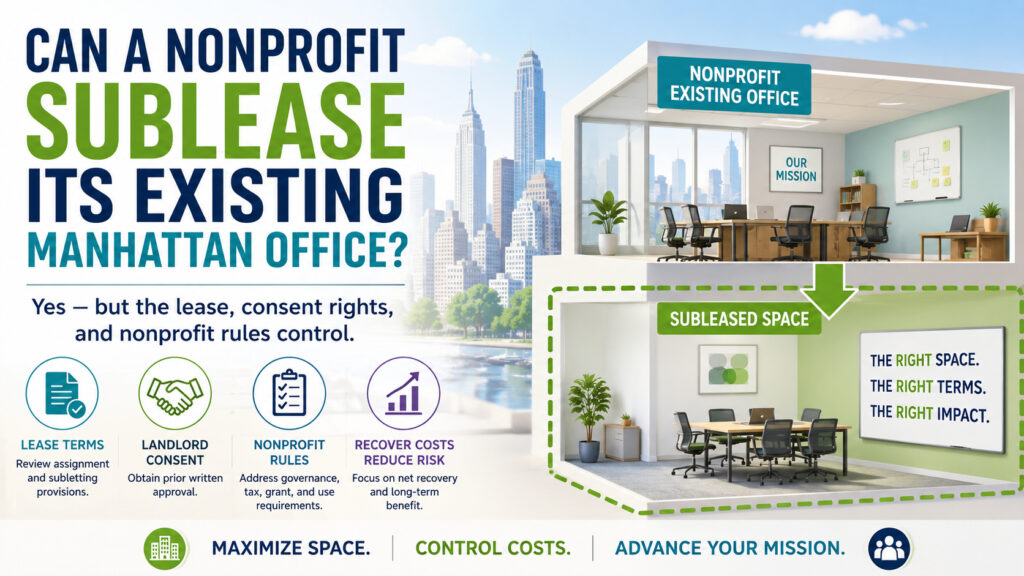
Yes, a nonprofit can often sublease unused Manhattan office space. However, the existing lease controls what the organization can actually do.
The nonprofit should first review its assignment and subletting provisions. Those clauses may require prior written landlord consent. They may also restrict the subtenant, proposed use, rent, term, or portion of space.
A sublease does not normally end the nonprofit’s original lease obligations. Instead, the nonprofit remains the prime tenant under its existing lease. The subtenant then receives occupancy rights through the nonprofit.
That distinction makes a sublease a disposal strategy, rather than a simple replacement tenant arrangement.
The practical answer: A nonprofit can sublease excess Manhattan office space when its lease permits the transaction. It must also satisfy every required consent condition. The organization should then address governance, tax, grant, use, insurance, and financial issues before occupancy begins.
For nonprofits carrying excess space, office subletting can reduce otherwise unavoidable occupancy costs. Yet the organization must evaluate net recovery, rather than headline subrent alone.
That calculation includes free rent, commissions, legal costs, landlord fees, furniture, operating expenses, and restoration costs.
A financially attractive proposal can still create unacceptable operational risk. Conversely, a discounted sublease can produce a strong result when it removes years of unnecessary carrying costs.
Commercial office subleasing differs from apartment subletting.
New York’s residential subletting statute specifically addresses tenants renting residences. It does not create a blanket commercial-office right to sublease Manhattan premises.
Commercial tenants therefore need to start with their negotiated lease language.
That point matters because online discussions often mix residential and commercial subletting rules. A Manhattan nonprofit should not rely on apartment-focused guidance for an office disposition.
Commercial leases can give landlords very different consent rights. One lease may prohibit a sublease completely. Another may require reasonable consent. A third may grant the landlord broad discretion.
New York courts have enforced commercial lease language allowing a landlord very broad discretion over transfers.
By contrast, courts apply objective standards when a lease says the landlord cannot unreasonably withhold consent. Relevant factors can include financial strength, proposed use, building suitability, and occupancy type.
Therefore, the question is not simply, “Can nonprofits sublease office space?”
The better question is:
“What rights does this nonprofit’s existing Manhattan lease give it, and what conditions must it satisfy?”
That approach produces a much more reliable answer.
What the existing Manhattan lease must allow
The prime lease provides the roadmap for any proposed sublease.
Before marketing excess space, gather the original lease and every later document. Include amendments, extensions, side letters, guaranties, consent agreements, and prior assignments.
Then review the entire transfer section in context.
A quick lease abstract helps. However, counsel should review the actual language before the nonprofit commits to transaction terms.
Our commercial leasing guide explains how interconnected lease provisions can affect occupancy economics.
Start with the assignment and subletting clause.
That clause should answer several threshold questions.
| Lease issue | What the nonprofit needs to determine |
|---|---|
| Right to sublease | Does the lease permit all, part, or none of the premises? |
| Consent standard | Can the landlord withhold consent freely, or must the landlord act reasonably? |
| Timing | When must the tenant submit its request and supporting materials? |
| Recapture | Can the landlord reclaim the proposed sublease area? |
| Economics | Does the landlord share sublease profit or excess rent? |
| Review costs | Must the nonprofit reimburse legal, administrative, or processing expenses? |
| Proposed use | Must the subtenant follow the existing permitted-use clause? |
| Financial test | Must the subtenant meet stated credit or net-worth standards? |
| Transfer restrictions | Does the lease restrict certain industries, occupants, or control changes? |
| Additional approvals | Does another party need to consent under the lease structure? |
Do not assume that landlord consent represents a formality.
A consent provision can operate as a true contractual condition. New York courts have enforced office sublease provisions that depended on timely written landlord consent.
Accordingly, the nonprofit should avoid unconditional promises before completing the consent process.
A signed sublease may still depend on another event.
The parties can sign their agreement while making effectiveness contingent upon landlord consent.
That structure can protect both sides during the approval period. Nevertheless, the drafting must clearly describe what happens if consent never arrives.
The agreement should address deposits, prepaid rent, legal expenses, and termination rights.
It should also identify the exact commencement trigger.
For example, commencement might occur after the parties receive fully executed consent. The agreement could then provide several business days for possession.
That approach avoids guessing about the landlord’s processing speed.
New York courts have treated expressly stated consent conditions strictly. Sophisticated parties should therefore follow the agreed signature and delivery process precisely.
Look for a landlord recapture right before marketing the space.
Some office leases let the landlord reclaim space after receiving a proposed transfer notice.
A recapture clause can completely change the nonprofit’s disposition strategy.
Suppose the organization wants to sublease one floor for four years. The lease might let the landlord terminate that portion instead.
Such an outcome could produce a cleaner exit. However, it could also remove economics that the nonprofit expected to receive.
For that reason, understand the recapture mechanism before sending any formal notice.
Check whether the clause applies to every proposed sublease. Some leases apply recapture only above certain sizes or durations.
Also determine whether a withdrawn proposal stops the recapture process.
Review profit-sharing language carefully.
A nonprofit may find a subtenant willing to pay more than the nonprofit’s effective rent.
That result does not automatically mean the nonprofit keeps every dollar.
Many negotiated leases contain formulas addressing excess sublease consideration. The formula can define profit after permitted transaction costs.
Allowable deductions might include brokerage, legal fees, improvements, furniture, and other transaction expenses.
Your exact lease controls the calculation.
Therefore, finance staff should model both gross subrent and net retained subrent.
A seemingly profitable transaction can produce much less recovery after contractual sharing provisions.
The subtenant cannot receive broader rights than the nonprofit holds.
The sublease should sit underneath the prime lease.
For example, the nonprofit should not promise unlimited after-hours HVAC when its lease provides only paid service.
Likewise, it should not promise unrestricted signage when the prime lease limits signs.
The same principle applies to freight access, roof rights, storage, parking, terraces, security, alterations, and building amenities.
Any mismatch creates a future dispute.
A good sublease therefore incorporates relevant prime lease obligations while identifying negotiated exceptions.
The proposed use deserves special attention for nonprofits.
Many nonprofits conduct activities that differ from conventional administrative office work.
Programs may involve visitors, counseling, classes, training, healthcare, community meetings, food distribution, or public events.
The lease’s permitted-use language must accommodate the subtenant’s activities.
Building rules also matter.
A building’s occupancy documentation states its legal use and permitted occupancy. Changes involving use, egress, or occupancy type can require additional approvals.
Consequently, “office use” should never become shorthand for every activity conducted behind office doors.
Part-floor subleases require another level of planning.
A nonprofit may need 7,000 square feet but occupy 12,000 square feet.
Subleasing the extra 5,000 square feet can sound simple. Physical reality can complicate the transaction.
Ask whether both organizations can reach their areas independently.
Then examine reception, conference rooms, kitchens, restrooms, emergency exits, server rooms, and storage.
Shared HVAC controls can also cause problems.
Security becomes particularly important for nonprofits handling health, donor, financial, educational, or client information.
The parties should define every shared area clearly.
Cleaning responsibilities also need precision.
Likewise, decide who manages visitors, deliveries, mail, conference-room scheduling, and after-hours access.
A partial sublease succeeds when the physical arrangement supports two organizations independently.
Do not confuse a sublease with an assignment.
New York law distinguishes these structures through the interest that the original tenant retains.
A traditional sublease leaves the original tenant with a reversionary interest. An assignment transfers the tenant’s entire remaining leasehold interest.
That distinction can matter even when a document carries the word “sublease.”
Therefore, a nonprofit trying to transfer its entire remaining term should discuss structure with counsel.
An assignment may better match an organization leaving the premises permanently.
A sublease often fits organizations that retain some term, some premises, or continuing lease responsibilities.
Nonprofit governance, tax, grant, and mission issues
A nonprofit should not treat an office sublease exactly like an ordinary corporate space disposition.
The underlying real estate concepts remain similar. However, nonprofit organizations may face additional authorization, reporting, tax, funding, and mission questions.
Those issues deserve review before final transaction approval.
Important: A sublease can create legal, tax, accounting, grant, and governance consequences. Real estate counsel and tax advisers should review each organization’s facts.
Confirm internal authority before someone signs.
The executive director may manage day-to-day operations. However, the organization’s bylaws or governing documents may reserve real estate decisions for directors.
New York nonprofit law also contains specific authorization rules for leases and dispositions involving real property. Section 509 addresses approval by directors or an authorized committee.
Because a tenant sublease concerns leasehold occupancy rights, counsel should confirm the proper approval path.
The organization’s records should then document the decision correctly.
That documentation can include the transaction’s business purpose.
For example, the board might record declining space needs, hybrid staffing, program changes, or a planned relocation.
Minutes can also describe expected cost recovery.
Such records create a clearer governance trail.
Extra rules can matter for unusually significant dispositions.
A routine partial office sublease will differ greatly from a transaction affecting a nonprofit’s principal asset base.
State law imposes additional procedures for dispositions involving all, or substantially all, corporate assets.
Most excess-office transactions will not reach that scale.
Still, organizations facing unusual structures should not make that assumption themselves.
Counsel should determine whether broader approval requirements apply.
A for-profit subtenant does not automatically create unrelated business taxable income.
This distinction matters.
Federal tax rules generally exclude rent from real property from unrelated business taxable income for many exempt organizations.
Several exceptions can change that treatment.
For example, substantial services can affect the rental exclusion.
Debt-financed property can also create a different analysis. Controlled-entity arrangements require separate attention as well.
Therefore, the subtenant’s for-profit status alone does not decide the tax result.
The structure matters more.
Passive occupancy differs from operating a service business.
Suppose a nonprofit subleases ordinary built office space.
It provides possession, ordinary building access, and customary common-area services.
That structure looks different from an arrangement involving extensive business services.
A heavily serviced arrangement can raise different federal tax questions.
Accordingly, the organization should separate real estate rent from optional services whenever appropriate.
Accounting treatment should follow the agreement’s actual economics.
Furniture can create another tax consideration.
Many Manhattan subleases include desks, chairs, conference tables, filing cabinets, and kitchen equipment.
That convenience can improve marketability.
However, federal tax rules distinguish rent attributable to real property from rent attributable to personal property.
Rules for mixed leases examine the personal-property portion. Amounts exceeding specified thresholds can change the rental-income treatment.
The nonprofit should therefore inventory significant furniture.
Then let tax advisers determine whether the agreement should allocate value.
Do not invent a nominal furniture figure simply to reach a preferred tax outcome.
Debt requires precise analysis, not assumptions.
Organizations sometimes hear that “any debt” makes sublease rent taxable.
That statement goes too far.
Federal rules focus on debt-financed property and acquisition indebtedness. They do not turn every organizational loan into relevant property debt.
Tax advisers should examine the actual debt and the property interest.
They should also review how the organization uses the relevant premises.
This issue can become particularly important in ownership structures. It can also matter with complex financing arrangements.
Federal grant funding may affect the economic calculation.
Some nonprofits charge occupancy expenses to federal awards.
Those organizations should involve grant-accounting staff before treating every sublease dollar as unrestricted savings.
Federal cost rules require applicable credits to reduce related allowable costs when those credits apply.
Federal rules also measure rental-cost reasonableness against market conditions, comparable properties, alternatives, and property characteristics.
That does not mean every sublease receipt automatically returns to a grant.
Instead, the finance team should review each award’s terms and cost allocation.
The organization should identify which programs currently absorb the office expense.
Then determine whether sublease receipts change those allocations.
Restricted funding deserves similar attention.
Foundation grants, government contracts, and donor restrictions can contain their own occupancy rules.
A grant may fund a particular program area.
Another funding source may reimburse rent according to headcount or square footage.
A third might restrict proceeds from assets connected with a funded project.
Consequently, finance staff should review material awards before executing the sublease.
The analysis should follow the organization’s actual funding structure.
Mission compatibility still matters, even when the lease permits the use.
A nonprofit may legally sublease to a business that creates operational concerns.
Consider a youth organization sharing a floor with an unsuitable high-traffic occupant.
Likewise, a health organization might need greater confidentiality than an ordinary office user provides.
The decision therefore involves more than rent.
Evaluate visitor traffic, noise, security, hours, deliveries, brand compatibility, and privacy.
A financially strong subtenant can still create a poor operational fit.
Related-party arrangements need heightened care.
Suppose a director, officer, donor, affiliate, or related entity wants the space.
The nonprofit should examine its conflict policies and applicable governance rules.
Independent review becomes particularly important when parties share leadership or financial interests.
The organization should document fair economics.
Federal grant rules also limit certain less-than-arm’s-length rental arrangements when award costs enter the analysis.
An arm’s-length market process can help establish the transaction’s reasonableness.
Commercial Rent Tax deserves a fact-specific review.
The city imposes a commercial rent tax on qualifying Manhattan occupancies south of 96th Street.
Current rules include exemptions for governmental bodies and certain nonprofit religious, charitable, and educational organizations.
Other nonprofit organizations can qualify under additional conditions.
The city also treats a sublessee as a tenant for this tax framework.
Therefore, both organizations should confirm their own tax treatment.
Do not assume the prime tenant’s exemption automatically answers every question for the subtenant.
Replacement-office incentives should remain a separate calculation.
A nonprofit may sublease its existing office while relocating elsewhere.
That creates two connected transactions, but each has different economics.
Some Lower Manhattan programs distinguish direct leases from subleases.
For example, one current commercial rent reduction program requires a lease rather than a sublease.
Accordingly, compare replacement-office incentives independently.
Do not reduce the current office’s sublease price simply because another location offers unrelated benefits.
How to price and position excess Manhattan office space
The nonprofit’s remaining rent does not determine market sublease value.
The market does.
A prime tenant may pay $70 per square foot and secure $60 from a subtenant.
Another organization might pay $55 and obtain $65.
Neither outcome alone proves that someone made a mistake.
Lease vintage, location, condition, term, concessions, and building quality can create substantial differences.
Current Manhattan data provides a useful starting point.
During the second quarter of 2026, Manhattan’s average office asking rent reached $80.17 per square foot.
Average sublease asking rent stood at $59.94 per square foot. Sublease availability measured 2.6%.
Midtown showed different numbers.
Its overall average asking rent reached $86.18 per square foot. Average sublease asking rent reached $63.19, with 2.3% sublease availability.
Downtown produced another pricing profile.
Its overall average asking rent reached $61.34 per square foot. Average sublease asking rent stood at $47.13, with 3.5% sublease availability.
These figures provide context, not an appraisal.
Averages combine different buildings, locations, floors, terms, conditions, and concessions.
The nonprofit needs comparable opportunities that a prospective subtenant could actually choose instead.
Today’s environment does not justify automatic deep-discount assumptions.
Sublease availability has tightened considerably from earlier periods.
Manhattan’s overall availability also fell to 14.4% during the second quarter of 2026.
Therefore, a nonprofit should not automatically advertise every sublease at a large discount.
Attractive built space can compete well when the term suits active tenants.
Conversely, dated space can still require aggressive economics.
An awkward expiration date can create the same problem.
Start by defining the competitive set.
A prospective subtenant will compare your office against several alternatives.
Those alternatives may include other subleases and direct landlord space.
The subtenant may also compare furnished space against construction-heavy options.
Therefore, benchmark more than asking rent.
Compare:
| Pricing factor | Why it changes the sublease value |
|---|---|
| Remaining term | A three-year opportunity serves different users than an eight-year term. |
| Building quality | Better services and stronger locations can support higher economics. |
| Existing buildout | Useful offices can eliminate substantial fit-out work. |
| Furniture | Quality furniture can accelerate occupancy and reduce upfront spending. |
| Condition | Worn carpeting or dated layouts can require a discount. |
| Floor position | Light, views, efficiency, and elevator exposure influence demand. |
| Access | Seven-day access can matter for many nonprofit and business users. |
| HVAC | After-hours costs can alter effective occupancy expenses. |
| Cleaning | Included cleaning can improve pricing comparisons. |
| Electricity | Direct metering and rent inclusion create different economics. |
| Concessions | Free rent changes the effective rate materially. |
| Expansion rights | Adjacent growth opportunities can increase appeal. |
| Use flexibility | Narrow permitted uses reduce the potential subtenant pool. |
Calculate the nonprofit’s real carrying cost.
Start with the prime rent.
Then add recurring charges that continue while the nonprofit controls the space.
These amounts can include escalation charges, electricity, cleaning, HVAC, insurance, and other occupancy expenses.
Some costs disappear after subleasing.
Others remain entirely with the nonprofit.
A simple monthly framework looks like this:
Net monthly recovery = cash subrent received − continuing sublandlord expenses − transaction-cost amortization
Compare that amount with the monthly cost of leaving the space empty.
The resulting savings matter more than the advertised sublease rent.
Free rent can improve a deal without lowering the face rate.
A subtenant may prefer several months of free rent.
Another prospect might want a lower stated rent throughout the term.
Those structures can produce similar economics.
Evaluate each proposal on a present-value and cash-flow basis.
Also consider when the nonprofit needs savings most.
An organization facing immediate budget pressure may value earlier cash differently.
Brokerage and legal costs belong in the model.
Subleasing creates transaction costs.
The nonprofit may incur brokerage commissions, legal fees, landlord review charges, cleaning, repairs, and furniture expenses.
Partial-floor transactions can also require construction.
For example, the organization might need a separation wall or additional access control.
Include these items before calculating savings.
Build a break-even test before launching.
Suppose the nonprofit can recover $25,000 each month after recurring costs.
Assume transaction costs total $150,000.
The transaction needs six months of net recovery merely to repay those costs.
That simple calculation changes the strategy when only eight months remain.
By contrast, the same costs can make sense with three years remaining.
Term therefore matters as much as rent.
Consider the cost of waiting.
Pricing too high can create months of vacancy.
Every empty month burns another month of prime rent.
For example, lowering the effective subrent by $5,000 could attract a subtenant three months sooner.
That discount may save more than holding out for a theoretical asking price.
Good pricing seeks the highest net recovery, not the highest advertised rate.
Term can become a competitive advantage.
Some tenants specifically need a two-year or three-year office solution.
Those users may not want a long direct commitment.
A nonprofit with a clean intermediate term can therefore offer something scarce.
However, extremely short terms narrow the audience.
Prospects rarely want to invest heavily in construction for brief occupancy.
That fact makes furnished, functional space especially important.
Leave enough time before the prime lease expires.
A sublease should not create a move-out crisis for the nonprofit.
The parties need time for the subtenant to vacate.
Then the nonprofit may need to remove furniture, cabling, signage, or alterations.
The prime lease can impose restoration obligations.
Therefore, consider ending the sublease before the prime expiration date.
The appropriate buffer depends on restoration work and transaction complexity.
Good marketing removes uncertainty.
Prospective subtenants should quickly understand the opportunity.
Prepare accurate square footage, floor plans, term dates, asking economics, furniture details, and permitted use.
Also state what the rent includes.
Clarify electricity, cleaning, real estate escalations, building services, and after-hours costs.
The listing should describe the office as it actually exists.
Do not promise construction that the nonprofit cannot fund.
A nonprofit also needs tour protocols.
Many nonprofit offices contain sensitive information.
Before marketing begins, remove client records, donor details, personnel files, financial documents, and confidential program materials.
Secure server rooms and medication areas when applicable.
Then establish clear tour windows.
That preparation protects the organization’s mission while allowing effective marketing.
How the sublease process works from decision to occupancy
A successful nonprofit sublease usually starts months before the first prospective occupant arrives.
The process should connect real estate, legal, finance, governance, facilities, and program operations.
Running those workstreams together can save substantial time.
Begin with an internal space decision.
First, determine how much office space the organization truly needs.
Avoid subleasing space simply because attendance feels low during one period.
Review staffing plans, program growth, grants, hybrid schedules, meeting demand, storage, and future hiring.
Then identify genuinely excess space.
A nonprofit should also decide whether the surplus will remain surplus throughout the proposed term.
Giving away tomorrow’s needed space creates another expensive problem.
Choose between a whole-space and partial-space strategy.
A full-premises sublease makes sense when the nonprofit plans to relocate entirely.
That structure can simplify day-to-day coexistence.
A partial sublease can work when the organization wants to remain in place.
However, shared-floor logistics become important.
The layout should support separate operations.
If significant construction becomes necessary, compare its cost against other disposal alternatives.
Create a lease abstract focused on disposition rights.
The abstract should identify the transfer clause and related sections.
Include permitted use, insurance, alterations, restoration, access, defaults, signage, and operating services.
Also identify landlord fees and notice requirements.
Check every amendment.
An old lease abstract may miss later negotiated changes.
Build the financial model next.
Finance staff should establish the monthly cost of keeping the space vacant.
Then estimate realistic sublease recovery.
Include commissions, legal expenses, landlord charges, free rent, and any required work.
Model several commencement dates.
A transaction beginning six months later can produce very different total savings.
Also compare the economics against assignment, surrender, and continued occupancy.
Secure internal authority before binding the organization.
Management should follow the organization’s bylaws and approval policies.
Counsel should also consider applicable nonprofit real-property authorization rules.
Document the approval process.
That step becomes especially important when the transaction carries mission, grant, or related-party implications.
Decide when to approach the landlord.
The lease may dictate formal notice timing.
However, the nonprofit can sometimes discuss its objectives informally before presenting a final candidate.
That conversation can expose practical concerns early.
For example, the landlord may prefer a specific subtenant profile.
The landlord may also consider a direct surrender or relocation within the portfolio.
Still, avoid triggering formal recapture rights accidentally.
Counsel should review the notice language first.
Prepare the marketing package.
The offering should answer practical questions immediately.
State the rentable area, availability date, expiration date, asking rent, furniture status, and floor configuration.
Describe conference rooms and private offices accurately.
Identify major building-access conditions.
For partial subleases, explain shared spaces.
Prospects should understand exactly what they receive.
Market to actual office users, not merely general audiences.
A disposition broker can circulate the opportunity among tenant representatives and active prospects.
The process should also compare competing direct and sublease inventory.
That competitive information helps adjust pricing quickly.
Our office subletting guidance covers the practical disposition process in greater detail.
Screen prospects before spending months negotiating.
A nonprofit should evaluate the proposed subtenant’s financial capacity.
Request enough information to understand whether it can meet the obligation.
The landlord may conduct its own review later.
However, the nonprofit should not rely exclusively on that review.
Remember that the subtenant pays the nonprofit.
Meanwhile, the nonprofit still owes rent under the prime lease.
A weak subtenant can therefore leave the nonprofit with two problems.
Evaluate the proposed use at the same time.
Financial strength alone does not make a prospect acceptable.
Compare the business use against the lease.
Then examine legal occupancy, visitor patterns, operating hours, deliveries, security, and building rules.
An unusual use can slow landlord approval.
A prohibited use can end the transaction entirely.
Negotiate a term sheet before drafting extensively.
The term sheet should cover the essential business deal.
Key terms include premises, commencement, expiration, rent, concessions, security, furniture, services, and condition.
Also identify any planned construction.
For partial space, address shared areas and operating costs.
State that the transaction remains subject to necessary approvals.
That language can prevent misunderstandings.
Clarify what happens to the furniture.
The nonprofit can lend furniture for the sublease term.
Alternatively, it can sell furniture to the subtenant.
Another structure can include furniture without a separate transfer.
Whatever approach the parties choose, prepare an inventory.
Photograph existing condition for transaction records.
Then allocate responsibility for repairs, replacements, and final removal.
Tax advisers should review material personal-property economics.
Draft the sublease around the prime lease.
The document should not operate independently from the prime lease.
Instead, counsel should identify which prime-lease provisions apply between nonprofit and subtenant.
Some provisions need modification.
Others should pass through almost unchanged.
The sublease should address what happens when the landlord controls performance.
For example, the nonprofit cannot guarantee building services beyond its own contractual rights.
Handle casualty rights carefully.
Suppose a fire makes the premises unusable.
The prime lease may give the nonprofit rent abatement only after certain conditions occur.
The sublease should not grant broader relief without understanding that gap.
Similar issues arise with condemnation.
Align termination and abatement rights wherever practical.
Insurance provisions need coordination.
The subtenant should carry appropriate insurance.
Coverage should satisfy relevant prime-lease requirements.
The agreements should also align indemnification responsibilities.
Before occupancy, collect required certificates and endorsements.
Do not wait until a claim occurs.
Prepare a complete landlord consent package.
The lease determines the exact submission.
A typical package can include financial information, organizational documents, proposed use, transaction terms, and the proposed agreement.
The landlord may also request insurance details.
Some landlords want ownership information.
Others may request a floor plan or construction description.
A complete package can reduce avoidable delays.
Do not promise a universal consent timeline.
Commercial consent periods vary considerably.
The lease may provide deadlines.
The landlord’s review team may also need counsel, management, ownership, or another party.
Complicated uses can take longer.
Therefore, build flexibility into commencement planning.
Recent New York decisions also demonstrate why parties should satisfy every signature requirement before treating consent as complete.
Coordinate possession only after conditions permit it.
Once the parties satisfy consent requirements, complete the operational handoff.
Issue access credentials.
Transfer keys.
Confirm insurance.
Document furniture.
Establish billing contacts.
Explain building rules and emergency procedures.
For shared spaces, establish communication protocols from the first day.
Keep administering the sublease after move-in.
The nonprofit does not stop having responsibilities once rent arrives.
Someone must monitor payments, insurance renewals, access matters, and notices.
The organization should also track its prime lease obligations.
Calendar both expiration dates.
Add restoration milestones well in advance.
A sublease succeeds only when the nonprofit exits cleanly at the end.

Risks, protections, and alternatives to a sublease
Subleasing solves excess-space problems, but it does not eliminate the prime lease.
That continuing liability represents the central risk.
The nonprofit should therefore compare the sublease against every realistic alternative.
The nonprofit normally remains responsible to the landlord.
Imagine that the subtenant stops paying.
The nonprofit must still perform under its prime lease.
A sublease therefore creates another credit exposure rather than replacing the original obligation.
This structure differs fundamentally from a landlord release.
Only an express release can reliably remove liability that the landlord otherwise retains.
The subtenant also carries prime-tenant risk.
A subtenant receives rights through the nonprofit’s leasehold position.
If the prime lease ends, the subtenant can face serious continuity problems.
New York authority illustrates how derivative subtenant rights can depend on the prime lease structure.
A sophisticated subtenant may therefore request additional landlord protections.
Those requests can include notice rights or direct recognition arrangements.
The landlord may decline them.
Still, both sides should understand the issue before signing.
A nonprofit should avoid overpromising renewal rights.
Suppose the prime lease expires in four years.
The nonprofit has a five-year renewal option.
That fact does not necessarily give the subtenant an independent five-year extension right.
Prime-lease renewal rights belong to the party holding them unless agreements provide otherwise.
The sublease should therefore state its expiration clearly.
Do not market renewal possibilities as guaranteed without documented rights.
Security should match the credit risk.
Subtenants vary widely.
An established organization with strong financials creates one profile.
A recently formed business creates another.
Possible protections include cash security, letters of credit, guaranties, or other negotiated support.
The appropriate structure depends on term, rent, credit, and transaction size.
A nonprofit should not underwrite a weak subtenant simply to fill empty desks quickly.
Partial occupancy can create privacy risks.
Shared reception can expose client names.
Common printers can expose records.
Unlocked conference rooms can create donor or personnel confidentiality issues.
Program operations may also involve vulnerable populations.
Therefore, map privacy risks before showing the space.
Physical separation sometimes matters more than an extra dollar of rent.
Shared facilities need written rules.
Do not rely on friendly expectations.
Define who can use each conference room.
Explain kitchen access.
Allocate storage.
Set cleaning arrangements.
Determine whether either party can host evening events.
Establish guest and delivery procedures.
Those details prevent small operational disputes from becoming larger relationship problems.
Construction creates another consent layer.
A partial sublease may require doors, partitions, access controls, electrical work, or supplementary HVAC.
The prime lease may require landlord approval for those alterations.
Building rules can add other requirements.
Legal occupancy also matters when alterations change use, egress, or occupancy conditions.
Budget both money and time for these approvals.
Restoration risk can erase part of the expected savings.
Many prime leases require tenants to remove certain alterations or installations.
The sublease should allocate responsibility for subtenant work.
It should also address cabling, signage, furniture, and abandoned property.
A short buffer before prime expiration can help.
However, the buffer itself creates carrying cost.
Include that cost in the original model.
Sublease rent may not equal collected rent.
Budgeting should distinguish contracted subrent from actual cash receipts.
Credit problems, disputes, or delayed commencement can reduce recovery.
A nonprofit facing tight cash reserves should stress-test the transaction.
For instance, model several months without subtenant payments.
Then ask whether the organization can still satisfy the prime lease.
Mission changes can happen during the sublease term.
Today’s excess space may become tomorrow’s needed program space.
A new grant could increase staffing.
Another program could require more private rooms.
The nonprofit might also merge with another organization.
Therefore, forecast likely space needs before committing the surplus long term.
A sublease saves money only when the organization can actually spare the premises.
An assignment may fit a complete exit better.
An assignment transfers the tenant’s full remaining leasehold interest rather than retaining a reversionary interest.
That structure can suit nonprofits leaving the premises permanently.
However, assignment does not automatically release the original tenant.
The landlord must expressly grant a release when the nonprofit wants complete liability elimination.
Therefore, distinguish transfer of possession from release of liability.
They are different objectives.
A negotiated surrender can produce a cleaner result.
The landlord and nonprofit can agree to terminate the lease early.
The nonprofit may pay a termination amount.
Alternatively, market conditions may motivate the landlord to reclaim attractive space.
A surrender avoids ongoing sublandlord administration after termination.
However, the economics may compare unfavorably with a successful sublease.
Model both choices before deciding.
A recapture can achieve a similar physical outcome.
The prime lease itself may let the landlord reclaim proposed sublease space.
When the landlord exercises that right, the contractual mechanism controls the outcome.
This possibility makes the recapture clause essential early reading.
A nonprofit should know whether starting the consent process could trigger that result.
A lease amendment can sometimes solve the problem directly.
The landlord might agree to reduce the premises.
That option can work when adjacent tenants need expansion space.
It can also accompany a renewal.
For example, the nonprofit could return one floor while extending another.
Such a transaction can remove subtenant credit risk.
The landlord, however, has no reason to accept unfavorable economics without another benefit.
Relocation can run alongside the disposition.
Some organizations decide to sublease their existing office and lease smaller replacement premises.
That approach can right-size occupancy faster.
However, the two transactions need careful scheduling.
The nonprofit may need temporary overlap.
It may also need landlord consent before relying on future sublease income.
Our discussion of sublease versus direct lease structures can help frame replacement-space risk.
Keeping the space can occasionally make more sense.
Not every excess office deserves a transaction.
Very little term may remain.
Transaction costs may exceed realistic recovery.
The layout might require expensive separation.
Alternatively, expected growth could make the space useful again soon.
In those cases, carrying unused capacity can cost less than creating a complicated sublease.
The correct decision follows net economics plus operational risk.
Frequently asked questions and the tenant-broker next step
Can a nonprofit sublease unused office space in Manhattan?
Yes, often.
The organization must first determine what its existing commercial lease permits.
It should then satisfy landlord-consent requirements and other contractual conditions.
Nonprofit governance, tax, grant, and operational issues also need review.
Does a Manhattan landlord have to approve the nonprofit’s sublease?
The lease controls that question.
Commercial office tenants should not rely on residential subletting rules.
New York’s statutory residential sublease framework expressly concerns residential tenancies.
A commercial lease may require prior written consent.
It may also state the standard that controls the landlord’s decision.
Can the landlord simply say no?
Sometimes.
A lease may grant broad consent discretion.
New York courts have enforced commercial lease language allowing landlords to withhold consent for arbitrary reasons.
Other leases prohibit unreasonable withholding.
When that standard applies, courts can examine objective factors. Those factors include financial responsibility, proposed use, suitability, and occupancy type.
Can a nonprofit sublease to a for-profit company?
Potentially, yes.
The for-profit status does not automatically make the transaction impermissible.
The nonprofit must still satisfy its lease, permitted-use requirements, governance process, and tax analysis.
Federal tax rules generally exclude qualifying real-property rent from unrelated business taxable income. Several important exceptions remain.
Can a nonprofit sublease to another nonprofit?
Potentially, yes.
However, nonprofit-to-nonprofit occupancy does not eliminate lease requirements.
The landlord’s consent provisions still apply.
Use restrictions still matter.
The organizations should also review their own governance, insurance, funding, and tax circumstances.
Will receiving sublease rent threaten tax-exempt status?
Ordinary real-property rent does not automatically create that result.
Federal rules generally exclude qualifying real-property rent from unrelated business taxable income.
However, substantial services, mixed personal-property rent, controlled entities, and debt-financed property can change the analysis.
Tax advisers should review material transactions.
Does furniture make the sublease taxable?
Not automatically.
Federal rules contain specific provisions for mixed real-property and personal-property rentals.
The amount attributable to furniture and other personal property can affect the result.
Document valuable furniture and discuss its treatment with tax advisers.
Can the nonprofit provide services to the subtenant?
Yes, subject to the lease and operational structure.
However, extensive services can affect the federal tax analysis.
Federal rules distinguish qualifying real-property rents from arrangements involving substantial personal services.
Keep the occupancy arrangement clear.
Does the nonprofit need board approval?
The organization should review its bylaws, delegated authority, and applicable state nonprofit law.
State law addresses board or authorized committee approval for real-property leases and dispositions.
Counsel should determine how those rules apply to the proposed leasehold transaction.
What happens when the office represents a major organizational asset?
Unusual transactions can require additional governance analysis.
State law contains special procedures for dispositions involving all, or substantially all, corporate assets.
Routine excess-office situations may not reach that threshold.
Counsel should make the determination.
How long can a Manhattan office sublease last?
The sublease cannot grant occupancy beyond rights available under the prime lease.
A true sublease also leaves the original tenant with a reversionary interest under traditional New York distinctions.
Practically, many subleases end before the prime lease expires.
That buffer can accommodate move-out and restoration work.
Can the nonprofit sublease only part of its office?
Yes, when the lease and physical premises permit that structure.
Partial subleases require extra attention to access, shared spaces, privacy, HVAC, security, and legal occupancy.
The organization should also confirm whether construction needs landlord approval.
Can a nonprofit sublease individual offices?
Possibly.
First determine whether the lease permits partial transfers or shared occupancy.
Then examine access and operational arrangements.
A structure that gives another party exclusive possession can create legal consequences regardless of its label. New York courts examine the actual occupancy rights.
Counsel should review unusual office-by-office arrangements.
What is the difference between a sublease and an assignment?
A sublease retains a reversionary interest for the original tenant.
An assignment transfers the tenant’s entire remaining leasehold interest.
An assignment can therefore better suit a complete permanent exit.
Neither structure automatically releases the nonprofit unless the landlord grants that release.
What is a lease surrender?
A surrender ends the lease through an agreement with the landlord.
The parties negotiate the termination date and financial terms.
That approach can remove future prime-lease obligations after the effective termination.
A sublease instead preserves the original lease relationship.
Can the landlord take the space back instead?
Possibly.
Some leases contain recapture rights after a tenant proposes a sublease.
The exact provision controls the landlord’s rights and the nonprofit’s response.
Review that clause before submitting a formal transfer notice.
Does subleasing release the nonprofit from rent obligations?
Usually, no.
The nonprofit generally remains responsible under the prime lease unless the landlord expressly releases it.
Therefore, sublease revenue offsets occupancy costs rather than automatically eliminating contractual liability.
That distinction should drive the nonprofit’s credit review of each proposed subtenant.
Who pays the landlord if the subtenant defaults?
The nonprofit continues to owe whatever its prime lease requires.
Meanwhile, it may pursue remedies against the defaulting subtenant under the sublease.
That two-contract structure explains why subtenant financial strength matters.
Can the subtenant pay rent directly to the landlord?
The parties can sometimes arrange payment mechanics with landlord approval.
However, direct payment does not necessarily create a direct landlord-subtenant lease.
Nor does it automatically release the nonprofit.
The written documents should define the legal relationships clearly.
What happens if the nonprofit defaults on its prime lease?
The subtenant can face serious occupancy risk because its rights depend on the prime lease.
A prospective subtenant may therefore ask for landlord recognition, notice, or other protections.
Availability of those protections depends on negotiation and lease structure.
Should the nonprofit request a landlord recognition agreement?
The answer depends on transaction size and leverage.
A recognition agreement can address what happens after certain prime-lease events.
Larger or longer-term subtenants may care more about this protection.
Landlords do not always agree.
Can a subtenant renew directly with the landlord?
Only through rights that the relevant agreements actually grant.
The nonprofit should never promise a future direct lease without landlord involvement.
A prospective subtenant can express interest in future occupancy.
However, the landlord ultimately controls any later direct leasing arrangement.
Can the nonprofit charge more than its own rent?
Market conditions may produce that possibility.
Still, the prime lease may contain profit-sharing or excess-rent provisions.
Review the definition of sublease profit carefully.
Also consider nonprofit tax and governance consequences.
The relevant question is how much net value the organization retains.
What happens when the nonprofit charges less than its own rent?
The nonprofit pays the difference.
That result can still make excellent financial sense.
Recovering 75% of an unavoidable cost can beat recovering nothing.
The analysis should compare the sublease against vacancy, not against an unrealistic full-recovery target.
How should a nonprofit determine the asking rent?
Use current comparable subleases and competing direct spaces.
Then adjust for term, location, buildout, furniture, concessions, condition, and services.
Second-quarter 2026 Manhattan data showed average sublease asking rent of $59.94 per square foot.
Midtown averaged $63.19, while Downtown averaged $47.13.
Individual opportunities can differ substantially from those averages.
Is Manhattan sublease space always deeply discounted?
No.
Current market data shows that sublease pricing remains below overall asking-rent averages.
However, sublease availability has also tightened.
During the second quarter of 2026, Manhattan’s sublease availability rate stood at 2.6%.
Quality, term, and location determine the necessary discount.
What makes a nonprofit office attractive to a subtenant?
Functional buildout can matter greatly.
Move-in-ready offices can reduce a subtenant’s construction needs.
Useful furniture can also add practical value.
Good natural light, conference rooms, efficient layouts, and predictable building services can improve marketability.
Term flexibility may create another advantage.
What hurts sublease value?
Dated interiors can reduce demand.
An awkward term can also limit the prospect pool.
Other disadvantages include difficult access, excessive shared areas, poor privacy, restrictive uses, or expensive after-hours services.
Unclear pricing can hurt interest as well.
Should the nonprofit renovate before marketing?
Usually, start by measuring the expected return from each improvement.
Small repairs and cleaning can make sense.
Expensive construction requires stronger justification.
A subtenant may prefer a rental discount over a costly redesign.
Do not spend a dollar merely because the existing office looks older.
Should the nonprofit leave its furniture?
Furniture can help market a short-term sublease.
It can also save moving and storage costs.
Nevertheless, determine whether the organization needs those assets elsewhere.
Document ownership and condition.
Tax advisers should review any significant rent allocation involving personal property.
Can the nonprofit sell the furniture separately?
Yes, subject to internal authority and any funding restrictions.
Grant-funded equipment may carry disposition rules.
Restricted donations can create separate considerations.
Therefore, finance staff should identify the source of significant assets before selling them.
How long does landlord consent take?
No single period applies to every commercial office sublease.
The lease may establish a review procedure.
Complex transactions can take longer than straightforward ones.
Incomplete information can also delay review.
Plan the commencement around actual consent rather than an assumed universal timeframe.
Can the nonprofit market the space before receiving consent?
Often, the parties can explore the market before final consent.
However, the lease can regulate notices and transfer activity.
A recapture provision deserves particular attention.
Counsel should identify what actions trigger formal landlord rights before marketing begins.
Can the nonprofit sign a term sheet before landlord consent?
Yes, parties often negotiate preliminary terms before final consent.
The document should state applicable conditions clearly.
Avoid promising unconditional occupancy when landlord approval remains outstanding.
Later agreements should follow every contractual condition precisely.
What should go into the landlord consent package?
Follow the lease.
The landlord may request financial information, proposed use details, organizational documents, insurance materials, and transaction documents.
Construction plans can also matter.
Provide a complete and consistent submission.
Missing information can create avoidable delay.
Can a landlord review the proposed subtenant’s finances?
The lease can permit or require that review.
Financial responsibility also represents an objective consideration under reasonableness standards recognized by New York courts.
The nonprofit should conduct its own credit review as well.
Remember that the nonprofit retains payment exposure.
What if the landlord rejects the proposed subtenant?
First, identify the consent standard.
A lease granting broad discretion produces a different analysis from one prohibiting unreasonable withholding.
When a reasonableness standard applies, objective factors can matter.
Counsel should review both the lease language and rejection basis.
Can the subtenant change the office use?
Only within the rights available under the prime lease and applicable legal-use rules.
A different use can trigger landlord concerns.
Changes in use, occupancy, or egress can also require building approvals.
Confirm feasibility before signing.
Can a counseling nonprofit sublease to an ordinary office user?
Possibly.
The answer depends on the lease, physical setup, legal use, and required approvals.
An ordinary administrative-office user may create fewer operational complications than a high-traffic program use.
Nevertheless, evaluate the actual facts.
Can an ordinary office nonprofit sublease to a clinic or educational program?
Possibly, but do not assume compatibility.
Clinical or instructional activities can create different occupancy, access, infrastructure, or lease issues.
The building’s legal-use documentation matters.
The landlord may also restrict those activities contractually.
Can two nonprofits share one Manhattan office?
Potentially.
They should define each organization’s rights carefully.
Exclusive possession, shared facilities, insurance, confidentiality, rent, and access all need documentation.
Do not assume that calling the arrangement “shared space” avoids the lease’s transfer restrictions.
Does the subtenant receive the nonprofit’s building amenities?
Only when the prime lease and building rules allow that access.
The nonprofit should verify conference facilities, bicycle rooms, terraces, gyms, freight access, and other amenities.
Never promise a right that the nonprofit cannot transfer.
Who pays for after-hours HVAC?
The agreements should answer that question.
Some buildings charge separately for extended HVAC.
A partial-floor arrangement can complicate allocation.
Clarify request procedures, billing, and minimum service periods before occupancy starts.
Who pays for electricity and cleaning?
That depends on the prime lease and sublease structure.
Electricity may enter rent, run through a meter, or follow another billing method.
Cleaning can follow a similar pattern.
State all recurring costs clearly in the term sheet.
Who handles repairs inside the subleased office?
The sublease should allocate responsibilities.
Some repairs remain within the nonprofit’s prime-lease obligations.
Others can fall to the subtenant.
Building systems may remain under landlord control.
The nonprofit should avoid promising repair authority it does not possess.
What happens to alterations at the end?
The agreements should identify removal and restoration obligations.
The nonprofit remains concerned because its prime lease can require restoration.
Require enough time to inspect the premises before prime expiration.
Security arrangements should support those obligations.
Should the sublease end before the prime lease?
Often, a buffer makes practical sense.
The nonprofit may need time for repairs, restoration, furniture removal, or final inspection.
How much time depends on the premises.
A heavily altered office can need a larger buffer.
Can grant-funded nonprofits keep every dollar of sublease income?
Do not assume so.
Federal cost rules require applicable credits to offset related award costs when those rules apply.
The correct treatment depends on funding sources, allocations, award terms, and accounting.
Grant staff should review the transaction before budgeting the proceeds.
Does Commercial Rent Tax apply to the nonprofit?
Current city rules provide exemptions for several nonprofit categories.
Other nonprofit organizations can qualify when additional conditions apply.
The city also recognizes sublessees within the definition of tenants.
Each party should confirm its own treatment.
Can a sublease affect Lower Manhattan incentives?
It can affect eligibility for programs that distinguish direct leases from subleases.
For example, one current commercial rent reduction program expressly requires a lease rather than a sublease.
Evaluate any replacement-office incentives separately from the disposition economics.
What documents should the nonprofit gather first?
Start with the lease and every amendment.
Next, gather floor plans, occupancy information, furniture inventories, and relevant operating-cost records.
Finance staff should also assemble current occupancy costs.
Organizational decision-makers will need enough information to evaluate net savings.
What financial information should the nonprofit request from a subtenant?
The appropriate package depends on the prospect.
Established organizations may provide financial statements and other credit information.
Newer entities may require greater security.
The landlord may request separate materials under the prime lease.
Protect confidential financial documents appropriately.
Should a nonprofit ask for a security deposit?
Usually, credit risk deserves some form of protection.
The size and type should reflect rent, term, financial strength, and landlord requirements.
Cash may suit one transaction.
Another deal may justify a different security instrument.
What happens to the security deposit when the sublease ends?
The sublease should define return timing and permitted deductions.
Potential deductions can include unpaid rent or restoration costs.
The nonprofit should inspect the premises promptly after move-out.
Documenting original condition makes that process easier.
What should the organization measure before approving a deal?
Measure total expected savings.
Then compare those savings against transaction costs and retained risk.
Also consider operational disruption, funding consequences, and future space needs.
The best sublease does not always produce the highest rent.
It produces the strongest risk-adjusted outcome.
When does a sublease make the most sense?
A sublease becomes attractive when meaningful term remains and space needs have clearly declined.
It also works well when the existing office needs little work.
A marketable layout improves the odds further.
Strong demand and realistic pricing can then shorten downtime.
When might an assignment make more sense?
Consider assignment when the nonprofit wants a complete permanent exit.
That approach matches a full transfer of the remaining leasehold more closely.
Still, negotiate an express release when eliminating future liability matters.
An assignment alone does not guarantee that result.
When might a surrender make more sense?
Consider a surrender when the landlord wants the space back.
It can also work when transaction costs make subleasing unattractive.
A clean termination can eliminate continuing administration.
Compare the surrender payment against projected net sublease recovery.
When should the nonprofit simply keep the office?
Keeping the premises can make sense with little remaining term.
The same conclusion can follow when separation costs consume potential savings.
Expected near-term growth provides another reason.
Run the numbers before turning temporary excess capacity into a binding multi-year commitment.
What is the most important mistake to avoid?
Do not start with the proposed sublease rent.
Start with the lease.
A strong asking price means little when the lease blocks the structure or triggers recapture.
Likewise, landlord approval alone does not answer nonprofit tax and governance questions.
What should a Manhattan nonprofit do first?
Gather the complete lease file.
Next, quantify the excess square footage and remaining term.
Then calculate current monthly carrying costs.
After that, review transfer rights and realistic market value together.
This sequence reveals whether a sublease deserves further effort.
Seeking to Sublease
We represent Manhattan office tenants and nonprofit occupiers on subleases, lease exits, renewals, and relocations. Our tenant-side work compares recovery, consent risk, timing, and replacement costs before you commit. Speak with a tenant broker when you need a disposition plan built around your lease and mission.
Fill out our 📋 online form or give us a call today 📞 212-967-2061 — let’s find the right options for your business.