How Early Should a Nonprofit Start Looking for Manhattan Office Space?
The practical answer for a Manhattan nonprofit
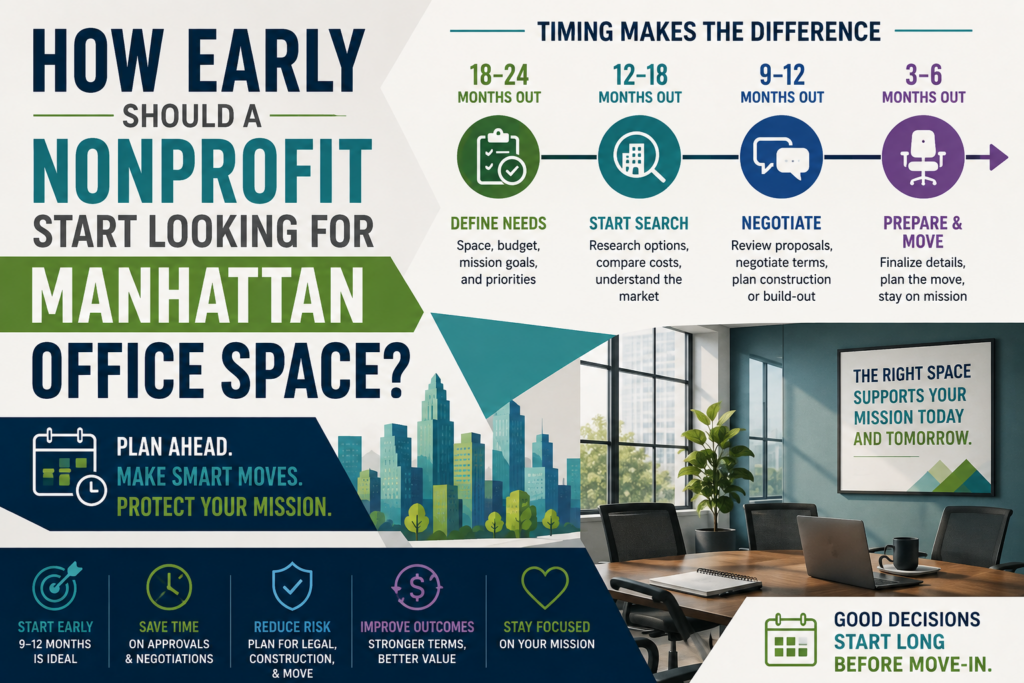
Most nonprofits should begin planning 12 to 18 months before their current lease expires. An active Manhattan office search should usually begin 9 to 12 months before the desired move-in date.
That schedule gives your organization time to compare a renewal against relocation. It also protects time for approvals, negotiations, legal review, construction, technology, and the physical move.
Larger or more complicated nonprofits should start earlier. Plan 18 to 24 months ahead when the requirement involves substantial construction or specialized program space. The same advice applies when funding, board approvals, or a possible purchase could affect the decision.
A smaller nonprofit may need less time. Six to nine months can work for a straightforward requirement with built office space. However, the organization should already understand its budget, size, and approval process.
Move-in-ready offices and furnished subleases can shorten the physical preparation period. Yet a faster space does not eliminate lease review, financial approval, or organizational decision-making. A rushed search can also weaken negotiating leverage.
A useful rule: Start early enough that staying, moving, and waiting are all still real choices.
For many nonprofits, that means starting the conversation one year before occupancy. Organizations with complex requirements should start closer to 18 months ahead.
What “start looking” should actually mean
Starting does not mean signing a lease 18 months early.
Instead, the first stage should answer five questions:
How much space do you actually need?
Determine peak daily attendance, private-office needs, meeting demand, storage, program functions, and visitor traffic.
What can the organization afford?
Model the entire occupancy cost, rather than asking rent alone. Our guide to the true monthly cost of Manhattan office space explains that distinction.
Must you remain in the current neighborhood?
Staff commuting, client access, donor meetings, volunteers, government relationships, and community services can change that answer.
Could renewal solve the problem?
A satisfactory existing office deserves a real renewal analysis. However, the landlord should compete against actual relocation alternatives.
Who must approve the transaction?
Identify the executive, finance, board, committee, counsel, and funding approvals before tours begin.
Getting those answers early does not commit the nonprofit to a move. Instead, it prevents later decisions from colliding with the lease expiration date.
A timeline based on the requirement
| Nonprofit office requirement | Recommended planning start | Active market search | Typical reason |
|---|---|---|---|
| Small, move-in-ready office | 6–9 months ahead | 4–6 months ahead | Limited construction and simple approval path |
| Typical nonprofit office | 12–18 months ahead | 9–12 months ahead | Renewal comparison, tours, approvals, negotiation, move planning |
| 10,000+ square feet | 12–18 months ahead | 9–12 months ahead | Fewer exact-fit options and more design decisions |
| 20,000–50,000 square feet | 15–18 months ahead | 12–18 months ahead | Scarcer large blocks and longer construction planning |
| Client-facing or program-heavy space | 15–24 months ahead | 12–18 months ahead | Accessibility, privacy, special rooms, permits, and operational continuity |
| Major custom build-out | 18–24 months ahead | 12–18 months ahead | Architecture, approvals, construction, furniture, and technology |
| Lease-versus-purchase evaluation | 18–24+ months ahead | Depends on acquisition path | Financing, diligence, approvals, and ownership analysis |
For midsize tenants pursuing higher-quality Manhattan buildings, a 12-to-18-month market window has become increasingly practical. Scarcity can appear long before citywide availability looks tight.
Our broader office leasing timeline guidance provides another useful benchmark. Requirements below 3,000 square feet can sometimes begin four to six months ahead. Larger offices generally deserve more runway.
Build the calendar backward from the date that cannot move
The lease expiration date matters. However, it should not serve as the only date controlling the search.
A nonprofit should create its calendar around the earliest hard deadline.
That date might involve a renewal option. Another lease could require advance notice before surrender. A board could only meet quarterly. Funding may also enter the next fiscal budget months before the lease expires.
Therefore, start by collecting the current lease and every amendment.
Then identify these dates:
| Date to identify | Why it matters |
|---|---|
| Current lease expiration | Establishes the final occupancy deadline |
| Renewal option deadline | Determines when a contractual right may disappear |
| Termination or notice date | Can force a decision before lease expiration |
| Restoration deadline | Affects construction and move-out planning |
| Board approval meeting | May control when a lease can receive authorization |
| Annual budget approval | Determines when occupancy costs enter the financial plan |
| Grant or funding decision | May affect acceptable lease length or exposure |
| Desired new-office opening | Establishes the real operational target |
| Program blackout periods | Protects fundraising, service delivery, audits, or major events |
Never assume lease expiration equals decision day.
A tenant may need to make a meaningful decision months earlier. Missing an option or notice date can remove leverage before the organization even tours alternatives.
Eighteen to twenty-four months before expiration
This stage should focus on strategy rather than listings.
Leadership should decide whether the current office still supports the mission. Examine staffing, attendance, programs, visitor traffic, storage, conference demand, and accessibility.
Next, review the current lease. Look for renewal options, notice requirements, restoration obligations, sublease rights, security requirements, and unusual surrender language.
The finance team should also establish an initial occupancy range. Avoid choosing a rent ceiling before calculating the full cost.
At this stage, a complex nonprofit should answer a larger question:
Are we only comparing leases, or could ownership become a serious alternative?
Ownership belongs on the calendar early because it creates a different process. Financing, property diligence, capital planning, and board review can take substantial time.
Federal nonprofit status alone does not automatically create a New York City property-tax exemption. The nonprofit generally must own the property and use it for an eligible purpose.
Twelve to eighteen months before expiration
Now the project should become concrete.
Develop the space program. Establish the target submarkets. Test the current landlord’s interest in a renewal.
Meanwhile, begin reviewing actual Manhattan availability.
Do not limit the search to spaces that happen to appear online that week. A long lead time also lets the nonprofit watch future availability.
A tenant may identify an ideal floor before the current occupant leaves. That opportunity could support a future direct lease.
Early planning also makes it easier to consider landlord-built prebuilts. Those spaces may deliver closer to your target occupancy.
At this stage, compare at least three strategic paths:
Stay and renew.
Relocate under a direct lease.
Use a built or furnished alternative with less capital exposure.
Keeping all three alive creates useful information. It also prevents the current landlord from becoming the default choice.
Nine to twelve months before occupancy
For a typical nonprofit, this is the core market-search period.
Tours should now involve serious candidates. Compare layouts, rentable square footage, building quality, accessibility, transportation, operating hours, and infrastructure.
At the same time, evaluate the landlord.
A nonprofit depends on more than attractive finishes. Building ownership, responsiveness, financial stability, elevator service, HVAC, security, and accessibility can affect daily operations.
After the first touring round, narrow the field.
Request proposals from competing landlords. A renewal proposal should enter the same comparison.
Then compare every alternative on the same economic basis.
The cheapest asking rent does not necessarily produce the cheapest occupancy.
Six to nine months before occupancy
By this stage, the nonprofit should usually have a leading option and credible alternatives.
Business negotiations can now address:
Base rent, free rent, construction, tenant allowances, security, annual increases, renewal rights, expansion rights, assignment, subleasing, operating hours, and surrender obligations.
The organization should also settle key design questions.
Does the floor plan work without major demolition? Can the landlord deliver the required conference rooms? Does the program need privacy or sound separation?
Technology planning should begin before lease execution when systems matter heavily.
For example, a nonprofit that relies on confidential consultations cannot treat acoustics as a post-signing issue.
Three to six months before occupancy
Construction and move planning now become critical.
Legal teams should finish the lease. Architects and contractors should finalize any required work.
Furniture decisions also need attention. Existing furniture may save capital, but moving it takes planning.
Meanwhile, confirm internet installation, security access, phones, audiovisual systems, printers, storage, mail delivery, and insurance.
Create an overlap strategy when possible.
A few weeks of lease overlap can cost money. However, zero overlap can create much greater operational risk.
That tradeoff matters most for nonprofits serving clients on-site.
The final ninety days
A nonprofit reaching this stage without a signed location has fewer choices.
However, the situation does not automatically require a poor lease.
The strategy should change.
Prioritize spaces that already have functional improvements. Furnished subleases can also reduce preparation time.
A recently marketed 7,367-square-foot furnished Midtown East sublease illustrates the format. It offers furniture, wiring, conference rooms, and immediate occupancy.
Direct space can also move quickly when the existing layout works. For example, this 5,999-square-foot move-in-ready Midtown West office already includes furniture and a completed office layout.
Those examples explain why physical readiness can compress a move. They do not remove financial, legal, and governance work.
Nonprofits need more runway for reasons that ordinary office timelines can miss
A nonprofit lease still follows the Manhattan commercial leasing process.
Yet the organization may have additional decision points.
Those extra steps often explain why a nonprofit should begin earlier than another tenant seeking the same square footage.
Board and committee approvals can control the transaction
The executive team may not hold unilateral authority to approve a substantial lease.
Your bylaws, governance policies, or board practices may require formal approval. A finance or real estate committee could also review the transaction first.
That process can add weeks.
More importantly, it may create fixed meeting dates.
Suppose the board meets in March and June. A lease requiring April approval could lose two months before anyone negotiates another business point.
Map those dates before touring.
Then decide what decision material the board needs.
A complete board package may include occupancy costs, competing proposals, commute impacts, space plans, funding implications, and lease risks.
Funding certainty should influence the schedule
A commercial lease creates a fixed obligation.
Nonprofit revenue can behave differently.
Government contracts may renew on a separate schedule. Grants may end during the lease term. Donations can also fluctuate.
Therefore, leadership should connect real-estate timing to funding timing.
An uncertain funding outlook does not always mean postponing the search.
Often, it means starting earlier.
More time lets the nonprofit compare shorter terms, built spaces, subleases, smaller footprints, termination structures, or expansion options.
Waiting for perfect certainty can create the opposite result. The organization may enter the market late and accept less flexibility.
Program space changes the definition of “office”
Some nonprofits need desks and meeting rooms.
Others operate counseling rooms, classrooms, interview areas, training rooms, libraries, testing spaces, volunteer centers, or community meeting facilities.
Those requirements change the search.
A conventional office layout may offer plenty of square footage but still fail operationally.
For example, a counseling organization may need strong acoustic separation. An education-focused nonprofit could require larger rooms and specific occupancy characteristics.
Another organization may need substantial evening access.
Identify those requirements before touring.
Otherwise, a seemingly attractive office can become expensive once architects test the actual program.
Clients, volunteers, and communities change location priorities
Staff commute matters, but it may represent only one part of the decision.
A client-facing nonprofit should map who actually travels to the office.
Consider subway access, bus routes, regional rail, walking distance, elevators, building entrances, and neighborhood comfort.
A small rent difference can matter less than lost participation.
Likewise, a prestige address should not automatically outrank practical accessibility.
The right Manhattan submarket depends on the people the nonprofit needs to reach.
Financial underwriting can create another timeline
Landlords evaluate nonprofit tenants as credit risks.
Mission status does not replace underwriting.
Prepare the financial package before a serious proposal.
That package may include audited statements, recent financials, budgets, tax filings, funding sources, cash reserves, and organizational history.
A landlord may also ask how the nonprofit plans to support a long lease.
When the credit presentation looks incomplete, negotiations can slow.
Therefore, organize those materials before the preferred space creates urgency.
Tax assumptions need verification
Nonprofits should not automatically model Manhattan occupancy costs exactly like a for-profit tenant.
New York City’s Commercial Rent Tax generally applies to qualifying commercial tenants south of 96th Street. However, nonprofit status can create an exemption.
Religious, charitable, and educational nonprofits qualify under the city’s exemption rules. Other nonprofit organizations may need noncommercial use and written approval.
Confirm the organization’s actual treatment with qualified tax counsel or an accountant.
Do that during budgeting, not after lease execution.
Also distinguish Commercial Rent Tax treatment from property-tax exemption. The rules address different taxes and different facts.
Most of the calendar disappears after you find a space
Tenants sometimes assume the search itself consumes most of the time.
Often, it does not.
Tours can move quickly. The complicated part frequently starts after leadership says, “We like this one.”
Defining the requirement
A nonprofit should first turn broad preferences into measurable criteria.
“Near transit” needs a definition.
So does “enough meeting space.”
Establish a target and acceptable range for rentable square footage. Then document required offices, conference rooms, program rooms, storage, pantry space, and reception.
This work might move quickly for a small administrative office.
A larger organization can spend months reconciling departments, programs, and future staffing.
Touring and revising the brief
First tours often change the requirement.
That outcome is normal.
A nonprofit might discover that 8,000 square feet works in one building but not another. Loss factors and layouts can alter usable capacity.
Another tenant may realize that one large training room matters more than several private offices.
Therefore, treat touring as research rather than a beauty contest.
After each tour round, revise the brief.
Good search criteria become more precise as the organization learns.
Comparing direct leases and subleases
A direct lease usually gives the nonprofit more control over term and improvements.
A sublease can offer furniture, wiring, and a shorter commitment.
Neither automatically wins.
The correct comparison should include remaining term, condition, credit risk, landlord consent, renewal prospects, furniture, and construction needs.
Our guide to Manhattan office subleasing explains the structure in greater depth.
A furnished sublease can solve an urgent timeline.
However, the nonprofit should understand what happens when that sublease expires.
A fast first move should not create another crisis two years later.
Negotiating the business deal
Finding the office does not mean the deal exists.
The tenant and landlord still need agreement on economics.
Negotiation should cover much more than rent.
For nonprofits, cash preservation can matter as much as face rent.
A landlord-funded build-out may protect reserves. More free rent could help during overlap.
Likewise, a smaller security package may free capital for programs.
Compare the value of every concession across the full term.
Landlord approval and credit review
The landlord will often review financial information before committing.
That step deserves preparation.
A strong presentation can explain the organization’s history, funding, reserves, leadership, lease record, and mission.
Problems usually arise when the tenant waits until the final stage to collect documents.
Instead, prepare underwriting materials while touring.
That allows the transaction to move once the nonprofit selects a building.
Lease negotiation
A letter of intent or accepted proposal does not replace the lease.
Commercial leases can contain detailed provisions covering money, construction, defaults, guarantees, assignment, subleasing, insurance, operating expenses, restoration, and access.
The nonprofit’s attorney should understand Manhattan commercial leasing.
Legal review can uncover a problem that changes the economics.
For that reason, avoid using the target move date as leverage against your own lawyer.
Create enough time to negotiate properly.
Architecture, permits, and construction
Construction creates the widest timing range.
A landlord might repaint and install carpet quickly.
Another office could require walls, doors, electrical changes, HVAC work, plumbing, accessibility work, or substantial design.
Major projects can take months.
The nonprofit should test construction assumptions before finalizing lease economics.
Otherwise, a large improvement allowance can sound generous without actually covering the program.
Furniture, technology, and the physical move
Furniture orders can create long lead times.
Telecommunications can also produce surprises.
Internet circuits, access-control systems, audiovisual equipment, servers, phones, and cabling require coordination.
Program operations make this more important.
A nonprofit should know exactly when its current systems shut down and when new systems become operational.
The moving company represents only one part of the move.
Operational continuity needs its own schedule.
Renewal and relocation should run together until one clearly wins
A nonprofit that expects to renew should still start early.
In fact, renewal may create one of the strongest reasons to start early.
Without relocation alternatives, the current landlord knows the tenant has limited options.
A real market search changes that dynamic.
Renewal can preserve more than rent
Staying avoids physical disruption.
It can also preserve existing cabling, furniture, improvements, meeting rooms, staff routines, client familiarity, and transportation patterns.
Those benefits have financial value.
For a service-oriented nonprofit, continuity may carry additional weight.
Clients might depend on a familiar location. Volunteers could also rely on existing transportation.
Therefore, the renewal analysis should include avoided costs.
Do not compare only new rent against renewal rent.
Relocation can correct structural problems
Moving becomes more compelling when the current office no longer fits.
Perhaps hybrid attendance changed the required footprint.
Program services might have expanded.
The building could also lack the accessibility, infrastructure, security, or operating hours the nonprofit needs.
Location matters too.
A move closer to major transit can improve access for staff, clients, volunteers, and visitors.
At that point, staying simply to avoid moving can become expensive in another way.

Run a true occupancy comparison
A meaningful stay-versus-move analysis should compare:
| Renewal cost | Relocation cost |
|---|---|
| Base rent | Base rent |
| Rent increases | Rent increases |
| Tax and operating obligations | Tax and operating obligations |
| Electricity and HVAC | Electricity and HVAC |
| Needed refurbishment | New construction |
| Furniture replacements | Furniture and moving |
| Technology upgrades | Cabling and technology |
| Lost flexibility | Lease flexibility |
| Existing inefficiencies | New layout efficiency |
| Minimal disruption | Operational move costs |
Then account for concessions.
Free rent, landlord work, improvement allowances, existing furniture, and reduced security can change the result dramatically.
Our renew-versus-relocate guide for Manhattan tenants covers that analysis in greater depth.
Start renewal talks before the landlord controls the clock
Early discussions do not require early acceptance.
Ask the landlord what a renewal could look like.
Then test that proposal against the market.
If the landlord’s economics look compelling, continue working the renewal.
However, keep relocation alternatives alive until the important terms become reliable.
That dual-track process protects the nonprofit from a late surprise.
A landlord can change its position. Construction assumptions can also shift.
Meanwhile, another building could provide a more efficient solution.
Time keeps those options real.
Manhattan’s 2026 market makes early planning more important, not less
Headline availability can create a dangerous impression.
A nonprofit may hear that Manhattan still has considerable office inventory. Therefore, leadership might assume waiting carries little risk.
That conclusion misses how the current market works.
Q2 2026 research put Manhattan office availability at 14.4%. Average asking rent reached $80.17 per square foot. Sublease availability fell to 2.6%, while average sublease asking rent reached $59.94.
Another major market measure placed availability at 13.0%. Methodologies differ, which explains part of the gap. More importantly, that research found tighter conditions in well-located and amenity-rich buildings.
So a nonprofit does not compete for “Manhattan office space” in the abstract.
It competes for offices that match its exact filters.
Effective inventory shrinks after real-world filters
Start with total availability.
Then remove offices that fail your size range.
Next, eliminate unsuitable layouts.
Remove inaccessible locations.
Exclude buildings that cannot support the required hours, program use, or infrastructure.
Afterward, screen out financially troubled ownership situations or unacceptable construction obligations.
Finally, compare asking economics.
The remaining list can look very different from the headline vacancy number.
Research on the current market describes exactly this narrowing effect. Even a few practical filters can materially reduce effective supply.
For nonprofits, the filter list can become even longer.
Client access, privacy, boardrooms, classrooms, storage, evening programs, and donor-facing functions may all matter.
Quality space can tighten while value space remains available
Current Manhattan conditions have become increasingly divided by building quality.
Well-positioned offices can attract strong demand while less competitive inventory remains available.
That distinction matters for timing.
A nonprofit seeking straightforward Class B value may retain broad choices later in the process.
By contrast, an organization demanding a specific transit hub, efficient floorplate, strong amenities, and polished prebuilt space may face a narrower market.
The same issue affects larger requirements.
Current guidance for 20,000-to-50,000-square-foot tenants supports starting 12 to 18 months before expiration when quality space matters.
Starting early does not mean paying rent early
Tenants sometimes resist an early search because they fear unnecessary overlap.
That concern confuses research timing with lease commencement.
A nonprofit can study the market 12 months early without starting rent 12 months early.
Future availability can align with the current expiration.
Landlords may also have space under construction or scheduled to become vacant.
Early market knowledge gives the nonprofit more ways to solve the timing puzzle.
Late searches remove those choices.
There is no universal “best month” to search
January does not hold a special advantage for every nonprofit.
Neither does summer or year-end.
Commercial office vacancies appear throughout the year because lease expirations occur throughout the year.
Therefore, the best month depends on your own lease calendar.
A nonprofit with a June 2027 expiration should not wait for January 2027 merely because it sounds like a natural planning point.
Its search could need to begin in summer or fall 2026.
The right question is not “What month has the best deals?”
Ask instead:
“How much runway does our specific transaction require?”
Settle these questions before the first serious tour
Touring without internal alignment can consume months without producing a decision.
A nonprofit does not need every detail resolved.
However, leadership should agree on the important boundaries.
What is the real headcount?
Do not size the office from total employees alone.
Determine peak simultaneous attendance.
A 60-person organization with 30 people present on its busiest day has different needs from a 60-person organization with 55 present.
Then consider growth.
The correct answer should also reflect programs, interns, volunteers, consultants, and visitors.
Which spaces must remain private?
Privacy can change the floor plan significantly.
Identify confidential functions before calculating square footage.
Executive offices may matter less than counseling rooms.
Conversely, a policy nonprofit might need several enclosed meeting rooms for stakeholder discussions.
List the functions first.
Then let the layout follow them.
How much public or program space is necessary?
Conference rooms are not interchangeable with training rooms.
A 30-person classroom creates different circulation and furniture requirements.
Community events can also create security and elevator considerations.
Document peak event attendance.
Next, decide whether the space must handle those events internally.
Renting occasional outside event space may sometimes cost less than leasing permanent capacity.
How important is the neighborhood?
Create three categories:
Required. Preferred. Flexible.
A required location might reflect client access or proximity to a government institution.
A preferred location could improve recruiting but remain negotiable.
Flexible criteria allow the search to capture better economics.
This hierarchy keeps emotion from turning every preference into a requirement.
What is the maximum all-in occupancy budget?
Avoid setting a budget as “$70 per square foot.”
That figure does not answer the real question.
Instead, establish annual and monthly occupancy limits.
Include base rent, escalations, electricity, cleaning, insurance, technology, moving, construction exposure, and security.
Then calculate landlord concessions.
A $75 asking rent can outperform a $65 asking rent when the first office includes substantial improvements.
Likewise, the cheaper face rent can win when both spaces need similar work.
Compare the entire stack.
How certain is the organization’s funding?
Classify the answer honestly.
A nonprofit with predictable multi-year funding can consider longer commitments.
Another organization may need flexibility.
That could mean a shorter sublease, lower capital investment, termination structure, expansion option, or more conservative footprint.
The lease should fit financial visibility.
Do not force financial uncertainty into a real-estate structure designed for certainty.
Can the current office support another term?
Review the existing office as critically as a new listing.
Ask whether it still fits the team.
Check furniture, HVAC, conference capacity, privacy, accessibility, storage, technology, and building service.
Then estimate refurbishment costs.
A renewal can look easy because everyone knows the space.
Familiarity should not substitute for analysis.
What happens if nothing changes?
This question often clarifies the decision.
Calculate the cost of remaining in place under realistic renewal terms.
Then consider the operational cost of doing nothing.
Could overcrowding hurt programs?
Would surplus space waste donor-funded resources?
Does the location create recruiting problems?
Would aging infrastructure require capital anyway?
The status quo has a cost.
Measure it.
Common questions about nonprofit office-search timing in Manhattan
Is six months enough to find Manhattan office space?
Sometimes.
Six months can work for a smaller nonprofit seeking a built office with straightforward requirements.
However, it provides less room for complicated construction or prolonged governance approvals.
A six-month search should begin with clear criteria, prepared financials, and fast decision authority.
Anything less organized can quickly become a four-month search.
Is twelve months too early?
No.
For a typical nonprofit, one year provides useful leverage.
You can study the market, compare renewal and relocation, revise the requirement, and negotiate without immediate deadline pressure.
Twelve months becomes particularly sensible when the office exceeds a few thousand square feet.
It also helps when multiple leaders must approve the transaction.
Is eighteen months too early?
Not for planning.
An 18-month start makes sense for a larger requirement, specialized program space, extensive construction, or complex approvals.
The nonprofit does not need to submit offers immediately.
Instead, use early months to establish requirements and track future availability.
For larger Class A searches, 12-to-18-month pre-leasing can also protect access to desirable space.
When should a nonprofit start if it expects to renew?
Start at roughly the same time as a relocation analysis.
A landlord usually negotiates more seriously when the tenant has credible alternatives.
Early review also exposes problems in the existing lease.
Do not wait until the organization lacks enough time to relocate.
At that point, the renewal can become a necessity instead of a choice.
When should the nonprofit contact its current landlord?
First review the existing lease and market.
Then decide what information you want from the landlord.
Starting the conversation early can help.
However, avoid revealing that relocation has become impossible.
A tenant should know its alternatives before surrendering leverage.
How long should office tours take?
A focused initial touring process can often happen within several weeks.
Yet the first round may reveal that the requirement needs revision.
Complex searches can require multiple rounds.
The goal should not involve touring the largest possible number.
Instead, tour enough options to understand pricing, quality, and tradeoffs.
How long can lease negotiation take?
Business terms may move quickly when both sides align.
Complicated deals take longer.
Legal negotiation follows the business deal and can expose new issues.
Therefore, never schedule the move around an unsigned proposal.
Treat the executed lease as the point when the transaction becomes dependable.
Does a furnished sublease make the search faster?
It can shorten construction and furniture work.
A suitable sublease may already contain offices, conference rooms, wiring, and furniture.
However, consent and legal review still matter.
The organization also needs to understand the remaining term.
Faster occupancy should not replace lease diligence.
Should the nonprofit choose a space before board approval?
That depends on its governance process.
Usually, the team can identify a preferred transaction before final approval.
However, decision-makers should understand the board’s required process beforehand.
Do not assume an upcoming meeting can automatically approve an incomplete lease proposal.
Build board timing into the real-estate calendar.
What if a grant decision will arrive only a few months before expiration?
Start the real-estate process before the grant decision.
Create different occupancy scenarios.
For example, model one requirement if funding arrives and another if it does not.
Then identify space structures that can support either outcome.
Waiting to begin all research after the funding decision can leave too little negotiating time.
Should a nonprofit lease more space for future growth?
Only when the growth case justifies the cost.
A modest amount of expansion capacity can help.
Excess space can become expensive over a long lease.
Instead, consider expansion rights, adjacent future space, shorter commitments, or a layout that supports higher density.
Flexibility can carry more value than empty square footage.
How much overlap should a nonprofit allow between offices?
The answer depends on operations.
A purely administrative office may tolerate a tight move.
Client-facing operations may need more protection.
Even short overlap can provide time for technology testing, furniture installation, staff orientation, and problem resolution.
Compare overlap rent against the cost of interrupted operations.
Does Manhattan’s available office inventory mean a nonprofit can safely wait?
No.
Citywide availability does not equal usable inventory for one organization.
Size, location, layout, condition, accessibility, building quality, and price can shrink the real list quickly.
Current 2026 data also show declining availability and rising asking rents across major measures.
The best-fitting spaces can tighten before the overall market does.
Should a nonprofit buy instead of lease?
Ownership deserves consideration when long-term occupancy looks stable and capital permits it.
However, buying solves a different problem.
It adds financing, acquisition diligence, capital needs, maintenance responsibility, and property-level risk.
Potential tax advantages also require careful eligibility review. Nonprofit status alone does not automatically exempt a purchased property.
For that reason, begin a serious buy-versus-lease evaluation much earlier than a simple office search.
What is the biggest mistake nonprofits make with timing?
Waiting until every internal question feels settled.
Real-estate research can help settle those questions.
A nonprofit does not need a final floor plan before learning the market.
It needs enough lead time to learn without being forced to transact.
When should a nonprofit engage a tenant broker?
Engage tenant representation before the market search becomes urgent.
Ideally, do that before serious renewal negotiations begin.
Early tenant representation can coordinate the requirement, market test, tours, proposals, economics, and negotiation schedule.
That creates one timeline instead of several disconnected processes.
The bottom line
For most Manhattan nonprofits, begin planning 12 to 18 months before lease expiration and actively search about 9 to 12 months before occupancy. Use 18 to 24 months when size, construction, governance, funding, or program requirements add complexity. A smaller move-in-ready requirement may succeed within six months, but that should represent an informed strategy rather than a late start.
Starting early does not obligate your nonprofit to relocate. Instead, it preserves the ability to renew, move, negotiate, redesign the requirement, or wait for the right opportunity. In Manhattan office leasing, time is not simply part of the schedule; time is tenant leverage.
We represent Manhattan office tenants, including nonprofits, from early planning through lease negotiation and occupancy. Our role is to compare renewal and relocation, test true costs, and protect the organization’s flexibility. Start before the calendar forces a compromise, so the mission can drive the office decision rather than the deadline.
Fill out our 📋 online form or give us a call today 📞 212-967-2061 — let’s find the right options for your business.