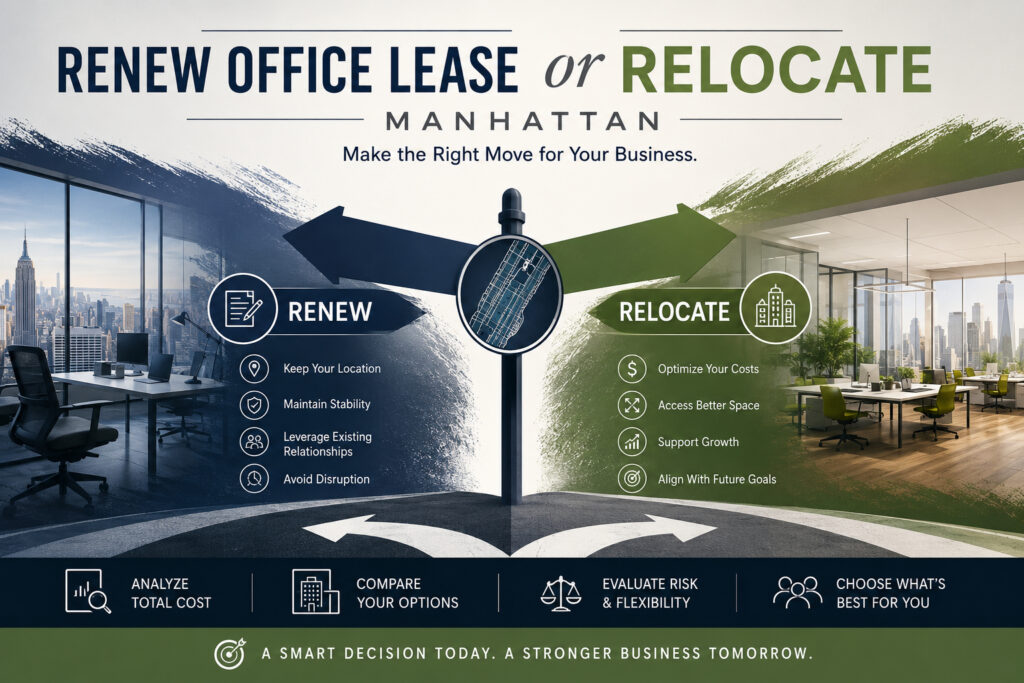
Renew Office Lease or Relocate Manhattan
Choosing between renewal and relocation can reset your business costs for years. First, learn the legal baseline. In Manhattan office leasing, the lease controls almost everything, the owner does not have to renew by law, and rent caps do not apply at expiration.
Smart tenants do not treat this choice as a simple vote. Instead, they run a live renewal path and a live relocation path together. That approach protects leverage because time, market options, and written lease rights decide the outcome.

The market you are choosing in
Manhattan no longer feels like a market with endless patience. In May 2026, leasing reached 3.02 million square feet, which ran 43% above the five-year monthly average. Meanwhile, year-to-date leasing reached 12.78 million square feet. Renewals totaled 4.87 million square feet. Availability tightened to 14.5%, while the average asking rent climbed to $80.42 per square foot.
Submarket spreads still matter. Midtown sat at 12.8% availability with an $86.55 asking rent in May. Midtown South carried 17.1% availability with an $86.38 asking rent. Downtown posted 16.9% availability with a far lower $61.14 asking rent.
Supply keeps thinning in the spaces tenants want most. Newmark reported eight straight quarters of declining available space. The same report showed only 210,886 square feet of 2026 deliveries. It also put direct trophy availability in Midtown at only 3.4%. VTS likewise showed New York office demand at a VODI of 91 in Q1 2026, up 17% from the prior quarter.
That does not mean tenants lost all leverage. However, it does mean polished prebuilt space, strong subleases, and true top-tier options vanish faster. Start with current New York Office Space Listings if you need a live market read before your landlord sets the tone.
A dual-track process beats a forced choice
The right question is not “renew or relocate” on day one. Rather, ask which path creates the better total outcome. Leadership, finance, operations, HR, IT, counsel, and a tenant-side broker should weigh space fit, commute friction, legal rights, cost, and timing together.
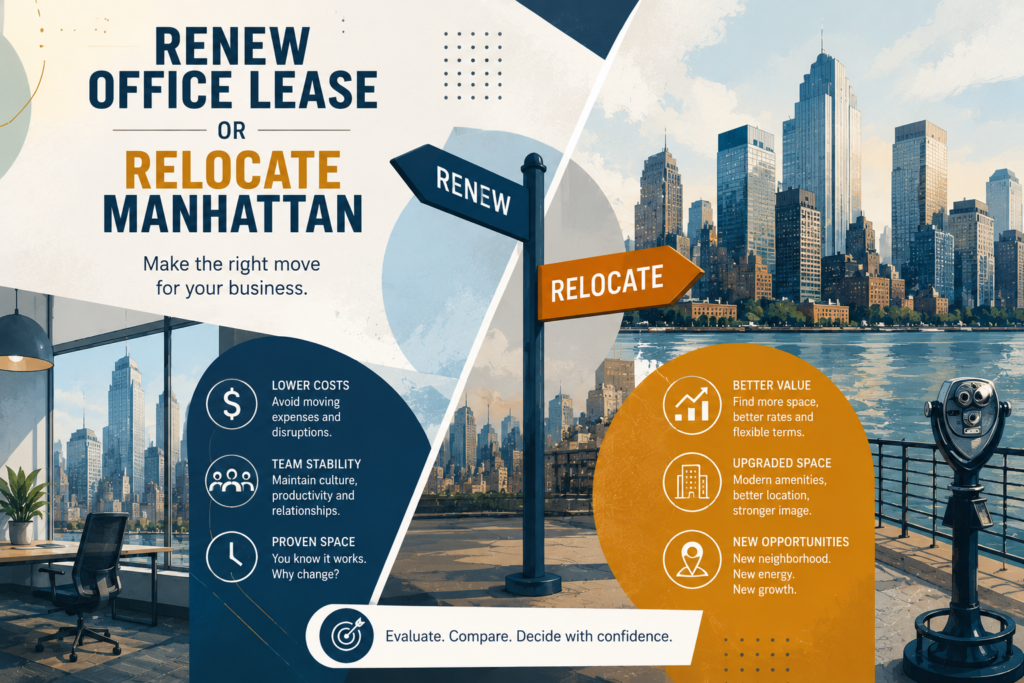
Renew first when the location still works, the current build-out still performs, and the landlord will pay to keep you. Relocate first when the footprint feels wrong, attendance patterns changed, the building lost relevance, or a different submarket solves your commute or image problem. Run both whenever you still have time before notice deadlines and want the market to price the answer for you.
Before you talk numbers, size the real requirement. The planning rule changes by layout, headcount, and hybrid policy. Use the Office Space Calculator and the Sq Ft per Person guide before you accept your landlord’s view of what should fit.
When renewing usually wins
Renewal makes the most sense when your office still supports how your team works today. If the location serves clients, the commute behaves, and the floor plan still supports staffing, staying often protects cash and continuity. That advantage grows when your current cabling, furniture, conference mix, and reception layout still work.
Lease language matters here. The City guide says commercial landlords do not have to renew, so a written option matters. Many renewal clauses use fixed annual increases of about 2% to 3%. Market-rate options, by contrast, often point to comparable rents and may rely on a neutral appraiser or broker if the parties cannot agree.
Tenants also need to remember one blunt rule. Renewal usually means continued use, not an automatic second round of concessions. Because of that, ask for paint, carpet, wiring, pantry work, conference upgrades, furniture credits, after-hours HVAC relief, extension rights, and swing space in the same conversation, not later.
Sometimes the best answer is neither stay as-is nor move. Instead, refresh the current office during a renewal. That middle path works well when the address still fits but the space needs better density, stronger amenities, or a cleaner client-facing image.
If you want to pressure-test a stay-put strategy, review the renewal options guide, the build-out budgeting guide, and the swing space guide.
When relocating usually wins
Relocation wins when your current lease traps you in the wrong size, wrong building, or wrong submarket. A move also makes sense when your team needs better transit, stronger amenities, newer infrastructure, or a sharper office story for hiring and retention. Most of all, relocation deserves a hard look when the landlord will not fund the changes your business now needs.
Space planning often reveals the case for a move before rent does. Recent Manhattan guidance places hybrid or remote-heavy teams around 100 to 150 RSF per person. Tech and creative teams often land around 150 to 200. Law and finance users often fall around 225 to 325. Loss factors can also run from 20% to above 35%, which means two similar suites can carry very different real capacity.
That math moves fast. A 30-person team planned at 225 RSF per person needs about 6,750 RSF. The same team planned at 150 RSF needs about 4,500 RSF. At Manhattan’s Q1 2026 average asking rent of $78.25, that difference adds roughly $14,672 in monthly base rent.
Short-term relocation economics can look even better in second-generation space. In Midtown, the May 2026 gap between average direct asking rent and average sublease asking rent equaled about $111,150 per year for a 5,000 RSF tenant. Downtown, the same comparison still came to about $73,950 per year.
When timing feels tight, compare direct, prebuilt, furnished, and sublease options at once. The short-term office guide and the move-in-ready office guide can help you move faster without guessing.
Compare the real cost, not the sticker rent
Monthly base rent = asking rent × rentable square feet ÷ 12. That formula gives you a starting point, not a decision. Real occupancy cost also turns on escalations, tax pass-throughs, utilities, cleaning, security deposit, guaranty exposure, tenant improvement dollars, free rent, furniture, IT, moving, and end-of-term obligations.
A simple submarket comparison proves the point. At May 2026 averages, 5,000 RSF in Midtown prices near $36,063 per month in base rent. The same footprint in Downtown prices near $25,475. That is a yearly spread of about $127,050 before concessions, tax escalations, electric, and legal structure.
Build-out costs can erase that spread fast if you ignore them. One recent Manhattan tenant guide places many finish scopes around $100 to $250 per square foot. Cushman’s 2026 fit-out guide puts New York City hard costs at $220.62 per square foot and all-in project costs at $330.92. On 5,000 square feet, that implies about $1.10 million in hard costs and roughly $1.65 million all-in.
Because of that, renewal often wins when your existing office basically works and only needs selective upgrades. On the other hand, relocation wins when lower rent, free rent, better infrastructure, and a landlord-funded build-out offset the moving friction. The smartest comparison always stacks both paths on the same spreadsheet.
For a cleaner first-pass budget, read How Does Office Space Pricing Work in Manhattan? before you compare proposals line by line.
Which Manhattan submarkets fit your next move
Grand Central and Midtown East suit firms that need rail access, client convenience, and classic Midtown credibility. Broad Midtown availability sat at 12.8% in May 2026, with asking rents at $86.55, so this area rewards early action. Start with Grand Central offices if you want broad inventory. Then compare that pool with a current 1,040 RSF direct office near Grand Central for a boutique move.
Penn Station and the West Side work well for firms that hire across the region and want direct commuter access. This corridor also offers large floors, strong amenities, and fast move-in options. Benchmark Penn Station offices against a current 7,675 RSF direct lease near Penn Station or a 4,776 RSF furnished Penn Plaza sublease.
Midtown South and Hudson Square fit tenants that want creative character, strong prebuilt inventory, and adjacency to today’s growth clusters. Midtown South carried 17.1% availability in May 2026, so tenants still have room to search, yet asking rents remained high at $86.38. Review Midtown South offices, Hudson Square offices, or a current 2,530 RSF furnished office in Hudson Square.
Downtown and the Financial District usually win on value. May 2026 averages put Downtown at $61.14 direct and $46.35 sublease, which creates a meaningful budget gap versus Midtown. Begin with Financial District offices, a 2,573 RSF furnished downtown suite, or a 10,000 RSF downtown sublease.
If you find an older downtown tax-break page, treat it as historical. The city rule only covered qualifying leases that began on or before March 31, 2024. Subleases did not qualify.
Timing, clauses, and traps that decide the outcome
Start earlier than feels comfortable. For large or specialized users, tenant-side advisors recommend beginning 18 to 36 months before expiration. Even standard office searches should begin at least 12 months out if you want real choice and real negotiating leverage.
Then audit the lease before you tour a single space. Confirm renewal notice dates, rent resets, assignment rights, sublease rights, after-hours HVAC language, restoration obligations, and any expansion or contraction options. Miss the notice window, and your leverage can disappear before the market test even starts.
Next, run proposals through a disciplined term-sheet process. The City guide notes that the letter of intent usually stays non-binding. It also notes that landlords often draft the first lease form, and that this draft usually favors the owner. Most important, it warns tenants not to make payments or start alterations before the lease gets signed.
Construction timing also changes the answer. Office build-outs can trigger approvals from the Department of Buildings, the Fire Department, and, in some cases, landmarks review. When that schedule feels tight, negotiate furnished space, prebuilt delivery, or swing space while your permanent office gets finished.
Questions tenants ask before they choose
Who should make the decision? Company leadership should own the final call. Finance, HR, operations, IT, legal counsel, and a tenant-side broker should shape the inputs. That group usually sees hidden risks faster than one executive can alone.
What if the lease has no renewal option? In that case, the owner does not have to renew by law and can ask for any rent at expiration. Therefore, start early, create outside options, and never wait for a friendly verbal promise.
How long should a new lease run? Traditional office leases often center on ten years with a five-year option. Shorter terms, however, can make sense when headcount, capital plans, or workplace policy still feel fluid. Short-term and sublease inventory also stays relevant in Midtown East, Midtown South, Hudson Yards, West Chelsea, and Downtown when flexibility matters more than perfect customization.
Should you choose direct space or sublease space? Choose direct space when you need term length, larger improvement packages, and more control over design. Pick sublease space when speed, furniture, and lower upfront cost matter more. In Manhattan today, both options deserve side-by-side pricing.
Can a renewal still include improvements? Yes, but ask for them clearly because renewal does not automatically trigger a fresh TI package. If staying still makes sense, tie the renewal economics to a defined scope of work and a written delivery timeline.
Do tenants usually pay for tenant representation? In standard NYC office leasing practice, the landlord usually pays the brokerage commission, though subleases and separate consulting structures can differ. Even if you already found a space online, tenant-side representation still matters because public listings rarely reveal the full cost or the real flexibility.
We represent tenants, not landlords. Our job is to benchmark renewals against live relocation options, then negotiate the structure that protects your cost, flexibility, and timing. Start with the Office Space Calculator, review New York Office Space Listings, or Contact a Broker when you are ready.
Fill out our 📋 online form or give us a call today 📞 212-967-2061 — let’s find the right office for your business.