Should You Lease or Buy Office Space in Flatiron?
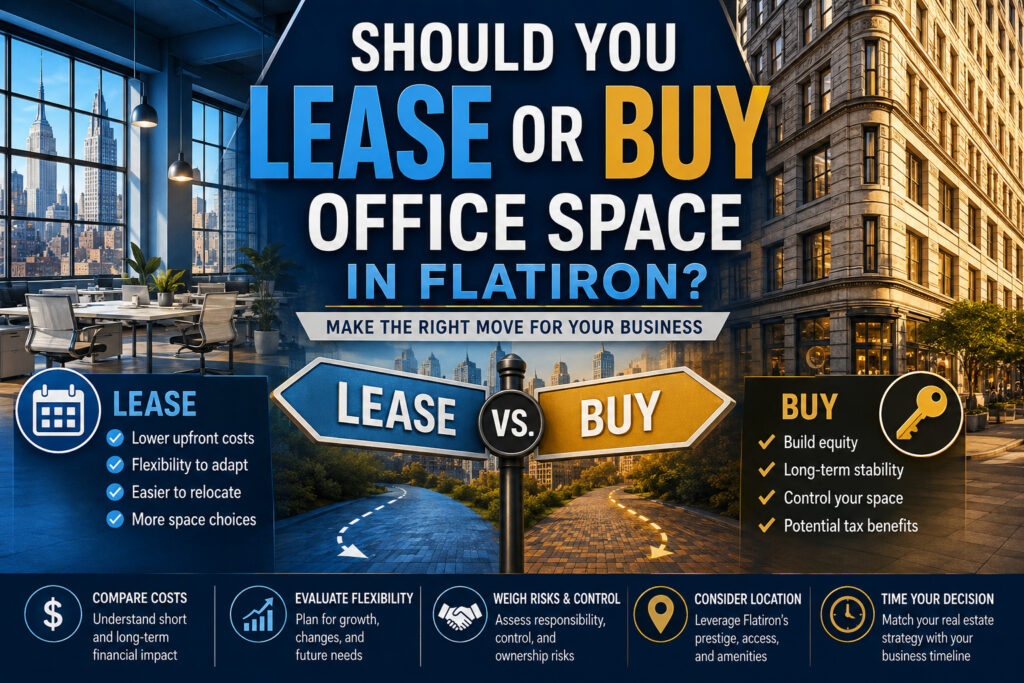
Most businesses should lease office space in Flatiron rather than buy it. Leasing preserves capital, supports headcount changes, and gives tenants access to far more available spaces.
Buying can still make sense for a stable business with predictable space needs. However, that business needs substantial liquidity and a long holding period. It must also find a suitable commercial condominium, cooperative unit, or full building.
The right answer depends on four connected questions:
| Decision factor | Leasing usually wins when | Buying becomes realistic when |
|---|---|---|
| Holding period | Your plans may change within ten years | You expect to stay for ten years or longer |
| Headcount | Your team may grow, shrink, or adopt hybrid work | Your long-term footprint looks predictable |
| Capital | Your business can use cash more productively elsewhere | You have ample cash beyond the down payment |
| Control | You can operate within a lease and building rules | You need lasting control over the premises |
| Risk | You want easier relocation and lower exit friction | You can absorb property and resale risk |
| Inventory | You want broad choices across many building types | You can wait for a rare ownership opportunity |
| Management | You want the owner to handle major building obligations | You can manage repairs, assessments, and capital work |
This guide explains both choices from the tenant’s perspective. It also addresses costs, financing, taxes, space planning, timing, and exit strategy.
The Practical Answer for Most Flatiron Businesses
Flatiron offers many offices for lease and relatively few offices for purchase. That inventory difference shapes the decision before financial analysis even begins.
A tenant can compare direct leases, subleases, built suites, furnished offices, and full floors. Buyers usually face a narrower group of commercial condominiums, cooperative units, and mixed-use spaces.
Consequently, leasing provides more control over location, size, layout, quality, timing, and term length. Buying provides more control over the property after closing.
Those advantages sound similar, but they solve different problems.
Leasing gives you more choices before occupancy. Ownership gives you more control after acquisition.
Why leasing usually fits Flatiron
Flatiron attracts businesses that value talent access, neighborhood identity, transit, architecture, and client convenience. Many of those businesses also experience changing headcounts.
Technology firms may hire quickly after a funding event. Creative firms may gain or lose project teams. Professional practices may change their hybrid attendance policies.
A lease can match those changing needs through several structures:
- A short sublease can bridge an uncertain period.
- A direct lease can support a stable medium-term plan.
- A built suite can reduce construction time.
- A full-floor lease can support privacy and branding.
- Expansion rights can protect future growth.
- Contraction rights can reduce long-term exposure.
Buying rarely provides the same operational flexibility. An owner-user cannot simply end occupancy when the business changes.
Instead, the owner must sell the unit, lease it to another occupant, or carry unused space. Each choice requires time, money, and professional management.
Why buying still deserves consideration
Ownership can work well when a company expects very little change. The strongest buyer usually knows its approximate headcount, room requirements, location needs, and holding period.
That business also holds enough capital to cover more than the purchase price. It can fund closing costs, renovations, reserves, furniture, technology, and unexpected work.
Certain occupiers may value permanence more than flexibility. Examples include established professional practices, specialized healthcare users, private investment offices, and long-standing headquarters operations.
Even then, the unit must support the intended use. A favorable price cannot repair incompatible zoning, weak infrastructure, poor access, or restrictive building rules.
The holding-period test
A short holding period usually weakens the ownership case. Acquisition costs and future selling costs consume a meaningful share of the investment.
Appreciation may offset those expenses, but buyers should never assume appreciation. Property values can move slowly or decline during an unfavorable exit period.
A ten-year horizon creates a more credible ownership case. Fifteen years provides more time to spread transaction costs and build equity.
However, time alone does not make buying superior. The space must remain useful throughout that period.
Ask whether the office could support the business after these events:
| Possible change | Question for a potential buyer |
|---|---|
| Headcount growth | Can the unit support more seats without harming usability? |
| Headcount reduction | Could you sublease or separate part of the unit? |
| Hybrid attendance | Would the layout still serve meetings and collaboration? |
| Leadership change | Would new leadership want the same location and image? |
| Acquisition or merger | Could another company use the space efficiently? |
| Business sale | Would ownership complicate the transaction? |
| Relocation | Could you manage the unit as an investment property? |
A company that cannot answer those questions should usually continue leasing.
What Leasing and Buying Actually Mean in Flatiron
“Lease or buy” sounds like a simple two-option question. In practice, each side contains several different structures.
The structure often matters as much as the broad decision.
Direct office lease
A direct lease creates a contractual relationship with the building owner. Terms commonly run from several years to a decade or longer.
The owner may provide a built suite, a construction allowance, free rent, or another concession. The tenant receives occupancy rights without acquiring the property.
A direct lease usually offers the strongest combination of term control and landlord participation. However, it also creates a meaningful long-term obligation.
Tenants must review more than the starting rent. Escalations, taxes, operating expenses, electricity, cleaning, and after-hours services can change the economics.
Our commercial leasing guide explains those lease components in greater detail.
Office sublease
A sublease transfers occupancy rights from an existing tenant to a new occupant. The original lease remains in place.
Subleases often include furniture, wiring, meeting rooms, and existing improvements. They may also offer lower rents than comparable direct spaces.
Current Flatiron benchmarks show a meaningful pricing gap between direct and sublease inventory. That gap can make subleasing attractive during uncertain growth periods.
However, subtenants inherit limitations from the original lease. They also depend on the original tenant’s continued performance.
A sublease may provide less control over:
- Extension rights
- Signage
- Alterations
- Building services
- Expansion
- Assignment
- Renewal
- Restoration obligations
The remaining lease term also controls the occupancy period. That can help a cautious tenant, but it can disrupt a stable business.
Furnished and plug-and-play lease
A furnished office includes desks, chairs, tables, and related furniture. A true plug-and-play office adds working technology infrastructure.
That infrastructure may include internet cabling, meeting rooms, access controls, pantry equipment, and audiovisual systems.
This format can reduce move-in time and initial spending. It works best when the existing layout closely matches your operational needs.
Flatiron currently offers furnished options across smaller suites, mid-sized offices, and larger full floors. Tenants can review the current plug-and-play office market before funding a custom buildout.
Furniture does not make an unsuitable office suitable. Poor acoustics, weak meeting capacity, or inadequate infrastructure can still create substantial costs.
Commercial condominium ownership
A commercial condominium buyer receives ownership of a defined unit. The owner also receives an interest in the building’s common elements.
Commercial condo owners usually pay their own property taxes. They also pay common charges for shared building expenses.
The governing documents control permitted uses, alterations, transfers, insurance, access, signage, and other operational matters.
Condo ownership can provide greater independence than leasing. Nevertheless, the board and documents still limit complete control.
A buyer should review:
- The declaration and bylaws
- House rules
- Financial statements
- Current budget
- Reserve levels
- Pending assessments
- Insurance coverage
- Alteration requirements
- Use restrictions
- Transfer charges
- Right-of-first-refusal provisions
- Litigation
- Major capital projects
Ownership never eliminates building rules. It only changes the source of those rules.
Commercial cooperative ownership
A cooperative buyer purchases shares in a corporation. Those shares support a proprietary lease for the office.
The buyer does not receive a conventional deed for the unit. That distinction can affect financing, approval, transfers, and subleasing.
Commercial cooperative buildings may offer attractive lofts and lower purchase prices. However, they often require additional board review.
Some lenders also prefer condominium collateral. A cooperative buyer may need a lender with suitable experience.
Before proceeding, review the cooperative’s:
- Proprietary lease
- Share allocation
- Board approval process
- Subletting rules
- Permitted-use language
- Financing restrictions
- Maintenance history
- Capital plan
- Reserve position
- Transfer policies
A low purchase price cannot compensate for restrictive ownership documents.
Live-work space
Some Flatiron lofts may support both residential and business activities. However, marketing language does not establish legal use.
Buyers must verify zoning, building approvals, occupancy documents, board rules, and actual permitted use.
The same caution applies to professional offices within residential buildings. A board may impose operating-hour, visitor, delivery, or staffing restrictions.
An entire building
Purchasing a full building creates the greatest control and the greatest responsibility. The buyer controls leasing, capital work, systems, and operations.
That control brings substantial exposure. The owner assumes responsibility for the roof, façade, elevators, mechanical systems, compliance, insurance, and staffing.
Few ordinary office occupiers need that level of control. Most should compare leasing with a commercial unit purchase instead.
The Current Flatiron Cost Picture
Flatiron no longer operates as a uniformly inexpensive loft market. The neighborhood contains several distinct pricing tiers.
Historic loft buildings may offer value. Renovated Class A properties and park-adjacent offices can command premium rents.
Recent market reporting placed Flatiron and Union Square asking rent near $87 per square foot annually. Direct availability averaged about $88 per square foot, while sublease space averaged about $69 per square foot.
Availability measured about 13.9% during that reporting period. Different surveys can produce different figures because they use different boundaries and building sets.
Tenants should therefore treat averages as planning tools. A specific office may price well below or above the neighborhood benchmark.
The Flatiron office rent guide explains the differences between loft, direct, sublease, Class A, and trophy pricing.
What a Flatiron lease can cost
Consider a 5,000 rentable-square-foot office at $88.34 per square foot.
Annual base rent
5,000 RSF × $88.34 = $441,700
Monthly base rent
$441,700 ÷ 12 = $36,808
That amount does not represent the complete occupancy cost.
The tenant may also pay:
| Cost component | What it can include |
|---|---|
| Base rent | Contracted annual rent |
| Annual increases | Fixed percentage or stated dollar increases |
| Real estate tax increases | Tenant share above a defined base |
| Operating increases | Building expense growth under the lease |
| Electricity | Direct meter, submeter, inclusion, or fixed charge |
| Cleaning | Included service or separate contract |
| After-hours HVAC | Charges outside standard operating hours |
| Insurance | Required tenant coverage |
| Internet and technology | Service, cabling, equipment, and redundancy |
| Furniture | Purchase, reuse, inclusion, or rental |
| Buildout | Construction beyond the owner’s contribution |
| Professional fees | Legal, design, engineering, and brokerage review |
| Restoration | Work required when the lease ends |
Free rent may reduce the effective cost. A construction allowance may also offset buildout spending.
However, concessions do not remove long-term risk. Tenants must compare the complete obligation through the expiration date.
What Flatiron offices for purchase can cost
Current Flatiron ownership offerings cover a wide range. Recent asking prices span roughly $515 to $1,120 per square foot across different unit types and conditions.
Many full-floor office opportunities cluster between approximately $590 and $950 per square foot. Those figures represent asking prices, not verified closing prices.
Current examples include:
| Approximate size | Asking price | Approximate asking price per square foot |
|---|---|---|
| 4,400 square feet | $4.15 million | $943 |
| 4,850 square feet | $3.45 million | $711 |
| 6,806 square feet | $3.50 million | $514 |
| 7,200 square feet | $4.25 million | $590 |
| 8,500 square feet | $7.65 million | $900 |
| 14,939 square feet | $13.00 million | $870 |
A buyer considering 5,000 square feet might therefore face a purchase price between $3.5 million and $4.75 million.
That range remains only an initial benchmark. Condition, floor height, light, building quality, use rights, and monthly expenses affect value.
Reviewing current Flatiron office purchase opportunities can provide more useful context than a neighborhood average.
Purchase price does not equal occupancy cost
An owner-user must fund more than the contract price. The complete acquisition budget may include:
- Equity contribution
- Loan costs
- Legal fees
- Appraisal
- Engineering review
- Environmental review
- Title or lien review
- Recording expenses
- Transfer-related costs
- Building application charges
- Renovation
- Furniture
- Technology
- Moving
- Initial operating reserves
After closing, the owner must cover recurring expenses.
Those expenses may include property taxes, common charges, insurance, repairs, utilities, management, and capital assessments.
For example, one current 4,400-square-foot offering reports annual taxes and common charges totaling about $76,000. That equals roughly $17.27 per square foot before financing, utilities, repairs, or insurance.
A buyer should never compare mortgage payments with base rent alone. That comparison omits several meaningful costs.
Rentable area and ownership area require careful comparison
Leases usually quote rentable square feet. That figure can exceed the space you physically occupy.
Purchase offerings may use condominium measurements, cooperative allocations, approximate interior areas, or marketing measurements.
Therefore, a $70 lease and a $700 purchase price do not create a simple ten-times relationship.
Compare these figures instead:
- Usable work area
- Seat capacity
- Meeting-room capacity
- Annual occupancy cost
- Upfront cash requirement
- Ten-year total cost
- Estimated exit value
- Cost per employee
- Cost per daily attendee
- Space efficiency
A smaller efficient office may outperform a larger inexpensive loft. Layout efficiency often matters more than the headline price.
Flexibility, Capital, and Holding Horizon
The lease-versus-buy question ultimately concerns resource allocation. Space represents only one use for business capital.
Ownership may build equity. However, it can also divert cash from hiring, technology, marketing, acquisitions, and working capital.
The flexibility advantage of leasing
Leasing limits the tenant’s commitment to a defined period. That period may still create substantial obligations.
Nevertheless, the tenant can plan for an expiration date. Ownership has no automatic endpoint.
A well-negotiated lease may also include:
| Lease right | Why it matters |
|---|---|
| Renewal option | Protects continued occupancy |
| Expansion option | Supports future growth |
| Right of first offer | Creates access to nearby space |
| Contraction right | Reduces future footprint risk |
| Termination right | Creates an early exit under stated conditions |
| Assignment right | Supports mergers, sales, and reorganizations |
| Sublease right | Allows another occupant to absorb unused space |
| Purchase option | Creates a possible future ownership path |
| Signage right | Protects visibility and branding |
| Exclusivity | Limits certain competing uses |
Landlords do not offer every right automatically. Tenants must negotiate them before signing.
The control advantage of ownership
An owner-user controls the interior for an indefinite period. That can support specialized investment and long-term identity.
Ownership may suit businesses that need expensive installations. Examples include medical equipment, secure data rooms, specialized ventilation, heavy power, and extensive soundproofing.
Still, ownership does not create unlimited freedom.
Condominium documents, cooperative rules, zoning, landmarks requirements, fire rules, and building codes continue to apply.
A buyer must also obtain permits for regulated work. Ownership does not replace public approvals.
The capital test
Start by separating available cash from truly deployable cash.
A company may have enough money for a down payment. Yet that does not mean the company should spend it.
The purchase must leave sufficient reserves for:
- Operating volatility
- Payroll
- Taxes
- Construction overruns
- Building assessments
- Equipment replacement
- Business expansion
- Debt service
- Emergency repairs
- A slower property sale
A buyer who exhausts liquidity creates a fragile ownership structure.
The strongest owner-user can purchase the property while preserving healthy business reserves. It can also carry the office during a weak operating period.
The headcount test
Flatiron offices often serve hybrid teams. Therefore, total employment no longer determines space needs by itself.
Use daily attendance, peak attendance, meeting demand, and work style.
A 60-person company may need only 35 daily seats. However, it may still require substantial collaboration and meeting space.
Ownership works best when those requirements will remain stable.
Ask these questions:
| Workforce question | Why it affects the decision |
|---|---|
| How many employees attend on normal days? | Determines core seat count |
| What happens on peak days? | Tests conference and overflow capacity |
| Will hiring occur locally? | Affects long-term footprint |
| Could departments relocate? | Changes occupancy needs |
| Does hybrid policy remain settled? | Reduces planning uncertainty |
| How many rooms need privacy? | Affects layout efficiency |
| Will clients visit frequently? | Increases reception and meeting needs |
| Could the company acquire another team? | Creates expansion risk |
A business with unresolved answers should usually lease.
The location test
Buying makes sense only when the business has lasting confidence in Flatiron.
The neighborhood supports excellent access to Midtown South, Union Square, Chelsea, NoMad, and nearby residential areas. It also provides diverse dining and client amenities.
However, another submarket may later fit the workforce better.
A company could eventually favor Midtown transit, Downtown pricing, West Side development, or another talent corridor.
Leasing protects that future choice. Ownership makes relocation more complicated.
The Flatiron location guide can help test the neighborhood before making a long commitment.
The alternative-use test
An owner should consider the unit’s future value to another occupant.
A highly customized office may serve one business perfectly. Yet those improvements can narrow the future buyer or tenant pool.
Flexible layouts usually support stronger exit options.
Useful features include:
- Multiple window exposures
- Regular column spacing
- Divisible floor plates
- Adequate bathrooms
- Strong elevator access
- Flexible meeting rooms
- Standard ceiling heights
- Modern power
- Reliable cooling
- General office approvals
- Limited specialty construction
A buyer should evaluate the space as both an occupant and a future seller.
Space, Building, and Legal Diligence
Flatiron contains historic loft buildings, renovated office properties, mixed-use buildings, and newer premium assets.
That variety creates opportunity. It also makes building-level diligence essential.
Historic loft offices
Many Flatiron tenants prefer loft character. High ceilings, large windows, exposed structure, and open floors create distinctive workplaces.
Older buildings may also present operational concerns.
Inspect:
| Building issue | Question to answer |
|---|---|
| Cooling | Does the system support full occupancy and equipment loads? |
| Heating | Who controls temperature and operating hours? |
| Electrical capacity | Can the space support current technology and pantry needs? |
| Elevators | Are passenger and freight services reliable? |
| Windows | Do they operate, leak, or require restoration? |
| Roof | Has ownership completed recent work? |
| Façade | Could inspection work affect access or costs? |
| Plumbing | Can the layout support bathrooms and pantry functions? |
| Accessibility | Can employees and visitors enter without barriers? |
| Life safety | Do alarms, sprinklers, and exits support the intended layout? |
| Internet | Can several providers reach the premises? |
| Deliveries | Do building procedures support daily operations? |
A beautiful loft can become expensive when infrastructure fails the business.
Modern and repositioned offices
Newer or renovated buildings may offer better systems, stronger lobbies, efficient elevators, and modern tenant amenities.
Those advantages often command higher rents or purchase prices.
Tenants should determine which features create actual operational value.
A polished lobby may support a client-facing firm. Yet it may offer little value to a private production team.
Likewise, premium amenity space may not justify a substantial rent increase. Compare use, not marketing language.
Permitted use
Never assume that existing occupancy proves legal use. Confirm the approved use through building and public records.
A general office may require different approvals from medical, educational, retail, production, or assembly uses.
Buyers should verify:
- Current occupancy classification
- Permitted business use
- Required exits
- Occupant load
- Accessibility requirements
- Sprinkler requirements
- Plumbing requirements
- Ventilation requirements
- Signage rights
- Delivery restrictions
- Hours of operation
- Public assembly limitations
Lease tenants need the same review. A landlord’s willingness to sign does not guarantee required approvals.
Medical and specialized users
Medical users often have stronger reasons to consider ownership. Their buildouts can cost more, and patient location continuity matters.
However, suitable Flatiron inventory remains limited.
A healthcare buyer must review plumbing, accessibility, elevator access, backup power, waste procedures, and permitted use.
Cooperative or condominium rules may also limit patient volume and operating hours.
Specialized technology, media, showroom, and production users need similar caution. Floor load, power, cooling, freight, noise, and hours can control suitability.
Alterations and construction
Lease tenants negotiate alteration rights with the landlord. Owners follow condominium, cooperative, and public approval requirements.
Both structures can create delays.
Before committing, obtain a preliminary test fit. Then identify major infrastructure conflicts.
The test fit should address:
- Workstation count
- Private offices
- Conference rooms
- Phone rooms
- Pantry
- Reception
- Storage
- Technology rooms
- Wellness rooms
- Circulation
- Egress
- Accessibility
- Daylight
- Acoustic separation
A test fit converts square footage into operational capacity. It also exposes inefficient columns, deep floor plates, and misplaced building cores.
Lease-document risks
A favorable rental rate can hide unfavorable lease language.
Common tenant mistakes include:
- Comparing only starting rent
- Ignoring tax and operating escalations
- Accepting vague construction obligations
- Underestimating permit timing
- Failing to protect sublease rights
- Overlooking restoration language
- Ignoring security deposits and guarantees
- Accepting weak renewal protection
- Failing to inspect building systems
- Signing before completing a test fit
- Assuming furniture and technology remain
- Ignoring after-hours access costs
Each mistake can cost more than a modest rent difference.
Purchase-document risks
Commercial ownership adds another layer of diligence.
The buyer’s team should review title, liens, surveys, financial records, building documents, contracts, and physical conditions.
For a condominium or cooperative, investigate planned capital work.
An inexpensive unit may face a large assessment after closing. That assessment can materially change the purchase economics.
Also review the building’s concentration risk. A few owners may control major decisions within a small property.
Landmark and exterior constraints
Parts of Flatiron contain protected architecture and historic streetscapes.
Exterior work, windows, signage, mechanical equipment, and rooftop installations may require additional review.
Interior work can also affect protected elements or building systems.
Tenants and buyers should identify these constraints before finalizing the transaction.
Comparing the Financial Outcomes
A proper comparison requires more than rent versus mortgage payments.
The analysis should measure upfront cash, annual occupancy, tax treatment, residual value, and exit risk.
The leasing model
Use this simplified framework:
Total lease cost
Base rent + escalations + operating costs + buildout + furniture + technology + fees − concessions
The model should cover the entire lease term.
Include free rent at its actual timing. A free period during construction offers less benefit than a free period after occupancy.
Also account for security deposits or letters of credit. Those items may restrict capital even when they remain refundable.
The ownership model
Use a broader framework:
Total ownership cost
Equity + debt service + taxes + common charges + insurance + repairs + capital work + closing costs
Then subtract the expected net sale proceeds.
Net sale proceeds
Future sale price − loan payoff − selling costs − taxes and transaction expenses
The future sale price requires a range, not one optimistic assumption.
Build at least three outcomes:
| Scenario | Property assumption | Business assumption |
|---|---|---|
| Downside | Value declines or stays flat | Business needs to move early |
| Base | Value grows modestly | Business occupies as planned |
| Upside | Value grows strongly | Business stays through the full horizon |
Ownership should remain supportable under the downside case.
A simplified 5,000-square-foot comparison
Assume a business needs approximately 5,000 square feet.
Lease scenario
- Asking rent: $88.34 per square foot
- Annual base rent: approximately $441,700
- Monthly base rent: approximately $36,808
- Initial capital: deposit, professional fees, furniture, and uncovered construction
- Exit: lease expiration, assignment, sublease, or negotiated termination
Purchase scenario
- Purchase range: approximately $3.5 million to $4.75 million
- Initial capital: equity, closing costs, buildout, furniture, and reserves
- Annual costs: debt service, taxes, common charges, insurance, and maintenance
- Exit: sale, third-party lease, or continued ownership
This example does not identify a universal winner.
A buyer may benefit from equity growth and tax treatment. A tenant may benefit from lower upfront capital and greater flexibility.
The outcome depends heavily on financing, concessions, appreciation, resale timing, and occupancy duration.
The opportunity-cost question
Money invested in real estate cannot support another business use simultaneously.
Compare the expected property return with the expected business return.
A growing company may generate more value through hiring or product investment. A mature business may prefer stable real estate ownership.
Neither choice automatically represents financial discipline. The correct choice follows the company’s strongest use of capital.
Tax treatment
Lease payments commonly create deductible business expenses, subject to applicable rules. Modern accounting may still require balance-sheet recognition of lease obligations.
Owners may receive deductions related to interest, property taxes, depreciation, and operating costs. Future sales can also create gains, losses, and depreciation-related consequences.
Entity structure matters as well.
Some businesses purchase the office through a separate property entity. That entity then leases the premises to the operating company.
Such a structure can separate real estate ownership from operating risk. However, it requires legal, tax, lending, and insurance review.
Never make the decision through tax benefits alone. A deduction only offsets part of an expense.
Financing risk
Commercial financing introduces interest-rate, maturity, covenant, and refinancing risk.
The monthly payment may remain manageable today. A future refinancing could produce a different result.
Buyers should understand:
- Fixed versus floating interest
- Amortization period
- Loan maturity
- Personal guarantees
- Prepayment penalties
- Required reserves
- Financial reporting
- Occupancy requirements
- Debt coverage tests
- Recourse provisions
- Refinancing assumptions
A short loan maturity can conflict with a long ownership plan. Match the financing structure to the intended holding period.
Appreciation and equity
Ownership can build equity through principal repayment. Property appreciation may add further value.
However, Flatiron’s desirability does not guarantee appreciation during every period.
Office values respond to financing costs, investor demand, building quality, tenant demand, and future capital needs.
An owner-user also faces concentration risk. The company and property may both depend on the same local economy.
Can unused space generate income?
A buyer may plan to lease unused rooms or part of the floor. That strategy can improve the economics.
Yet several conditions must align:
- The layout must divide efficiently.
- Building documents must permit leasing.
- Public approvals must support separate occupancy.
- Utilities and access must work for both parties.
- The lender must allow the arrangement.
- The owner must manage the tenant relationship.
- The market must support the asking rent.
Never base the purchase on income that remains legally or physically uncertain.
A Better Decision Process
The best decision process compares actual spaces. Abstract assumptions can only take the analysis so far.
A real lease and a real purchase opportunity create the information needed for a final choice.
Begin with one written occupancy plan
Prepare a short requirements document before touring.
It should state:
| Requirement | Information to define |
|---|---|
| Location | Required streets, transit, and client access |
| Size | Usable target and acceptable range |
| Attendance | Normal and peak daily population |
| Layout | Seats, rooms, offices, pantry, storage, and reception |
| Timing | Desired possession and operational date |
| Term | Minimum and maximum commitment |
| Budget | Annual occupancy and upfront capital |
| Infrastructure | Cooling, power, internet, freight, and security |
| Image | Loft, traditional, premium, discreet, or creative |
| Growth | Expected headcount and expansion needs |
| Ownership | Maximum purchase price and equity allocation |
| Exit | Sublease, sale, or future investment plan |
This document prevents attractive spaces from distracting the team.
Tour lease and purchase options during the same period
Market conditions can change between separate searches. Touring both categories together produces a better comparison.
Include at least:
- A value-oriented direct lease
- A premium direct lease
- A furnished sublease
- A commercial condominium
- A cooperative opportunity
- A larger divisible ownership option
The goal does not involve finding six finalists. It involves understanding each economic lane.
Normalize every option
Create one comparison sheet for every space.
Use the same measurement period and occupancy assumptions.
For leases, calculate:
- Starting rent
- Rent increases
- Additional rent
- Concessions
- Buildout cost
- Furniture
- Technology
- Moving
- Security
- Exit obligations
For purchases, calculate:
- Purchase price
- Closing costs
- Equity
- Financing
- Taxes
- Common charges
- Repairs
- Reserves
- Renovation
- Selling costs
- Estimated residual value
Then compare the results through year five, year ten, and year fifteen.
Complete test fits before final negotiations
A test fit may reveal that two similarly sized offices support different headcounts.
One floor could support 45 people comfortably. Another may support only 32 because of columns or circulation.
That difference changes the true cost per employee.
The test fit should also identify costly construction requirements. Moving bathrooms, adding supplemental cooling, or upgrading power can alter the decision.
Negotiate business terms before legal documents
For a lease, negotiate the term sheet carefully.
Address rent, concessions, construction, possession, security, guarantees, renewals, assignments, and subleasing.
For a purchase, negotiate price, diligence, financing contingencies, closing timing, included property, and delivery condition.
Business points lose leverage after the parties become emotionally committed.
Use separate walk-away rules
Create objective limits before negotiations.
A lease walk-away rule could address total occupancy cost, security, or inadequate flexibility.
A purchase walk-away rule could address valuation, assessment risk, financing, or legal use.
These rules protect the company from decision fatigue.
Choose leasing when these statements fit
Leasing likely provides the better outcome when:
- Your headcount remains uncertain.
- Your hybrid policy may change.
- You expect a shorter occupancy period.
- Your company needs capital elsewhere.
- You want several building choices.
- You need quick occupancy.
- You cannot absorb a large assessment.
- You lack property-management capacity.
- You may leave Flatiron.
- You need an easier exit.
Choose buying when these statements fit
Ownership deserves serious consideration when:
- You expect a long Flatiron presence.
- Your space needs remain predictable.
- You have substantial surplus capital.
- The unit supports long-term operations.
- You can manage property responsibilities.
- The building has sound finances.
- The ownership documents support your use.
- You can withstand a slow resale.
- You understand financing risk.
- You would accept the property as an investment.
No single statement proves the case. The full pattern should support the decision.
Consider a staged strategy
Some companies do not need an immediate permanent answer.
A staged strategy may involve leasing first and buying later.
For example, a business could take a three-year furnished office. During that period, it can test attendance and hiring assumptions.
The company could then pursue ownership with better information.
Another business might sign a longer lease with an option to purchase. Such options require careful pricing and legal terms.
A staged plan often reduces the risk of buying too early.
Frequently Asked Questions About Leasing or Buying in Flatiron
Is it better to lease or buy office space in Flatiron?
Leasing suits most Flatiron businesses because it offers greater inventory, lower upfront costs, and easier adaptation.
Buying suits well-capitalized companies with predictable space needs and long holding periods.
How long should my company stay before buying makes sense?
A company should usually expect at least a ten-year horizon. A longer period strengthens the ownership case.
Transaction costs and resale risk can overwhelm a short holding period.
Is renting office space a good idea?
Yes, especially when flexibility has meaningful business value.
Renting lets a company preserve capital and adjust its location or footprint. It also transfers many building responsibilities to ownership.
Does leasing waste money because the tenant builds no equity?
No. Rent purchases flexibility, occupancy, services, and reduced property risk.
Equity represents one benefit of ownership. It does not automatically outweigh the opportunity cost of invested capital.
Are offices available for purchase in Flatiron?
Yes. Options can include commercial condominiums, cooperative units, live-work lofts, and occasional mixed-use opportunities.
However, ownership inventory remains much thinner than lease inventory.
Current examples include a 4,400-square-foot full-floor condominium, a 7,200-square-foot cooperative loft, and a larger Broadway ownership opportunity.
What purchase price should I expect?
Current asking prices vary widely. Recent offerings range from roughly $515 to more than $1,100 per square foot.
Building quality, use rights, light, condition, size, and monthly charges affect the price.
What office rent should I expect?
Recent neighborhood benchmarks place average asking rent near the high $80s per square foot.
Sublease opportunities may ask less. Premium renovated offices can ask substantially more.
Review the latest Flatiron office rent ranges before establishing a budget.
Is a sublease better than a direct lease?
A sublease can offer lower rent, furniture, and faster occupancy.
However, it usually provides less control over term, renewal, alterations, and building negotiations.
Should a startup buy an office?
Most startups should lease.
Their capital, headcount, strategy, and attendance can change quickly. Those conditions conflict with an illiquid property investment.
A mature startup with stable revenue may still evaluate ownership. It should protect substantial operating reserves.
Should a medical practice buy its office?
Ownership can work well for an established medical practice. Patient continuity and specialized construction support a longer horizon.
Nevertheless, the unit must permit medical use and support accessibility, plumbing, ventilation, and patient traffic.
Can I lease unused space after buying?
Possibly. The layout, governing documents, lender, and legal occupancy must support the plan.
A buyer should confirm those conditions before counting future rent.
Can I buy the office through another legal entity?
Many owners separate real estate ownership from the operating company.
That structure may support risk management and succession planning. It requires coordinated legal, tax, insurance, and lending advice.
Does buying provide tax advantages?
Ownership may provide depreciation, interest deductions, and other benefits under applicable rules.
Leasing can also create deductible business expenses. Tax treatment depends on the company and transaction structure.
What happens when my company outgrows an owned office?
You may expand elsewhere, lease additional space, sell the unit, or rent it to another occupant.
Each solution creates cost and operational complexity. Buyers should model growth before closing.
What happens when my company outgrows a leased office?
A strong lease may provide expansion, assignment, or sublease rights.
Without those protections, the tenant may need a negotiated exit or a second location.
Can I negotiate a purchase option within a lease?
Yes, when the owner agrees.
The option should define price, timing, notice, diligence, financing, and closing procedures. Vague options often create disputes.
Should I lease or purchase office furniture?
Purchasing usually costs less over a long useful life.
Furniture leasing can make sense for a short term, uncertain headcount, or cash-preservation strategy.
A furnished sublease may offer a better alternative. It can bundle furniture with the premises.
What mistakes should I avoid when leasing?
Do not focus only on the starting rent.
Review total cost, construction, escalations, guarantees, subleasing, restoration, services, and renewal rights.
What mistakes should I avoid when buying?
Do not assume ownership guarantees appreciation.
Review the building’s finances, physical condition, rules, assessments, legal use, and future resale market.
Is a commercial condo better than a commercial cooperative?
A condominium often provides clearer unit ownership and broader financing options.
A cooperative may offer lower pricing or distinctive loft inventory. However, board rules and financing restrictions can add complexity.
How much cash should I retain after buying?
Retain enough liquidity for business operations, construction overruns, assessments, debt service, and unexpected repairs.
A purchase that drains working capital creates unnecessary risk.
Does Flatiron offer better value than nearby neighborhoods?
That depends on the building and office type.
Flatiron may cost more than some older Downtown options. It may cost less than certain premium Midtown properties.
Nearby areas can also overlap in pricing. Compare actual spaces rather than neighborhood labels.
How do I know whether Flatiron remains the right location?
Map employee commutes, client travel, leadership preferences, and recruiting needs.
Then compare those priorities against the neighborhood’s rent and purchase premium.
The Flatiron office space guide provides a broader overview of buildings, locations, and leasing choices.
What does “Flatiron office space” actually include?
Different parties use different neighborhood boundaries.
Some include blocks near Union Square, NoMad, Chelsea, or Gramercy. Always confirm the exact address and transit pattern.
Can I compare lease rent with mortgage payments?
Not by themselves.
A complete comparison must include concessions, taxes, common charges, repairs, closing costs, reserves, and exit value.
When should I begin the process?
Start before the business faces a deadline.
Leasing requires tours, proposals, legal review, design, permits, and construction. Purchasing adds financing and property diligence.
More time creates stronger negotiation leverage and fewer compromises.
Who should help evaluate the decision?
The team may include a tenant broker, attorney, accountant, lender, architect, engineer, and insurance adviser.
Each professional addresses a different risk. No single adviser should replace the complete team.
What is the final rule?
Lease when the business needs flexibility more than property control.
Buy when the business values long-term control and can safely absorb the financial commitment.
The best Flatiron office decision protects the company first. The real estate strategy should serve that goal.
Should You Lease or Buy Office Space in Flatiron?
Option Insights
We represent office tenants, not landlords, during the search and negotiation process. Our work compares lease options, purchase opportunities, occupancy costs, and execution risks across Flatiron. Begin with a confidential requirement review, then tour only the options that fit your decision.
Fill out our 📋 online form or give us a call today 📞 212-967-2061 — let’s find the right options for your business.