Office Vacancy Rates in 2026
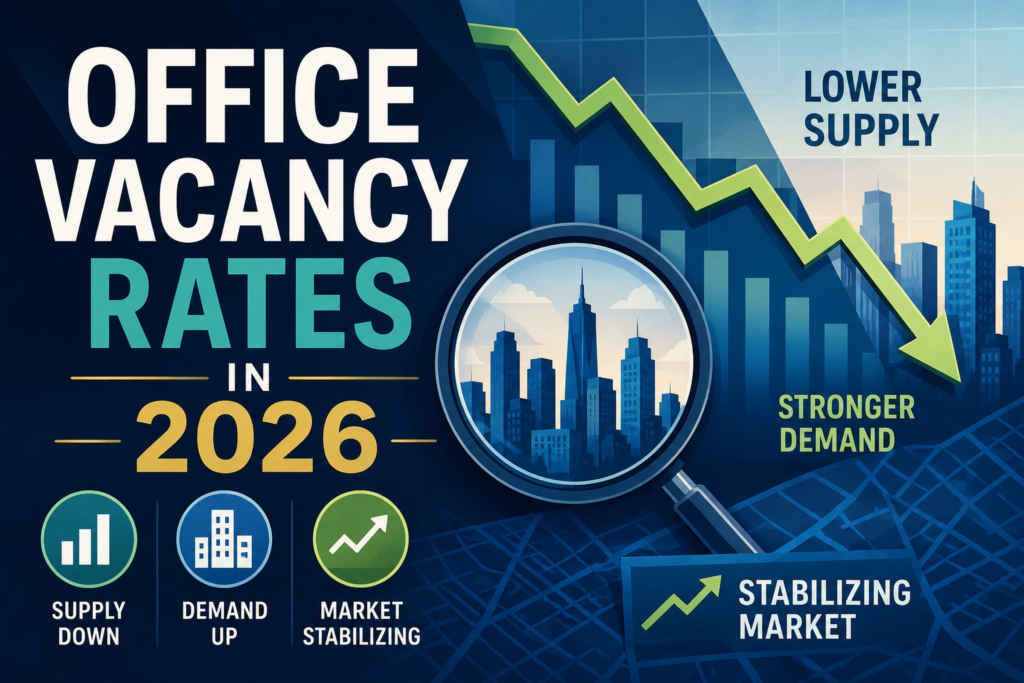
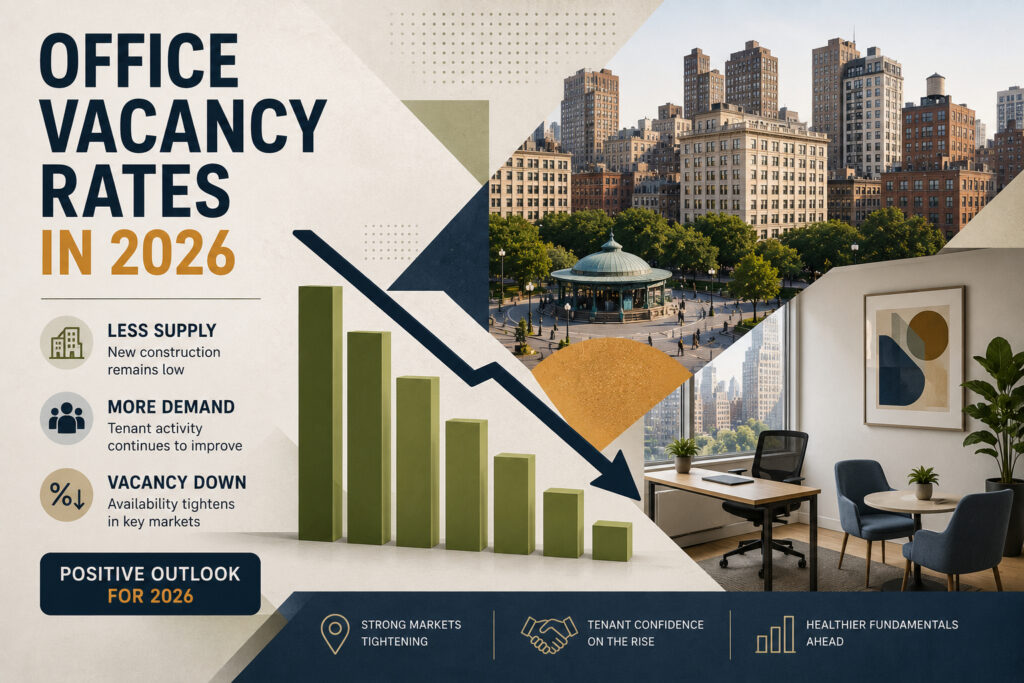
The national market did not heal. It did stabilize. Net absorption reached 6.9 million square feet in the first quarter, which marked the best Q1 result since 2020 and the eighth straight quarter of positive demand. At the same time, the new construction pipeline stayed historically low. One national report counted only 15.8 million square feet under construction in Q1, down 87% from the 2020 peak, while quarterly completions fell to the lowest level recorded since 1990. That mix matters for tenants because less new supply changes where leverage survives.
National pricing also needs context. One quarterly series showed average asking rent at $37.21 per square foot in Q1. A monthly national series showed full-service listing rates at $33.61 in May. Those numbers are not contradictory. They use different definitions. What matters is the direction. Owners still chase occupancy in weaker buildings, but better buildings have regained pricing power faster than the marketwide average suggests.
Why New York now outperforms the national headline
New York does not look like the average U.S. office market. The local recovery remains uneven, but it has direction. The City Comptroller found that Manhattan CBD availability fell from 18% at mid-2024 to roughly 14% by late 2025, while the nationwide rate in that same framework only edged down to 15.7%. Another 2026 citywide series, reflected in your SERP set, showed overall availability tightening to 14.6% in Q1 from 17.3% a year earlier. That change came largely from less sublease space and firmer direct demand.
Rents tell the second half of the story. Manhattan’s CBD still has room to negotiate because pricing never fully recovered in real terms. The Comptroller’s office said average gross asking rents in Manhattan’s CBD remained about 16% below year-end 2019 levels in nominal terms and nearly 35% lower after adjusting for inflation. That means tenants can still find value in 2026, even as better buildings tighten. In plain English, the market improved, but it still has scars. Those scars create opportunities for smart occupiers.
Vacancy is high, but quality is tighter
This is the core tenant takeaway for 2026. High vacancy still exists. Yet not all vacancy helps you. Older blocks, awkward floor plates, and less efficient assets keep the large headline elevated. Meanwhile, premier inventory shrank. In Manhattan, direct availability across 32 trophy towers fell to 1.7 million square feet, or 4.4% of inventory, down from 6.6 million square feet in early 2024. During the same stretch, leasing stayed strong enough that May 2026 alone reached 3.02 million square feet, which was 43% above the five-year monthly average.
That split changes how tenants should plan. If your team wants polished, transit-heavy, highly amenitized space, you should not treat 2026 as a lazy tenant’s market. You may still win on concessions, timing, and flexibility. However, you may lose on choice if you start too late. By contrast, if your team values price first and can tolerate older inventory, the larger vacancy pool still gives you room to negotiate hard. The headline rate remains useful. It just is no longer enough.
Leasing activity shows real conviction
Tenant behavior matters more than commentary. The market now shows that real users still commit when space solves a real need. In July, a large artificial intelligence firm leased an entire 16-story building in Hudson Square and said it plans to more than double its local headcount by year-end. On the same day, another major digital platform bought a 42,500-square-foot building near Park Avenue South for $81.5 million. These are not short-term signals. These are long-duration bets on New York as a place to hire, collaborate, and grow.
Downtown also tells a stronger story than many tenants assume. Lower Manhattan logged 4.75 million square feet of office leasing in 2025, which was its best year since 2019 and roughly double 2024. New tenants accounted for more than 592,000 square feet, and district vacancy fell to 22.2% by year-end. Downtown still offers more slack than core Midtown. Even so, the district no longer reads like a market without demand. It reads like a market where tenants can still buy value at scale.
What office vacancy rates in 2026 mean for costs
Tenants should think in layers. Start with broad market pricing. Then move to submarket pricing. Finally, push hard on effective rent. National asking rates in one 2026 monthly series averaged $33.61 per square foot. Manhattan averaged $69.29 in May in that same framework, which kept it among the highest-priced office markets in the country. That spread shows why national vacancy stories often fail local occupiers. New York remains expensive where demand stays deep.
Still, asking rent is only the first number. Effective economics often tell a friendlier story for tenants. The lingering gap versus 2019 real rent levels in Manhattan suggests that owners still need to protect occupancy and long-term cash flow. That can support free rent, build-out dollars, phased growth rights, early access, extension options, contraction rights, and concession packages that do not appear in the headline quote. Tenants who only focus on face rent miss part of the negotiation. Tenants who negotiate the full structure do better.
Where the best opportunities sit right now
If your team needs premium visibility and the strongest commute story, start around Grand Central. Buildings tied to that hub continue to benefit from direct rail and subway access, stronger attendance support, and premium tenant demand. A strong example is 1 Vanderbilt Avenue, which connects directly into Grand Central and was designed around high-speed vertical transit, large floor plates, and top-tier tenant infrastructure. Another proven Midtown East option is 230 Park Avenue, which continues to attract new leases and expansions in 2025 and 2026.
If your team wants a newer West Side feel, large floor plates, and Penn-area access, focus on the Penn District and Hudson Yards. 1 Manhattan West sits by Penn Station and Moynihan Train Hall, with direct access to major subway and rail lines. 30 Hudson Yards pairs headquarters-scale floors with strong connectivity through the 7 line and nearby commuter rail. Those neighborhoods fit firms that want a newer ecosystem and a highly polished employee experience.
If value and scale matter more than a Park Avenue address, look downtown before you assume Midtown is your only answer. Lower Manhattan posted real leasing momentum, but it still offers more room to negotiate than tighter Midtown trophy blocks. That makes large-block options especially relevant in 2026. 1 World Trade Center remains a major downtown anchor for teams that want scale and identity. 28 Liberty Street gives tenants a repositioned Financial District option with strong recent leasing activity and capital upgrades.
Hybrid work still matters, but it no longer explains everything
Office use changed for good. That much is clear. One national 2026 market report said office attendance has hovered around 55% for several years, even while vacancy improved. Separate mobile-location data showed New York City office visits in July 2025 rose 1.3% above July 2019 levels, which made New York the first major U.S. market in that series to clear its pre-pandemic benchmark. Read together, those numbers say something important. Hybrid work remains normal, but New York offices regained strategic value faster than most national commentary expected.
That matters on the ground. Companies do not need the same workplace they needed in 2019. They still need the right workplace for 2026. In practice, that means better transit, better layouts, better amenities, and stronger collaboration days. It also means fewer tenants want to over-lease. Right-sizing now wins. Yet over-cutting can backfire when attendance compresses into midweek peaks and when top space disappears first. The market now rewards fit, not just footprint.
The real 2026 answer
Office vacancy rates in 2026 do not point to one simple market. They describe two markets at once. The first market still has national slack, older inventory, and negotiation room. The second market has scarce high-quality choices, stronger leasing, lower new supply, and rising urgency for well-located blocks. Manhattan now sits closer to the second market than the first, especially at the top end.
So, should tenants wait? In most cases, no. Waiting for a dramatic collapse in vacancy may not help if the space you actually want keeps disappearing. A better move is to define your size, commute pattern, budget band, and timing now. Then compare older value inventory against newer performance inventory with a live negotiation strategy. In 2026, the best deals go to tenants who understand that vacancy still creates leverage, but only if the space fits how people work now.
Looking for More Info
We represent tenants, so our process starts with your headcount, timing, budget, and work pattern. Then we compare the strongest options across Midtown, Hudson Yards, and Downtown, line up tours, and negotiate the full economic package. If you want real leverage in 2026, we help you use today’s vacancy data the right way.
Fill out our 📋 online form or give us a call today 📞 212-967-2061 — let’s find the right office for your business.