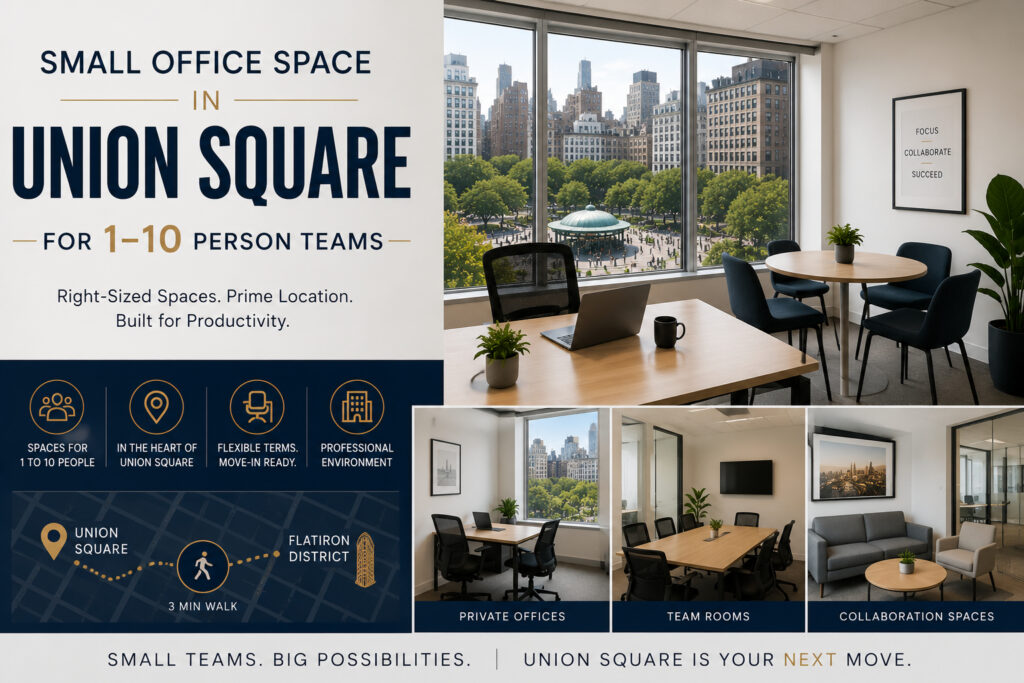
Small Office Space in Union Square for 1-10 Person Teams
Why Union Square works for small teams
We represent office tenants, not landlords. We help small teams compare private suites, subleases, and direct deals without overcommitting. Our job is to protect your leverage, your timeline, and your total monthly cost.
Union Square works because it solves three problems at once. First, it shortens the commute. Next, it puts a small team in a neighborhood with real energy. Finally, it offers access to several office formats, from shared private rooms to full small suites. That matters now because the submarket stays tighter than Manhattan overall, which means good small spaces still move.
The commute advantage is real
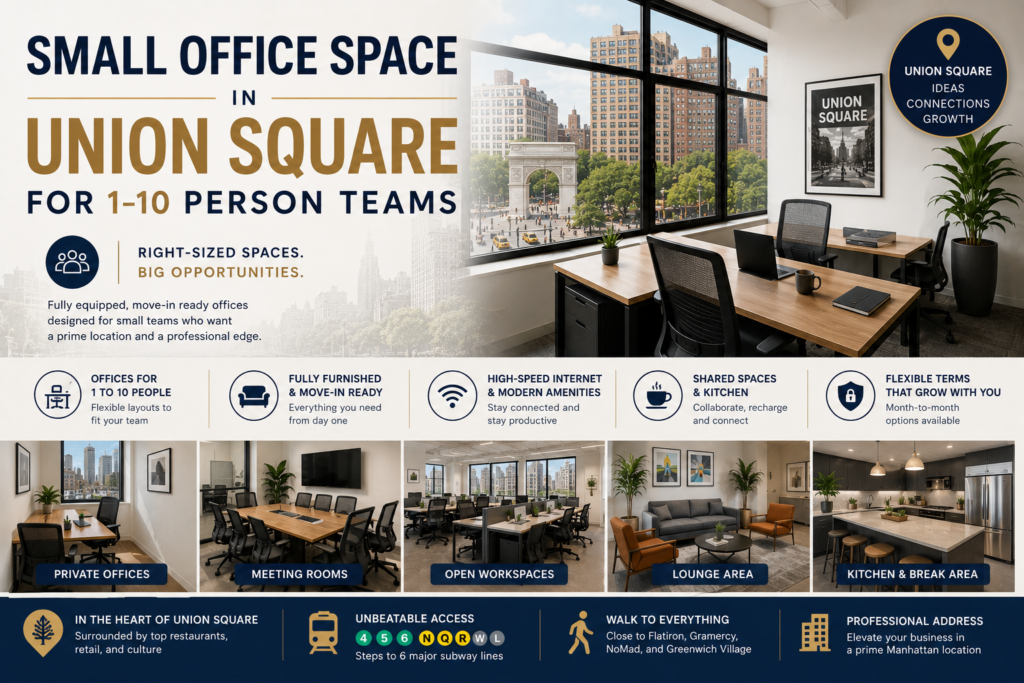
A small office only works if the trip feels easy. Union Square delivers one of Manhattan’s strongest transit positions. The 14th Street hub gives direct access to the 4, 5, 6, L, N, Q, R, and W lines. Nearby stations also add the F and M, while the 14th Street PATH remains within walking reach from the west side. In 2024, the 14 St–Union Square station reached 22.9 million riders and averaged about 65,000 daily riders, while the broader district saw about 380,000 average weekday trips across modes.
The district shows real demand, not just good branding
Union Square is not winning attention on image alone. The neighborhood supports more than 152,000 workers, more than 75,000 residents, and a growing student base. Worker visits rose 18% over the prior year in the Union Square Partnership’s 2025 market report, while office availability measured 10.9% in Q2 2025, well below Manhattan’s 17.2% and Midtown’s 14.8%. That mix signals a district with active office demand, strong daytime traffic, and an all-day customer base for teams that meet clients or hire talent in person.
Small teams benefit from the neighborhood scale
A 1-10 person team rarely needs a giant lobby or a corporate tower identity. Most small tenants need quick trains, nearby food, easy coffee meetings, and a workspace that feels credible on day one. Union Square checks those boxes, while Broadway Plaza alone averaged more than 40,000 daily visitors in 2025 and district storefront occupancy reached 88.5% by June 2025. So the neighborhood feels active and service-rich, which helps small employers recruit and retain people.
How much space a 1-10 person team really needs
Small office space in Union Square does not mean only one format. The market spans compact shared rooms, private serviced offices, furnished subleases, and true direct suites. Therefore, the right answer depends on headcount, privacy, meeting style, and growth pace. Public Union Square listings now show everything from a roughly 200-square-foot sublet for a 2-4 person user to a 1,750-square-foot direct suite with room for 10 workstations. Meanwhile, JLL’s 2025 occupancy benchmark puts average office and administrative planning at 165 rentable square feet per person.
A practical size guide for 1-10 person teams
Use these as planning ranges, not hard rules. A lean team with hybrid attendance can go smaller. A client-facing team often needs more room.
1-3 people: roughly 250 to 600 RSF works in many cases, especially if meeting needs stay light or the setup shares amenities. Public listings near Union Square include very small sublets and single-desk or tiny private office options.
4-6 people: roughly 600 to 1,000 RSF often fits best. At that size, one meeting room, one private office, and an open bench layout usually become more important. Public Union Square listings currently include 4-7 person private offices and 4-8 person suites in this range of user intent.
7-10 people: roughly 1,000 to 1,750 RSF usually gives a healthier balance. A live Union Square suite on our site totals 1,750 square feet and supports 10 workstations, two glass rooms, one interior room, a wet pantry, and a private restroom. That is a strong template for what many small teams actually want.
Layout matters more than raw square footage
A smart small-office layout beats a larger weak one. Teams in this size band usually perform best with an open work area, one or two perimeter rooms, one flexible interior room, decent light, and a pantry that does not interrupt the main work zone. Our current Union Square small-suite example checks those boxes with seating for 10 workstations, two glass-fronted rooms, an interior room, a private restroom, and a built-in pantry. That layout preserves privacy without wasting square footage on oversized corridors or unused executive build-outs.
What to prioritize first
Start with the basics. Natural light matters. A private room matters. A pantry matters. Fast internet readiness matters too.
Move-in-ready space often includes desks, conference furniture, cabling, and sometimes live internet service. Plug-and-play space also gives your team a private suite rather than a shared coworking floor, which means more control over brand, noise, and daily operations. For a small Union Square team, that difference can be the line between “temporary desk solution” and “real office.” If you want to compare that format in more detail, review our plug-and-play office guide and our Union Square office listings.
What small office space in Union Square costs right now
Pricing in Union Square depends on deal type first, then building class, then delivery condition. A direct lease, a furnished sublease, and a managed private office can all serve a 1-10 person team, yet they price very differently. For that reason, small tenants should compare monthly occupancy cost, not just face rent.
Direct lease budgeting in Union Square
For direct space, Union Square tenants should budget within Midtown South economics, not bargain-basement Manhattan pricing. In Q1 2026, Midtown South asking rents measured about $80.27 per square foot in one major report and $88.32 per square foot in another, while Manhattan overall sat at $78.01 per square foot in Q1 and $80.42 per square foot in June 2026. A neighborhood-focused Union Square page also places local asking rents in the high-$70s per square foot. Put plainly, direct lease budgeting for small Union Square offices usually starts around the high $70s and can move into the high $80s depending on the asset and term.
A simple monthly example
The math gets clearer when you convert annual rent into a real monthly number. A 1,250-RSF office at $80 per square foot equals about $100,000 per year, or roughly $8,333 per month in base rent. A 1,750-RSF office at the same rate lands around $11,667 per month before electricity, internet, insurance, and any tax exposure. Those figures line up closely with what many small direct or sublease users actually see in Union Square.
Flexible office and serviced suite pricing
Serviced offices near Union Square often price by desk or by team size. Current public listings show dedicated desks from about $399 to $620 per month, executive suites from roughly $850 to $1,886 per person per month in several Union Square and nearby options, and premium private offices that rise above that range. Entry-level shared memberships can price lower, with one major operator advertising memberships from $289 per month and day passes from $49. So flex space can feel simple at first, but per-seat costs rise fast once a team wants privacy, meeting bandwidth, and a true branded room.
Private suite and sublease examples for small teams
Public Union Square inventory also shows why teams should compare monthly totals, not abstract ranges. Current private office and short-term suite listings include about $4,000 per month for a 1-8 person suite, about $4,230 per month for a 4-7 person suite, and about $5,500 per month for a 4-8 person suite. Larger private suites step up to about $10,500 to $11,040 per month for teams around 7-17 people, while a 10-27 person Union Square suite recently listed around $15,000 per month. Those numbers do not mean every deal will match. Still, they give a live public picture of how fast cost rises as privacy, term flexibility, and built-out infrastructure improve.
Why small teams often misread cost
The cheapest asking rent does not always win. Electricity, internet, cleaning, overtime HVAC, deposit, furniture, and build-out realities can reverse the result. Our current cost guide makes the point directly: Manhattan rents may headline in the low-to-high $70s, yet the real monthly bill includes the full stack, not the quote alone. If you are comparing three Union Square options, run the same checklist across each one. Then review our true monthly cost guide and our proposal comparison guide before you commit.
Which lease type makes the most sense
A 1-10 person team usually picks from three paths. One path offers maximum simplicity. Another gives the strongest balance of control and savings. The third suits tenants ready for more commitment.
Choose flexible private office space when speed matters most
Flexible private offices work well for very small teams, very short terms, and businesses that want bundled services. Because furniture, internet, reception, and meeting-room access often come baked into one monthly number, this format reduces startup friction. It also lets a team test Union Square before taking more risk. On the other hand, per-seat pricing can climb quickly, and control over branding, layout, and privacy often stays limited compared with a true private suite. For teams of one to eight, that trade can still make sense.
Choose plug-and-play sublease when you want privacy without build-out pain
Plug-and-play subleases often hit the sweet spot for 4-10 person teams. They deliver a private suite, existing furniture, prewiring, and faster occupancy than a raw direct lease. Our sublease guide notes that sublease rents are often 15% to 40% lower than comparable direct leases, while our plug-and-play guide explains that these spaces frequently come furnished, internet-ready, and available on shorter terms. That combination can make a Union Square sublease the strongest option for teams that want a “real office” without construction, long leases, or large upfront spend. Review our sublease guide and our plug-and-play office guide if this path fits your timing.
Choose a direct lease when control matters more than speed
Direct leases make sense once a small team wants longer control, more renewal certainty, or stronger economics across a longer term. In Manhattan, solo and 1-5 person businesses often land in 1-3 year deals, while small companies more commonly see 3-5 year terms. Many direct landlords still prefer five years, especially in stronger buildings. So direct leasing works best when your headcount feels stable enough to justify more commitment. Our lease terms guide explains how longer terms can unlock more concessions and better economics.
Never skip the Good Guy Clause discussion
Small teams need an exit path. In New York, that usually means negotiating a Good Guy Clause. Our current guide explains that this clause can limit ongoing personal liability if the tenant gives notice, pays through move-out, and returns the space in proper condition. Typical notice windows often run from 60 to 180 days. For a 1-10 person company, that protection matters because growth plans can change fast. Read our Good Guy Clause guide before you sign any small Union Square deal.
How to evaluate a suite before you sign
Small offices reward discipline. A team can overpay for a pretty suite with weak deal terms. Another team can under-lease and outgrow the office in six months. Therefore, it helps to tour with a clear filter.
Start with location and building function
Do not overcomplicate the first screen. Stay close to the 14th Street transit hub if your people come from multiple boroughs. Look for elevator efficiency, good common-area condition, and a path to the suite that feels professional. Also ask whether the building supports modern internet carriers, after-hours HVAC, and simple visitor access. Union Square and Lower Fifth buildings near the station tend to win on this front because the corridor concentrates transit, dining, and office stock in one walkable zone.
Then test the floorplan against daily behavior
Ask five questions in the suite. Can everyone sit comfortably? Can two people take private calls? Can four to six people meet without taking over the whole office? Does the pantry work for daily use? Can the office handle growth without a second move?
Our current 1,750-square-foot Union Square suite offers a strong benchmark because it combines 10 workstations, glass rooms, a central interior room, a pantry, and a private restroom. That setup supports focused work, meetings, and basic hospitality within a compact footprint. If a smaller suite cannot do those jobs, it is not actually efficient. You can review that format here: move-in-ready Union Square suite for up to 10 workstations.
Check delivery condition with extra care
Delivery condition drives speed and hidden cost. A true plug-and-play office usually includes furniture, wiring, and often active internet infrastructure. By contrast, a prebuilt suite may look finished but still require desks, cabling, or minor setup work. That distinction changes move-in timing and cash needs. Small teams should ask for a full list of what stays, what goes, and what already works. If you expect growth soon, compare a compact suite with a slightly larger turnkey option, such as this larger team-ready suite within a short walk of Union Square or this furnished Union Square floor with room to expand.
Compare the deal, not the brochure
Once a suite passes the tour test, compare the paper. Loss factor, electric, rent escalations, deposit, furniture treatment, cleaning, free rent, and renewal rights often decide the winner. Our proposal guide makes this clear: the lowest asking rate can still lose once you model the actual full-term cost. That is why we compare spaces line by line, instead of chasing the lowest face rent. For a small Union Square tenant, that discipline often protects more value than a flashy concession.
Frequently asked questions
How much office space does a 5-person team need in Union Square?
Most 5-person teams should start around 600 to 1,000 rentable square feet unless they stay highly hybrid. That range usually allows open seating, one private room, and basic pantry function. Smaller managed offices can work too, but they often trade privacy for simplicity.
How much office space does a 10-person team need in Union Square?
A true 10-person private office often performs best around 1,000 to 1,750 rentable square feet. Our current small Union Square suite shows why. At 1,750 square feet, it supports 10 workstations and still includes private rooms, pantry space, and a restroom.
Is coworking cheaper than renting a private office?
Sometimes yes. Sometimes no. Flex space often wins for very small teams and very short terms because services bundle into one number. However, private subleases and direct suites often win once seat count rises and the team can spread costs over a longer term.
Is a 10 by 10 office too small for a team office?
For a real team office, yes. One hundred square feet can work for one person, or sometimes two in a tight setup. It does not work well for a 4-10 person team that needs meetings, privacy, and daily comfort. Union Square inventory for small teams quickly steps above that scale.
Are furnished offices available in Union Square?
Yes. Public serviced-office listings around Union Square and nearby blocks show furnished executive suites, private offices, and dedicated desks right now. Our own inventory also includes larger furnished Union Square options and nearby turnkey suites for teams that want immediate occupancy.
Can a small team get a short-term lease in Union Square?
Yes, but the format matters. Shorter terms often appear through flexible private offices, managed suites, and furnished subleases, while direct leases usually ask for more time. Our lease-term guide notes that 1-3 year deals are common for very small tenants, especially in furnished suites or subleases.
Should a small team choose Union Square or a nearby block?
If commute, liveliness, and meeting convenience matter, Union Square usually justifies the premium. If budget pressure runs higher, a nearby block within a short walk can deliver similar access with more flexibility in building type. The key is to keep the 14th Street transit advantage while widening the search radius enough to find better floorplans.
What should matter most before signing?
Start with monthly cost, delivery condition, and exit flexibility. Then confirm internet readiness, meeting capacity, and headcount fit. Finally, push hard on lease language, especially notice, deposit, and any Good Guy protection.
If your team wants to compare live options now, start with our Union Square office listings, review this small move-in-ready Union Square office, and use our tenant-focused cost guide to model the real monthly number. We can help you compare private suites, subleases, and direct deals without overcommitting. That way, your next office supports the team you have now and the one you expect next.
Fill out our 📋 online form or give us a call today 📞 212-967-2061 — let’s find the right office for your business.