Can You Legally Live in a Rented Office Space?
The short answer
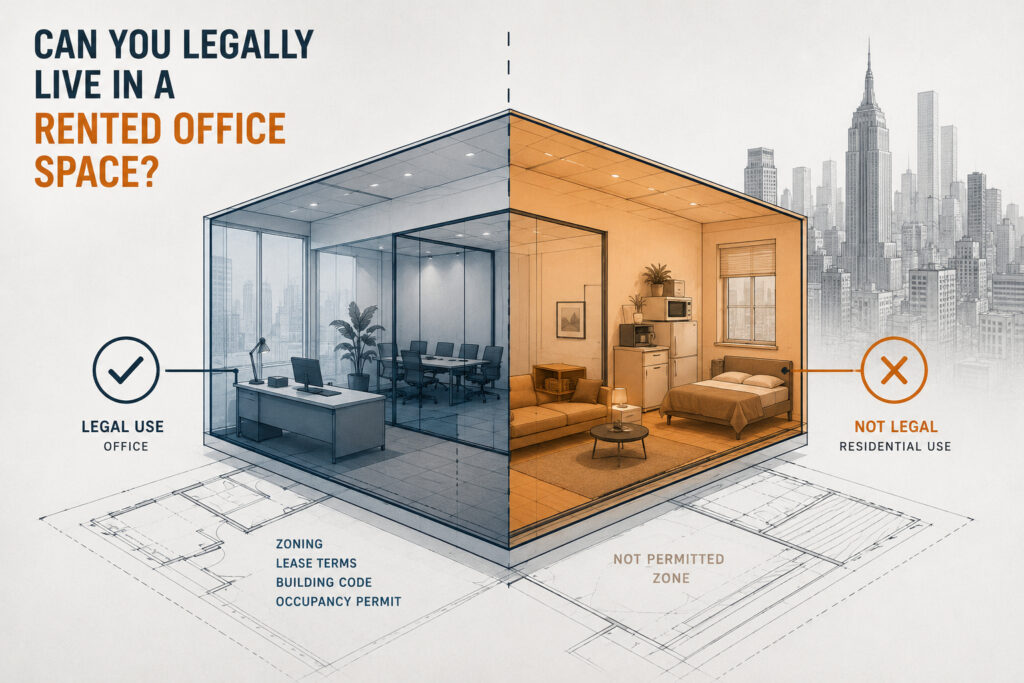
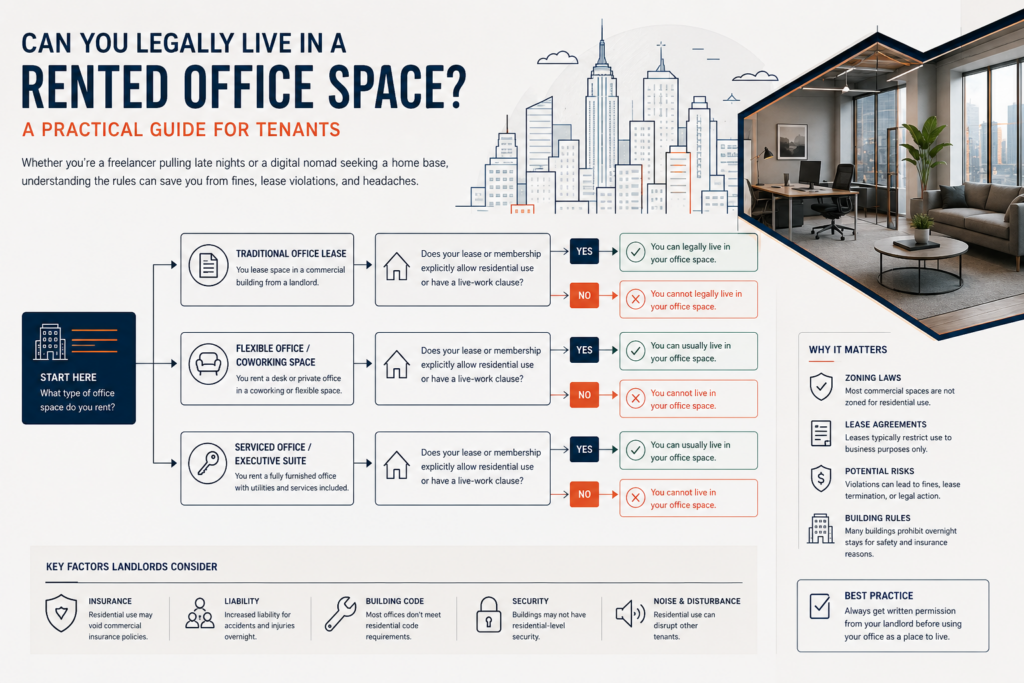
Usually, no. You can legally live in a rented office space only when residential use is lawful under zoning, the building’s legal occupancy allows dwelling or sleeping use, the space meets residential code requirements, and the lease expressly allows that use. If even one of those pieces fails, the setup can become illegal, unsafe, or both.
People ask this question more often now for a reason. Housing supply remains tight, and cities keep talking about office-to-residential conversions. In New York City, the rental vacancy rate fell to 1.4 percent in the 2023 survey, while the city comptroller counted 44 completed, ongoing, or potential office conversions totaling 15.2 million gross square feet as of the first quarter of 2025. That mix makes cheap office space look tempting. Still, a legal conversion is a formal land use and building process, not a shortcut.
Bottom line: a low-cost office can solve a workspace problem. It almost never solves a housing problem by itself.
Why the answer is usually no
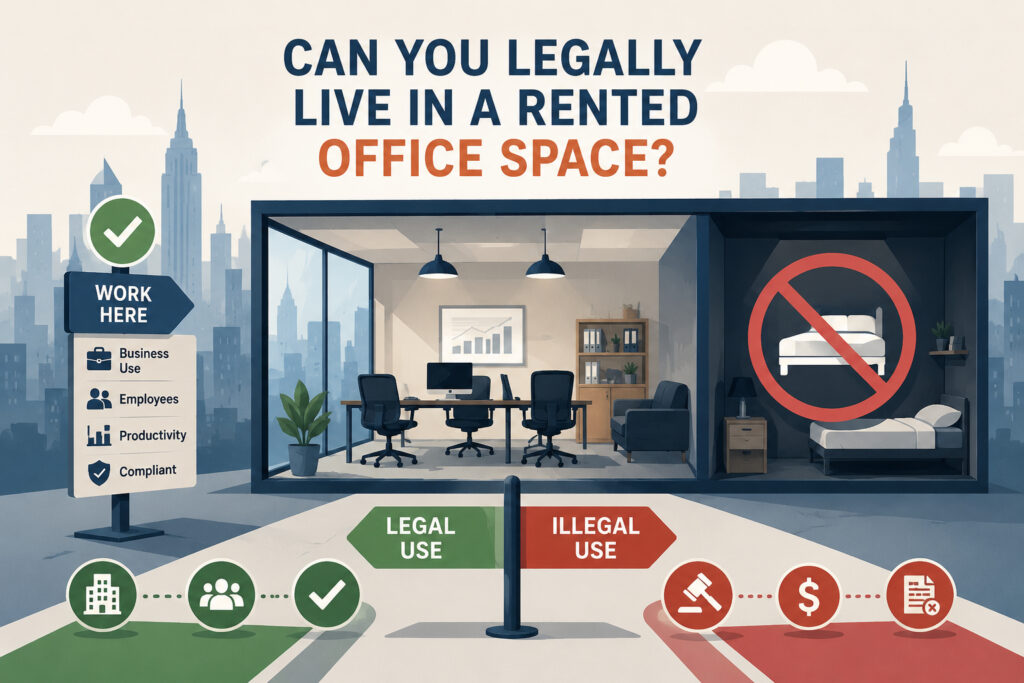
Building codes do not treat offices and homes as the same thing. Under widely used building code frameworks, offices fall under Business Group B. Residential spaces fall under Residential Group R, which covers dwelling or sleeping purposes. In New York City, the Department of Buildings also defines residential use as use for dwelling or sleeping purposes. That split matters because safety rules, plumbing rules, light and ventilation rules, fire protection, and exits all follow the legal occupancy type.
A rented office also sits inside a larger legal chain. First, zoning must allow a residence. Next, the building needs the right legal occupancy. Then, the physical space must meet residential standards. Finally, the lease must allow that use. The city’s Certificate of Occupancy states the legal use and permitted occupancy of a building, and no one may legally occupy a building until the department issues a CO or TCO.
New York City adds an important nuance. Many commercial districts do allow residences, and mixed buildings can combine residential and commercial uses. Yet that fact does not turn every office suite into a lawful home. The specific building and the specific unit still need the right legal occupancy and approvals. In other words, “commercial area” does not equal “legal live-in office.”
| What must be true | Why it matters |
|---|---|
| Zoning allows residential or mixed use | Land use rules must allow a dwelling there |
| The building has the right legal occupancy | The CO must match the intended use |
| The space meets residential code standards | Homes need compliant plumbing, light, ventilation, exits, and often fire protection |
| The lease allows residential or live-work use | Contract language controls what the tenant may do in the space |
That checklist comes straight from how cities regulate use, occupancy, permits, and code compliance. Philadelphia’s permit process, for example, also requires zoning approval for a change of use, building permits for renovation, and a CO for projects that change use or occupancy. The framework changes by city, but the structure stays familiar.
When it can be legal
A rented office can become legal to live in, but only in narrow situations. The cleanest example is a true mixed-use or live-work space that already carries lawful residential occupancy. Another example is a former office that an owner formally converts through permits, inspections, and a new or amended CO. In both cases, the key point stays the same: the legality comes from the approvals, not from the tenant’s personal need or the landlord’s casual consent.
That process usually demands real construction work. In New York City, major alterations that change use, egress, or occupancy require an ALT1 filing. Most construction requires permits, and a licensed engineer or architect usually must file plans before work begins. Philadelphia follows the same basic idea. If a project changes occupancy classification, increases occupant load, or includes renovations after a use change, the city requires permits and then a CO.
Residential compliance also means more than adding a bed. New York City states that each Class A dwelling unit or apartment must have its own kitchen or kitchenette and its own full bathroom. The Housing Maintenance Code adds detailed requirements for water closets, baths or showers, washbasins, kitchen equipment, and light or ventilation. Some conversions also trigger stricter fire protection and inspection obligations.
There are also narrow New York exceptions for legacy loft and artist-use situations. Existing lawful joint living-work quarters for artists can continue under specific occupancy restrictions, and some units covered by Loft Law rules may continue as residential use. However, those are specialized paths with their own rules, dates, filings, and occupancy restrictions. They are not a general permission slip for someone to move into a normal rented office.
Cities themselves now treat office-to-residential work as a specialized program. New York’s Office Conversion Accelerator exists to help owners analyze zoning feasibility, secure permits, and complete code-compliant conversions. That alone tells you something important: legal office living usually arrives only after a formal conversion process.
Sleeping in an office is not the same as legal occupancy
Many tenants ask a narrower question: Can I sleep in an office I rent? The practical answer still leans no when sleep becomes routine. A one-off late night after a deadline differs from using the office as your real living arrangement. Once overnight stays become regular, the space starts looking and functioning like residential occupancy. That shift matters because residential use covers dwelling or sleeping purposes, and cities enforce against commercial space used as a residence.
That means 24/7 access does not equal residential rights. Plenty of office leases let tenants access the space at all hours for work. Those same leases still limit the permitted use to office activity. A tenant can have keys, alarms, badge access, and late-night work rights, yet still lack any legal right to live there.
As a practical enforcement matter, repeated sleeping often leaves a trail. Bedding, toiletries, food prep, padlocks, improvised showers, blocked egress, extension cords, and altered rooms can all make a space look residential or unsafe. New York City’s tenant guidance flags illegal conversions as serious safety risks, and 311 accepts complaints for commercial space used as a residence.
So, can you crash in your office once after working very late? Maybe that single act never triggers a complaint. Can you rely on the office as your nightly housing plan? That is where the legal and practical risk jumps fast. This is a code-and-enforcement inference from the way cities define residential occupancy and police unauthorized residential use.
What can happen if you do it anyway
The first problem usually starts with the lease. Commercial leases spell out the permitted use of the space. New York City’s small business lease guide explains that the lease should clearly state which businesses may operate in the space, and for an office business the lease can allow “any office use.” That is very different from residential use. The same guide also makes a blunt point: the written lease governs the relationship, and anything important should appear in writing.
Once a tenant uses the office as living quarters, default risk follows. The same guide explains that a landlord holds the security deposit to protect against unpaid rent or lease violations. It also defines default as a lease violation. In practical terms, that can jeopardize your deposit, any guaranty, and your right to stay in the space.
Enforcement adds a second layer of risk. New York City lets people report building occupancy that goes against authorized use. The city also specifically states that people can report a commercial space used as a residence because that activity violates zoning regulations. If inspectors find hazardous non-compliance, the city says it can issue a vacate order.
Safety issues often drive that outcome. Residential units need compliant sanitary fixtures, cooking setups, light, ventilation, and egress. Philadelphia’s occupancy guidance also warns that when someone legalizes a use or occupancy, the space must meet current code requirements, including fire protection, exits, accessibility, and plumbing fixtures. A back-office sleep setup rarely checks those boxes.
Even if a landlord seems relaxed, private permission cannot override public law. A landlord cannot waive zoning, rewrite the CO by email, or turn a Group B office into a Group R residence with a wink and a spare key. If the use violates code, zoning, or occupancy rules, both tenant and owner can face problems.
Why affordability math does not legalize office living
Sticker price confuses many tenants. On paper, some office space can look cheaper than an apartment, especially in value-oriented Manhattan submarkets. Recent market guidance on New York office inventory shows Midtown East in the low-to-mid $80s per square foot on a direct asking basis, Grand Central often around $55 to $90 per square foot, Midtown South at $80.27 per square foot in the first quarter of 2026, Downtown at $61.70, and some budget inventory in cheaper buildings around $35 to $50 per square foot.
However, office rent does not behave like apartment rent. Commercial space usually quotes rent per rentable square foot per year, not as a simple monthly housing number. Base rent also rarely tells the full story. Manhattan office leases often add operating expense pass-throughs, tax escalations, fixed annual increases, electricity, cleaning, insurance, and other charges. New or small tenants also often face security deposits of three to six months, and landlords may ask for guaranties or letters of credit.
That is why “office is cheaper” often turns into a bad comparison. A cheap office still lacks tenant housing protections, lawful residential occupancy, and compliant living infrastructure. Worse, the hidden costs can erase a large part of the apparent savings before you even buy a mattress.
The same logic applies to the 30 percent rule. Federal housing guidance commonly treats housing as affordable when it costs no more than 30 percent of gross income. Using that rule, $1,200 in monthly rent implies about $48,000 in annual gross income. That budgeting shorthand helps you judge affordability. It does not make office living legal.
So, if residential rent feels impossible, the answer is not to pretend a commercial office is an apartment. The smarter answer is to separate the housing problem from the workspace problem and solve each one legally.
Better legal options for tenants
If your real goal is flexibility, privacy, speed, or a lower monthly burn, legal office products already exist. A plug-and-play office gives you furniture, wiring, and quick occupancy without asking you to fake a residence. A sublease can cut pricing and shorten term length. A flex deal can run from coworking to serviced offices to short-term direct leases. Those formats solve the actual need far better than sleeping behind your desk.
If you need very short duration, the market offers real options. Current reports hot desks around $40 to $80 per day, private day offices around $100 to $300 per day, and some Grand Central private office products starting around $824 per month for one person, with other nearby centers starting around $1,590 per month for small teams. That is legal flexibility, not legal gray area.
If you want a fast, tenant-friendly next step, start with the office type that matches your problem:
- Need speed and privacy? Review plug-and-play office space and move-in-ready offices in Manhattan.
- Need lower commitment? Compare short-term office rentals, flex office options near Grand Central, and sublease and flex opportunities.
- Need lower headline pricing? Search office sublets and office space for rent in New York.
- Need loft character, not a fake loft apartment? Browse SoHo office space, TriBeCa office space, Chelsea offices, and Flatiron office space.
- Need commute efficiency? Compare Midtown East office space and Grand Central area pricing.
- Need value downtown? Check Financial District office space, where recent market guidance placed Downtown around $61.70 per square foot in the first quarter of 2026.
Quick answers to the questions tenants keep asking
Can I rent an office and live in it? Usually no. You need lawful residential use under zoning, the right occupancy, code-compliant residential conditions, and a lease that allows it.
Can I sleep in an office space I rent? Not as an ongoing housing arrangement. Repeated sleeping can look like residential occupancy and can trigger lease, zoning, or safety problems.
Does landlord permission make it legal? No. Private consent cannot erase zoning, code, permit, or CO requirements.
Can anyone rent office space? Often yes, but landlords usually want financial documents, deposits, and, for smaller or newer businesses, some form of guaranty.
If I buy a commercial property, can I live there? Ownership does not erase legal use rules. A buyer still needs lawful zoning, permits, code compliance, and the right CO.
Local rules still vary by city, county, building, and lease form. Before you move furniture, install a shower, or start sleeping there, verify the zoning, the CO, the legal occupancy, and the lease in writing.
We represent tenants, not landlords. We help office users compare direct leases, subleases, flexible offices, and plug-and-play options across Manhattan. If your budget or timing makes office living look tempting, we can usually find a legal workspace solution that fits better.
Fill out our 📋 online form or give us a call today 📞 212-967-2061 — let’s find the right office for your business.