United Nations Office Space in Manhattan
What United Nations Office Space in Manhattan Actually Means
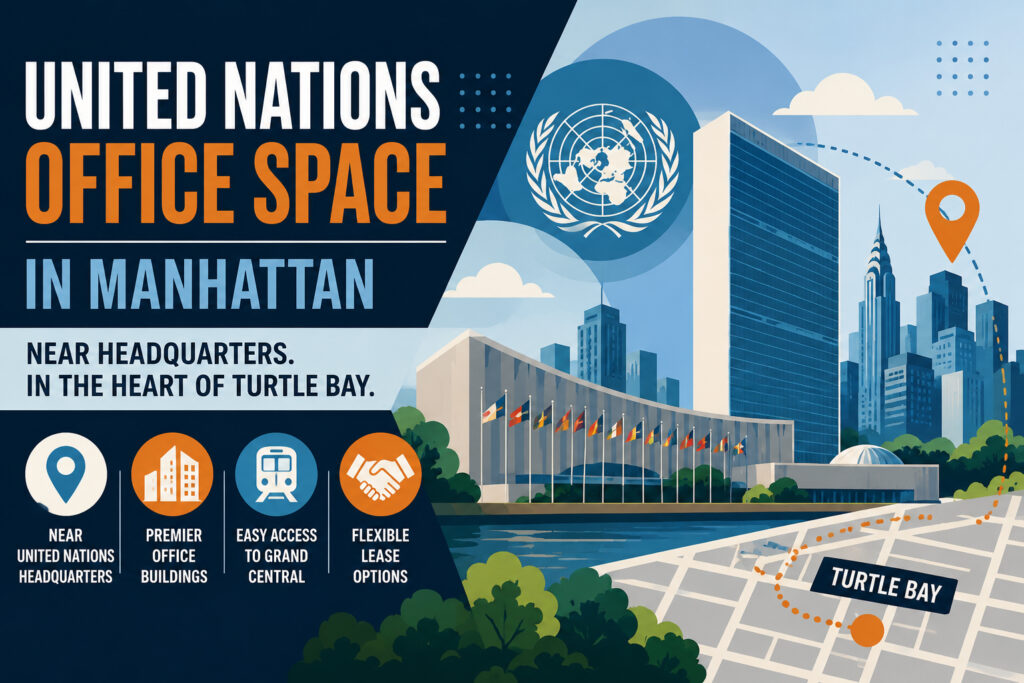
“United Nations office space in Manhattan” can describe several different property needs. Some people want an office near United Nations Headquarters. Others need information about offices that the organization and its agencies occupy.
Another group wants commercial space within buildings carrying a United Nations Plaza address. Buyers may also seek office condominiums near First Avenue. These categories overlap, but they do not represent the same inventory.
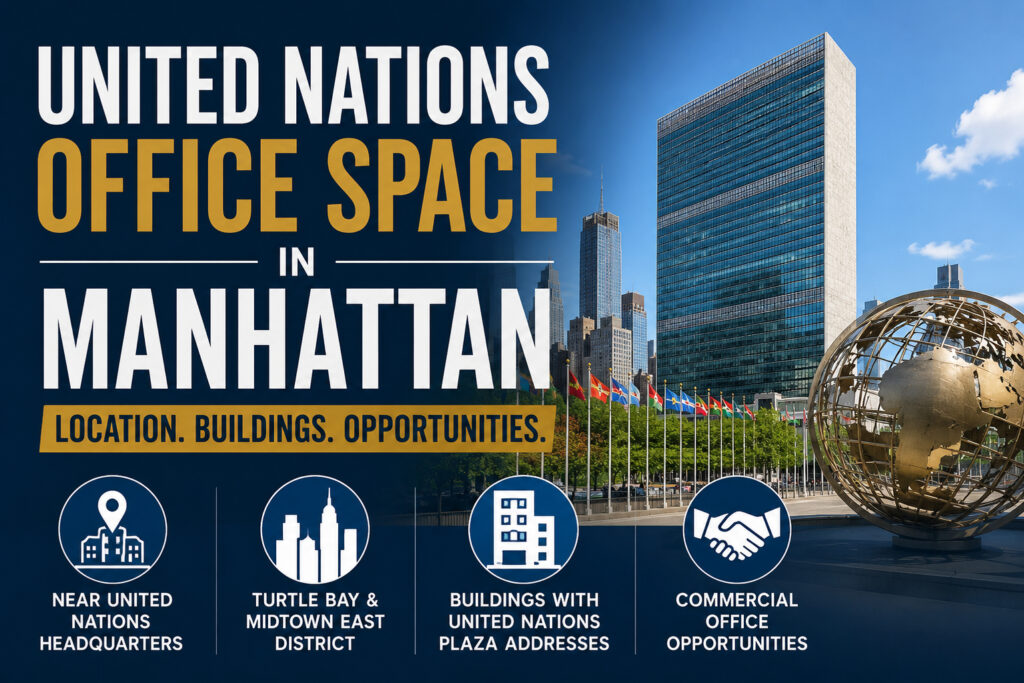
United Nations Headquarters is not a conventional office rental building. The headquarters campus occupies the East River side of First Avenue. Its public entrance sits near East 46th Street. Commercial tenants cannot normally lease an ordinary private office inside that campus.
The nearby office district forms part of Turtle Bay and Midtown East. Its tightest interpretation covers First and Second Avenues between East 42nd and East 48th Streets. A broader leasing search often extends west toward Third Avenue and Grand Central.
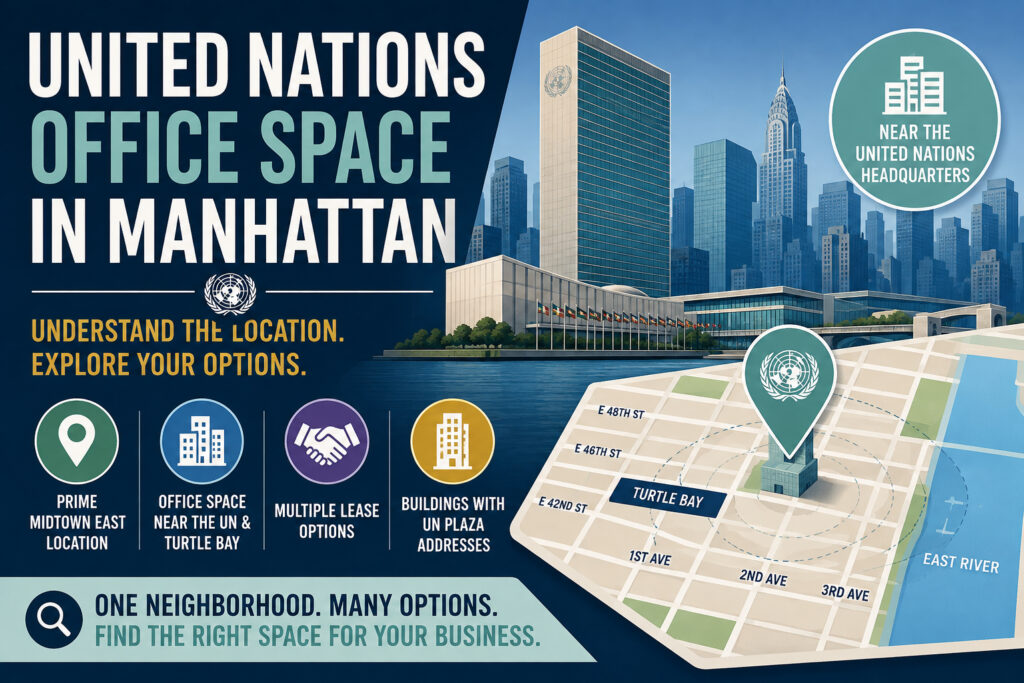
That wider boundary matters because available suites rarely follow neighborhood labels. A building may appear under Turtle Bay, Midtown East, Grand Central, United Nations Plaza, or East 40s inventory. The actual walking distance often matters more than the label.
Tenants should therefore define the location through travel time:
| Location zone | General position | Best use |
|---|---|---|
| Campus edge | First Avenue and nearby blocks | Maximum proximity to meetings and diplomatic activity |
| Diplomatic corridor | Second Avenue and East 40s | Missions, nonprofits, medical users, and international organizations |
| Transitional corridor | Third Avenue | Broader inventory and easier subway access |
| Grand Central edge | Lexington Avenue and west | Strongest regional transit access |
| Tudor City side streets | East 40s near the river | Smaller, quieter, and sometimes lower-cost offices |
A five-minute difference can change the building class, rental structure, commute, and available suite sizes. Consequently, tenants should compare several rings around the campus.
The phrase also creates confusion between United Nations Plaza addresses and offices available to independent tenants. An institutional address may house an agency, mission, hotel, or government-related use. That address does not guarantee open commercial inventory.
Which Buildings and Spaces Belong in the Search
The immediate district contains institutional buildings, commercial towers, office condominiums, mixed-use properties, and older side-street offices. Each type serves a different tenant requirement.
One, Two, and Three United Nations Plaza primarily support the United Nations community. One and Two contain office and hotel components. Three contains about 205,000 square feet and serves as a world headquarters facility for a major United Nations program. These properties do not function like ordinary multi-tenant leasing towers.
That distinction prevents a common misunderstanding. A tenant may see those names and assume that commercial suites remain openly available. In practice, institutional occupancy controls most space within those properties.
The commercial inventory begins around the campus rather than inside it. Office buildings near First and Second Avenues support diplomatic missions, consulates, foundations, legal practices, medical groups, associations, and private companies.
One important option involves the large office condominium at 866 United Nations Plaza. Its condominium structure can support both ownership and leasing opportunities. However, individual owners control separate units and floors.
As a result, availability can appear fragmented. One owner may offer a direct lease. Another may market a unit for sale. A third may occupy its premises indefinitely.
The property also attracts tenants that value East River views, diplomatic neighbors, security, and a recognizable address. Prospective occupants should examine ownership records, operating costs, alteration rights, and tax treatment before comparing units.
Second Avenue contains much of the practical leasing inventory. Buildings along this corridor often provide attended lobbies, conventional office floors, medical-compatible layouts, and direct access to First Avenue.
Many also contain smaller suites than major Park Avenue towers. That feature helps nonprofits, missions, professional practices, and growing companies control their footprint.
Third Avenue expands the selection considerably. Tenants gain access to larger floor plates, renovated office towers, prebuilt suites, and stronger proximity to the subway.
For example, the Midtown East office inventory includes small suites, midsize offices, and full-floor opportunities across the broader district. Current inventory spans several size bands, although individual listings change frequently.
Buildings near East 42nd Street also serve tenants that need both headquarters access and Grand Central connectivity. A currently marketed East 42nd Street office illustrates this middle ground. The 5,992-square-foot layout includes offices, workstations, conference space, reception, and a pantry.
Meanwhile, properties around East 45th Street can offer larger floor plates and faster regional access. Tenants should review options such as 733 Third Avenue and 140 East 45th Street when proximity allows a short westward expansion.
The strongest search usually includes three groups:
- Offices within a few blocks of First Avenue.
- Second and Third Avenue buildings within walking distance.
- Grand Central properties offering better commuter access.
That structure gives tenants enough choice without losing the location’s strategic value.
Current Rents, Availability, and Occupancy Costs
Office rents near the United Nations vary sharply. Building quality, ownership, views, suite condition, and lease structure create the largest differences.
As of the second quarter of 2026, major market reports placed Midtown asking rents in the upper $70s to upper $80s. One report measured Midtown’s overall average at $76.98 per square foot. Its Class A average reached $88.50 per square foot.
Another report placed Midtown’s average asking rent at $86.18 per square foot. It also measured a 12.7% availability rate. These figures use different building sets and measurement methods. Therefore, tenants should compare trends rather than treating one average as a universal quote.
The broader Manhattan market also tightened during early 2026. Leasing activity remained above recent quarterly averages, while available space declined. Nevertheless, older and less amenitized buildings still compete heavily for tenants.
For preliminary budgeting, the following bands provide a practical framework:
| Office type | Preliminary annual asking range | Typical characteristics |
|---|---|---|
| Older value space | $50–$70 per square foot | Basic lobby, older installation, limited amenities |
| Renovated Class B or B-plus | $65–$90 per square foot | Upgraded common areas, prebuilt suites, efficient layouts |
| Class A office space | $85–$110 per square foot | Strong systems, security, views, and better finishes |
| Premium or special-condition space | $110+ per square foot | Exceptional views, high-end buildout, or scarce identity space |
These ranges support early screening rather than final underwriting. Specific United Nations-area spaces may fall above or below them. The Midtown East rent guide explains how corridor, condition, and building class affect current pricing.
Asking rent represents only the starting point. Tenants must also calculate electricity, operating escalations, real estate tax increases, cleaning, security, insurance, legal fees, and construction costs.
A lease quoting $75 per square foot can cost more than an $82 alternative. The cheaper space may require extensive construction or deliver a poor usable-to-rentable ratio.
Consider this simplified example:
| Cost item | Office A | Office B |
|---|---|---|
| Rentable area | 5,000 square feet | 5,000 square feet |
| Asking rent | $75 | $82 |
| Annual base rent | $375,000 | $410,000 |
| Initial construction need | $350,000 | $75,000 |
| Free rent | 8 months | 10 months |
| Landlord allowance | $150,000 | $250,000 |
| Effective first-term result | Potentially higher | Potentially lower |
The exact result depends on lease length and escalation terms. Still, the example shows why asking rent alone can mislead tenants.
Concessions can change the economics significantly. Longer leases may support more free rent and greater construction allowances. Strong financials can also improve the package.
However, landlords often reduce concessions for shorter commitments. Turnkey suites may offer less construction money because the owner already completed the installation.
Loss factor also deserves attention. Manhattan landlords quote rentable square feet, which includes a share of common areas. The usable area behind the tenant’s door can run materially lower.
A space with efficient geometry may outperform a larger advertised suite. Before comparing prices, measure conference rooms, offices, circulation, and workstation capacity.
Choosing the Right Space for Your Organization
The best United Nations-area office depends on why the organization needs the location. A diplomatic mission has different requirements from a law firm, medical practice, or nonprofit.
Diplomatic and international organizations often prioritize proximity and control. Their requirements may include vehicle access, protected reception areas, secure storage, private meeting rooms, and separation between public and staff zones.
Some users also need space for cultural events or official functions. Others require direct access between executive offices and formal conference rooms.
Our consulate office space guide explains why missions often cluster in Turtle Bay and Midtown East. The area combines institutional neighbors, recognizable addresses, and specialized building experience.
Nonprofits and foundations usually balance mission access against budget. These tenants may need boardrooms, training rooms, donor meeting areas, and flexible workstations.
They should also examine tax status, ownership options, and landlord approval requirements. An exemption that benefits one organization may not apply to another.
Legal, advisory, and international business firms often value client access. A reception-forward layout may matter more than dense workstation capacity. Private offices, confidential conference rooms, and acoustic separation can support their work.
Third Avenue often provides a useful compromise. It remains walkable to the campus while offering more conventional corporate inventory.
Medical and wellness users face additional property constraints. They may need plumbing, supplemental cooling, accessible restrooms, patient circulation, and specific building approvals.
A landlord may permit general office use while restricting medical activity. Tenants should confirm permitted use before discussing economics.
Media and policy organizations may prioritize meeting capacity. Press activity, interviews, briefings, and visiting delegations can create irregular occupancy patterns.
A flexible conference suite may therefore provide more value than extra private offices. Reliable telecommunications and backup systems also deserve close review.
Staff count alone cannot determine the required size. Layout style produces a major difference.
| Workplace plan | Approximate rentable area per person | Typical fit |
|---|---|---|
| Dense open plan | 100–125 square feet | Operational teams and bench seating |
| Balanced hybrid plan | 125–175 square feet | Mixed offices, workstations, and meeting rooms |
| Traditional office plan | 200–250 square feet | Legal, diplomatic, financial, and advisory users |
| Conference-heavy plan | 225–300 square feet | Delegations, boards, training, and public meetings |
A 25-person organization may need 3,000 square feet under a dense plan. The same headcount could require 6,000 square feet with private offices.
Use the office size planning guide before setting the search range. It explains rentable area, usable area, and common planning ratios.
Future growth also needs a clear strategy. Tenants can lease extra space now, negotiate expansion rights, or pursue a flexible floor plan.
Each choice carries a cost. Empty offices waste rent, while an undersized lease can force an early relocation.
Location, Transit, Security, and Daily Operations
The United Nations district offers excellent regional access, but local transit requires careful evaluation. First Avenue does not have a subway station beside the campus.
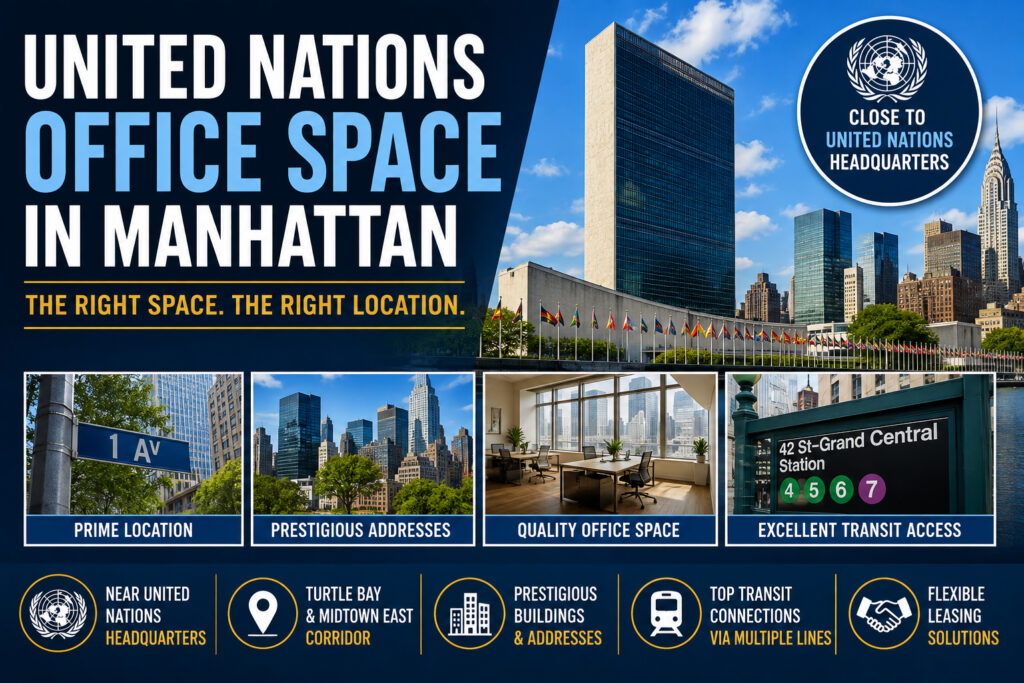
Grand Central provides subway, commuter rail, and regional connections west of the district. The practical walk varies by building, entrance, weather, and pedestrian pace.
Employees using Metro-North or Long Island Rail Road service may prefer Third Avenue or Lexington Avenue. Those locations reduce the final walking distance.
Conversely, employees who attend frequent campus meetings may favor First or Second Avenue. Their shorter meeting commute can outweigh the longer subway walk.
Bus access plays a larger role here than in many Midtown districts. First and Second Avenue routes connect the area with the Upper East Side, Lower Manhattan, and nearby subway stations.
Cycling infrastructure also runs through the corridor. However, security events can alter vehicle and bicycle movement.
Annual high-level meetings create the district’s largest operational disruption. Street closures, checkpoints, motorcades, and restricted curb access can affect First Avenue and nearby cross streets.
During the 2025 high-level meeting period, officials closed sections of First Avenue and several streets between First and Second Avenues. Authorities also warned about intermittent FDR Drive restrictions.
Midtown traffic speeds during that week historically fall below four miles per hour. Therefore, tenants should plan for transit-based commuting, earlier deliveries, and remote meeting alternatives.
Organizations with frequent deliveries should investigate loading procedures before signing. Important questions include:
- Which entrance accepts messengers?
- Does the building require advance delivery certificates?
- Can trucks reach the property during security closures?
- Where can visiting vehicles wait?
- Does the building offer an internal loading area?
- How does management handle diplomatic motorcades?
Building security varies substantially. Some properties use attended desks and basic visitor logs. Others maintain turnstiles, identification checks, package screening, and controlled elevator access.
Tenants should test the visitor experience during tours. An overly slow process can harm daily operations. Weak controls may create greater concerns.
Moreover, reception design matters for organizations receiving international visitors. Clear wayfinding, multilingual instructions, and comfortable waiting areas can improve the arrival process.
The neighborhood offers a quieter environment than central Midtown. East-side blocks contain plazas, residential buildings, small parks, hotels, restaurants, and diplomatic offices.
However, amenity depth changes as tenants move east. Third Avenue offers broader lunch and service choices. First Avenue provides better campus access but fewer immediate business amenities.
A building’s internal offerings can close that gap. Tenant lounges, conference facilities, cafés, terraces, and wellness areas may reduce reliance on street-level options.
Direct Leases, Subleases, Ownership, and Construction
Tenants can approach the district through four main occupancy structures. Each option creates different cost, control, and timing considerations.
A direct lease creates the clearest long-term relationship. The tenant contracts with the building owner for a defined term.
Direct leases may support landlord construction, improvement allowances, renewal rights, and expansion options. They also require greater financial disclosure and legal negotiation.
Tenants seeking a customized office often prefer this structure. Longer terms can justify significant construction investment.
A sublease transfers occupancy rights from an existing tenant. It may offer furniture, cabling, short terms, and rapid possession.
However, the original lease controls many rights. Both the sublandlord and building owner may need to approve the transaction.
Sublease tenants should review the remaining term, restoration duties, building access, furniture ownership, and renewal limitations. They also need financial information about the sublandlord.
A low sublease rent can lose value when the term ends too quickly. Moving twice within three years may erase the initial savings.
Office condominium ownership provides a third path. This structure appears more often near the United Nations than in most Manhattan office districts.
Ownership can support long-term control and protect against lease renewal risk. It also requires capital, due diligence, and ongoing common charges.
Buyers must investigate governing documents, reserve funds, assessments, permitted uses, financing, taxes, and alteration rules. Foreign governmental buyers may face additional legal and administrative requirements.
Ownership does not eliminate occupancy costs. Common charges, repairs, insurance, management, and capital projects continue after closing.
Furnished and prebuilt offices support faster occupancy. These spaces work well for tenants facing a fixed relocation date.
Still, “move-in ready” can mean several things. One suite may include usable furniture and cabling. Another may only contain walls and flooring.
During every tour, confirm the following:
- Furniture ownership and condition
- Data cabling and internet readiness
- Supplemental cooling
- Pantry appliances
- Conference-room technology
- Lighting controls
- Security systems
- Accessibility
- Fire and life-safety compliance
- Required cosmetic work
Construction schedules can exceed initial expectations. Design, engineering, landlord review, permits, procurement, and inspections all require time.
Smaller prebuilt suites can move quickly. Custom offices may need several months after lease execution.
Tenants should therefore separate the lease commencement date from the rent commencement date. They should also negotiate remedies for landlord delays.
The commercial leasing guide explains letters of intent, lease economics, construction, and occupancy planning in greater depth.
How Tenants Should Conduct the Search and Negotiation
A disciplined office search starts with operational facts rather than building names. The process should connect location, layout, timing, economics, and legal risk.
First, define the true location requirement. Decide whether the team needs immediate campus access or general Midtown East proximity.
A ten-minute walking radius creates more inventory than a two-block boundary. It can also improve employee transit.
Next, build the space program. Count current staff, projected hires, offices, workstations, meeting rooms, storage, and support areas.
Include visitor volume and conference peaks. These factors often create more space demand than permanent headcount.
Then, establish an all-in budget. Calculate annual base rent, escalations, electricity, cleaning, insurance, construction, technology, furniture, and legal costs.
Compare effective rent across the full term. Do not compare headline rents alone.
Afterward, review every occupancy structure. A direct lease may offer the strongest concessions. A sublease may offer the fastest move.
Ownership could suit a stable long-term user. A prebuilt office might reduce construction exposure.
Tour competing buildings together. Seeing several options during the same week creates better comparisons.
Score each property on a consistent basis:
| Evaluation factor | Suggested importance |
|---|---|
| Total occupancy cost | 25% |
| Layout efficiency | 20% |
| Location and commute | 15% |
| Building quality | 10% |
| Security and access | 10% |
| Expansion flexibility | 10% |
| Delivery timing | 10% |
The weighting should change for each organization. A mission may increase security’s importance. A nonprofit may give cost the highest weight.
Request proposals from several viable landlords. Competition creates leverage and reveals differences in flexibility.
A proposal should address more than rent. It should include term, free rent, construction allowance, possession, security deposit, renewal rights, and escalation structure.
Negotiate the business terms before final lease drafting. A detailed letter of intent reduces later disputes.
However, the letter does not replace legal review. Commercial lease language can shift costs and risks far beyond the headline economics.
A tenant representative should also evaluate landlord behavior. Some owners fund construction reliably. Others delay approvals or resist routine changes.
Our guide to what a tenant broker should actually do explains market coverage, financial comparison, and negotiation responsibilities.
In standard Manhattan leasing practice, the landlord usually pays the tenant broker’s commission. Tenants should still confirm the compensation structure in writing. Subleases and consulting assignments can follow different arrangements.
Most importantly, begin early. A small turnkey office may require only several weeks. A custom lease can require six to twelve months.
Early action creates alternatives. Alternatives create negotiating leverage.
Frequently Asked Questions About United Nations Office Space in Manhattan
Can a private company rent office space inside United Nations Headquarters?
Ordinary private companies generally cannot lease conventional commercial suites within the headquarters campus. Independent tenants should focus on nearby commercial properties.
Where is the main United Nations office district in Manhattan?
The core sits around First Avenue between East 42nd and East 48th Streets. Most tenant searches extend toward Second Avenue, Third Avenue, and Grand Central.
Is United Nations Plaza the same as Turtle Bay?
The terms overlap, but they do not always describe identical boundaries. Turtle Bay covers a broader neighborhood. United Nations Plaza usually refers to the immediate campus area.
What does a United Nations Plaza address indicate?
It may indicate proximity, an institutional building, a commercial office condominium, or a property associated with the United Nations community. Tenants must verify the building’s actual use.
How much does office space near the United Nations cost?
Older offices may quote from the $50s or $60s per square foot. Renovated and Class A options can reach the $80s, $90s, or higher. Suite condition and ownership can matter more than the block.
Current Midtown benchmarks range from the upper $70s to upper $80s per square foot. Specific buildings may differ materially.
Can tenants find small offices near the headquarters campus?
Yes. Smaller suites appear in boutique buildings, office condominiums, and older Second Avenue properties. Inventory may change quickly because many buildings contain limited floor areas.
Can a tenant lease an entire floor?
Yes. Full-floor options appear in several size ranges. Smaller buildings may offer floors below 10,000 square feet. Larger towers can offer much greater areas.
Can an organization buy office space near the United Nations?
Yes. Office condominium inventory provides ownership opportunities. Buyers should review common charges, taxes, permitted uses, financing, and building governance.
Do diplomatic missions receive special ownership benefits?
Possible benefits depend on the buyer, use, treaties, tax status, and government approvals. Qualified legal and tax advisers should review each acquisition.
Is the neighborhood suitable for nonprofits?
Yes. The district supports nonprofits, foundations, associations, policy groups, and international organizations. These users should compare direct leases, prebuilt offices, and ownership.
Is the area suitable for medical offices?
Several buildings permit medical uses. However, every tenant must confirm zoning, landlord consent, plumbing, accessibility, and certificate-of-occupancy requirements.
New York City zoning rules control allowable uses and building conditions. Tenants should verify the exact property rather than relying on a neighborhood assumption.
Which avenue provides the best subway access?
Lexington Avenue and the Grand Central area provide the strongest subway access. Third Avenue offers a practical compromise between transit and campus proximity.
How far is Grand Central from the United Nations?
The distance varies by building and entrance. Many locations near the campus require roughly a half-mile walk. Tenants should test the route during commuting hours.
Does the neighborhood have good vehicle access?
The FDR Drive provides useful north-south access. Nevertheless, congestion and security closures can disrupt travel near the campus.
What happens during the annual high-level meeting period?
Officials may close streets, establish checkpoints, and restrict vehicle access. Tenants should prepare remote-work, delivery, and visitor plans for that period.
Should a tenant choose First Avenue or Third Avenue?
First Avenue minimizes travel to campus meetings. Third Avenue usually improves subway access and inventory depth.
The right choice depends on staff commutes, visitor patterns, and meeting frequency.
What lease term should a tenant expect?
Direct leases commonly favor commitments of five years or longer. Shorter terms may appear through subleases, furnished suites, and selected prebuilt spaces.
How early should the search begin?
Start six to twelve months before a complicated move. Small turnkey requirements can move faster.
Organizations needing custom construction, government approval, or extensive security should allow additional time.
What information should a tenant prepare?
Prepare the target move date, budget, headcount, layout, preferred radius, financial statements, and legal entity details. Diplomatic and tax-exempt users should also prepare relevant status documents.
Find a Nearby Office
Why use a tenant broker for this location?
The district contains fragmented ownership, institutional properties, office condominiums, and conventional leases. Publicly displayed availability may not show every practical option.
We identify suitable offices, compare full-term costs, coordinate tours, solicit proposals, and negotiate on the tenant’s behalf. The process remains focused on your organization’s requirements rather than a landlord’s vacant inventory.
Fill out our 📋 online form or give us a call today 📞 212-967-2061 — let’s find the right options for your business.