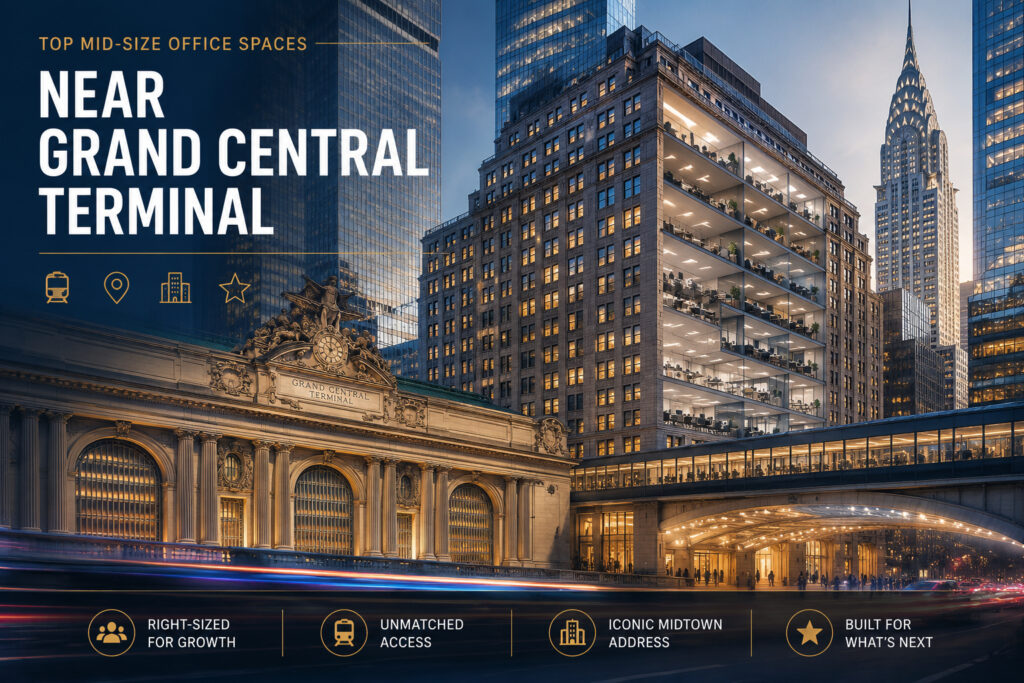
Top Mid-Size Office Spaces Near Grand Central Terminal
Why Grand Central Still Wins
Grand Central gives mid-size tenants a rare mix of reach and choice. The district spans roughly 70 blocks and about 76 million square feet of office space. Tenants also get suburban commuter rail, east-side rail from Long Island, and the 4, 5, 6, 7, and Shuttle lines. That transit stack matters because it expands hiring reach and cuts daily friction for staff and clients alike.
Just as important, the neighborhood does not stop at trains. The terminal now serves as a shopping, dining, and cultural hub with more than 80 shops and restaurants. Meanwhile, the local improvement district supports the area with supplemental public safety, sanitation, maintenance, horticulture, business support, and visitor services. As a result, tenants gain a stronger street experience than they often find in cheaper, less organized submarkets.
Another edge came from the new east-side rail project. The official transit agency says the project increased train capacity to and from New York City by 50 percent. That shift gives Grand Central even more weight for firms that hire from Long Island, Westchester, and Connecticut. For a commuter-heavy office, that advantage often outweighs a modest rent discount elsewhere.
Tenant takeaway: Grand Central works best for teams that want fast regional commutes, strong Midtown identity, and broad office choice.
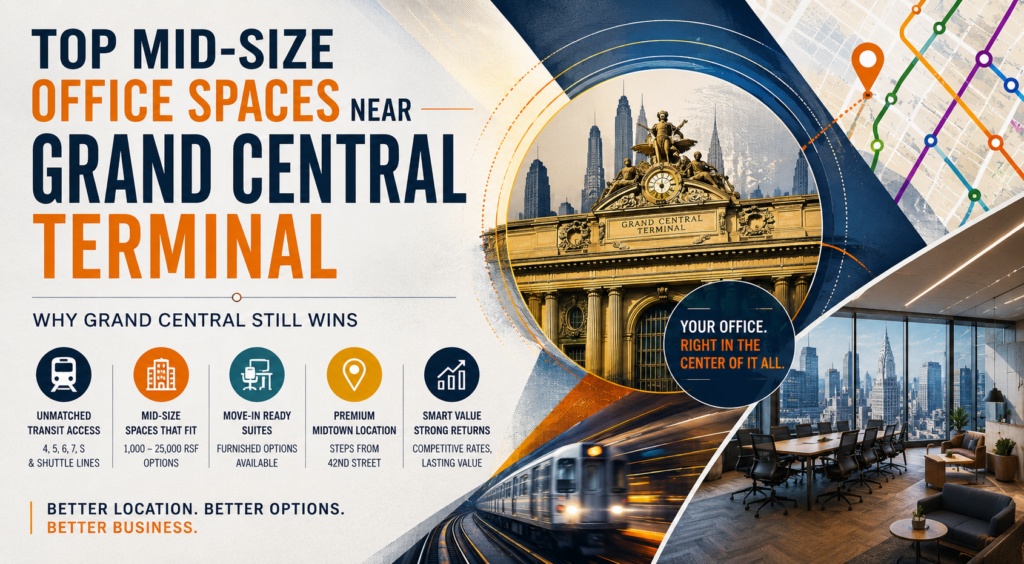
What Mid-Size Means Here
For this page, mid-size means roughly 5,000 to 25,000 square feet. That range covers many growing firms, professional practices, advisory groups, and satellite headquarters. In practical terms, a 5,000-square-foot office often fits a compact team with private offices and meeting rooms. A 10,000- to 20,000-square-foot office usually supports fuller departments, stronger branding, and more control over layout. A common planning rule still starts near 150 square feet per person, then moves up or down with density and private office count.
That size band still matters in Manhattan. Colliers showed that leases from 5,000 to 49,999 square feet made up 48 percent of Manhattan’s Q1 2026 leasing volume by size bucket. In other words, the market does not revolve only around giant headquarters deals. Mid-size tenants still drive a major share of everyday activity.
Near Grand Central, current brokerage data confirms depth. One major Q1 2026 report placed Grand Central leasing activity at 878,004 square feet. Another put the same submarket at 1,845,667 square feet. Those totals differ because research firms draw boundaries differently. Still, both reports point to the same conclusion: the area remains active, liquid, and large enough for real choice across direct leases, prebuilts, and subleases.
Pricing, Availability, and Deal Leverage
Current pricing near Grand Central calls for nuance, not one headline number. Cushman & Wakefield put the Q1 2026 submarket at $69.93 per square foot overall and $74.18 per square foot for Class A, with 18.5 percent vacancy. Colliers used a different map and landed at $76.30 overall, $78.42 for Class A, and 12.9 percent availability. Use those figures as a range, not a contradiction. Each firm tracks a slightly different inventory set.
For actual budgeting, many traditional Grand Central searches still fall into three lanes. Value and upgraded Class B space often lands around $55 to $70 per square foot. Standard Class A often runs $70 to $90. Top-tier space can push well beyond $100. That means a 5,000-square-foot search often budgets about $22,917 to $37,500 per month before extras. A 10,000-square-foot search often budgets about $45,833 to $75,000 per month. A 15,000-square-foot search often lands around $68,750 to $112,500 per month.
Face rent still tells only part of the story. Colliers reported that Manhattan direct deals with terms of five years or more averaged 12.0 months of rent abatement and $134.83 per square foot of tenant improvement allowance in year-to-date 2026. Because of that, no tenant should compare Grand Central spaces on asking rent alone. Instead, compare net effective rent, landlord work, electricity, after-hours HVAC, cleaning, and telecom setup before you rank any shortlist.
The Best Mid-Size Spaces to Tour First
Start broad with the Grand Central office listings page. Then narrow the search with the direct-access guide. That sequence works because Grand Central tenants usually care about two things first: exact commute path and the quality of the floorplate.
For classic direct access and deep mid-size inventory, begin with 420 Lexington Avenue and 60 East 42nd Street. The first currently surfaces examples from about 2,094 to 15,995 square feet on the site. The second currently shows public examples around 5,772, 11,590, and 39,556 square feet. Both fit firms that want strong arrival experience and true train convenience.
For value plus direct connection, look hard at 122 East 42nd Street. The page shows current examples around 2,341, 3,650, and 4,731 square feet, with a broader live range from about 1,500 to 7,000 square feet. That makes it one of the strongest choices for tenants who want character, access, and sharper economics.
For efficient modern floors, compare 335 Madison Avenue with 2 Grand Central Tower. One carries typical floors around 20,000 to 30,000 square feet, with some plates reaching roughly 40,000. The other offers typical floors around 15,000 to 20,000 square feet. Those addresses suit firms that want full-floor identity, cleaner planning, and room to grow.
For a refreshed Third Avenue alternative, add 666 Third Avenue to the tour list. The direct-access guide describes it as a connected, modernized option with move-in-ready inventory after its renovation. That can make it a smart fit for tenants who want access and efficiency without chasing the highest-priced core.
How to Compare the Right Options
First, rank spaces by commute path, not by lobby photos. A true indoor connection can save real time every day. That difference grows during bad weather and peak train flow. It matters even more now because the east-side rail concourse changed how many Long Island commuters reach the East Side. So, separate direct access from one-block proximity before the first tour.
Next, test the layout against real headcount. A broad planning rule starts near 150 square feet per person. Dense teams can push lower. Private-office-heavy teams often need more. Use the office space calculator before you tour, then ask each landlord for a seat plan that matches your actual workstyle. That step eliminates a lot of wasted touring.
Then, match lease type to timing. A direct lease gives the widest building choice and the most room to negotiate work and concessions. A sublease often wins on speed and existing furniture. A furnished or flexible office works best when you want minimal setup and shorter commitments. If quick occupancy matters, compare the furnished office options near Grand Central and the flexible office spaces near Grand Central alongside conventional leases.
Finally, press every option on the same checklist: loss factor, power, HVAC hours, wet pantry rights, freight access, signage, bathrooms, and expansion rights. Clean comparison creates better leverage.
Questions Tenants Ask Most
Which side of Grand Central usually gives better value?
In many searches, the better value sits east of the terminal and along older Midtown stock. The rent guide on the site places many value and upgraded Class B options around $55 to $70 per square foot, while standard Class A more often runs $70 to $90. That gap gives budget-conscious tenants meaningful room to trade polish, size, and timing against price.
Is direct access worth the premium?
Usually, yes, when your team relies on rail. A real indoor connection reduces weather friction, cuts a few daily minutes, and improves late-day reliability. The distinction matters because many pages blur “connected” and “nearby,” even though commuters feel that difference every morning.
Can I still find move-in-ready mid-size suites here?
Yes. Current Grand Central pages show prebuilt, furnished, and direct-access inventory across several core addresses. The live ranges at 420 Lexington Avenue, 122 East 42nd Street, and 60 East 42nd Street show that ready or near-ready suites still exist from the low 2,000s into the low teens, with larger blocks surfacing when timing lines up.
Should I tour now or wait?
If your target move falls inside the next year, tour now. Midtown has held stable or tighter availability for eight straight quarters, while demand continues to favor higher-quality space. Waiting can still work for fast subleases or furnished offices, but the best direct-access and clean full-floor options rarely improve with delay.
Can mid-size tenants still find a full floor near Grand Central?
Absolutely. 335 Madison Avenue and 2 Grand Central Tower remain strong examples. One supports floors around 20,000 to 30,000 square feet, and the other often runs around 15,000 to 20,000. That range gives mid-size firms a real shot at single-floor identity.
Start with the Right Search Path
Begin with Grand Central office listings and the direct-access guide. After that, compare 420 Lexington Avenue, 60 East 42nd Street, 122 East 42nd Street, 335 Madison Avenue, 2 Grand Central Tower, and 666 Third Avenue. If speed matters more than customization, add the furnished office page, the flexible office page, and the office space calculator.
We represent tenants, not landlords. That keeps the search focused on your commute, your budget, and your leverage. When you want the right mid-size office near Grand Central, shortlist smarter, tour tighter, and negotiate from facts rather than hype.
Fill out our 📋 online form or give us a call today 📞 212-967-2061 — let’s find the right office for your business.